
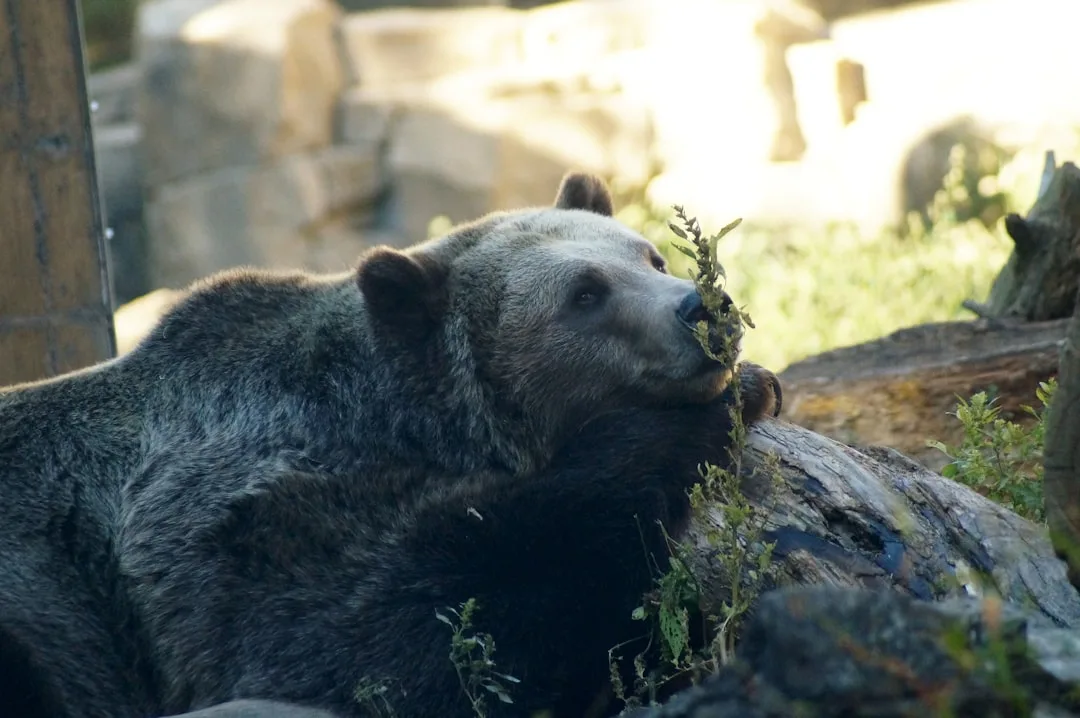
How big is a grizzly bear?
An adult male grizzly bear (Ursus arctos horribilis) typically weighs 180 to 360 kg (400 to 790 lb), stands 1.0 to 1.2 m at the shoulder on all fours, and reaches 2.0 to 2.4 m upright on its hind legs. Females are roughly two-thirds that mass at 130 to 200 kg.
Coastal Alaska grizzlies overlap with Kodiak brown bears and can exceed 500 kg, with the heaviest verified bear of this type, a Kodiak shot in 1894, weighing an estimated 751 kg. The interior-coastal gradient is the single most important variable in grizzly size, and it is driven almost entirely by access to salmon.
The short answer, and why it misleads
"How big is a grizzly bear?" is one of those questions where the honest answer is it depends where you are standing. A grizzly on the Hayden Valley in Yellowstone is a very different animal from a grizzly on the McNeil River in Alaska. They are the same subspecies, they share more than 99.9 percent of their DNA, and by late autumn the coastal bear may weigh twice the interior bear. The difference is sockeye salmon.
So before we dive into record holders and standing heights, a number to anchor the rest of the article. The average adult male grizzly across all North American populations weighs about 270 kg. That single figure hides a spread from roughly 130 kg (a lean interior female at spring emergence) to 726 kg (a captive coastal giant), a range that covers almost everything you need to know about grizzly bears. It is one of the widest size variations within any single large mammal species alive today.
For the species overview, population breakdown, and a broader view of the grizzly as a North American predator, start at the grizzly bear profile. This article drills into the numbers: weight, height, length, track size, sexual dimorphism, and how the grizzly stacks up against the black bear, the polar bear, and its own coastal cousin the Kodiak.
Weight: the working numbers
Adult males
Male grizzlies across the North American range fall into a predictable distribution, once you separate interior bears from coastal bears.
Interior males (Yellowstone, Alberta, Yukon, British Columbia interior): 180 to 360 kg. Median about 230 kg. Peak autumn weights of 400 kg are well documented but rare.
Coastal males (Admiralty Island, ABC islands, Alaska Peninsula, Kodiak Archipelago): 270 to 680 kg. Median about 400 kg in late autumn. The heaviest ever weighed in the field exceeded 680 kg.
Adult females
Female grizzlies run 1.5 to 2x smaller than males of the same population.
Interior females: 130 to 200 kg. Median about 160 kg.
Coastal females: 180 to 315 kg. Median about 230 kg.
Seasonal swing
Grizzly weight is not a fixed number. A single bear will lose 25 to 40 percent of its body mass during hibernation and regain it during hyperphagia, the late-summer-to-autumn feeding frenzy that packs on 1.5 to 2 kg of fat per day in the best feeding grounds. A grizzly weighed in March will look like a different animal from the same grizzly weighed in October.
"You cannot meaningfully state the weight of a grizzly bear without stating the month. A bear that emerged from the den at 180 kg in April will be a 300 kg bear by the third week of October. The numbers people quote in field guides are almost always pre-denning peak weights, which is the most useful number for describing what the bear is capable of, but not the number you would get if you tranquilised the same bear in May." - Harry V. Reynolds III, Alaska Department of Fish and Game, International Bear Association past president
Height, length, and shoulder measurements
Mass alone does not describe a bear. A grizzly's physical presence comes from the combination of shoulder hump, limb length, and standing reach.
Table 1. Grizzly bear linear measurements
| Measurement | Male (interior) | Male (coastal) | Female (interior) | Female (coastal) |
|---|---|---|---|---|
| Nose-to-tail body length | 1.8-2.3 m | 2.1-2.5 m | 1.6-1.9 m | 1.8-2.1 m |
| Shoulder height (on all fours) | 1.0-1.1 m | 1.1-1.3 m | 0.85-1.0 m | 0.95-1.15 m |
| Standing height (upright) | 2.0-2.4 m | 2.3-2.7 m | 1.7-2.0 m | 1.9-2.3 m |
| Skull length | 32-38 cm | 38-46 cm | 28-32 cm | 32-38 cm |
| Forepaw pad width | 15-18 cm | 17-20 cm | 10-13 cm | 12-15 cm |
| Front claw length | 8-10 cm | 8-12 cm | 7-9 cm | 8-10 cm |
The standing height figure deserves a note. A grizzly standing upright on its hind legs is rarely doing so in an aggressive context. Standing is a sensory posture: it raises the nose above surrounding vegetation, improves the acoustic field, and gives the bear a better visual sweep. An aggressive grizzly charges low, on all fours, with its ears flattened. A standing bear is almost always a curious bear.
This matters in the field. For more on how to read grizzly body language in an encounter, the grizzly bear vs black bear comparison goes into defensive behaviour in detail.
The shoulder hump
The defining physical feature of a grizzly is the muscular hump above the shoulders, a mass of trapezius and deltoid muscle attached to unusually long dorsal spines on the thoracic vertebrae. This hump powers the forelimbs for digging, turning over logs, flipping rocks, swimming against salmon currents, and striking prey. It also gives the grizzly its characteristic sloping-back silhouette, the single most reliable identifier at distance.
The hump is what makes a grizzly look bigger than its weight suggests. A 230 kg interior grizzly has a visual presence closer to a 300 kg black bear, because the concentrated shoulder mass reads as bulk. This is one reason why weight estimates from wildlife viewers almost always come in high: the shoulder hump fools the eye.
The interior-coastal gradient
The single largest source of variation in grizzly size is geography, and underneath geography sits diet.
Interior grizzlies
Populations in Yellowstone, the Greater Yellowstone Ecosystem, interior British Columbia, the Yukon, and Alaska's Brooks Range subsist on a diet that is 80 to 90 percent plant matter by volume. Army cutworm moths, whitebark pine nuts, grasses, sedges, roots, and berries make up the calorie base. Animal protein comes from elk and moose calves in spring, carrion year-round, and occasional predation. Salmon is unavailable.
The calorie ceiling is real. A Yellowstone grizzly eating cutworm moths in talus fields can consume 10,000 kcal a day, which sounds enormous until you notice that a coastal bear on a salmon run hits 30,000 kcal a day without effort. The interior grizzly tops out at 360 kg in an exceptional year because the landscape cannot deliver more.
For a full breakdown of grizzly feeding ecology, including the cutworm moth phenomenon and the role of whitebark pine, see what do grizzly bears eat.
Coastal grizzlies
Populations on the Alaska Peninsula, Kodiak Archipelago, the ABC islands (Admiralty, Baranof, Chichagof), and the British Columbia coast access the salmon runs. A single bear can consume 30 to 40 adult salmon a day at peak run, yielding 40,000 to 60,000 kcal. The bears eat only the highest-calorie parts of the fish, the brain and skin, and discard the rest. This is why coastal grizzlies are so much larger than interior bears: they are running on a different energy economy entirely.
The heaviest coastal grizzlies blur into Kodiak brown bears (Ursus arctos middendorffi), which is the same species at the level of genetics but a different subspecies by taxonomy. See grizzly bear vs Kodiak bear for the technical distinction and the ongoing taxonomic debate.
Table 2. Grizzly bear size by region (adult males, autumn peak)
| Region | Population | Typical male weight | Record | Notes |
|---|---|---|---|---|
| Greater Yellowstone | ~1,100 | 200-320 kg | 499 kg | Mostly plant, moth, and carrion diet |
| Northern Continental Divide | ~1,100 | 180-360 kg | 475 kg | Whitebark pine, cutworm moths, some ungulate predation |
| Yukon / Interior Alaska | ~10,000 | 180-320 kg | 450 kg | Caribou and moose in boreal forest |
| Alaska Peninsula | ~6,000 | 360-680 kg | 680 kg | Heavy salmon dependence |
| Kodiak Archipelago | ~3,500 | 400-680 kg | 751 kg (1894) | Classified as Kodiak brown bear |
| Admiralty Island (ABC) | ~1,500 | 400-590 kg | 635 kg | Highest bear density on Earth |
| Coastal British Columbia | ~15,000 | 270-450 kg | 540 kg | Includes grizzlies of Great Bear Rainforest |
The pattern is consistent everywhere it has been measured: where a grizzly can eat salmon, it will outweigh a grizzly that cannot. For the full picture of grizzly distribution and habitat, see where do grizzly bears live.
"We have studied the same grizzly bear populations over multiple decades. The bears on the coast are not genetically different from the interior bears. Put an interior bear on a salmon stream and by the second autumn it weighs 50 percent more. It is a simple energy story with complicated habitat implications." - Charles T. Robbins, Washington State University Bear Research, Education, and Conservation Center
The largest grizzly ever recorded
The 1894 Kodiak skull
The largest verifiably measured bear in the Ursus arctos complex is a Kodiak brown bear killed on Kodiak Island in 1894. The skull, still held in a private collection with documented provenance, measures 78.1 cm in greatest length, which back-calculates through the standard Craighead formula to an estimated live weight of 751 kg (1,656 lb). The figure carries uncertainty of roughly plus-or-minus 30 kg, but it remains the largest grizzly-type bear ever verified.
Kodiak brown bears are classified separately from interior grizzlies as Ursus arctos middendorffi because of the island's 12,000-year isolation, but genetic analysis shows they diverged from other North American grizzlies less than 15,000 years ago. By any meaningful criterion other than the subspecies label, they are the same animal as a grizzly bear.
Heaviest wild grizzly shot in the 20th century
A male grizzly killed in 2001 on the Alaska Peninsula weighed in at 680 kg after confirmed field weighing by Alaska Department of Fish and Game biologists. This is the heaviest field-verified bear of the Ursus arctos complex outside Kodiak Island in modern records.
Heaviest captive grizzly
A captive brown bear named Bart, raised in Alaska and used in numerous films from the 1980s onward, reached a confirmed weight of 680 kg at his peak. Bart was a Kodiak, not an interior grizzly. The heaviest interior-subspecies grizzly in captivity tops out closer to 450 kg.
Heaviest interior grizzly ever
Records from the Banff and Yoho National Park regions and from the Yukon place the heaviest verified interior grizzly at approximately 499 kg, killed in the Northern Continental Divide Ecosystem in the 1950s. A bear this size is at the absolute ceiling of what an interior population can produce.
"The largest grizzlies we document from interior Montana and the Greater Yellowstone Ecosystem cap out around 500 kilograms. The reason is ecological, not physiological. Yellowstone is not missing big-bear genes. It is missing salmon." - Chris Servheen, former U.S. Fish and Wildlife Grizzly Bear Recovery Coordinator
Sexual dimorphism
Grizzly bears are among the most sexually dimorphic of all terrestrial carnivores. Adult males are 1.5 to 2.0 times heavier than adult females of the same population, with the gap widening in coastal bears.
The dimorphism is a product of mating system. Male grizzlies do not provide parental care. They compete for access to females during the May-to-June breeding season, and larger males win more matings. Infanticide is a routine male behaviour directed at cubs sired by rivals, which means size also functions as a defensive trait for females choosing mates. The evolutionary pressure on male size is substantial, and it has produced one of the widest male-female size gaps in the large carnivore guild.
For practical purposes this means:
- A grizzly track 20 cm wide is almost certainly a male.
- A grizzly track 11 cm wide is almost certainly a female.
- A bear that appears visibly small next to a large bear in mating season is usually the female, not a smaller male.
- A sow with cubs will defend her cubs against a male twice her mass and sometimes win, because the male has no incentive to incur serious injury.
Estimating grizzly size from tracks
One of the most practical questions for backcountry travellers is how do I tell how big the bear is from the track? Paw pad width is the most reliable single variable.
The pad-width rule of thumb
Measure the width of the fore pad only, ignoring claw marks. The fore pad is the wide, kidney-shaped print. Multiply the width in inches by 12.5, then add 2 centimetres, and you get an approximate shoulder-hump height in inches. For metric, multiply the pad width in centimetres by 1.25, then add 5 cm, to get a shoulder height estimate.
Typical ranges:
- Fore pad 8-10 cm wide: subadult or small female, shoulder height ~70-85 cm, weight 100-150 kg.
- Fore pad 10-13 cm wide: adult female or young male, shoulder height ~85-100 cm, weight 150-230 kg.
- Fore pad 13-17 cm wide: mature male, shoulder height ~100-115 cm, weight 230-360 kg.
- Fore pad 17-20 cm wide: large mature male, shoulder height ~115-130 cm, weight 360-500 kg.
- Fore pad >20 cm wide: exceptional coastal male, potentially over 500 kg. Rare outside Kodiak, Admiralty, and the Alaska Peninsula.
The hind pad is longer than the fore pad but a less reliable indicator of body size because it varies more with substrate and gait. Claw marks should not be included in pad-width measurements, though the distance from claw tip to pad edge is diagnostic for distinguishing grizzly tracks (3 to 7 cm claw reach) from black bear tracks (1 to 3 cm claw reach). For the full identification sequence, see grizzly bear vs black bear.
"Pad width is the single most useful field measurement. Claw length tells you the species. Pad width tells you the sex and approximate mass. We use it in trail camera analysis and in mortality-site investigations because it is non-invasive and reproducible." - Alaska Department of Fish and Game, Grizzly Bear Management Report and Plan, 2022
How grizzlies compare with other bears
Size is most useful in context. The grizzly is one of eight living bear species and is frequently confused in media and popular culture with the polar bear, the black bear, and the Kodiak brown bear. Here are the numbers side by side.
Grizzly vs black bear
Black bears (Ursus americanus) are substantially smaller, more slender, and more arboreal. Male black bears weigh 60 to 300 kg, with most populations averaging around 150 kg. Female black bears weigh 40 to 180 kg. A large black bear can match the weight of a small female grizzly, but the shoulder hump, dished face, and claw length immediately separate the two species. See grizzly bear vs black bear for the full field-identification key.
Grizzly vs polar bear
Polar bears (Ursus maritimus) are the largest living bears on average. Adult males weigh 350 to 680 kg, with the heaviest verified specimen at 1,002 kg shot in northwestern Alaska in 1960. Polar bears are longer (2.4 to 3.0 m nose-to-tail) and carry proportionally more fat. Grizzlies are shorter, more muscular through the shoulders, and faster on land. For a head-to-head breakdown, see polar bear vs grizzly bear and the main polar bear profile.
Grizzly vs Kodiak brown bear
This one is almost a trick question. Coastal Alaskan grizzlies and Kodiak brown bears are the same species, Ursus arctos, differing only at the subspecies level (horribilis vs middendorffi). Kodiak bears are marginally larger on average because Kodiak Island has been an isolated, salmon-rich environment for 10,000 years. Male Kodiaks average 480 to 540 kg and top out near 750 kg. See grizzly bear vs Kodiak bear for the taxonomic argument.
Grizzly vs European brown bear
The European brown bear is the same species as the grizzly, just a different continent. European brown bears average 250 to 350 kg for adult males, similar to interior North American grizzlies. The Kamchatka brown bear of far eastern Russia is closer in size to coastal Alaska bears. See brown bear for the Eurasian range.
Size by life stage
A grizzly is not born large. It grows through a predictable sequence of stages.
Newborn cub (January, in the den): 450 to 600 grams. Smaller than a guinea pig. Born blind, nearly hairless, and entirely dependent on the mother's milk (30% fat, roughly the consistency of heavy cream).
Cub of the year (spring emergence, April): 4 to 7 kg. Cubs leave the den able to walk but not yet weaned.
Yearling (age 1, after first summer): 30 to 55 kg.
Two-year-old: 60 to 110 kg. Still with the mother in most cases.
Subadult (age 3-5, post-weaning): 90 to 200 kg depending on sex and region.
Prime adult (age 6-15): reaches population-typical weight. Growth continues slowly until about age 10 in males.
Old adult (age 15+): gradual weight loss, particularly in the final years. Old male grizzlies often show prominent spinal processes and lose condition in their final autumn.
The full life history, including reproduction, mortality, and population dynamics, sits on the main grizzly bear profile.
Why grizzlies keep getting reported as bigger than they are
A quick note for anyone reading trip reports, social media posts, or older hunting literature. Grizzly weight and height estimates in non-scientific sources are almost always too high.
Three reasons:
- The shoulder hump inflates visual mass. A 230 kg grizzly looks like a 320 kg black bear would look. Observers guessing by eye overshoot by 30 to 50 percent routinely.
- Standing height is measured wrong. A bear standing with its neck extended and head tilted back looks taller than it is. True standing height is measured from sole to crown, not to the extended nose.
- Trophy culture rewards exaggeration. Pre-scientific hunting narratives routinely described 900 kg and 1,000 kg grizzlies in the interior. None of those weights have ever been verified. The biological ceiling for interior grizzlies is about 500 kg, and it is reached rarely.
When you see a claim of a 900 kg grizzly in an interior state or province, it is almost certainly an estimate from a hunter who never put the bear on a scale. When you see a figure of 751 kg from Kodiak in 1894, that one is cross-checked by skull measurements archived in museum records. Sort claims by whether they include a verified weighing, a verified skull, or neither.
Do grizzlies keep growing their whole life?
Almost, but not quite. Growth rates slow substantially after sexual maturity at age 4 to 6 and effectively plateau around age 10 to 12 in males. Skeletal growth stops at about age 10. After that, weight changes come from fat deposition and muscle, not from getting longer or taller.
In exceptional coastal populations, males continue to gain weight slowly through age 15, which is why the very largest bears in any population tend to be 12 to 20 years old. After age 20 most bears lose condition as tooth wear and joint damage reduce feeding efficiency. The oldest wild grizzlies on record (mid-30s) are almost always reported as underweight in their final year.
The Numbers at a Glance
- Adult male grizzly: 180-360 kg typical, 1.0-1.2 m shoulder, 2.0-2.4 m standing.
- Adult female grizzly: 130-200 kg, roughly two-thirds of male size.
- Coastal grizzlies exceed interior grizzlies by 50-100 percent in mass, driven almost entirely by salmon access.
- Largest ever recorded: 751 kg Kodiak brown bear, 1894.
- Heaviest interior grizzly verified: ~499 kg.
- Sexual dimorphism: males 1.5-2.0 times heavier than females.
- Track pad width is the single best field indicator of grizzly body size and sex.
- Visual weight estimates routinely overshoot actual mass by 30-50 percent because of the shoulder hump.
For everything else about the species, the grizzly bear profile is the hub, and the sibling articles on speed, diet, habitat, and the vs black bear and vs Kodiak comparisons fill in the rest.
Further reading across the network
For readers interested in how we structure research-heavy wildlife features, the editorial process behind the Strange Animals network is shared with our partner sites. You can see similar long-form content design on whats-your-iq.com, the writing and communication guides at evolang.info, and the certification study tools at pass4-sure.us. Practical tools for converting or preparing reference material sit at fileformer.com.
References
- Craighead, J. J., Sumner, J. S., & Mitchell, J. A. (1995). The Grizzly Bears of Yellowstone: Their Ecology in the Yellowstone Ecosystem, 1959-1992. Island Press. DOI: 10.5962/bhl.title.60470
- Hilderbrand, G. V., Schwartz, C. C., Robbins, C. T., Jacoby, M. E., Hanley, T. A., Arthur, S. M., & Servheen, C. (1999). The importance of meat, particularly salmon, to body size, population productivity, and conservation of North American brown bears. Canadian Journal of Zoology, 77(1), 132-138. DOI: 10.1139/z98-195
- Robbins, C. T., Ben-David, M., Fortin, J. K., & Nelson, O. L. (2012). Maternal condition determines birth date and growth of newborn bear cubs. Journal of Mammalogy, 93(2), 540-546. DOI: 10.1644/11-MAMM-A-155.1
- Schwartz, C. C., Miller, S. D., & Haroldson, M. A. (2003). Grizzly bear. In G. A. Feldhamer, B. C. Thompson, & J. A. Chapman (Eds.), Wild Mammals of North America: Biology, Management, and Conservation. Johns Hopkins University Press. DOI: 10.56021/9780801874161
- Reynolds, H. V., Curatolo, J. A., & Quimby, R. (1976). Denning ecology of grizzly bears in northeastern Alaska. Bears: Their Biology and Management, 3, 403-409. DOI: 10.2307/3872784
- Van Daele, L. J., Barnes, V. G., & Belant, J. L. (2012). Ecological flexibility of brown bears on Kodiak Island, Alaska. Ursus, 23(1), 21-29. DOI: 10.2192/URSUS-D-10-00022.1
- Hilderbrand, G. V., Jenkins, S. G., Schwartz, C. C., Hanley, T. A., & Robbins, C. T. (1999). Effect of seasonal differences in dietary meat intake on changes in body mass and composition in wild and captive brown bears. Canadian Journal of Zoology, 77(10), 1623-1630. DOI: 10.1139/z99-133
- McLellan, B. N. (2011). Implications of a high-energy and low-protein diet on the body composition, fitness, and competitive abilities of black (Ursus americanus) and grizzly (Ursus arctos) bears. Canadian Journal of Zoology, 89(6), 546-558. DOI: 10.1139/z11-026
Frequently Asked Questions
How big is a grizzly bear on average?
An average adult male grizzly bear weighs 180 to 360 kg (400 to 790 lb), stands 1.0 to 1.2 m at the shoulder on all fours, and reaches 2.0 to 2.4 m (6.5 to 8 ft) when standing upright on its hind legs. Nose-to-tail body length runs 1.8 to 2.3 m. Adult females are roughly two-thirds the size of males, typically 130 to 200 kg.
Interior grizzlies, including those in Yellowstone and the Yukon, are smaller than coastal Alaska grizzlies, which overlap with Kodiak brown bears and can exceed 500 kg after a heavy salmon season. The difference is diet, not genetics: same subspecies, different calorie supply.
What is the largest grizzly bear ever recorded?
The largest verified grizzly-type bear on record is a Kodiak brown bear (Ursus arctos middendorffi) shot in 1894 on Kodiak Island, Alaska, with a skull measurement that back-calculates to approximately 751 kg (1,656 lb). Coastal Alaska grizzlies, which are genetically the same subspecies as interior grizzlies but taxonomically classified as brown bears in most references, have been weighed at 680 kg in the wild and up to 726 kg in captivity.
The heaviest verified interior grizzly, from Yellowstone and inland British Columbia records, sits near 500 to 550 kg. The line between a large coastal grizzly and a Kodiak brown bear is ecological rather than genetic: both are Ursus arctos with access to unlimited salmon.
How tall is a grizzly bear standing on its hind legs?
A fully grown male grizzly bear stands 2.0 to 2.4 m (6.5 to 8 ft) tall when upright on its hind legs, with exceptional coastal individuals reaching 2.7 m. Standing is not an aggressive posture in grizzlies, contrary to popular film depictions. It is a sensory behaviour: bears rise to get a better view, better wind scent, and a wider acoustic field. An aggressive grizzly charges on all fours with its head low and ears pinned back.
A standing bear is almost always a curious bear, not a committed attacker. Shoulder height on all fours, which is the biologically more relevant measurement for most encounters, is 1.0 to 1.2 m, or about waist height on an average adult human.