
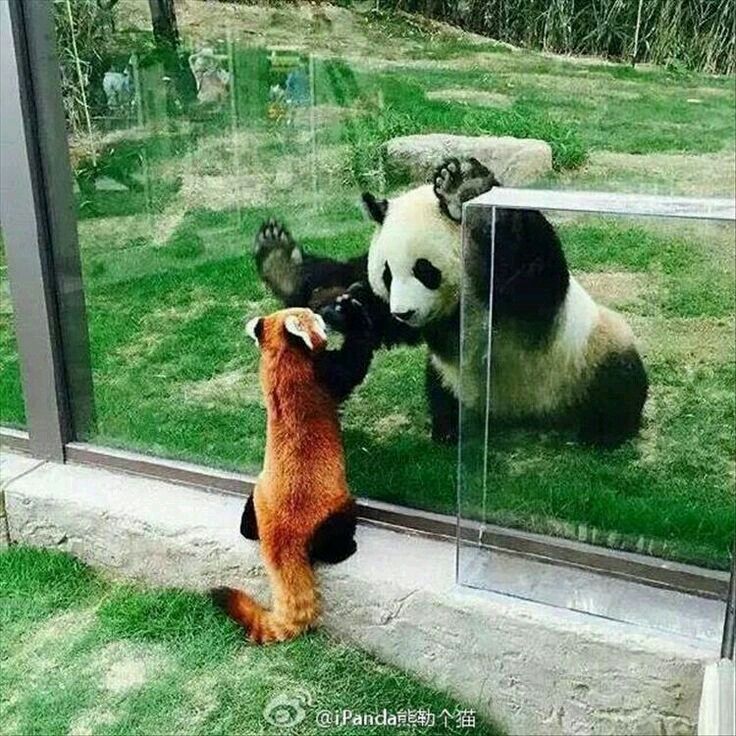
They share a name, a diet, a mountain range, and even a strangely modified wrist bone that works like a thumb. Yet the giant panda and the red panda are not close relatives. They are not cousins in any meaningful biological sense. They are not even in the same family.
If you lined up the tree of life for the order Carnivora, the giant panda would sit among the bears alongside the brown bear and the polar bear, while the red panda would sit on a completely different branch, closer to weasels, raccoons, and skunks than to any bear alive.
This guide walks through exactly how that happened. We compare taxonomy, body size, range, diet, anatomy, conservation status, and the peculiar history of the word panda itself.
The short version is that evolution has played a well documented trick on the human eye: two unrelated mammals independently became specialised bamboo feeders in the same Asian mountains and ended up looking and behaving alike enough for nineteenth century naturalists to assume they were related.
The long version is much more interesting, because the details reveal how convergent evolution works and why the shared English name is essentially a two hundred year old labeling mistake that nobody has bothered to fix.
The Short Answer First
Giant panda and red panda sit in different families. Both are carnivorans, which means they belong to the same order (Carnivora) that includes dogs, cats, weasels, and seals. Beyond that the relationship thins rapidly.
- Giant panda (Ailuropoda melanoleuca) is a bear. Family Ursidae. Sister to all other living bears. A basal lineage that split off from the rest of the bear family tree roughly eighteen to twenty five million years ago.
- Red panda (Ailurus fulgens) is the sole surviving member of its own family, Ailuridae. Its closest relatives are the Mustelidae (weasels, otters, badgers), the Procyonidae (raccoons, coatis, ringtails), and the Mephitidae (skunks). Together these four families form the superfamily Musteloidea.
The last common ancestor of the giant panda and the red panda lived roughly forty million years ago. For scale, that is older than the divergence between the pinnipeds (seals, sea lions, walruses) and the rest of the dog branch of Carnivora. Calling the two animals relatives because they share the word panda is about as accurate as grouping sea otters and giant pandas together because they both spend a lot of time lying around eating.
Fuwen Wei, lead author of the 2015 landmark comparative genome study, put the relationship bluntly. "The giant panda and the red panda are a classic example of convergent evolution. They arrived at the bamboo lifestyle by entirely independent routes, separated by tens of millions of years of mammalian history."
Taxonomy at a Glance
The clearest way to see the difference is to lay out the two classifications side by side. Read the first four rows and they look nearly identical. Read rows five through seven and the gap opens up.
| Rank | Giant panda | Red panda |
|---|---|---|
| Kingdom | Animalia | Animalia |
| Phylum | Chordata | Chordata |
| Class | Mammalia | Mammalia |
| Order | Carnivora | Carnivora |
| Superfamily | Ursoidea | Musteloidea |
| Family | Ursidae (bears) | Ailuridae |
| Genus | Ailuropoda | Ailurus |
| Species | A. melanoleuca | A. fulgens |
The superfamily row is where it becomes obvious. Ursoidea groups bears with their closest extinct and extant relatives. Musteloidea groups the red panda with mustelids, procyonids, and skunks. The two superfamilies share a common ancestor roughly fifty million years ago, early in the history of Carnivora, when the modern families were only beginning to differentiate.
The Musteloidea Connection
Musteloidea is a group most people have never heard of, but it is one of the more successful radiations of carnivorans. It includes:
- Mustelidae (weasels, otters, badgers, wolverines, martens), around sixty species
- Procyonidae (raccoons, coatis, kinkajous, ringtails), around fourteen species
- Mephitidae (skunks and stink badgers), around twelve species
- Ailuridae (red panda), one living species, possibly two
Genetic work through the 2000s and 2010s consistently placed Ailuridae as a sister lineage to the combined mustelid + procyonid + mephitid clade, sometimes called Mustelidea. Put simply, the red panda is closer to a raccoon than to a bear, and it is closer to a weasel than to a giant panda.
A Brief History of a Misleading Name
The word panda did not originate with the giant panda. It began with the smaller species.
In 1825 the French naturalist Frederic Cuvier described a strange reddish animal from the eastern Himalayas and named it Ailurus fulgens, meaning shining cat. He used panda as the common name, borrowing from a local word. The exact linguistic source is still debated.
The most widely accepted etymology traces panda to the Nepali ponya, itself sometimes given as nigalya ponya, meaning roughly bamboo eater or bamboo footed. The word travelled into French, then into English, attached firmly to Ailurus.
For forty four years, panda meant only the red panda.
Then in 1869 the French missionary and naturalist Pere Armand David sent skins and bones of a much larger black and white bear from Sichuan back to Paris, where Alphonse Milne-Edwards described it as Ursus melanoleucus, the black and white bear. David himself called the animal the parti coloured bear or the mottled bear.
It was only later, when the public noticed that this new bear also ate bamboo and lived in the same mountain belt as the familiar red panda, that the name panda spread. The giant qualifier appeared even later to distinguish the two. The red panda was then retroactively downgraded in popular usage to the lesser panda.
As taxonomist Colin Groves noted in his 2018 review of Ailuridae, "The giant panda inherited the name of the red panda, not the reverse. Every time a child learns that a giant panda is a panda and a red panda is a kind of smaller panda, they absorb a history of discovery in reverse."
So the next time someone refers to the red panda as the lesser panda, the technically accurate phrasing is: the red panda is the original panda, and the giant panda is the one that borrowed the name.
Body Size: A Twenty Fold Difference
The size comparison is not subtle. A single adult male giant panda outweighs an adult red panda by a factor of roughly thirty.
| Measurement | Giant panda | Red panda |
|---|---|---|
| Head and body length | 120 to 190 cm | 50 to 64 cm |
| Tail length | 10 to 15 cm (stubby) | 28 to 59 cm (bushy) |
| Shoulder height | 60 to 90 cm on all fours | 25 cm |
| Adult weight (male) | 100 to 160 kg | 3.7 to 6.2 kg |
| Adult weight (female) | 70 to 125 kg | 3.0 to 6.0 kg |
| Newborn weight | around 100 g | around 110 g |
| Daily food intake | 26 to 40 kg of bamboo | 1.5 to 4 kg |
| Typical home range | 4 to 10 square km | 1 to 2 square km |
One detail in that table is surprising. Newborn weights are almost identical. A giant panda cub weighs about one nine hundredth of its mother at birth, the most extreme ratio of any non marsupial mammal. A red panda cub weighs roughly one fiftieth of its mother, which is normal for a placental mammal. The two species end up with similarly sized infants for entirely different reasons, and they grow apart dramatically in the following year.
The tail is the other giveaway. A giant panda has a short stumpy tail you barely notice in photographs. A red panda has a ringed bushy tail nearly as long as its body, which doubles as a balance aid in trees and a wraparound blanket during sleep. Anyone who has seen both animals in person never mixes them up again.
Range and Overlap
Both species live in Asia. Their ranges touch, and in a few places they overlap, which is why the old naturalists mistakenly grouped them together in the first place.
Giant panda range
- Central China only: Sichuan, Shaanxi, and Gansu provinces
- Six mountain systems: Minshan, Qinling, Qionglai, Liangshan, Daxiangling, Xiaoxiangling
- Elevation: 1,200 to 3,400 metres
- Total occupied habitat: roughly 2.58 million hectares
Red panda range
- Eastern Himalayas across five countries: Nepal, India (Sikkim, Arunachal Pradesh, West Bengal), Bhutan, northern Myanmar, and south western China (Yunnan, Sichuan, Tibet)
- Elevation: 2,200 to 4,800 metres
- Total occupied habitat: roughly 35,000 square kilometres, heavily fragmented
The two species overlap in the bamboo forests of Sichuan and parts of Shaanxi, particularly in the Qionglai and Minshan systems. In these zones a single hillside can support both a resident giant panda moving slowly through ground level bamboo and a red panda foraging in the canopy above. They do not compete meaningfully, because they exploit different vertical strata of the same plant.
Diet: Near Total Convergence
Here is where the two species look most alike. Both are specialised bamboo feeders despite belonging to the order Carnivora.
Giant Panda Diet
- Approximately 99% bamboo by mass
- Eats more than twenty five bamboo species depending on region and season
- Prefers shoots in spring, leaves in summer and autumn, stems in winter
- Remaining one per cent includes pikas, bamboo rats, bird eggs, carrion, and insects
- Daily intake 26 to 40 kg, feeding ten to fourteen hours
Red Panda Diet
- Approximately 95% bamboo by mass in wild populations
- Also eats fruit, berries, acorns, roots, eggs, bird nestlings, and small vertebrates
- Specialises on bamboo leaves rather than shoots, because its body is too small to eat woody stems efficiently
- Daily intake 1.5 to 4 kg, feeding ten to thirteen hours
Both species retain a carnivore style gut, short and simple, with no chambered stomach and no proper caecum. Both extract an unusually small fraction of the nutrients in the bamboo they swallow. The giant panda absorbs roughly seventeen per cent of dry matter; the red panda absorbs about twenty four per cent. Both compensate with volume and feeding time, and both maintain a low basal metabolic rate to match.
The WWF species profile states, "The giant panda and red panda are the only two mammals on Earth that have independently become full time bamboo specialists. Their shared diet is one of the clearest cases of convergent ecology in modern mammalogy."
For the deeper story behind bamboo adaptation, see the companion article on why pandas eat bamboo, which walks through the cellulose problem and the gut microbiome research in more detail.
The Pseudo Thumb: Two Independent Inventions
The single most striking anatomical similarity between the two species is the so called pseudo thumb. Neither animal has a true opposable thumb. Both have independently modified a wrist bone, the radial sesamoid, into an enlarged gripping pad that sits opposite the five normal digits and allows them to hold bamboo stems securely while stripping leaves.
This is a textbook case of convergent evolution. The pseudo thumb evolved twice, in two lineages separated by forty million years of evolution, in response to the same mechanical problem: how do you hold a slippery cylindrical bamboo stalk with a paw designed for walking?
The fossil record confirms the two events are independent. Panda ancestors in the genus Ailurarctos from the late Miocene of China already had an enlarged radial sesamoid roughly six million years ago. Red panda relatives in the genus Simocyon, a cat sized musteloid from the late Miocene of Europe and Asia, also had an enlarged radial sesamoid, but the bone is shaped differently and appears to have first functioned as a climbing aid rather than a feeding tool.
Some researchers argue the two pseudo thumbs are not even built from exactly the same bone in every population, with certain interpretations of Ailuropoda emphasising the radial sesamoid plus a partial contribution from the scaphoid, while Ailurus uses the radial sesamoid more purely. The debate about the bones is technical, but the punch line is the same either way: the two pandas each invented a thumb substitute on their own, and neither inherited it from the other.
Stephen Jay Gould famously used the giant panda's pseudo thumb as the subject of his 1980 essay The Panda's Thumb, arguing that its awkward improvised design illustrates how natural selection works with available materials rather than engineering optimal solutions from scratch. The red panda's equivalent structure makes exactly the same point twice over. See the article on are pandas actually bears for the history of the scientific argument that finally placed the giant panda in Ursidae.
Behaviour and Temperament
Behaviourally the two species differ more than most people expect.
- Giant pandas are largely terrestrial and diurnal, active through the day with peaks at dawn and dusk. They climb occasionally but spend most of their time on the ground working through bamboo. They are solitary outside the breeding season, maintain loose home ranges, and avoid confrontation.
- Red pandas are largely arboreal and crepuscular to nocturnal, most active at dawn, dusk, and through the night. They sleep in the canopy, often curled on horizontal branches with the tail wrapped over the face. They are similarly solitary and similarly non confrontational, but they spend most of their day asleep in trees.
Vocalisations differ sharply too. Giant pandas use a repertoire of bleats, honks, barks, and chirps, most of them low to mid frequency. Red pandas use high pitched twitters, whistles, and a distinctive quack like call sometimes described as huff quack. Captive keepers who work with both species sometimes joke that the red panda sounds like a small bird and the giant panda sounds like a distant sheep.
Conservation Status
Both species are threatened. Neither is in the same category.
| Status metric | Giant panda | Red panda |
|---|---|---|
| IUCN Red List | Vulnerable (since 2016) | Endangered (since 2008) |
| Previous IUCN listing | Endangered (1990 to 2016) | Vulnerable (1996 to 2008) |
| Wild population estimate | around 1,864 (2014 census) | fewer than 10,000 mature |
| Trend | Increasing | Decreasing |
| Primary threats | Habitat fragmentation, climate pressure on bamboo | Habitat loss, poaching for fur and pets, road and dog conflict |
| Captive population | around 600 | around 900 |
The giant panda has become one of the best documented conservation success stories of the twenty first century. Decades of reserve creation, anti poaching work, and captive breeding in China produced a measurable recovery, and in 2016 the IUCN downgraded the species from Endangered to Vulnerable. Details of how this happened are covered in panda conservation success story and the population accounting in how many pandas are left.
The red panda has gone the other way. In 2008 its IUCN status was upgraded from Vulnerable to Endangered, and the trend since has continued downward. The species suffers from habitat loss to logging and agriculture, road kill, domestic dog attacks, illegal capture for the pet trade, and poaching for the fur used in traditional hats and ceremonial garments in parts of China and Myanmar.
The Smithsonian Conservation Biology Institute summarises the contrast. "The giant panda has become a symbol of what focused national investment in a single species can achieve. The red panda, which shares the bamboo habitat and faces many of the same pressures, has not received comparable attention and continues to decline."
In 2020 a molecular genetics team led by Yibo Hu formally split the red panda into two species based on mitochondrial and nuclear DNA differences: the Himalayan red panda Ailurus fulgens fulgens of Nepal, India, Bhutan, and southern Tibet, and the Chinese red panda Ailurus fulgens styani (sometimes elevated to Ailurus styani) of northern Myanmar and south western China.
If the split is accepted, each resulting unit has fewer individuals than the combined species and is even more vulnerable than previously thought.
For more on the range and natural history of the species itself, see the dedicated red panda profile.
Fossil Relatives
Both lineages have a much richer fossil record than their present day diversity suggests.
Giant panda ancestors
- Ailurarctos lufengensis, late Miocene China, around seven to eight million years ago. Already had a rudimentary pseudo thumb.
- Ailuropoda microta, early Pleistocene, around two million years ago. Half the size of the modern species but clearly a bamboo feeder based on dental wear.
- Ailuropoda baconi, middle Pleistocene, widespread across southern China and northern Vietnam. Slightly larger than the modern giant panda.
Red panda ancestors
- Parailurus anglicus, Pliocene, found across Europe, Asia, and North America. Roughly the size of a modern red panda but less specialised.
- Simocyon batalleri, late Miocene, a cat sized Eurasian musteloid with an enlarged radial sesamoid, likely the earliest lineage to invent the pseudo thumb as a climbing aid.
- Pristinailurus bristoli, Miocene of eastern North America. Shows that the red panda family was once far more widespread than its current Himalayan stronghold.
The Nature 2017 review of musteloid phylogeny concluded, "The single living red panda species is the last surviving member of what was once a globally distributed family. Ailuridae is not a young lineage confined to Asia; it is an old lineage now restricted to Asia."
This is the evolutionary context that most casual descriptions of the red panda miss. It is not a quirky little side branch of the raccoons. It is a relict of a much larger group, shrunk over millions of years to a single species clinging to a narrow altitudinal band in the eastern Himalayas.
Quick Reference: The Differences That Actually Matter
If you only remember six things about how the giant panda and the red panda differ, make it these.
- Family. Giant panda is in Ursidae. Red panda is in Ailuridae. They are not close relatives.
- Size. Giant pandas weigh one hundred plus kilograms. Red pandas weigh under six.
- Who got the name first. The red panda was named in 1825. The giant panda borrowed the name around 1869.
- Lifestyle. Giant pandas walk the forest floor. Red pandas climb and sleep in trees.
- Pseudo thumb. Both have one. Each invented it independently. Classic convergent evolution.
- Conservation direction. Giant panda population is rising. Red panda population is falling.
For head to head size and strength comparisons between the giant panda and other bears, see giant panda vs black bear. For the full biology of the larger species, return to the main giant panda profile.
What This Comparison Tells Us About Evolution
The most interesting thing about the giant panda and the red panda is not that they share a name. It is that two unrelated carnivorans, starting from completely different anatomical baselines, converged on the same diet, the same gripping adaptation, the same habitat preference, and even the same roughly chubby body outline. Evolution did not merge them. It sculpted two independent lineages into something that looks merged to the casual eye.
This is a textbook case of convergent evolution, and it matters beyond pandas. It tells us that when an ecological niche is open and stable, multiple lineages can arrive at surprisingly similar answers given enough time. The bamboo forests of Asia offered a steady, abundant, nutritionally poor food source with few competitors. Two completely different carnivorans independently saw an opportunity, shifted their diet, and reworked their forelimbs to handle cylindrical stems.
They are not the same animal. They are not related. But they live in the same forest, eat the same plant, grip it with equivalent tools, and together carry the same borrowed name. That is a strong enough reason to keep telling their story side by side, provided we remember which one was there first.
Further Reading on Pandas and Bears
Related material on this site:
- Giant panda, full biology and ecology of Ailuropoda melanoleuca
- Red panda, full profile of Ailurus fulgens
- Are pandas actually bears, the history of the taxonomic argument
- Why do pandas eat bamboo, the specialised diet in detail
- Panda conservation success story, how the giant panda recovered
- How many pandas are left, current population accounting
- Giant panda vs black bear, ursid size and strength comparison
- Brown bear, the giant panda's closer living relative
- Polar bear, another specialised ursid lineage
External resources for readers following related curiosities across science writing, language, and career topics include Whats Your IQ, When Notes Fly, Evolang, Pass4Sure, and File Converter Free.
References
- Hu, Y. et al. (2017). Comparative genomics reveals convergent evolution between the bamboo eating giant and red pandas. Proceedings of the National Academy of Sciences. https://doi.org/10.1073/pnas.1613870114
- Hu, Y. et al. (2020). Genomic evidence for two phylogenetic species and long term population bottlenecks in red pandas. Science Advances. https://doi.org/10.1126/sciadv.aax5751
- Wei, F. et al. (2015). Giant pandas are not an evolutionary cul de sac: evidence from multidisciplinary research. Molecular Biology and Evolution. https://doi.org/10.1093/molbev/msu278
- Salesa, M. J. et al. (2006). Evidence of a false thumb in a fossil carnivore clarifies the evolution of pandas. Proceedings of the National Academy of Sciences. https://doi.org/10.1073/pnas.0508777103
- Fulton, T. L. and Strobeck, C. (2006). Molecular phylogeny of the Arctoidea (Carnivora): effect of missing data on supertree and supermatrix analyses of multiple gene datasets. Molecular Phylogenetics and Evolution. https://doi.org/10.1016/j.ympev.2006.04.015
- Law, C. J., Slater, G. J. and Mehta, R. S. (2018). Lineage diversity and size disparity in Musteloidea: testing patterns of adaptive radiation. Systematic Biology. https://doi.org/10.1093/sysbio/syx047
- Nie, Y. et al. (2015). Exceptionally low daily energy expenditure in the bamboo eating giant panda. Science. https://doi.org/10.1126/science.aab2413
- Glatston, A. et al. (2015). Ailurus fulgens (errata version published in 2017): the IUCN Red List of Threatened Species. https://doi.org/10.2305/IUCN.UK.2015-4.RLTS.T714A110023718.en
Frequently Asked Questions
Are giant pandas and red pandas related?
Only very distantly. Both belong to the order Carnivora, but they sit on opposite sides of that order. Giant pandas (Ailuropoda melanoleuca) are true bears in family Ursidae. Red pandas (Ailurus fulgens) are the only living members of family Ailuridae, which sits within the Musteloidea superfamily alongside weasels, raccoons, and skunks.
Genetic estimates place the last common ancestor of the two species at roughly forty million years ago, which is older than the split between bears and seals. Calling them cousins overstates the relationship; they are more like distant in-laws who share a surname by accident.
Why are they both called pandas if they are not related?
The name belonged to the red panda first. European naturalists described Ailurus fulgens in 1825 and adopted the local Nepali word ponya, variously rendered as panda or poonya, meaning something close to bamboo eater or bamboo footed. The giant panda was not scientifically described until 1869 by Pere Armand David in Sichuan, and it was originally called the parti coloured bear or mottled bear.
The word panda was later extended to the giant species because it too ate bamboo and lived in overlapping mountain forests. So the giant panda is named after the red panda, not the other way around, even though most English speakers today assume the reverse.
Which one is bigger, a giant panda or a red panda?
The size gap is enormous. Adult giant pandas weigh between one hundred and one hundred sixty kilograms depending on sex and condition, with males at the upper end. Adult red pandas weigh only three to six kilograms, roughly the mass of a house cat. A single giant panda outweighs twenty or more red pandas.
Body length follows the same pattern: giant pandas stretch one and a half to nearly two metres, while red pandas measure only fifty to sixty four centimetres in the body, although their ringed tail adds another thirty to sixty centimetres. Despite the gap, the two species share habitat in parts of Sichuan and Shaanxi and can occasionally be seen in the same bamboo stands.