
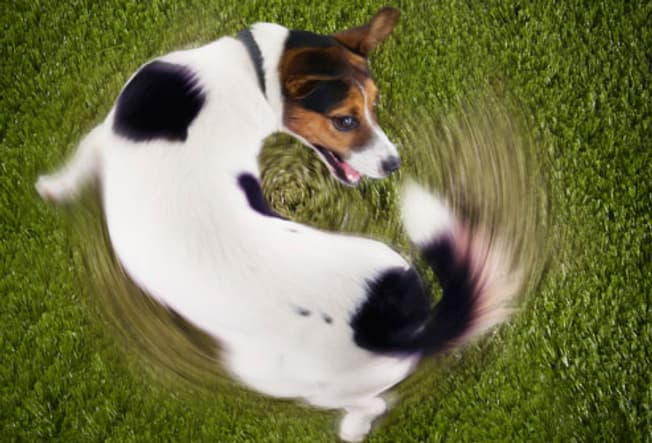
Dogs chase their tails for several reasons: as play behavior (especially in puppies), in response to irritation or physical discomfort at the tail base, out of boredom or under-stimulation, and in some cases as a manifestation of compulsive disorder. Distinguishing between normal, occasional tail-chasing and problematic repetitive behavior is important, as the latter can indicate medical or psychological conditions requiring veterinary attention.
Normal Tail-Chasing in Puppies
Puppies begin chasing their tails between 3 and 8 weeks of age, coinciding with the period when proprioception, the awareness of their own body's position and movement, is developing. For very young puppies, the tail is genuinely novel: they do not yet have complete awareness that it is attached to them. The tail moves, it enters their visual field, and they attempt to catch it.
This play behavior peaks in puppies and young dogs and naturally decreases as dogs mature and their self-awareness and attention diversify. Puppy tail-chasing that occurs in short, playful bouts with no signs of distress is entirely normal developmental behavior.
The play-circuit theory holds that tail-chasing activates the same neural reward pathways as other prey-simulation play behaviors. The moving tail is processed by a puppy's developing visual system in a similar way to a moving prey item, and the chase response is instinctively engaged.
"Tail-chasing in young dogs is a classic example of play behavior directed inward. It serves the same developmental function as play-fighting and object play: it exercises motor circuits, builds predatory movement patterns, and is rewarding in its own right." Dr. Ian Dunbar, veterinary behaviorist and founder of the Association of Pet Dog Trainers
Boredom and Under-Stimulation
In adult dogs, tail-chasing that emerges or persists beyond puppyhood is most commonly associated with insufficient physical and mental stimulation. Dogs are cognitively and physically active animals whose needs are frequently underestimated. A dog that lacks adequate exercise, play, and interaction will seek self-stimulation through displacement behaviors, activities that provide sensory input and activation in the absence of appropriate alternatives.
Breeds with the highest exercise and mental stimulation requirements are disproportionately represented in clinical reports of adult tail-chasing: herding breeds, working breeds, and high-drive terriers. A Border Collie or Belgian Malinois that receives insufficient stimulation may develop repetitive behaviors including tail-chasing, pacing, and excessive spinning as displacement outlets.
The management approach for boredom-driven tail-chasing is straightforward: increase exercise, introduce puzzle feeders and enrichment activities, provide training sessions, and ensure social interaction. In most cases, adequate stimulation eliminates the behavior within days to weeks.
Physical Causes: Fleas, Allergies, and Anal Gland Issues
Before assuming tail-chasing is purely behavioral, veterinary evaluation is warranted to rule out physical causes. Several medical conditions cause irritation at or near the tail that produces chasing, biting, and spinning behavior:
Flea infestation: Fleas concentrate at the tail base and lower back, which is a common flea feeding site. A dog with fleas may chase and bite at its tail to relieve intense itching. The tail-chasing may be accompanied by excessive scratching, hair loss at the tail base, and visible flea dirt (black specks) in the coat.
Anal gland impaction: Full or impacted anal glands cause intense discomfort in the perineal area. Dogs respond by scooting on the floor, licking at the anal area, and spinning to bite at the tail base and rear end. This is one of the most common physical causes of spinning and rear-end attention.
Skin allergies: Environmental or food allergies can cause generalized itching with concentration in certain areas, including the tail base. Dogs with atopic dermatitis or contact allergies may chase and mutilate their tails as a response to itching.
Injury or nerve damage: Trauma to the tail or lower spine can cause abnormal sensation including paresthesia (tingling or burning) that triggers self-directed attention and biting.
| Physical Cause | Key Signs | Accompanying Behaviors |
|---|---|---|
| Flea infestation | Visible fleas, flea dirt, hair loss at tail base | Scratching, biting at back and base of tail |
| Anal gland impaction | Scooting, licking at anus | Scooting, perineal licking, discomfort when sitting |
| Skin allergy | Hair loss, redness, hot spots | Excessive scratching, licking paws, face-rubbing |
| Tail injury | Wound, swelling, sensitivity | Reluctance to be touched at tail, guarding behavior |
| Intestinal parasites | Variable | Scooting, weight loss, pot-bellied appearance (puppies) |
| Perianal fistula | Open sores around anus | Marked discomfort, reluctance to defecate |
Compulsive Tail-Chasing: When It Becomes a Disorder
A subset of dogs develop tail-chasing as a true compulsive behavior, meaning the behavior is performed so frequently, so intensely, or so persistently that it interferes with normal function. Canine compulsive disorder (CCD) is the veterinary term for repetitive, stereotypic behaviors that appear driven by an uncontrollable impulse rather than environmental triggers.
Compulsive tail-chasing is distinguished from normal or boredom-driven behavior by several features:
- The behavior occurs in multiple contexts, not just when bored or under-stimulated
- The dog cannot easily be interrupted or distracted once the behavior has begun
- The behavior escalates in frequency or intensity over time
- The dog may actually catch and injure its own tail
- The dog appears distressed during or after bouts
"Canine compulsive disorder, including repetitive tail-chasing, shares neurobiological features with obsessive-compulsive disorder in humans. Both involve dysregulation of corticostriatal circuits and respond to similar pharmacological treatments." Moon-Fanelli, A. A., & Dodman, N. H. (1998), Tufts University Veterinary School
Compulsive tail-chasing has a genetic component. Bull Terriers, German Shepherds, and German Shepherd cross breeds are dramatically overrepresented in clinical populations. Certain Bull Terrier lines show compulsive spinning (a related behavior) at very high rates, and the condition appears to have a heritable basis in this breed.
Treatment of compulsive tail-chasing requires veterinary involvement. Approaches include behavior modification (structured enrichment, interruption protocols, reducing triggers), and in moderate to severe cases, pharmacological treatment with selective serotonin reuptake inhibitors (SSRIs) or clomipramine, which have demonstrated efficacy for canine compulsive behaviors in controlled trials.
Attention-Seeking Tail-Chasing
Some dogs learn that chasing their tails produces a reliable response from their owners, laughter, attention, exclamations of amusement. Dogs are highly attuned to social reinforcement, and if tail-chasing reliably produces owner attention (even negative attention such as scolding), the dog may repeat it deliberately for social effect.
This learned, operant variant of tail-chasing is distinguished from compulsive behavior by its contextual specificity: the dog typically performs it when the owner is present and paying attention, stops immediately when the owner leaves the room or ceases to respond, and shows no signs of distress during the behavior.
Management is simple: remove the reinforcement. If the owner consistently ignores tail-chasing (turns away, leaves the room), the attention-seeking function is extinguished. The behavior typically diminishes substantially within 1 to 2 weeks of consistent non-response.
| Tail-Chasing Type | Age Group | Key Features | Management |
|---|---|---|---|
| Developmental play | Puppies (3-16 weeks) | Short, playful, naturally diminishes | None needed; normal development |
| Boredom/under-stimulation | Any age | Occurs when idle, reduces with stimulation | Increase exercise and enrichment |
| Medical/physical cause | Any age | Accompanies itching, scooting, discomfort signs | Veterinary evaluation and treatment |
| Attention-seeking | Adult | Only when owner present; stops with non-response | Consistent owner non-response |
| Compulsive disorder | Adult | Frequent, intense, hard to interrupt, escalating | Veterinary behavior evaluation; possible medication |
When to See a Veterinarian
Tail-chasing that warrants veterinary evaluation includes:
- Any tail-chasing in an adult dog that was not present in puppyhood
- Tail-chasing accompanied by signs of physical discomfort (scooting, licking, hair loss)
- Tail-chasing that is difficult to interrupt
- Tail-chasing that has escalated in frequency or intensity over time
- Any tail self-mutilation, biting that breaks the skin or causes wounds
A complete physical examination, including anal gland assessment, skin evaluation, and neurological screening, is appropriate for new-onset or escalating tail-chasing in adult dogs.
For more on dog behavior and health, see Why Do Dogs Howl?, Why Do Dogs Eat Grass?, How Smart Are Dogs?, Signs of a Healthy Dog, and How to Stop a Dog from Barking.
References
Moon-Fanelli, A. A., & Dodman, N. H. (1998). Description and development of compulsive tail chasing in terriers and response to clomipramine treatment. Journal of the American Veterinary Medical Association, 212(8), 1252-1257.
Luescher, U. A. (2003). Diagnosis and management of compulsive disorders in dogs and cats. Veterinary Clinics of North America: Small Animal Practice, 33(2), 253-267. https://doi.org/10.1016/S0195-5616(02)00100-4
Dodman, N. H., Karlsson, E. K., Moon-Fanelli, A., Galdzicka, M., Perloski, M., Shuster, L., Lindblad-Toh, K., & Ginns, E. I. (2010). A canine chromosome 7 locus confers compulsive disorder susceptibility. Molecular Psychiatry, 15(1), 8-10. https://doi.org/10.1038/mp.2009.111
Hewson, C. J., Luescher, U. A., & Ball, R. O. (1998). Measuring change in the behavioural frequency of canine compulsive disorder using a Likert scale questionnaire. Applied Animal Behaviour Science, 55(3-4), 225-238. https://doi.org/10.1016/S0168-1591(97)00044-3
Overall, K. L., & Dunham, A. E. (2002). Clinical features and outcome in dogs and cats with obsessive-compulsive disorder: 126 cases (1989-2000). Journal of the American Veterinary Medical Association, 221(10), 1445-1452. https://doi.org/10.2460/javma.2002.221.1445
Frequently Asked Questions
Why do dogs chase their tails?
Dogs chase their tails for multiple reasons: as normal play behavior in puppies, out of boredom or under-stimulation, due to physical irritation (fleas, anal gland issues, allergies), to seek owner attention, or as a compulsive behavioral disorder in some adult dogs.
Is tail chasing normal in puppies?
Yes. Puppies between 3 and 8 weeks old chase their tails as normal play and proprioceptive development. The behavior naturally decreases as puppies mature and their attention diversifies.
When should I be worried about my dog chasing its tail?
Seek veterinary evaluation if: the behavior is new in an adult dog, accompanies signs of discomfort (scooting, licking, hair loss), is difficult to interrupt, has escalated over time, or involves self-injury to the tail.
Which breeds are most prone to compulsive tail chasing?
Bull Terriers and German Shepherds are dramatically overrepresented in clinical cases of compulsive tail-chasing. The condition has a genetic component in Bull Terriers specifically.
How do I stop my dog from chasing its tail?
Management depends on the cause. Increase exercise and enrichment for boredom-driven chasing. See a vet to rule out physical causes. Ignore attention-seeking tail-chasing consistently. For compulsive cases, consult a veterinary behaviorist about behavior modification and possible medication.
Can tail chasing be treated with medication?
Yes. Compulsive tail-chasing that does not respond to environmental management can be treated with SSRIs such as fluoxetine, or clomipramine, which have demonstrated efficacy in clinical studies for canine compulsive disorders.