
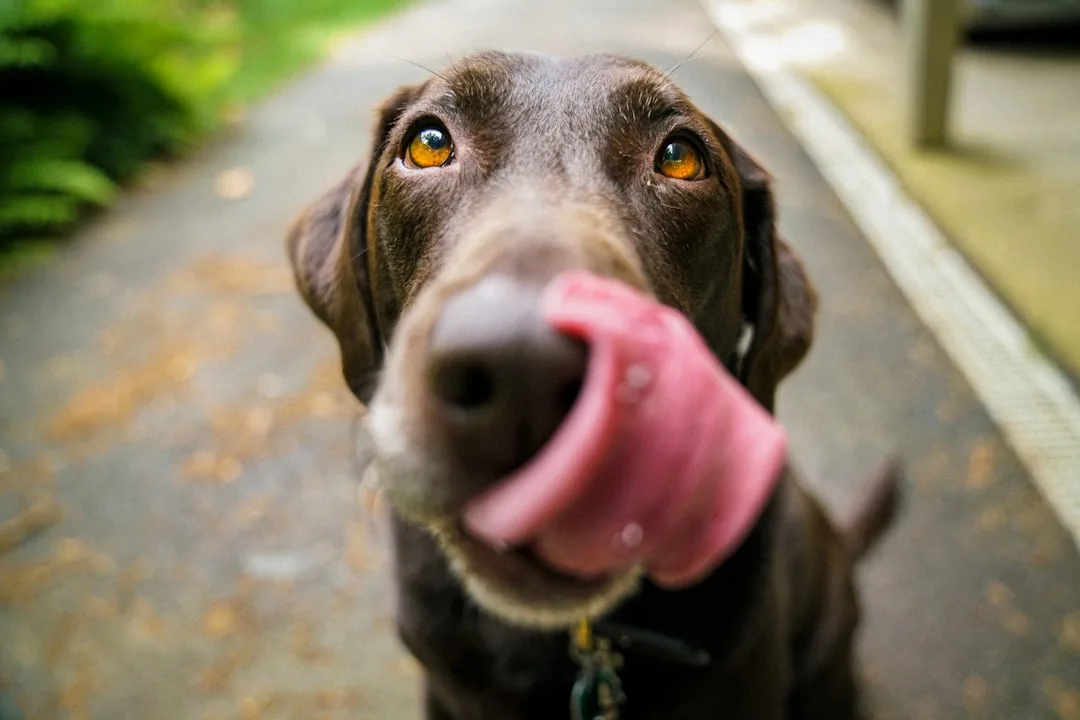
Dogs lick people primarily as a form of communication and social bonding derived from wolf ancestry, where licking signals submission, affection, and greeting. The behavior also releases feel-good endorphins for the dog, and humans' salty skin provides a sensory reward. Understanding the different contexts of licking helps owners interpret what their dog is communicating and recognize when licking crosses into a behavioral or medical problem.
The Evolutionary Origins of Dog Licking
Licking behavior in dogs traces directly to wolf pack dynamics. Subordinate wolves lick the muzzles of dominant pack members as a submissive appeasement gesture; it communicates "I recognize your status, I am not a threat." Wolf puppies also lick their mother's muzzle to stimulate regurgitation of food, a key feeding mechanism in wolf packs. Domestic dogs retain these behavioral programs even though the specific contexts (pack hierarchy, muzzle-feeding) no longer apply in family settings.
When a dog licks a human's face, particularly around the mouth and chin, it is likely performing a variation of this muzzle-licking greeting. Many behaviorists interpret face-licking as the dog's attempt to engage in the closest behavior it knows to canine greeting protocol with a very different-looking social partner.
"Face licking in dogs toward humans is almost certainly derived from the muzzle-licking behavior observed in wolves. It functions as a solicitation and appeasement display that communicates social affiliation." Alexandra Horowitz, cognitive scientist and dog cognition researcher, Barnard College
Why Licking Releases Endorphins for Dogs
Licking is not just communicative; it is physiologically rewarding for the dog performing it. The repetitive motion of licking stimulates the release of endorphins, the brain's natural opioid compounds. Endorphins produce a sensation of calm, comfort, and mild euphoria. This is why licking is a self-soothing behavior that dogs engage in during stress and anxiety, not just during positive social interactions.
The endorphin-licking connection helps explain why some dogs develop compulsive licking; they are essentially self-medicating with a behavior that chemically reduces anxiety. In these cases, the licking may escalate beyond normal social grooming into a stereotypy requiring behavioral or veterinary intervention.
This same mechanism underlies the fact that dogs lick their own wounds. The endorphin reward makes it difficult to stop a dog from licking a wound even when an Elizabethan collar or bandage is necessary for healing.
Licking as Communication: What Different Licking Patterns Mean
| Licking Context | Likely Meaning | What to Do |
|---|---|---|
| Licking hands on return home | Greeting and affection | Normal; allow or redirect as preferred |
| Licking face, especially mouth area | Submissive greeting / solicitation | Normal; set limits if preferred |
| Extended gentle licking of owner's arm | Social grooming, bonding | Normal affectionate behavior |
| Licking self-directed at wound or paw | Wound care / pain response | Monitor; prevent if wound present |
| Persistent licking of floor, walls, objects | Nausea (ELS), anxiety, PICA | Veterinary evaluation recommended |
| Frantic face licking with dilated pupils | Anxiety or stress response | Identify and address stressor |
| Licking air repeatedly | Nausea, dental pain, neurological | Veterinary evaluation |
Attention-Seeking and Learned Behavior
One of the most significant drivers of licking frequency in domestic dogs is learned reinforcement. When a dog licks a person and the person responds, even with a negative response such as laughing, pushing the dog away, or saying "no" the dog receives social feedback that licking produces interaction. Over time, a dog that wants attention reliably turns to licking because it works.
This is operant conditioning at work: the behavior (licking) produces a consequence (human attention) that the dog finds rewarding (interaction, even if mild disapproval), and the behavior is therefore maintained or increased. Dogs that receive consistent, strong, positive attention when they lick learn to lick more, while dogs whose licking is consistently redirected to alternative behaviors learn that those behaviors produce better outcomes.
For owners who want to reduce licking, the most effective approach is to remove all reinforcement from licking, standing up, turning away, and withdrawing attention entirely, while simultaneously rewarding sit, eye contact, or other compatible behaviors with the attention the dog is seeking.
Does Licking Mean a Dog Loves You?
This is the question most owners ask, and the honest answer involves nuance. Licking is strongly associated with positive social relationships in dogs. Dogs do not lick strangers as frequently as they lick familiar people, and licking frequency tends to correlate with attachment quality in studies of dog-human bonds. In this sense, frequent licking of a specific person is a reliable indicator of positive social relationship.
However, attributing human emotional vocabulary like "love" to dog licking risks anthropomorphism. More precisely, licking signals that the dog experiences the person as socially safe, familiar, high-status in a positive sense, and worth affiliating with. Whether this constitutes love depends on definitions, but the behavioral evidence clearly indicates a strong positive social bond.
"Dogs demonstrate clear preferences for specific people through proximity-seeking, following, gaze duration, and physical contact including licking. These behavioral indicators are consistent with what we call attachment and are measurable with the same tools used to assess attachment in human infants." Monique Udell, animal behaviorist, Oregon State University
The Salt Hypothesis: Dogs Like How We Taste
One underappreciated reason dogs lick people is purely sensory: human skin is salty. Sweat contains sodium, chloride, potassium, and other trace minerals that dogs find palatable. Dogs have taste receptors tuned to detect water and salt, and the skin of a person who has been exercising or simply existing in warm weather provides a concentrated source of these compounds.
Many owners notice their dogs lick them more intensely after exercise or in hot weather, direct evidence that the salt motivation is real and situational. Dogs also tend to lick areas of skin that are more saline, such as the hands and forearms, rather than areas covered by clothing or hair.
This does not mean licking is exclusively about taste, the communicative and endorphin elements are independently supported, but it helps explain why some dogs that are otherwise not particularly affiliative will still lick intensively.
When Is Licking a Problem?
Normal social licking is a regular part of dog behavior and generally requires no intervention unless the owner finds it unpleasant. However, several patterns suggest licking has become problematic.
Compulsive licking of objects, floors, walls, or the dog's own body may indicate Excessive Licking of Surfaces (ELS), a syndrome associated with gastrointestinal disease in approximately 14 of 19 affected dogs in a study by Bécuwe-Bonnet et al. (2012). Dogs with ELS typically show resolution or significant reduction of licking after treatment of the underlying GI condition.
Compulsive licking of body parts, particularly the paws (acral lick dermatitis), flank, or genitals, may indicate allergy, pain, anxiety, or obsessive-compulsive disorder in dogs. Acral lick dermatitis produces characteristic thickened, raised plaques on the upper paw or lower limb from chronic licking and requires veterinary management.
"Repetitive, compulsive licking that persists beyond normal grooming or social contexts warrants a thorough diagnostic workup. Both medical and behavioral causes may be present simultaneously." American College of Veterinary Behaviorists, Clinical Guidelines, 2019
PICA, the compulsive consumption of non-food items, can manifest as licking or chewing of fabric, dirt, metal, or concrete. PICA may reflect nutritional deficiency, gastrointestinal disease, anxiety, or neurological abnormality and requires veterinary evaluation.
Is Dog Saliva Safe for Humans?
Dog saliva contains numerous bacteria, some of which are capable of causing infection in humans with compromised immune systems. Capnocytophaga canimorsus, a bacterium found normally in dog mouths, can cause severe illness in people who are immunocompromised, have had splenectomy, or are undergoing chemotherapy. Cases of septicemia (bloodstream infection) from dog licking of open wounds have been reported in the medical literature.
For healthy adults, the risk from normal face or hand licking is low, though not zero. Dogs should be discouraged from licking open wounds, mucous membranes (eyes, nose, mouth), or the faces of infants, toddlers, elderly individuals, or immunocompromised people regardless of apparent health.
Managing Licking Behavior
For owners who want to reduce licking without damaging their relationship with their dog, consistent redirection is more effective than punishment. When the dog initiates licking, the owner calmly stands up or turns away (removing attention), waits for the dog to stop and offer an alternative behavior such as sitting, then delivers attention as reward. Repeating this sequence consistently over one to two weeks significantly reduces most normal licking.
For compulsive or anxiety-driven licking, behavioral modification is combined with addressing the underlying trigger. Environmental enrichment, regular exercise, and predictable routines reduce anxiety in most dogs. Cases that do not respond to environmental management may benefit from veterinary-prescribed anxiolytic medications as an adjunct to behavioral therapy.
For related reading, see Why Do Dogs Tilt Their Heads?, Why Do Dogs Eat Grass?, Signs of a Healthy Dog, How Smart Are Dogs?, and Why Do Dogs Howl?.
References
Bécuwe-Bonnet, V., Bélanger, M. C., Frank, D., Parent, J., & Hélie, P. (2012). Gastrointestinal disorders in dogs with excessive licking of surfaces. Journal of Veterinary Behavior, 7(4), 194-204. https://doi.org/10.1016/j.jveb.2011.07.003
Horowitz, A. (2009). Inside of a Dog: What Dogs See, Smell, and Know. Scribner.
Udell, M. A. R., Dorey, N. R., & Wynne, C. D. L. (2010). What did domestication do to dogs? A new account of dogs' sensitivity to human actions. Biological Reviews, 85(2), 327-345. https://doi.org/10.1111/j.1469-185X.2009.00104.x
Butler, T., Ostrowski, S. R., & Lund, O. (2015). Capnocytophaga canimorsus: An emerging cause of sepsis, endocarditis, and meningitis in otherwise healthy adults. Journal of Infection, 70(5), 455-463. https://doi.org/10.1016/j.jinf.2014.11.011
Lindsay, S. R. (2000). Handbook of Applied Dog Behavior and Training, Vol. 1: Adaptation and Learning. Iowa State University Press.
Frequently Asked Questions
Why do dogs lick people?
Dogs lick people as a social greeting derived from wolf behavior, to show affection and submission, because they enjoy the salt on human skin, and because licking releases calming endorphins. Licking is also reinforced when humans respond to it.
Does licking mean a dog loves you?
Frequent licking of a specific person is a reliable indicator of positive social attachment. Dogs lick preferred humans more than strangers, and the behavior is consistent with secure bonding as measured in animal behavior research.
Why does my dog lick me so much?
If licking is very frequent, it is likely because the behavior has been reinforced, even a small reaction from you rewards the dog and maintains the behavior. Consistent redirection to alternative behaviors is the most effective way to reduce frequency.
Is it safe to let your dog lick your face?
For healthy adults, occasional face licking carries low risk. However, dogs should not lick open wounds, eyes, or the faces of infants, elderly people, or immunocompromised individuals due to bacterial risk including Capnocytophaga canimorsus.
Why does my dog lick the floor and walls?
Repetitive licking of non-food surfaces (Excessive Licking of Surfaces, or ELS) is associated with gastrointestinal disease in the majority of affected dogs. If your dog persistently licks floors, walls, or objects, veterinary evaluation is recommended.
How do I stop my dog from licking me so much?
Remove all reinforcement: when your dog licks, stand up, turn away, and withhold attention entirely. When the dog stops and offers a calmer behavior like sitting, deliver the attention it is seeking. Consistent repetition over one to two weeks reduces most normal licking.