
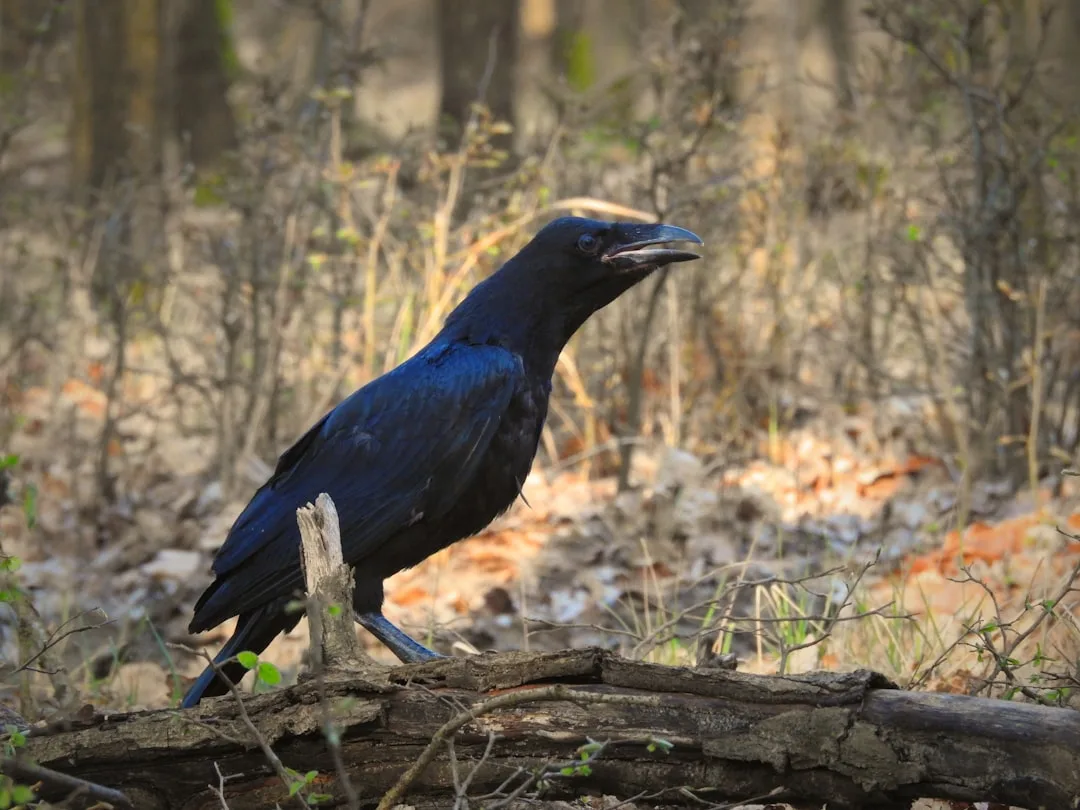
The common raven is the largest songbird on the planet and one of the most cognitively advanced non-human animals ever studied. Corvus corax is a true passerine - a member of the order that contains sparrows, wrens, and finches - yet it weighs as much as a red-tailed hawk, outlives most parrots in captivity, and solves problems that defeat four-year-old human children.
The raven occupies more of the Northern Hemisphere than any other corvid and thrives in conditions from -40 Celsius Arctic tundra to 45 Celsius desert canyons.
This guide covers the full biology, behaviour, and ecology of the common raven: size and anatomy, range, diet, hunting and scavenging, reproduction, social life, intelligence, vocal culture, the famous raven-wolf partnership, and the species' extraordinary mythological weight. It is a reference entry, not a summary, so expect specifics - centimetres, grams, neuron counts, kilometres, and verified records.
Etymology and Classification
The scientific name Corvus corax was formalised by Carl Linnaeus in 1758. Corvus is Latin for 'raven' or 'crow', and corax comes from the ancient Greek korax, an onomatopoeia for the bird's deep resonant call. The English word 'raven' descends from Old English hraefn and Proto-Germanic hrabnaz, ultimately imitative of the same croaking sound. Across Europe the species carries a family of related names - German Rabe, Dutch raaf, Old Norse hrafn, Welsh cigfran meaning 'flesh crow'.
The common raven is one of roughly forty species in the genus Corvus, the group that contains crows, rooks, jackdaws, and the larger ravens of Africa and Australia. Within Corvus it is the largest species and, along with the thick-billed raven of the Ethiopian highlands, one of the two most massive members of the entire Corvidae family.
Genetic analysis divides the common raven into at least eight recognised subspecies distributed across its vast range, with notable differences in body size, bill shape, and dialect. Some researchers have proposed splitting the western North American Corvus corax sinuatus lineage into a separate species, a debate that continues in peer-reviewed ornithology.
Despite looking superficially like a giant crow, the raven is the product of tens of millions of years of separate evolution. Corvids as a family probably diverged from other songbirds in Australasia around twenty million years ago and radiated outward, with ravens specialising toward larger body size, longer wings, and extended pair-bonding. The bird is therefore best understood not as an oversized crow but as the apex of the corvid lineage.
Size and Physical Description
Common ravens are the largest passerines alive today. The size range is wide because the species spans continents and climates, and the largest subspecies - those of Greenland, Iceland, and the Tibetan Plateau - can weigh more than double the smallest desert populations.
Body dimensions:
- Length: 54-70 cm from beak to tail
- Wingspan: 1.15-1.5 m
- Weight: 0.7-2.0 kg, typically 1.0-1.5 kg
- Bill length: 6-9 cm
- Tail length: 20-26 cm
Distinguishing features:
- Wedge-shaped tail, visible in flight silhouette
- Shaggy 'hackles' on throat - elongated pointed feathers
- Heavy, deeply curved bill with a pronounced culmen
- Long primary flight feathers creating a raptor-like wing shape
- Entirely black plumage with iridescent blue, purple, or green sheen in direct sunlight
- Black legs, feet, bill, iris in adults
Males average slightly larger and heavier than females but the difference is not reliable from field observation alone. Unlike many raptors the two sexes share identical plumage. Juvenile ravens can be distinguished from adults by a blue-grey iris (darkening to deep brown within the first year), duller plumage, and a proportionally shorter bill. The throat hackles develop fully only with adulthood.
In flight the raven is immediately distinguishable from any crow. Crows flap steadily and rarely glide far. Ravens soar on flat or slightly raised wings like a buzzard, perform acrobatic rolls and tumbles, and routinely ride thermals to impressive altitudes. Ravens have been recorded above six thousand metres in the Himalayas, flying over mountain passes that kill most other birds from hypoxia.
Range and Habitat
The common raven holds the widest natural distribution of any corvid and one of the widest of any songbird on Earth. Its range covers most of the Northern Hemisphere.
Global distribution:
| Region | Status |
|---|---|
| North America | Alaska, Canada, western US, Mexico, Central America |
| Europe | From Iberia and the Mediterranean to the Arctic coast |
| Asia | Russia, Mongolia, China, Himalayas, Middle East |
| North Africa | Atlas Mountains, coastal Morocco, parts of Egypt |
| Arctic | Greenland, Iceland, Svalbard, high-Arctic Russia |
Ravens occupy almost every terrestrial habitat in this range. They breed on sea cliffs in Cornwall and the Faroes, in Arctic tundra, in boreal spruce forest, in temperate deciduous woodland, on desert cliffs in Arizona and the Sahara, in high mountain meadows above 5,000 m, and in expanding numbers in cities and industrial landscapes.
They avoid only dense tropical rainforest and lowland farmland dominated by intensive agriculture - habitats that lack both the nesting structures they require and the diverse food supply they prefer.
The raven's climatic tolerance is extreme. Populations live year-round in areas that routinely drop below -40 Celsius and others in desert regions where summer shade temperatures exceed 45 Celsius. Few other birds match that thermal range. The common raven's success across climates is tied to its generalist diet, its intelligence, and its willingness to scavenge from any abundant food source.
Diet and Foraging
Ravens are among the most generalist feeders of any bird. Studies from across the range document dozens of food categories in a single population's annual diet, and individual ravens sometimes exploit local specialities that make up most of their intake for months at a time.
Main food categories:
- Carrion. Dominates the winter diet across most of the range. Ravens follow wolves, coyotes, large raptors, human hunters, and roadways to reach carcasses.
- Small vertebrates. Voles, mice, lizards, snakes, young rabbits, nestling birds. Ravens kill small prey directly with a stabbing strike of the bill.
- Eggs and nestlings. Raven predation is a documented pressure on seabird colonies, shorebird nests, and - in the western US - federally listed species such as desert tortoise hatchlings and sage grouse chicks.
- Insects and molluscs. Seasonally important, especially during spring and summer when caterpillars, beetles, and grasshoppers are abundant.
- Fruit, grain, and seeds. Ravens raid crops, dumpsters, livestock feeding troughs, and autumn berry crops with the same efficiency.
- Human refuse. Landfill sites, campgrounds, and urban streets support permanent urban raven populations in much of their range.
- Cached food. Ravens store surplus food and return to recover it days or weeks later, with good spatial memory for the cache location.
The raven's feeding style is opportunistic but organised. Pairs share food with each other, mob larger scavengers away from carcasses when they can, and call to recruit other ravens when the food source is too big to defend. Juveniles routinely travel in flocks around a single large carcass, overwhelming the territory-holding adult pair by sheer numbers - a strategy described by biologist Bernd Heinrich in his long-term Maine studies.
Reproduction and Life Cycle
Common ravens form long-term pair bonds that typically last until one partner dies. Courtship involves spectacular aerial displays - paired rolls, tumbles, synchronised dives, and mutual preening at the roost. Pairs establish a territory in the autumn of their third or fourth year and defend it year-round thereafter.
Breeding timeline:
- Late winter to early spring: courtship feeding, nest building, copulation
- Mid-February to April: clutch laid (earlier in warm regions, later in Arctic)
- 20-25 days: incubation, performed almost entirely by the female
- 35-45 days: nestling period to first flight
- Following 6-8 weeks: post-fledging care, parents feeding juveniles
- End of summer: juveniles disperse to non-breeding flocks
Clutch characteristics:
- Egg count: 3-7 (typically 4-6)
- Egg colour: pale green or blue-green with darker mottling
- Egg size: roughly 50 x 33 mm
Nests are enormous stick structures, up to 1.5 metres across and weighing tens of kilograms after successive years of use. Pairs may maintain two or three alternative nest sites within a territory and rotate between them across years, both to reduce parasite load and to make nest relocation easier after disturbance.
Preferred nest sites include tall trees, cliff ledges, power pylons, and large man-made structures. In the treeless Arctic, pairs will nest on any prominent ledge or even on the ground when no cliff is available.
Juveniles leave the nest weak and clumsy, staying in or near it for several days before making their first real flights. Parents feed them aggressively during this period and defend them with loud mobbing calls against eagles, owls, and any approaching human. Young ravens then join non-breeding flocks that may number several hundred individuals, roaming widely for two to four years before establishing a territory of their own.
Intelligence and Cognition
No bird species has been studied more thoroughly for cognition than the common raven, and no bird has produced more consistently impressive results. The raven's forebrain - specifically the pallium, the functional analogue of the mammalian cortex - contains neurons packed at a density comparable to great apes. The whole brain weighs approximately fifteen grams, yet holds roughly two billion pallium neurons. Cognition per gram is higher in ravens than in almost any other animal measured.
Documented cognitive abilities:
- Planning for future events. Ravens trained on a locked box were offered a tool now, a smaller immediate treat, or nothing. Birds consistently chose the tool, retained it, and used it up to seventeen hours later - a time horizon that rules out simple conditioning.
- Tactical deception. Ravens caching food in the presence of a competitor behave differently depending on whether the competitor can see them. They fake caches, relocate hidden food when the watcher leaves, and approach a new cache site silently when being observed.
- Mass and volume understanding. In the 'Aesop's fable' paradigm ravens dropped stones into a tube of water to raise a floating reward, preferring heavy stones over floating objects and solid over hollow stones.
- Mirror self-recognition (contested). Some studies report ravens passing a modified mirror mark test; others fail to replicate it. The scientific consensus is that the evidence is suggestive but incomplete.
- Theory of mind (contested). Ravens adjust caching behaviour as if modelling what an unseen competitor might know, which some researchers interpret as evidence of mental state attribution.
- Long-term individual recognition. Ravens trained to associate specific humans with capture events recognise and scold those individuals years later, while ignoring neutral strangers wearing identical clothing.
- Tool use and tool manufacture. While less documented than in the New Caledonian crow, wild and captive ravens have been observed breaking twigs to the right length to probe crevices and using objects to hold down food while tearing it.
Cognitive performance varies among individuals. Some ravens in the same test population solve a puzzle on first exposure; others never solve it. This individual variation, combined with long lifespans and strong social learning, supports the idea that raven culture transmits specific skills across generations within a local population.
Vocalisations and Dialects
Ravens have one of the most complex vocal systems of any bird. Field recordings identify more than thirty structurally distinct calls in a single population, used for territorial advertisement, pair contact, long-distance greeting, food signalling, alarm, juvenile begging, antagonistic display, and contexts that are still being characterised.
Representative call types:
- Kraa. The classic deep territorial call, carries over a kilometre in still air.
- Toc-toc-toc. A hard knocking call used in close-pair contact.
- Yell. A drawn-out food-recruitment call that attracts other ravens to a large carcass.
- Twang. A metallic ringing call given by juveniles and in social play.
- Quork. A low rolling greeting between paired birds.
- Whistle. Soft musical notes used in pair bonding and quiet contact.
Different populations develop distinct dialects. Ravens of Maine do not sound identical to those of Arizona, and Icelandic ravens differ again. Young birds appear to learn the dominant dialect of the non-breeding flock they join rather than the one their parents used, which is why dialect geography shifts slowly across the range.
Captive ravens are accomplished vocal mimics. They reproduce human speech, the calls of other species, car alarms, dog barks, toilet flushes, and mechanical sounds with clarity that often exceeds commonly talking parrots. Wild ravens mimic too, though more selectively - wolf howls, the barks of territorial eagles, and the calls of species they compete with at carcasses.
The Raven-Wolf Partnership
Few cross-species relationships have attracted as much scientific attention as the one between common ravens and grey wolves. Across the boreal forests, tundra, and mountain ranges of the Northern Hemisphere the two species live in a loose but persistent partnership sometimes called 'obligate commensalism' on the raven's side.
Ravens cannot open the thick hide of a moose, elk, bison, or deer with their beaks. Without a larger carnivore to break the body first, a freshly dead ungulate is almost useless to a raven. Wolves solve that problem. In return, ravens:
- Spot carcasses from the air and call wolves toward them
- Detect approaching danger and alarm-call the pack
- Scout prey movements ahead of the wolves
- Harass and distract prey during the kill
Researchers in Yellowstone have documented ravens arriving at a kill within minutes of the wolves - sometimes before the prey has stopped moving. Bernd Heinrich's long-term Maine work shows young ravens actively recruiting other ravens to a new carcass, overwhelming the territory-holding pair so that the whole flock can feed. In the absence of wolves, ravens associate with coyotes, bears, mountain lions, and human hunters for the same reason.
This partnership is old. Fossil and ecological evidence suggests it predates human arrival in North America by tens of thousands of years. Some researchers go so far as to argue that the raven co-evolved with large pack-hunting carnivores and is ecologically dependent on them in much of its northern range.
Play Behaviour
Ravens play. They play aerially, socially, and with objects. Observational and experimental studies have documented:
- Aerial barrel rolls, tumbles, and inverted flight with no territorial or courtship context
- Sliding repeatedly down snowbanks and steep roofs on their backs
- Hanging upside down from branches by one foot
- Passing sticks back and forth in midair between paired or associated birds
- Dropping objects in flight and catching them before they hit the ground
- Manipulating objects - pine cones, bones, bottle caps - without any food reward
Play is rare among birds and is almost always restricted to corvids, parrots, and a few raptors. The functional explanation remains open. Some researchers argue play is motor practice for hunting and flight; others that it consolidates social relationships; others that in highly intelligent animals with long juvenile periods, play is simply what spare cognitive and physical capacity produces.
Conservation Status
The IUCN Red List classifies the common raven as Least Concern, with a stable or increasing global population estimated in the tens of millions. The species has recovered strongly in Europe and eastern North America over the past century after centuries of persecution via shooting, trapping, poisoning, and egg collection. Ravens are now recolonising lowland habitats they vanished from in the nineteenth century and expanding into cities, suburbs, landfills, and road networks.
Current conservation issues:
- Range expansion. Raven populations in parts of the western US have increased many-fold since the 1960s, driven by subsidised food (landfills, agriculture) and nesting structures (power pylons, communication towers). This success creates conflict with endangered prey species, particularly desert tortoise hatchlings and sage grouse nests.
- Persecution. Ravens remain legally or illegally killed in some livestock regions. Targeted lethal control programmes exist in parts of the American West.
- Wind energy. Turbine collisions kill ravens, though at lower rates than some raptor species.
- Lead poisoning. Ravens scavenging on game shot with lead ammunition accumulate lead in bone and soft tissue. Regional studies report elevated blood lead in autumn.
Despite these pressures the common raven is in no sense at risk. If any large corvid is a conservation-success story, it is the raven. The harder question is how to balance a recovering predator with the declining smaller species it preys on.
Ravens in Culture and Mythology
Few animals carry the cultural weight of the raven. The species appears in foundation myths, funerary practices, and royal legends across three continents.
Norse tradition. The god Odin is accompanied by two ravens - Huginn meaning 'thought' and Muninn meaning 'memory' - who fly across the world each day and return to whisper what they have seen into his ears. Odin himself is sometimes called Hrafnagud - 'raven god'.
Celtic and British tradition. Ravens appear throughout Irish and Welsh mythology, often associated with the battlefield goddess Morrigan and with prophecy. The mythological British king Bran the Blessed shares his name with the Welsh word for raven. In present-day Britain, at least six ravens are kept by law at the Tower of London under the centuries-old prophecy that if the ravens leave, the kingdom will fall.
Native American traditions. Across the Pacific Northwest - Tlingit, Haida, Tsimshian, Kwakwaka'wakw - Raven is the culture hero and trickster who stole the sun, shaped the rivers, and created humans. In other First Nations traditions Raven is a messenger, a psychopomp, or a creator spirit.
Other traditions. Ravens appear as omens in the Hebrew Bible, as messengers in early Christian hagiography (feeding the prophet Elijah, burying Saint Paul the Hermit), and as battlefield scavengers in classical and medieval European literature.
This cultural weight reflects a long, close relationship between humans and ravens. Traditional societies across the Northern Hemisphere watched a large, intelligent, long-lived, vocal black bird follow their hunting parties, clean their battlefields, and share their winter camps. It is unsurprising that they made the raven carry meaning.
Related Reading
- Corvids: The Most Intelligent Birds on Earth
- Crows and Ravens: Cognitive Abilities That Rival Primates
- Can Crows Recognize Human Faces?
References
Relevant peer-reviewed and scholarly sources consulted for this entry include Bernd Heinrich's long-term field studies on raven feeding ecology and social behaviour (University of Vermont, 1989-2014), Thomas Bugnyar and colleagues' cognitive experiments at the Konrad Lorenz Research Station (Austria), John Marzluff's work on corvid recognition of human faces (University of Washington), the IUCN Red List assessment for Corvus corax (2021), the British Trust for Ornithology population monitoring series, and published research in Science, Nature Communications, Animal Cognition, and The Auk.
Population figures and range descriptions reflect the most recent consolidated estimates available at time of writing.
Frequently Asked Questions
How big is a common raven, and how is it different from a crow?
The common raven (Corvus corax) is the largest songbird on the planet. Adults measure 54-70 cm from beak to tail, weigh 0.7-2.0 kg, and stretch 1.15-1.5 m wingtip to wingtip - roughly the size of a red-tailed hawk. American and carrion crows, by contrast, weigh 300-600 g and are about two-thirds as long.
In flight ravens show a wedge-shaped tail rather than the crow’s fan, glide and soar on flat wings like a raptor, and give a deep resonant ‘kraaa’ or knocking call instead of the crow’s higher ‘caw’. At close range the raven’s shaggy throat hackles, heavier bill, and curved culmen are unmistakable.
How intelligent are common ravens?
Common ravens are among the most cognitively advanced non-human animals studied. They pass tests for planning, tactical deception, mental representation of absent objects, understanding of mass and volume, and - in some designs - theory of mind, meaning they behave differently depending on what another animal can or cannot see.
Their brain contains roughly 2 billion neurons in the pallium alone, a density comparable to great apes despite the entire brain weighing around fifteen grams. Experiments have shown ravens choosing a tool now to use up to seventeen hours later, passing the Aesop’s fable water-displacement task, and modifying their food-caching behaviour when they notice competitors watching.
Where do common ravens live?
The common raven has the widest natural distribution of any corvid and one of the widest of any songbird. Its range covers most of the Northern Hemisphere - from high Arctic tundra and boreal forest across Europe, Asia, and North America, south through the western United States, Mexico, and Central America, into North Africa, the Arabian Peninsula, and the Himalayas. Ravens thrive in conditions from -40 Celsius Arctic winters to 45 Celsius desert summers.
They occupy tundra, taiga, temperate forest, mountain, coast, desert, and increasingly urban environments, which is why their populations are growing in many regions where crows are also expanding.
What do common ravens eat?
Ravens are opportunistic omnivores with one of the broadest diets of any bird. Major food categories include carrion - which dominates the diet in winter and in wolf country - small mammals, reptiles, amphibians, eggs, nestlings, insects, molluscs, grain, fruit, human refuse, and stored or cached items recovered weeks later.
Ravens will kill prey up to the size of a small rabbit, scavenge whale and deer carcasses, raid seabird colonies, and follow predators such as wolves, coyotes, and polar bears to share kills they could not open themselves. Pairs often share food with each other, and parents feed fledged young for weeks after they leave the nest.
How long do common ravens live?
Wild common ravens typically live 10-15 years. Survival in the first year is low - perhaps 50 per cent - but once a bird reaches breeding age and claims a territory its odds improve considerably. Captive ravens regularly exceed 30 years under good care, and a few well-documented individuals have passed 40. The famous Tower of London ravens include birds confirmed to have lived into their mid-forties.
Breeding pairs generally bond for life and defend the same territory year after year, and the longevity gap between wild and captive birds is driven mainly by predation, collisions, poisoning, and starvation rather than biological ageing.
Why do wolves and ravens hunt together?
Ravens and wolves have co-evolved a loose partnership across the Northern Hemisphere. Ravens cannot open the thick hide of a moose, bison, or deer carcass with their beaks, so they rely on larger predators to break into the body. In return, ravens spot prey, carcasses, and approaching danger from the air.
Biologists have documented ravens calling to alert wolves to food, leading wolves toward carcasses, and waiting for wolves to feed first before moving in. Wolf scientists studying Yellowstone describe ravens as almost constant companions of active packs, and some researchers consider the raven ‘wolf bird’ relationship obligatory for ravens in much of the northern boreal zone.
Are common ravens endangered?
No. The IUCN Red List classifies the common raven as Least Concern, with a stable or increasing population across most of its range. Global population is estimated in the tens of millions. Ravens were historically persecuted in much of Europe and eastern North America and pushed out of many lowland areas by shooting, poisoning, and egg collection.
Since the mid-twentieth century they have recovered strongly, recolonising former range and expanding into cities, suburbs, and agricultural landscapes. In some regions their success now raises conflicts with livestock producers and with conservation programmes for endangered prey species such as desert tortoises and sage grouse.
Can ravens really talk, and what do their calls mean?
Ravens are accomplished vocal mimics. Captive birds routinely reproduce human words, car alarms, dog barks, toilet flushes, and the calls of other species with accuracy that often exceeds well-known talking parrots. In the wild, their natural repertoire contains more than thirty structurally distinct calls used for territorial advertisement, pair contact, alarm, food signalling, juvenile begging, and antagonistic display.
Different populations develop regional dialects, and mated pairs use private call variants that differ from neighbouring pairs. Young ravens appear to learn the dominant dialect of the flock they join rather than the one their parents used, which is why vocal geography shifts slowly across the range.