
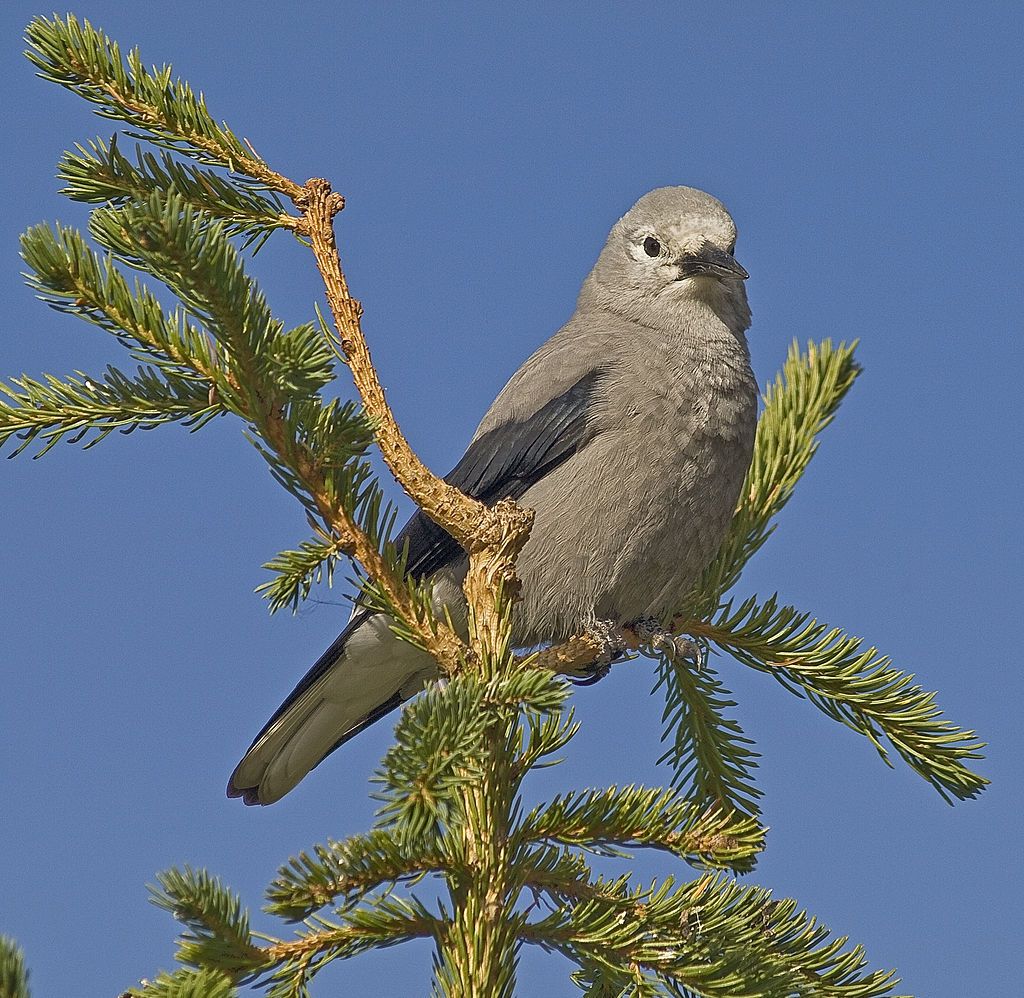
In late summer, high in the subalpine pine forests of the Rocky Mountains and the Sierra Nevada, a pale grey corvid with a black bill and black-and-white wings works through the crowns of whitebark pines with systematic efficiency.
Nucifraga columbiana, Clark’s nutcracker, chisels seeds from unopened cones, transfers them to a specialised skin pouch beneath its tongue that can hold up to 150 seeds, flies to a south-facing slope with exposed mineral soil, and buries them in small caches.
It will repeat this process across days and weeks, accumulating as many as 98,000 seeds in up to 30,000 separate locations across a home range that may span 800 square kilometres.
In the following months, as snow buries the mountain landscape and food becomes unavailable, the nutcracker will relocate the majority of those cache sites using spatial memory keyed to multiple environmental landmarks.
Laboratory studies of this retrieval performance have placed Clark’s nutcracker among the most spatially capable animals ever tested, with demonstrated memory for more than 9,000 individual cache locations simultaneously, a feat that reflects a neurological specialisation centred on an enlarged hippocampus without parallel in most comparable-sized birds.
The relationship between Clark’s nutcracker and whitebark pine is not merely ecological but evolutionary. The two species have shaped each other over millions of years: the pine produces large, wingless seeds adapted for no dispersal mechanism other than corvid transport, and the nutcracker is the essentially sole means by which whitebark pine moves upslope, colonises new terrain, and regenerates after fire.
As whitebark pine enters critical decline across its range, driven by introduced disease and climate-driven beetle outbreaks, the nutcracker’s future and the pine’s future are linked in ways that wildlife managers are increasingly working to address.
Etymology and Classification
The genus Nucifraga derives from the Latin nux (nut) and frangere (to break), meaning “nut-breaker” a direct reference to the behaviour of cracking open hard pine cones to extract seeds. The species name columbiana refers to the Columbia River, near which Meriwether Lewis first documented the bird on 22 August 1805 during the Lewis and Clark Expedition.
Lewis described it in his journal with considerable accuracy but mistakenly identified it as a woodpecker based on its chisel-like bill action. The species was formally described and named by Alexander Wilson in 1811, who assigned the name columbiana in honour of Lewis’s co-leader William Clark.
The genus Nucifraga contains two species: N. columbiana (Clark’s nutcracker of western North America) and N. caryocatactes (the Eurasian nutcracker, distributed across Europe and Asia).
Both species are specialist seed-cachers with unusually large sublingual pouches, and both maintain mutually dependent ecological relationships with five-needled pines: the Eurasian nutcracker with Arolla pine (Pinus cembra) in the Alps and Siberian stone pine (Pinus sibirica) across Russia, and Clark’s nutcracker primarily with whitebark pine (Pinus albicaulis) and limber pine (Pinus flexilis) in North America.
Within the family Corvidae, Nucifraga sits among the more derived lineages, sharing its overall position with the jays, though it is phylogenetically distinct from them. The corvid family as a whole is remarkable for cognitive flexibility, and the nutcrackers represent a specialisation of corvid intelligence toward an extreme in spatial memory and seed-storage ecology.
No other corvid group has evolved the specific sublingual pouch anatomy that makes large-scale seed transport efficient; the nutcracker’s pouch is therefore a synapomorphic character linking the two Nucifraga species and distinguishing them from all other corvids.
Physical Description
Clark’s nutcracker is a medium-sized corvid, considerably smaller than a crow but larger than a jay. Adults measure 27 to 33 cm in total length and weigh 100 to 156 g, with little consistent size difference between sexes. Wingspan ranges from 45 to 61 cm.
The plumage is a distinctive pale grey on the head, back, and underparts, lighter than almost any other corvid, with jet-black wings and tail. The secondaries and outer tail feathers have broad white edges and tips, creating a striking black-and-white wing pattern visible in flight. The face is pale, almost white around the bill, with a subtle darkening toward the crown.
The bill is long, pointed, and slightly curved downward at the tip, adapted for probing into cone scales and prying seeds free. This bill is substantially longer and more sharply pointed than the bill of any jay, reflecting the specific extraction function it must perform.
The sublingual pouch is the most remarkable anatomical feature. Located beneath the tongue and extending anteriorly into the throat, the pouch is a simple expandable pocket of thin skin with no muscular or skeletal support. When empty, it is invisible. When full, it creates a distinct forward-bulging mass below the bill that can extend several centimetres.
Measurements of pouch capacity in experimental settings have confirmed that birds can carry 90 to 150 whitebark pine seeds per load, depending on seed size. The seeds are stacked loosely within the pouch and transported without damage to the seed coat or embryo.
Flight profile is distinctive: the wing beats are more fluid and languid than expected for a corvid of this size, with the broad black-and-white wing pattern flashing at each beat. In mountain habitats, the bird soars and glides across valley gaps, using updrafts to cover the long distances between seed source trees and optimal caching areas efficiently.
Habitat and Range
Clark’s nutcracker is a bird of the western mountain ranges of North America. Its range extends from the mountains of British Columbia and Alberta in the north, through the Rocky Mountains, the Cascades, and the Sierra Nevada, to the mountains of Baja California in the south, and eastward to the Black Hills of South Dakota. It is most abundant in the subalpine zone, typically at elevations of 1,500 to 3,700 m, wherever its key tree species grow.
The preferred habitat is subalpine conifer forest at or near the timberline, where whitebark pine and limber pine dominate or co-dominate the forest. In the Cascades and Sierra Nevada, western white pine (Pinus monticola) and pinyon pines (Pinus edulis, P. monophylla) are important supplementary seed sources. At lower elevations, ponderosa pine seeds are used during years when high-altitude cone crops fail.
The bird is not migratory in the traditional sense but undertakes irruptive downslope movements in years when the high-altitude pine seed crop is poor, moving to valley pines, junipers, and even agricultural areas in search of food. These irruptions, sometimes called “invasions,” bring nutcrackers far outside their normal range in exceptional years.
Within the subalpine zone, the nutcracker occupies a specific three-dimensional space: the upper canopy of conifers for cone access and surveying, the forest floor and treeless rocky slopes for caching and cache retrieval, and the airspace between these for transport.
South-facing slopes with shallow soil and exposed mineral substrate are preferred caching areas, as these sites tend to melt out of snow earlier in spring, allowing cache retrieval before new food sources are available. Caching areas are often several kilometres from seed-source trees, requiring long over-terrain flights.
Seed Caching: Mechanics and Scale
The caching process is precisely orchestrated. A nutcracker approaches a cone-bearing tree, braces against the branch or cone, and uses its bill to pry back cone scales and extract seeds. Seeds are transferred from bill to pouch through a tongue-flicking action. The bird continues working along the tree and between trees until the pouch is full, then flies to its caching area.
At each cache site, the bird lands, probes the substrate with its bill to create a hole 1 to 3 cm deep, deposits 1 to 15 seeds with the bill, and tamps the soil or leaf litter back over the cache with bill movements.
The choice of cache site is non-random. Experimental studies have shown that nutcrackers preferentially cache on south-facing slopes with distinctive landmarks, rocks, logs, tree trunks, that will remain visible through winter snow cover.
Cache depth is calibrated to local conditions; deeper caches in areas with light snow cover, shallower caches in areas of deep snow where surface access is needed for retrieval. Multiple landmarks are memorised for each cache site, providing redundancy if some landmarks are obscured by snow.
Retrieval accuracy in experimental studies is approximately 70 to 90% for caches recovered within a few months, declining but still substantially above chance for caches more than six months old. In natural settings, survival-critical cache retrieval requires the bird to relocate its own caches while simultaneously avoiding theft by other nutcrackers, jays, and small mammals that observe caching and steal seeds.
This competitive pressure appears to have driven the elaboration of spatial memory to levels far beyond what simple individual survival would require, as a higher-memory bird recovers more of its own caches before they are found by competitors.
Spatial Memory and Cognition
The investigation of Clark’s nutcracker spatial memory has produced some of the most significant findings in comparative cognition. The foundational experimental work by Stephen Vander Wall and Russell Balda in the 1970s and 1980s established that nutcrackers recover caches with above-chance accuracy many months after storage. Subsequent controlled laboratory studies by Balda, Kamil, and colleagues systematically quantified this performance and placed it in comparative context.
In the most demanding laboratory experiments, nutcrackers were allowed to cache seeds in a room with a distinctive arrangement of landmarks (wooden stakes or stones placed in a fixed pattern on a sand floor). The room configuration was then modified before retrieval testing: landmarks were removed, repositioned, or replaced with novel objects.
Nutcrackers searched preferentially at the spatial location of their caches relative to the original landmark configuration, demonstrating that they used landmarks as reference points rather than remembering absolute floor positions. When landmarks were shifted as a unit, the birds shifted their search locations proportionally, confirming landmark-referenced spatial memory.
Comparative studies testing other corvids, pigeons, and other animals on comparable spatial memory tasks have consistently found that Clark’s nutcracker outperforms species that do not cache seeds, while other highly caching species, such as scrub jays and pinyon jays, perform at intermediate levels. The correlation between caching behaviour and spatial memory capacity across corvid species is one of the most robust behavioural-neurological correlations in comparative psychology.
The neurological basis of this enhanced memory is an enlarged hippocampus. Volumetric brain analyses comparing corvid species with different caching intensities have found that hippocampal volume scales with the degree of dependence on caching behaviour: Clark’s nutcracker has the largest hippocampus relative to total brain mass among the corvids studied.
This finding extends across birds: food-caching chickadees have larger hippocampi than non-caching titmice, and hippocampal enlargement during the caching season has been documented in some species, implying a dynamic neural response to seasonal memory demands.
Reproduction and Life Cycle
Clark’s nutcracker nests earlier in the year than almost any other North American mountain bird. Egg laying begins in late January to March, while the subalpine zone is still deeply snow-covered and temperatures regularly drop below minus 20 degrees Celsius at night. This timing is driven by the feeding ecology: chicks must hatch and develop during the window when the winter seed cache is still accessible and the parents’ foraging efficiency is high.
Nests are built in conifer trees, typically lodgepole pine, spruce, or whitebark pine, at a height of 2 to 9 m. The nest is a cup of sticks, bark strips, and plant material, lined with grass, pine needles, and sometimes feathers. The deep cup and compact construction minimise heat loss, and both adults share incubation of the 2 to 4 eggs. Incubation lasts 16 to 18 days.
The incubating bird must maintain egg temperature through overnight temperatures that can reach minus 20 to minus 30 degrees Celsius, and the nest architecture and adult behaviour, particularly the non-incubating partner’s role in bringing food to the incubating adult, are both adapted to this thermal challenge.
Chicks hatch altricial and are brooded continuously for the first 2 to 3 weeks. Both parents feed them regurgitated pine seeds and insects. Fledging occurs at approximately 18 to 28 days, and young birds remain with the parents for several weeks after fledging. Juvenile nutcrackers begin caching behaviour in their first autumn, and while their spatial memory for cache locations is less precise than adults’, the innate capacity for the behaviour is present from the outset.
Conservation Status
Clark’s nutcracker is listed as Least Concern by the IUCN. It remains relatively common across its western North American range and is not directly threatened by harvesting, persecution, or the ornamental trade. However, its dependence on whitebark pine creates a significant indirect conservation concern that is intensifying.
Whitebark pine is listed as Threatened under the United States Endangered Species Act and as Endangered by the IUCN.
The species has experienced severe decline across much of its Rocky Mountain and Sierra Nevada range as a result of two compounding threats: white pine blister rust (Cronartium ribicola), an introduced fungal pathogen from Europe that kills whitebark pines by girdling branches and eventually the main stem, and mountain pine beetle (Dendroctonus ponderosae), whose outbreak frequency and geographic range are expanding with climate warming.
In some areas of the northern Rockies and the Cascades, more than 90% of whitebark pines in monitored stands have been killed.
Conservation of whitebark pine, through breeding blister-rust-resistant seedlings and replanting, is the primary measure likely to benefit Clark’s nutcracker in the long term. The nutcracker’s role as the pine’s primary seed dispersal agent means that nutcrackers themselves contribute to whitebark pine recovery when they cache seeds in areas where seedling establishment is possible.
This positive feedback between conservation of the plant and the bird creates a potential for synergistic management where maintaining nutcracker populations enhances pine recovery and vice versa.
Related Reading
- Crows and Ravens: Cognitive Abilities That Rival Primates
- American Crow (Corvus brachyrhynchos)
- Parrots That Understand Language: Alex the African Grey
- Shoebill (Balaeniceps rex)
References
Vander Wall, S. B., & Balda, R. P. (1977). Coadaptations of the Clark’s nutcracker and the pinon pine for efficient seed harvest and dispersal. Ecological Monographs, 47(1), 89–111. https://doi.org/10.2307/1942225
Kamil, A. C., & Balda, R. P. (1985). Cache recovery and spatial memory in Clark’s nutcrackers (Nucifraga columbiana). Journal of Experimental Psychology: Animal Behavior Processes, 11(1), 95–111. https://doi.org/10.1037/0097-7403.11.1.95
Sherry, D. F., Vaccarino, A. L., Buckenham, K., & Herz, R. S. (1989). The hippocampal complex of food-storing birds. Brain, Behavior and Evolution, 34(5), 308–317. https://doi.org/10.1159/000116516
Tomback, D. F. (2001). Clark’s nutcracker: Agent of regeneration. In D. F. Tomback, S. F. Arno, & R. E. Keane (Eds.), Whitebark Pine Communities: Ecology and Restoration (pp. 89–104). Island Press. ISBN: 9781559637954
Balda, R. P., & Kamil, A. C. (1992). Long-term spatial memory in Clark’s nutcracker, Nucifraga columbiana. Animal Behaviour, 44(4), 761–769. https://doi.org/10.1016/S0003-3472(05)80302-0
Keane, R. E., Tomback, D. F., Aubry, C. A., Bower, A. D., Campbell, E. M., Cripps, C. L., & Smith, C. M. (2012). A range-wide restoration strategy for whitebark pine (Pinus albicaulis). General Technical Report RMRS-GTR-279. USDA Forest Service. https://doi.org/10.2737/RMRS-GTR-279
Frequently Asked Questions
How does Clark's nutcracker remember where it hid its seeds?
Clark’s nutcracker uses a sophisticated spatial memory system based on multiple environmental landmarks. Experimental studies have demonstrated that the birds memorise the positions of cache sites relative to a suite of visible landmarks, distinctive rocks, tree trunks, topographic features, rather than following a simple GPS grid or relying on a single cue.
When researchers experimentally shift landmarks, nutcrackers adjust their search locations accordingly, demonstrating that they integrate multiple reference points. The hippocampus, a brain region associated with spatial memory across vertebrates, is proportionally enlarged in Clark’s nutcracker compared with related corvids that do not cache heavily, suggesting a neurological basis for the species’ exceptional spatial memory capacity.
Why does Clark's nutcracker cache so many seeds?
Clark’s nutcracker lives in high-mountain habitats where food availability is highly seasonal. Whitebark and limber pine seeds ripen in late summer and early autumn, and this brief pulse of highly nutritious, energy-rich food must be converted into a winter and spring food store sufficient to sustain the bird through months of snow cover when no other significant food is available.
The arithmetic of survival demands very large caches: a nutcracker needs approximately 22,000 seeds to survive a full winter, and it caches far in excess of this, up to 98,000 seeds, because cache recovery is imperfect, some caches are stolen by other animals, and the excess must cover early breeding season when the bird is feeding chicks before summer food sources are available.
What is the relationship between Clark's nutcracker and whitebark pine?
Clark’s nutcracker and whitebark pine (Pinus albicaulis) are in a mutually dependent (mutualistic) relationship that has shaped the evolution of both species. Whitebark pine produces large, calorie-rich seeds enclosed in cones that do not open at maturity, an unusual feature among pines. The seeds have no wing and cannot disperse on the wind.
The nutcracker is the virtually exclusive effective disperser of these seeds: it extracts seeds from unopened cones using its strong chisel-like bill and transports them in its sublingual pouch to cache sites, often on south-facing slopes with good drainage that are favourable for seedling germination. Seeds not recovered effectively become planted trees.
Whitebark pine has no other seed-dispersal mechanism at scale, making the nutcracker essential for the species’ upslope range expansion and recovery after disturbance.
When does Clark's nutcracker breed?
Clark’s nutcracker breeds remarkably early by mountain bird standards, beginning nest construction and egg laying in late January to March, when snow still covers most of the subalpine zone. This early breeding timing is driven by the food caching strategy: chicks hatch in March or April, and the parents feed them primarily from their cached seed reserves.
Breeding early enough ensures that the primary food supply, the winter cache, is still accessible when chicks have their highest caloric demands. By the time the cache is largely depleted, summer insects and other food sources are becoming available. The nest is built in a conifer tree, usually heavily shaded by surrounding branches, and the incubating bird must withstand sub-zero temperatures for the 16 to 18 day incubation period.
Is Clark's nutcracker a corvid?
Yes. Clark’s nutcracker belongs to the family Corvidae, the same family as crows, ravens, jays, magpies, and jackdaws. It is most closely related to the Eurasian nutcracker (Nucifraga caryocatactes), which performs a similar ecological role with stone pine (Pinus cembra) in European mountain forests.
Both nutcracker species have independently evolved the specialised sublingual pouch for seed transport, though the Clark’s nutcracker’s pouch is larger relative to body size. The nutcrackers represent a distinct genus within the corvids whose entire ecology is centred on seed caching, distinguishing them functionally from the more omnivorous generalists that dominate the family.
What threatens Clark's nutcracker?
Clark’s nutcracker is listed as Least Concern by the IUCN, but its dependence on whitebark pine creates a serious indirect vulnerability. Whitebark pine is declining across much of the Rocky Mountain and Sierra Nevada range due to the combined effects of white pine blister rust (an introduced fungal pathogen), outbreaks of mountain pine beetle (whose range is expanding with climate warming), and altered fire regimes.
Where whitebark pine is lost, nutcracker populations decline in proportion. Climate change is also shifting the altitudinal range of suitable subalpine habitat upward, potentially compressing the zone where whitebark pine grows into areas too small to support viable nutcracker populations.
Current conservation of whitebark pine, through breeding disease-resistant trees and replanting, is the most effective conservation measure for the nutcracker by extension.
How many seeds can a Clark's nutcracker carry at once?
A Clark’s nutcracker can carry 90 to 150 seeds in a single load in its sublingual pouch, a specialised expandable skin pocket beneath the tongue that extends down into the throat when full. The pouch has no bony support and inflates to a distinct bulge visible on the front of the throat when packed with seeds.
This extraordinary carrying capacity makes each foraging trip very efficient: the bird can collect seeds from many cones in one location, fill its pouch, and then fly to a suitable caching area, where it deposits seeds in small groups of 1 to 15 per cache site.
The combination of pouch capacity, flying range, and memory for cache sites allows a single nutcracker to move seeds kilometres from the parent tree to locations where seedling establishment may be more favourable.
How long does Clark's nutcracker live?
Clark’s nutcracker can live up to 17 years in the wild, an exceptionally long lifespan for a bird of its size. The record is based on banded individuals tracked through long-term mark-recapture studies in western North American mountain ranges.
Average lifespan in the wild is likely shorter due to predation, severe weather events, and food shortage years, but the potential for long life means that experienced adult birds that have refined their caching and retrieval strategy over many seasons dominate the breeding population. Captive nutcrackers have lived to at least 15 years.
Juveniles in their first autumn must establish caches entirely by instinct and observation, with no opportunity to learn cache sites from experienced birds, which may contribute to higher mortality in the first winter.