
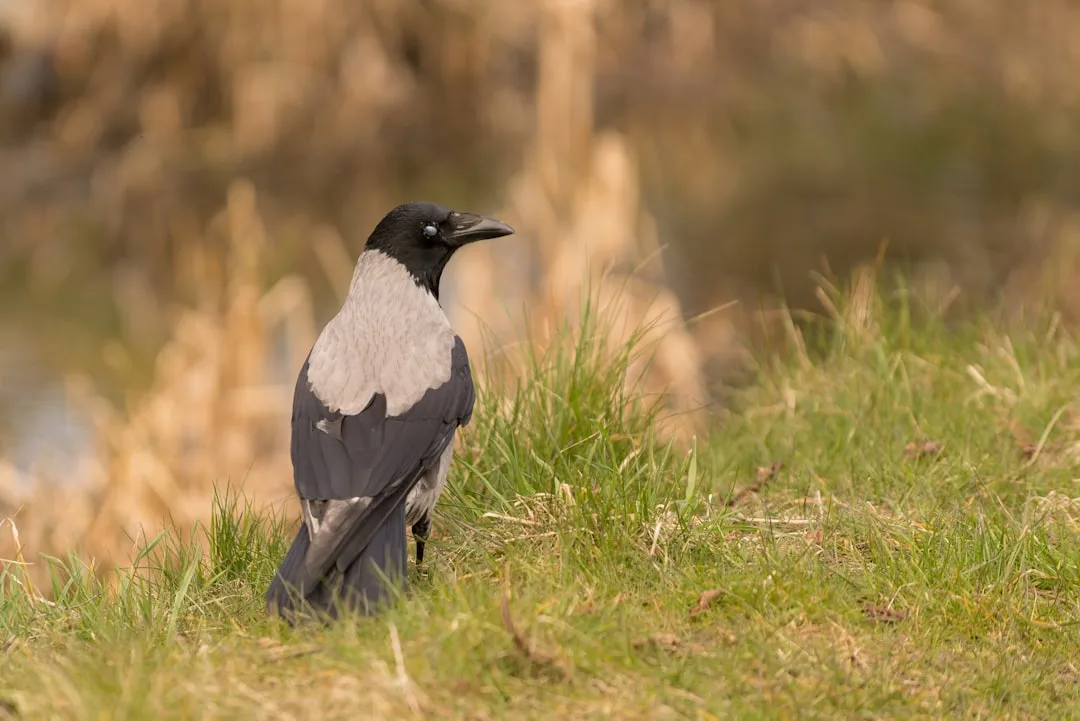
The Eurasian magpie is one of the most intelligent non-human animals on Earth and almost certainly the most intelligent bird that regularly lives within a short flight of a human garden. It is a member of the crow family, Corvidae, and shares that family's near-legendary cognitive toolkit: tool use, planning, cultural learning, and a sense of self that for decades was assumed to belong exclusively to great apes.
Pica pica is the best-known representative of the true magpies and the reason the word 'magpie' appears in so many idioms about thieves, gossips, hoarders, and omens.
This guide covers every major aspect of Eurasian magpie biology, ecology, and behaviour: size and plumage, distribution, diet, breeding, intelligence, self-recognition, cache memory, social behaviour, conservation status, and the complex relationship between magpies and the humans whose settlements they now increasingly share. Expect specifics - grams, centimetres, hectares, clutch sizes, life-history figures - rather than general impressions.
Etymology and Classification
The scientific name Pica pica is a tautonym - genus and species share the same Latin word - introduced by Carl Linnaeus in the tenth edition of Systema Naturae in 1758. Pica is the classical Latin name for the bird, from which the English 'pica' (an eating disorder involving non-food items) also derives, referencing the magpie's reputation for picking up and eating almost anything.
The English word 'magpie' combines 'Mag', a medieval diminutive of Margaret used colloquially for chattering women, with 'pie' from the same Latin pica.
Taxonomically the Eurasian magpie sits in:
- Kingdom: Animalia
- Phylum: Chordata
- Class: Aves
- Order: Passeriformes
- Family: Corvidae
- Genus: Pica
- Species: P. pica
For most of the twentieth century ornithologists lumped all Holarctic magpies into Pica pica. Molecular studies in the 2000s split the group into several species: Pica pica (Eurasian magpie, Europe and temperate Asia), Pica serica (Oriental magpie, East Asia), Pica hudsonia (black-billed magpie, western North America), Pica nuttalli (yellow-billed magpie, endemic to California), and Pica mauritanica (Maghreb magpie, northwest Africa). This entry focuses on the Eurasian species.
Size, Shape, and Plumage
Eurasian magpies are medium-sized corvids with a distinctive silhouette that is easy to recognise even in poor light. The long graduated tail is the single most reliable field mark.
Body metrics:
- Total length: 44-46 cm (roughly half of which is tail)
- Wingspan: 52-62 cm
- Weight: 200-250 g
- Sexual dimorphism: males average slightly heavier, but the difference is too small to sex birds reliably in the field
Plumage pattern:
The coat is commonly described as black-and-white, but this understates the bird considerably. The head, throat, chest, back, and much of the wing are glossy black. The belly, flanks, and a large shoulder patch are clean white. The primary flight feathers are also largely white, which produces a flashing black-and-white strobe effect in flight.
The black areas are not pigment-black in the flat sense. Under direct sunlight the feathers reveal structural iridescence in layers: the wings flash electric blue, the tail glows bottle-green, and the head shows violet tints at the right angle. This iridescence is not produced by pigment but by microscopic keratin lattices in the feather barbules that interfere with specific wavelengths of light.
Young birds show duller, less contrasting plumage and gradually develop full adult iridescence through their first year.
The tail is the most characteristic anatomical feature. In a fit adult it can exceed the body length, each feather longer than the one beside it, producing a graduated wedge. It is used like a rudder and brake, allowing magpies to perform tight turns through dense scrub that would stall a shorter-tailed corvid such as a jackdaw.
Range, Habitat, and Urban Expansion
The Eurasian magpie occupies one of the largest breeding ranges of any Palaearctic passerine. The species is distributed across virtually all of Europe - from Ireland and Portugal east through the Russian boreal zone - across temperate Asia to Japan and Korea, and into parts of northwest Africa. They are not found in Iceland, the far north of Scandinavia, the high Arctic, or the driest central Asian deserts.
Preferred habitats:
- Open woodland with scattered trees and hedges
- Farmland with hedgerows, copses, and rough pasture
- Riverside willow scrub and reedbeds
- Suburban gardens, parks, cemeteries, and allotments
- Urban cores with mature trees and food subsidies
Magpies avoid dense closed-canopy forest because they rely on open ground for foraging and need clear lines of sight to watch for predators. They also avoid the largest, most fragmented industrial landscapes where tree cover is insufficient for nesting.
Urban colonisation has been one of the great ornithological stories of the last half-century. Magpies were historically a bird of open countryside; since the 1970s they have moved into city centres across Europe. Warsaw, Berlin, Paris, Madrid, London, and Istanbul all now host dense urban magpie populations, often at densities several times higher than nearby countryside.
The reasons appear to be a combination of abundant food (refuse, roadkill, pet food, bird tables), mature urban tree cover, reduced persecution (urban populations are not shot at), and tolerance for human proximity. Urban magpies show measurably bolder behaviour, smaller flight-initiation distances, and higher tolerance for noise than their rural counterparts.
Diet and Foraging
Eurasian magpies are among the most flexible omnivores in the temperate zone. Their foraging strategy adjusts to season, location, and individual experience rather than to a narrow dietary specialisation.
Seasonal diet shift:
- Spring: invertebrates dominate - beetles, caterpillars, earthworms, spiders - plus eggs and nestlings of other birds when available
- Summer: continued invertebrates, fruit, soft grain, and small vertebrates (lizards, amphibians, small rodents)
- Autumn: heavy caching of acorns, nuts, seeds, windfall fruit; scavenging increases
- Winter: cached items retrieved; carrion, refuse, and bird-feeder spoils dominate
A typical foraging magpie walks or hops across open ground, probing tufts of grass and flipping leaves with the bill. It uses its strong feet to pin larger prey while dismembering it. Group foraging is common outside the breeding season and offers a numerical advantage: more eyes on the sky, faster predator detection.
| Food category | Approximate share of annual diet |
|---|---|
| Invertebrates | 35-45% |
| Seeds and grain | 15-25% |
| Fruit and berries | 10-15% |
| Carrion and refuse | 10-15% |
| Eggs and nestlings | 3-7% |
| Small vertebrates | 3-5% |
Magpies are widely blamed for declines in songbird populations because their nest raiding is so conspicuous. Long-term work by the British Trust for Ornithology and similar European organisations has repeatedly failed to find a population-level effect. Songbird declines in the UK track habitat loss, pesticide use, and free-ranging cats far more closely than they track magpie density.
Food Caching and Episodic Memory
One of the most intensively studied aspects of magpie behaviour is their autumn caching. A single adult can stash thousands of food items across a home range of tens of hectares, burying each item separately in a scrape, crevice, or tuft of grass, and then retrieving most of them through winter.
Three capabilities make this remarkable:
- Scale. Thousands of separate cache sites over weeks, with overlap avoided.
- Selective retrieval. Magpies preferentially retrieve perishable items (insects, worms) before non-perishable ones (nuts, seeds), suggesting knowledge of food type as well as location.
- Episodic-like memory. Experiments show magpies recall what was cached, where, and when, and integrate those three kinds of information in a single decision. This is the combination Nicola Clayton and colleagues identified as 'episodic-like' in corvids and that was previously considered unique to humans.
Caching is also socially sensitive. A magpie observed by a rival while burying food will often return alone later and move the cache to a new location. Birds that have themselves stolen others' caches are especially likely to re-hide their own - a pattern interpreted as 'it takes a thief to know one' and cited as evidence of perspective-taking.
Intelligence and the Mirror Test
The single most famous scientific result about magpies is the 2008 study by Helmut Prior, Ariane Schwarz, and Onur Gunturkun at Goethe University Frankfurt, published in PLOS Biology. Five magpies were fitted with coloured stickers placed on a spot on the throat that was only visible via a mirror. Three of the five used the mirror to locate and attempt to remove the sticker - the classic mark test criterion for self-recognition.
Before this study, mirror self-recognition had been demonstrated reliably only in great apes, bottlenose dolphins, Asian elephants, and (subsequently) a handful of other species. Magpies were the first non-mammals to pass, and the result was striking because corvid brains lack the neocortex that had been assumed necessary for the capability.
The magpie result helped reshape neurobiology: it became clear that the avian pallium, organised very differently from the mammalian cortex, supports equivalent cognitive functions.
Beyond the mirror test, laboratory and field studies have shown Eurasian magpies performing:
- Multi-step problem solving to access food behind barriers
- Tool use in captivity, including the use of sticks to rake items within reach
- Simple numerical discrimination up to around five items
- Future-oriented planning via selective caching
- Social learning and cultural transmission of foraging techniques
- Long-term individual recognition of humans and other magpies
The overall pattern is of a species operating at a cognitive level comparable to, though not identical to, New Caledonian crows and common ravens.
Social Behaviour and Mobbing
Magpies are social throughout the year, though the nature of their groups changes with the season. Established breeding pairs defend territories and spend most of their time as couples. Non-breeders form loose flocks of a few dozen birds that roam larger areas and gather communally at night roosts. These flocks are the main source of future territorial pairs: young birds pair up within the flock and take over territories opportunistically.
Mobbing is one of the most visible magpie behaviours. When a group detects a predator - cat, fox, sparrowhawk, owl, domestic dog, even humans near a nest - several birds gather, call loudly with harsh chattering alarms, and coordinate attacks from multiple angles. Larger predators are swooped at without contact; smaller threats are physically struck.
Neighbouring pairs frequently join, and mobbing groups can reach a dozen or more birds. The tactic serves both to drive the threat off and to teach younger birds which species to fear.
Gatherings around dead flockmates have been reported frequently enough across Europe, East Asia, and North America (in sister species) to count as a genuine species-level behaviour rather than scattered anecdote.
Accounts share a common pattern: one bird discovers the body, calls repeatedly, draws others in, the group approaches cautiously with specific soft vocalisations, and after several minutes to an hour some birds depart while others occasionally place a twig or grass stem beside the body.
Researchers interpret the behaviour variously as threat assessment (learning about the environment that killed the bird), social acknowledgement, or both. Whatever the interpretation, the behaviour is consistent enough that it deserves the descriptive name it has acquired: a magpie funeral.
Breeding and Nest Architecture
Magpies pair monogamously, usually for life, and hold the same territory across multiple years. Territory sizes range from around two hectares in productive farmland up to ten or more hectares in marginal habitat.
Breeding timeline:
- Late winter: pair bonds re-establish, courtship displays
- February-March: nest construction or renovation
- March-April: egg laying (5-8 eggs typical, range 3-10)
- Incubation: 17-22 days, female only
- Nestling period: 24-30 days
- Post-fledging dependence: 4-8 weeks
- Independence: by late summer in most pairs
Magpie nests are unusually elaborate for a songbird. A typical nest is a large spherical or oval structure up to 70 cm across, built of thorny twigs on the outside, lined with mud and finer material inside, and topped with a domed roof of interlaced thorns.
Most nests feature two entrances: a principal opening used routinely, and a secondary exit on the opposite side used only as an emergency escape route when a predator arrives at the main entrance. The roof defends against aerial predators - crows, raptors, owls - that would otherwise reach into an open cup nest.
Pairs frequently reuse and expand the same nest across years. An old magpie nest can exceed a metre in diameter and weigh several kilograms after accumulated additions. Other species - small owls, falcons, even squirrels - exploit abandoned magpie nests as ready-made shelters.
Lifespan, Mortality, and Demography
Typical wild lifespan is three to five years. First-year mortality is high, with roughly sixty per cent of fledglings lost within the first twelve months to starvation, raptor predation, cats, road collisions, and disease. Birds that reach adulthood face much lower annual mortality and can live ten to fifteen years in good conditions. Captive magpies sheltered from predation, road traffic, and weather have exceeded twenty years.
| Life stage | Typical annual mortality |
|---|---|
| Egg to fledgling | 30-50% |
| Fledgling year | 50-60% |
| Adult (year 2+) | 20-30% |
| Senescent | rising with age |
The species' reproductive strategy - large clutches, biparental care, long pair bonds, stable territories - is well suited to this pattern of heavy early mortality followed by long adult tenure. A successful pair can produce several dozen surviving offspring across a breeding career of a decade or more.
Conservation Status
The IUCN Red List classifies Pica pica as Least Concern. The global population is estimated in the tens of millions and is stable or increasing in most of Europe. BirdLife International reports no major threats at the species level, although local populations can fluctuate with land use, persecution, and climate.
Known pressures:
- Gamekeeper and farmer persecution in parts of the UK and continental Europe, where magpies are still legally controlled as nest predators in certain jurisdictions
- Pesticides reducing invertebrate prey in intensively farmed landscapes
- Road mortality, particularly where birds scavenge carrion on fast roads
- Emerging infectious diseases including West Nile virus in parts of the range
Despite these pressures, the overall trajectory is positive. Urbanisation has favoured magpies rather than harmed them, and the species is expanding into some regions (parts of Ireland, Scandinavia) where it was previously scarce.
Magpies and Humans
Few wild birds have accumulated as much cultural baggage as the magpie. In the United Kingdom and Ireland the bird is traditionally an omen of sorrow when encountered alone - the rhyme 'One for sorrow, two for joy, three for a girl, four for a boy' is probably the best-known British bird superstition. Folk practices of saluting the magpie, greeting it politely, or turning away to avoid bad luck are still alive enough to be mentioned regularly in casual conversation.
Chinese and Korean traditions take the opposite view. The magpie is a symbol of joy, good news, marital happiness, and good fortune. It appears on Chinese New Year paintings, Korean folk art, and as a national bird symbol in South Korea. The same black-and-white plumage read as funereal in the British Isles is read as auspicious across East Asia.
The 'thieving magpie' stereotype - a bird that steals shiny objects - is embedded deeply enough in western culture to have given Rossini an opera (La gazza ladra). Recent controlled experiments at the University of Exeter failed to find any significant magpie attraction to shiny objects beyond mild curiosity, and in many cases the birds were actively wary of reflective items. The stereotype appears to be cultural rather than behavioural.
Modern relationships with humans are dominated by the urban expansion described earlier. Magpies have learned to recognise individual human faces. Field experiments in Seoul and elsewhere show magpies scolding and dive-bombing specific people who had previously handled nestlings, while ignoring others nearby, and maintaining the recognition for years. The same capacity makes them tolerant and even semi-familiar with regular park visitors who feed them.
Related Reading
- Corvid Intelligence: The Smartest Birds on Earth
- Common Raven: Mythology and Mind
- How Birds Remember Thousands of Food Caches
- Urban Wildlife: Animals That Thrive in Cities
References
Peer-reviewed and institutional sources consulted for this entry include Prior, H., Schwarz, A., and Gunturkun, O.
(2008) 'Mirror-induced behavior in the magpie (Pica pica): evidence of self-recognition', PLOS Biology 6(8), e202; Clayton, N.S. and Dickinson, A. on episodic-like memory in corvids; long-running surveys by the British Trust for Ornithology and the European Bird Census Council; BirdLife International species factsheets; the IUCN Red List assessment for Pica pica; and ethological work by Marc Bekoff and others on post-mortem behaviour in corvids.
Frequently Asked Questions
How intelligent are magpies?
Eurasian magpies are among the most intelligent birds ever studied. Their brain-to-body ratio rivals that of great apes, and they consistently perform at corvid level on cognitive tasks. The 2008 Prior study at Goethe University showed magpies passing the mirror self-recognition test - a benchmark previously passed only by great apes, dolphins, Asian elephants, and one magpie species.
In laboratory settings magpies solve multi-step food puzzles, plan for the future by caching food in locations they will revisit, discriminate small numerical quantities, and show episodic-like memory for what, where, and when events occurred. Field studies add social intelligence: individual face recognition, cooperative mobbing, and cultural transmission of behaviours between neighbours.
Do magpies really have funerals?
The behaviour is real, though ‘funeral’ is the popular word rather than the scientific one. Ethologist Marc Bekoff and several European field teams have documented repeated cases in which magpies gather around a dead conspecific, call with specific alarm and distress vocalisations, approach and then retreat, and - in a fraction of cases - place small twigs, grass stems, or leaves near the body before departing.
Interpretations range from risk assessment (learning about dangers that killed the bird) to social acknowledgement of loss. What is not disputed is that magpies respond to dead flockmates differently from the way they respond to dead strangers or other dead animals, and that the behaviour is consistent enough to be called a ritual in the descriptive sense.
Where do magpies live?
The Eurasian magpie occupies a huge range that stretches from Ireland and Spain eastward across Europe and temperate Asia to Korea and Japan, and south into northwest Africa. They avoid dense closed forests and extreme deserts but thrive almost everywhere else: farmland hedges, open woodland, riverside scrub, suburban gardens, and dense urban cores. City populations have expanded sharply over the last fifty years.
Magpies are resident birds - they do not migrate - and individuals typically spend their entire adult lives within a few kilometres of their birth site. Separate but closely related species (Pica hudsonia, Pica nuttalli, Pica serica) occupy parts of North America and East Asia.
What do magpies eat?
Magpies are true omnivores and adjust their diet aggressively to local conditions. In spring and summer they eat mostly invertebrates - beetles, caterpillars, spiders, earthworms, grasshoppers - supplemented by small vertebrates, eggs, and nestlings of other birds. In autumn they shift toward seeds, grain, acorns, berries, and fallen fruit, caching thousands of items for winter retrieval.
Year-round they scavenge carrion on roadsides and will exploit human food waste, compost piles, pet food, and bird feeders. Their reputation as nest robbers is accurate but often overstated: studies in the United Kingdom found no evidence that magpie predation caused declines in songbird populations overall.
Are magpies dangerous to other birds?
Magpies opportunistically raid nests for eggs and chicks, and this behaviour is visible enough to generate complaints from gardeners and songbird enthusiasts. Large-scale studies by the British Trust for Ornithology and others have repeatedly failed to find a population-level effect of magpie predation on common garden birds. Habitat loss, pesticides, cats, and collisions cause far greater declines.
Within their own communities magpies mob raptors, corvids, and ground predators with enough intensity to genuinely drive them off, which can indirectly protect smaller species nesting nearby.
How long do magpies live?
Typical wild Eurasian magpies live only three to five years. First-year mortality is high - roughly sixty per cent of fledglings do not survive their first winter. Causes include predation by raptors and cats, starvation, road collisions, and disease. Birds that survive to adulthood can reach ten to fifteen years in the wild under favourable conditions, and captive magpies have lived beyond twenty years.
Breeding pairs are usually monogamous and can hold the same territory together for many years, refreshing and expanding the same nest site across seasons.
Why are magpies associated with bad luck?
The superstition is primarily British and Irish and is encoded in the rhyme ‘One for sorrow, two for joy’. A single magpie is traditionally considered an omen of bad fortune, and folk remedies involve saluting the bird, greeting it politely, or acknowledging ‘Good morning, Mr. Magpie’.
The negative association likely grew from the bird’s black-and-white plumage (read as funereal), its reputation as a thief, its loud chattering calls, and its willingness to scavenge near death and carrion. The association is far from universal: in Chinese and Korean cultures magpies are considered symbols of joy, good luck, and marital happiness, and Chinese New Year paintings routinely feature magpies as bearers of good news.
Can magpies really count?
Within limits, yes. Controlled experiments have shown that Eurasian magpies and other corvids can discriminate between small sets of objects - for example, choosing a tray with four pieces of food over a tray with three - and can maintain the discrimination when the total number of items is hidden, suggesting numerical rather than surface-area-based judgement.
The effective ceiling is around five items, consistent with the subitising range observed in primates and human infants. These results are part of a broader pattern showing corvid cognition converging on primate-level performance in many domains despite vastly different brain architecture.