
How powerful was the bite force of Tyrannosaurus rex?
T. rex possessed the most powerful bite of any land animal that ever lived, generating approximately 12,800 pounds of force - roughly equivalent to the weight of a large African elephant concentrated on a single tooth. Biomechanical modeling published in Scientific Reports (2019) confirmed this figure, showing that T.
For 165 million years, dinosaurs dominated every terrestrial ecosystem on the planet. They ranged from chicken-sized predators to lumbering titans heavier than a fleet of commercial aircraft. They evolved armor plating, bone-crushing jaws, hollow skeletons optimized for speed, and - as we now know with certainty - feathers.
Their reign spanned three geological periods, survived multiple extinction pulses, and produced a lineage that persists to this day in the form of roughly 10,000 species of living birds.
Understanding dinosaurs is not a matter of childhood fascination alone. Dinosaur paleontology sits at the intersection of geology, evolutionary biology, biomechanics, and climate science. Every major fossil discovery reshapes our understanding of how life on Earth responds to environmental catastrophe, how body plans scale, and how ecosystems assemble and collapse.
What follows is a thorough examination of the major groups, the key discoveries, and the scientific debates that continue to define this field.
The Mesozoic Era: Three Periods, One Dynasty
The Mesozoic Era - often called the "Age of Reptiles" - spans approximately 252 to 66 million years ago and is divided into three periods: the Triassic, Jurassic, and Cretaceous. Each period shaped dinosaur evolution in distinct ways.
The Triassic Period (252-201 Million Years Ago)
The Triassic began in the aftermath of the Permian-Triassic extinction, the most devastating mass extinction in Earth's history, which eliminated roughly 90 percent of all marine species and 70 percent of terrestrial vertebrate species. Life was rebuilding. The supercontinent Pangaea was still intact, and global climates were hot and largely arid.
The first dinosaurs appeared in the Middle to Late Triassic, around 230 to 240 million years ago. Early forms like Eoraptor and Herrerasaurus, both discovered in the Ischigualasto Formation of Argentina, were small, bipedal predators no larger than a medium-sized dog. They coexisted with - and were often overshadowed by - other archosaur groups, including pseudosuchians (the ancestors of modern crocodilians), which were the dominant terrestrial predators of the period.
Dinosaurs did not dominate the Triassic. They were bit players in a world ruled by other reptilian lineages. Their ascendancy came only after the Triassic-Jurassic extinction event (approximately 201 million years ago), which eliminated many competing groups and opened ecological niches that dinosaurs rapidly filled.
The Jurassic Period (201-145 Million Years Ago)
The Jurassic was the period of dinosaur diversification. Pangaea began to break apart, opening seaways that altered ocean currents and global climate. Temperatures were warm and relatively stable, and extensive forests of conifers, ferns, and cycads covered much of the land surface.
This was the era of the great sauropods - Brachiosaurus, Diplodocus, Apatosaurus - long-necked herbivores that reached staggering sizes. It was also the period that produced iconic predators like Allosaurus, a 9-meter-long carnivore that was the apex predator of Late Jurassic North America. Stegosaurs, with their distinctive dorsal plates, thrived during this period, and the first birds appeared near its close.
The Cretaceous Period (145-66 Million Years Ago)
The Cretaceous was the longest and final period of the Mesozoic, and it witnessed the peak of dinosaur diversity. Flowering plants (angiosperms) evolved and diversified, fundamentally transforming terrestrial ecosystems. Continental drift had separated the landmasses into configurations approaching their modern positions, leading to increased regional specialization among dinosaur faunas.
The Cretaceous produced the most famous dinosaurs of all: Tyrannosaurus rex, Triceratops, Velociraptor, Spinosaurus, and the titanosaur sauropods. It ended abruptly 66 million years ago with the Cretaceous-Paleogene (K-Pg) extinction event, the asteroid impact that wiped out all non-avian dinosaurs and approximately 75 percent of all species on Earth.
Tyrannosaurus Rex: The Tyrant King
No dinosaur occupies the public imagination like Tyrannosaurus rex. And for once, the popular reputation is largely justified by the science. T. rex was one of the most formidable predators in the history of terrestrial life.
Anatomy of a Predator
An adult T. rex measured approximately 12 to 13 meters in length, stood roughly 4 meters at the hip, and weighed between 8 and 14 metric tons depending on the specimen and estimation method. Its skull alone was over 1.5 meters long and built to withstand extraordinary mechanical stress.
The defining feature was its bite. Biomechanical studies published in Scientific Reports (2019) calculated that T. rex could generate a bite force of approximately 12,800 pounds (roughly 57,000 Newtons) - the most powerful bite of any terrestrial animal in the fossil record. This is not merely a strong bite; it is a fundamentally different category of feeding.
T. rex practiced osteophagy, the ability to bite through and digest solid bone, as evidenced by coprolites (fossilized feces) containing pulverized bone fragments. No living terrestrial predator can replicate this.
T. rex also possessed binocular vision. The forward-facing position of its eyes gave it overlapping visual fields, enabling stereoscopic depth perception - a trait associated with active predation rather than scavenging. CT scans of T. rex braincases have revealed large olfactory bulbs, indicating an acute sense of smell comparable to that of modern vultures, and substantial optic lobes suggesting strong visual processing.
The Scavenger vs. Predator Debate
For over two decades, the question of whether T. rex was an active predator or an obligate scavenger provoked one of paleontology's most public debates. The scavenger hypothesis was most prominently championed by Jack Horner, who argued that the animal's small arms, massive size, and slow estimated running speed were inconsistent with active pursuit predation.
"I've always thought T. rex was too big, too slow, and too conspicuous to have been an effective predator. The evidence is much more consistent with a dedicated scavenging lifestyle." - Jack Horner, interview with Smithsonian Magazine (2011)
The scientific consensus has largely moved against the pure scavenger hypothesis. While T. rex almost certainly scavenged when the opportunity arose - as virtually all large predators do - multiple lines of evidence support active predation.
These include healed bite marks on the tails and vertebrae of hadrosaurs (duck-billed dinosaurs) that the prey animal survived, indicating an attack on a living animal; the binocular vision mentioned above; and ecological modeling showing that the Cretaceous landscapes of western North America could not have supported an animal of T. rex's metabolic requirements through scavenging alone.
The current consensus is that T. rex was an opportunistic apex predator that both hunted and scavenged, similar in ecological role to modern spotted hyenas or large crocodilians.
Sue: The Most Complete Skeleton
The most complete T. rex skeleton ever found is FMNH PR 2081, known as "Sue," discovered on August 12, 1990, by fossil hunter Sue Hendrickson on the Cheyenne River Sioux reservation in South Dakota. The specimen is approximately 90 percent complete - an extraordinary figure for a large theropod.
Sue's discovery triggered a prolonged legal battle over ownership between Hendrickson's employer (the Black Hills Institute), the landowner (Maurice Williams), and the federal government. In 1997, after the courts ruled in favor of Williams, the specimen was auctioned at Sotheby's in New York for $8.36 million - at the time, the highest price ever paid for a fossil.
The Field Museum of Natural History in Chicago, backed by corporate sponsors including McDonald's and Disney, acquired the specimen. Sue went on permanent display in 2000 and was moved to a dedicated private suite on the museum's second floor in 2018.
Analysis of Sue revealed that the animal was approximately 28 years old at death and had suffered from gout, broken ribs, a torn tendon in the right arm, and a parasitic infection of the lower jaw. These pathologies provide an extraordinary window into the life history of a single individual that lived 67 million years ago.
Argentinosaurus: The Largest Land Animal That Ever Lived
If T. rex represents the apex of predatory evolution, the titanosaur sauropods represent the apex of vertebrate body mass. The leading candidate for the heaviest land animal in Earth's history is Argentinosaurus huinculensis, a titanosaur from the Late Cretaceous of Argentina.
Argentinosaurus is known from a fragmentary but deeply impressive set of remains: several dorsal vertebrae, a tibia, fragmentary ribs, and a sacrum. Individual vertebrae measure over 1.5 meters in height. Based on these elements and comparison with more complete titanosaur skeletons, Argentinosaurus is estimated to have reached 30 to 40 meters in length and weighed between 70 and 80 metric tons - roughly equivalent to 12 African elephants.
The biomechanics of an animal this size stretch the known limits of terrestrial vertebrate biology. Locomotion modeling suggests Argentinosaurus moved at a slow walk of approximately 8 km/h, with a stride length of about 2.5 meters.
Its cardiovascular system would have required a heart capable of generating enormous blood pressure to push oxygenated blood up through a neck that may have been held at moderate elevation. Sauropod bones contain extensive pneumatic (air-filled) chambers that reduced weight without sacrificing structural integrity - an engineering solution analogous to the hollow construction of modern aircraft wings.
A more recently discovered titanosaur, Patagotitan mayorum (described in 2017), is known from a more complete skeleton and provides an estimated mass of approximately 69 metric tons. The competition for "largest dinosaur" remains active, with new discoveries from Argentina and other southern hemisphere sites regularly entering the debate.
Velociraptor: Hollywood Fiction vs. Fossil Reality
No dinosaur has been more thoroughly misrepresented in popular culture than Velociraptor mongoliensis. The Jurassic Park franchise depicted it as a 2-meter-tall, scaly, hyper-intelligent pack hunter. The reality is considerably different - and in many ways, more interesting.
True Size and Appearance
A real Velociraptor stood approximately 0.5 meters tall at the hip, measured about 2 meters from nose to tail tip, and weighed roughly 15 to 20 kilograms - about the size of a large turkey. Crucially, Velociraptor was almost certainly feathered.
In 2007, paleontologists Turner, Makovicky, and Norell published a description of quill knobs on the ulna (forearm bone) of a Velociraptor specimen - the same bony attachment points for flight feathers found in modern birds. The animal could not fly, but it was covered in a coat of feathers that likely served thermoregulatory and display functions.
The raptors in Jurassic Park were actually modeled on Deinonychus antirrhopus, a considerably larger dromaeosaurid from Early Cretaceous North America that measured roughly 3.4 meters long. Author Michael Crichton used the name Velociraptor because he considered it more dramatic.
The Pack Hunting Debate
The idea that dromaeosaurids hunted in coordinated packs, as depicted in Jurassic Park, remains unresolved. The famous "Fighting Dinosaurs" specimen from Mongolia - a Velociraptor locked in combat with a Protoceratops - preserves a one-on-one encounter, not a group attack.
Some bonebeds contain multiple dromaeosaurid individuals associated with single prey items, but this could indicate mob feeding (as seen in modern Komodo dragons) rather than cooperative hunting (as seen in wolves). The distinction is important: mob feeding requires no social coordination, while true pack hunting requires communication, role differentiation, and shared intent.
Spinosaurus: The River Monster
Spinosaurus aegyptiacus holds the title of the largest carnivorous dinosaur ever discovered, exceeding T. rex in total body length. Estimated at 14 to 18 meters long and weighing 7 to 9 metric tons, Spinosaurus was a genuinely bizarre animal - and its story of discovery and rediscovery is one of the most dramatic in paleontology.
A Troubled Fossil History
The original Spinosaurus fossils were collected in Egypt in 1912 by the German paleontologist Ernst Stromer and described in 1915. These specimens were housed in the Bavarian State Collection in Munich until April 24, 1944, when an Allied bombing raid destroyed the museum and the fossils with it. For decades, Spinosaurus was known only from Stromer's drawings and descriptions.
The animal was resurrected in dramatic fashion in 2014 when Nizar Ibrahim, a Moroccan-German paleontologist, tracked down a partial skeleton in the Kem Kem beds of Morocco. Ibrahim's reconstruction, published in Science, revealed that Spinosaurus was unlike any theropod previously known: it had shortened hind limbs, dense bones (rare in theropods, but common in aquatic animals for ballast), paddle-like feet, and a tall dorsal sail formed by neural spines reaching up to 1.65 meters in height.
Aquatic Adaptations
Subsequent research, including a 2020 study of the tail, revealed that Spinosaurus possessed a broad, fin-like tail capable of generating propulsive force in water - the first direct evidence of swimming locomotion in a large theropod dinosaur. Its elongated, crocodile-like snout contained conical teeth suited to gripping fish rather than slicing flesh, and isotopic analysis of its tooth enamel confirmed a diet heavy in aquatic prey.
Spinosaurus was, in effect, a dinosaurian analogue to a giant crocodile - a semi-aquatic apex predator of Cretaceous North African river systems. Nothing like it had been seen before in the theropod fossil record.
Triceratops: The Three-Horned Face
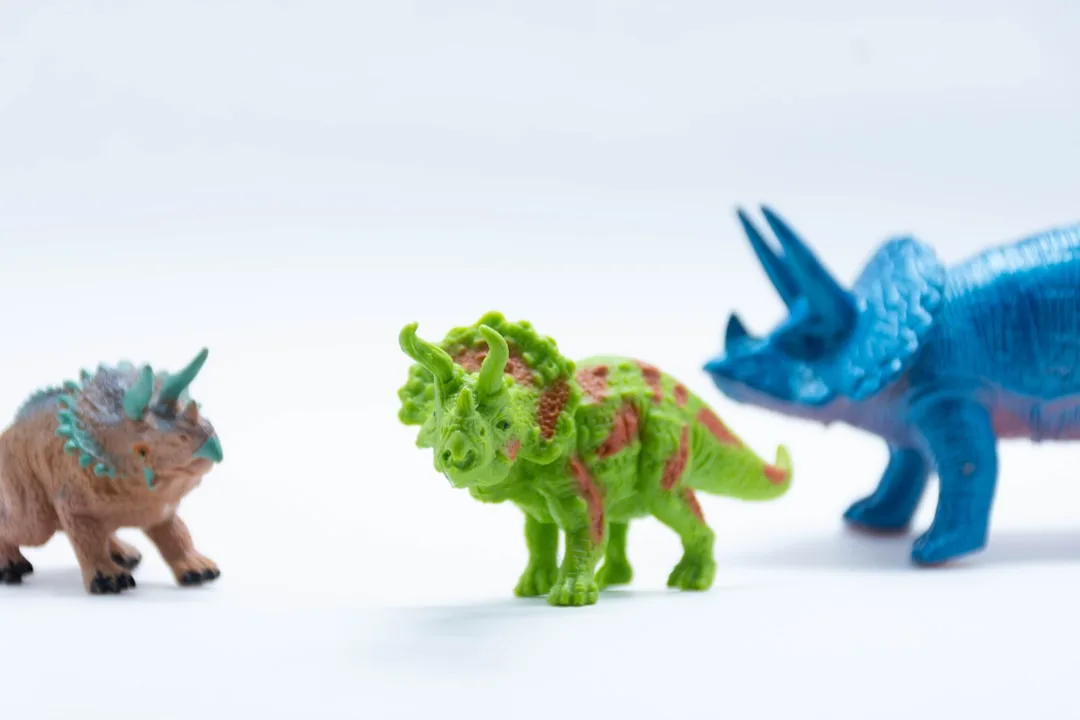
Triceratops horridus is one of the most recognizable dinosaurs, instantly identified by its three facial horns and massive bony frill. An adult Triceratops measured approximately 9 meters long, stood 3 meters tall, and weighed up to 12 metric tons.
Frill Function
The function of the Triceratops frill has been debated since the animal was first described in 1889 by O.C. Marsh. Three primary hypotheses have been proposed: defense against predators, thermoregulation via blood vessels running through the frill's bony surface, and species recognition or sexual display.
The frill was relatively thin bone in many areas and would have been vulnerable to a direct T. rex bite, which argues against a purely defensive function. The most widely accepted current interpretation is that the frill served primarily for intraspecific display and recognition, with secondary functions in thermoregulation and some degree of passive protection.
Horn Combat Evidence
Fossil evidence strongly supports the idea that Triceratops used its horns in combat with members of its own species. A 2009 study by Andrew Farke and colleagues examined 400 Triceratops skulls and found that nearly 15 percent showed healed lesions on the squamosal bone of the frill - precisely the location predicted by models of horn-to-frill combat between rival individuals.
These lesions were significantly more common in Triceratops than in the related ceratopsian Centrosaurus, which had a different horn configuration, suggesting that horn morphology directly influenced fighting style.
Stegosaurus: Plates, Spikes, and the "Walnut Brain" Myth
Stegosaurus stenops, the plated dinosaur of the Late Jurassic, weighed approximately 5 metric tons and measured 9 meters in length. Its two rows of alternating dorsal plates and the four tail spikes (collectively known as the "thagomizer," a term that originated in a 1982 Gary Larson Far Side cartoon and was subsequently adopted by paleontologists) are among the most distinctive anatomical features of any dinosaur.
The Brain Size Myth
Stegosaurus is often cited as having a brain "the size of a walnut." This is misleading. The brain of Stegosaurus was small relative to its body size - its endocast (the cavity inside the braincase) had a volume of roughly 80 milliliters, about the size of a large lime rather than a walnut.
More importantly, relative brain size (the encephalization quotient) is a poor predictor of behavioral complexity in non-mammalian vertebrates. Modern crocodilians have low encephalization quotients but display complex social behaviors including parental care and coordinated hunting. The idea that Stegosaurus was exceptionally "stupid" even by dinosaur standards is an oversimplification.
An older myth held that Stegosaurus possessed a "second brain" in its hip region - an enlarged neural canal in the sacrum that was interpreted as auxiliary neural tissue to control the rear half of the body. This idea has been thoroughly debunked. The enlargement likely housed a glycogen body similar to that found in modern birds, which serves as an energy reserve for the nervous system rather than functioning as a supplementary brain.
Plate Thermoregulation
The dorsal plates of Stegosaurus were not solid bone but were covered in a keratinous sheath and permeated by blood vessels. Experimental modeling and CT analysis suggest the plates functioned primarily as thermoregulatory structures, allowing the animal to dump excess body heat by flushing blood through the vascular network in the plates - essentially acting as biological radiators.
A secondary display function is also probable, as the plates would have been visually prominent and potentially flushed with color during social interactions.
Dinosaur-Bird Evolution: Feathers, Flight, and Living Dinosaurs
The evolutionary relationship between dinosaurs and birds is no longer a hypothesis. It is one of the most thoroughly documented transitions in the entire vertebrate fossil record.
Archaeopteryx and the First Evidence
The story begins with Archaeopteryx lithographica, discovered in 1861 in the Solnhofen limestone of Bavaria, Germany - just two years after Darwin published On the Origin of Species. Archaeopteryx possessed a mosaic of reptilian features (teeth, a bony tail, clawed fingers) and avian features (flight feathers, a wishbone). It was immediately recognized as a transitional form, and it remains one of the most important fossils ever discovered.
Feathered Dinosaurs of Liaoning
The modern revolution in understanding the dinosaur-bird connection came from China's Liaoning Province in the 1990s and 2000s.
Exceptional preservation conditions in volcanic lake sediments yielded a series of fossils that transformed the field: Sinosauropteryx (1996), the first non-avian dinosaur found with preserved feather-like structures; Microraptor (2003), a four-winged dromaeosaurid with flight feathers on both its arms and legs; and Yutyrannus (2012), a 9-meter-long tyrannosaur relative covered in filamentous feathers, demonstrating that even large theropods could be feathered.
Birds ARE Dinosaurs
In cladistic taxonomy, birds are not merely "descended from" dinosaurs. They are dinosaurs - specifically, they are members of the theropod clade Maniraptora, nested within the broader group Coelurosauria. The phylogenetic evidence is overwhelming: birds share with their non-avian theropod relatives hollow bones, a furcula (wishbone), a backwards-pointing pubis, feathered body covering, and dozens of other derived skeletal features.
"Birds are not just closely related to dinosaurs - they are dinosaurs. Every time you look at a pigeon or a sparrow, you are looking at a small, feathered dinosaur." - Mary Schweitzer, paleontologist, North Carolina State University
The implication is striking: dinosaurs did not go entirely extinct 66 million years ago. Approximately 10,000 species of avian dinosaurs survive today, making them the most species-rich class of terrestrial vertebrates after fish and insects.
The Warm-Blooded vs. Cold-Blooded Debate
For most of the 20th century, dinosaurs were depicted as sluggish, cold-blooded (ectothermic) animals - giant reptiles limited by their inability to regulate internal body temperature. This view has been substantially revised.
Multiple lines of evidence now support the conclusion that many dinosaurs were endothermic or mesothermic (maintaining elevated body temperatures through internal metabolic processes, either fully or partially):
- Bone histology: Dinosaur long bones show fibrolamellar bone tissue with dense Haversian canal systems, indicating rapid growth rates comparable to those of modern mammals and birds, not the slow, seasonal growth rings typical of ectotherms.
- Isotopic analysis: Oxygen isotope ratios in dinosaur teeth and eggshells suggest body temperatures in the range of 36 to 40 degrees Celsius for many species - squarely in the mammalian and avian range.
- Posture and locomotion: The erect, parasagittal limb posture of dinosaurs (legs held directly beneath the body) is energetically demanding and associated with endothermy in all living animals that display it.
- Polar dinosaurs: Fossil dinosaurs have been found at paleolatitudes within the Arctic and Antarctic circles, where even Mesozoic climates would have experienced prolonged darkness and cool temperatures incompatible with purely ectothermic physiology.
- Growth rates: Histological studies of bone growth lines indicate that large sauropods reached adult size in 15 to 30 years - far too fast for ectothermic metabolism to support.
The emerging consensus is that dinosaur thermoregulation was varied. Small theropods and ornithischians were likely fully endothermic. Large sauropods may have been gigantotherms - animals whose sheer body mass retained heat so effectively that active metabolic regulation was unnecessary. The old image of the slow, cold-blooded dinosaur is, by and large, dead.
Comparison of Notable Dinosaur Species
| Species | Period | Length | Weight | Diet | Key Feature |
|---|---|---|---|---|---|
| Tyrannosaurus rex | Late Cretaceous | 12-13 m | 8-14 tons | Carnivore | 12,800-lb bite force |
| Argentinosaurus | Late Cretaceous | 30-40 m | 70-80 tons | Herbivore | Largest land animal |
| Velociraptor | Late Cretaceous | 2 m | 15-20 kg | Carnivore | Feathered, sickle claw |
| Spinosaurus | Late Cretaceous | 14-18 m | 7-9 tons | Piscivore | Semi-aquatic, dorsal sail |
| Triceratops | Late Cretaceous | 9 m | 12 tons | Herbivore | Three horns, bony frill |
| Stegosaurus | Late Jurassic | 9 m | 5 tons | Herbivore | Dorsal plates, thagomizer |
| Archaeopteryx | Late Jurassic | 0.5 m | 0.5-1 kg | Carnivore | Transitional bird-dinosaur |
| Brachiosaurus | Late Jurassic | 22 m | 56 tons | Herbivore | Elevated neck posture |
The K-Pg Extinction: The Day the Dinosaurs Died
The Cretaceous-Paleogene (K-Pg) extinction event, 66 million years ago, was not the largest mass extinction in Earth's history, but it is the most thoroughly studied and the most dramatic in its implications. It ended the 165-million-year reign of the non-avian dinosaurs and cleared the ecological stage for the rise of mammals.
The Chicxulub Impact
The cause is now well established. An asteroid approximately 10 to 15 kilometers in diameter struck what is now the Yucatan Peninsula of Mexico, creating the Chicxulub crater - a structure roughly 180 kilometers in diameter. The impact released energy equivalent to approximately 10 billion Hiroshima bombs.
The immediate effects were catastrophic. The impact generated a megatsunami with waves estimated at 100 meters or more in height. Ejecta launched into the atmosphere re-entered at high velocity, heating the upper atmosphere to the point where infrared radiation at ground level may have been sufficient to ignite wildfires across much of North America and possibly globally.
Soot and sulfate aerosols injected into the stratosphere blocked sunlight for months to years, collapsing photosynthesis and plunging the planet into a prolonged period sometimes described as a "nuclear winter."
The Scale of Destruction
Approximately 75 percent of all species on Earth went extinct in the aftermath. All non-avian dinosaurs perished. So did the pterosaurs (flying reptiles), the mosasaurs and plesiosaurs (marine reptiles), the ammonites (shelled cephalopods), and most planktonic foraminifera.
The pattern of survival is instructive: organisms that could shelter underground, survive on detritus, or tolerate prolonged darkness and cold were disproportionately likely to survive. Small body size was a strong predictor of survival. No terrestrial animal weighing more than approximately 25 kilograms is known to have survived the extinction boundary.
The Deccan Traps Controversy
A minority of researchers have argued that massive volcanic eruptions in the Deccan Traps of India, which were occurring simultaneously with the asteroid impact, were a significant contributing factor or even the primary cause of the extinction. The Deccan eruptions released enormous quantities of sulfur dioxide and carbon dioxide over a period of approximately 800,000 years spanning the K-Pg boundary.
Current evidence suggests a combined model: the Deccan volcanism stressed global ecosystems over an extended period, and the Chicxulub impact delivered the killing blow to a biosphere already under pressure.
The Ongoing Revolution
Dinosaur paleontology is not a settled field. Major discoveries occur annually, and computational techniques - from CT scanning to finite element analysis to molecular paleontology - continue to extract new information from existing specimens.
Mary Schweitzer's discovery of soft tissue preservation in a 68-million-year-old T. rex femur in 2005 upended the assumption that no original biological material could survive fossilization over such timescales. Her work has been both revolutionary and controversial.
"The finding was so unexpected that I think many people initially assumed there had to be contamination. But we've replicated it now in multiple specimens. The chemistry is consistent with original biological material." - Mary Schweitzer, interview with Discover Magazine (2006)
New species are described at a rate of roughly 50 per year, with particularly productive excavation sites in China, Argentina, Morocco, and the western United States. The image of the dinosaur has transformed radically in the last three decades - from sluggish, tail-dragging lizards to active, feathered, warm-blooded animals that were every bit as dynamic and diverse as the mammals that replaced them.
The story of the dinosaurs is, ultimately, a story about the contingency of life on Earth. For 165 million years, they were the dominant large animals on every continent. Their removal required nothing less than the impact of a celestial body the size of a mountain. And even then, they did not entirely disappear. The sparrows outside your window are living proof.
References
[1] Brusatte, S.L., et al. "The Origin and Diversification of Dinosaurs." Current Biology, vol. 20, no. 13, 2010, pp. R588-R597.
[2] Schulte, P., et al. "The Chicxulub Asteroid Impact and Mass Extinction at the Cretaceous-Paleogene Boundary." Science, vol. 327, no. 5970, 2010, pp. 1214-1218.
[3] Ibrahim, N., et al. "Semiaquatic Adaptations in a Giant Predatory Dinosaur." Science, vol. 345, no. 6204, 2014, pp. 1613-1616.
[4] Schweitzer, M.H., et al. "Soft-Tissue Vessels and Cellular Preservation in Tyrannosaurus rex." Science, vol. 307, no. 5717, 2005, pp. 1952-1955.
[5] Bates, K.T. and Falkingham, P.L. "Estimating Maximum Bite Performance in Tyrannosaurus rex Using Multi-body Dynamics." Biology Letters, vol. 8, no. 4, 2012, pp. 660-664.
[6] Xu, X., et al. "An Integrative Approach to Understanding Bird Origins." Science, vol. 346, no. 6215, 2014, pp. 1253293.
[7] Farke, A.A., et al. "Evidence of Combat in Triceratops." PLoS ONE, vol. 4, no. 1, 2009, e4252.
Frequently Asked Questions
How powerful was the bite force of Tyrannosaurus rex?
T. rex possessed the most powerful bite of any land animal that ever lived, generating approximately 12,800 pounds of force - roughly equivalent to the weight of a large African elephant concentrated on a single tooth. Biomechanical modeling published in Scientific Reports (2019) confirmed this figure, showing that T. rex could crush solid bone, a feeding strategy known as osteophagy that no living terrestrial predator can replicate.
What was the largest dinosaur ever discovered?
Argentinosaurus huinculensis, a titanosaur sauropod from Late Cretaceous Argentina, is among the strongest candidates for the largest land animal in Earth’s history. Estimates based on fragmentary but massive vertebrae and limb bones place its weight between 70 and 80 metric tons and its length at roughly 30 to 40 meters. Patagotitan mayorum, discovered in 2014, rivals it with a more complete skeleton and an estimated mass of 69 tons.
Are birds really dinosaurs?
Yes. In modern cladistic taxonomy, birds are classified as theropod dinosaurs - specifically members of the clade Maniraptora. The evolutionary link was first suggested by the 1861 discovery of Archaeopteryx and has been confirmed by hundreds of feathered dinosaur fossils from China’s Liaoning Province. Birds share hollow bones, wishbones, and feathered body plans with their non-avian theropod ancestors.
Technically, dinosaurs never went fully extinct - around 10,000 species of living birds carry their lineage forward.