
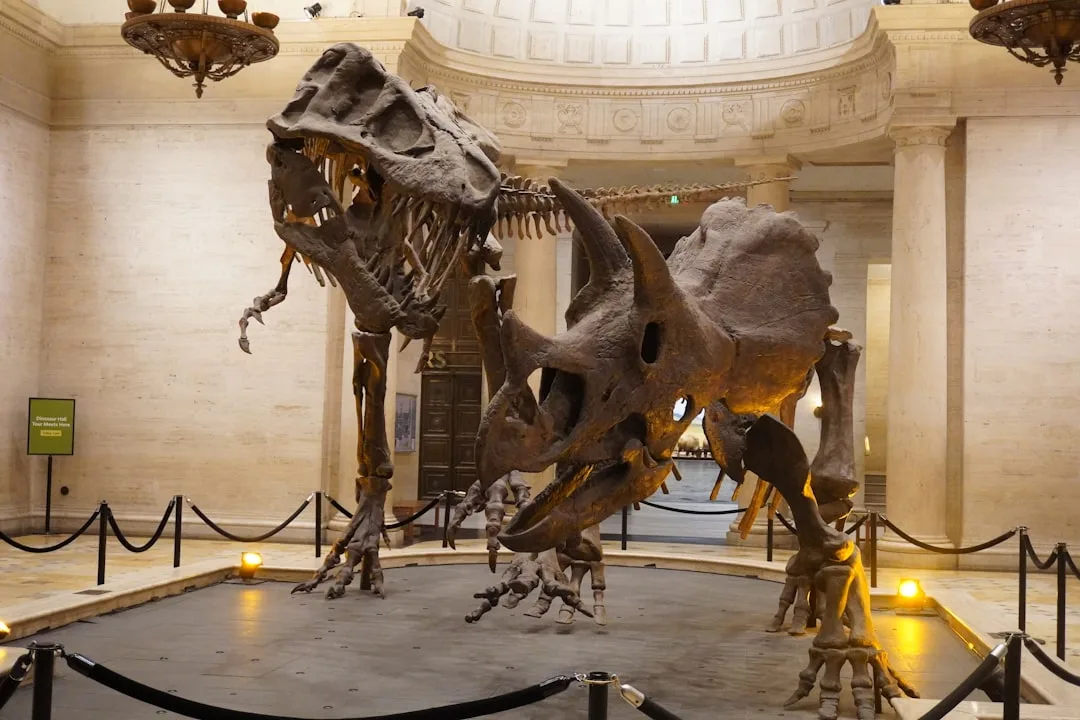
Triceratops is the three-horned herbivore of the very last chapter of the Age of Dinosaurs. It lived across the coastal plains of western North America during the final two million years of the Cretaceous, standing on four short columnar legs beneath a skull that is, by every available measure, the largest skull of any land animal that has ever existed.
When the Chicxulub asteroid struck off the coast of what is now Mexico roughly 66 million years ago, Triceratops individuals were still walking the Hell Creek floodplains - making this species one of the very last non-avian dinosaurs alive on Earth.
This guide covers every aspect of Triceratops biology and palaeobiology: its discovery, its absurd skull, its 1,000-tooth dental battery, its horns and frill, its long-running taxonomic argument with Torosaurus, its relationship with Tyrannosaurus rex, and its place in the extinction event that ended the Mesozoic era. It is a reference entry, not a summary - so expect specifics: metres, tonnes, dates, formations, and verified specimens.
Discovery and Naming
The modern story of Triceratops starts in 1887. That spring, fossil hunter George Lyman Cannon sent a pair of enormous brow horns embedded in rock from near Denver, Colorado to the Yale University palaeontologist Othniel Charles Marsh.
Marsh, working at breakneck speed during the so-called Bone Wars rivalry with Edward Drinker Cope, initially misidentified the specimen as an extinct bison and named it Bison alticornis. Within two years he revised the attribution once much better material arrived from Wyoming and Montana.
That better material came from a single remarkable field collector: John Bell Hatcher. Hatcher worked for Marsh from 1884 onward and proved to be one of the most effective fossil hunters in the history of palaeontology.
Between 1889 and 1892, Hatcher extracted more than thirty Triceratops skulls and partial skeletons from the Lance Formation of eastern Wyoming and the Hell Creek Formation of Montana, shipping them east by wagon and train in plaster jackets weighing hundreds of kilograms each. Marsh used Hatcher's material to formally name Triceratops horridus in 1889.
The type specimen, catalogued as YPM 1820, remains housed at the Yale Peabody Museum of Natural History in New Haven, Connecticut.
The name combines three Greek roots: tri- for three, keras for horn, and ops for face. Together they produce "three-horned face" - one of the more literal and self-explanatory names in palaeontology. The species epithet horridus means "rough" or "bristly", a reference to the weathered texture of the skull bones in the type specimen.
A second species, Triceratops prorsus, was named by Marsh in 1890 and remains valid today. It is distinguished from T. horridus by a longer, more forward-pointing nasal horn and slightly different frill geometry. Stratigraphic work in the Hell Creek Formation indicates that T. prorsus appeared later in geological time than T. horridus and may represent a direct descendant rather than a contemporary.
Classification and Evolution
Triceratops belongs to the family Ceratopsidae, a group of large, quadrupedal, horned ornithischian dinosaurs that diversified spectacularly in North America during the last 20 million years of the Cretaceous. Within Ceratopsidae, Triceratops sits inside the subfamily Chasmosaurinae - the long-frilled ceratopsids that include Torosaurus, Chasmosaurus, Pentaceratops, and several newly described forms.
The other ceratopsid subfamily, Centrosaurinae, contains short-frilled, large-nosed animals like Styracosaurus and Centrosaurus.
Ceratopsians in general evolved from small, bipedal, parrot-beaked ancestors in the Early Cretaceous of Asia. Genera like Psittacosaurus and Protoceratops represent intermediate stages on the way to the huge quadrupedal forms of Late Cretaceous North America. The enormous frill and horn anatomy characteristic of Triceratops is a derived feature that appears relatively late in the evolutionary history of the group.
Size and Physical Description
Triceratops was enormous, even by Cretaceous standards, and much of its mass was concentrated at the front of the body.
Adult body dimensions:
- Total length: 8-9 metres from beak tip to tail tip
- Shoulder height: approximately 3 metres
- Hip height: approximately 3 metres (the back was close to horizontal)
- Weight: 6-12 tonnes depending on individual and estimation method
- Skull length: up to approximately 2 metres including frill
- Skull weight: close to 2 tonnes for the largest specimens
The skull alone represented roughly one third of total body length, and the animal's entire skeletal architecture was reorganised around supporting and moving that weight. The neck vertebrae are partially fused into a rigid bony beam known as the syncervical - three cervical vertebrae locked together - that functions essentially as a load-bearing plate.
The shoulder girdle is massively enlarged, the forelimbs are held in a semi-upright posture directly beneath the body, and the hindlimbs are shorter and more column-like than in most ornithischians.
Surface texture is preserved in several Triceratops skin impressions. The integument consisted of rounded non-overlapping scales roughly 1-10 cm across, arranged in a honeycomb pattern. At least one specimen preserves evidence of simple bristles or filaments along the tail - consistent with a wider pattern of sparse filamentous structures across ornithischian dinosaurs - but the majority of the body was scaled, not feathered.
The Skull
No other land animal known from fossils has a skull like that of Triceratops. The combination of size, ornamentation, and structural complexity is unique, and the skull accounts for almost every aspect of the animal's fame.
Key features:
- Nasal horn. A single short horn sits above the nostrils, projecting forward. It is approximately 15-30 cm long in T. horridus and noticeably longer in T. prorsus.
- Brow horns. Paired horns project forward and upward from above the eye sockets. In mature adults these horns can exceed 1 metre in length, making them larger than the horns of any living horned mammal.
- Frill. A massive bony shield extends back from the skull over the neck and shoulders. In Triceratops the frill is solid - unlike the fenestrated frills of Torosaurus and Pentaceratops, which have large paired windows of soft tissue.
- Beak. The front of the skull terminates in a sharp hooked beak formed by the rostral and predentary bones. The beak was covered in keratin in life and used to crop vegetation.
- Jaw muscles. The massive temporal openings behind the eyes housed enormous jaw-closing muscles that generated bite forces sufficient to shear through thick plant stems.
The Dental Battery
Triceratops had one of the most sophisticated dental systems of any animal that has ever lived. The teeth were organised into four batteries - two in the upper jaw and two in the lower jaw - each consisting of tightly packed vertical columns. A mature adult carried roughly 800 to 1,000 individual teeth in total, although only about 200 were actively in use at any one time; the remainder were developing replacements.
Key properties of the dental battery:
| Feature | Value |
|---|---|
| Total teeth (adult) | ~800-1,000 |
| Active cutting teeth | ~200 |
| Replacement tooth depth | ~5 per column beneath each functional tooth |
| Tooth tissue types | 5 (enamel, orthodentine, interdentine, cementum, vasodentine) |
| Replacement rate | Continuous throughout life |
| Chewing motion | Near-vertical slicing, scissor-like |
A 2015 study by Brandon Hedrick and colleagues published in Science Advances demonstrated that Triceratops teeth were built from five structurally distinct tissues, each with different mechanical properties. The result was a self-sharpening cutting edge that maintained a sharp slicing surface as the tooth wore against abrasive plant material - more sophisticated than the tooth structure of any living reptile and closer in complexity to the teeth of large mammals.
This dental architecture allowed Triceratops to exploit extremely tough, fibrous vegetation that other large herbivores could not efficiently process. Cycads, palm fronds, and woody ground cover all became available food, which is one of the reasons the genus became so abundant in its environment.
Diet and Feeding
Triceratops was a bulk-feeding low-browsing herbivore. Its narrow, hooked beak cropped vegetation within about 1 metre of the ground, and its dental battery then sheared the harvested material into small fragments before swallowing. The animal did not chew in the grinding, rotational sense used by modern cattle - the jaw joint only allowed near-vertical motion - but the slicing efficiency of the teeth compensated.
Likely food items:
- Ferns (abundant ground cover across Late Cretaceous floodplains)
- Cycads
- Palm fronds
- Low shrubs and ground-growing angiosperms
- Occasional tougher woody material
Grass did not yet exist in its modern form, so any grass in the diet came only from the very earliest grass lineages, which were rare. Flowering plants (angiosperms) were diversifying rapidly during the last few million years of the Cretaceous, so the Triceratops diet during its lifespan probably expanded in floral variety compared with its chasmosaurine ancestors.
Stomach contents have not been preserved for Triceratops, but microwear analysis of teeth confirms extensive contact with highly abrasive plant material. Wear facets are deep and consistent, indicating near-identical tooth-on-tooth occlusion across thousands of bites over the animal's lifetime.
Horns, Frill, and Combat
The three horns and massive frill of Triceratops have invited speculation since 1889. Modern work suggests that these structures served several overlapping functions rather than a single purpose.
Probable functions:
- Intraspecific combat. Fossil evidence of healed punctures on adult frills, particularly in the squamosal bones on the sides of the shield, matches the spacing of Triceratops brow horns. This pattern is consistent with head-to-head pushing and horn-locking contests between rival Triceratops, analogous to modern deer and bighorn sheep.
- Species recognition and display. The distinctive arrangement of horns and frill shape would have allowed Triceratops to recognise members of its own species and distinguish them from other ceratopsids sharing the same environment.
- Predator defence. A lowered head presenting three metre-long horns and a metre-wide bony shield is a serious obstacle for any predator. However, direct evidence of frill use against T. rex is mixed - the frill was too thin in places to reliably stop a bite.
- Muscle attachment. The frill provided extensive surface area for the attachment of massive jaw-closing muscles, contributing to the animal's biting power.
- Thermoregulation. Networks of vascular grooves on the frill surface suggest the shield was covered by heavily vascularised soft tissue in life, which may have helped dissipate body heat.
The combination of evidence points to a multi-purpose structure that originated for one selective reason and was refined by several more.
Triceratops Versus Tyrannosaurus
Triceratops and Tyrannosaurus rex lived alongside each other in the Hell Creek, Lance, and Scollard formations of Laramidia during the last two million years of the Cretaceous. Every large T. rex that ever existed almost certainly encountered Triceratops regularly. The fossil record preserves both predation and survival.
Documented evidence of T. rex-Triceratops interactions:
- Triceratops frill fragments with healed puncture wounds matching T. rex tooth spacing
- Triceratops brow horn with a broken tip embedded in the region of a T. rex mouth
- A Triceratops pelvis bearing roughly 80 T. rex bite marks, both pre- and post-mortem
- Healed bone regrowth on multiple Triceratops specimens proving individuals survived at least one T. rex attack
Triceratops was not easy prey. An adult weighed as much or more than an adult T. rex and carried three horns capable of inflicting lethal injuries. Several T. rex specimens show facial scars, broken teeth, and healed bone infections consistent with high-risk encounters. The overall picture is of a genuine apex predator and a genuine armoured herbivore - neither comfortably dominant over the other, with success in any individual fight depending on terrain, health, age, and luck.
The Torosaurus Debate
One of the longest-running taxonomic arguments in palaeontology concerns whether Triceratops and Torosaurus are two separate genera or a single genus at different growth stages.
The controversial hypothesis was published in 2010 by Jack Horner and John Scannella of Montana State University in the Journal of Vertebrate Paleontology. They argued that:
- Known Triceratops specimens all appear immature based on bone histology.
- Known Torosaurus specimens all appear fully mature.
- Transitional specimens exist showing the Triceratops frill thinning and opening into Torosaurus-style fenestrae.
- Therefore, Torosaurus is simply the mature adult form of Triceratops, and the older name (Triceratops) should prevail.
The hypothesis implied that half of the ceratopsid fossils from the Hell Creek Formation had been mis-classified for more than a century. If correct, it would also mean almost no Triceratops individual ever reached full adulthood in the fossil record - every skeleton represents a sub-adult.
Later work pushed back strongly. Nicholas Longrich and Daniel Field, in a 2012 paper in PLOS ONE, identified features of the Torosaurus frill and skull roof that never appear in any stage of Triceratops growth series and argued that at least one genuinely juvenile Torosaurus specimen is known. Subsequent analyses by Andrew Farke, Denver Fowler, and others have found the synonymy unsupported.
As of 2026, the Triceratops-Torosaurus synonymy remains a minority position. Most ceratopsian specialists treat the two genera as closely related but distinct. The debate has been productive regardless, forcing the community to re-examine assumptions about ceratopsid growth and the completeness of the Hell Creek record.
Abundance and the Hell Creek Fossil Record
Triceratops is the single most abundant large dinosaur fossil in the Hell Creek Formation of Montana, North Dakota, and South Dakota. Quarry counts vary, but in many locations Triceratops bones account for more than 40 per cent of all large dinosaur specimens recovered. It was genuinely a dominant large herbivore of its environment, not simply a common museum piece.
Notable specimens:
| Specimen | Institution | Distinction |
|---|---|---|
| YPM 1820 | Yale Peabody Museum | Type specimen of T. horridus, Marsh 1889 |
| Raymond | Museum of the Rockies, Bozeman | Exceptional growth-series comparison |
| Cliff | Houston Museum of Natural Science | Detailed frill preservation |
| Kelsey | Private (on loan) | Near-complete adult skeleton |
| Homer | Rocky Mountain Dinosaur Resource | Juvenile, key for growth studies |
| Yoshi's Trike | Museum of the Rockies | Studied alongside possible Torosaurus adults |
The large sample size - more than a hundred partial skeletons and several hundred skulls in major collections - makes Triceratops one of the best-understood dinosaurs in terms of population-level anatomy. Growth series, sexual dimorphism, pathology, and geographic variation have all been studied more thoroughly in Triceratops than in most other ceratopsids.
Palaeoenvironment
The Triceratops world was the Late Cretaceous coastal plain of Laramidia, a long island continent that existed when the Western Interior Seaway divided North America into eastern and western landmasses. The environment included:
- Wide, low-gradient river systems with active floodplains
- Subtropical forests of conifers, ginkgoes, and early angiosperms
- Open fern-dominated plains between river channels
- Coastal marshes along the eastern margin of Laramidia
- A warm, humid climate without polar ice caps
Triceratops shared this landscape with Tyrannosaurus rex, the hadrosaur Edmontosaurus, the thick-skulled Pachycephalosaurus, the armoured Ankylosaurus, the ostrich-like ornithomimid Ornithomimus, the small theropod Acheroraptor, and numerous small mammals, crocodyliforms, turtles, and early birds. The ecosystem was complex, geologically young, and about to be destroyed.
Extinction
Triceratops disappeared at the K-Pg boundary approximately 66 million years ago. The immediate cause was the impact of a roughly 10-kilometre asteroid at Chicxulub, in what is now the Yucatan Peninsula of Mexico. The impact released energy equivalent to billions of Hiroshima bombs and triggered a cascade of global consequences:
- Immediate regional firestorm and ejecta blanket across North America
- Tsunamis across the Gulf of Mexico and Western Interior Seaway
- Months-long stratospheric dust and sulphate veil blocking sunlight
- Global crash of photosynthesis and subsequent collapse of food chains
- Acid rain, ocean acidification, and multi-year climatic disruption
As a large-bodied herbivore entirely dependent on abundant living plant cover, Triceratops was especially vulnerable to a shutdown of primary productivity. Fossil evidence from the Hell Creek Formation shows Triceratops bones within a few centimetres of the K-Pg boundary clay, which means individuals of this species were still alive in the weeks or days before the impact.
The "three-foot gap" controversy - whether there is a genuine gap between the youngest dinosaur fossils and the boundary layer - has largely been resolved in favour of dinosaurs being present right up to the impact itself.
Some researchers have argued that additional long-term stressors, including Deccan Traps volcanism in India and falling global sea levels, had already weakened Cretaceous ecosystems before the Chicxulub impact. The asteroid delivered the final blow rather than causing the extinction in isolation. Either way, Triceratops was among the last non-avian dinosaurs to walk the Earth.
Cultural Legacy
Triceratops is one of the most recognisable dinosaurs in popular culture, alongside Tyrannosaurus rex, Stegosaurus, and Velociraptor. It appears in virtually every dinosaur-themed book, film, toy, and museum display produced since the early twentieth century. The animal is the official state dinosaur or fossil of South Dakota and Wyoming, and it features in thousands of educational programmes worldwide.
Triceratops also anchors public understanding of ceratopsian diversity. For most people, every horned dinosaur is a "Triceratops" in casual speech, in the same way every long-necked sauropod is a "Brontosaurus". The taxonomic reality is that more than thirty genera of ceratopsids are now recognised from Late Cretaceous North America alone, but Triceratops remains the cultural flagship of the entire group.
Related Reading
- Tyrannosaurus rex: The King of the Cretaceous
- How Big Was T. rex Really?
- Velociraptor: The Feathered Hunter
- Dinosaurs: Rulers of the Earth for 165 Million Years
References
Relevant peer-reviewed sources consulted for this entry include work by Marsh (1889, 1890) on the original description of Triceratops horridus and T. prorsus; Hatcher, Marsh, and Lull (1907) on the Ceratopsia monograph; Scannella and Horner (2010) in the Journal of Vertebrate Paleontology on the proposed Triceratops-Torosaurus synonymy; Longrich and Field (2012) in PLOS ONE on the rebuttal; Farke et al.
(2011) on ceratopsid growth; Hedrick et al. (2015) in Science Advances on the dental tissue architecture; Fowler (2017) on Hell Creek stratigraphy and Triceratops species succession; and the US National Park Service Hell Creek Formation palaeontological inventory (2023).
Specific specimen and dimensional figures reflect published museum catalogues at the Yale Peabody Museum, the Museum of the Rockies, and the Smithsonian National Museum of Natural History as of the most recent accession data available.
Frequently Asked Questions
How big was Triceratops?
A fully grown Triceratops horridus reached roughly 8 to 9 metres from beak to tail tip, stood about 3 metres tall at the shoulder, and weighed between 6 and 12 tonnes depending on the individual and the estimation method. That is comparable to an adult African bush elephant in length but substantially more massive in the heaviest individuals.
The skull alone could be about 2 metres long - the longest of any known land animal that ever lived - and weighed close to 2 tonnes, which is why Triceratops walked on four short, pillar-like legs rather than rearing up. Females may have been slightly smaller than males, but sexual dimorphism is not reliably established from the current fossil record.
What did Triceratops eat?
Triceratops was a large bulk-feeding herbivore that cropped low-growing plants with a hooked, parrot-like beak and then sheared them to pieces using a dental battery of up to 1,000 teeth. Likely food sources included ferns, cycads, early palms, and tough fibrous vegetation within about 1 metre of the ground.
The teeth were arranged in vertical columns, with fresh replacements continuously growing beneath every functional tooth, so the animal never wore out its cutting surfaces even while chewing highly abrasive plant material. Microwear analysis of Triceratops teeth suggests a slicing, scissor-like chewing motion rather than the grinding motion used by modern cattle, which means Triceratops processed plants more like an industrial shredder than a lawnmower.
Did Triceratops fight Tyrannosaurus rex?
Yes, and the fossil record preserves actual physical evidence of these fights. Multiple Triceratops specimens from the Hell Creek Formation show healed puncture wounds on the frill and brow horns that match the tooth spacing of Tyrannosaurus rex, proving that at least some Triceratops survived T. rex attacks.
A Triceratops pelvis in one specimen bears roughly 80 T. rex bite marks, some showing bone regrowth and others showing clean post-mortem feeding traces, which together document both predation and scavenging. The two animals were direct ecological contemporaries in the last 2 million years of the Cretaceous, and every large T. rex almost certainly had regular encounters with every large Triceratops across their shared Laramidian range.
Who discovered Triceratops?
The first recognised Triceratops fossils were collected in 1887 by the prolific field palaeontologist John Bell Hatcher, working for Othniel Charles Marsh of Yale University. Hatcher shipped more than 30 Triceratops skulls and partial skeletons east from Wyoming and Montana over the next several years, creating what is still one of the richest single-species collections in palaeontology.
Marsh formally named the genus Triceratops in 1889 based on the type species T. horridus, and the type specimen remains housed at the Yale Peabody Museum of Natural History. Earlier specimens collected in 1887 near Denver, Colorado had initially been mistaken for an extinct bison, but Marsh revised the identification once Hatcher’s better material arrived.
Is Torosaurus actually the adult form of Triceratops?
In 2010, palaeontologists Jack Horner and John Scannella published a controversial hypothesis in the Journal of Vertebrate Paleontology arguing that Torosaurus - a long-frilled ceratopsid traditionally treated as a separate genus - is simply the fully mature adult form of Triceratops. Their evidence centred on bone histology, frill thinning, and the apparent absence of juvenile Torosaurus and elderly Triceratops specimens.
Later work by Nicholas Longrich, Daniel Field, and others pushed back, arguing that Torosaurus shows several features that never appear in Triceratops growth series and that known juvenile Torosaurus material does exist. The synonymy remains actively debated and is not currently accepted by the majority of ceratopsian specialists, although the two genera clearly had a close evolutionary relationship.
What were the horns and frill actually for?
The three horns and massive neck frill of Triceratops almost certainly served multiple overlapping functions rather than a single purpose. Fossil evidence of healed horn punctures on adult frills strongly supports use in intraspecific combat - head-to-head pushing contests between rival Triceratops, similar to modern bighorn sheep or deer.
The frill itself was too thin in places to reliably stop a T. rex bite, suggesting defence against predators was secondary to display and species recognition, much like the enlarged ornaments of modern male elk or peacocks. Heat dissipation, muscle attachment for the massive jaw, and physical protection of the neck vertebrae likely provided additional selective benefits.
Juveniles developed horns and frills long before any reproductive role was possible, consistent with the multi-function interpretation.
Why did Triceratops go extinct?
Triceratops disappeared at the very end of the Cretaceous period, approximately 66 million years ago, during the K-Pg mass extinction event that eliminated all non-avian dinosaurs. The immediate cause was the impact of a roughly 10-kilometre asteroid at Chicxulub in what is now Mexico, which triggered global wildfires, a months-long dust and sulphate veil blocking sunlight, collapse of photosynthesis, and the breakdown of terrestrial food chains.
As a large-bodied herbivore dependent on abundant low-growing plant cover, Triceratops was especially vulnerable to a prolonged shutdown of photosynthesis. Bones recovered within a few centimetres of the K-Pg boundary clay in Montana show that Triceratops was still abundant at the moment of impact, making it one of the last non-avian dinosaurs to walk the Earth.
How many teeth did Triceratops really have?
Adult Triceratops carried between roughly 800 and 1,000 individual teeth arranged in two large dental batteries, one in each side of the upper jaw and one in each side of the lower jaw. Each battery consisted of tightly packed vertical columns of teeth cemented together by bone, with only the top tooth in each column actively cutting food at any given time.
Beneath every functional tooth, several replacement teeth were simultaneously maturing, so when a tooth wore out or broke, the next one was already in position. Recent studies by Brandon Hedrick and colleagues revealed that Triceratops teeth had a uniquely complex five-tissue internal structure, more sophisticated than almost any modern reptile tooth, that allowed them to self-sharpen as they wore against tough plant fibres.