
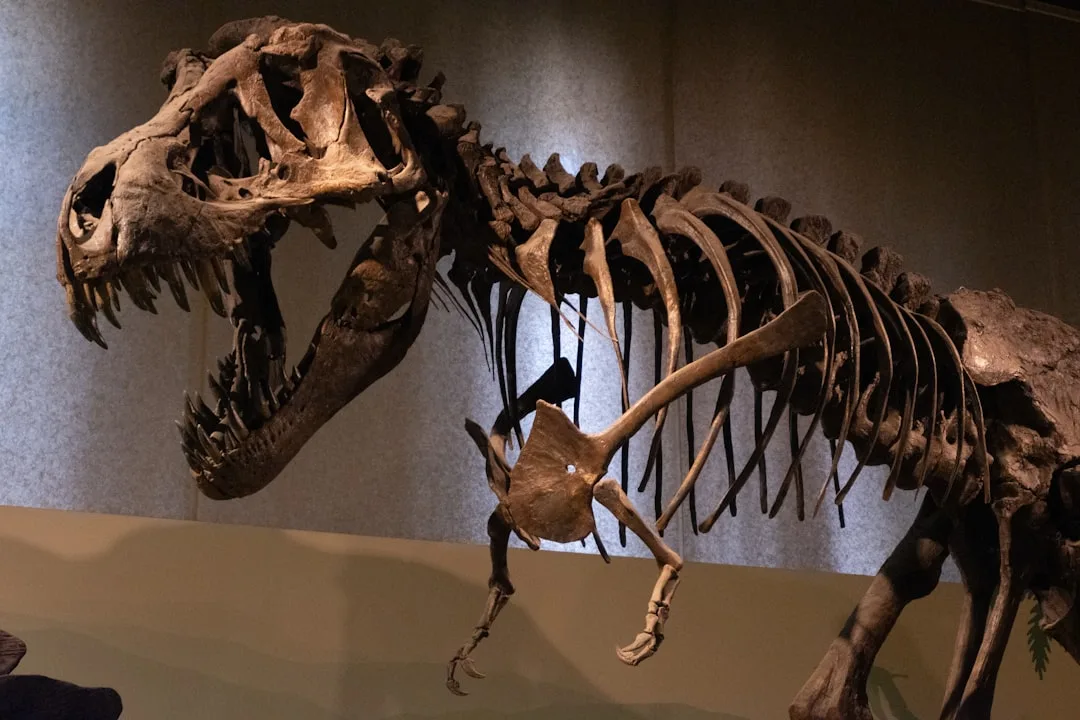
Tyrannosaurus rex is the most thoroughly studied extinct animal in history. More than fifty reasonably complete specimens have been recovered from the badlands of western North America, and each new find reshapes what we know about how the animal moved, hunted, grew, and died. Tyrannosaurus rex is not simply a famous dinosaur - it is a benchmark species against which almost every other theropod is measured.
Its bite was the strongest of any land animal that ever lived, its vision was probably sharper than a modern eagle's, its growth rate outpaced that of every other dinosaur known, and its lineage produced the birds flying past your window right now.
This guide covers every aspect of T. rex biology and ecology that fossils, histology, biomechanics, and comparative anatomy can support: size and weight, bite force, vision, smell, feathers, growth, lifespan, famous specimens, extinction, and the relationship between T. rex and the modern birds that are its only living descendants. It is a reference entry, not a summary - so expect specifics: kilograms, newtons, millimetres, and verified ages.
Etymology and Classification
The name Tyrannosaurus rex was coined by American palaeontologist Henry Fairfield Osborn in 1905, based on a partial skeleton collected by fossil hunter Barnum Brown in the Hell Creek Formation of Montana two years earlier. The genus name blends the Greek tyrannos ('tyrant') and sauros ('lizard'). The species epithet rex is Latin for 'king'. Together the binomial translates as 'tyrant lizard king', and no other dinosaur name has achieved such cultural saturation.
Taxonomically, Tyrannosaurus rex sits deep inside the theropod branch of the dinosaur tree:
- Kingdom: Animalia
- Phylum: Chordata
- Class: Reptilia
- Clade: Dinosauria
- Order: Saurischia (lizard-hipped dinosaurs)
- Suborder: Theropoda (hollow-boned, bipedal, mostly carnivorous)
- Family: Tyrannosauridae
- Genus: Tyrannosaurus
- Species: T. rex
Tyrannosauridae includes roughly a dozen known genera, among them Albertosaurus, Gorgosaurus, Daspletosaurus, and Tarbosaurus - the last, an Asian relative, is so similar to T. rex that some researchers have argued for placing it inside Tyrannosaurus.
A controversial 2022 paper proposed splitting Tyrannosaurus into three species (T. rex, T. regina, T. imperator), but subsequent analyses have mostly rejected the split and the mainstream literature continues to treat T. rex as a single, morphologically variable species.
Temporal Range and Extinction
Tyrannosaurus rex lived during the final two million years of the Cretaceous period, roughly 68 to 66 million years ago, in an interval known as the late Maastrichtian. This is a short species duration in geological terms - shorter than the likely duration of Homo sapiens as a distinct species - but immensely well documented because the rocks of the Hell Creek, Lance, and Scollard formations preserve the final chapter of the dinosaur world in extraordinary detail.
T. rex disappeared at the K-Pg boundary, the thin iridium-rich clay layer that marks the end of the Cretaceous and the beginning of the Paleogene. The immediate trigger was the impact of an asteroid roughly 10 kilometres in diameter at Chicxulub on the northern Yucatan Peninsula.
Models published over the past two decades describe a cascading disaster: an instantaneous fireball, continent-scale seismic shaking, tsunamis hundreds of metres tall, a global rain of incandescent ejecta that ignited forests, months of dust-darkened skies, a photosynthetic collapse, the failure of plant and marine primary productivity, and the crash of every food web dependent on large-bodied animals.
As an apex predator reliant on multi-tonne herbivores, T. rex had no path through the bottleneck.
Long-term stressors were probably already pressing on Late Cretaceous ecosystems: the massive Deccan Traps volcanic province in India was erupting, global sea levels were falling, and climates were cooling and fluctuating. But the fossil record makes clear that Tyrannosaurus rex was thriving, not declining, at the moment of the impact.
Range and Habitat
Every confirmed Tyrannosaurus rex specimen has come from western North America. During the Late Cretaceous this region formed its own island continent - Laramidia - separated from eastern North America (Appalachia) by the Western Interior Seaway, a shallow epicontinental sea stretching from the Arctic to the Gulf of Mexico. T. rex ranged across Laramidia from what is now Saskatchewan and Alberta in the north, through Montana, the Dakotas, Wyoming, Colorado, Utah, New Mexico, and into Texas.
The habitat was a warm, subtropical mosaic of:
- River floodplains and meandering channels
- Broadleaf forests dominated by flowering plants
- Conifer stands and palm-like cycads
- Seasonal wetlands and coastal lagoons
Climate was warmer than modern North America - mean annual temperatures around 15 to 20 degrees Celsius at T. rex latitudes, with mild winters and heavy seasonal rains. Co-occurring fauna included Triceratops, Edmontosaurus, Ankylosaurus, Pachycephalosaurus, and a dense cast of smaller theropods, crocodylians, turtles, lizards, mammals, and some of the earliest known modern-type birds.
Size and Physical Description
Tyrannosaurus rex is one of the largest terrestrial carnivores known to have existed. Size varies meaningfully between specimens; the large, robust morphs (sometimes interpreted as females) reach greater masses than the more gracile morphs.
Adult dimensions:
- Length: typically 11-12 m; Sue measures 12.3 m
- Hip height: roughly 3.7 m
- Skull length: 1.5 m (Sue's skull is 1.53 m)
- Weight: 8-9 tonnes for large adults
- Teeth: up to 60 in total, the largest ~20 cm including the root, ~12 cm of crown exposed
The body plan is instantly recognisable: massive head, thick S-curved neck, barrel-shaped torso balanced over two pillar-like hind legs, long counterweighting tail, and famously reduced two-fingered forelimbs. The skull is reinforced by thick, fused bone across the nasal and frontal regions to transmit enormous bite forces without shattering. The lower jaw contains an intramandibular joint that allowed the bone to flex slightly under load, acting as shock absorption.
Teeth are the most distinctive feature. T. rex teeth are not the narrow blades seen in allosaurs and most theropods; they are thick, D-shaped in cross-section, deeply rooted, and heavily serrated along both edges. Biomechanical studies compare them to reinforced crushing cones capable of sustaining repeated impacts against bone without fracturing.
Teeth were continuously replaced throughout life: a new tooth grew beneath every functional tooth, with full replacement cycles estimated at around 2 to 3 years per tooth.
The Famous Tiny Arms
Tyrannosaurus rex forelimbs are famously disproportionate - roughly 1 metre long on an animal 12 metres long. This is not a drawing error or a result of incomplete preservation; the bones are small, and every well-preserved specimen confirms it. The arms have only two functional fingers (a vestigial metacarpal III is present but bears no phalanges).
Despite their modest size, the arms are extraordinarily robust. Estimates of muscle cross-sectional area based on bone attachment scars suggest the biceps alone could have curled around 200 kilograms - greater than the record human curl. Proposed functions include:
- Holding struggling prey against the body during feeding
- Assisting the animal in standing up from a prone position
- Gripping during mating
- Intra-species signalling or combat
None of these hypotheses is fully settled. What is clear is that the arms were not decorative or vestigial in the functional sense - they were small but strong, specialised tools whose exact role remains a genuine open question in palaeontology.
Bite Force
The bite of Tyrannosaurus rex is the strongest documented for any land animal in Earth history, living or extinct. Direct measurement is impossible, but two independent approaches converge on the same answer.
Biomechanical modelling by Gregory Erickson and colleagues, using high-fidelity reconstructions of jaw musculature anchored in scars on the skull, estimates posterior bite forces between 35,000 and 57,000 newtons. The 57,000-newton figure, published in the Scientific Reports paper by Gignac and Erickson in 2017, corresponds to roughly 5,800 kilogram-force - enough to pulverise the leg bone of a Triceratops in a single closure.
Comparative bite forces:
| Animal | Bite force (newtons, approximate) |
|---|---|
| Tyrannosaurus rex | up to 57,000 |
| Saltwater crocodile | ~16,000 |
| Spotted hyena | ~4,500 |
| African lion | ~1,300 |
| Great white shark | ~18,000 |
| Megalodon (extinct shark) | ~108,000-180,000 (estimate) |
| Adult human | ~700 |
Bone fragments embedded in T. rex coprolites - fossilised dung - confirm that bones were not just crushed but swallowed whole and digested. This "punch-through" feeding mechanism is unique among known terrestrial carnivores and explains why so many Hell Creek prey fossils show puncture wounds shaped exactly like T. rex teeth.
Senses: Vision, Smell, and Hearing
Tyrannosaurus rex was a sensory specialist in at least two dimensions.
Vision. The skull places the eyes in a forward-facing orientation with an overlap in the field of view of roughly 55 degrees - binocular vision far superior to most theropods, which tend to have laterally placed eyes. Studies by Kent Stevens using scaled reconstructions calculate a visual acuity 13 times higher than a human's and sharper than that of a modern golden eagle. This supports the predatory hypothesis: ambush predators benefit from depth perception to time a strike.
Smell. Endocast studies of T. rex braincases reveal enormous olfactory bulbs relative to brain size - the largest in proportional terms of any non-avian theropod examined. Comparative work by Darla Zelenitsky and colleagues ranks T. rex olfaction alongside modern turkey vultures and kiwis, both of which hunt or scavenge primarily by smell. For a predator roaming floodplain forests thick with obstructions, a long-range chemical sense would have been as useful as any visual advantage.
Hearing. Inner ear anatomy indicates best hearing sensitivity in the low-frequency range, roughly 200 to 3,200 Hz, similar to modern crocodilians. Low-frequency sensitivity is consistent with large-body communication - infrasonic rumbles audible over kilometres in dense forest.
Feathers: What the Babies Looked Like
The feather question is one of the most revised aspects of Tyrannosaurus rex reconstruction. Two lines of evidence pull in different directions.
On one hand, the closely related Chinese tyrannosauroid Yutyrannus huali (Xu et al., 2012) preserves body-wide filamentous feathers on a 9-metre animal. Phylogenetically, feathers are ancestral to the tyrannosauroid group, so a feathered condition at some life stage is expected.
On the other hand, multiple skin impressions from Tyrannosaurus rex itself - including a specimen nicknamed Wyrex - show scaly patches on the neck, flanks, pelvis, and tail, not feathers. The scales are small, bumpy, and non-overlapping.
The reconciliation now favoured by most researchers is ontogenetic: juveniles hatched with a thick downy coat that provided insulation, while adults lost most of that coat as they grew too large to need it for thermoregulation. Modern parallels include elephants and rhinos, which hairy as babies, become largely bald as multi-tonne adults.
Growth and Life History
Bone histology - counting lines of arrested growth in thin sections of fossilised bone - has delivered precise age estimates for dozens of T. rex specimens, allowing palaeontologists to reconstruct a full growth curve.
Growth phases (Erickson et al., 2004, and subsequent work):
| Age (years) | Mass (approx.) | Life stage |
|---|---|---|
| 0 (hatch) | 1-3 kg | Feathered chick |
| 5 | 50-100 kg | Juvenile hunter |
| 10 | 500-1,000 kg | Sub-adult |
| 14-18 | 2,500-6,000 kg | Rapid growth spurt |
| 20 | ~7,000 kg | Near full size |
| 28 (Sue) | ~8,400-9,000 kg | Senescent adult |
The adolescent growth spurt is remarkable. Between ages 14 and 18, T. rex gained roughly 600 kilograms per year - about 1.6 kilograms per day - the fastest growth of any known dinosaur, and faster in absolute terms than any land animal alive today.
During this phase, juveniles had to eat prodigiously, probably targeting smaller and faster prey than adults, which explains the ecological puzzle of Laramidia: Tyrannosaurus rex appears to be the only large theropod in its environment, and juveniles may have filled the niches otherwise occupied by medium-sized predators.
Few individuals lived to full old age. Pathologies - healed fractures, bone infections, gout, and bite wounds inflicted by other tyrannosaurs - are common across the known sample. Sue bears evidence of a serious jaw infection that may have contributed to death at around 28 years of age.
Population and Species Abundance
A 2021 study by Charles Marshall and colleagues, published in Science, used modern ecological scaling relationships between predator body size and population density to estimate how many Tyrannosaurus rex existed. The answer, widely reported, is that:
- About 20,000 post-juvenile adults were alive at any one time
- Generations overlapped for roughly 2 million years
- Roughly 2.5 billion individuals lived across the species' full existence
- Only 1 in roughly 80 million individuals has been recovered as a fossil
The 2.5 billion figure surprises most readers, but it is consistent with long species duration combined with a large-bodied apex predator's low standing population. Rarity of fossils reflects the extraordinary improbability of any single animal surviving the geological filter from death through burial, fossilisation, preservation, uplift, and exposure in an outcrop during the small window human palaeontologists have been collecting.
Famous Specimens
Tyrannosaurus rex has produced the most culturally and scientifically significant individual fossils of any dinosaur.
- Sue (FMNH PR 2081). Discovered in 1990 in South Dakota by fossil hunter Sue Hendrickson. About 90 per cent complete, 12.3 metres long, 28 years old at death. Sold at auction in 1997 for 8.36 million dollars, it is now the centrepiece of the Field Museum in Chicago and is insured at over 31.8 million dollars.
- Stan (BHI 3033). Found in 1987 in South Dakota, about 70 per cent complete. Sold for 31.8 million dollars in 2020, at the time the most expensive fossil ever auctioned. Now residing at a planned natural history museum in Abu Dhabi.
- Trix. Excavated in 2013 in Montana, about 75 per cent complete. Housed at Naturalis Biodiversity Center in Leiden, Netherlands. One of the oldest known specimens at roughly 30 years at death.
- Scotty (RSM P2523.8). Recovered in Saskatchewan beginning in 1991. Based on femur robustness, possibly the most massive T. rex specimen yet described at around 8.87 tonnes.
- Black Beauty. A dark-coloured skeleton found in Alberta in 1980, about 28 per cent complete, famous for its striking preservation hue caused by manganese in the surrounding rock.
Each specimen has contributed specific scientific advances. Sue's brain and ear anatomy were reconstructed via CT scanning. Stan's pathologies informed our understanding of intra-species combat. Scotty provided a new upper bound on mass. Trix's completeness enabled detailed biomechanical modelling.
Soft Tissue and Molecular Evidence
In 2005, Mary Schweitzer and colleagues reported the recovery of flexible, stretchy tissue and structures resembling blood vessels from the femur of a 68-million-year-old Tyrannosaurus rex from the Hell Creek Formation (MOR 1125). Subsequent work reported protein sequences - fragments of collagen - whose closest match in a modern reference database was chicken, followed by ostrich.
The findings, controversial from the moment of publication, have been attacked, defended, re-analysed, and partly replicated for nearly two decades.
If the molecular identifications hold, they have two implications. First, organic molecules can survive tens of millions of years under the right preservation conditions, a claim that upends long-standing assumptions in taphonomy. Second, T. rex protein clusters with modern birds to the exclusion of reptiles, reinforcing the cladistic placement of birds inside dinosaurs.
Sceptics argue that the recovered structures may be biofilms produced by modern bacteria colonising the fossil, and that the protein sequences may be contamination. The issue is genuinely unresolved. What is not controversial is that the investigation itself - combining palaeontology, molecular biology, and mass spectrometry - has opened a new frontier in the study of extinct animals.
Living Relatives
Every non-avian dinosaur went extinct at the K-Pg boundary. Avian dinosaurs did not. The avian lineage, which had branched off from other theropods tens of millions of years before Tyrannosaurus rex appeared, survived the impact for reasons that likely included small body size, seed-eating diets, and burrow-nesting behaviours.
Modern birds - more than 10,000 species, from hummingbirds to ostriches - are the direct evolutionary descendants of theropod dinosaurs, and therefore the closest living relatives of Tyrannosaurus rex. Chickens, turkeys, and ostriches in particular share specific skeletal and biochemical features with T. rex that distinguish them from crocodilians, the next closest living relatives of dinosaurs more broadly.
In a cladistic sense, dinosaurs are not extinct. Tyrannosaurs are.
Related Reading
- Extinction: How the Dinosaurs Ended
- Triceratops: The Horned Giant of the Late Cretaceous
- Velociraptor: The Real Dromaeosaur Behind the Myth
- Birds as Living Dinosaurs
References
Relevant peer-reviewed sources consulted for this entry include Erickson et al. 2004 ('Gigantism and comparative life-history parameters of tyrannosaurid dinosaurs', Nature), Gignac and Erickson 2017 ('The biomechanics behind extreme osteophagy in Tyrannosaurus rex', Scientific Reports), Marshall et al. 2021 ('Absolute abundance and preservation rate of Tyrannosaurus rex', Science), Schweitzer et al. 2005 ('Soft-tissue vessels and cellular preservation in Tyrannosaurus rex', Science), Xu et al. 2012 ('A gigantic feathered dinosaur from the Lower Cretaceous of China', Nature), and Hutchinson and Garcia 2002 ('Tyrannosaurus was not a fast runner', Nature).
Specimen data reflect current records maintained by the Field Museum, the Royal Saskatchewan Museum, Naturalis Biodiversity Center, and the Museum of the Rockies.
Frequently Asked Questions
How big was Tyrannosaurus rex?
A fully grown Tyrannosaurus rex reached roughly 12 metres in length from snout to tail tip, stood about 3.7 metres tall at the hip, and weighed 8 to 9 tonnes. The largest verified specimen, Sue (FMNH PR 2081) at the Field Museum in Chicago, measures 12.3 metres long and is estimated at around 8.4 to 9 tonnes based on femur circumference scaling. The skull alone could exceed 1.5 metres in length.
Scotty, a Saskatchewan specimen, may have been even heavier at roughly 8.87 tonnes based on bone robustness. For comparison, T. rex was shorter than some theropods like Spinosaurus but substantially more massive and powerful.
What did T. rex eat?
Tyrannosaurus rex was a hypercarnivore at the top of the Late Cretaceous food web in Laramidia. Primary prey included large herbivorous dinosaurs that shared its environment: hadrosaurs such as Edmontosaurus, ceratopsians such as Triceratops, and juvenile members of every other local species. Bite marks on hadrosaur tail vertebrae and healed Triceratops horn injuries confirm active predation, not just scavenging.
Coprolites - fossilised dung - contain crushed bone fragments, showing T. rex could bite through and digest skeletal material. The long-running ‘predator versus scavenger’ debate is now settled: T. rex was both, like every large modern carnivore from lions to hyenas.
How strong was a T. rex bite?
Tyrannosaurus rex had the most powerful bite of any land animal that has ever existed. Biomechanical modelling led by Gregory Erickson and Paul Gignac estimated posterior bite forces up to 57,000 newtons - roughly 6,000 kilogram-force - at the back teeth. That is more than double the bite force of a modern saltwater crocodile and about thirty times that of a lion.
The teeth were not knives but reinforced serrated cones designed to crush bone rather than slice flesh. T. rex used this bite to shatter Triceratops frills, hadrosaur hips, and the vertebrae of juvenile prey, something no other predator in its ecosystem could do.
Did T. rex have feathers?
Juvenile Tyrannosaurus rex very likely had feathers, though adults were probably mostly or entirely scaled. The key evidence comes from Yutyrannus huali, a 9-metre tyrannosauroid from Liaoning, China, preserved with filamentous feather impressions across its body. Because Yutyrannus sits close to Tyrannosaurus on the tyrannosauroid family tree, feathers are probably ancestral to the group.
However, skin impressions from T. rex specimens themselves show scaly patches on the neck, pelvis, and tail, suggesting adult coverage was reduced. The most likely picture is a fluffy, downy chick transitioning to a mostly bare adult - similar in thermoregulatory strategy to modern elephants or rhinos.
How fast could T. rex run?
Tyrannosaurus rex could not truly run in the way a sprinting ostrich or racehorse does. Biomechanical studies based on leg proportions and bone stress limits suggest a maximum sustained pace of roughly 20 kilometres per hour - a fast walk or gentle jog. Models published by John Hutchinson and colleagues indicate that faster speeds would have exceeded the load-bearing capacity of the leg bones, risking catastrophic fracture at the animal’s 8-tonne mass.
This does not mean T. rex was slow in any meaningful sense: a 12-metre predator walking at 20 km/h outruns virtually every large prey animal of its era over short distances. Juveniles, lighter and longer-legged relative to body size, were probably considerably faster.
Why did Tyrannosaurus rex go extinct?
Tyrannosaurus rex disappeared at the end of the Cretaceous period, approximately 66 million years ago, during the K-Pg mass extinction event. The immediate cause was the impact of a roughly 10-kilometre asteroid at Chicxulub, in what is now the Yucatan Peninsula, which released energy equivalent to billions of Hiroshima bombs.
The impact triggered global wildfires, a months-long dust and sulphate veil that blocked sunlight, collapse of photosynthesis, and a subsequent crash of food chains. All non-avian dinosaurs went extinct within a geologically instantaneous window. T. rex, as an apex predator dependent on large herbivores, was especially vulnerable.
Long-term stressors - Deccan Traps volcanism, falling sea levels, and climatic cooling - may have weakened ecosystems before the impact.
Are birds really descendants of T. rex?
Birds are the direct evolutionary descendants of theropod dinosaurs - the same group that includes Tyrannosaurus rex - though they did not descend from T. rex itself. Both birds and T. rex belong to the clade Theropoda, with birds branching off within a subgroup called Maniraptora long before the end of the Cretaceous.
Protein sequencing of Tyrannosaurus collagen, reported in Science in 2007 and refined in subsequent years, showed that T. rex protein was more similar to chicken and ostrich than to any reptile. In cladistic terms, every chickadee and eagle alive today is a living dinosaur, and T. rex is their distant cousin. Non-avian dinosaurs went extinct 66 million years ago; avian dinosaurs are thriving with more than 10,000 species.
How long did T. rex live?
Bone histology - the study of growth rings inside fossilised bone - indicates that Tyrannosaurus rex could live up to about 28 to 30 years. Sue, the most famously studied specimen, was roughly 28 years old at death. T. rex life history was compressed and violent: hatchlings grew slowly for the first decade, then entered an explosive adolescent growth spurt between ages 14 and 18, gaining approximately 600 kilograms per year.
Growth slowed after sexual maturity around 18 to 20. Few individuals reached full old age; most died young from injuries, disease, starvation, or fights with other T. rex. Pathologies - healed fractures, infected bite wounds, gout - are common in adult specimens, documenting a brutal daily existence.