
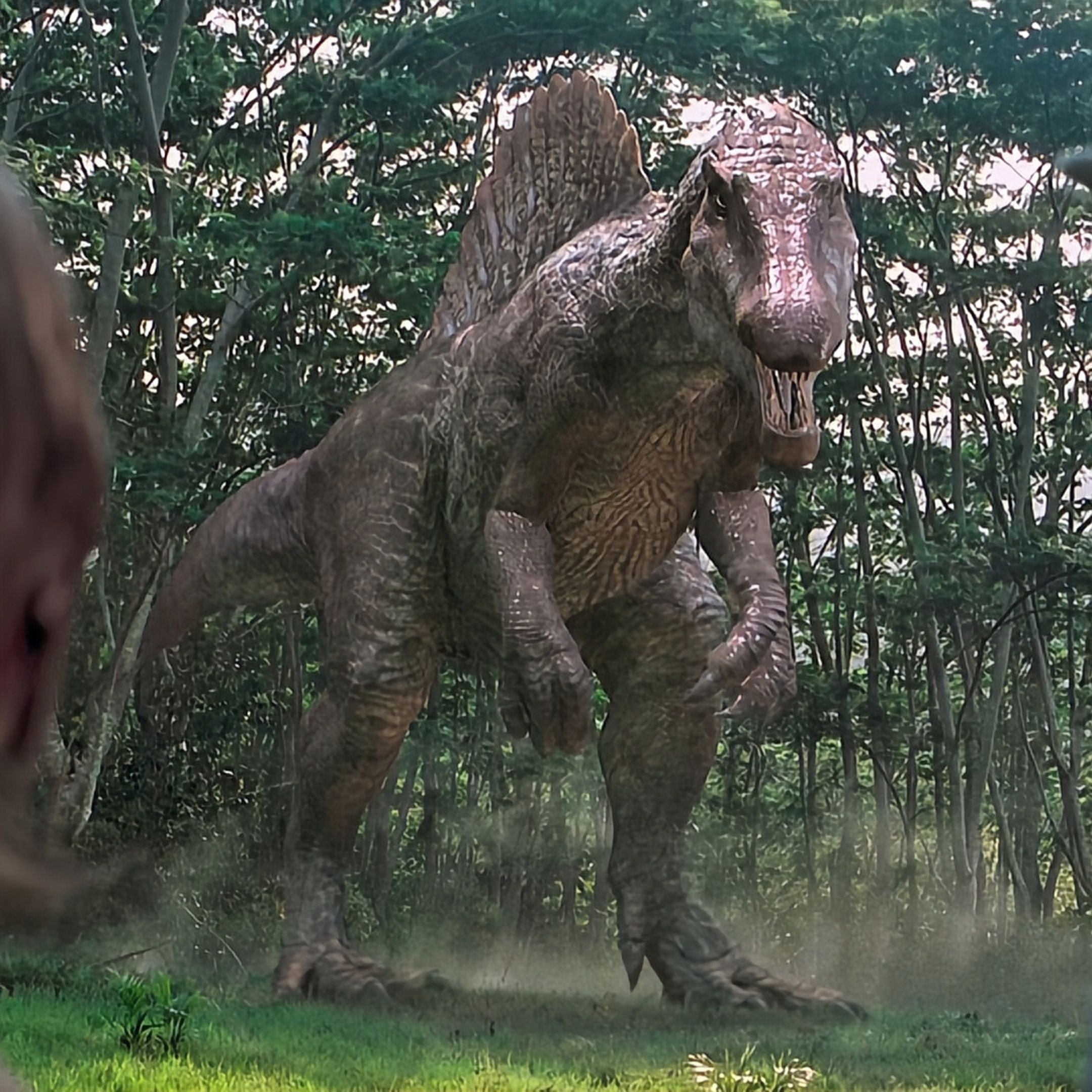
Spinosaurus aegyptiacus is the largest carnivorous dinosaur ever described and the only non-avian dinosaur known with reasonable certainty to have swum. At 14 to 18 metres long, it outstretched Tyrannosaurus rex. Its skull was narrow and crocodile-like rather than box-shaped and bone-crushing. Its tail formed a true paddle. Its hind limbs were absurdly short.
Its back carried a sail of 1.8 metre neural spines whose purpose is still debated more than a century after the first bones came out of the Egyptian desert.
Spinosaurus also has one of the strangest histories in vertebrate palaeontology. The original specimen was pulled from the Bahariya Oasis in 1912, described by the German aristocrat Ernst Stromer, shipped to Munich, studied for a generation - and then obliterated by Royal Air Force bombs in April 1944. For sixty years afterwards, science worked from photographs and plates in Stromer's published monograph.
Only in 2008 did palaeontologist Nizar Ibrahim stumble on a Moroccan fossil dealer carrying a box of bones that would eventually force a complete rewrite of what this animal was and how it lived.
This entry covers every major aspect of Spinosaurus: anatomy, size, taxonomy, environment, diet, locomotion, the sail, the tail, the discovery story, the destruction and rediscovery of the species, the Kem Kem fossil beds, and the controversies that still divide palaeontologists. It is a reference article, not a summary, so expect specifics - metres, ages, isotope values, and citations.
Etymology and Classification
The genus name Spinosaurus means "spine lizard", a direct reference to the tall neural spines of the back vertebrae. Stromer coined the name in 1915 in his formal description of the Egyptian material, pairing it with the species epithet aegyptiacus for the country of discovery. The full binomial Spinosaurus aegyptiacus translates roughly as "Egyptian spine lizard".
Spinosaurus is the type genus of the family Spinosauridae, a group of large piscivorous theropods that also includes Baryonyx from England, Suchomimus from Niger, Irritator and Oxalaia from Brazil, and Ichthyovenator from Laos. Spinosauridae sits within the superfamily Megalosauroidea, one of several major branches of theropod dinosaurs.
The group is united by long, low crocodile-like skulls, conical unserrated teeth, powerful forelimbs with large thumb claws, and a tendency toward semi-aquatic lifestyles.
The full accepted taxonomic chain is Animalia, Chordata, Reptilia, Dinosauria, Saurischia, Theropoda, Megalosauroidea, Spinosauridae, Spinosaurus, S. aegyptiacus. A second species, Spinosaurus maroccanus, was proposed in the 1990s based on fragmentary Moroccan material but is now generally considered either invalid or a synonym of S. aegyptiacus. The consensus view since Ibrahim's 2014 work treats all well-preserved Spinosaurus material as one species.
Size and Physical Description
Spinosaurus is the longest known carnivorous dinosaur. Length estimates cluster between 14 and 18 metres from snout to tail tip, with most modern reconstructions favouring the upper end. Mass is harder to determine because the skeleton is proportioned unlike any conventional theropod - short legs, long tail, low centre of gravity, sail on the back - so extrapolating from other species introduces systematic error.
Published estimates range from about 7,000 kilograms to more than 20,000 kilograms, with 12,000 to 15,000 kilograms frequently cited as a reasonable midpoint.
Skull:
- Length: approximately 1.5 to 1.75 metres
- Shape: long, narrow, low, slightly upturned at the tip
- Jaw: conical unserrated interlocking teeth, pressure-sensing pits in the snout
- Nostrils: positioned well back on the skull, consistent with submerged feeding
Body:
- Total length: 14-18 metres
- Neck: S-shaped, longer and more flexible than most large theropods
- Forelimbs: robust, with large recurved claws on three-fingered hands
- Hind limbs: short relative to body, positioned well back
- Tail: long, flexible, ending in a flat paddle formed by elongated neural spines and chevrons
Sail:
- Height: up to 1.8 metres at the tallest spines
- Structure: elongated thoracic and lumbar neural spines connected by skin
- Shape: roughly rectangular or trapezoidal, not rounded
Relative to other giant theropods, Spinosaurus carried its mass low and long. Compared to T. rex, which stood tall on enormous hind legs, Spinosaurus is stretched out and close to the ground.
The short legs and elongated torso are part of why the animal was reconstructed for decades as a land predator standing on its hind legs - artists and scientists alike assumed a conventional bipedal theropod and worked backwards. Ibrahim's 2014 Science paper overturned this, arguing that the proportions only make sense in a semi-aquatic animal.
Temporal Range and Environment
Spinosaurus lived during the Late Cretaceous, in the Cenomanian stage, from roughly 99 to 93.5 million years ago. At that time North Africa was a warm, humid, low-lying coastal region straddling the southern margin of the ancient Tethys Sea. The landscapes preserved at Bahariya and in the Kem Kem Group were a mosaic of braided rivers, tidal channels, mangrove-like coastal forests, shallow lagoons, and deltaic mudflats.
Geological formations preserving Spinosaurus:
- Bahariya Formation, Egypt
- Kem Kem Group (Gara Sbaa and Douira formations), Morocco
- Chenini Formation, Tunisia
- Scattered beds in Algeria and Libya
Fossil evidence from these deposits includes large fish (the giant sawfish Onchopristis, lungfish Mawsonia, coelacanths), freshwater sharks (Onchopristis-associated hybodonts), turtles, crocodyliforms (Elosuchus, Aegisuchus, Kemkemia), pterosaurs (Alanqa), and other theropods.
The Kem Kem Beds have been nicknamed the most dangerous place in Earth's history because four giant predators - Spinosaurus, Carcharodontosaurus, Deltadromeus, and Sauroniops - appear to have coexisted, a density of large carnivores unmatched in any modern ecosystem. Niche partitioning, with Spinosaurus dominating the aquatic niche, is the leading explanation for how such an ecosystem could function.
Discovery History
The story begins in 1910, when Ernst Stromer, a Bavarian palaeontologist and minor aristocrat, persuaded the Bavarian Academy of Sciences to fund an expedition to the Bahariya Oasis in Egypt's Western Desert.
His collector Richard Markgraf began excavating in 1911 and in 1912 recovered the original Spinosaurus material: a lower jaw, isolated teeth, cervical, dorsal, sacral, and caudal vertebrae (including the famous tall neural spines), and fragmentary ribs and limb bones. The specimen was shipped to Munich, where it sat in the Bayerische Staatssammlung fuer Palaeontologie.
Stromer formally described and named Spinosaurus aegyptiacus in 1915. His monograph was meticulous - careful measurements, detailed anatomical plates, and thoughtful comparisons with other theropods. For almost thirty years his type specimen was the only scientifically examined Spinosaurus material on Earth.
During the 1930s and early 1940s, Stromer grew politically isolated. An outspoken anti-Nazi, he lost his academic standing and his three sons to the war. He repeatedly begged the director of the Munich museum to evacuate the irreplaceable fossils from a likely Allied bombing target. The director, a Nazi loyalist, refused. On the night of 24-25 April 1944, a Royal Air Force raid struck Munich. The museum burned.
The only Spinosaurus type specimen in existence was destroyed. Stromer survived the war, recovered some of his papers, and died in 1952 without seeing his lost fossils replaced.
For the rest of the twentieth century, Spinosaurus existed as photographs, lithographs, and measurements in Stromer's 1915 monograph. A handful of isolated teeth and bones trickled out of North African deposits, but no associated skeletal material was found for ninety years.
The Rediscovery: Ibrahim and the Kem Kem
In 2008 the Moroccan-German palaeontologist Nizar Ibrahim, then a graduate student, travelled to Morocco to track rumours of a significant new Spinosaurus specimen in private hands. Fossil collecting in the Kem Kem Beds had become an informal cottage industry, with locals digging in the cliffs and selling bones to dealers. Ibrahim followed leads for more than a year before tracking down the man who had sold the specimen and convincing him to reveal the exact dig site.
The recovered skeleton, now housed at the University of Casablanca and the Milan Natural History Museum, is a subadult estimated at around 11 metres long. It preserves dorsal vertebrae, pelvic elements, hind limbs, and parts of the skull. When Ibrahim and his team published the specimen in Science in 2014, three features rewrote the palaeontological understanding of the animal:
- The hind limbs were disproportionately short for a theropod of this size, forcing a reassessment of terrestrial locomotion.
- The leg bones were dense and pachyostotic, matching the ballast-bone pattern seen in penguins, hippos, and manatees - animals that dive.
- The foot bones showed a flat, splayed, paddle-like shape consistent with swimming rather than running.
In 2020 Ibrahim's team returned to the Kem Kem and, after further excavation, recovered the tail of the same individual. The tail turned out to be the smoking gun. Its neural spines and chevrons were elongated top and bottom to form a tall, narrow, flexible fin-like paddle - the first such propulsive structure documented in any non-avian dinosaur.
A 2020 Nature paper described the tail, presented computational fluid dynamics modelling showing it could generate real underwater thrust, and argued definitively that Spinosaurus was an actively swimming predator, not merely a wading shoreline hunter.
Diet and Feeding
Spinosaurus was a piscivore specialised for catching large aquatic prey. Direct and indirect evidence converges on this conclusion:
Anatomical evidence:
- Long, low, narrow skull with a crocodile-like profile
- Conical, unserrated, interlocking teeth optimised for gripping rather than slicing
- Pressure-sensing neurovascular pits in the snout (similar to crocodilians, used to detect movement in water)
- Retracted nostrils allowing breathing while partly submerged
- Large recurved thumb claws on the forelimbs for hooking prey
- Long flexible neck for rapid strike motion
Isotopic evidence:
Oxygen isotope ratios in Spinosaurus tooth enamel cluster with values seen in aquatic reptiles and fish-eating birds rather than with contemporary terrestrial theropods. These ratios reflect drinking and foraging in freshwater rather than eating only terrestrial prey.
Gut and tooth-mark evidence:
Fossil material from Bahariya and Kem Kem includes Spinosaurus teeth associated with bones of the giant sawfish Onchopristis, lungfish, coelacanths, and turtles. A vertebra of Onchopristis with a Spinosaurus tooth embedded in it has been reported. Stomach content fossils are rare but consistent.
The picture that emerges is of an enormous, long-snouted, partly aquatic predator that patrolled river channels and coastal lagoons, hooking large fish with its forelimbs and snapping them up in long conical-toothed jaws. Size alone made it an opportunistic generalist - it was big enough to also eat turtles, small crocodyliforms, and juvenile terrestrial dinosaurs that ventured too close to the water.
Locomotion and the Semi-Aquatic Question
Whether Spinosaurus was truly aquatic, semi-aquatic, or simply a shoreline wader remains debated, but the weight of evidence since 2014 supports genuine swimming ability.
Arguments for active swimming:
- Short hind limbs unsuited to long walks on land
- Dense pachyostotic bone providing ballast for diving
- Paddle-like feet with flat, splayed digits
- Tall flexible propulsive tail capable of lateral undulation
- Retracted nostrils and pressure-sensing snout pits
- Oxygen isotope values typical of aquatic animals
- Foraging evidence pointing to large fish
Arguments against deep diving:
- The sail on the back would create drag and destabilise the animal underwater
- Some biomechanical models suggest the tail, while propulsive, was less efficient than expected
- Modern aquatic vertebrates generally lack tall dorsal sails
- No evidence of blubber, fur, or other insulation for prolonged submersion
The current consensus, articulated across several 2020s publications, treats Spinosaurus as a capable swimmer that spent significant time in water but also moved on land, perhaps with a slow, low-slung, crocodile-like walking gait. It was probably not a pursuit predator like a shark but more likely an ambusher, a pelican-like surface forager, or a slow patroller of coastal channels.
Whatever the exact behaviour, the old image of an upright bipedal giant theropod running down prey on dry land is no longer tenable.
The Sail
The most iconic feature of Spinosaurus is the sail, formed by dorsal and lumbar vertebrae whose neural spines are elongated into blade-like projections up to 1.8 metres tall. In life the spines were connected by skin, muscle, and connective tissue to form a continuous vertical structure.
Proposed functions of the sail:
| Hypothesis | Support | Problems |
|---|---|---|
| Thermoregulation | Large surface area; hot Cretaceous lowlands | 2022 study found spines poorly vascularised |
| Sexual display | Large conspicuous structure common in display organs | Cannot be tested directly from fossils |
| Species recognition | Useful in ecosystems with multiple giant predators | Same problem - not directly testable |
| Fat storage (like a bison hump) | Would explain the bulk | Poor fit to thin, blade-like spine shape |
| Hydrodynamic stabilisation | Possible role during swimming | Creates drag in lateral undulation |
| Intimidation | Large profile discourages competitors | Untestable |
No single explanation commands consensus. The sail was almost certainly multifunctional, performing several roles simultaneously in a large, social, semi-aquatic animal inhabiting a warm, predator-rich landscape.
Reproduction and Life History
Direct evidence of Spinosaurus reproduction is essentially absent. No eggs, nests, embryos, or juvenile bone pathologies have been formally attributed to the species. What can be inferred comes from comparison with better-known theropods and crocodyliforms.
Inferred patterns:
- Oviparous (egg-laying), like all known dinosaurs
- Likely nested on riverbanks or vegetated shorelines
- Juvenile Spinosaurus material suggests relatively rapid early growth
- Sexual maturity probably reached well before full adult size, as in other large theropods
The 11-metre Ibrahim specimen is thought to be subadult, which implies adults could exceed 16 metres. Bone histology work on Spinosauridae generally suggests growth curves similar to other large theropods - fast juvenile growth, slowing as animals approached full size.
Extinction and Fate
Spinosaurus disappeared at the end of the Cenomanian, approximately 93.5 million years ago. The Cenomanian-Turonian boundary is marked globally by a major oceanic anoxic event, sea level change, and significant turnover in marine and coastal faunas. In North Africa the Spinosauridae as a group vanish from the fossil record at roughly this point, along with many of the giant coastal fish they ate and the sawfish they hunted.
Spinosaurus is therefore not associated with the famous end-Cretaceous asteroid impact (66 million years ago) that killed the non-avian dinosaurs. It had been extinct for nearly thirty million years before that event. Its disappearance reflects a regional environmental collapse, probably driven by marine regression and climatic shifts, rather than a global mass extinction.
Cultural Legacy
Spinosaurus became globally recognisable in 2001 with its appearance in Jurassic Park III, where the film's Spinosaurus kills a Tyrannosaurus rex in a jungle clearing. Palaeontologists have criticised almost every element of the scene - the head shape, the jaw mechanics, the posture, the geography, the age (the two species never coexisted).
The biomechanics of a long, narrow, fish-catching skull twisting a T. rex neck are implausible. Yet the sequence gave Spinosaurus a public profile no other obscure theropod enjoys and drove renewed scientific and popular interest in the animal just as Ibrahim's rediscovery work was getting underway.
Since 2014 Spinosaurus has appeared in major museum reconstructions around the world, including a full-scale model at the National Geographic Museum in Washington, DC, and animated reconstructions at the Milan Natural History Museum. Scientific documentaries have tracked both the Ibrahim rediscovery and the 2020 tail discovery. The Stromer story - discovery, destruction, rediscovery - has become a common-case study in the fragility and resilience of palaeontological knowledge.
Related Reading
- Tyrannosaurus rex: Apex Predator of Late Cretaceous North America
- Carcharodontosaurus: Africa's Shark-Toothed Giant
- Giganotosaurus: The Other Giant Theropod
- Dinosaurs of the Kem Kem Beds
References
Sources consulted for this entry include Stromer (1915), the original monograph in Abhandlungen der Koeniglich Bayerischen Akademie der Wissenschaften; Ibrahim et al. (2014), "Semiaquatic adaptations in a giant predatory dinosaur", Science; Ibrahim et al. (2020), "Tail-propelled aquatic locomotion in a theropod dinosaur", Nature; Hone and Holtz (2017), "A century of spinosaurs", Acta Geologica Sinica; Amiot et al.
(2010), oxygen isotope work on spinosaurid teeth; and Sereno et al. (2022) on sail vascularisation. Population and ecosystem figures reflect the most recent Kem Kem biodiversity assessments.
Frequently Asked Questions
How big was Spinosaurus compared to Tyrannosaurus rex?
Spinosaurus aegyptiacus reached 14-18 metres from snout to tail tip, making it meaningfully longer than Tyrannosaurus rex, which topped out around 12-13 metres. Mass estimates are harder to pin down because the specimens are incomplete and the body plan is unusual. Most modern reconstructions place Spinosaurus between 7,000 and 20,000 kilograms, overlapping T. rex at the lower end and exceeding it at the upper end.
Length alone makes Spinosaurus the longest known carnivorous dinosaur, though Giganotosaurus and Carcharodontosaurus may have been similarly heavy. Direct comparison is complicated because Spinosaurus carried much of its body mass low and long, with short hind limbs, while T. rex stood tall on powerful legs.
Was Spinosaurus really semi-aquatic?
Yes, the current evidence strongly supports a semi-aquatic lifestyle. A 2014 paper in Science, led by Nizar Ibrahim, presented a new partial skeleton from Morocco showing short hind limbs, dense bone, paddle-like feet, retracted nostrils, and proportions suited to swimming. In 2020 the same team described a complete tail with tall, thin neural spines forming a fin or paddle - a structure that generates thrust in water.
Independent oxygen isotope analysis of Spinosaurus teeth returned values typical of aquatic animals, not terrestrial theropods. Some researchers argue the animal was more of a wading shoreline hunter than a deep diver, but the combined skeletal, isotopic, and functional evidence makes Spinosaurus the first confirmed swimming non-avian dinosaur.
What did Spinosaurus eat?
Spinosaurus was a piscivore specialised for catching large fish. Its 1.5 to 1.75 metre skull was long, narrow, and crocodile-like, tipped with conical unserrated teeth that interlocked when the jaws closed - ideal for gripping slippery prey rather than slicing flesh. Fossil stomach contents and tooth-marked bones show it consumed sawfish (Onchopristis), lungfish, coelacanths, and turtles.
Oxygen isotope values from its teeth match those of fish-eaters rather than land predators. It almost certainly also ate crocodyliforms, juvenile dinosaurs, and anything it could ambush in shallow water. Vertebrae from large prehistoric sawfish up to seven metres long have been recovered in the same deposits, implying prey big enough to satisfy an eighteen-metre theropod.
What was the sail on Spinosaurus for?
The 1.8 metre neural spines projecting from the vertebrae clearly supported a tall dorsal sail, but its function remains debated more than a century after discovery.
The leading hypotheses include thermoregulation (radiating excess heat in hot Cretaceous lowlands, or capturing solar warmth), visual display (attracting mates or intimidating rivals), species recognition (distinguishing Spinosaurus from sympatric giant theropods), and hydrodynamic stabilisation during swimming. A 2022 study argued the sail was too poorly vascularised to serve as an efficient radiator, shifting consensus toward display.
The truth is likely a combination - a large sail in a hot environment performs several functions simultaneously - but no single explanation is universally accepted.
Who discovered Spinosaurus and what happened to the original fossils?
Spinosaurus was discovered in 1912 in the Bahariya Oasis of Egypt by a team funded by German aristocrat and palaeontologist Ernst Stromer, who formally named the animal Spinosaurus aegyptiacus in 1915. The type specimen, including a partial jaw, vertebrae with the famous tall spines, and limb elements, was housed in the Bayerische Staatssammlung fuer Palaeontologie in Munich.
On the night of 24-25 April 1944, Royal Air Force bombers struck Munich, destroying the museum and every original Spinosaurus bone. Stromer had begged Nazi officials to evacuate the collection and was refused. He died in 1952. Rediscovery waited until 2008-2014, when Nizar Ibrahim tracked down new Moroccan material and reconstructed the animal from scratch.
Where and when did Spinosaurus live?
Spinosaurus lived during the Late Cretaceous, specifically the Cenomanian stage, roughly 99 to 93.5 million years ago. Fossils come from North Africa - Egypt’s Bahariya Formation, Morocco’s Kem Kem Group, and scattered finds in Tunisia, Algeria, and Libya. At the time, this region was a vast coastal floodplain with braided rivers, tidal channels, mangrove forests, and shallow lagoons draining into the ancient Tethys Sea.
The Kem Kem ecosystem has been called the most dangerous place in Earth’s history because it supported at least four giant predators simultaneously: Spinosaurus, Carcharodontosaurus, Deltadromeus, and Sauroniops. Spinosaurus occupied the aquatic niche, letting the others dominate purely terrestrial predation and reducing direct competition.
Why was Jurassic Park III's Spinosaurus controversial?
The 2001 film Jurassic Park III introduced Spinosaurus to a mass audience by having it kill a Tyrannosaurus rex in a jungle fight. Palaeontologists criticised the scene on three grounds. First, the skull reconstruction was based on pre-Ibrahim science, giving the film’s animal a sturdier, more conventionally theropod-like head than the narrow fish-catching jaw now known.
Second, the fight choreography shows Spinosaurus biting a T. rex neck at a powerful angle - biomechanically difficult given the real animal’s long, lightly built skull optimised for aquatic prey. Third, the two species never coexisted: Spinosaurus lived in North Africa tens of millions of years before T. rex appeared in North America. The scene remains culturally iconic but scientifically inaccurate in nearly every detail.
How do we know Spinosaurus swam if the original fossils are gone?
Modern knowledge of Spinosaurus rests on new material recovered after 2000, not the destroyed Munich specimen. In 2008 palaeontologist Nizar Ibrahim began tracking Moroccan fossil dealers in the Kem Kem region and identified a partial skeleton eventually described in Science in 2014. That specimen revealed short hind limbs, dense pachyostotic bone, paddle-like feet, and retracted nostrils consistent with swimming.
In 2020 Ibrahim’s team returned to the same site and recovered the tail, whose tall, thin neural spines formed a genuine propulsive fin. Stromer’s detailed 1915 monograph, illustrated with careful plates and measurements, allowed later workers to confirm that new Moroccan material belonged to the same species despite the loss of the holotype. Isotope chemistry and biomechanical modelling have since added independent confirmation.