
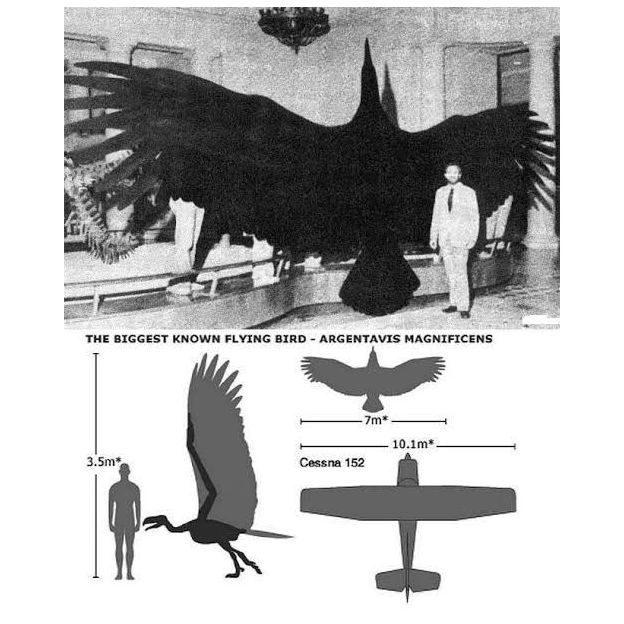
Argentavis magnificens is the largest flying bird ever confirmed from the fossil record. A mature individual carried a wingspan of six to seven metres, weighed seventy to eighty kilograms, and stood nearly two metres tall at the shoulder.
For several million years during the Late Miocene it glided above the open grasslands of what is now central Argentina, riding thermal updrafts and the rising slopes of the young Andes in search of the large mammal carcasses that sustained it.
The species is so large that aeronautical engineers and ornithologists have repeatedly described it as the physical upper limit of powered flight - a bird operating, by all available evidence, at the absolute ceiling of what biology and physics together will allow an active flier to be.
This guide covers every aspect of Argentavis biology and ecology that the fossil record and modern biomechanical reconstruction allow: classification within the teratorns, discovery history in Argentina, size and skeletal anatomy, the extraordinary mechanics of thermal soaring at this scale, diet as a scavenger and possible small-prey hunter, the Miocene South American world that produced and then outlived it, and the debates that still surround its lifestyle more than four decades after its formal description.
It is a reference entry, not a summary - so expect specifics: kilograms, metres, million-year dates, joules of flight energy, and verified records from the 1979-1983 discovery campaign and the papers that followed.
Etymology and Classification
The scientific name Argentavis magnificens was erected in 1980 by the American palaeontologist Kenneth E. Campbell of the Natural History Museum of Los Angeles County and the Argentine palaeontologist Eduardo Pedro Tonni, working on material recovered from Epecuen Formation deposits in La Pampa Province.
The genus name combines the Latin argentum (silver, referencing Argentina, "the land of silver") with avis (bird) to produce "Argentine bird". The species epithet magnificens means "magnificent" or "splendid" and reflects the extraordinary scale of the material being described.
Informal translations such as "magnificent argentine bird" and "giant teratorn of the pampas" appear in the popular and educational literature.
Campbell and Tonni placed the new species within the family Teratornithidae, a small but ecologically dramatic group of giant soaring birds endemic to the New World.
Teratorns are generally classified within the order Accipitriformes alongside hawks, eagles, and Old World vultures, though a minority of researchers argue the group is distinct enough - particularly in skull and pelvic architecture - to warrant its own order. Within the family, Argentavis is by far the largest known representative.
The formal taxonomy runs:
- Kingdom: Animalia
- Phylum: Chordata
- Class: Aves
- Order: Accipitriformes
- Family: Teratornithidae
- Genus: Argentavis
- Species: Argentavis magnificens
The closest living relatives of the teratorns are the New World vultures and condors (family Cathartidae), including the Andean condor (Vultur gryphus) and the California condor (Gymnogyps californianus). These living cathartids share the obligate soaring lifestyle, the hooked carrion-tearing beak, and the broad bare-skinned head region that Argentavis is reconstructed as having.
They also share the same continent: the Andean condor still rides the same Andean updraft systems that Argentavis once used, at a smaller scale and in a modified landscape.
Discovery and the Type Specimen
The first diagnostic Argentavis material came to light in 1979 at a fossil-rich quarry in the Epecuen Formation of La Pampa Province, roughly 500 kilometres west of Buenos Aires. The initial find - a strikingly large humerus - was so much bigger than any previously reported avian wing bone from the region that palaeontologists initially struggled to identify the element.
A humerus measuring approximately 55 centimetres in length was at the time longer than the entire torso of most modern large birds, and early comparison had to reach for condor and teratorn analogues scaled up several fold before the bird's true dimensions became obvious.
Campbell and Tonni published their formal description in 1980, naming the new species and assigning the recovered material as the type. A follow-up flight-reconstruction paper in 1983 extended the analysis to wing anatomy, mass estimation, and the first serious effort at biomechanical modelling.
Between 1979 and 1983 additional Argentavis material was recovered both from La Pampa and from the Andalhuala Formation of Catamarca Province to the north, widening the bird's known range and confirming that the initial find was not an isolated giant but a member of a stable species.
The type specimen and principal reference collection are housed at the Museo de La Plata, the natural-history museum of the National University of La Plata in Buenos Aires Province, one of the most important palaeontological institutions in South America. The museum holds the core wing, skull, and hindlimb material on which all subsequent reconstructions have been based.
Additional Argentavis fossils have since been reported from further Miocene deposits of central and northern Argentina, but all well-documented remains to date come from inside modern Argentine borders.
Size and Physical Description
The sheer scale of Argentavis is the single feature that sets it apart from any other known bird.
Body dimensions:
- Wingspan: 6-7 metres (wingtip to wingtip)
- Body mass: 70-80 kg, with some estimates up to 110 kg for the largest individuals
- Total body length (beak to tail): approximately 1.25-1.40 metres
- Standing height at the shoulder: 1.5-2.0 metres
- Skull length: approximately 55-60 cm
Wing and feather structure:
- Humerus length: up to 55 cm - longer than an adult chicken head-to-tail
- Primary feather length: estimated up to 1.5 m
- Primary feather width: up to 20 cm
- Wing loading: roughly 8.5-11 kg per square metre, similar to a hang glider
For comparison, the largest flying birds alive today top out at roughly twelve to fifteen kilograms of body mass. The wandering albatross (Diomedea exulans) reaches a wingspan of about 3.5 metres and a body mass near 12 kilograms. The Andean condor (Vultur gryphus), which rides the same Andean thermal systems Argentavis once used, reaches a 3.2-metre wingspan and about 15 kilograms. Argentavis was therefore roughly twice as wide as any living flying bird and five to seven times heavier.
The only comparably sized flying bird in the fossil record is the seabird Pelagornis sandersi, described in 2014 from an Oligocene deposit in South Carolina, with an estimated wingspan of 6.1 to 7.4 metres. Pelagornis, however, had a much more lightly built body in the 20 to 40 kilogram range because it was a long-distance ocean soarer optimised for minimum wing loading.
By combined wingspan and body mass, Argentavis magnificens remains unmatched among known birds. It is, in the strict numerical sense, the largest flying bird the Earth is known to have produced.
The body was disproportionately short relative to the wings. A torso little over a metre long supported wings three times that length each. This geometry is shared at smaller scales with modern albatrosses and condors and is diagnostic of a lifestyle committed to long-duration soaring rather than manoeuvrable flapping. The head was large, the beak heavy and hooked, and the neck long and muscular - a configuration matched today by condors and other large obligate scavengers.
Flight - A Living Glider
The most contested and most interesting aspect of Argentavis biology is how it flew. For decades after its discovery, researchers debated whether such a large bird could fly at all. Biomechanical modelling has since converged on a clear answer: yes, Argentavis flew, but it did so almost entirely by soaring rather than flapping, and its flight mode is closer to a sailplane than to any living bird.
The key analysis is a 2007 paper by the palaeontologist Sankar Chatterjee, the aerodynamicist R. Jack Templin, and Kenneth Campbell himself, published in the Proceedings of the National Academy of Sciences. Chatterjee and colleagues applied standard aircraft-flight-dynamics models to Argentavis's reconstructed mass, wing area, aspect ratio, and muscle-power envelope. Their conclusions were unambiguous:
- The bird's pectoral musculature could not generate enough sustained power for level flapping flight at its body mass.
- Takeoff by flapping from flat ground was implausible; Argentavis needed a slope, a headwind, or an elevated launch to reach flying airspeed.
- Once airborne, Argentavis could exploit thermal updrafts over sun-heated open country and orographic (slope) lift along the rising Andes to stay aloft for hours with minimal energy expenditure.
- Estimated cruising airspeed under thermal soaring was approximately 65 to 70 kilometres per hour, with a glide ratio of roughly 12:1 - meaning the bird travelled 12 metres forward for every metre lost to gravity in still air.
This is the flight mode of a hang glider or sailplane, not of a modern flapping bird. Argentavis lived by climbing thermal columns and then gliding across country between thermals, riding cumulus-driven heat columns and ridge-driven mountain lift exactly the way Andean condors do today - but scaled up enormously.
Flight limits and implications:
- Early-morning and late-afternoon flight would have been severely restricted when thermals were weak.
- Overcast and rainy days effectively grounded the bird.
- Seasonal and geographic patterns of atmospheric heating shaped where and when Argentavis could operate at all.
- Long flights across open ocean or unbroken forest - where thermals fail - were probably impossible.
This makes Argentavis one of the most environmentally constrained flying animals known. Its ecology and its atmosphere were inseparable. Every landscape Argentavis inhabited had to provide predictable updrafts, suitable launch points, and enough time per day under convective conditions for the bird to forage profitably.
The Andean Updraft Engine
Argentavis's dependence on soaring makes the geography of Late Miocene Argentina part of its biology. Two sources of lift supported it: thermal convection over open plains and slope lift along the rising proto-Andes to the west.
During the Late Miocene, the Andes were undergoing a phase of rapid uplift. By the time Argentavis is found in the fossil record, the range was high enough to deflect the prevailing westerly winds upward into powerful standing slope lift along its eastern flank. That ridge of lift ran for thousands of kilometres along the western edge of Argentavis's range and provided reliable, predictable updrafts that a soaring giant could use for long-distance travel.
The open pampas and monte habitats of central Argentina, meanwhile, produced classic thermal columns under the strong mid-latitude sun. Convective thermals over sun-heated savanna typically rise at three to five metres per second - more than enough to keep a 70 to 80 kilogram bird climbing. Under good conditions Argentavis could combine thermal soaring over open country with orographic soaring along the Andes to cover several hundred kilometres in a single day with almost no flapping.
This coupling of mountain uplift, continental-scale wind patterns, and open-terrain thermals appears to have been a necessary precondition for the species. Argentavis is known only from Argentina because no other region of the Late Miocene world offered the same combination of convection and slope lift at the same scale.
Diet and Feeding Ecology
The diet of Argentavis has been debated since the species was first described. Two positions have persisted in the literature: the scavenger hypothesis (analogous to a giant condor) and the predator hypothesis (analogous to a giant eagle). The modern consensus sits much closer to the scavenger end, with opportunistic predation on small-to-medium prey as a minor component.
Evidence for the scavenger interpretation:
- Skull, beak, and neck morphology resemble New World vultures and condors more than active predators.
- Obligate soaring flight is inefficient for pursuing live prey that can take cover.
- Wing loading and flight envelope match the optimum for long-duration searching across open country - the classic scavenger strategy.
- No large talons or raptorial grip structure are preserved in the known material.
- The Late Miocene pampas supported abundant large herbivores and therefore a steady carcass supply.
Evidence for occasional predation:
- The hooked beak was capable of killing and tearing prey up to the size of a small mammal.
- Modern large cathartids - turkey vultures, caracaras, and even condors on occasion - opportunistically take live prey when available.
- The Argentavis skull shows some features more robustly built than purely carrion-feeding taxa require.
- Live small prey may have been swallowed whole in the manner modern vultures use.
The likely picture is a bird that spent most of its foraging time searching for large carcasses across the Miocene pampas from high altitude, descending to feed on ungulate and glyptodont remains, and supplementing that diet with small live prey when circumstances allowed. A mature Argentavis probably required on the order of five to ten kilograms of meat per day, and a single large carcass could feed the bird, its mate, and potentially its offspring for several days.
| Feature | Argentavis magnificens | Andean condor (modern) |
|---|---|---|
| Body mass | 70-80 kg | 11-15 kg |
| Wingspan | 6-7 m | 3.0-3.3 m |
| Cruise airspeed | ~65-70 km/h | ~55 km/h |
| Wing loading | ~8.5-11 kg/m^2 | ~12 kg/m^2 |
| Diet | Carcasses + occasional prey | Carcasses (near obligate) |
| Flight mode | Obligate thermal and slope soaring | Obligate thermal and slope soaring |
| Range | Late Miocene Argentina | Modern western South America |
The Andean condor is the clearest modern analogue, which is why the ecological reconstruction of Argentavis leans so heavily on condor behaviour. A condor foraging above the Andes today covers up to 250 kilometres in a single day with essentially no flapping, returning to the same cliff-roost sites night after night. Scaled up, that is roughly the lifestyle researchers assign to Argentavis: a wide-ranging condor of continental proportions.
The Miocene Argentine World
The Late Miocene of central Argentina - 6 to 8 million years ago - was a different world from the pampas of today, though continuous enough to be recognisable. Temperatures were warmer, rainfall more seasonal, and the fauna radically stranger.
Key fauna of Argentavis's ecosystem:
- Toxodonts - rhino-sized notoungulate herbivores
- Macrauchenia-like litopterns - long-necked three-toed browsers
- Glyptodonts - armoured armadillo relatives up to two metres long
- Ground sloths of multiple lineages
- Large notoungulate browsers and grazers
- Phorusrhacids - the "terror birds", another apex group of giant flightless predators
- Sparassodonts - large marsupial-like carnivores
This was the classic isolated South American fauna, still effectively cut off from North America by the open Central American seaway that would not close for another three to four million years. Apex predation was divided between sparassodont carnivores and phorusrhacid terror birds. Apex scavenging, on the evidence, belonged to the teratorns - and Argentavis sat at the top of that guild.
The ecosystem produced exactly the kind of large-bodied prey base an obligate soaring scavenger needed. Toxodonts, glyptodonts, and large notoungulates together generated a steady supply of multi-hundred-kilogram carcasses on the open pampas, enough to support a species with Argentavis's foraging strategy across millions of years.
Life History - What We Can Infer
Direct life-history data for Argentavis is limited, because the fossil record preserves bones rather than behaviours. The inferences drawn from the bird's size, lifestyle, and living relatives align closely, however.
Expected life-history parameters:
- Clutch size: 1-2 eggs, by analogy with large soaring raptors and condors
- Incubation: approximately 60 days
- Fledging age: 12-16 months
- Age at first breeding: probably 10+ years
- Lifespan: 50-100 years by analogy with modern condors
- Breeding interval: every 2 years or less often, limited by offspring growth
This is the classic profile of a slow-breeding, long-lived apex soaring scavenger. Individual longevity high, reproductive tempo low, population density low. The resulting population was durable under stable conditions but fragile under any sustained environmental disruption - the same vulnerability pattern seen in modern condors and other large raptors.
Nesting sites are generally assumed to have been cliff ledges and rocky outcrops along the eastern Andean foothills and comparable uplift features, because open pampas lacked the structural substrates required to support the nest of a bird weighing 70 to 80 kilograms. Modern Andean condors similarly nest on cliff ledges, using identical geography.
Extinction
Argentavis magnificens vanishes from the fossil record at the end of the Miocene, approximately 5 to 6 million years ago. The precise cause is not firmly established, but several converging environmental shifts match the timing.
Likely contributing factors:
- Climatic drying. The Late Miocene-Pliocene transition in South America brought drier, more seasonal climates across much of the continent. Open pampas persisted, but productivity fluctuated more strongly across years. For a slow-breeding apex scavenger, multi-year prey shortfalls are catastrophic.
- Andean uplift reshaping thermals. The ongoing rise of the Andes altered regional atmospheric circulation, potentially disrupting the predictable thermal and slope lift patterns Argentavis depended on to fly at all.
- Fauna turnover. Shifts in the South American large-mammal fauna during the late Miocene-Pliocene changed the composition of the carcass supply, with some preferred prey taxa declining before the Great American Biotic Interchange introduced new competitors.
- Approach of the Great American Biotic Interchange. Although the Panamanian isthmus did not fully close until approximately 3 million years ago, new faunal elements began filtering between the Americas before complete closure. New carnivore and scavenger communities applied new competitive pressure.
No single cause is known to have been decisive. The combination of climate drying, atmospheric reorganisation, and fauna turnover in a species already living at the physical upper limit of flight appears to have been enough.
Smaller teratorns persisted in the Americas until the very end of the Pleistocene, roughly 10,000 years ago - Teratornis merriami is well represented at the La Brea tar pits of Los Angeles - but the giant obligate-soaring apex scavenger Argentavis itself disappeared millions of years earlier.
Argentavis and Other Flying Giants
Argentavis is the largest confirmed flying bird, but the broader category of flying animals includes larger organisms from other groups.
| Taxon | Wingspan | Body mass | Group | Age |
|---|---|---|---|---|
| Quetzalcoatlus northropi | 10-11 m | 200-250 kg | Pterosaur | Late Cretaceous |
| Hatzegopteryx thambema | 10-11 m | 200-250 kg | Pterosaur | Late Cretaceous |
| Argentavis magnificens | 6-7 m | 70-80 kg | Bird | Late Miocene |
| Pelagornis sandersi | 6.1-7.4 m | 20-40 kg | Bird | Late Oligocene |
| Teratornis merriami | 3.5-4 m | 15 kg | Bird | Late Pleistocene |
| Wandering albatross (modern) | 3.5 m | 12 kg | Bird | Recent |
| Andean condor (modern) | 3.0-3.3 m | 11-15 kg | Bird | Recent |
Among non-birds, the azhdarchid pterosaurs of the Late Cretaceous remain the largest known flying animals, with Quetzalcoatlus northropi and Hatzegopteryx reaching 10 to 11 metre wingspans and estimated body masses of 200 to 250 kilograms. Those species predated Argentavis by more than sixty million years and belonged to an entirely different clade.
Among birds specifically, the Pelagornis sandersi described in 2014 from South Carolina approaches Argentavis in wing dimension but was less than half the body mass, reflecting its specialisation as a light ocean-soarer rather than a terrestrial apex scavenger.
By wingspan alone Argentavis is approximately tied with the largest known birds. By combined wingspan and body mass, it is alone.
The 1980 Reconstruction and Its Legacy
The original Campbell and Tonni reconstruction of Argentavis, published in 1980 and extended in the 1983 flight-dynamics paper, set the benchmark for all subsequent work on the species. It immediately rewrote the known upper size limit for flying birds and prompted a new generation of aerodynamic modelling of giant vertebrate fliers, including renewed work on the azhdarchid pterosaurs.
The reconstruction has been refined in details - body mass estimates have drifted upward slightly, flight-energy calculations have become more sophisticated, wing-shape modelling has improved - but the core picture Campbell and Tonni produced in 1980 has held up for more than four decades. Argentavis remains a soaring giant of the Miocene pampas, a living glider tied to Andean updrafts, and the practical upper limit of what powered flight has so far produced in the bird lineage.
Related Reading
- Haast's Eagle: The Largest Eagle That Ever Lived
- Moa: Giant Flightless Birds of New Zealand
- Terror Bird: Apex Predator of South America
- Prehistoric Birds: Terror Birds and Ancient Avian Giants
References
Relevant peer-reviewed and historical sources consulted for this entry include the original species description by Campbell and Tonni (1980) in Contributions in Science of the Natural History Museum of Los Angeles County, the 1983 flight and palaeoecology paper by the same authors, the biomechanical flight analysis by Chatterjee, Templin, and Campbell (2007) in the Proceedings of the National Academy of Sciences, subsequent teratorn systematic work placing Argentavis within Teratornithidae, and comparative work on the South American Late Miocene fauna and Andean uplift history.
The type specimen and principal reference material for the species are held at the Museo de La Plata, Buenos Aires Province, Argentina.
Frequently Asked Questions
How big was Argentavis magnificens?
Argentavis magnificens is the largest flying bird confirmed from the fossil record. Wingspan estimates derived from the length and proportion of preserved humerus, ulna, and carpometacarpus bones place it at 6 to 7 metres from wingtip to wingtip. Estimated body mass ranges from 70 to 80 kilograms based on skeletal volumes and density-based reconstructions. Standing height at the shoulder was 1.5 to 2 metres.
For comparison, the largest flying bird alive today, the wandering albatross, has a wingspan of 3.5 metres and a body mass of roughly 12 kilograms. The Andean condor, which lives in the same region today, reaches 3.2 metres and 15 kilograms. Argentavis was therefore roughly twice as wide and five to seven times heavier than any living flying bird.
When and where did Argentavis live?
Argentavis lived in the Late Miocene, approximately 6 to 8 million years ago, in what is now central and northern Argentina. Fossil material is concentrated in the Epecuen Formation of La Pampa Province and the Andalhuala Formation of Catamarca Province, with additional fragmentary remains from Buenos Aires Province.
The Late Miocene South American landscape featured extensive grasslands and open savannas with abundant large mammals, and the proto-Andes were rising rapidly to the west. This combination of open terrain for carcass spotting and mountain-driven thermal updrafts for soaring appears to have supported an apex avian scavenger radiation of which Argentavis was the largest member.
No Argentavis remains have been found outside Argentina, making the species effectively endemic to that region.
Was Argentavis a predator or a scavenger?
The modern consensus treats Argentavis as primarily an apex scavenger, analogous in ecology to today’s Andean condor but scaled up several fold. The bird’s skull, beak, and neck morphology resemble the Cathartidae (New World vultures and condors) more than they resemble active predators. Its massive size and obligate soaring flight made swift predatory strikes energetically expensive.
However, some researchers argue Argentavis may have occasionally taken small-to-medium live prey - rabbits, small rodents, and juvenile ungulates - swallowed whole like modern vultures and caracaras sometimes do. The hooked beak was capable of both tearing carcasses and dispatching small prey.
The predator-versus-scavenger debate began with the species’ 1980 description and has never been fully settled, but the weight of evidence points to a carcass-dominated diet with opportunistic predation on small prey when conditions allowed.
Could Argentavis actually fly?
Yes, Argentavis could fly, but with significant caveats. Biomechanical studies - most notably a 2007 paper by Chatterjee, Templin, and Campbell in the Proceedings of the National Academy of Sciences - concluded that the bird was too heavy for sustained flapping flight. Its pectoral muscles, while enormous, could not generate enough power to keep a 70 to 80 kilogram body airborne by flapping alone.
Instead Argentavis flew as a glider, relying on thermal updrafts over sun-heated plains and slope-generated lift along the rising Andes to stay aloft for hours at a time. Takeoff was challenging: the bird likely ran downhill into the wind or dropped from an elevated perch to reach the airspeed necessary for lift.
Once airborne on a rising thermal it could cruise at approximately 65 to 70 kilometres per hour with minimal energy expenditure and could probably cover several hundred kilometres per day under good atmospheric conditions.
What is Argentavis most closely related to?
Argentavis belongs to the family Teratornithidae, commonly known as teratorns - a uniquely New World group of giant soaring birds that persisted until the end of the Pleistocene. Teratorns are most closely related to the New World vultures and condors (Cathartidae), and the group is usually placed within the order Accipitriformes alongside modern hawks, eagles, and Old World vultures, though some researchers argue teratorns deserve their own order.
Pleistocene relatives included Teratornis merriami, known from the La Brea tar pits of California with a 3.5 to 4 metre wingspan, and Aiolornis incredibilis of North America with a 5 metre wingspan. Argentavis was the oldest and largest known teratorn.
The closest living analogue by ecology and morphology is the Andean condor, Vultur gryphus, which shares the same South American range and also depends heavily on thermal and slope soaring - but at roughly one-sixth the mass of Argentavis.
Who discovered Argentavis and where is the type specimen?
Argentavis magnificens was discovered between 1979 and 1983 in Argentine fossil deposits, with the key initial material recovered from a quarry in La Pampa Province in 1979. The species was formally described in 1980 by American palaeontologist Kenneth E. Campbell of the Natural History Museum of Los Angeles County, working with Argentine palaeontologist Eduardo Tonni.
The type specimen and principal reference material are held at the Museo de La Plata in La Plata, Buenos Aires Province - one of the most important palaeontological institutions in South America. The type material includes a nearly complete humerus measuring roughly 55 centimetres, an ulna, a skull fragment, and associated wing and leg bones. Additional Argentavis material has since been recovered from the Andalhuala Formation of Catamarca Province.
The 1980 description and Campbell and Tonni’s subsequent 1983 flight reconstruction remain foundational references for the species.
Why did Argentavis go extinct?
The precise cause of Argentavis’s extinction is not firmly established, but its disappearance coincides with the major climatic and ecological transitions of the late Miocene into the Pliocene approximately 5 to 6 million years ago. Several factors probably combined. The Miocene South American climate shifted toward drier and more seasonal conditions, reducing the open-country large-mammal carcass supply Argentavis depended on for food.
The rise of the Andes altered regional atmospheric patterns and thermal behaviour, potentially changing the predictability of soaring conditions the bird required to fly at all. The closure of the Panamanian isthmus around 3 million years ago triggered the Great American Biotic Interchange, bringing new carnivores, new scavenger competitors, and novel prey communities into South America.
Any of these changes alone might have been survivable, but their combined effect on an apex obligate soaring scavenger - a species at the extreme end of its ecological viability even under ideal conditions - appears to have been terminal. Smaller teratorns persisted in the Americas until the end of the Pleistocene, but Argentavis itself vanished millions of years earlier.
How does Argentavis compare with other flying giants of the past?
Argentavis is the largest flying bird ever confirmed, but it is not the largest flying animal ever. Several pterosaurs of the Late Cretaceous - notably Quetzalcoatlus northropi of North America and Hatzegopteryx of Europe - are estimated to have reached wingspans of 10 to 11 metres and body masses of 200 to 250 kilograms.
Those species predated Argentavis by more than 60 million years and belonged to an entirely different group, the azhdarchid pterosaurs, which were not birds. Among birds specifically, Argentavis remains the record-holder.
A possible challenger named Pelagornis sandersi, a seabird described in 2014 from South Carolina with a 6.1 to 7.4 metre wingspan, approaches Argentavis in wing dimensions but had a much lighter body - probably 20 to 40 kilograms - because it was built for long-duration ocean soaring.
By combined wingspan and body mass, Argentavis magnificens remains unmatched among known birds, and its flight dynamics sit at the physical upper limit for any animal capable of active takeoff under gravity on Earth.