
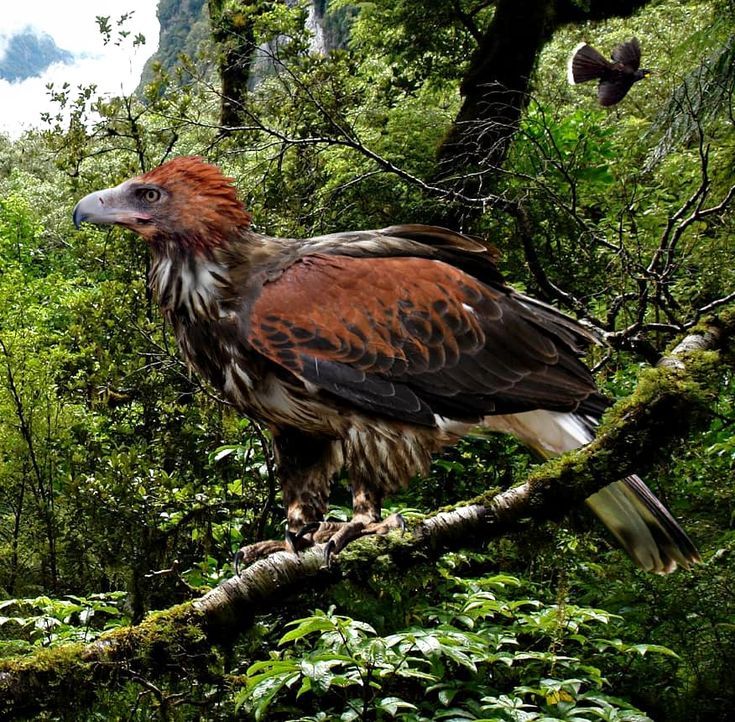
Haast's eagle was the largest eagle ever known to have existed. A female in peak condition weighed up to eighteen kilograms, carried a wingspan of nearly three metres, and struck prey with talons that matched a modern tiger's claws in both length and curvature.
For at least a million years it was the apex predator of New Zealand's South Island, hunting moa several times its own body mass in dense forest and along alpine cliff faces. It was also, on the balance of available evidence, the only known raptor to have regularly taken human beings as prey.
This guide covers every aspect of Haast's eagle biology, ecology, and extinction: classification, evolutionary origin, body size and strike mechanics, hunting behaviour, relationship with the moa, the Maori oral tradition of the pouakai, forensic evidence of attacks on humans, the ancient DNA work that rewrote its taxonomy, and the co-extinction pair that linked its fate to the moa.
It is a reference entry, not an overview - so expect specifics: kilograms, centimetres, radiocarbon dates, joules of impact energy, and verified records.
Etymology and Classification
The Maori name for Haast's eagle is pouakai in the majority of South Island oral traditions, with hokioi (sometimes transcribed as hakawai) appearing in other regional accounts. Both names refer to a gigantic predatory bird that descended from the mountains and seized prey - including, in multiple traditions, people. These names survived in song, whakatauki, and place names for centuries after the species itself had disappeared.
The European scientific name was erected in 1871 by the German-born New Zealand geologist Julius von Haast, who worked from sub-fossil bones recovered in Canterbury swamps and caves. Haast placed the bird in its own genus as Harpagornis moorei, meaning "grappling hook bird" in reference to the enormous talons, with the species epithet honouring landowner George Moore of Glenmark Station whose property yielded many of the key specimens.
Taxonomic opinion shifted in 2005 when ancient DNA work by Michael Bunce and colleagues sequenced mitochondrial genes from sub-fossil Haast's eagle bone. The results were striking: the bird was not a deep-time relict in its own genus but a close cousin of the little eagle (Hieraaetus morphnoides) of Australia and New Guinea. The scientific name was revised to Hieraaetus moorei, though older sources and many museum specimen labels still read Harpagornis moorei.
The formal taxonomy runs:
- Kingdom: Animalia
- Phylum: Chordata
- Class: Aves
- Order: Accipitriformes
- Family: Accipitridae
- Genus: Hieraaetus
- Species: Hieraaetus moorei
Placing the bird inside Hieraaetus has significant evolutionary implications. It means Haast's eagle is not a distant ancient lineage but a recently evolved giant - the product of an ancestor that reached New Zealand from Australia within the last one to two million years and underwent explosive size increase after arrival.
The Fastest Size Increase in the Fossil Record
The little eagle, Haast's eagle's closest living relative, weighs approximately one kilogram. Haast's eagle weighed up to eighteen kilograms. That is a roughly ten to fifteen-fold mass increase - in well under two million years.
This is one of the most rapid body size expansions ever documented in any vertebrate lineage. For context, most raptor lineages show only modest size shifts across tens of millions of years. The Haast's eagle expansion happened within a geologically trivial window.
Ecological opportunity drove the change. The little eagle's ancestor arrived in a country with:
- No mammalian predators of any kind larger than bats.
- Nine species of flightless moa occupying every available herbivore niche from coastal dune to alpine grassland.
- Abundant other flightless birds including giant geese, rails, and kakapo.
- No existing large raptor to compete for the vacant apex predator role.
An open top-predator niche with enormous packed-protein prey selected for bigger and more powerful birds across generations. Each successive generation that could handle larger moa had a significant fitness advantage. Over perhaps one to two million years this produced the eighteen-kilogram giant that Julius von Haast would eventually reconstruct from fossil bone.
Size and Physical Description
Haast's eagle exhibited strong reverse sexual size dimorphism, with females substantially larger than males. This pattern is typical across raptors but reached extreme proportions in Haast's eagle.
Females:
- Weight: 12-18 kilograms
- Wingspan: 2.8-3.0 metres
- Total length (bill to tail): approximately 1.4 metres
- Talon length (outer curve): up to 9 centimetres
Males:
- Weight: 10-12 kilograms
- Wingspan: 2.6-2.8 metres
- Total length: approximately 1.2 metres
For comparison, the largest eagles alive today - Steller's sea eagle, the harpy eagle, and the Philippine eagle - all top out around nine kilograms, with wingspans of 2.0 to 2.5 metres. Haast's eagle was roughly thirty to forty per cent heavier than any living eagle, with talons that exceeded those of any living raptor in both length and structural robustness.
The wings were relatively short and broad for the body mass - a feature sometimes used in older literature to argue the bird could not truly fly. Modern biomechanical modelling has firmly rejected that interpretation. The short wings are an adaptation to dense New Zealand forest habitat, where long wings would catch on vegetation during ambush attacks. The bird flew powerfully but was built for manoeuvrability and impact, not for open-country soaring.
The skull was massive. Beak depth and curvature match modern booted eagles scaled up several times. Optic orbits were large and forward-facing, consistent with binocular vision for targeting prey during high-speed stoops. The cranial robustness suggests a strike force well beyond anything seen in living raptors.
The Talons
Haast's eagle's talons are the single feature that most dramatically set it apart from any living bird of prey. Each foot bore four talons, with the two outer talons - analogous to the hallux in living eagles - being especially enlarged.
Talon dimensions:
- Outer curve length: up to 9 centimetres
- Straight-line length: approximately 6-7 centimetres
- Cross-sectional diameter at base: up to 2 centimetres
- Curvature profile: steep hook, comparable to a felid claw
Sub-fossil talons recovered from South Island swamps have repeatedly been compared in size and shape to the claws of Bengal tigers. Both structures converge on the same solution: a hook built for deep penetration and anchor-point grip on large mammalian or avian prey. The comparison is not poetic licence; it reflects real structural and dimensional similarity.
Haast's eagle foot articulation allowed enormous grip force. Biomechanical reconstruction of talon attachment points suggests grip strength exceeding any living raptor, sufficient to penetrate the thick muscle and tendon of an adult moa and reach underlying bone in a single strike.
Hunting and Strike Mechanics
Haast's eagle hunted by stooping on prey from elevated perches or from circling flight. Reconstructed attack dynamics estimate strike velocities of around 80 kilometres per hour and impact energies in excess of 300 joules - roughly equivalent to a concrete block dropped from the roof of a two-storey house.
Attack sequence as reconstructed:
- Perch or soar. The eagle watched from a ridge, cliff face, or open forest edge for moa activity below.
- Stoop. When a target presented a clear angle, the eagle dived with wings partially folded, accelerating under gravity and wingbeats.
- Strike. Both feet extended forward, talons spread wide, targeting the pelvic region of the moa.
- Penetration and collapse. Outer talons drove deep into pelvic muscle and bone; the moa's legs buckled under the combined impact and talon anchorage.
- Feeding over days. Once the moa was immobilised, the eagle fed on soft tissue and organs, caching and revisiting the carcass over several days.
The pelvic targeting strategy is confirmed by sub-fossil pelvic bones recovered from moa deposits across the South Island. Many moa pelvises show paired puncture wounds spaced exactly the width of Haast's eagle's foot grip, with penetration depths matching the length of the bird's outer talons. These pathologies are so diagnostic that palaeontologists use them to identify eagle predation at sites where no eagle bone is preserved.
| Metric | Haast's eagle | Modern harpy eagle |
|---|---|---|
| Body mass (female) | up to 18 kg | up to 9 kg |
| Wingspan | 2.6-3.0 m | 1.8-2.0 m |
| Outer talon length | up to 9 cm | up to 7 cm |
| Strike energy (estimated) | ~300 J | ~100 J |
| Typical prey mass ceiling | up to ~200 kg (moa) | up to ~10 kg (sloths) |
| Prey-to-eagle mass ratio | up to ~15:1 | up to ~1.5:1 |
The prey-to-predator ratio is the key number. No living eagle routinely takes prey more than twice its own body mass. Haast's eagle took prey up to fifteen times its own body mass. That shift required not just bigger body size but a different hunting strategy, focused on single high-impact strikes and long-duration carcass use rather than repeated kills.
Prey and Feeding Ecology
Haast's eagle's primary prey was moa. The South Island supported five to six moa species in overlapping ranges, spanning thirty-kilogram bush moa through to 230-kilogram giant moa. Haast's eagle could and did target the full range, with body-size pairing between predator and prey adjusted by circumstance.
Confirmed and inferred prey species:
- Dinornis robustus - South Island giant moa, primary prey by biomass
- Pachyornis elephantopus - heavy-footed moa, commonly targeted
- Emeus crassus - eastern moa
- Euryapteryx curtus - coastal moa
- Anomalopteryx didiformis - bush moa
- Cnemiornis calcitrans - South Island goose, a large flightless waterfowl
- Aptornis defossor - South Island adzebill, a heavy flightless gruiform
- Kakapo, weka, juvenile moa, and smaller flightless rails - opportunistic prey
A single adult moa carcass of 150 to 200 kilograms provided far more meat than one eagle could consume in one meal. Haast's eagle is therefore thought to have behaved more like a large solitary felid around kills than like a typical raptor. The bird fed on the carcass repeatedly over several days, returning to the kill site and, where topography allowed, physically dragging pieces to a favoured perch or rock outcrop for consumption.
This pattern has implications for the bird's overall density and range. A specialist predator eating moa at one kill every several days requires large territories. Population estimates for pre-human Haast's eagle are uncertain but likely in the low thousands of individuals across both main islands.
Nesting and Life History
Haast's eagle nesting sites are inferred from bone deposits, cave burials, and analogy with related raptors. Unlike most eagles, Haast's eagle is thought to have nested primarily on cliff ledges and rocky ground sites rather than in trees.
The reason is mechanical. New Zealand's native forest trees - podocarps, beech, lancewood - generally lack the thick horizontal branch architecture required to support a nest holding a bird of fifteen to eighteen kilograms plus one to two large eggs and growing young. Cliff ledges, by contrast, offer stable rock platforms that could bear any reasonable combination of bird and nest material.
Several South Island caves and rock shelters preserve Haast's eagle bones in configurations consistent with ground-level or ledge nesting, including juvenile and sub-adult material that strongly suggests these locations served as breeding sites rather than incidental death traps.
Inferred life history parameters:
- Clutch size: 1-2 eggs, based on large-raptor analogy
- Incubation duration: estimated 40-50 days
- Fledging age: 3-6 months
- Age at independence: probably well over a year, given body size
- Age at first breeding: likely 4-6 years
- Lifespan: probably 20-30 years in favourable conditions
These life-history parameters describe a slow-breeding, long-lived apex predator - the classic profile of a species highly vulnerable to any sustained mortality increase. When moa populations collapsed under Polynesian hunting, Haast's eagle's reproductive tempo was simply too slow to respond.
The Pouakai - Maori Oral Tradition
Maori oral tradition preserves an extensive memory of a gigantic predatory bird called the pouakai (or regionally hokioi or poukai) that seized people, livestock, and children from open ground. The bird is described as living on mountain cliffs, descending from the heights to snatch prey, and being powerful enough to carry off an adult or child.
Key elements of the pouakai tradition include:
- Cliff-based habitation. Consistently described as a bird of the mountains and cliff faces, not the lowland forest.
- Attack from above. Narratives describe the bird stooping from height onto unsuspecting humans.
- Predation on humans. Including specific accounts of children seized from near settlements.
- Defeat by human heroes. Multiple traditions record villages or individuals killing a pouakai to end its predation.
- Retention in place names. Several South Island place names contain pouakai as an element, often marking cliff sites or valleys where the bird was remembered.
Early European ethnographers generally dismissed these accounts as mythical embellishment. Haast himself, when he described the eagle in 1871, already suspected the connection to pouakai tradition but could not prove it.
The Forensic Confirmation
The key turning point came in 2009 when a morphological study published in PLOS Biology examined the attack biomechanics of Haast's eagle alongside preserved Maori skeletal material. The study found that:
- The bird's skull, beak, and talon geometry matched a dedicated killing strategy, not a scavenging one.
- Strike profile and talon spacing matched puncture wounds on some Maori skeletal remains.
- The bird's body mass and wing configuration were compatible with attacking and lifting prey in the size range of young humans or moderate loads.
Together these results rehabilitated the pouakai tradition as an accurate cultural memory of a real ecological interaction. The consensus position today is that Haast's eagle was the only known raptor confirmed to have preyed on humans, and the pouakai legend is treated as one of the clearest examples of long-distance oral transmission of accurate natural-history information in the human record.
Extinction
Haast's eagle went extinct around 1400 CE, within roughly one century of the collapse of its primary prey base. The timing is closely linked to the moa extinction sequence.
Extinction sequence:
- ~1280 CE: Polynesian settlers reach New Zealand. Moa hunting begins.
- 1280-1400 CE: Moa populations collapse across both main islands.
- ~1400 CE: Last well-dated Haast's eagle remains.
- ~1445 CE: Last well-dated moa remains.
The exact end date for Haast's eagle is difficult to pin down because sub-fossil material is rarer than for the moa. But radiocarbon work on eagle bone material consistently clusters in the 1300s and early 1400s, implying a functional extinction of the eagle either alongside or slightly before the final collapse of the moa.
Three factors combined to end the species:
- Prey base collapse. Moa provided the bulk of the eagle's caloric intake. As moa populations crashed from hunting, habitat burning, and nest predation, Haast's eagle could not switch to alternative prey of comparable size.
- Direct hunting. Maori hunted Haast's eagle for bone tools and plumage. Attacks on humans may have made deliberate extermination of localised pairs a cultural priority.
- Habitat change. Forest clearance by burning reduced the mosaic of forest, edge, and open shrubland that maximised moa density and eagle hunting opportunity.
The resulting co-extinction is one of the tightest predator-prey linkages in the recent fossil record - a single human generation saw the end of both species. It is also a textbook illustration of how specialist apex predators are disproportionately vulnerable to ecosystem disruption. Generalist predators can shift prey; specialists cannot.
Ancient DNA and Ongoing Science
Haast's eagle has become a productive system for ancient DNA work. Because the youngest remains are only around 600 years old and many come from cool South Island cave deposits, DNA preservation is reasonably good.
Milestones include:
- 2005: Full mitochondrial genome recovered and analysed. Haast's eagle placed inside Hieraaetus, closest relative identified as the little eagle.
- 2009: Morphological and biomechanical study in PLOS Biology confirmed attack profile compatible with moa pelvic damage and Maori skeletal wounds.
- 2010s: Partial nuclear genome recovery from multiple specimens refined divergence date estimates for the Haast's eagle / little eagle split.
- 2020s: Work continues on inferring genes associated with rapid body size increase during the New Zealand colonisation.
The little eagle result remains the single most important finding. It reframes Haast's eagle from an ancient relict into a recently evolved giant and makes it one of the headline cases for how rapidly body size can evolve under ecological release. The implications extend beyond the bird itself into the general question of how quickly vertebrate lineages can respond to island colonisation and empty apex predator niches.
Haast's Eagle Compared with Modern Giants
| Species | Weight (max) | Wingspan (max) | Main prey | Status |
|---|---|---|---|---|
| Haast's eagle | 18 kg | 3.0 m | Moa, other flightless birds | Extinct |
| Steller's sea eagle | 9 kg | 2.5 m | Salmon, sea birds | Vulnerable |
| Harpy eagle | 9 kg | 2.0 m | Sloths, monkeys | Vulnerable |
| Philippine eagle | 8 kg | 2.2 m | Monkeys, flying lemurs | Critically Endangered |
| Golden eagle | 7 kg | 2.3 m | Hares, marmots, ungulates | Least Concern |
| Little eagle (closest relative) | 1 kg | 1.3 m | Rabbits, reptiles | Least Concern |
The table makes the scale of Haast's eagle tangible: twice the mass of the largest eagles flying today, with a strike apparatus that has no living analogue and prey in a weight class - moa at up to 200 kilograms - that no living raptor approaches.
Related Reading
- Moa: Giant Flightless Birds of New Zealand
- Terror Bird: Apex Predator of South America
- Prehistoric Birds: Terror Birds and Ancient Avian Giants
- Dodo: The Flightless Bird That Vanished
References
Relevant peer-reviewed and historical sources consulted for this entry include ancient DNA work by Bunce et al. published in PLOS Biology (2005) establishing the Hieraaetus placement, the morphological and biomechanical analysis by Scofield and Ashwell (2009) on pouakai tradition and skull reconstruction, radiocarbon-based extinction modelling by Holdaway and colleagues on the New Zealand Holocene extinction sequence, Haast's original 1871 description in the Transactions and Proceedings of the New Zealand Institute, and the accumulated sub-fossil record held at Canterbury Museum, Te Papa Tongarewa, and Otago Museum.
Prey biomechanics and talon comparison data draw on the published raptor morphometric literature and New Zealand's sub-fossil pelvic trauma surveys.
Frequently Asked Questions
How big was Haast's eagle?
Haast’s eagle (Hieraaetus moorei) is the largest eagle known to have ever existed. Females, which were consistently larger than males, weighed 12 to 18 kilograms, while males weighed 10 to 12 kilograms. Wingspan reached 2.6 to 3 metres. By weight it was roughly 30 to 40% heavier than the largest eagles alive today - Steller’s sea eagle, the harpy eagle, and the Philippine eagle - all of which top out around 9 kilograms.
Its wings were relatively short and broad for its mass, an adaptation to manoeuvring in dense New Zealand forest rather than soaring over open terrain. Talons measured up to 9 centimetres along the outer curve, comparable in size to the claws of a modern tiger.
What did Haast's eagle eat?
Haast’s eagle was a specialist predator of moa, the giant flightless birds that dominated pre-human New Zealand. Primary prey species included Dinornis robustus and other large-bodied moa weighing between 50 and 230 kilograms. The eagle also took smaller flightless birds including the South Island goose and probably juvenile moa, kakapo, and weka.
Attack marks on moa pelvic bones preserved in sub-fossil deposits match the talon spacing and penetration depth of Haast’s eagle, confirming the predator-prey relationship biomechanically. After Polynesian settlement, forensic analysis of some Maori skeletal remains shows puncture wounds consistent with eagle talons, supporting oral traditions of human predation.
Carcasses far exceeded what a single eagle could eat at once, so each bird cached and revisited kills over several days.
Where did Haast's eagle live?
Haast’s eagle lived in New Zealand, primarily on the South Island where moa density was highest. Forested lowland valleys, forest-shrubland edges, and open alpine zones in the Canterbury and Otago regions produced the densest concentrations of sub-fossil remains. North Island records exist but are rarer.
Nesting took place on cliff ledges and ground sites among rock outcrops rather than in trees, because the bird’s mass - up to 18 kilograms - exceeded the load-bearing capacity of most New Zealand forest canopy. The species was endemic to New Zealand and never occurred anywhere else on Earth, having evolved in isolation on the archipelago for at least 1 to 2 million years before its extinction.
When and why did Haast's eagle go extinct?
Haast’s eagle went extinct around 1400 CE, within roughly a century of the collapse of its primary prey base. Polynesian settlers reached New Zealand around 1280 CE and hunted moa to extinction within 100 to 200 years. Haast’s eagle, as a specialist predator dependent on large moa for most of its caloric intake, could not switch to alternative prey in sufficient quantities to sustain its population.
Direct hunting by Maori for feathers and bone tools, combined with habitat change from forest clearance, accelerated the decline. The eagle’s disappearance is one of the clearest predator-prey co-extinctions in the recent fossil record - when the moa vanished, the eagle that depended on them vanished within the same human generation.
What is the closest living relative of Haast's eagle?
Haast’s eagle’s closest living relative is the little eagle (Hieraaetus morphnoides) of Australia and New Guinea. DNA analysis of sub-fossil Haast’s eagle bones, published in PLOS Biology in 2005, showed that the two species diverged from a common ancestor sometime within the last 1 to 2 million years. The little eagle weighs roughly 1 kilogram. Haast’s eagle weighed up to 18 kilograms.
This represents one of the most rapid body size increases ever documented in a vertebrate lineage - a roughly 10 to 15-fold mass expansion in well under 2 million years.
The shift was driven by ecological opportunity: on arrival in New Zealand the ancestor found a landscape populated by huge flightless birds with no mammalian predators, and natural selection favoured larger and more powerful individuals across generations until the eagle became a moa specialist.
Did Haast's eagle really attack humans?
The balance of evidence - Maori oral tradition, forensic analysis of skeletal remains, and attack biomechanics - indicates that Haast’s eagle did prey on humans at least occasionally. Maori traditions consistently describe a giant bird called the pouakai or hokioi that swept down from mountain cliffs to seize people, including children.
These accounts were dismissed as myth by early European ethnographers, but a 2009 morphological study of the eagle’s beak and talon geometry published in PLOS Biology demonstrated that its strike force and wound profile matched puncture marks found on a subset of Maori skeletal remains. The eagle’s mass - up to 18 kilograms - was sufficient to kill an adult human with a single high-speed strike.
The pouakai legend is now treated as an accurate cultural memory of a real ecological interaction between humans and a giant predatory bird.
How did Haast's eagle kill prey so much larger than itself?
Haast’s eagle killed prey up to 15 times its own body mass by combining high strike velocity, massive talons, and precise targeting of the pelvic region. Biomechanical reconstruction suggests the eagle stooped on moa from above at speeds of up to 80 kilometres per hour, striking with both feet extended. Estimated impact energy exceeds 300 joules - comparable to a concrete block dropped from a house roof.
The outer talons, measuring up to 9 centimetres, penetrated the moa’s thick musculature and reached the pelvic bones or internal organs. Many moa pelvises recovered from sub-fossil sites show paired puncture wounds spaced exactly the width of Haast’s eagle’s foot grip. Once a moa was immobilised the eagle fed on the carcass over several days, caching portions of the kill.
Who discovered Haast's eagle?
Haast’s eagle was formally described in 1871 by the German-born New Zealand geologist Julius von Haast, who worked from sub-fossil bones recovered in swamps and caves across the Canterbury region of the South Island. Haast named the species Harpagornis moorei in honour of George Moore, the landowner whose Glenmark swamp yielded key specimens. The genus Harpagornis - meaning ‘grappling hook bird’ - reflected the enormous talons.
DNA analysis published in 2005 showed the bird was actually nested within the existing genus Hieraaetus alongside the Australian little eagle, and the species is now formally called Hieraaetus moorei, though the name Harpagornis moorei still appears in older literature. Haast also described the moa bone beds at Glenmark and Pyramid Valley during the same era, making him one of the founding figures of New Zealand palaeontology.