
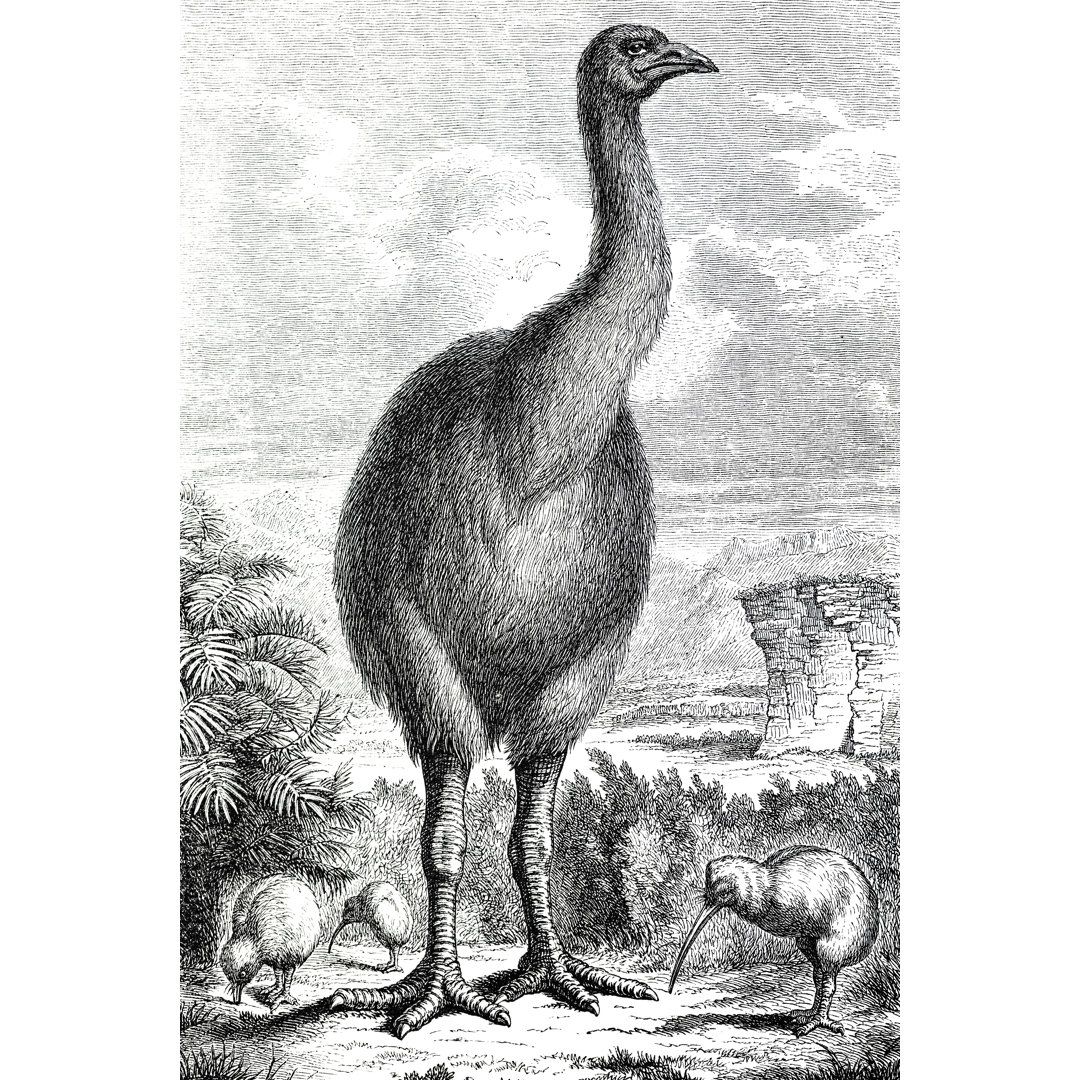
The moa was the tallest bird ever known, the only major bird lineage to lose its wings completely, and for roughly seventeen million years the undisputed dominant herbivore of prehistoric New Zealand. Nine recognised species in the family Dinornithidae and allied families evolved across an archipelago where no native land mammal grew larger than a bat.
When Polynesian settlers arrived in the late thirteenth century, they found a country populated by giant browsing birds with no instinctive fear of humans. Within roughly one to two centuries every moa species had been wiped out, leaving behind butchered bone middens, mummified carcasses in dry caves, cleaned skeletons in museums, and a persistent place in Maori oral tradition.
This guide covers every aspect of moa biology, ecology, and extinction: classification, size and physical structure, distribution across species, diet and digestion, reproduction, relationship to kiwis and tinamous, the collapse caused by human arrival, the rediscovery by Richard Owen, and the strange forensic and genetic work that continues to pull information out of moa remains centuries after the last bird fell.
It is a reference entry, not an overview - so expect specifics: centimetres, kilograms, radiocarbon dates, species counts, and verified records.
Etymology and Classification
The name moa comes directly from the Maori language and was already in use across New Zealand oral tradition long before any European collected a bone. The word appears in many cognate Polynesian languages for domestic fowl, and its retention for the extinct giants of New Zealand shows that memory of the living bird survived settlement, extinction, and centuries of silence.
The scientific name Dinornis, meaning 'terrible bird', was coined by the English anatomist Richard Owen in 1839. The representative species for this entry is Dinornis robustus, the South Island giant moa, with its close relative Dinornis novaezealandiae (the North Island giant moa) filling a similar ecological role in the northern half of the country.
Moa sit within the palaeognath radiation, the ancient branch of birds that also contains ostriches, emus, cassowaries, rheas, kiwis, and tinamous. The formal taxonomy runs:
- Kingdom: Animalia
- Phylum: Chordata
- Class: Aves
- Order: Dinornithiformes
- Family: Dinornithidae (plus allied families Emeidae and Megalapterygidae)
- Genus: Dinornis
- Species: Dinornis robustus (representative)
Historically over twenty moa species were described, many of them based on bones whose size differed markedly within a single site. Ancient DNA analysis, beginning in the mid-2000s and refined over the next decade, collapsed this inflated taxonomy by demonstrating that many of the 'species' were simply the two sexes of a single species displaying extreme reverse sexual size dimorphism. Modern consensus settles on nine species across six genera:
- Dinornis robustus - South Island giant moa
- Dinornis novaezealandiae - North Island giant moa
- Anomalopteryx didiformis - bush moa
- Emeus crassus - eastern moa
- Euryapteryx curtus - broad-billed or coastal moa
- Pachyornis elephantopus - heavy-footed moa
- Pachyornis australis - crested moa
- Pachyornis geranoides - Mantell's moa
- Megalapteryx didinus - upland moa
Some authors split or merge these groups slightly, but the nine-species framework is the working standard. Each species filled a distinct combination of habitat and plant community, from lowland conifer-broadleaf forest to subalpine tussock grassland.
Size and Physical Description
Moa were not uniformly giant. The family ranged from birds roughly the size of a large turkey up to the extreme proportions of Dinornis robustus. What united them was a complete loss of wings - a feature that makes them unique among known birds.
Dinornis robustus females (giant moa):
- Standing height (neck extended): up to 3.6 metres
- Back height: approximately 2 metres
- Weight: up to 230 kilograms
- Femur length: up to 99 centimetres
Dinornis robustus males:
- Back height: approximately 1.5-1.7 metres
- Weight: approximately 75-85 kilograms
Bush moa (Anomalopteryx didiformis):
- Back height: approximately 1 metre
- Weight: approximately 30 kilograms
Egg dimensions (giant moa):
- Length: up to 240 millimetres
- Width: up to 178 millimetres
- Shell thickness: approximately 1 millimetre
The defining anatomical feature of moa was the total loss of wings. Most flightless birds retain reduced wings and a keeled or partially keeled sternum - kiwis have vestigial wings, ostriches have display wings, rheas and cassowaries both retain visible wing bones. Moa alone reduced their forelimbs to the point of complete absence. No wing bones, no shoulder girdle, no coracoid, no scapula of recognisable avian form. The sternum lacks a keel entirely and is a flat, plate-like structure.
The legs, in contrast, were enormously powerful. Femur, tibiotarsus, and tarsometatarsus were all proportionally thickened compared with any living ratite. Foot bones from Pachyornis elephantopus - the heavy-footed moa - are so massive that they resemble small elephant limb bones in proportion, which is how the species got its name.
The feet ended in three forward-pointing toes with a small hallux in some species, and footprints preserved in fossilised mudflats show gaits ranging from slow browsing walks to longer purposeful strides.
Heads were small relative to body size. Beak shape varied by species and correlated with diet - giant moa had relatively straight, chisel-shaped beaks suited to cropping leaves, while broad-billed moa had wider, flatter bills suited to more varied foraging. Eyes were oriented to give good lateral vision, consistent with a browsing rather than predatory ecology.
Feathers, Skin, and Soft Tissue
Because several dry caves in Central Otago and elsewhere in the South Island preserve organic material over centuries, palaeontologists have recovered more soft tissue from moa than from almost any other extinct megafauna of comparable age. Mummified feet still bearing skin, leathery muscle fragments, tracheal rings, and feathers attached to their original skin patches have all been described.
Feather analysis shows that moa plumage was dense, hair-like at first glance, and coloured in a range of dark browns, blacks, and warm reds with occasional speckled or banded patterns. Some specimens show purple-black sheen, others cream-and-black streaking. The fact that flightless birds with no wings still evolved varied feather colouration suggests visual communication and possibly display, though the exact mechanisms remain speculative in the absence of living specimens to observe.
Skin preserved on feet shows a scaly, reptile-like surface characteristic of ratite birds. Tracheal ring samples from Euryapteryx and Emeus have allowed reconstruction of probable vocalisations based on tube length and cross-section - moa are inferred to have produced deep, resonant calls audible over long distances in forest.
Diet and Digestion
Moa were strict herbivores. Diet reconstruction comes from three independent lines of evidence:
- Coprolites (fossilised droppings), particularly from dry rock shelters, preserve identifiable plant fragments including leaves, twigs, fruits, seeds, spores, and pollen.
- Gut contents of mummified specimens preserve partially digested plant material directly in the bird's abdomen.
- Stable isotope analysis of moa bone collagen provides a chemical signature of long-term diet, distinguishing C3 forest browsers from C4 grassland feeders.
Different moa species specialised on different plant communities. Giant moa (Dinornis) concentrated on tall forest browsing - leaves, twigs, and fruit from trees and tall shrubs. Upland moa (Megalapteryx didinus) extended into subalpine tussock and shrubland, eating grasses, sedges, and alpine herbs. Coastal moa (Euryapteryx) foraged in dunes and coastal forest edge. Heavy-footed moa (Pachyornis elephantopus) appears to have been a bulk browser of woody material in drier eastern forests.
Example plant taxa identified in moa coprolites:
| Plant group | Example species | Role in moa diet |
|---|---|---|
| Coprosma | Coprosma rugosa | Fruit and leaves, multiple moa species |
| Pseudopanax | Pseudopanax crassifolius | Leaves, giant moa (divaricate tolerant) |
| Tussock grasses | Chionochloa spp. | Alpine species, upland moa |
| Ferns | Pteridium, Blechnum | Forest-floor browsers |
| Lancewood | Pseudopanax crassifolius | Leaves, giant moa |
| Podocarp fruits | Prumnopitys, Podocarpus | Seasonal fruit, multiple species |
New Zealand's highly distinctive divaricating shrubs - plants with small leaves on tangled wire-like branches - are widely interpreted as an evolutionary response to moa browsing. The architecture deters browsing by making it energetically costly for a large bird to strip leaves efficiently. The persistence of divaricate forms today, millennia after moa extinction, is one of the clearest ecological fingerprints of the missing giant birds.
Like all large herbivorous birds moa swallowed gastroliths - stones retained in a muscular gizzard - to grind plant matter against each other and against the gizzard wall. Preserved moa gizzard stone collections have weighed several kilograms in a single bird, comprising smoothly polished quartz, greywacke, and agate pebbles collected over the bird's lifetime. Gastroliths scattered across sub-fossil sites are one of the easiest diagnostic features of moa bone deposits.
Reproduction and Life History
Moa reproduction is reconstructed from egg preservation, nest site discovery, and bone histology. Ancient DNA work in 2010 allowed eggshell DNA to be matched to parent species, clarifying that the largest eggs in the New Zealand sub-fossil record indeed came from Dinornis.
Egg facts:
- Giant moa egg: up to 240 mm long, 178 mm wide, approximately 4 litres in volume
- Shell thickness: approximately 1 millimetre
- Shell colour: pale greenish-blue to white in life, bleached to cream after burial
- Clutch size: estimated 1-2 eggs per clutch
- Incubation duration: estimated at several months based on ratite comparisons
A striking puzzle concerns incubation. The largest moa eggs, laid by females weighing up to 230 kilograms, had fragile shells only about a millimetre thick. A sitting female of that mass would have crushed the egg.
DNA analysis of eggshell membranes has helped resolve the puzzle by showing that incubation was probably performed by the much smaller males, a pattern consistent with other ratites (rheas, cassowaries, and emus all have male-biased incubation).
This interpretation makes the extreme reverse sexual size dimorphism of Dinornis ecologically coherent: large females maximised reproductive output, small males performed all parental care.
Bone histology shows that moa growth was slow by bird standards. Growth rings in the cortical bone of juveniles suggest that giant moa required several years - possibly up to a decade - to reach full adult size. By contrast, comparable-sized ratites like ostriches reach sexual maturity in three to four years.
Slow growth may reflect the relatively low metabolic rate and steady food supply of New Zealand's pre-human forests. It also made moa populations slow to recover from any pressure, a factor that almost certainly accelerated their collapse under hunting.
Clutch size was small - one or two eggs in a season - and there is no evidence of rapid re-laying. A slow-maturing, small-clutch bird in a country suddenly full of armed hunters faced population dynamics that were mathematically difficult to sustain.
Distribution and Species Ecology
Moa were endemic to New Zealand and occupied essentially every terrestrial habitat on both main islands plus some offshore islands. Different species separated by elevation, vegetation type, and island.
| Species | Main distribution | Preferred habitat | Approximate size |
|---|---|---|---|
| Dinornis robustus | South Island | Forest, forest edge | Up to 230 kg |
| Dinornis novaezealandiae | North Island | Forest, forest edge | Up to 200 kg |
| Anomalopteryx didiformis | Both islands | Lowland forest | ~30 kg |
| Emeus crassus | South Island | Eastern lowland forest | ~70 kg |
| Euryapteryx curtus | Both islands, coastal | Coastal shrub, dune | ~80 kg |
| Pachyornis elephantopus | South Island, eastern | Drier lowland forest, shrubland | ~160 kg |
| Pachyornis australis | South Island, upland | Subalpine shrubland | ~75 kg |
| Pachyornis geranoides | North Island | Forest | ~35 kg |
| Megalapteryx didinus | South Island, alpine | Subalpine and alpine grassland | ~40 kg |
The coexistence of up to six moa species in overlapping ranges suggests ecological partitioning by diet and habitat layer. This diversity is one of the features that made New Zealand's pre-human forest ecosystems so distinctive - a large-bird-dominated browser guild in place of the large-mammal guild typical of most continents.
The Arrival of Humans and the Collapse
Polynesian settlers reached New Zealand around 1280 CE, the last major landmass on Earth to be occupied by humans. They arrived in a country with no mammalian predators, no terrestrial mammals larger than bats, abundant fish and seabirds, and a population of giant browsing birds that had never encountered a bipedal hunter with stone tools.
The archaeological record is unambiguous about what happened next. Across the early Maori archaeological sequence - roughly 1280 to 1450 CE - moa bone middens appear in enormous concentrations along the east coasts of both islands and at key river mouths.
Sites like Wairau Bar, Shag River Mouth, and Pyramid Valley preserve tens of thousands of butchered moa bones stacked in meter-thick deposits. Eggshell fragments are also abundant, indicating systematic harvesting of nests in addition to adult birds.
Hunting methods included spears, snares, pit traps, and deliberately set fires to drive birds or burn forest habitat. Moa, lacking any inherited behavioural defence against a new predator, were easily approached and killed. Large-bodied forest browsers cannot hide from determined human hunters in the way small, fast-breeding species can.
Radiocarbon dating combined with statistical modelling places the collapse of moa populations within approximately one century of first settlement. By around 1400 CE, moa had disappeared from most of the North Island and much of the South Island. The last well-dated moa remains cluster near 1445 CE, though a small number of contested regional accounts push survival into the 1500s or 1600s in isolated inland valleys.
By the time the first European ships reached New Zealand - Abel Tasman in 1642, James Cook in 1769 - the moa was already gone. No European ever saw a living moa, and no definitive sighting has ever been confirmed since.
The scale and speed of the extinction is striking even among megafaunal losses:
- Pre-settlement moa population estimate: 160,000 birds across all species
- Approximate duration from first human arrival to functional extinction: 100-200 years
- Number of species lost: 9 (plus the specialist predator, Haast's eagle)
- Continental habitat still intact at extinction: most of it
The moa extinction is now used in conservation biology as a textbook case of how rapidly large, slow-breeding species can disappear when exposed to efficient novel predators, regardless of habitat availability.
Haast's Eagle - The Moa's Only Natural Enemy
The moa's sole pre-human predator was Haast's eagle (Hieraaetus moorei), the largest eagle known to have ever existed. Females weighed up to 15 kilograms with a wingspan of 2.6 to 3 metres, and their talons were comparable in size to those of a modern tiger. The eagle struck from above, usually at the pelvis of an adult moa, using impact force and talon penetration to disable the bird before feeding on the carcass.
Bone pathology on moa pelvises from archaeological and sub-fossil sites shows puncture wounds consistent with the talon shape of Haast's eagle. The eagle's own fossil record ends around 1400 CE - essentially the same window as the last moa. The disappearance of the moa removed the only prey large enough to support the eagle's enormous body size, and Haast's eagle went extinct shortly after its prey base collapsed.
This makes the moa-Haast's eagle pair one of the tightest predator-prey coupling losses in the recent extinction record, where the extinction of one drove the extinction of the other within the same human generation.
Ancient DNA and Modern Science
Moa have become one of the most productive ancient DNA systems in palaeogenomics. Because the youngest remains are only around 600 years old and many specimens come from cool, dry caves, DNA preservation is exceptional compared with most extinct megafauna.
Milestones in moa genetics include:
- 1992: First partial mitochondrial DNA sequences recovered from moa bone.
- 2001: Mitochondrial phylogeny of moa species published, collapsing several historical species designations.
- 2008: Ancient DNA analysis demonstrates that moa's closest living relatives are tinamous of South America, not kiwis.
- 2010: Eggshell DNA successfully amplified and matched to parent species, allowing eggs to be assigned to Dinornis, Euryapteryx, and others.
- 2014-2018: Partial nuclear genomes recovered for multiple moa species.
- 2020s: Work continues on environmental DNA from cave sediments and targeted functional gene reconstruction.
The tinamou result is one of the most significant outcomes. For over a century the default assumption was that the two flightless bird groups of New Zealand - moa and kiwis - were close relatives, having evolved flightlessness in situ from a common flying ancestor that reached New Zealand once.
The molecular evidence shows instead that moa sit near tinamous (still flying, still in South America), while kiwis group with cassowaries and emus (Australia and New Guinea). Moa and kiwi ancestors reached New Zealand independently, at different times, and lost flight separately.
This has reshaped understanding of palaeognath evolution and of how isolated island systems can repeatedly recruit flying birds that later lose flight.
The Moa in Maori Culture
The extinction of moa preceded European contact by more than two centuries, but moa are not forgotten in Maori cultural memory. References to moa appear in:
- Waiata (traditional songs) describing hunts and great birds.
- Whakatauki (proverbs), including the still-used saying 'ka ngaro i te ngaro o te moa' - 'lost as the moa is lost' - used to describe something gone beyond recovery.
- Place names across both islands that contain 'moa' as an element, often marking valleys or hunting grounds.
- Rock art at some South Island sites depicting tall long-necked birds interpreted as moa.
- Ceremonial objects, including a complete moa egg found interred with a Maori chief at Kaikoura, suggesting continued symbolic value after the bird's disappearance.
This cultural continuity gives moa a status different from most extinct megafauna. Mammoths and sabretooth cats are known only through archaeology; moa are known through archaeology, ancient DNA, and a living human tradition that remembers them.
Richard Owen and the Rediscovery
Outside Maori tradition, the scientific rediscovery of moa began in 1839, when a ship's surgeon named John Rule brought a fifteen-centimetre shaft of fossilised bone to London and presented it to the anatomist Richard Owen. Owen, already one of the leading comparative anatomists of his generation, was shown a bone fragment with thick cortical walls and internal structure that he identified as avian but scaled to a body far larger than any living bird.
Despite opposition from colleagues who thought the bone must be from a cow or some other large mammal, Owen formally described the specimen to the Zoological Society of London and erected the genus Dinornis. He predicted that further fossil material from New Zealand would reveal a bird comparable in scale to the ostrich or larger. Within a decade a steady flow of complete skeletons and larger bone shipments arrived from New Zealand and vindicated his reconstruction beyond doubt.
Owen's identification of Dinornis from a single bone fragment is considered one of the most impressive feats of vertebrate palaeontology in the nineteenth century. It established his reputation and helped launch systematic European scientific interest in New Zealand fauna. Many of the bones Owen studied remain on display in the Natural History Museum, London.
Related Reading
- Terror Bird: Apex Predator of South America
- Prehistoric Birds: Terror Birds and Ancient Avian Giants
- Dodo: The Flightless Bird That Vanished
- Haast's Eagle: Giant Predator of New Zealand
References
Relevant peer-reviewed sources consulted for this entry include ancient DNA studies published in PLOS Biology (Phillips et al., 2010), Trends in Genetics and Systematic Biology on moa-tinamou phylogeny, the extensive moa sub-fossil record from New Zealand's Canterbury Museum and Otago Museum collections, radiocarbon-based extinction modelling work by Holdaway and Jacomb, and historical documentation of the Richard Owen Dinornis description (Owen, 1840, Transactions of the Zoological Society of London).
Species counts and distribution reflect the consolidated Bunce et al. taxonomic revision and subsequent updates through the 2020s.
Frequently Asked Questions
How big was the moa?
The giant moa (Dinornis robustus on South Island and Dinornis novaezealandiae on North Island) was the tallest bird ever known. Females stood up to 3.6 metres with the neck fully extended and weighed up to 230 kilograms. Back height was closer to 2 metres in a relaxed posture. Males were dramatically smaller, typically around 85 kilograms.
Smaller moa species in the same family were closer to turkey or emu size - the bush moa (Anomalopteryx didiformis) stood only about 1.3 metres tall. All moa species together ranged from roughly 20 kilograms at the small end to more than 230 kilograms at the giant end, with females consistently larger than males across the Dinornis genus.
What did moa eat?
Moa were strict herbivores. Coprolite (fossilised dropping) analysis and gut content preserved in mummified specimens show a diet of leaves, twigs, fruits, flowers, seeds, and fibrous plant material from both native forest trees and alpine shrubs. Different species specialised on different plant communities.
Giant moa browsed taller vegetation including tree lucerne, coprosma, and various Pseudopanax species, while smaller species grazed grasses, ferns, and low shrubs. Coastal moa fed on beach-zone vegetation and even opportunistically on washed-up marine material. All moa used gastroliths - stones swallowed and retained in a muscular gizzard - to grind tough plant matter, with individual birds carrying several kilograms of grinding stones.
Why did moa go extinct?
Moa were hunted to extinction by Maori within approximately 100 to 200 years of Polynesian settlement of New Zealand around 1280 CE. Radiocarbon dating places the last confirmed moa remains at roughly 1445 CE, though some regional accounts and scattered sub-fossil evidence suggest isolated populations may have persisted into the 1600s in remote areas.
Moa evolved for millions of years in the absence of mammalian predators and had no defensive adaptations against humans armed with spears, snares, and fire. Large butchering sites, moa bone middens along coastlines, and habitat burning combined to collapse populations across every known species within a few generations. The moa extinction is one of the fastest documented cases of human-caused megafauna collapse.
What are the closest living relatives of moa?
The closest living relatives of moa are the tinamous of Central and South America, a group of partridge-like ground birds that can still fly. This result, confirmed by ancient DNA analysis of moa bones published in 2008 and 2010, overturned the long-standing assumption that kiwis - the other flightless birds of New Zealand - were the moa’s nearest kin.
Molecular phylogenies now place moa and tinamous as sister taxa within the palaeognath bird radiation, with kiwis more closely related to the Australian cassowaries and emus. The implication is dramatic: the ancestors of moa and kiwis arrived in New Zealand separately, at different times, and both independently lost the ability to fly.
How many species of moa were there?
Modern taxonomy recognises 9 species of moa across 6 genera, distributed in the family Dinornithidae and related families within the order Dinornithiformes. The genera are Dinornis (giant moa, 2 species), Anomalopteryx (bush moa, 1 species), Emeus (eastern moa, 1 species), Euryapteryx (broad-billed or coastal moa, 1 species), Pachyornis (heavy-footed and crested moa, 3 species), and Megalapteryx (upland moa, 1 species).
Earlier classifications proposed as many as 20 species, but DNA analysis showed that many were simply males and females of the same species - a confusion caused by the extreme reverse sexual size dimorphism that made female and male moa look like separate species based on bone size alone.
Could moa still be alive today in remote parts of New Zealand?
No credible physical evidence supports the survival of moa into the modern era. The last confirmed radiocarbon dates on moa bone fall near 1445 CE, with disputed reports pushing into the 1600s in some isolated regions. Claims of moa sightings in Fiordland and other remote areas persist in New Zealand folklore, but no feather, footprint, bone, or camera trap image has ever verified a living moa.
Extensive sub-fossil deposits, environmental DNA surveys, and continuous conservation monitoring across even the most remote public land have produced nothing. A bird standing two to three metres tall in a country the size of the United Kingdom would be extraordinarily difficult to hide for six centuries, particularly from modern aerial and satellite surveys.
How did Richard Owen identify the moa from a single bone?
In 1839 the English anatomist Richard Owen was shown a 15 centimetre fragment of femur shaft brought from New Zealand by John Rule, a ship’s surgeon. Owen noted the bone’s thick walls and internal structure were unmistakably avian but scaled to a body far larger than any bird then known. He presented his conclusion to the Zoological Society of London and named the genus Dinornis (terrible bird) based on the single fragment.
Many colleagues initially refused to accept that a bird of such dimensions could have existed. Subsequent shipments of more complete skeletons from New Zealand within a decade vindicated Owen’s reconstruction and established him as one of the founding figures of vertebrate palaeontology. It remains one of the boldest taxonomic calls in the history of zoology.
Did moa have any natural predators before humans arrived?
Yes - one: the Haast’s eagle (Hieraaetus moorei), the largest eagle known to have ever lived. Haast’s eagle weighed up to 15 kilograms with a wingspan of 2.6-3 metres and was specialised for ambushing moa from above, striking with talons comparable in size to a tiger’s claws. Analysis of Haast’s eagle claw pathology and moa pelvic damage shows the eagle could kill adult moa several times its own mass.
New Zealand had no mammalian predators of any kind larger than bats, so the moa-eagle system was the entire top of the food web. When humans eliminated moa, Haast’s eagle lost its primary prey and went extinct shortly afterward - around 1400 CE - making it one of the most closely linked predator-prey extinction pairs on record.