
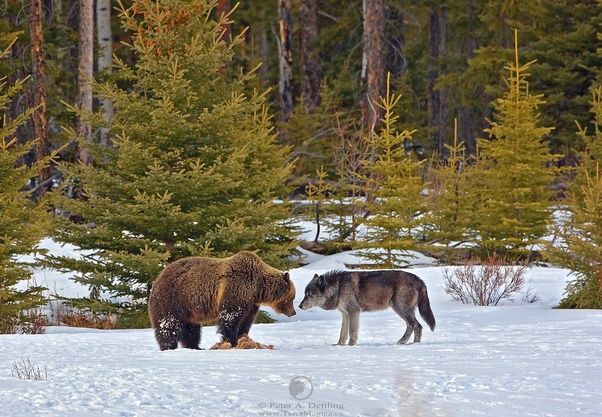
Few questions in North American wildlife generate as much confusion as brown bear vs grizzly bear. Tourists in Yellowstone assume they are watching something different from what tourists in Katmai are watching. Field guides disagree. Park rangers switch terminology depending on who they are talking to. The scientific literature uses one convention while the general public uses another, and the internet is awash with articles written by people who did not resolve the ambiguity before publishing.
The resolution is actually simple. Every grizzly is a brown bear, but not every brown bear is a grizzly. The brown bear is a single species, Ursus arctos, with a vast Holarctic range and a handful of recognised subspecies. The grizzly is one of those subspecies, native to interior North America. The word brown bear is used both as a general species name and as the common name for the Eurasian subspecies, which is where most of the confusion begins.
This article walks through the taxonomy, the regional name conventions, the salmon-driven size differences that make coastal Alaska bears look larger than their inland cousins despite being the same subspecies, and the practical implications for anyone planning a wildlife-watching trip. For the full species profile, see our reference entry on the brown bear, which this piece expands on throughout.
The One-Line Answer
If you only remember one sentence from this article, remember this one.
Ursus arctos is the brown bear. The grizzly is the interior North American subspecies of that brown bear. Coastal Alaskan brown bears, with one island-bound exception, are the same subspecies as interior grizzlies but eat a radically different diet and grow much larger as a result.
Everything below is the explanation of that sentence.
Taxonomy in Plain English
Species are biological units. Subspecies are geographic varieties within a species that interbreed freely where their ranges overlap and that retain enough genetic and morphological consistency to be worth naming. Brown bears are one of the textbook examples of a species with meaningful subspecies variation, and the taxonomic tree looks like this.
| Rank | Name | What it means |
|---|---|---|
| Genus | Ursus | The "true bears" including brown, black, polar, Asiatic black, and sun bear |
| Species | Ursus arctos | The brown bear, a single interbreeding species across Eurasia and North America |
| Subspecies | U. a. arctos | Eurasian brown bear, Europe and western Russia |
| Subspecies | U. a. horribilis | Grizzly bear and most coastal Alaska brown bears, interior and coastal North America |
| Subspecies | U. a. middendorffi | Kodiak bear, Kodiak Archipelago only |
| Subspecies | U. a. sitkensis | ABC Islands bear, genetically unusual, Admiralty, Baranof, and Chichagof |
| Subspecies | U. a. beringianus | Kamchatka brown bear, far eastern Russia |
| Subspecies | U. a. isabellinus | Himalayan brown bear, high Himalaya |
| Subspecies | U. a. gobiensis | Gobi bear, Mongolian Gobi desert |
| Subspecies | U. a. pruinosus | Tibetan blue bear, Tibetan Plateau |
| Subspecies | U. a. syriacus | Syrian brown bear, Caucasus and Middle East |
The point that this table is trying to make is that Ursus arctos is an umbrella, and grizzlies sit under one panel of it. A Spanish brown bear in the Cantabrian Mountains, a Hokkaido brown bear in northern Japan, and a Wyoming grizzly in the Absaroka Range are all members of the same species.
They could interbreed and produce fertile offspring if a breeder put them in the same enclosure, and they would be indistinguishable at the mitochondrial level from most other Ursus arctos populations. The brown bear subspecies page maps each group in detail.
"Brown bears are the most geographically variable of all bear species. Subspecies status within Ursus arctos reflects long-standing regional isolation and local adaptation rather than speciation in progress. Every population we recognise is still, at base, a brown bear."
, IUCN/SSC Bear Specialist Group, Brown Bear Conservation Action Plan
So when someone asks is a grizzly a brown bear, the honest answer is yes, unambiguously. The reverse question, whether every brown bear is a grizzly, is where careful usage says no.
Where the Word Grizzly Comes From
The grizzly's name is an American invention. Meriwether Lewis, travelling up the Missouri River on the Lewis and Clark expedition in May 1805, shot a large bear and recorded the event in his journal. Lewis described the animal's coat as "grizzled," meaning streaked or frosted with grey, a reference to the silver-tipped guard hairs that give interior brown bears their characteristic appearance.
The word grizzled was already in English usage to describe greying hair in humans and animals, and Lewis applied it descriptively.
The name stuck. By the time the naturalist George Ord sat down to describe the animal formally in 1815, the popular term was widespread enough that Ord used it as the basis for the scientific epithet horribilis, meaning frightful, which he paired with a formal reference to the grizzled appearance. The full binomial he chose, Ursus horribilis, treated the animal as a separate species.
Later taxonomists demoted it to subspecies status within Ursus arctos, giving us the modern name Ursus arctos horribilis.
Europeans never went through that naming step because they did not need to. Brown bears had been part of European natural history since prehistory, and every major European language had a pre-existing word for the animal. Those words survived into the scientific era, and braunbär in German, ours brun in French, oso pardo in Spanish, medved in Russian, and boz ayi in Turkish all translate directly to brown bear.
There was no New World expedition to rebrand the species for European audiences, so the Eurasian subspecies never acquired a distinctive common name of its own.
The result is the asymmetry we live with today. North Americans say grizzly to distinguish interior bears from something (usually coastal brown bears). Europeans say brown bear because there is nothing else to distinguish it from. Both continents are talking about Ursus arctos.
Coastal Brown Bear vs Grizzly: The Same Subspecies
This is the subtlest and most misunderstood part of the story. A visitor at Brooks Falls in Katmai National Park watches salmon-fishing bears and is told they are coastal brown bears. A visitor at Lamar Valley in Yellowstone watches a bear on an elk carcass and is told it is a grizzly. The two animals look different enough that most observers assume they are different subspecies. They are not.
Both belong to Ursus arctos horribilis. The scientific literature does not recognise a separate coastal Alaska subspecies outside of Kodiak and the ABC Islands. The Alaska Peninsula, the Katmai coast, the Chugach, Kenai, and most of mainland southeast Alaska are inhabited by bears taxonomically identical to Yellowstone grizzlies.
What differs is the ecology, and the ecological difference produces morphological consequences so large that the two populations look like different animals.
| Feature | Interior grizzly | Coastal brown bear (same subspecies) |
|---|---|---|
| Taxonomy | U. a. horribilis | U. a. horribilis |
| Range | Rockies, Yukon, interior Alaska | Alaska Peninsula, Katmai, Chugach, SE Alaska mainland |
| Dominant summer food | Grasses, roots, moths, carrion, berries | Pacific salmon, sedges, beach grass |
| Adult male weight | 180 to 360 kg | 300 to 600 kg |
| Population density | 1 per 100 to 300 km2 | 1 per 5 to 20 km2 |
| Salmon access | None to trivial | Four months of continuous runs |
| Common nickname | Grizzly | Brown bear, coastal brown |
A single litter of cubs, separated at birth and raised on either diet, would produce adults of dramatically different size despite being genetically identical. Biologists who study captive bears have observed the dietary effect under controlled conditions, and the brown bear reference entry discusses the full diet-to-body-mass relationship. For the raw size comparisons in the wild, our companion piece on how big brown bears get works through the numbers in detail.
"Body mass in brown bears responds to diet quality with remarkable plasticity. A salmon-rich maritime environment can more than double adult male body mass compared with a vegetation-dominated interior diet, even when the populations are essentially one gene pool."
, Charlie Robbins, Washington State University Bear Center, on decades of captive metabolic studies
So when a Katmai ranger calls the bears on Brooks Falls coastal brown bears and carefully avoids the word grizzly, that choice is colloquial rather than taxonomic. The subspecies is the same. The culture of terminology has simply reserved grizzly for inland populations and brown bear for coastal ones.
The Two Real Exceptions: Kodiak and ABC Islands
There are two North American populations that are not Ursus arctos horribilis, and knowing them is the key to using the vocabulary precisely.
The first is the Kodiak bear, Ursus arctos middendorffi. Kodiak bears live only on the Kodiak Archipelago in southwestern Alaska, where they have been reproductively isolated from mainland brown bears for roughly 10,000 to 12,000 years. They are genuinely a distinct subspecies, carrying mitochondrial haplotypes not found on the mainland, and they are the largest brown bears on Earth by average body mass.
A Kodiak is not a grizzly, but it is a brown bear in the species sense. For the full treatment, see our dedicated piece on the Kodiak bear, the largest brown bear, and the grizzly vs Kodiak comparison that pairs with this article.
The second is the ABC Islands bear, Ursus arctos sitkensis, found on Admiralty, Baranof, and Chichagof Islands in southeast Alaska. These bears are physically typical-looking brown bears, but their mitochondrial DNA tells one of the strangest stories in mammal genetics.
The ABC lineage clusters genetically with polar bears on the maternal side, meaning that at some point in the Pleistocene, polar bear females and brown bear males hybridised on or near those islands, and the ABC population carries polar bear mitochondria to this day.
"What we find in the ABC Islands brown bears is that their mitochondrial genome is essentially a polar bear genome, nested within the polar bear clade, even though phenotypically and nuclear-genetically they are brown bears. The simplest explanation is an ancient hybridisation event where brown bear males replaced polar bear males in the population."
, Charlotte Lindqvist, University at Buffalo, on her team's whole-genome sequencing of brown bear lineages
Lindqvist's work, published in PNAS and in Science, reshaped the brown bear family tree. It turns out the polar bear itself is phylogenetically nested inside the brown bear clade in some analyses, which complicates the neat "one species" picture but does not change everyday usage. The ABC Islands bears are classified as brown bears, they interbreed with mainland brown bears on the rare occasions the two populations meet, and they are never called grizzlies.
So when you map out the North American Ursus arctos populations carefully, the classification looks like this.
| Population | Subspecies | Common name in use |
|---|---|---|
| Yellowstone, Rockies, interior | U. a. horribilis | Grizzly bear |
| Interior Alaska, Yukon, NWT | U. a. horribilis | Grizzly bear |
| Alaska Peninsula, Katmai, Chugach coast | U. a. horribilis | Coastal brown bear |
| Kodiak Archipelago | U. a. middendorffi | Kodiak bear |
| Admiralty, Baranof, Chichagof islands | U. a. sitkensis | ABC Islands brown bear |
Every entry in that table is a brown bear. Only the first two are grizzlies in the proper sense.
The European Picture
Europe's brown bear situation is simpler. One subspecies, Ursus arctos arctos, covers the entire continental range. It is smaller on average than its North American relatives because European bears have lived under thousands of years of intense human persecution, which has selected for shy, small-ranging, low-conflict individuals, and because there is no sustained salmon run on European rivers comparable to what coastal Alaska offers.
Population estimates put European brown bears at roughly 17,000 individuals, concentrated in a few strongholds. The Carpathian Mountains of Romania hold the largest population at 6,000 to 7,000. The Dinaric-Pindos range through Slovenia, Croatia, Bosnia, Montenegro, Albania, and northern Greece holds another 3,000 to 4,000. Scandinavia supports 3,000 in Sweden and Norway combined.
Smaller relict populations survive in the Cantabrian Mountains of Spain (about 350), the Pyrenees (about 80 after reintroductions), the Apennines of central Italy (about 50 marsican bears), and the Trentino Alps of northern Italy (about 100 after reintroduction from Slovenia). For the full distribution and politics, our article on the European brown bear, where they live today covers the continent country by country.
Crucially, no European ever calls these animals grizzlies. The word is geographically specific to North America and does not translate naturally into any European language's wildlife vocabulary. Even English-language field guides written for European audiences use brown bear throughout and reserve grizzly for American contexts.
Diet Drives Everything
We have said repeatedly that the size difference between interior grizzlies and coastal brown bears is dietary rather than genetic. It is worth pausing on why.
Pacific salmon are extraordinarily rich in fat and protein. A single adult sockeye carries approximately 4,500 kilocalories of usable energy, of which more than half is lipid. A bear with access to a salmon run can acquire 20,000 to 40,000 kilocalories per day during peak fishing, which is three to five times what the same bear could extract from the best vegetation diet available in the interior.
An interior grizzly spends the summer foraging across large territories for grasses, sedges, roots, whitebark pine seeds, army cutworm moths at high altitude in the Greater Yellowstone Ecosystem, berries, and the occasional elk calf or winter-killed ungulate. Calorie intake is diffuse, territory sizes are enormous (often 500 to 2,500 square kilometres for males), and population density is low.
A coastal brown bear on the Alaska Peninsula spends June through October standing knee-deep in a river while food swims past. Territories are smaller, sometimes only a few square kilometres of productive river valley, and densities can reach one bear per five square kilometres in the best habitat. Cubs grow faster, adults reach maturity quicker, and body mass at maturity is close to the physiological maximum the species can sustain.
Our article on what brown bears eat works through the full dietary breakdown season by season.
"The best summary of brown bear ecology is that the species is body-mass plastic to an extreme degree. Give Ursus arctos salmon and it becomes the largest terrestrial carnivore. Give it grass and moths and it becomes a competent but modestly sized omnivore. The subspecies label matters much less than the river."
, Harry Reynolds, International Association for Bear Research and Management (IBA), speaking at the 2010 IBA conference
Reynolds' observation is the key to understanding why the brown bear vs grizzly difference is simultaneously real and illusory. Real, because a grizzly watching cutworm moths above timberline behaves nothing like a coastal brown bear fishing salmon. Illusory, because the animals are essentially interchangeable at the genome level, and their differences are a function of where they live and what they eat rather than what they fundamentally are.
Practical Advice for Wildlife Watchers
If you are planning a bear-watching trip, here is the naming convention to use so you sound like a biologist rather than a tourist.
In Yellowstone, Grand Teton, or Glacier National Park, call them grizzlies. The interior nomenclature is universal inside US continental bear country, and every ranger, guide, and trail sign will use grizzly. For a full profile of those bears, see the grizzly bear reference entry.
In Katmai National Park at Brooks Falls, in Lake Clark, or on the Alaska Peninsula, call them coastal brown bears or simply brown bears. The locals reserve grizzly for inland bears, and using brown bear in this context signals that you understand the regional distinction. The bears are taxonomically Ursus arctos horribilis regardless, but the cultural vocabulary differs.
On Kodiak Island or anywhere in the Kodiak Archipelago, call them Kodiak bears. Never grizzly, occasionally brown bear in casual conversation, but Kodiak is the precise term and it is the term everyone on the islands uses.
On Admiralty, Baranof, or Chichagof, call them brown bears. The ABC Islands genetics are fascinating but not part of normal conversation, and the locals will say brown bear.
In Denali, the Yukon, interior British Columbia, or the Brooks Range, grizzly is correct. These populations are interior horribilis and the name grizzly applies cleanly.
In Europe or Asia, brown bear is the only option. Grizzly is an Americanism and translates awkwardly.
In zoos or captive settings, check the signage, because many zoos house Eurasian brown bears rather than grizzlies, and the two are visibly similar but taxonomically distinct.
For a comparison with the other common large bear of North America, our article on grizzly bear vs black bear walks through the identification features that actually matter in the field. For distinguishing a grizzly from an island subspecies, see grizzly bear vs Kodiak bear.
Conservation Status Varies by Subspecies
The conservation picture for Ursus arctos is not uniform, and knowing which population you are talking about changes the answer significantly.
- Lower 48 grizzlies are listed as threatened under the US Endangered Species Act. Fewer than 2,000 individuals survive across six recovery zones, and political debates about delisting have recurred for decades.
- Alaska grizzlies and coastal brown bears number approximately 32,000 animals and are not endangered. Sport hunting is regulated but permitted.
- Kodiak bears number roughly 3,500 on a 13,000 square kilometre archipelago, one of the densest brown bear populations on Earth.
- European brown bears are listed as Least Concern overall but Vulnerable or Endangered in specific national frameworks. The Apennine marsican bears are down to about 50 individuals and functionally critical.
- Gobi bears in Mongolia are Critically Endangered with approximately 40 individuals remaining, arguably the rarest brown bear population anywhere.
The same species sits in radically different conservation contexts across its range, which is another reason getting the subspecies and regional vocabulary right matters.
Frequently Asked Questions in One Place
Are brown bears and grizzly bears the same animal? Same species, different subspecies in most uses. A grizzly is always a brown bear. A brown bear may or may not be a grizzly.
Is a coastal Alaska bear a grizzly? Taxonomically yes, colloquially no. Locals reserve grizzly for inland populations.
Is a Kodiak a grizzly? No. Kodiaks are a distinct subspecies, Ursus arctos middendorffi.
Is a European brown bear a grizzly? No. European bears are Ursus arctos arctos, a separate subspecies, and the word grizzly is not used in European contexts.
What is the biggest brown bear? On average, the Kodiak. In the wild, the ABC Islands and Alaska Peninsula coastal bears come close.
Are polar bears brown bears? Polar bears are a separate species, Ursus maritimus, but genetic work shows the two are extraordinarily close and the brown bear clade contains the polar bear lineage in some reconstructions.
Closing Synthesis
The brown bear vs grizzly bear debate dissolves once you keep three facts straight. First, brown bear is a species name for Ursus arctos across the northern hemisphere. Second, grizzly is the common name for the interior North American subspecies, Ursus arctos horribilis, and occasionally extended to coastal populations of the same subspecies depending on local usage.
Third, the size and behaviour differences that make coastal and interior populations look so different are almost entirely driven by diet, not genetics.
If you want the species profile, the brown bear reference entry is the place to start. If you want the interior subspecies profile, the grizzly bear piece goes deeper on North American populations specifically. For island subspecies and the largest bodies in the species, the Kodiak profile fills in the archipelago story.
For broader science reading, the content platforms at Evolang, What's Your IQ, and Pass4Sure publish companion material on biology, taxonomy, and the logic of species classification that connects directly to how biologists decide where one brown bear ends and the next begins.
References
- Lindqvist, C. et al. (2010). "Complete mitochondrial genome of a Pleistocene jawbone unveils the origin of polar bear." PNAS, 107(11), 5053-5057. doi:10.1073/pnas.0914266107
- Miller, W. et al. (2012). "Polar and brown bear genomes reveal ancient admixture and demographic footprints of past climate change." PNAS, 109(36), E2382-E2390. doi:10.1073/pnas.1210506109
- Hirata, D. et al. (2013). "Molecular phylogeography of the brown bear (Ursus arctos) in Northeastern Asia based on analyses of complete mitochondrial DNA sequences." Molecular Biology and Evolution, 30(7), 1644-1652. doi:10.1093/molbev/mst077
- Waits, L. P. et al. (1998). "Mitochondrial DNA phylogeography of the North American brown bear and implications for conservation." Conservation Biology, 12(2), 408-417. doi:10.1111/j.1523-1739.1998.96351.x
- Robbins, C. T. et al. (2012). "Hibernation and seasonal fasting in bears: the energetic homeostasis of a winter animal." Journal of Comparative Physiology B, 182(7), 847-854. doi:10.1007/s00360-012-0664-9
- McLellan, B. N. (2011). "Implications of a high-energy and low-protein diet on the body composition, fitness, and competitive abilities of black (Ursus americanus) and grizzly (Ursus arctos) bears." Canadian Journal of Zoology, 89(6), 546-558. doi:10.1139/z11-026
- Talbot, S. L. and Shields, G. F. (1996). "A phylogeny of the bears (Ursidae) inferred from complete sequences of three mitochondrial genes." Molecular Phylogenetics and Evolution, 5(3), 567-575. doi:10.1006/mpev.1996.0051
- McLoughlin, P. D. et al. (2008). "Factors affecting the density of brown bears (Ursus arctos) in coastal British Columbia." Ursus, 19(2), 138-147. doi:10.2192/08GR007.1
For production tools used by wildlife researchers compiling field data and managing publication workflows, the utilities at When Notes Fly and File Converter Free cover note capture and format conversion respectively.
Frequently Asked Questions
Is a grizzly bear a brown bear?
Yes. Every grizzly bear is a brown bear, but not every brown bear is a grizzly. The brown bear is the species Ursus arctos, which has a Holarctic distribution from Spain through Eurasia to western North America. The grizzly is one subspecies within that species, Ursus arctos horribilis, defined by its range across interior North America from Alaska through the Yukon and British Columbia and down into the Rocky Mountains of Montana and Wyoming.
Europeans and Asians almost always call the animal a brown bear because that is the only kind they have. North Americans often reserve the word grizzly for interior populations and switch to coastal brown bear or simply brown bear once they are near salt water. The names are regional and ecological rather than taxonomic, and underneath them sits a single interbreeding species.
What is the difference between a brown bear and a grizzly bear in North America?
In North America the distinction is primarily about habitat rather than genetics. Brown bears found within about 100 km of salt water in Alaska, including the Alaska Peninsula, Admiralty Island, and the Katmai coast, are commonly called coastal brown bears. Bears of the same subspecies, Ursus arctos horribilis, living inland in places like Denali, the Yukon, and the Rocky Mountains south into Yellowstone are called grizzlies.
The two groups are genetically almost identical but look strikingly different. A salmon-fed coastal brown bear male can weigh 400 to 600 kg, while an interior grizzly male averages 180 to 360 kg. The size gap is dietary, not hereditary, and transplanted bears raised on the opposite diet would converge toward the opposite size.
The Kodiak bear is a separate case, classified as Ursus arctos middendorffi, and is not referred to as either a grizzly or a generic brown bear in careful usage.
Why do Europeans say brown bear and Americans say grizzly?
The naming divergence is historical. Europeans have lived alongside Ursus arctos for thousands of years and developed their own words for it long before anyone wrote the scientific binomial. German says braunbär, French says ours brun, Spanish says oso pardo, Russian says medved, and Turkish says boz ayi. All translate to brown bear and refer to the continent’s single brown bear subspecies, Ursus arctos arctos.
In North America the same species was encountered by European settlers through Meriwether Lewis, who described a bear killed on the Missouri River in 1805 as having a grizzled, silver-tipped coat. Grizzly stuck as the common name for interior populations and was eventually cemented by George Ord in 1815 when he gave the subspecies the scientific epithet horribilis.
Two continents with one species and two vocabularies is the result, and both names are correct within their regional context.