
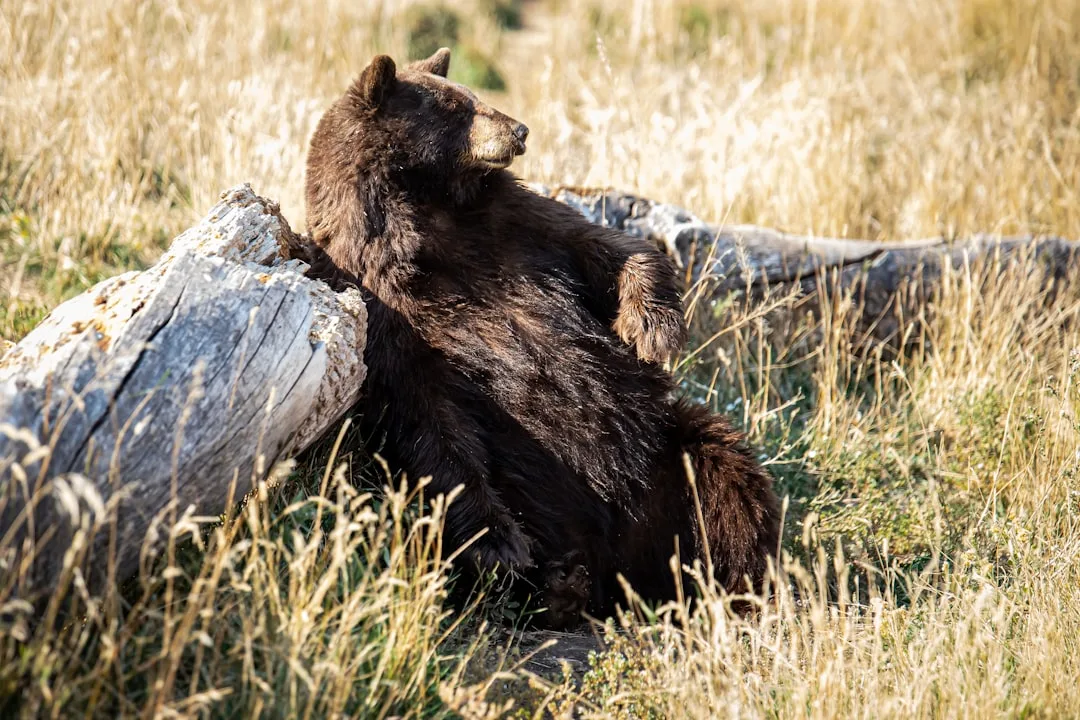
Ask a biologist how big a brown bear is and you will not get a number. You will get a question back: which brown bear, and eating what? The species Ursus arctos spans a greater body-size range than almost any other terrestrial carnivore on earth. A Gobi bear on the edge of the Mongolian desert, clawing through stone for roots and the occasional pika, tops out at 135 kilograms and looks rangy even in a winter coat.
A Kodiak bear on Alaska's southwest coast, gorging on a salmon stream for six weeks every summer, can clear 680 kilograms and stand three metres tall. They are the same species. The seven-fold difference in mass is not taxonomy. It is ecology.
This article is a full technical breakdown of how big brown bears are: by subspecies, by region, by sex, by season, and by diet. It is the companion piece to our main brown bear species profile, which covers the animal's biology, behaviour, and conservation status more broadly. Here we focus narrowly on the size question: how much do brown bears weigh, how tall do they stand, how long are they nose to tail, how big are their tracks, and who has held the world record.
If you only remember one thing, remember this. Brown bear body size is a calorie-density map, not a genetic map. Populations with unlimited salmon are enormous. Populations surviving on roots, berries, and small mammals are small. The subspecies labels come after the food supply, not before it.
The Short Answer, in Numbers
Before the ecology and the biomechanics, the headline numbers people come to an article like this to find.
| Measurement | Small subspecies (Gobi, Syrian) | Eurasian brown bear | Alaska coastal brown bear | Kodiak bear |
|---|---|---|---|---|
| Adult male mass | 80-250 kg | 200-300 kg | 300-500 kg | 270-630 kg |
| Adult female mass | 50-130 kg | 100-200 kg | 150-270 kg | 180-320 kg |
| Shoulder height (on all fours) | 0.8-1.0 m | 1.0-1.2 m | 1.2-1.4 m | 1.3-1.5 m |
| Standing height (on hind legs) | 1.8-2.0 m | 2.2-2.5 m | 2.5-2.8 m | 2.7-3.0 m |
| Length (nose to tail) | 1.4-1.9 m | 1.7-2.2 m | 2.0-2.5 m | 2.2-2.8 m |
| Record individual | ~250 kg (Syrian) | ~480 kg (Kamchatka) | ~680 kg (Alaska Peninsula) | 751 kg (1894) |
Those numbers come from a fusion of peer-reviewed literature, Alaska Department of Fish and Game field data, Boone and Crockett skull records, and decades of IUCN/SSC Bear Specialist Group monitoring across Eurasia. The species-wide extremes, 80 kilograms at the low end to 751 kilograms at the top, are the widest mass envelope in the Ursidae and one of the widest in any modern carnivoran.
"Brown bear body size is the single best illustration in carnivore biology that a genome is a template and the environment writes the animal. You can raise a Kodiak cub in poor range and produce a 200 kilogram bear. You can raise an Eurasian brown bear on a salmon stream and produce a 400 kilogram bear. The genes do not change. The calories do."
- Charlie Robbins, Director, Washington State University Bear Research, Education and Conservation Center
Why the Range Is So Enormous
Three ecological variables explain almost all of the variation in brown bear body size across the species' range. Subspecies taxonomy is partly a shorthand for the interaction of those three variables, which is why the genetic differences between, say, a coastal Alaska bear and a Yellowstone grizzly are minor while the body-size differences are dramatic.
1. Access to high-lipid, protein-dense food. Salmon runs are the single biggest driver. A coastal bear in Katmai, Kodiak, or Kamchatka can eat 80,000 to 100,000 kilocalories a day during peak salmon, more than ten times the maintenance requirement of a human. Interior bears surviving on roots, grasses, ungulate carcasses, and sporadic berry crops cannot match that calorie density even in a good year.
2. Length of the feeding season. Subarctic coastal bears have a compressed but intensely productive summer. Mediterranean and central Asian bears have a longer growing season but thinner food. Gobi bears have almost no productive season at all. Fat deposition in the last eight weeks before denning is what drives adult body mass, and that window is where the calorie-rich populations pull away.
3. Female reproductive cost. Sexual dimorphism in brown bears is steep, with males typically 1.5 to 2 times the mass of females. Females carry the cost of lactation in the den and cannot prioritise maximum-growth foraging the way males can. This is why the male-female gap is wider in large-bodied populations than in small ones. An Alaska Peninsula male might be 500 kg while the local female is 250 kg. A Gobi male might be 120 kg while the local female is 90 kg.
"Size clines in Ursus arctos are best understood as a response to salmon-derived marine nutrients. Where anadromous fish are abundant and reliable, brown bears grow large. Where they are absent, body size tracks the carrying capacity of terrestrial foods, and that is a much lower ceiling."
- Ursus, journal of the International Association for Bear Research and Management, on Northern Hemisphere size clines
Size by Subspecies
Taxonomy of Ursus arctos remains debated. The current IUCN/SSC Bear Specialist Group recognises roughly 15 to 16 subspecies depending on the authority, though genetic work keeps collapsing some of them. For size purposes, the subspecies framework is still useful because it tracks regional ecologies that produce consistent body-size outcomes.
The size league, from smallest to largest
| Subspecies | Common name | Typical male mass | Typical female mass | Notable feature |
|---|---|---|---|---|
| Ursus arctos gobiensis | Gobi bear (mazaalai) | 80-135 kg | 50-100 kg | Smallest brown bear, under 40 individuals remaining |
| U. a. syriacus | Syrian brown bear | 90-250 kg | 70-150 kg | Pale-coated, fragmented across the Caucasus and Iran |
| U. a. pruinosus | Tibetan blue bear | 100-200 kg | 80-150 kg | High-altitude Himalayan plateau |
| U. a. isabellinus | Himalayan brown bear | 130-250 kg | 100-180 kg | Critically endangered in Pakistan and India |
| U. a. arctos | Eurasian brown bear | 200-300 kg | 100-200 kg | Widespread from Spain to the Pacific |
| U. a. horribilis | Grizzly bear (interior NA) | 180-360 kg | 130-200 kg | Same taxon as coastal Alaska bears |
| U. a. beringianus | Kamchatka brown bear | 300-500 kg | 180-300 kg | Largest Eurasian population |
| U. a. alascensis | Alaska Peninsula brown bear | 300-500 kg | 150-270 kg | Salmon-fed coastal giants |
| U. a. middendorffi | Kodiak bear | 270-630 kg | 180-320 kg | Record 751 kg (1894) |
The span from a 120 kg Gobi male to a 600 kg Kodiak male is five times the body mass in the same species. That is a wider envelope than separates a leopard from a Siberian tiger, and both of those are called different species.
For a deeper treatment of the subspecies framework, their genetics, and their geography, see our full piece on brown bear subspecies explained. Readers interested specifically in the record-holding population should continue with Kodiak bear, the largest brown bear.
Size by Region
A regional breakdown tells much the same story as the subspecies table, but organised around ecology rather than taxonomy. This is how most field biologists actually think about brown bear body size.
Coastal Alaska and Kamchatka: the heavyweight belt
The coastal rainforest zones of southwest Alaska, Kodiak Island, and the Kamchatka Peninsula produce the largest brown bears on earth. The defining feature is an anadromous salmon run running from late June through September, layered on top of a terrestrial forage base of sedges, berries, and the occasional ungulate carcass.
Adult males in these populations average 350 to 500 kg, with the largest individuals exceeding 700 kg after a peak feeding season. Late-autumn weights before denning are typically 20 to 30 per cent above mid-summer weights.
Interior North America: the grizzly profile
Interior grizzlies from Yellowstone, the Canadian Rockies, and northwest Montana are genetically the same subspecies as coastal Alaska bears but live in a salmon-free ecology. Their diet leans on army cutworm moths, whitebark pine seeds, cutthroat trout spawning runs, and elk calves in the spring. Adult males weigh 180 to 360 kg. Females weigh 130 to 200 kg.
The best biological treatment of the dividing line between grizzly and coastal brown bear is given in our comparison article brown bear vs grizzly bear, which argues, correctly, that the two names describe one animal in two ecologies.
Eurasian forests: the middleweight belt
The Carpathian range, the Dinaric Alps, the Cantabrian Mountains of Spain, and the boreal forests of Scandinavia and European Russia hold Eurasian brown bears with adult male weights typically in the 200 to 300 kg band. These are densely forested, seasonally productive ecologies without salmon but with substantial mast crops (beech, oak, hazel), berry fields, and managed ungulate populations. For a regional deep dive, see European brown bear, where they live.
Central and Southwest Asia: the lightweight populations
The Syrian, Gobi, Himalayan, and Tibetan brown bears live in ecologies without salmon, without reliable mast crops, and often at high altitude or on the margins of desert. Adult males in these populations rarely exceed 250 kg, and the Gobi bear, living on sparse vegetation and insects in the southern Mongolian desert, is the smallest subspecies of all.
"When I weigh a Gobi bear male at 110 kilograms in autumn and then, three weeks later, weigh an Alaska Peninsula male at 540 kilograms, I am looking at the same animal adjusted for food supply. The behaviour is similar. The social structure is similar. The metabolism is similar. Only the body is different, and the body is different because the pantry is different."
- Harry Reynolds, bear biologist, International Association for Bear Research and Management, Gobi Bear Project
Sexual Dimorphism
Brown bears are among the most sexually dimorphic terrestrial carnivores. The male-female body mass ratio is typically 1.5 to 2.0, with the steepest dimorphism occurring in the largest-bodied populations and the shallowest dimorphism in the smallest ones.
- Kodiak and Alaska coastal: male-to-female ratio of approximately 2.0. Males 400-630 kg, females 180-320 kg.
- Kamchatka: similar, with males around 400-500 kg and females 200-300 kg.
- Eurasian (Carpathian, Scandinavian): ratio of approximately 1.5 to 1.7. Males 220-280 kg, females 130-180 kg.
- Syrian, Gobi: ratio of approximately 1.3 to 1.5. Males 100-150 kg, females 80-110 kg.
The ecological logic is straightforward. In populations where food supply allows males to grow very large, competition for females favours the largest males, and sexual selection amplifies the dimorphism. In populations constrained by food supply, the ceiling on male size is closer to the ceiling on female size, so dimorphism is reduced.
There is a second, often overlooked piece of this picture. Female brown bears have a metabolic cost that males do not. Females must enter the den with enough fat to support two to four months of cub lactation without feeding. This is why even in poor food years females almost always den in better condition than males. It also caps the upper end of female body size: beyond a certain mass, the marginal return from additional fat is lower than the cost of acquiring and carrying it through the den.
For the full reproductive biology of brown bears, our treatment is in the main brown bear species profile.
Standing Height and the Bart the Bear Phenomenon
Popular imagination fixes on the image of a brown bear rearing up on its hind legs. That is the iconic shot in natural history films, wildlife photography, and, most indelibly, in Hollywood. Standing height is almost always overestimated by eyewitnesses because a bear on its hind legs is enormous compared with nearly any other terrestrial mammal at the same moment in a human's field of view.
Standing height in brown bears scales roughly with overall body size:
- Gobi, Syrian: 1.8 to 2.0 m upright.
- Eurasian brown bear: 2.2 to 2.5 m.
- Interior grizzly: 2.4 to 2.7 m.
- Alaska coastal brown bear: 2.5 to 2.8 m.
- Kodiak bear: 2.7 to 3.0 m, with exceptional individuals pushing slightly higher.
The outlier case everyone eventually asks about is Bart the Bear, the trained Kodiak actor who appeared in The Bear (1988), Legends of the Fall, The Edge, and nearly fifty other productions between 1980 and 2000. Bart was an exceptionally large Kodiak male, weighed at approximately 680 kg in his prime, and measured at just over 3 metres standing upright.
He was never a wild bear, having been raised from a cub by trainers Doug and Lynne Seus, but he was a real Kodiak, not a genetic anomaly, and his size represents the upper end of what the subspecies naturally produces when given abundant food year-round.
Bart remains the clearest public reference point for how large a coastal brown bear can actually get. His body proportions, photographed against human co-stars including Anthony Hopkins on the set of The Edge, communicate the scale of the animal better than any field photograph of a wild bear at distance.
It is worth emphasising that a standing brown bear is almost never aggressive. The posture is sensory. Bears stand to see over brush, to catch wind scent on a crosswind, and to identify what they are looking at. An aggressive brown bear charges on all fours, head low and ears flattened, not upright.
Length, Shoulder Height, and Footprint
Two measurements matter more biologically than standing height for most field applications: shoulder height on all fours and track width. These are the numbers that determine how the animal interacts with terrain, how it passes through cover, and how biologists and hunters identify it from sign.
Shoulder height
Shoulder height in adult brown bears ranges from 0.8 metres in Gobi bears to 1.5 metres in the largest Kodiaks. The average Eurasian brown bear stands 1.1 metres at the shoulder. The average adult male interior grizzly stands 1.05 to 1.2 metres. An Alaska coastal brown bear stands 1.2 to 1.4 metres. For context, 1.1 metres is roughly belt-buckle height on an average adult human, and 1.4 metres is mid-chest.
This is the measurement that dictates whether a bear can walk under a fallen log, squeeze through a canyon narrows, or push through alder thickets without breaking stride. It is also the measurement that determines the force vector when a bear swats with a forelimb: the bigger the shoulder height, the higher the strike and the more dangerous the blow.
Body length, nose to tail
Body length is measured from the tip of the nose to the base of the tail. Brown bears have a vestigial tail, typically 6 to 20 cm, which is not meaningfully contributing to overall length.
- Gobi, Syrian: 1.4 to 1.9 m.
- Eurasian: 1.7 to 2.2 m.
- Interior grizzly: 1.8 to 2.3 m.
- Alaska coastal: 2.0 to 2.5 m.
- Kodiak: 2.2 to 2.8 m.
The longest verified Kodiak body length is close to 3 metres, measured on a full-extension skin with some post-mortem stretching. Live-animal measurements cap around 2.8 metres.
Track size and paw width
Paw width is the single most useful field indicator of brown bear body size. The front paw pad width, measured across the widest part of the pad excluding claws, scales almost linearly with total body mass.
| Subspecies | Front paw pad width | Hind track length (heel to toe, claws included) |
|---|---|---|
| Gobi, Syrian | 12-16 cm | 18-22 cm |
| Eurasian brown bear | 14-18 cm | 22-28 cm |
| Interior grizzly | 15-20 cm | 25-30 cm |
| Alaska coastal brown bear | 20-25 cm | 30-36 cm |
| Kodiak bear | 22-30 cm | 33-40 cm |
Wildlife officers in Alaska use a simple rule for coastal brown bears: add one to the paw-pad width in inches, and the result is the estimated shoulder height in feet. A 9-inch pad on a Kodiak indicates a bear standing roughly 10 feet tall upright. The rule is imprecise but field-useful, and it has been cross-validated by the Alaska Department of Fish and Game against weighed and measured specimens.
"Track width is the best proxy field biologists have for brown bear body size without handling the animal. A front paw pad above 20 centimetres is reliably a mature coastal male. Below 15 centimetres it is a subadult or a female. Between those numbers is where the guessing starts."
- Alaska Department of Fish and Game, Brown Bear Field Handbook
Diet and the Size Cline
The single best predictor of brown bear body size across the entire species range is not latitude, not genetics, and not individual age: it is salmon access. Populations with reliable anadromous fish runs are large. Populations without them are small. The correlation is strong enough that researchers can estimate the adult male body mass of an unfamiliar population within a kilogram or two just by knowing whether salmon is available and for how many weeks per year.
The mechanism is calorie density. A single sockeye salmon contains roughly 4,500 to 6,000 kilocalories. A bear that catches and consumes 30 sockeye in a single fishing day has taken in 150,000 kilocalories, which is the equivalent of nearly three weeks of maintenance intake compressed into 12 hours. Repeated across the 50 to 70 days of a salmon run, this translates into a fat accumulation curve that is simply not possible for interior bears surviving on roots, grasses, and ungulate calves.
For the full diet picture across all populations, our dedicated article is what do brown bears eat. It covers the seasonal food calendar, the plant-to-protein ratio across populations, and the specific ecology of the salmon-driven size cline.
Size within a single lifetime
An individual brown bear's body size changes dramatically over its life, and year to year depending on food supply.
- Newborn cubs: 0.3 to 0.5 kg, smaller than a domestic cat kitten, born in the den in January or February.
- Cubs of the year, autumn: 25 to 60 kg, depending on subspecies.
- Subadults (2 to 4 years): 100 to 200 kg for most subspecies, 150 to 300 kg for coastal populations.
- Prime adults (7 to 20 years): peak mass, subject to the subspecies ranges given above.
- Senescent adults (25+ years): typically 15 to 25 per cent below peak mass, with muscle loss and reduced foraging efficiency.
Within a single year, an Alaska coastal bear may gain 30 per cent of its mass between June and October, then lose roughly half of that gain during the five-month denning period. The swing between spring emergence weight and pre-denning autumn weight can exceed 200 kilograms in a mature male Kodiak.
Record Holders and Verified Maxima
A brief and realistic tour of the big individuals.
- The 751 kg Kodiak (1894). Shot on Kodiak Island by a hunter named Henry Swanson, weighed by scales at a cannery, and recorded as the heaviest brown bear ever taken. Some later analyses dispute the scale calibration. Even allowing for a 10 per cent over-reading, the animal would still sit at 680 kg, making it the largest verified brown bear on record.
- Clyde, the 726 kg captive. A Kodiak male held at the Dakota Zoo, weighed at approximately 726 kg at the end of a feeding regime that has not been matched in captivity since. Clyde is often cited alongside Bart the Bear as the upper bound of captive Kodiak size.
- Bart the Bear (1977-2000). A trained Kodiak actor measured at approximately 680 kg and 3 metres standing, widely photographed and filmed. Not a record for raw mass, but the clearest public reference point for the size the subspecies can naturally achieve.
- Kamchatka record, approximately 650 kg. Reported from a fisheries observer on the Kurilskoye Lake system in the 1990s, unconfirmed by formal weighing. Kamchatka males regularly exceed 500 kg in autumn, and 650 kg is within the plausible envelope of the population.
- Interior grizzly record, approximately 500 to 550 kg. From Yellowstone and northern British Columbia records, well-documented but not definitively ranked. Interior grizzlies rarely exceed 400 kg even in excellent conditions.
Comparison with other large bears puts brown bear size in useful perspective. For readers more interested in the grizzly range specifically, our parallel article on how big are grizzly bears, size and weight covers the same ground with a tighter focus on North American interior populations.
Polar bears, the only bear species that routinely rivals Kodiaks in size, are treated in our polar bear species profile. The specific question of Kodiak versus interior grizzly is covered in grizzly bear vs Kodiak bear.
Bite Force, Claws, and Absolute Power
Size is not only mass. It is also what the animal can do with that mass. A coastal brown bear or Kodiak has the bite force and claw structure to deliver damage disproportionate to its already enormous body.
- Bite force at the canines: approximately 1,160 psi in a large coastal brown bear, placing it among the most powerful-jawed terrestrial mammals. Lions, by comparison, produce around 650 psi, and an adult male lion is smaller than an adult male Kodiak.
- Claw length: 8 to 11 cm in coastal populations, 6 to 9 cm in Eurasian brown bears, 5 to 7 cm in Gobi bears. Claws are non-retractile, designed for digging rather than climbing, but a forelimb swat with a 10 cm claw can break the neck of an adult moose, a feat documented in the Denali region.
- Forelimb strike force: estimated at around 2,000 newtons for a mature Kodiak swat, sufficient to lift a 200 kg carcass off the ground in a single motion.
- Dragging capacity: coastal brown bears routinely drag 300 to 400 kg carcasses several hundred metres to cache sites.
These are not decorative numbers. They are the practical manifestation of body size. A 600 kg Kodiak is dangerous not only because of its mass but because its mass is attached to a bite and a forelimb that can deliver damage at the upper end of what any mammalian predator has ever produced.
How Brown Bear Size Stacks Up Across the Ursidae
Placing brown bears against the rest of the bear family puts the size question in useful context.
| Species | Typical male mass | Record mass | Notes |
|---|---|---|---|
| Polar bear (U. maritimus) | 350-700 kg | ~1,000 kg | Rivals Kodiak for largest bear |
| Kodiak brown bear (U. a. middendorffi) | 270-630 kg | 751 kg (1894) | Largest brown bear subspecies |
| Alaska coastal brown bear | 300-500 kg | ~680 kg | Same taxon as grizzly |
| Kamchatka brown bear | 300-500 kg | ~650 kg | Largest Eurasian population |
| Interior grizzly | 180-360 kg | ~550 kg | Salmon-poor ecology |
| Eurasian brown bear | 200-300 kg | ~480 kg | Boreal and mountain forests |
| American black bear (U. americanus) | 60-250 kg | ~400 kg | Most common North American bear |
| Asian black bear (U. thibetanus) | 60-200 kg | ~240 kg | Forest-dwelling |
| Syrian brown bear | 90-250 kg | ~250 kg | Fragmented range |
| Sloth bear (M. ursinus) | 80-140 kg | ~200 kg | Myrmecophage specialist |
| Giant panda (A. melanoleuca) | 90-125 kg | ~160 kg | Vegetarian |
| Spectacled bear (T. ornatus) | 100-175 kg | ~200 kg | Only South American bear |
| Gobi bear (U. a. gobiensis) | 80-135 kg | ~160 kg | Smallest brown bear subspecies |
| Sun bear (H. malayanus) | 25-65 kg | ~80 kg | Smallest bear species |
The critical observation is that the brown bear species alone spans almost the entire size range of the Ursidae, from smaller than the American black bear at one extreme to rivalling the polar bear at the other. No other carnivoran family shows that kind of within-species size plasticity.
"The taxonomic label brown bear is doing an enormous amount of work. It covers animals from 80 kilograms to 750 kilograms, across three continents, in ecosystems that have essentially nothing in common except the presence of the animal itself. I am not sure any other mammal on earth tests the species concept harder than Ursus arctos."
- Djuro Huber, University of Zagreb, IUCN/SSC Bear Specialist Group, on the Eurasian end of the brown bear size spectrum
What Size Does Not Tell You
Body mass is a useful summary statistic and a useless predictor of behaviour.
A 600 kg Kodiak is not proportionally more dangerous than a 250 kg Eurasian brown bear, because most bear-human encounters are governed by behavioural variables that size says nothing about: whether the bear is surprised, whether cubs are present, whether a carcass is nearby, whether the animal is food-conditioned, and whether the human runs.
A small Syrian brown bear surprised at close range is more dangerous than a large Kodiak that detected you at 200 metres and is already leaving.
Size also does not track aggression across populations. Coastal Alaska brown bears, the largest on earth, have a lower per-capita aggression rate toward humans than Eurasian brown bears in many parts of their range, largely because salmon-fed bears are not as hungry as mast-and-root-fed bears during the same season.
For behavioural risk and encounter ecology, our main brown bear species profile covers attack rates, habitat-specific risk, and evidence-based deterrence across the species range.
Further Reading Across the Site
Readers who enjoyed this size breakdown will find natural follow-ons in our brown bear species profile, brown bear subspecies explained, Kodiak bear the largest brown bear, brown bear vs grizzly bear, what do brown bears eat, and European brown bear where they live.
The comparison question, often asked by the same readers, is addressed in grizzly bear vs Kodiak bear and how big are grizzly bears size and weight, and the only bear species that rivals Kodiaks in size is covered in our polar bear profile.
For readers who enjoy long-form analytical writing outside of wildlife biology, longer essays on language and cognition are published at Evolang, cognitive assessment and reasoning puzzles at What's Your IQ, reading-and-memory tooling at When Notes Fly, certification study structures at Pass4Sure, and PDF and reference utilities at File Converter Free, which many of our readers use for managing peer-reviewed literature on carnivore biology.
References
- Hilderbrand, G. V., Schwartz, C. C., Robbins, C. T., Jacoby, M. E., Hanley, T. A., Arthur, S. M., & Servheen, C. (1999). The importance of meat, particularly salmon, to body size, population productivity, and conservation of North American brown bears. Canadian Journal of Zoology, 77(1), 132-138. https://doi.org/10.1139/z98-195
- Robbins, C. T., Schwartz, C. C., & Felicetti, L. A. (2004). Nutritional ecology of ursids: a review of newer methods and management implications. Ursus, 15(2), 161-171. https://doi.org/10.2192/1537-6176(2004)015<0161:NEOUAR>2.0.CO;2
- Swenson, J. E., Adamic, M., Huber, D., & Stokke, S. (2007). Brown bear body mass and growth in northern and southern Europe. Oecologia, 153(1), 37-47. https://doi.org/10.1007/s00442-007-0715-1
- Van Daele, L. J., Barnes, V. G., & Belant, J. L. (2012). Ecological flexibility of brown bears on Kodiak Island, Alaska. Ursus, 23(1), 21-29. https://doi.org/10.2192/URSUS-D-10-00022.1
- Rode, K. D., Farley, S. D., & Robbins, C. T. (2006). Behavioral responses of brown bears mediate nutritional effects of experimentally introduced tourism. Biological Conservation, 133(1), 70-80. https://doi.org/10.1016/j.biocon.2006.05.021
- McLellan, B. N. (2011). Implications of a high-energy and low-protein diet on the body composition, fitness, and competitive abilities of black and grizzly bears. Canadian Journal of Zoology, 89(6), 546-558. https://doi.org/10.1139/z11-026
- Mattson, D. J., Blanchard, B. M., & Knight, R. R. (1991). Food habits of Yellowstone grizzly bears, 1977-1987. Canadian Journal of Zoology, 69(6), 1619-1629. https://doi.org/10.1139/z91-226
- Reynolds, H. V., Hundertmark, K. J., & Brownlee, E. G. (2010). Status of the Gobi bear in Mongolia. Ursus, 21(1), 77-81. https://doi.org/10.2192/09SC010.1
Frequently Asked Questions
How big is a brown bear on average?
There is no meaningful species-wide average for the brown bear, because body size in Ursus arctos varies by subspecies and diet more dramatically than in almost any other carnivore. A Eurasian brown bear male in the Carpathians or the Cantabrian range typically weighs 200 to 300 kg, stands 1.0 to 1.2 m at the shoulder, and reaches 2.5 m upright on its hind legs.
A coastal Alaska brown bear of the same species, fed on summer salmon, usually runs 300 to 500 kg and can exceed 700 kg. A Gobi bear, the smallest subspecies, rarely passes 135 kg. Females across all populations are 1.5 to 2 times lighter than males. The single useful generalisation is that if you know where the bear lives and what it eats, you can predict its body size to within about 20 per cent. The species itself is plastic.
What is the largest brown bear ever recorded?
The largest verified brown bear on record is a Kodiak bear (Ursus arctos middendorffi) shot in 1894 on Kodiak Island, Alaska, whose weight was reconstructed at approximately 751 kg (1,656 lb). Skull measurement records from the Boone and Crockett Club confirm several Kodiak specimens in the 680 to 726 kg range. In captivity, a trained Kodiak actor named Bart the Bear reached approximately 680 kg and stood close to 3 m tall on his hind legs.
Coastal Alaska brown bears and Kamchatka brown bears routinely exceed 500 kg after a heavy salmon season, and some large Kamchatka males have been weighed at 650 kg in autumn. The 751 kg Kodiak figure remains the benchmark for the entire species, and although a handful of unverified reports from Siberia and Alaska hint at heavier animals, none have been weighed on a calibrated scale.
How tall is a brown bear standing on its hind legs?
A typical adult male brown bear stands 2.0 to 3.0 m on its hind legs, depending on subspecies. Eurasian brown bears reach about 2.2 to 2.5 m, Alaska coastal brown bears and Kodiaks often 2.7 to 3.0 m, and the smaller Syrian and Gobi bears cap out near 1.8 to 2.0 m. Standing is almost never aggressive in brown bears. It is a sensory behaviour: bears rise to get a better view, a cleaner scent cone, and a wider acoustic field.
Shoulder height on all fours, which is the biologically relevant measurement for most encounters, is 1.0 to 1.5 m. That is waist to chest height on an average adult human for an Alaska coastal bear, and it means the animal in front of you is physically larger than you even before it rears.