
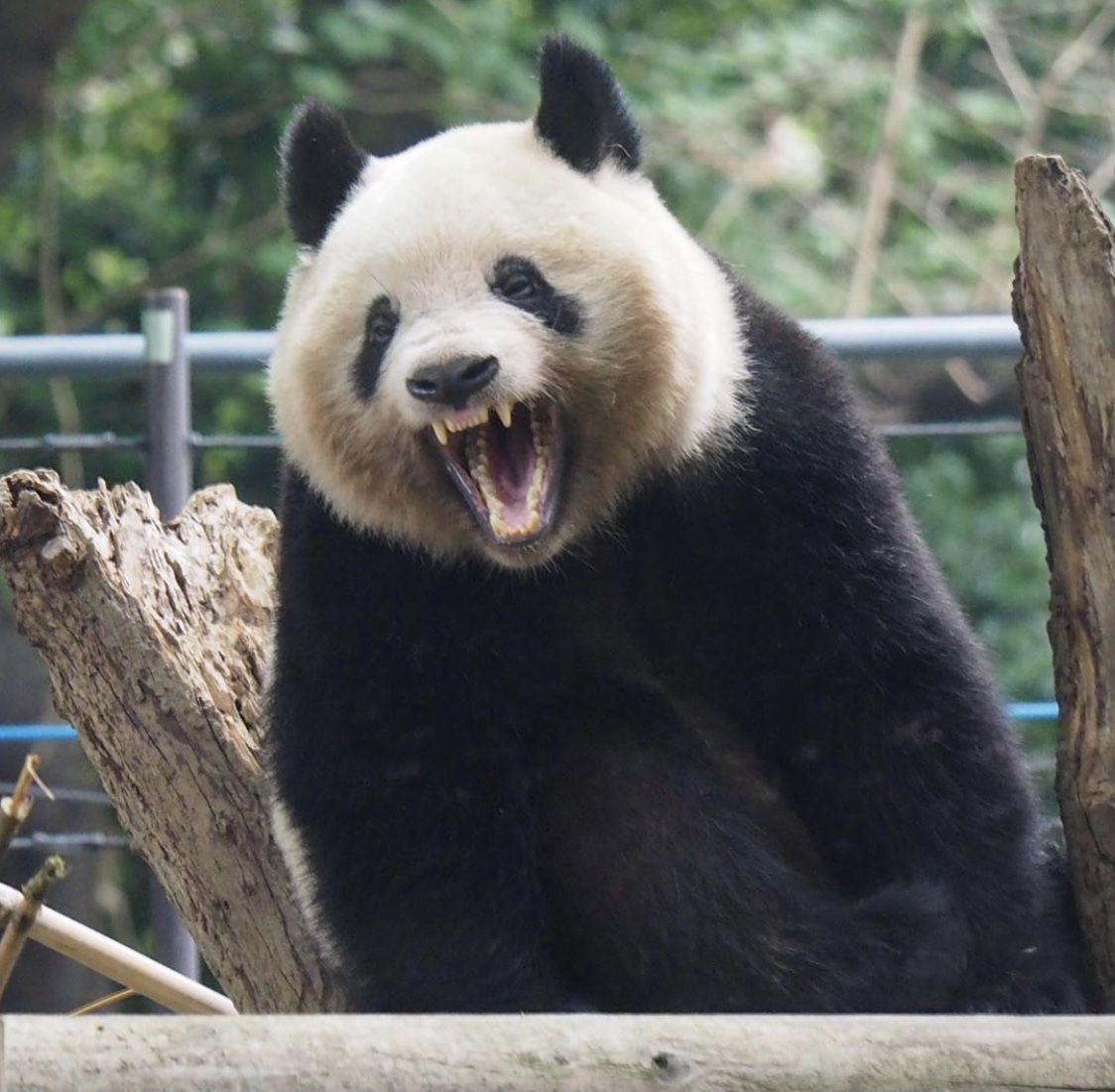
Walk into the bamboo forests of Sichuan at dawn and you might find two sets of bear tracks on the same muddy trail. One belongs to a giant panda pulling itself through the understory at a steady two kilometres an hour. The other belongs to an Asiatic black bear heading uphill toward an acorn-heavy oak. Both animals are true members of the family Ursidae. Both spend their lives in the same Chinese mountains.
And yet they lead almost completely different lives, because evolution shaped them to avoid one another rather than to compete.
This guide compares the giant panda with the three bear species most often confused with it: the Asiatic black bear (Ursus thibetanus), the American black bear (Ursus americanus), and the sun bear (Ursus malayanus). It also touches on the sloth bear (Melursus ursinus) for completeness.
The focus is on what happens where giant panda and Asiatic black bear ranges actually overlap, because that is the only place on Earth where two bear species coexist in significant numbers on bamboo-dominated mountains.
Why the Comparison Matters
Most English-speaking readers picture only two kinds of bear: a brown one that eats salmon and a polar one that eats seals. The reality is that Ursidae contains eight living species and that the Asian half of the family is far stranger than the Western one. Three of those species live in tropical or subtropical Asia.
Two of them, the giant panda and the Asiatic black bear, share the same mountain forests in central China. For a visitor scanning the forest floor or checking a camera-trap image, telling them apart matters. The animals look superficially similar at a glance: both are black-and-white or black-and-pale, both sit on their haunches, both climb.
The deeper reason to compare them is ecological. Giant pandas are the clearest example in all of Carnivora of a species that escaped competition by specialising into a near-exclusive bamboo diet. They share their habitat with a flexible, aggressive, widely distributed omnivore - the Asiatic black bear - and they do it without direct conflict.
Understanding how that coexistence works tells us something important about niche evolution, about why species that look alike do not always fight, and about why pandas remain one of conservation's most curious success stories.
"Giant pandas and Asiatic black bears illustrate a classic case of resource partitioning. They share geographical space but not ecological space. One animal eats bamboo on the ground; the other eats fruit and acorns in the trees. They rarely notice each other."
- Fuwen Wei, Institute of Zoology, Chinese Academy of Sciences
The Cast of Characters
Before diving into direct comparison, it is worth naming the players.
- Ailuropoda melanoleuca, the giant panda. Endemic to central China. Roughly 100-160 kg. Eats 99 percent bamboo. Conservation status: Vulnerable, downlisted from Endangered in 2016.
- Ursus thibetanus, the Asiatic black bear (also called the moon bear for the pale crescent on its chest). Ranges across forested Asia from Iran to Japan. 60-200 kg for males. True omnivore. Conservation status: Vulnerable, with bile farming as a major pressure.
- Ursus americanus, the American black bear. Native only to North America. 40-300 kg depending on sex and food supply. The most common bear on Earth. Conservation status: Least Concern.
- Ursus malayanus, the sun bear. Southeast Asian tropical forests. 27-65 kg. Smallest bear. Conservation status: Vulnerable.
- Melursus ursinus, the sloth bear. Indian subcontinent. 55-140 kg. Termite specialist. Conservation status: Vulnerable.
Of these five, only the giant panda and the Asiatic black bear live in the same forests. The others appear in this guide to settle the common mix-ups and to show how unrelated the bamboo specialist really is from the tropical species that sometimes get thrown into the same conversation.
Giant Panda vs Asiatic Black Bear at a Glance
The table below compares the two bears that actually share habitat. Values are typical adult ranges, not extremes.
| Trait | Giant Panda (Ailuropoda melanoleuca) | Asiatic Black Bear (Ursus thibetanus) |
|---|---|---|
| Adult male weight | 100-160 kg | 100-200 kg |
| Adult female weight | 70-125 kg | 60-125 kg |
| Body length | 120-180 cm | 120-190 cm |
| Coat pattern | White body, black legs, black ears, black eye patches | Black body, pale V or crescent on chest |
| Skull shape | Broad, high crest, massive jaw muscles | Rounded, flatter face |
| Bite force | ~1,300 psi (bamboo-crushing) | ~520 psi |
| Diet | 99% bamboo, trace meat and carrion | Omnivore: fruit, acorns, insects, small mammals, carrion |
| Daily foraging time | 10-16 hours | 6-10 hours |
| Activity pattern | Diurnal with a midday siesta | Crepuscular, often nocturnal near humans |
| Tree climbing | Cubs and subadults climb; adults rarely | All ages climb routinely |
| Hibernation | No true hibernation | Partial, in northern parts of range |
| Cubs per litter | 1-2, typically only 1 survives | 1-3 |
| Range in China | Sichuan, Shaanxi, Gansu | All forested provinces including panda range |
| IUCN status | Vulnerable | Vulnerable |
The numbers tell one story, but the behaviour tells another. A panda and an Asiatic black bear of similar weight do not live similar lives. One grinds through 12 to 38 kilograms of bamboo a day to survive on a poor diet; the other covers ground looking for whatever is ripe, nutritious, and portable.
Shared Mountains, Separate Lives
Giant pandas occupy a narrow sliver of habitat: roughly 2,500 to 3,500 metres of elevation in the Qinling, Minshan, Qionglai, Liangshan, Xiangling, and Daxiangling mountain ranges. Inside that sliver, bamboo understory is non-negotiable. Roughly 20 bamboo species make up the panda diet across its range, and every panda reserve is defined by the bamboo species that grow there.
Asiatic black bears use the same elevation band but also drop lower, following oak mast and wild fruit trees down to 1,500 metres and occasionally below.
Camera-trap studies from Wolong, Foping, and the Qinling panda reserves consistently show that both species pass through the same forest compartments, often on the same trails, without apparent aggression. The reason is that they are not chasing the same calories. To see how the overlap actually works, think in vertical layers.
- Ground layer, 0-1 m. Bamboo stems and shoots. This is the panda's world almost exclusively. Asiatic black bears walk through it but do not feed on bamboo.
- Shrub layer, 1-5 m. Understory berries, rhododendron, wild kiwi. Asiatic black bears forage here in summer. Pandas largely ignore it.
- Canopy layer, 5-30 m. Oak mast, wild pear, wild peach, cherry, walnut. Asiatic black bears climb routinely and often build feeding nests - broken branches arranged in a bowl - to hold themselves while they strip fruit. Adult pandas almost never climb to this layer.
- Deadwood and forest floor. Insect larvae, rodents, occasional carrion. Asiatic black bears exploit these opportunistically. Pandas ignore them except when a cub finds a pika or a carcass.
The spatial overlap is essentially total. The dietary overlap is close to zero. This is textbook niche partitioning, and it is the reason the two species persist together in an environment that cannot support two large omnivores.
"We set up camera traps in Qinling expecting to see one dominant bear species per site. What we actually saw was extensive co-occurrence. The two animals are using the same ridges and valleys but they are reading entirely different menus."
- Dajun Wang, Peking University, School of Life Sciences
For a deeper dive into what makes the panda so tightly bound to bamboo, see the companion guides on why pandas eat bamboo and how pandas survive on bamboo.
Size and Body Plan
At first glance a large male Asiatic black bear and a typical adult giant panda are close in weight. The similarity ends at the scale. Their bodies are engineered for different jobs.
The giant panda has a massive head relative to its body, with a sagittal crest that anchors oversized temporalis muscles. That crest and those muscles power the bite force required to crush woody bamboo culms. Panda molars are broad and flattened, with cusps arranged to grind fibrous plant material rather than shear meat.
The famous pseudo-thumb, an enlarged wrist bone on each forepaw, allows a panda to grip a bamboo stem while stripping it. The body is compact and low-slung. Pandas are poor runners, mediocre climbers as adults, and indifferent swimmers. They do not need to chase anything; their food grows in place.
The Asiatic black bear has a rounder, flatter skull with a smaller jaw apparatus. Its molars are sharper and its canines longer, in line with an omnivorous diet that includes meat when meat is available. Its forelimbs are long and strongly muscled, with short curved claws built for climbing rather than digging.
Asiatic black bears are excellent climbers throughout their lives - one of the best in the bear family - and they can cover ground quickly when they choose to. They can stand on their hind legs for long periods and are known to walk bipedally over short distances, a behaviour rare in other bears.
Coat patterns settle any remaining identification question:
- Giant panda: white base with black ears, black limbs, a black band across the shoulders, and black patches around the eyes.
- Asiatic black bear: black across the entire body with a sharp pale chest marking shaped like a crescent moon or a V.
- American black bear: typically solid black or cinnamon across North America, sometimes with a small white chest patch, but without the strong V of the Asian cousin.
- Sun bear: short black coat with a golden or orange chest crest, much smaller body, and a noticeably long tongue.
The coat differences are absolute. No one who sees both animals in the flesh ever confuses a giant panda with any other bear species.
Activity and Behaviour
Pandas and Asiatic black bears also separate themselves in time, not only in space.
Giant pandas are diurnal with two long foraging peaks: early morning and late afternoon, broken by a long midday rest. The rest is not laziness; it is necessary because bamboo is so poor a food that pandas must spend their active hours eating rather than travelling. A panda will often eat for six hours, sleep for two, eat for another six, and sleep again. Travel distances are short, typically under 1 kilometre a day within a bamboo patch.
Asiatic black bears are crepuscular to nocturnal, especially in areas with any human presence. They are active at dawn and dusk, travel more widely than pandas (often 3 to 10 kilometres a day during acorn season), and frequently rest in tree crotches rather than on the ground. Where humans or large carnivores are common, black bears shift their activity almost entirely into darkness.
In remote panda reserves without tigers or leopards, Asiatic black bears sometimes show a more mixed activity pattern, but they still avoid the brightest midday hours that pandas prefer.
The behaviour split matters because it reduces encounter rates further. A panda feeding at 10 a.m. and an Asiatic black bear feeding at 10 p.m. use the same tree without ever seeing each other.
"Asiatic black bears in protected Chinese reserves push their activity into night even when there is no apparent threat. Pandas, by contrast, show no such shift. The two species end up in the same places at different clock times."
- Don Reid, Wildlife Conservation Society Canada, co-author on Asian bear activity studies
Reproduction and Life History
Both species are slow reproducers, but they space their investment differently.
Giant pandas have one of the briefest mating windows of any mammal, with females receptive for only 24 to 72 hours per year. Gestation is 95 to 160 days due to delayed implantation. Litters are typically one cub, occasionally two, and almost always only one survives in the wild because the mother cannot produce enough milk for two. Cubs are born the size of a stick of butter and take around 18 months to leave their mothers. Wild females breed roughly every two to three years.
Asiatic black bears have longer receptive windows, with females oestrous for several weeks in early summer. Gestation is 6 to 8 months with delayed implantation. Litters average two cubs, with three not unusual, and cubs stay with their mother for 24 to 30 months. Female Asiatic black bears can reproduce every two years under good conditions.
The Asiatic black bear's reproductive output is about double the panda's - a crucial reason the species has held onto wider populations despite the bile-farming trade.
The panda reproductive strategy is paradoxical for a large carnivore: almost as slow as an elephant's, in an animal the size of a man. The reasons, and the conservation implications, are explored in the dedicated guide to panda conservation success.
Range Overlap With Other Asian Bears
Readers searching for sun bear vs panda or comparing the five Asian bears sometimes assume the species mingle freely. They do not. The table below shows which Asian bear species actually share habitat with the giant panda.
| Species | Latin name | Range | Overlap with giant panda? |
|---|---|---|---|
| Asiatic black bear | Ursus thibetanus | Forested Asia, Iran to Japan | Yes, extensive. Sichuan, Shaanxi, Gansu panda reserves |
| Brown bear (Tibetan blue bear) | Ursus arctos pruinosus | Tibetan plateau, high Himalaya | Marginal. Touches panda range on the western edge, favours higher alpine zones |
| Sun bear | Ursus malayanus | Southeast Asia, Borneo, Sumatra | No. Northern edge stops in southern Yunnan, hundreds of km from panda habitat |
| Sloth bear | Melursus ursinus | Indian subcontinent, Sri Lanka | No. Entire species range is south and west of the Himalayas |
| American black bear | Ursus americanus | North America only | No. Different continent entirely |
The takeaway is that the only Asian bear that routinely shares a forest with a giant panda is the Asiatic black bear. Anything you read about pandas "competing with sun bears" or "living alongside sloth bears" is geographically impossible. See the detailed brown bear entry for the Tibetan blue bear population that grazes the edge of panda country without ever dropping into the bamboo belt.
Giant Panda vs American Black Bear
Because so many English-speaking readers default to "black bear" when they picture an Ursus species, it is worth handling the American black bear (Ursus americanus) separately.
American black bears are North American only. They live nowhere in Asia. They are the third-closest living relative of the giant panda behind the other Ursus species, but they occupy ecological ground that looks nothing like panda habitat: deciduous forests of the Appalachians, spruce-fir forests of the Rockies, coastal rainforests of British Columbia. They eat berries, acorns, insects, deer fawns, and garbage. They hibernate for up to seven months in northern populations.
The only useful comparison between a giant panda and an American black bear is taxonomic: both belong to Ursidae, but giant pandas branched off the bear family tree around 18 to 22 million years ago, long before Ursus diversified. American black bears are genetically closer to Asiatic black bears, brown bears, and polar bears than they are to pandas. For a head-to-head comparison of the two North American look-alikes, see grizzly bear vs black bear and brown bear.
"The giant panda is the deepest branch within the living bear family. It has been evolving on its own trajectory since before the rest of Ursidae diversified. Comparing a panda with a black bear is like comparing a platypus with any other mammal: the family is the same, the evolutionary distance is huge."
- Editorial note, Ursus journal, International Association for Bear Research and Management
Why Pandas Evolved Away From Competition
The modern giant panda is a dietary specialist in a family of generalists. The fossil record shows that the ancestors of Ailuropoda were omnivores, and genetic analysis confirms that the panda lineage still carries a functional digestive system for meat. The species lost its ability to taste umami (meat flavour) around 4 million years ago, when a mutation disabled the T1R1 taste receptor gene.
That single genetic event is one of the best-documented cases of dietary specialisation on a genome level in the mammal class.
From an evolutionary standpoint, the panda did not have to become a bamboo specialist. Bamboo was simply abundant, year-round, unguarded by other large herbivores, and available at elevations where few other carnivores bothered to live. Over several million years the panda lineage shifted its teeth, jaw, gut microbiome, and foraging behaviour to exploit this resource. Each shift further reduced competition with omnivorous bears in the same forests.
The Asiatic black bear, meanwhile, stayed omnivorous. It spread widely across Asia, tolerating climates from the Russian Far East to Iran. It kept its climbing ability, its meat-processing teeth, and its behavioural flexibility. Where the two species meet in Chinese bamboo forests, the panda eats what nothing else eats and the black bear eats what pandas cannot climb for.
The outcome is what ecologists call character displacement: two related species diverge most sharply where they overlap, because any individual that avoids competition leaves more offspring. The giant panda is perhaps the most extreme example of character displacement in any mammal.
For the taxonomic question that the name invites - are pandas actually bears? - see are pandas actually bears and giant panda vs red panda. Both are settled questions. Giant pandas are bears. Red pandas are not.
Conservation Paths Diverge
Giant pandas and Asiatic black bears share a forest and an IUCN category, but they are on different trajectories.
Pandas were uplisted to global conservation priority in the 1960s, pushed through four decades of intensive habitat protection, and downlisted from Endangered to Vulnerable in 2016 on the basis of population recovery. Current estimates put wild giant panda numbers at around 1,800 to 2,100 adults across 67 nature reserves.
The network of protected reserves in Sichuan, Shaanxi, and Gansu now also shelters Asiatic black bears, takins, golden snub-nosed monkeys, and countless smaller species. Panda conservation pulled an entire ecosystem along with it. See the panda conservation success story for the full history.
Asiatic black bears get none of that attention. Their numbers are thought to be declining across most of their range, in large part because of the bile farming industry, which extracts bile from live captive bears for traditional medicine markets. Tens of thousands of animals sit in cages in China, Vietnam, Korea, and Laos. Wild populations suffer from poaching for gall bladders and paws.
In the same reserves where pandas are guarded by rangers, black bears are sometimes trapped illegally only a few kilometres away.
"The Asiatic black bear gets almost none of the funding that pandas attract, yet its decline is steeper. Bile farming and gall bladder poaching are the main pressures. The species badly needs the kind of attention that was focused on giant pandas in the 1980s."
- IUCN Bear Specialist Group, Asiatic Black Bear Status Report
The polar bear, covered in the dedicated polar bear guide, faces its own pressures from sea ice loss. Brown bears, sun bears, sloth bears, and American black bears all sit somewhere on the same spectrum between Least Concern and Vulnerable. The giant panda is now arguably the most secure of all Asian bears thanks to decades of coordinated state-level protection, and the Asiatic black bear is arguably the least secure despite being numerically more abundant.
Practical Identification in the Field
If you are in a Chinese mountain reserve and spot a bear, here is the shortest possible decision tree.
- Is it mostly white? If yes, giant panda.
- Is it small, solid black, with a V-shaped pale chest patch? Asiatic black bear.
- Is it in a tree? Probably Asiatic black bear. Adult pandas rarely climb.
- Is it chewing something fibrous and sitting on its rump? Almost certainly a panda.
- Is it at dawn or dusk on a trail? Probably an Asiatic black bear. Pandas are midday feeders.
Tracks help too. Panda prints show the large pseudo-thumb on the forepaw, giving an extra lobe that no other bear produces. Asiatic black bear prints look like a typical Ursus print: five toes, heel pad, curved front claws.
The Takeaway
The giant panda and the Asiatic black bear are true siblings in the bear family. They evolved on the same continent, they share the same Chinese mountains, and they face the same IUCN threat level. But one became a bamboo specialist with a bite force to crack wood, diurnal habits, and no hibernation.
The other stayed an omnivore with a climbing build, crepuscular habits, and partial winter dormancy. They coexist because evolution pushed them apart. They both need protection because human pressure refuses to.
Neither animal competes with the sun bear, the sloth bear, or the American black bear, because those three live on other parts of the planet. When someone asks about "panda vs black bear", they are almost always asking about the moon bear - the quiet, dark, climbing omnivore that shares every panda reserve on Earth. Knowing that one detail transforms a confused comparison into a clear ecological story.
For further reading on how pandas fit into the wider bear family, pair this guide with giant panda, are pandas actually bears, and giant panda vs red panda. Readers interested in comparison content across our network can also look at sister guides on whats-your-iq.com, writing resources on evolang.info, and cert-path content on pass4-sure.us.
References
- Wei, F., Swaisgood, R., Hu, Y., et al. (2015). Progress in the ecology and conservation of giant pandas. Conservation Biology, 29(6), 1497-1507. https://doi.org/10.1111/cobi.12582
- Garshelis, D., & Steinmetz, R. (2020). Ursus thibetanus (amended version of 2016 assessment). The IUCN Red List of Threatened Species. https://doi.org/10.2305/IUCN.UK.2020-3.RLTS.T22824A166528664.en
- Hu, Y., Wu, Q., Ma, S., et al. (2017). Comparative genomics reveals convergent evolution between the bamboo-eating giant and red pandas. PNAS, 114(5), 1081-1086. https://doi.org/10.1073/pnas.1613870114
- Zhu, L., Wu, Q., Dai, J., Zhang, S., & Wei, F. (2011). Evidence of cellulose metabolism by the giant panda gut microbiome. PNAS, 108(43), 17714-17719. https://doi.org/10.1073/pnas.1017956108
- Hwang, M. H., Garshelis, D. L., & Wang, Y. (2002). Diets of Asiatic black bears in Taiwan, with methodological and geographical comparisons. Ursus, 13, 111-125. https://doi.org/10.2192/1537-6176(2007)18[211:MAFOAB]2.0.CO;2
- Liu, F., McShea, W. J., Garshelis, D. L., et al. (2011). Spatial distribution as a measure of conservation needs: an example with Asiatic black bears in south-western China. Diversity and Distributions, 17(2), 338-348. https://doi.org/10.1111/j.1472-4642.2011.00735.x
- Jin, K., Xue, C., Wu, X., Qian, J., et al. (2011). Why does the giant panda eat bamboo? A comparative analysis of appetite-reward-related genes among mammals. PLoS ONE, 6(7), e22602. https://doi.org/10.1371/journal.pone.0022602
- Nie, Y., Speakman, J. R., Wu, Q., et al. (2015). Exceptionally low daily energy expenditure in the bamboo-eating giant panda. Science, 349(6244), 171-174. https://doi.org/10.1126/science.aab2413
Frequently Asked Questions
Do giant pandas and Asiatic black bears live in the same forests?
Yes, the two species overlap extensively across the temperate bamboo and mixed broadleaf forests of Sichuan, Shaanxi, and Gansu provinces in central China. Camera-trap surveys in Wolong, Foping, and Qinling reserves routinely record giant pandas (Ailuropoda melanoleuca) and Asiatic black bears (Ursus thibetanus) on the same trails, sometimes only hours apart. Co-occurrence does not mean competition, however.
Pandas stay low in the understory eating bamboo stems and shoots, while Asiatic black bears climb into the canopy for acorns, wild pears, and cherries. The two bears partition the same mountain vertically rather than fighting over it.
Which is bigger, a giant panda or an Asiatic black bear?
It depends on the individual. Giant pandas average 100-160 kg, with males typically at the heavier end. Asiatic black bears are more variable: females weigh 60-125 kg, while large males in acorn-rich years can push 180-200 kg, heavier than most wild pandas. On average the two are close in mass, but an Asiatic black bear is leaner and more athletic, while a panda is stockier with a broader skull and more powerful jaw muscles.
A panda’s bite force is roughly 1,300 psi, one of the strongest of any carnivoran, because it needs to crush fibrous bamboo culms every day.
Do sun bears or sloth bears overlap with giant pandas?
No. The sun bear (Ursus malayanus) lives in the tropical forests of Southeast Asia, from southern Yunnan through Indochina to Borneo, and the northern edge of its range stops hundreds of kilometres south of any giant panda population. The sloth bear (Melursus ursinus) is restricted to the Indian subcontinent and parts of Sri Lanka. The only bear species that genuinely shares habitat with the giant panda is the Asiatic black bear.
Brown bears (Ursus arctos pruinosus, the Tibetan blue bear) touch panda range along its northwestern edge but favour higher, more open terrain above the bamboo belt.