
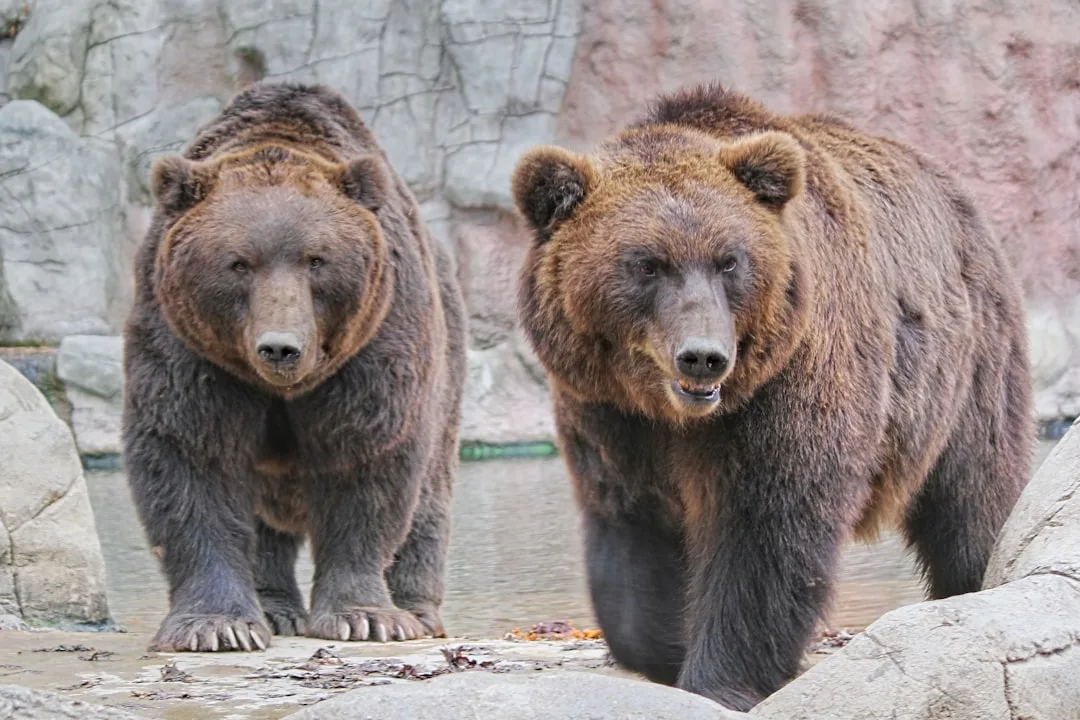
Ask a wildlife biologist working in the Andes how big a spectacled bear is and they will pause before answering, because the honest reply has two layers. On the surface, the spectacled bear is a medium-sized animal: males average around 110 kilograms, females around 60, and a fully grown adult on its hind legs is roughly the height of a tall human. That is the number you put in a field guide.
Underneath that, the spectacled bear is the small surviving relative of the largest bears that ever lived. Its closest evolutionary cousins, the extinct South American genus Arctotherium, included individuals estimated at 1,500 kilograms and three metres tall on their hind legs. The living spectacled bear is what is left of that lineage after the Pleistocene extinctions. It is a medium-sized bear standing on the floor of a giant's footprint.
This article is the technical size breakdown for Tremarctos ornatus, the only living member of the subfamily Tremarctinae and the only bear species native to South America. It is the companion piece to our main spectacled bear species profile, which covers the full biology, ecology, and conservation status of the species.
Here we focus narrowly on the size question: how much do spectacled bears weigh, how tall do they stand, how long are they nose to rump, how strong is the dimorphism between males and females, and how the species compares with both its living ursid relatives and its extinct giant cousins.
If you only remember one thing, remember this. The spectacled bear is the last short-faced bear on Earth, and the short-faced bears used to include the largest bears in history. The animal you see today, mid-sized and stocky, climbing a wax palm in an Ecuadorian cloud forest, is the small surviving branch of a lineage that once walked the New World at three metres tall.
The Short Answer, in Numbers
Before the comparative anatomy and the deep time, the headline numbers people come to an article like this to find. These figures are drawn from the IUCN/SSC Bear Specialist Group's spectacled bear conservation action plan, peer-reviewed Andean field studies, and the long-running Spectacled Bear Conservation programme in northern Peru.
| Measurement | Adult male | Adult female | Cub at birth |
|---|---|---|---|
| Body mass | 60-150 kg (avg ~110 kg) | 35-82 kg (avg ~60 kg) | 300-360 g |
| Body length (nose to rump) | 1.5-2.0 m | 1.4-1.8 m | 25-35 cm |
| Shoulder height (on all fours) | ~70 cm | ~65 cm | n/a |
| Standing height (on hind legs) | 1.6-1.9 m | 1.4-1.7 m | n/a |
| Sexual dimorphism (mass ratio) | ~2x female mass | baseline | n/a |
| Estimated bite force | ~700 psi | ~600 psi | n/a |
Read across the table and a clear profile emerges. The spectacled bear is medium-sized, stocky, strongly sexually dimorphic, and surprisingly tall when reared up. The standing figure of 1.6 to 1.9 metres is the one that surprises hikers most often, because the bear looks compact on all fours and then rises into something close to human height when it wants a better look at a sound or a smell.
"People expect Andean bears to be small because they live in tropical mountains and they look short and round on the ground. Then a male stands up in front of you on a ridge and he is six feet tall and 250 pounds and you stop expecting anything. The size is medium. The presence is not."
- Russ Van Horn, Wildlife Conservation Society and San Diego Zoo Wildlife Alliance, on field encounters in northern Peru
Why the Spectacled Bear Is Sized the Way It Is
Three factors explain why Tremarctos ornatus sits where it does on the bear size scale, neither as large as the brown bear lineage nor as small as the sun bear lineage.
1. A predominantly herbivorous diet in a calorie-thin environment. Spectacled bears eat roughly 95 percent plant matter. Their core foods, bromeliad hearts, palm fruits, cactus pads, figs, and orchid bulbs, are far less calorie-dense than the salmon runs that build coastal Alaska brown bears or the seal blubber that builds polar bears.
A herbivorous bear in a tropical mountain ecology has a much lower ceiling on body mass than a carnivorous bear with anadromous fish. For the full diet picture see what do spectacled bears eat.
2. Steep, broken Andean terrain. Andean cloud forest is structurally three-dimensional. Bears climb constantly, building feeding platforms in trees, scaling cliffs to reach bromeliads, and travelling vertically up and down elevational gradients between 250 and 4,750 metres. Extreme body mass is a liability in that ecology.
Selection has favoured a build that is strong, climbing-capable, and metabolically sustainable on plant matter rather than maximally large. A bear that weighed 400 kilograms could not safely hold the upper canopy of a fruiting Ficus in cloud forest.
3. Tropical year-round activity. Spectacled bears do not hibernate. They remain active twelve months of the year, migrating vertically along the Andes to follow fruit cycles. Bears that hibernate, brown bears, black bears, polar bears, can pack on enormous fat reserves before denning because they will burn through them across a multi-month dormancy. A non-hibernating tropical bear has no equivalent driver for extreme seasonal fat deposition, and so the body-size ceiling sits lower.
"The Andean bear's size is what you get when you strip the salmon out of a brown bear and replace it with bromeliads, take away the hibernation, and add a 4,500 metre vertical commute. Medium-sized, stocky, and built to climb. Not built to grow."
- Ursus, journal of the International Association for Bear Research and Management, on Tremarctine body-size constraints
Sexual Dimorphism: The Roughly 2x Rule
Spectacled bears show pronounced sexual size dimorphism. On average a male weighs about twice as much as a female from the same population. That ratio is steeper than in the American black bear (where males are typically 1.5x females) and comparable to the brown bear at the upper end of its dimorphism range.
In some northern Peruvian populations the ratio appears to climb higher still, with large males four to five times the mass of small females, although those extremes are anecdotal rather than from systematic weighed samples.
| Population sex | Typical mass | Typical body length | Typical standing height |
|---|---|---|---|
| Adult male | 60-150 kg (avg 110) | 1.5-2.0 m | 1.6-1.9 m |
| Adult female | 35-82 kg (avg 60) | 1.4-1.8 m | 1.4-1.7 m |
| Subadult male (3-5 yr) | 40-90 kg | 1.3-1.7 m | 1.4-1.6 m |
| Subadult female (3-5 yr) | 30-55 kg | 1.2-1.5 m | 1.3-1.5 m |
| Yearling | 12-25 kg | 0.8-1.1 m | n/a |
| Cub at six months | 4-8 kg | 0.4-0.6 m | n/a |
Three biological consequences flow from this dimorphism. First, females cannot rely on size alone to defend cubs and instead use elusiveness, nocturnal movement, and tree-cavity birth dens high above ground. Second, male home ranges are typically several times larger than female home ranges and overlap multiple female territories. Third, body-size studies that pool sexes produce misleading averages. Any honest figure for spectacled bear mass needs to specify male, female, or both.
For more on family structure and how cubs grow into this dimorphic adult body plan, see spectacled bear cubs and family life.
Standing Height and Why Spectacled Bears Stand So Often
The standing height figure of 1.6 to 1.8 metres deserves its own section because spectacled bears stand more frequently than almost any other living bear. In Andean cloud forest, where sightlines are short and the forest is structured vertically, rearing on the hind legs is a routine behaviour rather than a rare display.
Why they stand:
- Better visual horizon in dense vegetation
- Cleaner scent cone lifted above ground-level air masses
- Wider acoustic field away from leaf-litter rustle
- Functional feeding posture to reach bromeliads and fruit
- Assessment of unfamiliar objects, including humans
A standing spectacled bear is rarely aggressive. The posture is investigative, not threatening. It is the bear deciding whether to stay or leave, and in the overwhelming majority of encounters it leaves. The species is among the most reliably non-aggressive bears toward humans, with no confirmed unprovoked fatal attacks on adults in the modern record.
The standing height also explains why the spectacled bear is often called taller than it should be for its weight. A 110 kilogram male standing 1.8 metres has a much higher height-to-mass ratio than, say, a 110 kilogram interior grizzly, which would stand closer to 2.2 metres but at very different body proportions. The spectacled bear achieves its standing height with long forelimbs and a relatively narrow chest, an arboreal climbing build, rather than with raw mass.
Body Build: The Stocky, Round-Headed Profile
A spectacled bear in side profile reads as short, broad, and round. The head is rounder than other bears, the muzzle markedly shorter, the neck thick, and the limbs disproportionately strong for the body size. This morphology is not accidental. It is the inherited signature of the subfamily Tremarctinae, the short-faced bears.
Defining anatomical features:
- Round, dome-like skull with shortened rostrum
- Broad zygomatic arches that anchor powerful jaw muscles
- Compact dentition adapted for crushing fibrous plant matter
- Forelimbs longer than hindlimbs, an arboreal trait
- Strong, curved, non-retractile claws for climbing bark and rock
- Thick, dense black or dark brown coat with cream or yellow facial markings
- Barrel chest and short tail (typically 7 cm)
The short rostrum is the most diagnostic feature. Where a brown bear or polar bear has a long, almost dog-like muzzle, a spectacled bear has a face that looks slightly compressed, almost cat-like in proportion. That compression is what gave the subfamily its name and is the most direct visible link between the modern spectacled bear and its giant extinct relatives.
The skull of a spectacled bear and the skull of Arctodus simus, the North American giant short-faced bear, share the same basic geometry. One is the size of a melon. The other is the size of a basketball. The shape is the same.
For more on what those facial markings mean and how researchers use them as fingerprints, see why spectacled bears have spectacles.
How the Spectacled Bear Compares to Other Living Bears
The spectacled bear sits firmly in the medium-size band of the Ursidae. The clearest way to place it is to line it up against every other living bear species at typical adult male mass.
| Species | Typical adult male mass | Standing height | Notes |
|---|---|---|---|
| Polar bear (Ursus maritimus) | 350-700 kg | 2.4-3.0 m | Largest land carnivore by mass |
| Kodiak/coastal brown bear | 300-630 kg | 2.7-3.0 m | Salmon-fed brown bear giants |
| Brown bear (Eurasian) | 200-300 kg | 2.2-2.5 m | Widespread northern hemisphere |
| Grizzly bear (interior NA) | 180-360 kg | 2.0-2.5 m | Same species as brown bear |
| American black bear | 100-280 kg | 1.8-2.1 m | Most common North American bear |
| Asiatic black bear | 100-200 kg | 1.7-2.0 m | The "moon bear" of South Asia |
| Sloth bear | 80-140 kg | 1.6-1.9 m | India and Sri Lanka, termite specialist |
| Spectacled bear (T. ornatus) | 60-150 kg (avg 110) | 1.6-1.9 m | Only South American bear |
| Giant panda | 85-125 kg | 1.5-1.8 m | Bamboo specialist, Sichuan |
| Sun bear | 30-65 kg | 1.2-1.5 m | World's smallest bear |
Read this table top to bottom and the spectacled bear is the eighth-largest of nine living bears. It outweighs only the giant panda and the sun bear, and the panda overlap is small. It is roughly half the mass of an American black bear and about a third the mass of an interior grizzly. Compared to its closest geographic neighbour in the New World, the American black bear, an adult male spectacled bear is shorter, lighter, and rounder.
For deeper comparisons against specific species see how big are grizzly bears, size and weight, how big are brown bears, and how small is the sun bear, the world's smallest bear. For a head-to-head treatment of the spectacled bear against other ursids, see spectacled bear vs other bears.
"In bear comparisons, the spectacled bear is the species you forget exists until you see one. It is medium-sized, mostly black, mostly silent, and lives in country most bear biologists never visit. It is not extreme in any direction except evolutionary history, where it is the only one of its kind left."
- Bernard Peyton, IUCN/SSC Bear Specialist Group, on the position of Tremarctos ornatus
The Giant Cousins: Arctotherium and Arctodus
To understand why the spectacled bear's size is the headline of a story rather than a random data point, you have to look at the rest of the subfamily Tremarctinae. The short-faced bears split from the lineage leading to modern brown and black bears (subfamily Ursinae) approximately 13 million years ago. The Tremarctinae then radiated across the Americas and produced some of the largest terrestrial carnivorans ever to exist.
Extinct Tremarctine relatives of the spectacled bear:
- Arctotherium angustidens - South American Pleistocene giant. Estimated body mass for the largest specimens has been reconstructed at up to 1,500 kilograms, with standing height approaching three metres. Considered by several authorities the largest bear that ever lived.
- Arctotherium other species - A radiation of South American short-faced bears across the Pleistocene. Sizes ranged from large to enormous. Most became progressively smaller through the Pleistocene before going extinct entirely.
- Arctodus simus - The North American giant short-faced bear. Body mass commonly estimated at 600-900 kilograms, with the largest specimens potentially exceeding 1,000 kg. Standing height around 2.4 to 3.4 metres on hind legs. Long-limbed and proportionally tall, with debate over how predatory or scavenging its ecology was.
- Arctodus pristinus - A smaller, more bear-like North American Tremarctine, intermediate between the spectacled bear and Arctodus simus.
- Plionarctos - The earliest known Tremarctine genus, from the late Miocene of North America, ancestral to both the Arctodus and Arctotherium lineages and indirectly to Tremarctos.
The 110 kilogram spectacled bear and the 1,500 kilogram Arctotherium are members of the same subfamily. The mass difference between them is greater than the mass difference between any two living bears. The spectacled bear has not stayed small because the lineage was always small. It has stayed small because the giant cousins all died.
The end-Pleistocene extinctions, between roughly 12,000 and 11,000 years ago, removed the megafaunal Tremarctines along with most of the New World's megafauna in general. Tremarctos ornatus survived in part because it was the smallest, the most herbivorous, and the most arboreal of the Tremarctines, occupying steep tropical mountains where the ecological pressures driving the giants extinct were less severe. Today it is the entire surviving branch of a once-dominant carnivoran subfamily.
"Tremarctos ornatus is the last short-faced bear. That sentence is small and it should not be. The Tremarctines once produced the largest bears ever to walk the New World. Today they produce a single species in the cloud forests of the Andes, and that species is the medium-sized animal we are trying to keep on the planet."
- San Diego Zoo Wildlife Alliance, Andean Bear Conservation Program
For where these surviving bears actually live in the modern Andes, see where do spectacled bears live.
Bite Force and Functional Strength
A spectacled bear's bite force has not been directly measured by gauge in a wild adult, but estimates from skull morphology, jaw musculature, and dental wear patterns place the bite at approximately 700 psi (pounds per square inch). That is well above the bite force of large dogs (around 200 to 400 psi) and broadly comparable to the bite of an American black bear. It is below the bite force of a brown bear (around 1,000 psi) and well below a polar bear or jaguar.
The functional consequence is that spectacled bears can:
- Crack hardwood the thickness of a broomstick
- Crush bromeliad bases to extract starchy hearts
- Open palm nuts that smaller carnivores cannot
- Process cactus pads with embedded spines without injury
- Handle bone when scavenging livestock carcasses, although this is rare
The bite force is a herbivore's bite force, optimised for fibrous plant matter rather than for killing large prey. It is the dental signature of a bear that has spent millions of years grinding bromeliad hearts in the high Andes.
Tracks, Footprints, and Field Identification
In Andean field surveys, body size is most often inferred not from weight but from track measurements and camera-trap morphometrics. A spectacled bear's footprint is a useful proxy.
| Track measurement | Adult male | Adult female |
|---|---|---|
| Front pad width | 11-14 cm | 8-11 cm |
| Hind pad width | 10-12 cm | 7-10 cm |
| Front print length (with claws) | 18-22 cm | 14-18 cm |
| Hind print length | 22-28 cm | 17-22 cm |
| Stride length (walking) | 60-90 cm | 50-75 cm |
A spectacled bear hind print is plantigrade and elongated, with five toes and visible claw marks. It is often confused with human footprints in remote Andean trails, especially when partial. The full plantigrade impression with five symmetrical toes and prominent claw marks is the diagnostic. Front prints are shorter and wider than hind prints, with the same five-toe arrangement.
For field workers, track size is the primary tool for estimating individual mass without a capture event. Combined with photo identification of the unique facial markings, it allows non-invasive monitoring of population structure and approximate body sizes across sites where direct weighing is impossible.
How the Size Affects Conservation
Body size is not just a curiosity figure. It has direct implications for spectacled bear conservation, several of which shape current protection strategies across the Andes.
Implications of medium body size:
- Lower calorie requirements than large bears, which lets the species persist on relatively thin tropical mountain forage
- Smaller individual home ranges than large bears (10 to 60 square kilometres typical), which means smaller protected areas can support viable populations
- Lower visibility to humans than large charismatic bears, which has limited public interest and conservation funding
- Lower flight distance from livestock, which has produced human-bear conflict over cattle losses despite the bear's small size relative to the prey
- Higher climbing ability than large bears, which lets females rear cubs in tree-cavity dens out of reach of most predators
The medium body size has been a survival advantage in the post-Pleistocene Andes. It is also a public-relations disadvantage: the spectacled bear does not capture imaginations the way grizzly bears or polar bears do, and conservation funding has historically been a fraction of what comparable populations of larger bears attract.
The Spectacled Bear Conservation programme in Peru, the Andean Bear Foundation in Ecuador, and the long-running Wildlife Conservation Society work in northern South America have together built much of what is known about wild spectacled bear body sizes from systematic capture-and-release studies.
"Andean bears are the right size to disappear. They are big enough to need real habitat, small enough to be ignored in conservation funding cycles, and shy enough to vanish from a forest before anyone realises they were there. Their medium body size is part of what has kept them alive and part of what makes them invisible."
- IUCN/SSC Bear Specialist Group, Andean Bear Expert Team, situational assessment
Comparing Spectacled Bear Size to Common Reference Points
For readers who want a more intuitive sense of spectacled bear mass, here are everyday comparisons.
An average adult male spectacled bear (110 kg) is roughly:
- The mass of a large adult male human plus a small child
- The mass of a competition powerlifter
- The body length of a human lying down with arms slightly extended
- The standing height of a tall human adult
An average adult female spectacled bear (60 kg) is roughly:
- The mass of a slim adult human
- The body length of an average adult human lying down
- The standing height of a short adult human
A large male spectacled bear (150 kg) is roughly:
- The mass of two average adult women
- The standing height of a tall human male
- Approximately one third the mass of an average male grizzly bear
These comparisons matter for trail safety briefings. The honest message for hikers in spectacled bear country is that the animal you might encounter is comparable in mass to a large adult human and reaches roughly your height when reared up. It is not a brown bear. It is not a polar bear. It is a medium animal in steep tropical country, and almost every documented encounter has ended with the bear leaving.
Curiosities Outside the Andes
Strangeanimals.info covers many size and morphology curiosities across global wildlife. If you found this spectacled bear breakdown useful, you may also like our work on cognitive testing at What's Your IQ, which has nothing to do with bears but everything to do with how human minds estimate animal sizes badly.
For musical curiosities including the strange acoustic properties of cloud-forest environments, see When Notes Fly. For language and naming curiosities, including how species names like Tremarctos are constructed and translated across the bear's range in Spanish, Quechua, and Aymara, see Evolang.
A Medium Bear with a Giant Family Tree
The spectacled bear is a medium-sized ursid. Males weigh 60 to 150 kilograms with an average around 110, females 35 to 82 with an average around 60. Body length runs 1.4 to 2.0 metres. Shoulder height on all fours is around 70 centimetres. Standing height on hind legs is 1.6 to 1.8 metres. Sexual dimorphism is steep, with males roughly twice the mass of females.
By the standards of living bears, the species is medium. By the standards of its own evolutionary lineage, the subfamily Tremarctinae, it is the small surviving member of a family that once produced the 1,500 kilogram Arctotherium. The end-Pleistocene extinctions removed the giants. The medium-sized, herbivorous, climbing, tropical-mountain spectacled bear is what remains.
For the full species profile see our main spectacled bear article. For more on the diet, distribution, social life, facial markings, and conservation status that flow out of this body plan, see where do spectacled bears live, what do spectacled bears eat, why spectacled bears have spectacles, and spectacled bear cubs and family life. For comparisons with other bears at different size scales, see spectacled bear vs other bears.
References
Peyton, B. (1999). Spectacled Bear Conservation Action Plan. IUCN/SSC Bear Specialist Group. https://doi.org/10.2305/IUCN.CH.1999.SSC-AP.4.en
Velez-Liendo, X., & Garcia-Rangel, S. (2017). Tremarctos ornatus (errata version published in 2018). The IUCN Red List of Threatened Species 2017: e.T22066A123792952. https://doi.org/10.2305/IUCN.UK.2017-3.RLTS.T22066A45034047.en
Garcia-Rangel, S. (2012). Andean bear Tremarctos ornatus natural history and conservation. Mammal Review, 42(2), 85-119. https://doi.org/10.1111/j.1365-2907.2011.00207.x
Soibelzon, L. H., & Schubert, B. W. (2011). The largest known bear, Arctotherium angustidens, from the Early Pleistocene Pampean Region of Argentina: With a discussion of size and diet trends in bears. Journal of Paleontology, 85(1), 69-75. https://doi.org/10.1666/10-037.1
Krause, J., Unger, T., Nocon, A., Malaspinas, A. S., Kolokotronis, S. O., Stiller, M., et al. (2008). Mitochondrial genomes reveal an explosive radiation of extinct and extant bears near the Miocene-Pliocene boundary. BMC Evolutionary Biology, 8, 220. https://doi.org/10.1186/1471-2148-8-220
Van Horn, R. C., Zug, B., LaCombe, C., Velez-Liendo, X., & Paisley, S. (2014). Human visual identification of individual Andean bears Tremarctos ornatus. Wildlife Biology, 20(5), 291-299. https://doi.org/10.2981/wlb.00023
Mitchell, K. J., Bray, S. C., Bover, P., Soibelzon, L., Schubert, B. W., Prevosti, F., et al. (2016). Ancient mitochondrial DNA reveals convergent evolution of giant short-faced bears (Tremarctinae) in North and South America. Biology Letters, 12(4), 20160062. https://doi.org/10.1098/rsbl.2016.0062
Figueirido, B., & Soibelzon, L. H. (2010). Inferring palaeoecology in extinct tremarctine bears (Carnivora, Ursidae) using geometric morphometrics. Lethaia, 43(2), 209-222. https://doi.org/10.1111/j.1502-3931.2009.00184.x
Frequently Asked Questions
How big is a spectacled bear?
Adult male spectacled bears (Tremarctos ornatus) typically weigh 60 to 150 kilograms with an average around 110 kg, and measure 1.5 to 2.0 metres from nose to rump. Adult females weigh 35 to 82 kilograms, average around 60 kg, and measure 1.4 to 1.8 metres. Shoulder height on all fours is roughly 70 centimetres in both sexes, and a fully reared adult on its hind legs reaches 1.6 to 1.8 metres tall.
The species is medium-sized by ursid standards, smaller than a brown bear or grizzly but considerably larger than a sun bear or red panda. Body shape is stocky, with a barrel chest, short legs, and a notably short rostrum that reflects the spectacled bear’s membership in the otherwise extinct subfamily Tremarctinae.
How tall is a spectacled bear standing on its hind legs?
A typical adult spectacled bear stands 1.6 to 1.8 metres tall when reared on its hind legs, with the largest males approaching 1.9 metres. That is roughly the height of an average adult human male. Spectacled bears stand frequently and for longer than most bears, both as a sensory posture in dense Andean cloud forest and as a feeding posture when reaching into bromeliads or fruiting trees.
Standing height should not be confused with shoulder height on all fours, which is much lower at about 70 centimetres. The 1.6 to 1.8 metre standing figure is the number you would actually face if a spectacled bear rose in front of you on a trail. They look surprisingly tall because their forelimbs are long relative to body size, an adaptation for climbing.
Are spectacled bears bigger than other bears?
No. The spectacled bear is a medium-sized ursid that sits in the lower middle of the bear size league. It is smaller than the brown bear, grizzly, polar bear, and American black bear, comparable in mass to the sloth bear and Asiatic black bear, and clearly larger than the sun bear, which is the world’s smallest bear.
A male spectacled bear at 110 kilograms is roughly one third the mass of an average male grizzly and less than one fifth the mass of a coastal Kodiak. However, the spectacled bear’s extinct close relatives in the subfamily Tremarctinae included Arctotherium angustidens, a Pleistocene South American giant that may have weighed up to 1,500 kilograms and stood three metres on its hind legs. Among living bears the species is medium.
Among its own evolutionary lineage, it is the small surviving cousin of the largest bears that ever lived.