
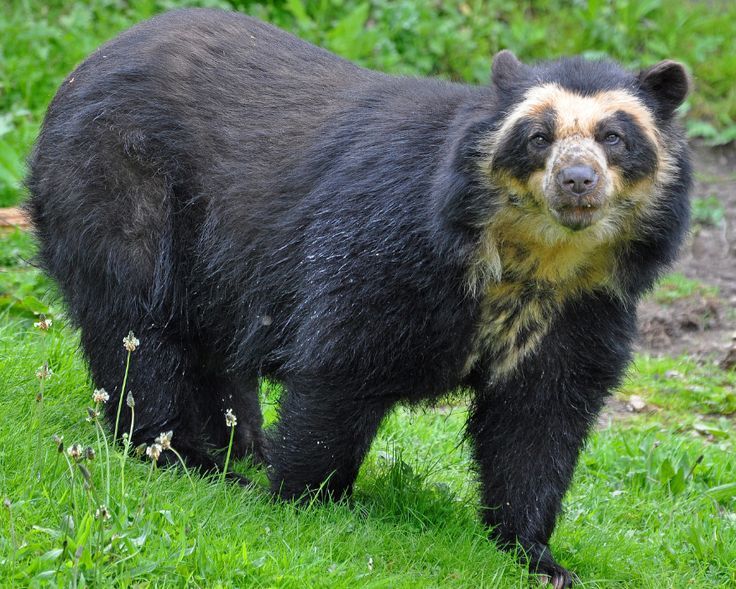
What do spectacled bears eat?
Spectacled bears (Tremarctos ornatus), also called Andean bears, are the most herbivorous of all living bears. Roughly 95 percent of the annual diet by mass is plant matter, dominated by bromeliad hearts (Puya raimondii, Tillandsia, Guzmania), palm fruits and pith (chonta, wax palm), figs, melastome berries, bamboo shoots, and cactus in drier valleys. Animal matter (insects, the occasional small mammal, rare livestock) makes up just 1 to 5 percent.
A Bear That Lives Like a Primate
A male Andean bear, roughly 130 kilograms, is climbing a fig tree on the eastern slope of the Peruvian Andes at 2,400 metres. He has been in the canopy for three days. A platform of broken branches, woven loosely into the crown of the tree about 25 metres above the ground, is his current dining table. He has stripped the surrounding figs and shifted to a neighbouring melastome to keep feeding.
When he descends, he will move to a stand of Puya bromeliads on a nearby ridge and chew the hearts out of a dozen rosettes before sleeping under a rock overhang.
Forty kilometres away, on the western, drier flank of the same mountain range, a female bear is eating columnar cactus in a dry inter-Andean valley. Eight hundred kilometres south, in the Bolivian yungas, a third bear is biting off bamboo shoots from a Chusquea thicket and licking termites from a rotting log. None of these bears has eaten meaningful vertebrate prey in months. None of them needs to.
This is the strangest thing about Tremarctos ornatus: it is officially a member of the order Carnivora, sister taxon to all the other living bears, and yet its lifestyle is closer to a giant arboreal primate than to a polar bear or a grizzly. Understanding the spectacled bear as a species starts with understanding that almost everything in its mouth came from a plant.
"The Andean bear is the most vegetarian bear in the world. Its molars are wide and crushing, its canines reduced, its gut adapted to long fermentation of fibrous plant matter. It is a carnivore in name only. In the Andes, it is functionally a frugivore-folivore that occasionally takes an insect."
- Bernard Peyton, IUCN Bear Specialist Group, in Studies on the Biology and Ecology of the Spectacled Bear, 1980, the foundational ecological monograph for the species.
The 95 Percent Plant Diet by the Numbers
The figure of 95 percent plant matter comes up again and again in the Andean bear literature, and it holds across every long-term diet study from Venezuela to Bolivia. What changes between sites is not the meat-to-plant ratio but the composition of the plant fraction. A bear in the cloud forest at 2,500 metres eats different species than a bear in paramo at 4,000 metres, but both eat almost only plants.
Mean annual diet composition (Andean bear, central range)
| Food category | Share of annual diet | Peak season | Typical species |
|---|---|---|---|
| Bromeliad hearts and bases | 30 to 60% | Year-round | Puya raimondii, P. clava-herculis, Tillandsia, Guzmania |
| Palm fruits and palm pith | 10 to 25% | Variable, fruiting cycles | Bactris gasipaes (chonta), Ceroxylon (wax palm), Aiphanes |
| Soft fruits (figs, melastomes, lauraceae) | 10 to 20% | Local fruiting peaks | Ficus, Miconia, Nectandra, Hyeronima |
| Bamboo shoots and culms | 3 to 10% | Variable | Chusquea spp. |
| Cactus fruit and pads | 0 to 15% (dry valleys) | Dry season | Browningia, Echinopsis, Opuntia |
| Orchid bulbs and aroid corms | 2 to 8% | Year-round | Various |
| Achiote and miscellaneous seeds | 1 to 5% | Fruiting peaks | Bixa orellana, Erythrina |
| Insects (ants, termites, bee brood) | 1 to 4% | Wet season | Formicidae, Termitidae, Meliponini |
| Small vertebrates (rodents, fawns, nestlings) | <1% | Opportunistic | Various |
| Carrion and scavenging | <1% | Opportunistic | Various |
| Cattle (livestock predation) | 0 to 3% (locally elevated) | Year-round | Domestic Bos taurus |
Among living bears, only the giant panda is more strictly vegetarian, and the panda achieves that statistic by eating almost nothing but bamboo. The spectacled bear gets to a similar plant percentage by spreading its appetite across hundreds of plant species, which is one reason its ecological role is so much harder to replace.
For a side-by-side with North America's most flexible omnivore, see what grizzly bears eat. Grizzlies eat 70 to 85 percent plants by mass; Andean bears push that share another ten points higher and shed almost all of the meat-eating apparatus.
Bromeliads: The Keystone Food
If the spectacled bear has a single signature food, it is the bromeliad. Across most of the range, bromeliad hearts are eaten on more days of the year than any other plant category. The bear approaches a Puya or large Tillandsia rosette, bites off and discards the spiny outer leaves with its long claws and broad jaws, and reaches the soft, starchy heart at the centre of the plant. The discarded leaf litter, sometimes a metre wide, is a diagnostic field sign in cloud forest and paramo surveys.
Why bromeliads work
- They are abundant. Puya and Tillandsia dominate large stretches of paramo and rocky Andean slope.
- They are available year-round. Unlike fruits, which depend on flowering cycles, bromeliad hearts persist through dry and wet seasons alike.
- They are nutritionally dense at the base. The starchy, water-rich heart contains roughly 4 to 7 percent sugars and a workable protein fraction.
- They are mechanically defended in a way the bear can defeat. The outer leaves carry hooked spines that deter most herbivores; the bear's hide and claw structure pass through them with little cost.
The most famous bromeliad in the diet is Puya raimondii, the Queen of the Andes, which can grow to ten metres tall and lives 80 to 150 years before flowering once and dying. Bears do not normally take down a flowering Puya raimondii, but they aggressively eat the smaller rosettes and the Puya clava-herculis, P. cryptantha, and other less spectacular species that share the high country.
"We have followed bears that fed almost exclusively on Puya and Tillandsia for weeks at a stretch. In one site in southern Ecuador, more than half of all bear feeding signs we recorded over a 12-month survey involved bromeliads. The pattern is so consistent that bromeliad density is now used as a coarse predictor of habitat suitability in our range-wide modelling."
- Susanna Paisley, Andean bear ecologist, Ursus 18(1):29-39 (2007)
Palms, Figs, and the Tree-Climbing Forager
Bromeliads ground the diet, but fruits drive the bear into the canopy. Tremarctos ornatus is the only American bear that climbs frequently to forage as an adult, and it is among the most arboreal living ursids worldwide. The behaviour is dietary in origin. Most of the high-quality fruits in cloud forest hang where only climbing animals can reach them.
Palms
Palm fruits are arguably the second most important food after bromeliads. Across the range, the bear takes:
- Chonta or pejibaye (Bactris gasipaes): oily orange fruits eaten whole.
- Wax palms (Ceroxylon spp.): clusters of small fruit on tall trunks, raided by climbing.
- Spiny palms (Aiphanes spp.): bears bite off the fruit clusters and process them on the ground, ignoring the trunk spines.
- Mountain palm (Geonoma spp.): smaller, but locally abundant.
When palm fruits ripen synchronously, individual bears can spend most of a week feeding under or in a single palm grove. Palm pith and palm hearts are also taken, particularly when fruits are out of season.
Figs
Ficus is the genus that built spectacled bear ecology. Strangler figs and free-standing figs in cloud forest produce massive crops of small fruits over weeks at a time. A bear that locates a fruiting Ficus will often climb into the crown, build a feeding platform, and remain for days.
Camera-trap studies have repeatedly recorded the same individual returning to a productive fig tree across multiple seasons. Fig seeds pass through the bear's gut intact and are dispersed kilometres from the parent tree.
Melastomes and lauraceae
The melastome family (Miconia, Tibouchina, Clidemia) and the laurel family (Nectandra, Ocotea, Hyeronima) provide a long calendar of soft fruit through cloud forest. These genera fruit asynchronously, which means there is almost always something ripe somewhere in a bear's home range.
Tracking the fruit calendar is one of the main reasons spectacled bears move so dramatically up and down elevation gradients across the year. To see how that movement compares with global bear ranges, the where do spectacled bears live overview covers the elevational sweep.
Tree platforms
The arboreal feeding platform is the most striking behavioural footprint of the species. Bears bend, break, and weave branches into a coarse rim about 1.5 to 2 metres across, often 20 to 30 metres up. The platforms are used both as feeding stations and as resting sites between feeding bouts. They persist for months, and field biologists use platform density as a presence-absence index almost as reliable as scat counts.
"No other large mammal in the Andes builds anything like the spectacled bear's tree platforms. They are a behavioural fingerprint of the species. We have walked entire transects in Manu and identified bear-occupied valleys purely from platform density in the canopy."
- Russ Van Horn, San Diego Zoo Wildlife Alliance, Tropical Conservation Science 7(1):76-91 (2014)
Bamboo, Cactus, and the Regional Specialists
The Andean bear's diet is not uniform across its 4,500-metre elevation range. Different populations specialise on locally abundant foods, and the variation across sites is one of the species' most underappreciated traits.
Bamboo
In humid yungas forests, particularly in Bolivia and southern Peru, Chusquea bamboo dominates large patches of mid-elevation cloud forest. Bears in these zones eat bamboo shoots much like a giant panda, although the dependency is far weaker. Chusquea shoots can deliver 5 to 15 percent of local diet during the early-rainy-season flush. To understand why bamboo is such a difficult food for bears in general, the article on why pandas eat bamboo goes into the digestive economics in depth.
Cactus in dry valleys
The dry inter-Andean valleys of central Peru and northern Bolivia change the menu sharply. Here, columnar cacti such as Browningia and Echinopsis and clumping Opuntia substitute for fruits. Bears bite off cactus pads and fruits, brushing through spines that deter most other mammals. In some dry-season weeks, cactus may comprise 40 percent or more of intake at these sites.
Paramo grasses and aroids
In high-altitude paramo and puna above 3,500 metres, grasses, sedges, and aroid corms supplement bromeliads. The bear digs out the starchy underground portions of Anthurium and similar genera with its claws.
Diet by region (illustrative)
| Region | Dominant food category | Secondary foods | Notes |
|---|---|---|---|
| Venezuelan cloud forest | Bromeliads | Palm fruits, figs | Northernmost limit; smaller bears |
| Colombian Andes (north) | Bromeliads, melastomes | Puya, palms | Cattle conflict elevated |
| Ecuadorian eastern slope | Palm fruits, figs | Bromeliads, bamboo | Heaviest fruit specialism documented |
| Peruvian dry forest (north-west) | Cactus, dry forest fruits | Bromeliads, ungulate carrion | Driest population, most variable |
| Peruvian yungas (Manu) | Figs, bromeliads | Palms, bamboo | Highest known bear densities |
| Bolivian yungas | Bamboo, melastomes | Bromeliads, palm fruits | Smaller home ranges |
| Argentine north (extreme south) | Bromeliads, fruits | Bamboo | Marginal range |
Insects, Honey, and the Stingless-Bee Raid
Animal foods are minor in the Andean bear's diet, but they are not absent. The largest non-plant calorie source is invertebrate.
Ants and termites
Spectacled bears tear apart rotting logs and termite mounds for adult insects, larvae, and brood. Atta and Acromyrmex leafcutter ant nests are excavated in some lower-elevation forests. Termites in standing dead wood are a routine target. The protein and lipid yield is small per gram, but the bear can sustain a feeding bout on a single rotten log for half an hour.
Stingless bee honey raids
The most spectacular feeding behaviour in the species, after tree-climbing for fruit, is the honey raid. Andean bears target colonies of stingless bees of the tribe Meliponini, which nest in tree cavities throughout cloud and montane forest. The bear locates a nest, tears the entrance open with its claws, and consumes brood comb, pollen stores, and honey together. Stingless bees do not sting, but they bite and produce defensive secretions; the bear's tolerance for these is high.
Honey is among the highest-energy foods available in Andean forest, and it is one of the few items in the diet that drives bears to direct mechanical destruction of substrate. The behaviour is documented in indigenous folklore across the Andes long before it appeared in the scientific literature.
Vertebrates
Vertebrate prey is rare. Documented cases include:
- Rodents (Cricetidae, Sigmodontinae): occasionally dug from nests or surface tunnels.
- Deer fawns (white-tailed deer, Mazama brockets): rare ambush in fawning season.
- Nestling birds: opportunistic.
- Fish: documented in a few Ecuadorian streams, but anecdotal.
- Carrion: any large carcass the bear encounters.
In several long-term diet studies, bears went entire annual cycles without taking measurable vertebrate prey. This is not the behaviour of a meat-eating carnivore.
Cattle Predation and the Politics of the Andean Bear
Although livestock contribute at most 1 to 3 percent of the species' diet, even at locally elevated levels they generate the single largest human-bear conflict in the range. A bear that kills a calf or yearling cow in a high-elevation pasture can eat 50 to 100 kilograms of meat in a few sittings, but it also imposes a major economic loss on a smallholder farming family. The political weight of those events vastly exceeds their dietary share.
"Cattle make up a tiny percentage of what an Andean bear actually eats, but every confirmed kill triggers retaliation that may cost the local population an entire breeding female. The species can survive low rates of livestock loss. It cannot survive the human response to those losses."
- Journal of Mammalogy, Goldstein, Paisley, Wallace, Jorgenson, Cuesta and Castellanos, 2006, in the foundational range-wide review of human-bear conflict for T. ornatus.
A small subset of bears (often older males or bears with injuries that limit climbing) become repeat livestock predators. Most bears never take a cow. The main conservation strategy is to identify and either translocate or compensate around individual problem bears rather than treat the entire population as a livestock threat.
The full picture is covered in the dedicated article on spectacled bear conservation threats, and the related question of whether spectacled bears are dangerous connects to the same conflict landscape.
Seed Dispersal and the Coprophagic Tail
The other side of the spectacled bear's plant diet is its role as a seed disperser. Because the species eats fig, melastome, lauraceae, and palm fruits in enormous volumes, and because it moves daily across kilometres of vertical and horizontal terrain, it deposits seeds in scats far from the parent trees. For some Andean plant species, the bear is one of only a handful of effective long-distance seed vectors.
A study of Tremarctos ornatus scats in southern Ecuador identified more than 40 plant genera in dispersal samples, with germination rates from gut-passed seeds matching or exceeding those of seeds processed by birds and primates. In paramo habitats with few large frugivores, the bear is the only mammal moving large fleshy seeds at scale.
Coprophagy, where one animal eats the dung of another to recover undigested nutrients, is occasionally documented in Andean bears feeding on tapir and deer scat. The phenomenon is rare but reinforces the species' broad role as a nutrient mover in cloud-forest ecosystems.
How the Diet Compares to Other Bears
Setting the spectacled bear next to the other seven living bears makes the contrast unmistakable.
| Species | Plant share of diet | Animal share | Most distinctive food |
|---|---|---|---|
| Spectacled bear (Tremarctos ornatus) | ~95% | ~5% | Bromeliad hearts |
| Giant panda (Ailuropoda melanoleuca) | ~99% | ~1% | Bamboo |
| Sun bear (Helarctos malayanus) | ~50-70% | ~30-50% | Honey, termites |
| American black bear (Ursus americanus) | ~75-85% | ~15-25% | Berries, acorns |
| Sloth bear (Melursus ursinus) | ~30-50% | ~50-70% | Termites |
| Brown / grizzly bear (Ursus arctos) | ~70-85% | ~15-30% (or ~50% coastal) | Salmon, ungulate calves |
| Asiatic black bear (Ursus thibetanus) | ~70-80% | ~20-30% | Acorns, bee brood |
| Polar bear (Ursus maritimus) | <2% | >98% | Ringed seals |
The Andean bear sits at the herbivorous extreme of the Ursidae alongside the panda, but with vastly more dietary breadth. Where the panda has put almost all its evolutionary chips on a single grass (and even shares some adaptations with pandas as bears), the spectacled bear spreads risk across hundreds of plant species in one of the most botanically diverse mountain systems on Earth.
The contrast with the polar bear, an essentially obligate carnivore, is the tightest in mammalian biology: two species in the same family with diet compositions that mirror each other in opposite directions.
Why It Matters: The Andean Bear as Ecosystem Architect
A bear that eats 95 percent plants and disperses seeds across vertical kilometres is not just a curiosity. It is an ecosystem engineer. Cloud-forest tree communities, paramo bromeliad assemblages, and yungas palm groves all carry ecological signatures of bear feeding and seed dispersal. Removing the species from a watershed changes which trees regenerate, which bromeliads dominate, and which fruits ever reach the ground intact.
That role is also why dietary research feeds directly into conservation policy. Identifying which bromeliads, palms, figs, and bamboo are critical to local bear populations lets conservation groups protect the right forests rather than blanket polygons. The species' unique facial markings, used to identify individual bears in camera traps, allow researchers to link diet observations to specific bears and trace each animal's movement through fruiting cycles.
The spectacled bear's profile is also what made it the perfect basis for a fictional bear from Peru. The story of the spectacled bear behind Paddington matches the real animal's gentle, frugivorous lifestyle far better than the popular image of bears as ferocious predators.
"The Andean bear functions as a flagship species for the entire tropical Andes hotspot, and its diet is one of the reasons. A bear that disperses seeds for hundreds of plant species and destroys nothing but bromeliad rosettes leaves a different ecological footprint than a wolf or a puma. Conserving T. ornatus effectively conserves the forest that feeds it."
- Tropical Conservation Science, Velez-Liendo, Strindberg, Spaan and Quigley, 2014, on the role of Tremarctos ornatus as an indicator and umbrella species.
For more on how diet maps onto language, learning, and the scientific method, Pass4Sure runs an extensive library of biology and conservation study guides at pass4-sure.us. Vocabulary builders for naturalists are available at evolang.info, and image and field-photo conversions for camera-trap data are handled at fileformer.com.
Frequently Asked Questions
How much does a spectacled bear eat each day? Adult Andean bears consume an estimated 5,000 to 8,000 kcal per day during fruiting peaks, dropping to 3,000 to 5,000 kcal in lean bromeliad-only periods. They do not hibernate and so do not undergo the hyperphagia binge of northern bears, but daily intake is steady and high relative to body mass.
Do spectacled bears eat sugarcane and corn crops? Yes, occasionally. In agricultural fringes of the range, bears raid maize, sugarcane, and orchard crops. These foods can briefly dominate local diet during harvest. They also generate a major share of human-bear conflict alongside livestock predation.
Are spectacled bears effective predators of livestock? Most are not. Cattle predation is documented but limited to a small fraction of bears, often older males or animals with reduced climbing ability. The vast majority of Andean bears go their entire lives without killing a domestic animal.
References
- Peyton, B. (1980). Ecology, distribution, and food habits of spectacled bears (Tremarctos ornatus) in Peru. Journal of Mammalogy, 61(4), 639-652. https://doi.org/10.2307/1380309
- Goldstein, I., Paisley, S., Wallace, R., Jorgenson, J. P., Cuesta, F., & Castellanos, A. (2006). Andean bear-livestock conflicts: a review. Ursus, 17(1), 8-15. https://doi.org/10.2192/1537-6176(2006)17[8:ABCAR]2.0.CO;2
- Paisley, S., & Garshelis, D. L. (2006). Activity patterns and time budgets of Andean bears (Tremarctos ornatus) in the Apolobamba Range of Bolivia. Journal of Zoology, 268(1), 25-34. https://doi.org/10.1111/j.1469-7998.2005.00008.x
- Velez-Liendo, X., Strindberg, S., Spaan, F., & Quigley, H. (2014). Effects of bridging structures on Andean bear (Tremarctos ornatus) connectivity in fragmented landscapes. Tropical Conservation Science, 7(1), 76-91. https://doi.org/10.1177/194008291400700113
- Garcia-Rangel, S. (2012). Andean bear Tremarctos ornatus natural history and conservation. Mammal Review, 42(2), 85-119. https://doi.org/10.1111/j.1365-2907.2011.00207.x
- Castellanos, A., Altamirano, M., & Tapia, G. (2005). Ecology and behaviour of reintroduced Andean bears in the Maquipucuna Biological Reserve, Ecuador. International Bear News, 14(3), 22-23. https://doi.org/10.1644/ibn.2005.143
- Van Horn, R. C., Zug, B., LaCombe, C., Velez-Liendo, X., & Paisley, S. (2014). Human visual identification of individual Andean bears (Tremarctos ornatus). Wildlife Biology, 20(5), 291-299. https://doi.org/10.2981/wlb.00023
- Rios-Uzeda, B., Gomez, H., & Wallace, R. B. (2006). Habitat preferences of the Andean bear (Tremarctos ornatus) in the Bolivian Andes. Journal of Zoology, 271(4), 390-395. https://doi.org/10.1111/j.1469-7998.2006.00227.x
For more on bears in popular culture and their psychology, the team at whats-your-iq.com covers cognitive comparisons across mammals, while whennotesfly.com runs nature-based learning resources for educators and students.
Frequently Asked Questions
Do spectacled bears eat meat?
Spectacled bears (Tremarctos ornatus) belong to the order Carnivora, but in practice they are the most herbivorous of all living bears. Roughly 95 percent of the annual diet by mass is plant matter – bromeliad hearts, palm fruits, figs, melastome berries, bamboo shoots, cactus, orchid bulbs, and tender vegetative tissue from cloud-forest understories. Animal matter accounts for only 1 to 5 percent.
That tiny meat fraction is mostly insects (ants, termites, beetle larvae) and stingless-bee brood raided from hives. Vertebrate prey is rare and almost always small or scavenged: rodents, nestling birds, the occasional deer fawn or carrion. Cattle predation is documented but ecologically minor, contributing perhaps 1 to 3 percent of diet at the highest local extreme.
The species has the smallest carnivore-style canines and the broadest, flattest molars of any New World bear, anatomy that mirrors the diet far more than the taxonomic order suggests.
What are the main foods of the Andean bear?
The single most important food category for the Andean bear is bromeliads, particularly the giant rosette species Puya raimondii and various Tillandsia and Guzmania. The bear bites off the outer leaves and eats the soft, starchy heart at the center. Across most of the range, bromeliad hearts deliver 30 to 60 percent of annual calories.
Behind bromeliads come palm fruits and palm-heart pith from chonta (Bactris gasipaes), wax palms (Ceroxylon spp.), and Aiphanes spp. – 10 to 25 percent of the diet, depending on elevation. Then come figs (Ficus spp.), melastome berries (Miconia, Tibouchina), achiote (Bixa orellana) seeds, bamboo shoots from Chusquea genus stands, and cactus fruits and pads from columnar cacti in dry inter-Andean valleys.
Honey from stingless bees of the tribe Meliponini is a high-value seasonal target, and the bears will tear apart a hollow log or rip into a tree cavity to reach the brood comb. Insects, mostly ants and termites, fill in the protein gap.
Why do spectacled bears climb trees so often?
Of the eight living bear species, Tremarctos ornatus is the only one that builds and uses arboreal feeding platforms as a routine adult behavior. The bear ascends a fruiting Ficus, Nectandra, or Hyeronima tree, often 20 to 30 metres up, weaves nearby branches into a coarse rim, and feeds for hours or days from the platform. The reason is dietary.
Most of the bear’s high-quality fruits ripen in the canopy, well above the reach of a ground-feeding ungulate or a smaller carnivore. Climbing puts the bear in front of figs and laurel-family fruits before they fall. The platforms also provide rest sites between feeding bouts, somewhere safe from puma encounters and out of the wet understory.
Researchers use platform density in canopy surveys as a proxy for bear presence – the structures persist for months and are diagnostic of T. ornatus because no other Neotropical mammal builds them at that scale. The behavior makes the spectacled bear, alongside the giant panda and the sun bear, one of the most arboreal living ursids.