
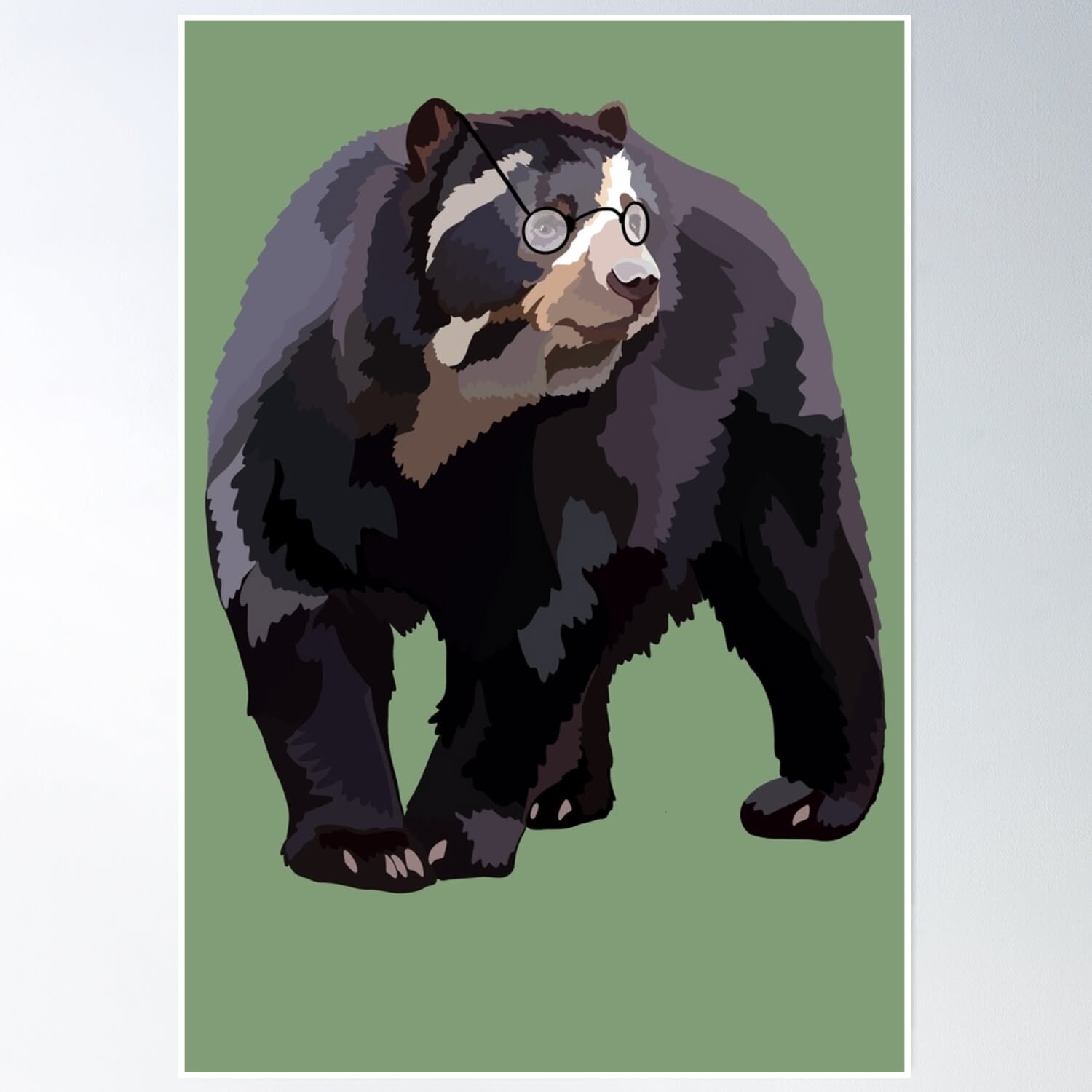
Why are spectacled bears called spectacled?
The spectacled bear (Tremarctos ornatus), South America's only living bear, takes its common name from the pale cream or yellow rings of fur that surround its eyes, often extending down the muzzle, across the throat, and onto the chest in a continuous bib of light pigment against an otherwise jet-black coat.
These markings sit on the face like a pair of round spectacles, and to a 19th-century European naturalist they looked exactly like the round wire-rim glasses worn by gentlemen of the period. Each bear's pattern is unique to the individual, stable across adult life, and so distinctive that field biologists use facial photographs as a non-invasive census tool.
Not every spectacled bear actually has spectacles: roughly five percent of individuals show no visible markings at all, and many show only partial or asymmetric patterns. The genetic basis is thought to involve the melanocortin pathway, the same family of genes that controls pigment polymorphism in many mammals, but the specific locus has not yet been mapped.
A Bear Named for Its Face
The Andes hold a single bear species, and it is named for the only feature you reliably see before it disappears into the cloud forest: its face.
Tremarctos ornatus, literally the ornate short-faced bear, has a black body and a face that, in most individuals, looks as if someone has painted pale cream rings around the eyes, dribbled a streak down the muzzle, and continued the same colour into a bib across the chest. The Spanish-speaking world calls it the oso de anteojos, the bear with eyeglasses.
In Quechua it is ucumari, a name that long predates the European naturalists who eventually attached the spectacles metaphor.
For the species-level overview, see our main page on the spectacled bear. The page you are reading now focuses on one feature only: the cream face markings, what they actually look like across real wild populations, why they vary so wildly from bear to bear, what function they may or may not serve, and how researchers have turned them into one of the most powerful non-invasive tools in modern carnivore field biology.
"I started photographing the faces of bears I encountered in 1977 because I needed to know which animal I was looking at on any given day. Within a year it became clear that the patterns were as individual as fingerprints, and that the technique could replace ear tags and collars entirely for our population work in Peru." - Bernard Peyton, on the origin of facial-marking identification, in Ursus (1999)
The Peyton observation is the foundational moment. Before the late 1970s, spectacled bear research depended on tracks, scat, and rare direct sightings. After Peyton, every serious Andean bear field programme used the face as the primary identification feature, and the rise of automated camera traps in the 2000s converted the technique into an industrial-scale census tool.
What the Markings Actually Look Like
The cream pattern is built from pheomelanin-pigmented hair sitting against a background of eumelanin-pigmented black hair. In a maximally marked individual, the cream takes the form of:
- Two complete rings around each eye, often connected across the brow by a pale band
- A muzzle stripe running from the brow ring down the bridge of the nose to just above the rhinarium
- Cheek patches flanking the muzzle stripe
- A throat patch that often spreads across the chin
- A chest bib, which can be a small pale blaze or a continuous V-shape extending most of the way to the belly
In a minimally marked individual, only one or two of these elements may be present, and the cream may be reduced to a thin crescent under the eye or a single chin spot. Importantly, the left and right sides of the face are often asymmetric in the same animal: a bear can wear a complete spectacle on the right eye and a half-circle on the left, or have a strong muzzle stripe with no chest bib at all.
The colour itself ranges from a near-white ivory in some individuals to a saturated deep yellow or even pale orange in others, and a few bears show two distinct colour zones in the same pattern, with cream eye-rings and yellower chest markings. The markings darken slightly with age in some individuals and remain stable in others; cubs typically show the same pattern as their adult selves, scaled smaller, although the precise edges sharpen as the cub's face develops.
A Catalogue of Marking Types
Field workers have informally grouped Andean bear faces into recurring categories. The classification is not taxonomic and does not split the species; it is simply a useful field shorthand. The breakdown below approximates the distribution observed in long-term camera-trap catalogues from northern Peru, southern Ecuador, and the Colombian Andes.
| Marking type | Description | Approximate frequency |
|---|---|---|
| Full spectacles | Complete cream rings around both eyes, muzzle stripe present, full chest bib | ~25% |
| Partial spectacles | One or both eye rings incomplete, muzzle stripe usually present, chest bib reduced or absent | ~35% |
| Half-mask | Cream concentrated on one side of the face only, asymmetric | ~10% |
| Muzzle and chin only | No eye rings, but pale stripe down the muzzle and patch on the chin | ~10% |
| Chest bib only | Face fully black, but pale V on the chest | ~10% |
| Minimal flecks | Only a few scattered cream hairs, often only visible at close range | ~5% |
| Solid black | No visible cream markings anywhere on face or chest | ~5% |
These numbers vary by population and by sex. In some Bolivian populations, chest-bib-only individuals are more common than full-spectacle individuals, while in northern Peruvian dry forest the full-spectacle type is the modal phenotype. There is no clear evidence that any subspecies-level distinction tracks the marking variation; the polymorphism is present across the whole range of T. ornatus, from western Venezuela down to northern Argentina.
For the broader context of how Andean bears occupy this enormous latitudinal range, see our companion piece on where do spectacled bears live.
Each Bear's Face Is a Fingerprint
The single most useful biological fact about the cream markings is that each individual bear's pattern is unique, and the pattern is stable across the bear's adult life. This combination is rare in mammals.
Many species have individually variable markings (zebra stripes, giraffe blotches, leopard rosettes), but the spectacled bear is unusual among carnivores in providing such a clean, photographable, asymmetric facial signature on a face that the bear cannot help but show to a camera as it walks past.
Bernard Peyton's pioneering work in the 1980s established the principle. By the 2000s, automated camera traps with infrared triggers had made it operationally cheap to deploy hundreds of capture stations across remote Andean valleys.
Each station produces dozens to thousands of bear face photographs, and modern catalogue software (some of it built on the same image-matching algorithms used for whale-fluke and tiger-flank identification) can match a new face against a reference library of hundreds of known bears in seconds.
"We have catalogued more than 250 individuals across the Tabaconas-Namballe and Cutervo systems using only facial markings. The technique has completely replaced live capture in our programme. We get density estimates that are tighter than anything telemetry would have produced, and we never anaesthetise an animal." - Russ Van Horn, San Diego Zoo Wildlife Alliance, in a 2018 Animal Behaviour commentary on non-invasive carnivore monitoring
The Van Horn programme in northern Peru, the Robyn Appleton-led Spectacled Bear Conservation Society work in the dry forests of Lambayeque, and the Wildlife Conservation Society Andes programme in Ecuador and Colombia all rely on the same principle. So does the Bolivian Programa de Conservacion del Oso Andino and the Venezuelan Fundacion AndigenA. None of these programmes could function as efficiently if the bears were not natural fingerprint-bearers.
What the Markings Are For: Three Hypotheses
This is where honest science has to admit it does not yet know. The function of the cream markings is genuinely debated, and no single hypothesis has been confirmed by experimental work in the field. The three serious proposals on the table are summarised below, in rough order of how much support each has from the existing literature.
1. Individual Recognition (most supported)
The strongest circumstantial case is that the markings function as individual identity badges, allowing bears to recognise specific neighbours, mates, or rivals from a distance. The supporting points are:
- High inter-individual variation: spectacles vary more between two bears than almost any other feature.
- Stability across adult life: a bear's pattern is the same when it is twenty as when it was four.
- Asymmetry: left-right differences make each face distinctive even from a partial view.
- The practical fact that the technique works for humans: if humans can match faces from a single camera-trap photo, conspecifics with vision similar to other ursids can plausibly do the same.
Spectacled bears are largely solitary but maintain overlapping home ranges and meet repeatedly at fruiting trees and at bromeliad clumps. A capacity to recognise which specific bear you are looking at, rather than just that there is a bear, would be valuable in a species where mothers, ex-mates, and rivals can all show up at the same fruit patch in a single week.
2. Mate Signalling
A weaker hypothesis proposes that bolder, brighter, or more symmetric spectacles correlate with reproductive success or condition, and that the markings serve as a sexual signal. The supporting evidence is thin: no published study has demonstrated assortative mating by spectacle pattern, and the markings do not appear to differ systematically between males and females. The hypothesis is not refuted, only untested.
3. Aposematic Warning
A third hypothesis treats the high-contrast face pattern as an aposematic display, by analogy with skunks and badgers, warning predators or conspecifics that the bear is dangerous. The case is weak because:
- Spectacled bears are not chemically defended.
- The markings face forwards with the eyes, not laterally toward the body, so they are not a typical warning signal.
- Adult Andean bears have no significant predators and would not benefit from advertising danger to non-existent attackers.
The aposematic interpretation is mostly a holdover from older mammal-pattern reviews and is not currently favoured by Andean bear specialists.
"The honest answer is that we do not know what the spectacles are for. Individual recognition is the most parsimonious explanation given how variable, stable, and forward-facing the patterns are, but the experiment that would confirm it (manipulating a bear's apparent identity to see whether conspecifics respond differently) has never been run and probably never will be on this species." - Robyn Appleton, Spectacled Bear Conservation, in Ursus (2014)
A fourth hypothesis, thermoregulation, has been proposed for panda eye-patches and other dark-on-light face markings in some carnivores. There is no empirical support for thermoregulatory function in T. ornatus: the bears live across a huge altitudinal gradient from lowland dry forest to high paramo, the markings do not vary systematically with elevation or climate, and the absorbed-heat differential between black and cream patches is small relative to the bear's overall thermal load.
The Genetics: Melanocortin, Probably
The pigment biology of the cream markings is straightforward in outline. The black body fur is eumelanin-rich, the cream face and chest fur is pheomelanin-rich, and the boundary between the two is sharply defined at the skin level.
The genes that decide whether a follicle produces eumelanin or pheomelanin are well known across mammals; the most studied is MC1R (melanocortin-1 receptor), with ASIP (agouti signalling protein) and a small number of downstream effectors providing the pattern modulation.
In black bears, MC1R polymorphism is the basis of the cinnamon, blond, and white spirit-bear morphs, which we cover in detail in black bear color phases: cinnamon, blond, Kermode. In giant pandas, the eye-patch and limb-patch pattern has been linked to a mix of pigmentation genes including ASIP.
In the Asiatic black bear, the pale chest crescent shows individual variation comparable to spectacled bear faces and is presumed to involve the same melanocortin pathway, although the specific gene has not been confirmed.
For the spectacled bear specifically, the picture is suggestive but unfinished:
- The pheomelanin-on-eumelanin patterning strongly implicates the melanocortin pathway as the mechanistic substrate.
- The high inter-individual variation, including totally unmarked individuals at low frequency, is consistent with multiple alleles segregating in the population rather than a simple dominant-recessive switch.
- A 2019 population-genomic study sequenced reduced-representation libraries from a small sample of Peruvian and Ecuadorian bears and found candidate variants in genes adjacent to MC1R, but the sample size was too small to confirm a causal locus.
- The genetics of left-right asymmetry within an individual face are essentially unstudied and may involve developmental noise rather than genotype.
The reasonable summary is that the cream pattern is genetically heritable, that the melanocortin pathway is almost certainly involved, and that the specific causal locus or loci have not yet been identified. This is a wide-open research question for a graduate student with access to non-invasive hair-snare DNA from a known camera-trap-catalogued population.
Comparison With Other Bear Markings
The spectacled bear is not the only ursid with conspicuous pale markings on a black background. The pattern recurs across the bear family, sometimes serving similar functions and sometimes clearly different ones. The table below sets the spectacled bear's face against four close comparisons.
| Species | Marking type | Inter-individual variation | Used for ID? | Likely function |
|---|---|---|---|---|
| Spectacled bear (Tremarctos ornatus) | Cream eye rings, muzzle, chest bib | Very high; ~5% unmarked | Yes, standard method | Probably individual recognition |
| Giant panda (Ailuropoda melanoleuca) | Black eye patches, ears, limbs on white body | Low; pattern essentially fixed | No, pattern too uniform | Camouflage in patchy snow plus possible signalling |
| Asiatic black bear (Ursus thibetanus) | Pale V or crescent on chest | High; many variants, some unmarked | Yes, in some studies | Probably individual recognition |
| Sun bear (Helarctos malayanus) | Cream U or horseshoe on chest | High | Yes, in camera-trap work | Possibly threat display, possibly recognition |
| Sloth bear (Melursus ursinus) | White Y or U on chest | Moderate | Sometimes | Less studied; possibly recognition |
| American black bear (Ursus americanus) | Occasional white chest blaze, full coat-colour polymorphism | Body colour polymorphic, blaze variable | Limited | Coat colour mostly thermoregulatory or selective |
| Polar bear (Ursus maritimus) | None; uniformly white coat over black skin | Effectively none | No | Camouflage in snow |
The cluster that matters here is the three Asian bears (Asiatic black, sun, sloth) plus the spectacled bear. All four wear high-contrast pale markings on dark coats, all four show substantial individual variation, and all four are used (at least in some studies) for camera-trap identification.
The convergence is striking: four bear species on three continents with no recent common ancestor have independently evolved similar patterns of cream-on-black markings, suggesting that the trait has repeatedly been a useful one in solitary forest-dwelling ursids.
The giant panda is the odd member of the group. Its black-and-white pattern is almost identical between individuals, which rules out individual-recognition function and points instead toward a mix of camouflage in patchy snow-and-rock terrain and possible long-range species-level signalling. For the broader story of why pandas look the way they do, see our page on the giant panda.
For the surprising case of how a polar bear's all-white coat works, see polar bear fur and black skin explained.
How to Read a Spectacled Bear's Face in the Field
Field workers and serious wildlife photographers in the Andes use a small set of conventions when documenting a bear's face. The protocol matters because consistency across photographers makes catalogue matching tractable.
- Photograph the full face front-on whenever possible. A three-quarter angle from either side is the second-best capture; a pure profile loses too much pattern information.
- Capture both sides of the face separately if the animal is moving past at right angles. Asymmetry is diagnostic, so both sides count.
- Note the chest bib in any image where it is visible, even if the face is partly obscured. A bear with a unique chest bib can be identified from a chest-only image alone.
- Avoid identification from a single distant image if possible. The asymmetry and the chest-vs-face combination usually require at least two angles for confident matching.
- Record date, location, and bear posture with every face image. The catalogues are spatial as well as visual; a face match without location data is much less useful for population work.
The same conventions are used by the camera-trap programmes themselves. Stations are placed with the lens at bear-shoulder height (about 80 to 110 centimetres above the trail) so that the trigger captures the face rather than the back, and most stations are baited with scent lures rather than food to keep the animal in front of the lens long enough to fire two or three frames.
For the broader picture of how big these bears actually are, which matters when calibrating camera-trap geometry, see how big are spectacled bears.
Spectacles and the Paddington Question
The spectacled bear's face is also the reason the species is so culturally familiar to people who have never set foot in the Andes.
Michael Bond's Paddington Bear was explicitly inspired by the spectacled bear, and the iconic illustration of Paddington in his blue duffel coat carries the unmistakable cream eye markings of Tremarctos ornatus (somewhat romanticised, slightly cartoon-perfect, and considerably tidier than any wild bear's actual face).
For the full story of that connection and the gap between the literary bear and the real animal, see spectacled bear vs Paddington: the real Andean bear.
The cultural recognition is genuinely useful for conservation. Andean bears occupy fragmented forest in five countries and depend heavily on local goodwill in their core ranges. A species that everyone already feels a soft warmth toward, because they grew up reading about a polite stowaway in a marmalade-stained hat, is a species that does measurably better at fundraising and at land-use negotiations. The face does the work.
What the Markings Mean for Conservation Practice
The practical importance of the spectacles for T. ornatus conservation is hard to overstate. Camera-trap-based population estimates, built on facial-marking individual identification, now form the backbone of regional density and trend estimates across the species' range. Without the markings, every Andean bear study would need either telemetry collars (expensive, invasive, hazardous) or genetic capture-recapture from non-invasive samples (powerful but slow and lab-intensive).
A 2020 review compiled spectacled bear monitoring efforts from Venezuela, Colombia, Ecuador, Peru, Bolivia, and Argentina, and reported the following ID method breakdown across active programmes:
| Country | Active programmes | Primary ID method | Estimated catalogued individuals |
|---|---|---|---|
| Venezuela | 2 | Facial markings | ~40 |
| Colombia | 5 | Facial markings | ~120 |
| Ecuador | 4 | Facial markings | ~150 |
| Peru | 7 | Facial markings | ~350 |
| Bolivia | 3 | Facial markings + scat genetics | ~90 |
| Argentina | 1 | Facial markings (very small population) | <20 |
The total of around 770 catalogued individuals out of an estimated wild population of perhaps 6,000 to 18,000 means that roughly 5 to 12 percent of all wild spectacled bears are personally known to a researcher by the pattern on their face. No other bear species has anything close to this level of individual coverage, and the only reason the figure is achievable is that the markings exist and are useful.
For more on the conservation context and the population numbers that frame this work, see where do spectacled bears live and the closely related question of what do spectacled bears eat, since diet drives where the camera traps go.
Frequently Asked Field Questions
Do males and females have different markings? No systematic sex difference has been documented. Both sexes show the full range from solid black to full spectacles, and within a litter siblings can show strikingly different patterns.
Do cubs match their mothers? Sometimes, but not reliably. Heritability appears to be moderate rather than strong, consistent with multiple loci contributing to pattern formation. A cream-faced mother can produce a near-black cub and vice versa, although the typical case is that cubs resemble at least one parent in general pattern strength.
Can a bear's pattern change after a serious injury? Scarring can disrupt local pigmentation and create distinctive marks, but the underlying cream-versus-black distribution is set by hair-follicle genetics and does not shift with age or injury. Researchers note scars as additional ID features alongside the natural pattern.
Why do photographs sometimes make spectacles look more or less obvious? Lighting matters. In direct overhead sun, the cream patches can wash out and look almost the same brightness as the black coat. In overcast light or under canopy, the contrast is much higher. This is why field protocols recommend multiple frames and ideally images from different parts of the day before catalogue matching.
For more on bear comparisons that frequently come up alongside the spectacles question, see spectacled bear vs other bears, which puts the Andean bear next to all seven of its living relatives.
What We Still Do Not Know
The spectacled bear's face is one of the best-studied carnivore patterns in field practice and one of the worst-studied at the level of mechanism. The major open questions are:
- Which gene or genes actually control the pattern. The melanocortin pathway is implicated by analogy with other bears, but the causal locus has not been mapped.
- Whether spectacled bears themselves use the markings for recognition. The hypothesis is plausible and the markings are the right shape for it, but no behavioural experiment has demonstrated that bears recognise specific conspecifics by face.
- Why the unmarked phenotype persists at low frequency. If the cream markings are functionally important, why do roughly five percent of bears manage perfectly well without them?
- How developmental asymmetry produces left-right differences within an individual. This is essentially unstudied.
- Whether the markings are under any current selection. Comparative work between populations with different mean spectacle expression has not been done.
Each of these questions is tractable with current methods. The spectacled bear is an unusually accessible study system for a large carnivore because the camera-trap catalogues already exist; what is missing is the link from catalogue to genome and from catalogue to behavioural experiment.
How the Spectacles Fit the Bear's Wider Biology
Face markings are only one piece of what makes Tremarctos ornatus unusual. The species is the last surviving member of the short-faced bear lineage (Tremarctinae), a group that once included the giant short-faced bear Arctotherium of Pleistocene South America and Arctodus of North America. Its closest living relatives among modern bears are the giant panda and, more distantly, the rest of the Ursidae.
The face that makes it the spectacled bear is sitting on a skull whose architecture is quite different from any other bear alive: short, broad, with deep zygomatic arches built for crushing tough plant material rather than long-snouted predation.
The combination of a distinctive face and a distinctive skull has consequences for everything else, from diet (heavily plant-based, see what do spectacled bears eat) to social behaviour (largely solitary but with extensive overlapping ranges, see spectacled bear cubs and family life) to conservation status (vulnerable, with a wild population estimated in the low tens of thousands at most).
The spectacles are the most visible feature, but they sit on top of an evolutionary story that the face alone does not tell. For that wider story, return to the main page on the spectacled bear.
Further Reading and Related Tools
For more long-form animal biology in the same vein as this article, our sister sites cover the cognitive and cultural side of how humans interact with the natural world.
whats-your-iq.com runs an expert-curated cognitive testing platform that overlaps with the comparative-cognition literature on bears and other large mammals, while evolang.info covers communication and signalling across species, which is directly relevant to the individual-recognition hypothesis discussed above.
For practical writing tools used by field biologists in preparing reports and grant applications, fileformer.com offers free PDF and image conversion utilities.
References
- Peyton, B. (1980). Ecology, distribution, and food habits of spectacled bears, Tremarctos ornatus, in Peru. Journal of Mammalogy, 61(4), 639-652. https://doi.org/10.2307/1380309
- Peyton, B. (1999). Spectacled bear conservation action plan. In Bears: Status survey and conservation action plan (pp. 157-198). IUCN/SSC Bear Specialist Group. https://doi.org/10.2305/IUCN.CH.1999.SSC-AP.4.en
- Van Horn, R. C., Zug, B., LaCombe, C., Velez-Liendo, X., & Paisley, S. (2014). Human visual identification of individual Andean bears Tremarctos ornatus. Wildlife Biology, 20(5), 291-299. https://doi.org/10.2981/wlb.00023
- Appleton, R. D., Van Horn, R. C., Noyce, K. V., Spady, T. J., Swaisgood, R. R., & Arnemo, J. M. (2018). Phenotypic plasticity in the timing of reproduction in Andean bears. Journal of Zoology, 305(2), 105-113. https://doi.org/10.1111/jzo.12541
- Garcia-Rangel, S. (2012). Andean bear Tremarctos ornatus natural history and conservation. Mammal Review, 42(2), 85-119. https://doi.org/10.1111/j.1365-2907.2011.00207.x
- Velez-Liendo, X., Strubbe, D., & Matthysen, E. (2013). Effects of variable selection on modelling habitat and potential distribution of the Andean bear in Bolivia. Ursus, 24(2), 127-138. https://doi.org/10.2192/URSUS-D-12-00031.1
- Ritland, K., Newton, C., & Marshall, H. D. (2001). Inheritance and population structure of the white-phased Kermode black bear. Current Biology, 11(18), 1468-1472. https://doi.org/10.1016/S0960-9822(01)00448-1
- Higashide, D., Miura, S., & Miguchi, H. (2012). Are chest marks unique to Asiatic black bear individuals? Journal of Zoology, 288(3), 199-206. https://doi.org/10.1111/j.1469-7998.2012.00945.x
Frequently Asked Questions
Do all spectacled bears actually have spectacles?
No, and this is one of the most common misconceptions about the species. Field surveys across Peru, Ecuador, Colombia, Bolivia, and Venezuela have documented enormous variation: some Andean bears wear bold, near-perfect cream rings around both eyes that extend down the muzzle and across the chest, while others show only faint smudges, a single half-spectacle on one eye, or markings restricted entirely to the chin.
A small fraction of individuals, roughly five percent in most surveyed populations, show no visible cream markings at all and present as solid black bears. These unmarked animals are still Tremarctos ornatus and still belong to the same species, breeding population, and behavioural lineage as their fully spectacled neighbours.
The variation is the point: the markings are a polymorphism, not a uniform species trait, and the absence of spectacles in some individuals is part of what makes them a useful fingerprint for individual recognition.
Why do researchers photograph spectacled bear faces?
Because every spectacled bear face pattern is unique to that individual, and the pattern stays effectively stable across an adult bear’s life. Bernard Peyton pioneered the use of facial markings for individual identification in his 1980s field work in Peru, and the technique has since become the standard non-invasive method for population estimation across the Andes.
Camera traps placed along ridge trails and feeding sites capture the bear’s face as it passes; researchers then match each new image against a reference catalogue of known individuals. The Andean Bear Conservation Alliance, the Wildlife Conservation Society Andean program, and SBC-Peru all maintain catalogues that now contain hundreds of identified bears.
The advantage over collaring is enormous: no anaesthesia, no capture, no injury risk, and a single camera deployment can produce density estimates for an entire valley over several months.
What is the actual function of the cream face markings?
The function is genuinely debated and no single hypothesis has been confirmed. Three serious proposals are on the table. The first, individual recognition, has the most circumstantial support: high inter-individual variation, stable patterns across an adult life, and the practical fact that the markings work as fingerprints for human researchers suggests that bears might also use them to recognise specific neighbours, mates, or rivals at a distance.
The second, mate signalling, proposes that bolder spectacles correlate with reproductive success or social status, but this has not been rigorously tested in the wild. The third, warning or aposematic display, draws on the analogy of skunks and badgers, but spectacled bears are not chemically defended and the markings face the same direction as the eyes rather than the body, so the warning case is weak.
Thermoregulatory hypotheses, sometimes proposed for panda eye patches, have no empirical support in spectacled bears.