
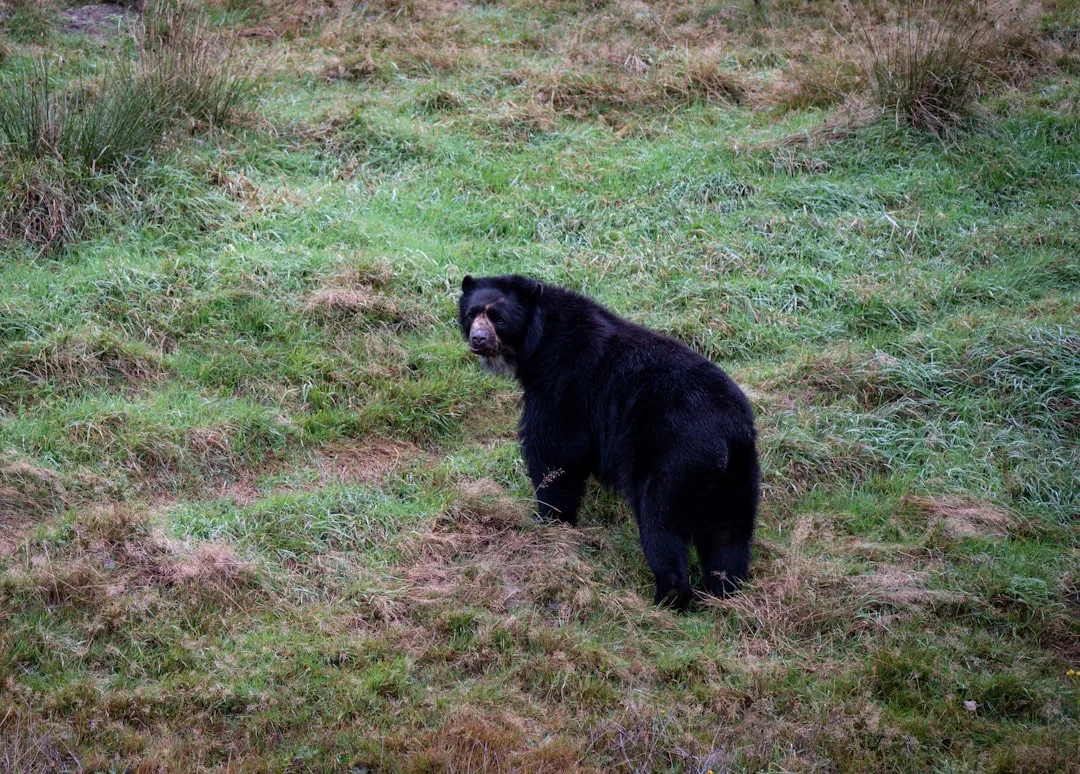
Spectacled bear facts start with geography: it is the only bear species native to South America and the last surviving member of the short-faced bear subfamily Tremarctinae. Found only in the tropical Andes, Tremarctos ornatus is a medium-sized, predominantly herbivorous bear with striking pale facial markings that gave the species its common name.
It is also the real-world animal behind the fictional Paddington Bear, sent in Michael Bond's 1958 story from "deepest darkest Peru" - a descriptor that, at the time, could refer to no other bear.
This guide covers every major aspect of spectacled bear biology and ecology: size, taxonomy, Andean habitat, diet, tree-platform behaviour, reproduction, evolutionary history, conservation status, and the strange cultural overlap with a marmalade-loving fictional bear. It is a reference entry, not a summary - so expect specifics: kilograms, elevations, population figures, and verified records from the six Andean countries where the species still holds on.
Etymology and Classification
The scientific name Tremarctos ornatus was established by Frederic Cuvier in 1825. Tremarctos derives from Greek roots meaning "trembling bear", a reference to the lineage's characteristic stance; ornatus is Latin for "decorated" or "ornate", pointing at the pale facial markings.
Across the Andean range the species carries many local names: oso de anteojos (Spanish for "bear with spectacles"), oso andino (Andean bear), ukumari in Quechua, and jukumari in Aymara. In many highland cultures the bear appears in pre-Columbian iconography, mythology, and ritual - often as a shape-shifting intermediary between human and wild worlds.
Taxonomically the spectacled bear sits alone. It is the only living species in the genus Tremarctos and the only surviving member of the subfamily Tremarctinae, commonly called the short-faced bears.
Extinct relatives once ranged across the Americas, including the massive South American genus Arctotherium - some specimens of which may have been the largest bears that ever lived - and the North American Arctodus simus, the giant short-faced bear of the Ice Age. When Arctotherium and Arctodus vanished at the end of the Pleistocene, Tremarctos ornatus became the sole surviving short-faced bear on Earth.
All other modern bears - polar, brown, black, sun, sloth, panda - belong to other subfamilies. The spectacled bear's closest evolutionary relatives are not the bears it physically resembles but the extinct giants of Pleistocene South America.
Size and Physical Description
Spectacled bears are medium-sized ursids with extreme sexual dimorphism - males can weigh four to five times more than females of the same population, one of the widest weight ratios among living bears.
Males:
- Body length: 1.5-1.9 metres
- Shoulder height: 0.7-0.9 metres on all fours
- Weight: typically 100-175 kg, occasionally up to 200 kg
- Powerful forequarters and neck for climbing and tearing vegetation
Females:
- Body length: 1.3-1.6 metres
- Weight: typically 35-82 kg
- Smaller skull and jaw, narrower chest
Cubs at birth:
- Length: roughly 25-35 cm
- Weight: 300-360 grams - about the size of a small mango
- Born blind, nearly furless, inside a sheltered den
The coat is predominantly black or very dark brown, sometimes with a reddish or chestnut tint visible in strong sun. The defining feature is the pale facial marking - cream, ivory, or yellowish-white - that typically extends around one or both eyes, down the muzzle, and onto the chin, throat, and chest. No two bears show the same pattern.
Some individuals have full symmetrical "spectacles", some have only a smear on one side, and a small minority have almost no light marking at all. Researchers catalogue these patterns from camera-trap photographs as individual identifiers, a non-invasive tool that has become central to population monitoring across the Andes.
The skull is noticeably shorter and rounder than that of other living bears. This is the anatomical feature that gave the subfamily its name - the short-faced bears had compressed muzzles and deep jaws compared to their contemporaries. The spectacled bear has inherited a softened version of that skull geometry, useful for crushing tough plant matter such as bromeliad hearts, palm nuts, and hard fruits.
Their limbs are long relative to body size and strongly built for climbing. The claws are curved, sharp, and non-retractile, giving excellent grip on bark and rock. Front paws are particularly dextrous and are used to manipulate food, strip leaves, and build platforms.
Andean Habitat and Range
Spectacled bears occupy a narrow ribbon of habitat along the tropical Andes, stretching roughly 4,600 kilometres from western Venezuela south through Colombia, Ecuador, Peru, and Bolivia, with a very small presence in far north-western Argentina. They are absent from the lowland Amazon basin, the Pacific coastal deserts, and the southern temperate Andes beyond the tropics.
Primary habitat types:
- Andean cloud forest (most important, generally 1,500-3,500 m)
- Paramo - high-elevation tropical grassland above the treeline
- Puna - drier high grasslands of Peru and Bolivia
- Dry forest on the western Andean slopes (especially northern Peru)
- Upper Amazonian rainforest at foothill elevations
Elevation range: 250-4,750 metres. This spread covers lowland dry forest up through alpine ecosystems and gives the spectacled bear one of the widest vertical distributions of any large mammal on Earth. Individual bears migrate seasonally along elevational gradients, following fruit and bromeliad cycles from lower forest into higher grasslands and back.
Populations are fragmented. Roads, farms, cattle pasture, and mining concessions cut the original continuous range into isolated patches, some too small to support viable breeding populations. Genetic studies detect measurable isolation between several populations, which increases long-term extinction risk even when short-term numbers look stable.
Diet: The Most Herbivorous Bear
Despite membership in the order Carnivora, Tremarctos ornatus is effectively a vegetarian with occasional meat supplements. Dietary studies across the range consistently report that roughly 95% of food intake by volume is plant matter. Only the giant panda rivals the spectacled bear as the most herbivorous living bear.
Core plant foods:
- Bromeliad hearts - especially Puya and Tillandsia species, whose tough basal leaves are stripped to reach the soft starchy heart
- Palm fruit, pith, and nuts
- Fig species (Ficus) - seasonally critical
- Cactus pads and fruit (especially at lower, drier elevations)
- Bamboo shoots
- Orchid bulbs and tender shoots
- Wild avocado, lucuma, and a wide range of montane fruits
- Maize, when available near farms
Animal foods (rare):
- Carrion (including livestock carcasses)
- Small rodents, birds, and insects
- Occasional young livestock (a source of conflict with farmers)
- Honey and bee larvae when nests can be raided
The bear's specialised jaw and short face generate strong bite force well suited to cracking hard plant structures. A bear can strip a dense bromeliad stand, leaving shredded leaf crowns scattered across a hillside in patterns so characteristic that surveyors can confirm bear presence from the plant remains alone. Cacti are processed by tearing away the spines with the paws and biting through the softer flesh beneath.
Because fruits and bromeliads ripen at different elevations across the year, spectacled bears effectively track their own larder vertically up and down the Andes, a seasonal migration pattern that depends on unbroken elevational connectivity.
Tree Platforms and Behaviour
Spectacled bears are among the most arboreal of all bears. Adults climb routinely and expertly; cubs climb before they can keep up with their mother on the ground. Tree use goes beyond simple climbing. The species is famous for constructing tree platforms - rough nests of bent and broken branches woven into the canopy.
Platform types and uses:
- Feeding platforms in fruiting trees, used repeatedly until the fruit is stripped
- Resting platforms where a bear sleeps during the heat of the day
- Overnight platforms in trees with abundant food, where bears may spend several consecutive days without descending
- Observation perches on tall emergent trees overlooking clearings and trails
Platforms are built by breaking branches inward toward a central fork, then flattening and matting them down until a stable rough basket forms. Some structures are two metres across and sturdy enough to hold a 150 kg bear for days. Researchers use platform density as a coarse measure of local bear activity, and in some areas platforms are the most visible sign that bears still inhabit a forest block.
Females sometimes climb trees before giving birth and rear their tiny cubs inside tree-cavity dens high above the ground, a denning strategy unusual among bears and reminiscent of some arboreal primates. Most births, however, occur in ground-level shelter - rock overhangs, cavities at the base of large trees, thick bamboo thickets, or dug cavities.
Spectacled bears are largely solitary outside the mating season and the mother-cub bond. Home ranges vary with habitat quality but typically run from 10 to more than 150 square kilometres, with male ranges overlapping multiple female ranges. They communicate through scent marking on trees, scratch marks, and a vocal repertoire that includes huffs, woofs, tongue-clicks, and a soft trilling call used between mothers and cubs.
Reproduction and Life Cycle
Reproduction is flexible and less strictly seasonal than in temperate bears. Mating can occur across several months, typically aligned with peaks in fruit availability that allow females to build the fat reserves needed for pregnancy and lactation. The gestation period, including delayed implantation, ranges from about 5.5 to 8.5 months.
Reproductive timeline:
- Mating: most commonly April-June across much of the range, but variable
- Delayed implantation: fertilised egg suspended until female condition is adequate
- Birth: typically during the dry season, in a sheltered den
- Den emergence: cubs remain with mother until roughly 8-12 months old before first extended travel
- Weaning: around 6-8 months
- Independence: cubs separate at about 1.5-2 years old
Cubs are born tiny - 300 to 360 grams - blind, and nearly helpless. The mother nurses them on extremely rich milk while remaining in or near the den for the first critical months. Unlike the deep hibernation of northern bears, the denning mother remains alert and active, capable of defending the den aggressively and leaving periodically to feed on nearby vegetation.
Litter size is usually one or two cubs, occasionally three, rarely four. Cubs follow their mother through the full elevational migration as they grow, learning which trees fruit in which months, how to climb without falling, how to strip a bromeliad without shredding its spines into the mouth, and how to build a sleeping platform. Females typically reproduce every two to four years.
Wild lifespan is usually 20-25 years. Captive specimens have reached at least 36 years and in several cases well into the 30s, putting spectacled bears among the longer-lived bears in zoo conditions.
Evolution and the Short-Faced Bear Legacy
The subfamily Tremarctinae diverged from other bears roughly 5 to 6 million years ago. For most of its history the subfamily was dominated by larger species than the modern spectacled bear. In North America, Arctodus simus - the giant short-faced bear - stood up to 3.5 metres tall on its hind legs and weighed up to around a tonne at its largest.
In South America, Arctotherium angustidens may have been even larger, with some estimates pushing maximum weight beyond a tonne and a half, potentially making it the largest bear ever to have lived.
Both vanished at the end of the last Ice Age, roughly 11,000 years ago, alongside much of the Pleistocene megafauna of the Americas. Only the smaller, more specialised, and more herbivorous Tremarctos ornatus survived - the last of a once-dominant bear lineage.
This evolutionary history is why the spectacled bear is treated by biologists as a relict species. Its shortened skull, robust jaw, and unusual dentition are holdovers from a subfamily adapted for processing a wide range of foods, including tough plant matter, in environments where other bears were scarce or absent. In that sense, the modern spectacled bear is not simply a South American bear - it is the living thread connecting the Pleistocene short-faced bears to the present.
Population and Subpopulations
Wild populations are difficult to count. The species lives at low density across rugged terrain, is cryptic, and is often detected only through camera traps, plant damage, faeces, and tree platforms. Current estimates of the total wild population range from 10,000 to 18,000 individuals, with considerable uncertainty.
Approximate country distribution:
| Country | Habitat area (approx.) | Status notes |
|---|---|---|
| Peru | Largest share | Core range across northern and central Andes |
| Bolivia | Substantial | Yungas cloud forest populations |
| Ecuador | Significant | Cloud forest and paramo, increasingly fragmented |
| Colombia | Significant | Andean forests and paramo, fragmented |
| Venezuela | Small | Limited to north-western Andes |
| Argentina | Marginal | Small population in far north-west only |
Populations in Peru, particularly in protected areas such as Manu, Machu Picchu Historical Sanctuary, and Cutervo, are among the most studied. Elsewhere, monitoring is sparse, and several populations are essentially data-deficient at national scale.
Conservation Status and Threats
The IUCN Red List classifies the spectacled bear as Vulnerable with a decreasing population trend. The species is listed on CITES Appendix I, the strictest international trade category, and is legally protected in every country within its range. Enforcement, however, varies widely.
Primary threats:
- Habitat loss. Agricultural expansion, cattle ranching, coca cultivation, road building, and mining have fragmented Andean forests throughout the bear's range. Cloud forest is being lost at one of the highest rates of any tropical ecosystem.
- Climate change. Warming pushes cloud forest ecosystems upslope. When the slope runs out, the habitat disappears. Bromeliad communities and fruiting trees shift faster than forest can regenerate above them.
- Direct persecution. Farmers kill bears blamed for damaging maize crops or preying on cattle. In some areas, a single bear that learns to kill calves can trigger lethal response across an entire valley.
- Illegal wildlife trade. Bear parts - gall bladders, paws, fat, claws - are sold for traditional medicine and folk magic across parts of the Andes. Cubs are sometimes taken for the pet trade after their mother is killed.
- Road mortality. New roads through cloud forest cause both direct vehicle strikes and indirect mortality by opening previously inaccessible forest to hunters and loggers.
- Isolation of populations. Fragmentation reduces gene flow and increases local extinction risk, particularly in Venezuela, northern Colombia, and Argentina.
Conservation efforts include protected areas across all six range countries, community-based livestock-guardian programmes, corridor projects to reconnect fragmented habitats, and anti-poaching patrols.
A number of NGOs - including the Spectacled Bear Conservation Society, Andean Bear Foundation affiliates, and several country-specific organisations - run long-term field programmes, often combining camera-trap monitoring with community engagement. Several zoos have active captive-breeding and reintroduction programmes, though releases remain rare.
The species is considered a keystone and umbrella species in the Andes. Its home range overlaps with countless other species of concern, and protecting bear habitat protects entire cloud forest ecosystems by extension.
Spectacled Bears and Humans
Indigenous Andean cultures have lived alongside the spectacled bear for thousands of years. In Quechua tradition the ukumari appears in folktales as a trickster-bridegroom who marries a human woman and fathers a half-bear son. In several highland festivals dancers wear bear costumes during rituals tied to agricultural cycles and mountain spirits, and pre-Columbian ceramics from the Moche, Chavin, and Chimu cultures include stylised bear imagery.
Modern human-bear relationships are more strained. Expansion of cattle grazing into former forest causes bears to encounter livestock; bears that kill a calf or raid a cornfield can be shot, poisoned, or captured. Coexistence programmes that include guardian dogs, improved fencing, and compensation schemes have measurably reduced retaliatory killings in several pilot areas.
The most unexpected human connection is fictional. When author Michael Bond created Paddington Bear in 1958, he chose to describe his character as arriving in London from "deepest darkest Peru". At the time - and still today - the only bear native to Peru is Tremarctos ornatus.
The Paddington books and later films have been referenced in multiple conservation campaigns, and royalties from some film-related merchandise have supported field projects for wild spectacled bears in northern Peru. Few fictional animals have mapped so directly onto a real, threatened species.
Related Reading
References
Relevant peer-reviewed and governmental sources consulted for this entry include IUCN Red List assessments for Tremarctos ornatus (most recent revision), the IUCN/SSC Bear Specialist Group Andean Bear Expert Team reports, Peruvian SERFOR population studies, published research in Ursus, Oryx, Journal of Mammalogy, and Biological Conservation, and long-running field monitoring programmes across Peru, Ecuador, Colombia, and Bolivia.
Specific population figures reflect consolidated estimates from the most recent range-wide assessments available.
Frequently Asked Questions
How big is the spectacled bear?
Spectacled bears (Tremarctos ornatus) show strong sexual dimorphism. Adult males typically weigh 100-200 kg with a body length of 1.5-1.9 m. Adult females are much smaller at 35-82 kg and 1.3-1.6 m long. Shoulder height is about 0.7-0.9 m on all fours. Compared to brown bears or polar bears the spectacled bear is a medium-sized ursid, roughly the mass of a large American black bear.
Cubs are born tiny - around 300-360 grams, smaller than a can of soda - and develop slowly inside tree-cavity or rock-shelter dens for their first two to three months.
What do spectacled bears eat?
Despite being classified in the order Carnivora, spectacled bears are overwhelmingly herbivorous. Roughly 95% of their diet is plant matter. Core foods include bromeliad hearts (especially puya and tillandsia species), the fruit and pith of various palms, figs, orchid bulbs, cactus fruit and pads, berries, and bamboo shoots. They also take honey, insects, small rodents, birds, carrion, and occasionally young livestock.
In drier regions they rely heavily on cacti during the dry season. The species has one of the most plant-heavy diets of any bear, rivalled only by the giant panda among ursids.
Where do spectacled bears live?
Spectacled bears are restricted to the tropical Andes mountains, ranging from western Venezuela south through Colombia, Ecuador, Peru, and Bolivia into far north-western Argentina. They are the only bear species native to South America. Habitats span cloud forest, high-altitude grassland (paramo and puna), dry forest on the western Andean slopes, and the edges of Amazonian rainforest.
Elevation range is exceptional - from lowland dry forest around 250 metres up to alpine environments at 4,750 metres. This vertical spread gives the species one of the widest elevational distributions of any large mammal on Earth.
Why is it called the spectacled bear?
The common name comes from pale cream or yellowish markings on the face, chest, and throat that often form rings or arcs around the eyes resembling eyeglasses or spectacles. The Latin name Tremarctos ornatus translates roughly to ‘ornate trembling bear’, a reference both to the striking facial pattern and to the short-faced lineage it belongs to.
The markings vary enormously from bear to bear - some animals show full rings, others crescent shapes, partial patches, or almost no marking at all. Biologists use the patterns as natural identification tags, comparing photographs across camera-trap surveys to track individuals without physical capture.
Is the spectacled bear really Paddington Bear?
Yes, at least in origin. When Michael Bond wrote the first Paddington Bear story in 1958 he chose to send his fictional bear ‘from deepest darkest Peru’. At the time, the spectacled bear was the only bear species native to South America, and it remains so today. The illustrated Paddington is stylised rather than anatomically accurate, but the backstory points directly at Tremarctos ornatus.
The 2014 and later Paddington films have supported real conservation work for spectacled bears through partnerships with the Spectacled Bear Conservation Society, with some proceeds directed toward habitat protection and anti-poaching efforts in Peru.
Are spectacled bears endangered?
The IUCN Red List classifies the spectacled bear as Vulnerable with a decreasing population trend. Wild population estimates range between 10,000 and 18,000 individuals, fragmented across six Andean nations.
The primary threats are habitat loss from agricultural expansion, cattle grazing, road construction, and mining; direct persecution by farmers who blame bears for livestock and crop damage; and a small but persistent illegal trade in bear parts for traditional medicine. Climate change is pushing cloud forest habitats upslope faster than bears can track.
Because the species lives at low density across rugged terrain, accurate counts are difficult and real population trends may be worse than current estimates suggest.
Do spectacled bears hibernate?
No. Because they live in tropical latitudes with relatively stable year-round temperatures and continuous food availability across elevations, spectacled bears do not hibernate. They remain active throughout the year and migrate vertically up and down the Andes to follow fruiting cycles and seasonal foods.
Pregnant females do seek sheltered dens - tree cavities, rock overhangs, thick vegetation - to give birth and nurse their tiny cubs, but this is birth denning rather than true hibernation. The species retains none of the metabolic machinery for the deep winter torpor seen in brown, black, and polar bears.
How long do spectacled bears live?
Wild spectacled bears typically live 20-25 years, though data from rugged Andean habitat is sparse and most wild lifespans are inferred rather than directly measured. In captivity the species does unusually well, with multiple documented individuals living past 30 years and at least one confirmed captive bear reaching 36+ years. Extended captive lifespan reflects consistent food, veterinary care, and absence of predators or human conflict.
Females typically first reproduce between ages 4 and 7 and can continue producing litters into their late teens, giving birth every 2-4 years depending on body condition and food availability.