
How does the spectacled bear compare to other bear species?
The spectacled bear (Tremarctos ornatus) is the only living bear in South America, the only surviving member of the subfamily Tremarctinae, and the only bear that is nearly vegetarian outside the giant panda. It is markedly smaller than the brown, polar, and grizzly bears, comparable in size to the Asiatic black and American black bears, and substantially larger than the sun bear.
It is the second-deepest branch of the living bear family tree after the giant panda, having split from the Ursinae lineage roughly 12 to 14 million years ago. Among the eight living bears, the Andean bear is the most evolutionarily isolated species after the panda and the only one whose closest cousins, the giant short-faced bears of Pleistocene America, are entirely extinct.
One Bear, One Continent, One Subfamily
Of the world's eight living bear species, seven are clustered across Eurasia and North America in tight ecological proximity. Only one lives south of the Panama Canal. The spectacled bear, also called the Andean bear, holds the entire South American continent as exclusive bear territory, ranging from the western slopes of Venezuela to northern Argentina along the Andean spine.
That geographic isolation is matched by a deeper evolutionary isolation. While brown bears, polar bears, sun bears, sloth bears, Asiatic black bears, and American black bears all share the recent subfamily Ursinae, and the giant panda sits alone in Ailuropodinae, the spectacled bear is the lone survivor of a third subfamily called Tremarctinae, the short-faced bears.
Its nearest blood relatives are not any living bear at all. They are the long-extinct Arctodus simus of North America and Arctotherium angustidens of Pleistocene South America, the latter of which was, by mass, the largest terrestrial mammalian carnivore that has ever lived.
This article compares Tremarctos ornatus head-to-head with each of the other seven bears across the metrics that matter most to readers: size, range, diet, conservation status, and phylogeny. For a deeper look at the biology of the species itself, the main entry on the spectacled bear covers reproduction, habitat, behaviour, and natural history.
The Phylogenetic Picture: Three Subfamilies, Eight Species
Living Ursidae break cleanly into three subfamilies. Two of them contain a single species each.
Subfamily phylogeny of living bears
| Subfamily | Living species | Number of living species | Approximate divergence from sister subfamily |
|---|---|---|---|
| Ailuropodinae | Giant panda (Ailuropoda melanoleuca) | 1 | ~19-22 million years ago from all other bears |
| Tremarctinae | Spectacled bear (Tremarctos ornatus) | 1 | ~12-14 million years ago from Ursinae |
| Ursinae | Brown, polar, American black, Asiatic black, sloth, sun bears | 6 | crown radiation 5-6 Mya |
The subfamily structure tells a tidy story. The giant panda branched off first, before the rest of the bear family had even begun its recognisable Miocene radiation. The spectacled bear lineage branched off second, when the Andes were already lifting and South America was still an island continent connected only intermittently to North America.
Everything else, the brown bears and polar bears and black bears that dominate temperate-zone ecosystems today, are part of a more recent burst of speciation within Ursinae.
"The persistence of Tremarctos ornatus through the late Pleistocene extinctions, while every other tremarctine genus disappeared, makes the Andean bear one of the most phylogenetically distinct large carnivores alive. It is, in a real sense, a relict of a vanished mammalian world." - Bernard Peyton, IUCN Bear Specialist Group, on the evolutionary significance of the Andean bear
The phrase only living member of Tremarctinae is more than a footnote. It means that if the spectacled bear goes extinct, an entire subfamily of Ursidae, with a 13-million-year independent evolutionary history, vanishes from the planet. There is no backup species. There is no closely related lineage from which a Tremarctine bear could re-evolve. Conservation-wise this places the Andean bear in a category of phylogenetic uniqueness shared, among large carnivorans, only by the giant panda.
Side-by-Side: The Eight Living Bears
The most useful way to position the spectacled bear among its cousins is a single table comparing all eight species across the metrics that readers most often want to know.
Comparison of all 8 living bear species
| Species | Subfamily | Adult male mass | Diet pattern | Native range | IUCN status |
|---|---|---|---|---|---|
| Spectacled bear (T. ornatus) | Tremarctinae | 60-150 kg | ~95% herbivorous, broad plant diet | Andes (Venezuela to Argentina) | Vulnerable |
| Giant panda (A. melanoleuca) | Ailuropodinae | 100-160 kg | ~99% bamboo specialist | Central China montane forest | Vulnerable |
| Sun bear (H. malayanus) | Ursinae | 27-65 kg | Omnivore, fruit and insects | Southeast Asia | Vulnerable |
| Sloth bear (M. ursinus) | Ursinae | 55-145 kg | Myrmecophagous specialist | Indian subcontinent | Vulnerable |
| Asiatic black bear (U. thibetanus) | Ursinae | 60-200 kg | Omnivore, fruit-heavy | Asia (Iran to Japan) | Vulnerable |
| American black bear (U. americanus) | Ursinae | 60-300 kg | Omnivore, very flexible | North America | Least Concern |
| Brown bear (U. arctos) | Ursinae | 80-680 kg | Omnivore, salmon and ungulates regionally | Holarctic | Least Concern |
| Polar bear (U. maritimus) | Ursinae | 350-680 kg | Hypercarnivore, ringed seals | Arctic sea ice | Vulnerable |
A few patterns jump out. The spectacled bear is in the middle of the size distribution, not the bottom. Only the sun bear is reliably smaller. The Andean bear is roughly the same size as the sloth bear, the Asiatic black bear, and a small American black bear, and it is in the same weight class as a giant panda. It is not in the weight class of any brown bear subspecies, polar bear, or large American black bear from a productive habitat such as the eastern deciduous forest.
The diet column is where the spectacled bear stands out. Two species, the spectacled bear and the giant panda, are essentially herbivorous, but they specialise on completely different plant groups. The Andean bear eats hundreds of species across the Andean elevational gradient, while the panda eats only a handful of bamboos. Both arrived at near-vegetarianism independently, from a carnivoran ancestor, and both retain the gut anatomy of a meat eater while doing it.
Spectacled Bear vs Brown Bear and Grizzly
The single most common comparison readers make is between the spectacled bear and the bears they already know from North America and Europe. That comparison can mislead, because the size gap is large.
Body size and bite mechanics
Adult male brown bears in interior North America (the grizzly, Ursus arctos horribilis) average around 180 to 360 kilograms. Coastal brown bears in Kamchatka, Alaska, and Kodiak Island routinely exceed 400 kilograms, with the largest reliably weighed individuals approaching 680 kilograms.
By comparison, an exceptionally large adult male spectacled bear weighs around 150 kilograms. Even on the upper tail of its distribution, the Andean bear is no heavier than the lower tail of an interior grizzly.
The size gap shows up in skull and jaw mechanics. Grizzly bite force at the canines exceeds 1,200 newtons in adult males, suited to crushing salmon vertebrae and ungulate long bones. Spectacled bear bite force is closer to 500 to 700 newtons, adequate for cracking the woody base of a Puya bromeliad but not in the same league as a grizzly's.
The shoulder hump that defines a grizzly silhouette, an attachment point for the massive forelimb muscles used in digging, is absent in Tremarctos ornatus. Andean bears do dig, but mostly for soft bromeliad roots and small mammals, and they rely far more on climbing than any brown bear ever does.
For a more detailed treatment of the body proportions question alone, see the dedicated page on how big spectacled bears really are and the brown bear subspecies breakdown.
Range and ecology
Brown bears are the most cosmopolitan of all bears, occupying a Holarctic distribution across Europe, northern Asia, and northern North America. Spectacled bears occupy a single mountain chain.
The Andean bear's entire global range is a strip of cloud forest, paramo, and dry valleys roughly 4,500 kilometres long but typically less than 200 kilometres wide, hugging the Andes from the Cordillera de Mérida in Venezuela to the Yungas of Bolivia and northern Argentina. The total habitat area for the species is smaller than the area inhabited by brown bears in Romania and Slovakia combined.
"Andean bears occupy roughly 260,000 square kilometres of habitat, less than five percent of the area used by brown bears across the Holarctic. Restricting one species to a narrow latitudinal band on a single mountain range, while a sister subfamily occupies an entire hemisphere, is an unusual outcome of late Cenozoic biogeography." - Molecular Ecology, on Andean bear distributional ecology
Spectacled Bear vs Polar Bear
The contrast with the polar bear is the most extreme on every axis. Polar bears are hypercarnivores, living almost exclusively on ringed and bearded seals, with a diet that is somewhere between 95 and 99 percent meat. Spectacled bears are at the opposite end of the carnivoran spectrum, with field studies consistently finding 90 to 95 percent plant material in the diet. The two species are eating, almost literally, opposite menus.
Body size is also opposite. A large adult male polar bear weighs 450 to 680 kilograms. A large adult male spectacled bear weighs 130 to 150 kilograms. Polar bears are four to five times the mass of an Andean bear, and that difference is visible everywhere from skull length to paw size to the cross-section of a femur.
Climate and habitat are the third axis of contrast. Polar bears live on Arctic sea ice in temperatures that routinely fall below minus 40 degrees Celsius. Spectacled bears live in tropical Andean cloud forest where annual temperatures swing only mildly across the year, between roughly 5 and 25 degrees Celsius depending on elevation. They are tropical, montane, and overwhelmingly diurnal in their activity. Polar bears, by contrast, are polar in every literal sense.
The two species share, at most, the family Ursidae. They have nothing else in common. Polar bears diverged from brown bears within the Ursinae crown group only about 150,000 to 500,000 years ago. The spectacled bear's ancestors had been on a separate evolutionary path for more than 12 million years before the polar bear lineage even existed.
Spectacled Bear vs Giant Panda
This is the comparison that produces the most surprises for general readers, because the two species are ecologically similar but phylogenetically far apart.
The giant panda is in its own subfamily Ailuropodinae and split from all other bears around 19 to 22 million years ago. The spectacled bear is in Tremarctinae and split from Ursinae around 12 to 14 million years ago. Both lineages had been independent for tens of millions of years before settling into a near-vegetarian lifestyle. They are the two living bears that crossed the same dietary line, but they did so independently.
| Trait | Spectacled bear | Giant panda |
|---|---|---|
| Subfamily | Tremarctinae | Ailuropodinae |
| Plant fraction of diet | ~90-95% | ~99% |
| Plant breadth | Hundreds of species | A handful of bamboo species |
| Body mass (adult male) | 60-150 kg | 100-160 kg |
| Pseudo-thumb | Absent | Present (modified radial sesamoid) |
| Range | Andes, South America | Central China |
| Subfamily survivors | 1 (itself) | 1 (itself) |
The pseudo-thumb is the single most famous panda anatomical feature, a modified wrist sesamoid bone that forms a graspable digit used to manipulate bamboo stalks. Spectacled bears have no such structure. They handle bromeliad hearts and palm fruits with ordinary forepaws, sometimes using rocks or their own teeth as wedges, and they climb extensively to reach high-canopy fruit.
Where the panda evolved one extreme adaptation for one extreme food, the Andean bear evolved a wide ecological tolerance for many marginally digestible foods.
For the broader question of whether pandas are even bears at all, see Are Pandas Actually Bears? and the side-by-side comparison Giant Panda vs Red Panda. The short answer is that the giant panda is unambiguously a bear and the red panda is not a bear at all.
Spectacled Bear vs Asian Bears: Asiatic Black, Sun, and Sloth
The three Asian Ursinae bears are the closest size matches for the Andean bear, but the dietary and ecological profiles differ.
Asiatic black bear
The Asiatic black bear (Ursus thibetanus) is the closest body-mass analogue to the spectacled bear. Adult males of the Asian species weigh roughly 60 to 200 kilograms, with most populations falling in a range that overlaps almost completely with adult male Andean bears.
The two species are also similar in proportions, both being moderately compact, strongly arboreal, and reliant on tree-cavity dens or improvised platform nests during day rests. The dietary profile is different. Asiatic black bears are flexible omnivores with a strong fruit and nut bias, and meat (mostly carrion and small ungulate calves) accounts for a meaningful fraction of caloric intake in some populations. Spectacled bears stay closer to plants year-round.
Sloth bear
The sloth bear (Melursus ursinus) is roughly Andean-bear sized, with adult males between 80 and 145 kilograms in most Indian populations. The defining ecology, however, is myrmecophagy. Sloth bears are termite and ant specialists, with a modified palate and missing upper incisors that turn the mouth into a vacuum tube for sucking insects out of mounds.
Spectacled bears do eat insects opportunistically, but they are not specialists. The two species are convergent in nothing except family membership. Sloth bears are essentially insectivorous bears, while Andean bears are essentially herbivorous bears.
Sun bear
The sun bear (Helarctos malayanus) is the smallest living bear, at 27 to 65 kilograms, and is the only living bear consistently lighter than an adult male spectacled bear. Sun bears live in lowland tropical rainforest in Southeast Asia, are nocturnal or crepuscular, and are heavily dependent on tree cavities for both daytime rest and reproduction.
The size gap matters because it is the only direction in which the Andean bear is clearly larger than another living bear. A 130-kilogram male Andean bear is roughly twice the mass of a 65-kilogram male sun bear.
"Tremarctos ornatus is among the smaller ursids, larger than Helarctos but consistently smaller than mainland Ursus arctos and substantially smaller than Ursus maritimus. Ecologically and morphologically the closest analogues among extant bears are the Asiatic and American black bears, but the dietary profile is closer to that of Ailuropoda melanoleuca." - Ursus, Journal of the International Association for Bear Research and Management
Spectacled Bear vs American Black Bear
The American black bear (Ursus americanus) is the most numerous bear in the world, with roughly 800,000 individuals across North America. It is also one of the most ecologically variable. American black bears in Florida hammocks weigh 60 to 100 kilograms; American black bears in the eastern deciduous forest with access to acorns, beechnuts, and hickory mast can exceed 300 kilograms. The species spans the entire size range of Tremarctos ornatus and reaches well above it.
Range overlap is zero. American black bears stop at Mexico's southern highlands, with a small remnant population in the Sierra Madre. Spectacled bears begin in the Venezuelan Andes. There is no place on the planet where an American black bear and an Andean bear naturally coexist. The two species are, however, the only bears native to the western hemisphere today, and that is itself a striking fact: the Americas contain just two living bear species, while Eurasia contains six.
Behaviourally, both are excellent climbers, both are largely solitary, both build platform nests in trees during fruiting seasons, and both have a partial reliance on hibernation or seasonal denning. The Andean bear does not undergo true hibernation, since the Andean climate does not impose a long cold dormancy, but females den to give birth and may use rest dens for several days at a stretch. American black bears in northern populations enter long winter torpor.
Spectacled Bear vs Other Bears: Conservation Comparison
Conservation status separates the spectacled bear from the most familiar bears in an important way. Brown bears and American black bears are listed as Least Concern by the IUCN, with global populations measured in the hundreds of thousands and broadly stable. The spectacled bear is Vulnerable, with a population estimated by IUCN at between 13,000 and 18,000 mature individuals across its entire range. That total is smaller than the brown bear population of Romania alone.
Population estimates and status
| Species | Estimated wild population | IUCN status | Population trend |
|---|---|---|---|
| American black bear | ~800,000 | Least Concern | Increasing |
| Brown bear | ~200,000 | Least Concern | Stable |
| Asiatic black bear | ~50,000 | Vulnerable | Decreasing |
| Polar bear | ~22,000-31,000 | Vulnerable | Decreasing |
| Sloth bear | ~10,000-20,000 | Vulnerable | Decreasing |
| Spectacled bear | ~13,000-18,000 | Vulnerable | Decreasing |
| Sun bear | ~10,000-25,000 | Vulnerable | Decreasing |
| Giant panda | ~1,800 | Vulnerable | Increasing |
The threats are different too. Polar bears face climate-driven sea-ice collapse. Sun bears face the deforestation of Sundaic lowland rainforest. Sloth bears face direct conflict with farmers and villagers.
The spectacled bear is hammered primarily by habitat fragmentation in the Andes, conflict over crops and livestock, and a small but persistent illegal trade in gallbladders and paws driven by traditional medicine markets. The conservation literature, including detailed analyses of spectacled bear conservation threats, makes clear that protecting Andean cloud forest is not an optional add-on for the species. It is the species.
"The Andean bear is a flagship and umbrella species for cloud forest conservation. Protecting the cloud forests on which Tremarctos ornatus depends simultaneously protects watersheds for tens of millions of people and a disproportionate share of New World montane biodiversity." - IUCN Bear Specialist Group, Andean Bear Expert Team statement
Why "Spectacled" and Why It Matters for Identification
One feature that distinguishes the Andean bear from every other living bear is the variable cream-coloured marking around the eyes, throat, and chest, the so-called spectacles that give the species its name. The pattern is genetically variable and individually unique, like a fingerprint or a giraffe's reticulation pattern.
Some individuals have full goggles, some have partial markings, and some have no facial pale markings at all. The biology and signalling function of the markings is covered in why spectacled bears have spectacles.
No other living bear has anything close to this pattern. Sloth bears have a chest blaze, sun bears have a chest crescent, Asiatic black bears have a V-shaped white chest mark, and American black bears occasionally have a small white chest patch. None of these is on the face, and none is anywhere near as variable across individuals as the Andean bear's spectacles.
From a pure identification standpoint, a small, dark, robust bear with cream markings around the eyes and chest in the Andes is almost certainly Tremarctos ornatus.
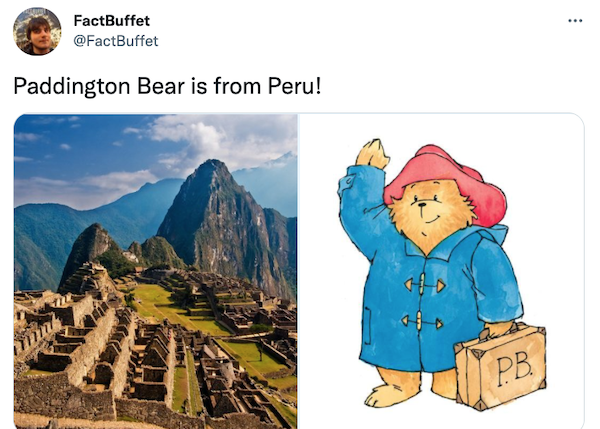
It is also the only bear that has become a global cultural icon partly because of its facial markings: Paddington Bear, in Michael Bond's 1958 stories, is a spectacled bear from "darkest Peru". For the gap between the storybook and the species, see Spectacled Bear vs Paddington: the real Andean bear.
What the Andean Bear Eats Compared to Other Bears
Diet is where the spectacled bear most clearly stands apart. The numbers from field studies are blunt:
- Spectacled bear: 90 to 95 percent plant matter by volume, hundreds of plant species across an elevational gradient from 1,000 to 4,000 metres.
- Giant panda: 99 percent plant matter, a handful of bamboo species.
- Sloth bear: roughly 50 percent insects (termites, ants), 40 percent fruit, 10 percent other.
- Sun bear: roughly 70 percent fruit, 20 percent insects, 10 percent vertebrates and honey.
- Asiatic black bear: roughly 60 percent fruit and mast, 20 percent insects, 20 percent vertebrate matter.
- American black bear: highly variable; fruit and mast in mast years, ungulate calves in spring, garbage where available.
- Brown bear: highly variable; salmon-dominated on coasts, ungulate-dominated in interior, plant-dominated in steppe and meadow systems.
- Polar bear: 95+ percent ringed and bearded seal.
A useful reference point is that only two living bear species are functionally herbivorous, the giant panda and the spectacled bear. Every other bear, even the relatively fruit-heavy sun and Asiatic black, takes meaningful animal protein over the year. A more granular breakdown of Andean diet is in what spectacled bears eat, but for a one-line summary: bromeliads first, palm fruits second, everything else far behind.
Quick Reference: Spectacled Bear Among the Eight
To pull the comparison together in a single block:
- Smallest living bear? No, that is the sun bear. The spectacled bear is the second smallest among adult males in some populations and is comfortably mid-pack overall.
- Most herbivorous living bear? No, that is the giant panda at 99 percent bamboo. The spectacled bear is second at 90 to 95 percent.
- Only South American bear? Yes. Tremarctos ornatus is the only ursid native to South America.
- Only living member of its subfamily? Yes, alongside the giant panda. Both Tremarctinae and Ailuropodinae are single-species subfamilies.
- Oldest divergent lineage among living bears? Second oldest. The giant panda branched first (~19-22 Mya), the spectacled bear branched second (~12-14 Mya), and everything else is part of the Ursinae crown radiation (~5-6 Mya).
- Most threatened living bear? Not by raw population numbers, but Vulnerable nonetheless. The giant panda has fewer wild individuals (~1,800), but Andean bear numbers (~13,000-18,000) are declining and habitat is fragmenting fast.
A Note on Extinct Tremarctine Cousins
Any honest comparison of Tremarctos ornatus to other bears has to mention the relatives the species has lost. During the late Pleistocene, the subfamily Tremarctinae included at least three other genera. Arctodus simus, the giant short-faced bear of North America, stood up to 1.8 metres at the shoulder on all fours and an estimated 3.4 metres standing, weighing 700 to 1,000 kilograms.
Arctotherium angustidens of South America was, on current biomechanical estimates, even larger, with the largest specimens probably exceeding 1,200 kilograms. Both were apex carnivores. Both vanished at the end of the last Ice Age, roughly 11,000 years ago, in the same wave of megafaunal extinction that took the mammoths, ground sloths, and sabre-tooths.
The spectacled bear is the survivor. It is the only Tremarctine to have made it through the late Pleistocene extinction filter, and it did so by being smaller, more arboreal, more herbivorous, and tied to a habitat (Andean cloud forest) that human hunters never densely occupied. The other bears alive today have living relatives within their own subfamily. The spectacled bear does not. Every closely related species it has is a fossil.
References
- Krause, J., Unger, T., Noçon, A., Malaspinas, A., Kolokotronis, S., Stiller, M., Soibelzon, L., Spriggs, H., Dear, P. H., Briggs, A. W., Bray, S. C. E., O'Brien, S. J., Rabeder, G., Matheus, P., Cooper, A., Slatkin, M., Pääbo, S., & Hofreiter, M. (2008). Mitochondrial genomes reveal an explosive radiation of extinct and extant bears near the Miocene-Pliocene boundary. BMC Evolutionary Biology, 8, 220. https://doi.org/10.1186/1471-2148-8-220
- Kutschera, V. E., Bidon, T., Hailer, F., Rodi, J. L., Fain, S. R., & Janke, A. (2014). Bears in a forest of gene trees: Phylogenetic inference is complicated by incomplete lineage sorting and gene flow. Molecular Biology and Evolution, 31(8), 2004-2017. https://doi.org/10.1093/molbev/msu186
- Velez-Liendo, X., & García-Rangel, S. (2017). Tremarctos ornatus (errata version published in 2018). The IUCN Red List of Threatened Species, e.T22066A123792952. https://doi.org/10.2305/IUCN.UK.2017-3.RLTS.T22066A45034047.en
- Soibelzon, L. H., & Schubert, B. W. (2011). The largest known bear, Arctotherium angustidens, from the early Pleistocene Pampean region of Argentina: With a discussion of size and diet trends in bears. Journal of Paleontology, 85(1), 69-75. https://doi.org/10.1666/10-037.1
- Peyton, B. (1980). Ecology, distribution, and food habits of spectacled bears, Tremarctos ornatus, in Peru. Journal of Mammalogy, 61(4), 639-652. https://doi.org/10.2307/1380309
- Lindqvist, C., Schuster, S. C., Sun, Y., Talbot, S. L., Qi, J., Ratan, A., Tomsho, L. P., Kasson, L., Zeyl, E., Aars, J., Miller, W., Ingólfsson, Ó., Bachmann, L., & Wiig, Ø. (2010). Complete mitochondrial genome of a Pleistocene jawbone unveils the origin of polar bear. Proceedings of the National Academy of Sciences, 107(11), 5053-5057. https://doi.org/10.1073/pnas.0914266107
- Garcia-Rangel, S. (2012). Andean bear Tremarctos ornatus natural history and conservation. Mammal Review, 42(2), 85-119. https://doi.org/10.1111/j.1365-2907.2011.00207.x
- Pagès, M., Calvignac, S., Klein, C., Paris, M., Hughes, S., & Hänni, C. (2008). Combined analysis of fourteen nuclear genes refines the Ursidae phylogeny. Molecular Phylogenetics and Evolution, 47(1), 73-83. https://doi.org/10.1016/j.ympev.2007.10.019
Further Reading
For more on the evolutionary and behavioural context discussed above, the following essays continue the comparison from different angles. The main entry on the spectacled bear is the natural starting point for anyone new to the species. From there, how big spectacled bears get, what they eat, and why their facial markings vary so much build out the biology.
For the conservation picture, spectacled bear conservation threats is a focused treatment. For broader bear-family context, Are Pandas Actually Bears?, the brown bear subspecies breakdown, and the giant panda vs red panda comparison round out the picture.
If you enjoy this kind of comparative natural history, you may also like the long-form science writing at Strange Animals, the cognitive-science articles at What's Your IQ, and the language and writing essays at Evolang.
Frequently Asked Questions
How does the spectacled bear compare in size to a grizzly bear?
A spectacled bear is markedly smaller than a grizzly. Adult male spectacled bears (Tremarctos ornatus) typically weigh between 60 and 150 kilograms, with females closer to 35 to 80 kilograms, and stand about 1.5 to 1.8 metres long. Adult male grizzlies (Ursus arctos horribilis), by contrast, weigh between 180 and 360 kilograms in interior populations and can exceed 500 kilograms on the salmon-rich coasts of Alaska and Kamchatka.
The largest reliably weighed grizzlies have approached 680 kilograms, more than four times the upper limit of any wild spectacled bear. Skull length, shoulder height, and bite force all scale accordingly. The two animals are not in the same weight class, even when the largest spectacled bears are compared with the smallest interior grizzlies.
The Andean bear is closer in body mass to an Asiatic black bear or an American black bear than to any subspecies of brown bear.
Is the spectacled bear more closely related to the giant panda or to the grizzly bear?
Neither is a near relative, but the spectacled bear is genealogically closer to the grizzly than to the giant panda. All eight living bears sit inside the family Ursidae, but they are split across three subfamilies. The giant panda is the lone survivor of Ailuropodinae, which branched off the rest of the bear family around 19 to 22 million years ago.
The spectacled bear is the lone survivor of Tremarctinae, the short-faced bears, which split from the Ursinae lineage roughly 12 to 14 million years ago. The grizzly belongs to Ursinae alongside six other species. So the spectacled bear and grizzly share a common ancestor about 12 to 14 million years back, while the spectacled bear and giant panda share a common ancestor closer to 19 to 22 million years back.
The spectacled bear is the last surviving member of a once enormous group of short-faced bears that included the largest land carnivore ever to exist, Arctotherium angustidens of Pleistocene South America.
Why is the spectacled bear nearly vegetarian when most other bears eat meat?
Spectacled bear diet is overwhelmingly plant-based, with field studies in Ecuador, Peru, and Bolivia consistently reporting 90 to 95 percent vegetable matter by volume across the year. Bromeliad hearts, palm fruits, cactus, orchids, and unripe puya make up most of the intake, with insects, carrion, and the occasional cattle calf adding modest protein. This is not unique within Ursidae.
Giant pandas are roughly 99 percent vegetarian on bamboo, and sloth bears specialise on termites and ants while still taking large amounts of fruit. What is distinctive about the spectacled bear is the breadth of its plant diet. Pandas eat only a few bamboo species. Spectacled bears eat hundreds of plant species, switching opportunistically across the elevational gradient of the Andes from cloud forest at 1,000 metres up to paramo above 4,000 metres.
The dietary similarity to pandas is therefore convergent rather than inherited, and it reflects a similar ecological problem solved with a similar solution: a large-bodied carnivoran adapting to landscapes where digestible animal protein is sparse and seasonal.