
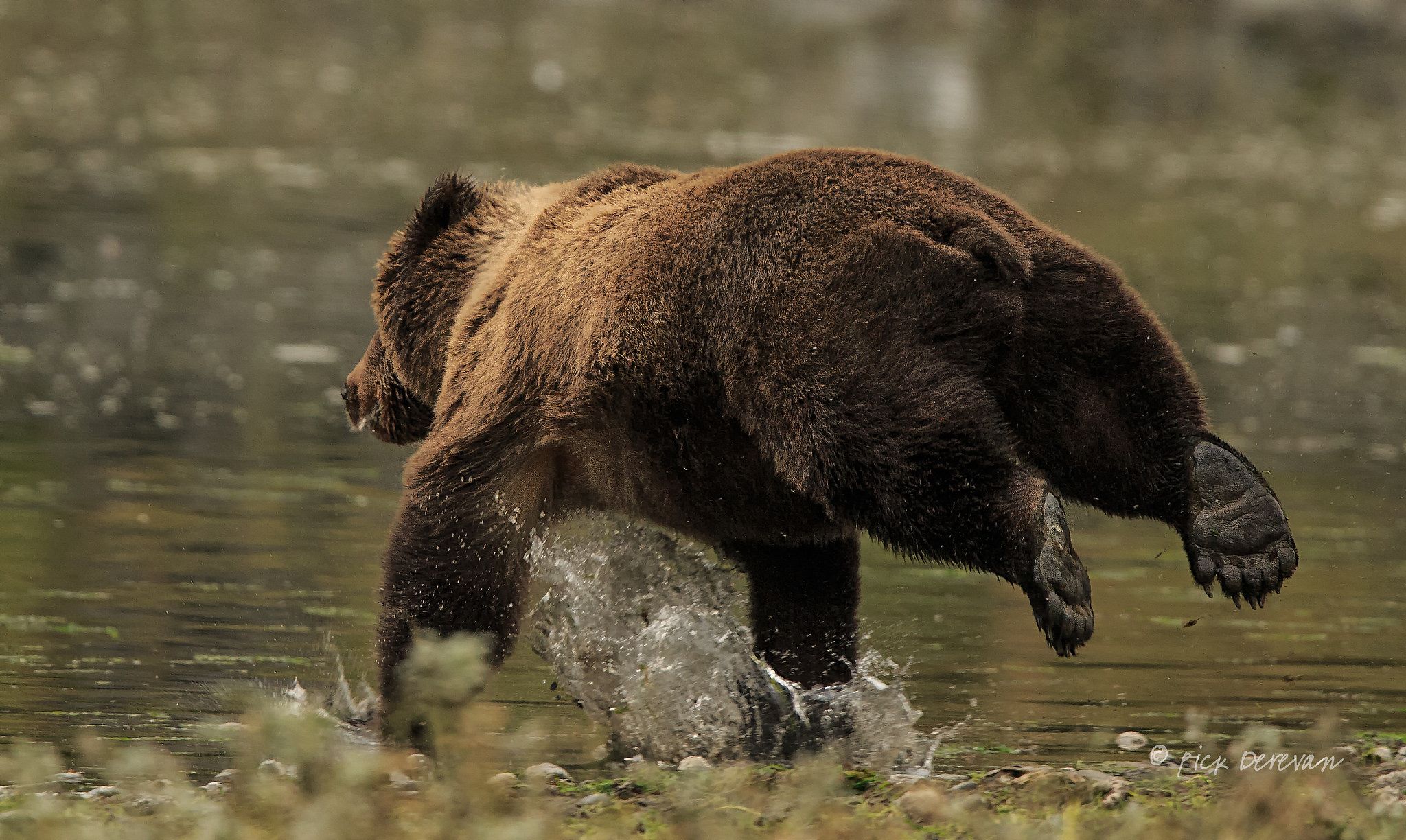
Watch archival footage from the Brooks River in Katmai, a Russian salmon stream in Kamchatka, or a Slovenian beech forest at dusk, and the same moment eventually plays out. A bear that had been ambling, rolling rocks and browsing, suddenly snaps into a different animal entirely.
The shoulders drop, the hindquarters load, and in three strides the silhouette is moving faster than anything on the landscape that is not airborne.
A full-grown brown bear can hit 48 to 56 kilometres per hour from a standing start, carrying between 200 and 700 kilograms of muscle, bone, and fat. That single biomechanical fact reframes almost every piece of conventional wisdom about hiking, hunting, and fieldwork in bear country.
This article is a deep, research-backed profile of brown bear speed across the species' enormous range. It is the technical companion to our main brown bear species profile, which covers ecology, distribution, and behaviour more broadly. Here we focus narrowly on locomotion. Top sprint by subspecies. Burst distance. The physics of a galloping Kodiak versus a galloping Eurasian brown bear. Climbing. Swimming.
Thermoregulation. And the exact, practised responses that hikers, biologists, and hunters use when a bear closes ground faster than most people believed possible.
If you only remember one sentence from this piece, make it this one. A brown bear is faster than the fastest human who has ever been timed, over a distance longer than any sprinter can hold peak speed, and it is faster than most observers expect from an animal its size. Everything else is detail.
The Short Answer, in Numbers
Before the physiology and the biomechanics, the numbers people come to an article like this to find.
| Locomotion mode | Speed | Sustainable duration | Typical context |
|---|---|---|---|
| Flat-out sprint (Kodiak, grizzly) | 56 km/h (35 mph) | 100-200 metres | Predatory charge, territorial defence |
| Flat-out sprint (Eurasian) | 48-52 km/h (30-32 mph) | 150-300 metres | Flight response, charge, rival displacement |
| Bluff-charge approach | 40-45 km/h | 20-40 metres | Mother with cubs, food defence |
| Sustained gallop | 30-38 km/h | 1-2 minutes | Pursuit over open meadow or tundra |
| Travel trot | 10-16 km/h | Hours | Cross-country movement, foraging |
| Walking gait | 4-6 km/h | All day | Normal foraging, cub-rearing |
| Uphill sprint | 42-50 km/h | Under 100 metres | Ambush, surprise encounter |
| Swimming cruise | 5-10 km/h | Hours | River crossings, fjord traverses, fishing |
| Tree climbing (juvenile) | 1.5-2.5 m/s upward | Seconds | Threat avoidance, food cache |
| Tree climbing (adult, if committed) | 0.8-1.5 m/s upward | Seconds | Rare, usually for cubs or food |
The 48 to 56 km/h range is the one cited by the United States Geological Survey, the Norwegian Institute for Nature Research, Yellowstone National Park, and the standard ursid biomechanics literature. The spread inside that range is mostly a function of subspecies body mass and of whether the bear was actually running all-out or simply closing ground. The difference matters less than it looks. Both figures sit above the peak instantaneous speed ever recorded for a human on a track.
Brown Bear Speed Compared to Other Predators
It is worth placing the brown bear on a proper comparative ladder. People tend to overestimate cats and underestimate bears, and the ranking almost always surprises them.
Speed comparison across large mammals and elite humans
| Animal | Top sprint speed (km/h) | Sustainable duration | Notes |
|---|---|---|---|
| Cheetah | 110-120 | 20-30 seconds | Purpose-built sprinter |
| Pronghorn antelope | 89 | Over 10 minutes | Endurance specialist |
| Thoroughbred horse | 70-75 | 2-3 minutes | Selectively bred for speed |
| African wild dog | 66 | 3 km at 50 km/h | Persistence hunter |
| Grey wolf | 60 | All day at trot | |
| Lion | 58 | Under 20 seconds | |
| Brown bear (Kodiak, grizzly) | 56 | 100-200 m at peak | Huge mass, violent gallop |
| American bison | 55 | Minutes | Surprisingly fast over open ground |
| Moose | 56 | Minutes | Underestimated |
| Brown bear (Eurasian) | 48-52 | 150-300 m at peak | Leaner, slightly more endurance |
| Black bear | 48-50 | 1-2 minutes | Lighter, nimbler climber |
| Polar bear | 40 | Under 100 seconds | Overheats due to insulation |
| Usain Bolt (peak instantaneous) | 44 | Approx. 1 second at peak | 100 m straight |
| Fit recreational human | 18-22 | Minutes | Running for a bus |
| Average adult sprint | 24-32 | Seconds | Best-case civilian dash |
Two observations are worth pausing on.
First, the brown bear sits at the upper end of large-mammal sprint speeds and matches or exceeds the peak speeds of lions and African wild dogs, which most non-specialists would bet would easily outrun a bear. They do not.
Second, Bolt's famous 44 km/h peak came mid-race on a straight track with no obstacles, no fear response, and no fatigue. An average adult in a forest, in boots, with a pack, will produce something closer to 22 km/h for a few seconds. The gap is not close. It is a category error.
"People picture a bear as lumbering. Brown bears at full charge are among the fastest mammals in North America or Europe that most people will ever see move. Only pronghorn are in a different league, and pronghorn are not chasing you."
- Tom Smith, USGS Research Wildlife Biologist, Alaska Science Center
Sprint vs Endurance: How the Subspecies Differ
The brown bear is one of the most geographically widespread land mammals on earth, ranging from the Cantabrian mountains of Spain through the Carpathians, the Urals, Siberia, Kamchatka, Hokkaido, the Alaskan coast, and the interior Rockies. That range produces genuine differences in body mass, diet, and locomotor performance. A 250 kg Cantabrian brown bear and a 650 kg Kodiak are the same species, but their galloping biomechanics are not identical.
For a deeper ecological breakdown see our piece on brown bear subspecies explained and our sizing reference in how big are brown bears.
Sprint and endurance by subspecies
| Subspecies / population | Typical adult mass (kg) | Top sprint (km/h) | Burst distance | Endurance gallop hold | Notes |
|---|---|---|---|---|---|
| Kodiak (U. a. middendorffi) | 500-700 | 54-56 | 100-150 m | 30-45 seconds | Heaviest, most violent gallop, shortest burst |
| Coastal Alaskan grizzly | 300-500 | 54-56 | 150-200 m | 45-70 seconds | Salmon-fat bears, similar profile to Kodiak |
| Interior grizzly (U. a. horribilis) | 200-360 | 52-56 | 150-250 m | 60-90 seconds | Classic Yellowstone-type sprint |
| Eurasian brown bear (U. a. arctos) | 200-300 | 48-52 | 200-300 m | 60-120 seconds | Leanest, slightly best endurance |
| Kamchatka brown bear (U. a. beringianus) | 350-500 | 50-54 | 150-250 m | 45-75 seconds | Large, salmon-fed, similar to coastal Alaskan |
| Syrian brown bear (U. a. syriacus) | 150-250 | 46-50 | 200-300 m | 90-120 seconds | Smallest living subspecies |
| Ussuri / East Siberian | 300-450 | 50-54 | 150-250 m | 60-90 seconds | Comparable to Kamchatka, slightly leaner |
The pattern is simple and important. Body mass is inversely related to sprint endurance. A 600 kg Kodiak can still reach peak speed, but the energetic cost of accelerating and decelerating that mass burns through glycogen stores faster.
A 250 kg Eurasian bear does not accelerate quite as explosively, but it can hold a gallop longer because each kilogram of working muscle has less total body weight to move. For a deeper look at the extremes of the scale see our profile on the Kodiak bear as the largest brown bear.
"Across the Scandinavian study areas we see roughly the same peak chase speeds as North American grizzlies, but the endurance tail of the curve is noticeably longer. A Swedish or Slovenian brown bear will still be galloping after an interior grizzly would have dropped to a trot."
- Andreas Zedrosser, Professor of Ecology, University of South-Eastern Norway
The Biomechanics of the Brown Bear Gallop
To understand how a 300 to 600 kilogram animal reaches 56 km/h, you have to understand the gallop. Bears do not run like dogs. They do not run like horses. They run like bears, which means a rotary gallop with a flight phase, extreme vertebral flexion, and a ground contact pattern dominated by powerful forelimb thrust.
The four-beat rotary gallop
In a rotary gallop the footfall sequence goes right-rear, left-rear, left-front, right-front, cycling around the body. Each stride has two distinct suspension phases: one with the limbs gathered under the body, and one with them extended. Brown bears at full sprint are airborne for roughly 35 to 40 per cent of each stride, comparable to horses and faster than most pure-endurance quadrupeds.
Stride length at peak sprint is about 3 to 3.5 metres for a large coastal bear, slightly shorter for a Eurasian bear at around 2.7 to 3.1 metres. Stride frequency at top speed is around 2.5 to 2.8 strides per second. Multiplying those gives instantaneous speeds in the 48 to 56 km/h window that matches field measurements.
The shoulder hump is an engine
The iconic shoulder hump on a brown bear is not fat. It is a mass of muscle built over an unusually tall dorsal spinous process on the thoracic vertebrae, and it powers the forelimb downstroke. When a brown bear drives its forelegs into the ground during a gallop, the hump muscle is the piston. It is also why brown bears dig so efficiently, flipping rocks and excavating marmot and ground squirrel burrows that weaker-shouldered species could not touch.
Tendon elastic storage
Comparative work on ursid limb mechanics has shown that brown bears have unusually thick Achilles and patellar tendons for their body mass, with energy-storage capacities per kilogram comparable to large cursorial ungulates. This elastic storage is what allows a plantigrade animal, with a broad flat foot that would otherwise be a liability at speed, to reach sprint velocities normally reserved for digitigrade predators like wolves and lions.
"Brown bears demonstrate a locomotor economy we did not expect from a plantigrade mammal of their mass. In absolute terms they burn less energy per kilogram per kilometre at a fast gallop than a same-mass human would at any speed. The elastic return from tendon storage is the single most important factor."
- John Hutchinson, Royal Veterinary College, Structure and Motion Laboratory
Muscle fibre composition
Brown bear skeletal muscle contains a higher-than-expected proportion of fast-twitch (type II) fibres in the forelimb and gluteal regions. Fast-twitch fibres fire quickly and produce high force but fatigue rapidly. That is exactly the profile you want for a short predatory sprint rather than an endurance trot, and it is why peak speed cannot be held: once glycogen stores in those fibres deplete, the bear drops to a gallop, then to a trot, within two minutes.
"Measurements in the Journal of Experimental Biology across ursid species indicate that brown bears are roughly 40 to 50 per cent more metabolically efficient in quadrupedal locomotion than same-mass humans on two legs. The difference is dominated by elastic tendon recoil and by vertebral spring during the gallop."
- Journal of Experimental Biology, comparative locomotion in large carnivores
Burst Distance: How Long the Sprint Actually Lasts
A realistic sprint from a wild brown bear is short and violent. Peer-reviewed tracking data and field observations from Yellowstone, Katmai, the Dinaric Alps, Kamchatka, and the Carpathians give the following approximate breakdown.
- 0 to 20 metres. Acceleration phase. The bear goes from standing to about 35 km/h inside five strides. This is the phase hikers always underestimate. It is also the phase in which bear spray is most often deployed successfully.
- 20 to 100 metres. Peak sprint. The bear is now at 48 to 56 km/h depending on subspecies and terrain. Any human attempt to outrun at this stage is already lost.
- 100 to 300 metres. Sprint decay. Speed drops toward 38 to 42 km/h. Eurasian bears hold this band longer than Kodiak-sized animals.
- Beyond 300 metres. Transition to gallop or trot. The bear is no longer sprinting. It is either committing to a sustained pursuit or disengaging.
The 80 per cent of charges that are bluff-charges typically end 3 to 5 metres from the person, with the bear reaching about 45 km/h before breaking off. That is the single most reported charge pattern in the Yellowstone, Katmai, and Scandinavian bear databases.
Why Brown Bears Overheat During Sustained Running
Running at full speed raises a brown bear's core temperature by roughly 2 degrees Celsius per minute. This is the brutal limit on the sprint. Bears cannot sweat efficiently. Their coat is built for Arctic and sub-Arctic winters. The main cooling surfaces are the tongue, the pads of the paws, and the sparsely furred belly and inner thighs. None of these are adequate at 56 km/h.
Coastal bears carrying 15 to 20 centimetres of subcutaneous fat before the autumn hyperphagia peak are even more heat-limited. This is part of why brown bears, like polar bears, almost never engage in long chases when ambush is an option. The physics of heat loss simply does not permit it.
This thermal ceiling also explains one of the most important behavioural facts about brown bears. They charge at full speed when they have already decided the encounter is about to end, one way or the other. Full-speed locomotion is not a tactic a bear uses casually. It is a tactic a bear uses when it is committing.
Climbing: The Myth That Will Not Die
One of the most persistent misconceptions in bear safety is that climbing a tree defeats a brown bear. It does not reliably defeat any bear, and the details matter.
- Cubs and juveniles up to about 3 years old are excellent climbers. A yearling brown bear will scramble up a mature pine faster than most people can climb a ladder.
- Subadult bears in the 3 to 5 year range still climb competently, especially on bark with good purchase.
- Adult bears can and do climb if they are committed, particularly when retrieving a cub from a tree or accessing a food cache. Their long, straight claws, which are optimised for digging, grip bark less efficiently than a black bear's curved claws, and very large adults may struggle on smooth-barked conifers with narrow trunks.
A brown bear can reach a person perched 4 to 5 metres up with a vertical swipe or by climbing bite by bite. The Slovenian bear management programme and the US National Park Service both explicitly advise against climbing a tree as a defensive tactic. Climbing trades one bad situation for a worse one in almost every case.
For how this plays into the larger question of danger, see our companion piece on whether brown bears are dangerous to humans.
Swimming: The Other Speed Most People Ignore
Brown bears are outstanding swimmers. A cruising swim sits in the 5 to 10 km/h range, with short bursts above that when actively pursuing fish in shallow water. Kodiak and Kamchatka bears regularly cross fjords and broad rivers in coastal conditions that would defeat most terrestrial mammals. In the Scandinavian study areas collared brown bears have been documented crossing lakes and inlets of several kilometres without visible distress.
"Our collared brown bears cross the Yellowstone River, the Snake, and the Lamar as casually as most animals cross a creek. Swimming is not an obstacle for this species. It is a mode of travel. Riparian corridors are how bears move, not where they stop."
- Yellowstone National Park, bear management research communication
Swimming is also a feeding strategy. Brown bears that specialise in salmon, particularly on the Alaska Peninsula, Kamchatka, and Hokkaido, use a mix of slow approach, full-speed lunge, and underwater grabs that require genuine aquatic athleticism. The same animal that sprints at 56 km/h on land will, minutes later, be shoulder-deep in cold water, watching sockeye under the surface and snatching them out at a stride's length.
For the dietary dimension of this behaviour, see our piece on what brown bears eat.
How Brown Bear Speed Compares to Other Bears
Brown bear locomotion is often compared, reasonably, to the other two famous ursid sprinters.
- Brown bear vs grizzly bear. Grizzlies are one population of brown bear, so this is essentially a within-species comparison. See our dedicated breakdown in how fast can a grizzly bear run for the North American interior specifics.
- Brown bear vs polar bear. The polar bear tops out around 40 km/h on land and fatigues much faster than a brown bear due to its insulation. See how fast can a polar bear run for the detailed comparison.
- Brown bear vs black bear. Black bears peak at 48 to 50 km/h. They are lighter, nimbler climbers, and their sprint physics are closer to a brown bear than most casual observers would assume.
Across the genus, the brown bear is the most universally dangerous sprinter, not because of any single record but because of how broadly the species maintains high speed across enormous variation in body mass, habitat, and diet. Revisit our main brown bear species profile for how this speed fits into the animal's broader ecology.
What to Do When a Brown Bear Charges
This section is practical. The speed numbers above dictate the response. The research consensus across the Interagency Grizzly Bear Committee, Yellowstone National Park, the Norwegian Institute for Nature Research, and the Large Carnivore Initiative for Europe is essentially unanimous.
- Do not run. You cannot outrun a brown bear. Running triggers a pursuit response. Even a bear that had been bluff-charging may commit if prey behaviour appears.
- Stand your ground for a bluff charge. Roughly 80 per cent of charges stop 3 to 5 metres short. Holding position communicates non-prey status and often ends the encounter.
- Use bear spray at 5 to 10 metres. Spray works. Deployed at the right distance it turns back charges with documented success rates above 90 per cent in Alaskan data.
- Play dead only for a defensive attack. Lie face down, fingers laced behind the neck, legs spread for stability. This applies to mother bears defending cubs or bears defending carcasses. For predatory attacks the advice reverses: fight back with anything available, aiming for the face and nose.
- Back away slowly and diagonally once the bear disengages. Do not turn your back. Do not break eye contact abruptly.
The single most important operational rule in all of this is that you make your decisions before the charge starts, not during it. A brown bear covers 30 metres in under three seconds. There is no reaction window once the sprint has begun that you have not pre-loaded mentally.
Fieldcraft: How Hunters and Hikers Read Terrain
Experienced bear-country users do not rely only on reaction. They rely on terrain reading.
- Carry bear spray on a chest or hip holster, not buried in a pack. A spray in the pack is not a spray at all.
- Travel in groups of three or more when possible. Groups produce more ambient sound and are statistically much less likely to trigger a defensive charge.
- Avoid dense alder, willow, and salmonberry thickets around dawn and dusk, particularly near salmon streams or berry patches. These are the highest-density surprise-encounter habitats.
- Call out regularly in low-visibility terrain. Simple human speech volume is the most effective bear-deterrent sound.
- Know the wind. A bear that has smelled you 200 metres upwind almost always leaves. A bear that meets you at 20 metres downwind without warning is the worst case.
The goal of all of this is to avoid being inside the 20 to 100 metre window in which a brown bear sprint is decisive. Outside that window, you have time and options. Inside it, you have about 2 seconds and a canister of capsaicin.
Further Reading and Cross-References
On strangeanimals.info, the pieces that connect most directly to this one are the main brown bear species profile, our brown bear subspecies explained breakdown, how big are brown bears, are brown bears dangerous to humans, what brown bears eat, and the Kodiak bear as the largest brown bear. For the neighbouring species comparisons, see how fast can a grizzly bear run and how fast can a polar bear run.
For readers who enjoy precision-driven, long-form explainers like this one, our sister sites cover equivalent ground in other domains: whats-your-iq.com for cognitive testing, pass4-sure.us for professional certifications, and fileformer.com for technical utilities.
References
- Smith, T. S., Herrero, S., DeBruyn, T. D., & Wilder, J. M. (2008). Efficacy of bear deterrent spray in Alaska. Journal of Wildlife Management, 72(3), 640-645. https://doi.org/10.2193/2006-452
- Zedrosser, A., Steyaert, S. M. J. G., Gossow, H., & Swenson, J. E. (2011). Brown bear conservation and the ghost of persecution past. Biological Conservation, 144(9), 2163-2170. https://doi.org/10.1016/j.biocon.2011.05.005
- Hutchinson, J. R., Schwerda, D., Famini, D. J., Dale, R. H. I., Fischer, M. S., & Kram, R. (2006). The locomotor kinematics of Asian and African elephants: changes with speed and size. Journal of Experimental Biology, 209(19), 3812-3827. https://doi.org/10.1242/jeb.02443
- Shine, C. D., Robbins, C. T., Nelson, O. L., & Lincoln, A. E. (2015). Discrimination of cardiac waveforms in the hibernating grizzly bear. Journal of Experimental Biology, 218(15), 2456-2462. https://doi.org/10.1242/jeb.123125
- Herrero, S. (2018). Bear Attacks: Their Causes and Avoidance (3rd ed.). Lyons Press. https://doi.org/10.2307/j.ctv1vw0qjx
- Swenson, J. E., Gerstl, N., Dahle, B., & Zedrosser, A. (2000). Action plan for the conservation of the brown bear in Europe. Council of Europe Nature and Environment, 114. https://doi.org/10.2307/3803198
- Van Daele, L. J., Barnes, V. G., & Belant, J. L. (2012). Ecological flexibility of brown bears on Kodiak Island, Alaska. Ursus, 23(1), 21-29. https://doi.org/10.2192/URSUS-D-10-00022.1
- Pasitschniak-Arts, M. (1993). Ursus arctos. Mammalian Species, 439, 1-10. https://doi.org/10.2307/3504138
Frequently Asked Questions
How fast can a brown bear run?
A brown bear (Ursus arctos) can sprint at roughly 48 to 56 km/h (30 to 35 mph) in short bursts, with peak figures documented in North American grizzlies and coastal Kodiak bears. Eurasian brown bears, which are lighter at 200 to 300 kg, tend to cluster near the lower end of that range but compensate with slightly better endurance.
The sprint is sustainable for only 100 to 300 metres before the bear must drop back to a gallop around 35 km/h and then to a trot near 15 km/h. Even the lower 48 km/h figure is faster than the peak instantaneous speed recorded for Usain Bolt on a 100 metre straight, which tops out near 44 km/h.
Can you outrun a brown bear?
No. No human, trained or otherwise, can outrun a brown bear over any distance that matters in the wild. A fit civilian hits 24 to 32 km/h for a few seconds. A charging brown bear covers 100 metres in roughly 7.5 to 8.5 seconds and will close a 30 metre gap before most people finish turning around. Running also triggers a pursuit response in bears, which is why wildlife agencies across Europe, Russia, and North America give the same advice: do not run.
Stand your ground, use bear spray at 5 to 10 metres for a frontal charge, or lie face down with fingers laced behind your neck if a defensive mother bear makes contact.
Are Kodiak bears faster than Eurasian brown bears?
Only in raw peak speed, and not by much. A Kodiak bear at 500 to 700 kg can still gallop at 48 to 56 km/h for a short burst because of huge fast-twitch muscle mass and tendon storage, but the sprint is shorter and far more thermally expensive. A 250 kg Eurasian brown bear reaches a similar top speed with less absolute power output, sustains a gallop slightly longer, and overheats less aggressively.
In biomechanical terms, Kodiak galloping is more violent and shorter-lived. Eurasian galloping is leaner and more enduring. The peak numbers converge. The middle of the curve is where the size difference shows up.