
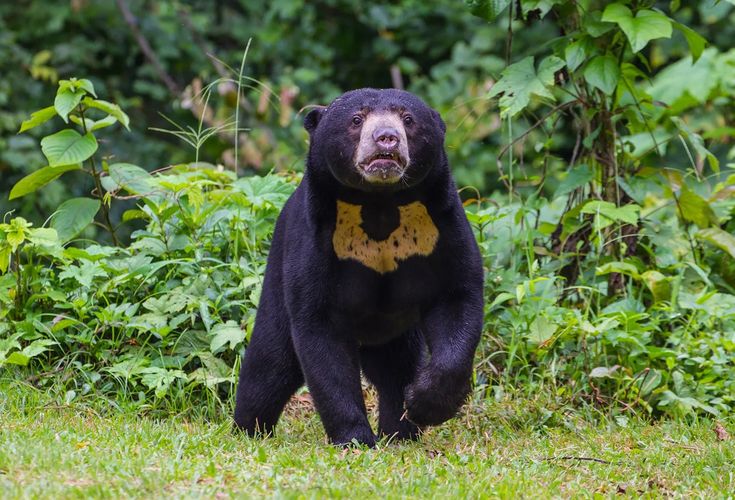
How many spectacled bears are left?
Roughly 13,000 to 18,000 spectacled bears (Tremarctos ornatus) remain in the wild across the tropical Andes. The IUCN lists the species as Vulnerable with a decreasing trend. Peru holds the largest national population at about 5,000 bears, followed by Bolivia (~3,000), Ecuador (~2,500), Colombia (~1,500), Venezuela (~500), and Argentina (fewer than 200). A further ~250 animals live in zoos worldwide.
The species is split across at least 28 identified subpopulations, several of which are now functionally isolated. The wide 13,000-18,000 estimate band reflects the genuine difficulty of counting a forest bear at high elevation in steep, cloud-shrouded terrain.
A Bear in a Cloud Forest
Most large mammals on Earth can be counted from the air, from a Land Rover, or by walking line transects across open habitat. The spectacled bear cannot. South America's only living bear lives in some of the most vertical, wettest, and least accessible terrain on the continent: the cloud forests of the eastern Andean slopes, the paramo grasslands above them, and the dry inter-Andean valleys between the cordilleras.
Visibility in a typical Andean cloud forest is frequently below 10 metres. Slopes regularly exceed 60 degrees. Bears here are quiet, largely solitary, and partly arboreal, sleeping in beds of bromeliads tens of metres up in the canopy.
This is not a complaint. It is the reason every population figure for the spectacled bear is reported as a range. When you see 13,000-18,000 quoted in a journal article, an IUCN assessment, or a government wildlife report, that range is not an editorial hedge. It is the honest output of indirect counting methods stitched together across six countries with very different research traditions and very different amounts of money for fieldwork.
For the species profile, including taxonomy, diet, and natural history, the anchor article is the spectacled bear. For range-by-range geography, see where spectacled bears live. This article concentrates strictly on the demographics: how many bears, where, by what method, and on what trajectory.
The IUCN Listing in Context
The International Union for Conservation of Nature has assessed Tremarctos ornatus as Vulnerable (VU) under criterion A4cd, which means a suspected population reduction of at least 30 percent over three generations (past, ongoing, and projected), driven by a decline in area, extent, or quality of habitat (c) and by exploitation (d). The listing has been stable since the 2008 reassessment and was reaffirmed in subsequent updates.
Several national authorities are stricter than the IUCN. Venezuela's Red Book of Venezuelan Fauna lists the spectacled bear as Endangered at the national level. Argentina lists the species as In Danger of Extinction under federal wildlife law because the country holds at most a few dozen bears in the Yungas of Salta and Jujuy.
Colombia's national assessment treats the species as Vulnerable but flags several subpopulations, particularly in the Sierra Nevada de Santa Marta and the Eastern Cordillera, as locally Endangered.
"A rangewide Vulnerable listing is the right call for Tremarctos ornatus given current evidence, but it conceals enormous heterogeneity. The Yungas bears of Argentina, the Sierra Nevada de Santa Marta bears, and several Venezuelan subpopulations would each qualify as Endangered if assessed in isolation. The species is one population at the global tier and twenty-eight populations on the ground." - IUCN Bear Specialist Group, Andean Bear Expert Team consensus statement
For comparison with other ursids on the IUCN list, the giant panda was downlisted from Endangered to Vulnerable in 2016 (see how many pandas are left) and the polar bear remains Vulnerable for climate-driven reasons (see why polar bears are endangered). The spectacled bear sits in the same Vulnerable tier as both, but the underlying demographics, threats, and management options are entirely different.
The Country-by-Country Numbers
Spectacled bear range covers six countries: Venezuela, Colombia, Ecuador, Peru, Bolivia, and a sliver of northwestern Argentina. The range broadly tracks the tropical Andes from about 9 degrees north latitude in the Sierra de Perija on the Colombia-Venezuela border down to about 23 degrees south in the Argentine Yungas. Population is not evenly distributed along that corridor.
The largest blocks of intact habitat lie in central and southern Peru and in Bolivia, with progressively smaller and more fragmented populations to the north and at the southern tip of the range.
Wild population by country
| Country | Estimated wild population | Approximate share of global total | National conservation status | Notes |
|---|---|---|---|---|
| Peru | ~5,000+ | ~30-35% | Vulnerable | Largest population; strongholds in Manu, Tambopata, Cordillera de Vilcabamba |
| Bolivia | ~3,000 | ~18-22% | Vulnerable | Madidi, Apolobamba, Amboro; large but understudied |
| Ecuador | ~2,500 | ~15-18% | Endangered (national) | Strong populations in Sangay, Podocarpus, Cayambe-Coca |
| Colombia | ~1,500 | ~9-11% | Vulnerable | Highly fragmented; Chingaza, Las Hermosas, Sierra Nevada |
| Venezuela | ~500 | ~3-4% | Endangered | Sierra de Perija, Cordillera de Merida; isolated subpopulations |
| Argentina | <200 | <1.5% | In Danger of Extinction | Marginal range in Yungas of Salta and Jujuy |
Two notes on this table. First, the country totals add to roughly 12,700 at the low end and 14,200 at the upper midpoint, which sits inside the IUCN-cited rangewide band of 13,000-18,000 once additional bears in cross-border zones and uncounted intermediate elevations are accounted for. Second, the percentage shares are inherently fuzzy because the underlying national figures themselves are ranges. Treat them as orders of magnitude, not as census results.
Peru: The Stronghold
Peru is the demographic core of the species. The country contains an estimated 5,000-plus spectacled bears, more than a third of the global wild population, distributed across the eastern slopes of the Andes from Cajamarca and Amazonas in the north down through Cusco and Puno in the south. The most important continuous habitat blocks are:
- Cordillera de Colan and the upper Maranon valley (Amazonas, San Martin)
- Cordillera Azul National Park and Cordillera de Vilcabamba
- Manu National Park and the surrounding Manu Biosphere Reserve (Madre de Dios, Cusco)
- Tambopata National Reserve and Bahuaja-Sonene National Park (Madre de Dios, Puno)
- Apurimac, Ayacucho, and Junin paramos
Manu in particular is one of the few protected areas where spectacled bears have been studied with rigorous capture-recapture camera trapping over multiple field seasons. Research led by Russ Van Horn of the San Diego Zoo Wildlife Alliance, working with Peruvian collaborators, has been instrumental in establishing realistic density estimates for cloud forest bears.
"When we put 80 camera trap stations across the Cordillera de Vilcanota over two years, we did not find a sea of bears. We found a sparse but persistent population at densities consistent with intact Andean forest, somewhere in the order of 5 to 7 bears per 100 square kilometres. Multiply that across actual habitat area and Peru still comes out as the global stronghold, but the bears are nowhere near as common per hectare as people imagine." - Russ Van Horn, San Diego Zoo Wildlife Alliance, summarising Andean bear density work in Peru
Peru's strength is habitat extent. Even where density is low, the sheer area of intact eastern slope forest above 1,000 metres dwarfs the protected ranges of any other Andean country. The risk in Peru is not present-day collapse but the slow attrition of mid-elevation forest to coca cultivation, road expansion (the Interoceanic Highway in particular), and informal cattle ranching pushing up the slopes.
Bolivia: Large, Wild, and Underestimated
Bolivia is widely believed to hold the second-largest national population at around 3,000 bears, but the underlying field data are thinner than for Peru. The Bolivian Yungas, on the eastern flank of the Cordillera Real and Cordillera de Apolobamba, contain extensive and largely unbroken cloud forest. The two anchor protected areas are:
- Madidi National Park (~19,000 km2)
- Apolobamba Integrated Management Natural Area
- Amboro National Park
- Carrasco National Park
- Cotapata National Park
Madidi alone is comparable in size to Belgium and runs from sub-300-metre Amazonian lowland up to glaciated peaks above 5,000 metres, capturing the full elevational range a spectacled bear can occupy. Camera trap surveys by Bolivian researchers and by the Wildlife Conservation Society have repeatedly confirmed bears across Madidi, but published density estimates remain limited.
"Bolivia probably has the second-largest spectacled bear population on the continent, but the supporting count is the least published. We are confident in the rough magnitude, around three thousand bears, on the basis of habitat extent and consistent presence-absence data. We are not yet confident enough to say whether the trend in Bolivia is stable, slowly declining, or, in some Yungas valleys, possibly increasing as cattle pressure shifts." - Oryx, editorial summary of Andean bear demography across the southern range
The honest answer for Bolivia is that the country is too large, too rugged, and too understudied to give a single point estimate. Three thousand is the consensus figure used in IUCN documents and Bolivian government wildlife planning.
Ecuador: Compact Range, Active Research
Ecuador holds about 2,500 spectacled bears in a relatively compact territory along the Sierra and the eastern Andean foothills. Despite a smaller country area, Ecuador hosts a disproportionately large research community working on Tremarctos. Key populations live in:
- Sangay National Park and the Llanganates-Sangay corridor
- Cayambe-Coca National Park
- Podocarpus National Park (southern Ecuador)
- Cotacachi-Cayapas Ecological Reserve
- Antisana Ecological Reserve
The Llanganates-Sangay corridor in central Ecuador is one of the best-studied spectacled bear landscapes anywhere. Ecuadorian biologists, often partnering with the Andean Bear Foundation and international universities, have used dense camera trap arrays, hair traps, and scat DNA across this corridor to produce some of the firmest spatially explicit density estimates in the species range.
Ecuadorian work has also generated some of the most useful range-edge ecological information: how bears use paramo above the treeline, how they exploit Symplocos and Ficus mast in cloud forest, and how home ranges shift seasonally. For background on family structure, see spectacled bear cubs and family life.
Colombia: 1,500 Bears in Many Pieces
Colombia's roughly 1,500 spectacled bears are spread across all three Andean cordilleras (Western, Central, and Eastern) plus the isolated Sierra Nevada de Santa Marta massif on the Caribbean coast. The country's geography is a textbook of fragmentation. Cordillera ranges are separated by deeply inhabited and farmed inter-Andean valleys, and the Sierra Nevada de Santa Marta is genuinely an island for an Andean bear, separated from the main range by hundreds of kilometres of low, hot lowland.
Important Colombian populations include:
- Chingaza National Park and Sumapaz National Park (Eastern Cordillera, near Bogota)
- Las Hermosas National Park (Central Cordillera)
- Tatama National Park (Western Cordillera)
- Sierra Nevada de Santa Marta National Park (isolated coastal massif)
- Serrania de los Yariguies
Field research and conservation in Colombia has been complicated by decades of armed conflict, which restricted access to large parts of the Andean cordilleras. Since the 2016 peace process, ecological survey work has expanded rapidly, and Colombian biologists have been catching up on population data that other range countries gathered in the 1990s.
Sierra Nevada de Santa Marta is of particular concern because its bear population is biogeographically isolated, demographically small, and increasingly hemmed in by agricultural expansion on the lower slopes.
Venezuela: 500 Bears Under Pressure
Venezuela's spectacled bear population is concentrated in two regions:
- The Sierra de Perija along the Colombian border
- The Cordillera de Merida in the central-western Andes (Sierra Nevada National Park, Sierra de la Culata)
Total numbers are estimated at around 500 bears, and the trend is more clearly downward than in any other range country. Venezuela's compounding political and economic crisis from the mid-2010s onward has reduced enforcement capacity in protected areas, increased illegal hunting pressure, and pushed agricultural expansion into former bear habitat.
Venezuelan biologists, often working with limited resources, have nonetheless maintained long-term presence-absence monitoring in the Cordillera de Merida.
The Sierra de Perija population, which crosses into Colombia, is genetically and demographically continuous with Colombian Perija bears and is one of the few transboundary subpopulations where coordinated conservation across two governments would clearly benefit the species. Practical cooperation has been limited.
Argentina: A Marginal Population
Argentina sits at the southern tip of spectacled bear range. The country's national population is estimated at fewer than 200 bears, and possibly as low as 50-100 in some assessments. Bears here are restricted to the Yungas cloud forest of the provinces of Salta and Jujuy, with Calilegua National Park and Baritu National Park as the principal strongholds.
Argentine bears live at the very ecological margin of the species. The Yungas here are drier and more seasonal than the Ecuadorian or Peruvian cloud forest core, and the bears must contend with a narrow elevational band of suitable habitat squeezed between agricultural lowlands and the dry Puna highlands. Argentina lists the species as In Danger of Extinction at the federal level, an objectively appropriate classification given the size and isolation of the national population.
Argentine bears matter out of proportion to their numbers because they represent the southernmost evolutionary edge of the species. Loss of this population would not only be a national extinction but a contraction of the global range by hundreds of kilometres.
How Many Subpopulations? At Least 28
Conservation biologists working on Tremarctos generally recognise at least 28 distinct subpopulations rangewide. The exact number depends on how strict you are about what counts as functional isolation, but the figure has stabilised in the high 20s across recent IUCN assessments and regional working groups.
Of those subpopulations, a meaningful fraction are now considered functionally isolated, meaning that gene flow with other subpopulations is either absent or so rare that it cannot offset local genetic drift.
Subpopulation viability assessment
| Viability tier | Approximate count | Typical bear numbers | Examples | Demographic outlook |
|---|---|---|---|---|
| Robust | 5-7 | >500 bears | Manu (Peru), Madidi (Bolivia), Sangay (Ecuador) | Stable to slowly declining |
| Moderate | 10-12 | 50-500 bears | Chingaza (Colombia), Cayambe-Coca (Ecuador), Apolobamba (Bolivia) | Declining; corridor-dependent |
| Fragile | 8-10 | 10-50 bears | Sierra Nevada de Santa Marta (Colombia), Sierra de Perija (Venezuela/Colombia) | Declining; isolation risk |
| Functionally isolated / critical | 3-5 | <50 bears, often <20 | Argentine Yungas, several Venezuelan Andes subunits | High extinction risk without intervention |
The fragile and functionally isolated tiers together hold a small fraction of the global bear total but account for an outsized share of the extinction risk. Local extinction in any of these subpopulations would not threaten the species as a whole, but it would erode genetic diversity, range continuity, and the ability of the species to track climate change northward and uphill.
"Fragmented ranges of long-lived, low-fecundity vertebrates do not collapse with a bang. They lose subpopulations one at a time, often quietly, over decades. By the time the last bear in a 50-square-kilometre forest island is gone, the regional papers no longer mention that bears were ever there." - Conservation Biology, special issue on Andean vertebrate fragmentation
For a deeper treatment of the threats driving this fragmentation, see spectacled bear conservation threats.
Captive Population: Around 250 Worldwide
The captive population of spectacled bears is small compared with giant pandas or polar bears. Approximately 250 spectacled bears live in zoos worldwide, primarily in:
- North American AZA-accredited zoos (around 50-60 animals)
- European EAZA-accredited zoos (around 70-80 animals)
- Latin American zoos and rescue centres in range countries (the largest single block, with the rest scattered)
- A handful of Asian zoos
Captive breeding has been successful enough to maintain the population without continued imports from the wild, but the captive group is not large enough to act as a meaningful genetic reservoir for an in-situ population of 13,000-18,000. The captive role is primarily educational and political: keeping the species visible to the public, particularly in countries far from its range.
The cultural visibility boost provided by Paddington Bear, the fictional spectacled bear from Peru, is genuinely significant for conservation fundraising. For background on the connection, see spectacled bear vs Paddington: the real Andean bear.
For comparison, the captive giant panda population is now around 600 animals (see giant panda), which is more than double the captive spectacled bear count despite the wild giant panda population being roughly an order of magnitude smaller. The mismatch reflects political investment more than biological need.
How Researchers Actually Count These Bears
Counting forest bears in steep terrain is a craft as much as a science. Three core methods, often used in combination, generate the numbers cited in IUCN assessments and national reports.
1. Camera trap arrays with spatially explicit capture-recapture
Camera traps placed along game trails, ridge lines, and salt licks photograph bears as they pass. Spectacled bears can be individually identified from the chest and facial cream-coloured markings, which are roughly as distinctive as fingerprints.
With enough cameras over enough months, biologists can build photographic capture histories of individual bears and feed them into spatially explicit capture-recapture (SECR) models. SECR converts capture events into density estimates per unit area, which can then be extrapolated across mapped habitat.
This is the gold standard for spectacled bear density estimation. It has been applied successfully in Manu (Peru), the Llanganates-Sangay corridor (Ecuador), and several Bolivian sites.
2. Hair trap and scat DNA
Hair traps use a baited corral surrounded by barbed wire that snags hair as bears pass through. Scat collected along trails yields gut-cell DNA. Both methods produce genotypes that can identify individuals, estimate effective population size, and detect inbreeding.
The hair trap approach was pioneered for spectacled bears in part by Russ Van Horn and colleagues at San Diego Zoo Wildlife Alliance, building on grizzly bear methods originally developed in North America. Hair trap programmes in Peru and Ecuador have been particularly productive for genetic monitoring.
"A hair trap is a low-tech device that produces extraordinarily high-information data. One barbed wire corral and a smelly attractant can yield individual genotypes for every bear in a 50-square-kilometre area over a single field season. Scaled across a national park, that adds up to a real population estimate." - Andean Bear Specialist Group, methods workshop summary
3. Foraging-platform counts in fruiting trees
Spectacled bears construct foraging platforms in fruiting trees, particularly Symplocos, Ficus, and certain Lauraceae species. These platforms are tangles of broken branches the bear builds while feeding, and they persist for months after a bear has moved on. Counts of fresh platforms in known fruiting trees during peak fruiting season give an index of bear use.
This is not a direct census method, but combined with phenology data and known bear foraging ecology, platform counts are a useful relative-abundance signal between sites or across years at the same site.
Earlier interview-based and sign-survey work
Before camera traps and DNA were affordable, the bulk of spectacled bear demographic information came from interview surveys with rural communities, sign surveys (tracks, scat, claw marks on trees), and opportunistic encounter records. The pioneering biologist Bernard Peyton spent the 1970s and early 1980s assembling the first rangewide picture of Tremarctos using exactly these methods, and his work is still the foundational baseline for the species.
"When I started in the 1970s we had no satellite telemetry, no DNA, no camera traps. We had pens, notebooks, mules, and Spanish. The surprising thing in retrospect is not that we got numbers wrong by some unknown margin. The surprising thing is how much of the basic geographic picture, where the bears are and where they are not, has held up against modern molecular evidence." - Bernard Peyton, on the foundational Andean bear surveys of 1976-1985
What Is Driving the Decline
The spectacled bear's IUCN-listed declining trend is driven by three principal threats, generally acting together rather than in isolation. For the full treatment see spectacled bear conservation threats; the demographic-relevant summary is below.
Habitat loss and fragmentation
Andean cloud forest and paramo are being lost at roughly 2-4 percent per year in the worst-affected regions, with cumulative losses across the past half-century in the tens of percent. The drivers are agriculture (potato, coffee, coca), cattle ranching pushing up the slopes, road construction (Peru's Interoceanic Highway and various oil and mining roads), and small-scale logging.
The result is not only loss of total habitat but progressive fragmentation, which is what generates the 28-plus subpopulation pattern.
Retaliatory killing for cattle predation
Spectacled bears are predominantly herbivorous (around 90-95 percent of the diet) but will occasionally take cattle, especially calves on slopes where bears and free-ranging livestock overlap. Whether or not bears are responsible for any given dead calf (puma predation and natural mortality are often misattributed), bears are killed in retaliation.
Studies in Peru and Ecuador suggest that retaliatory killing accounts for a meaningful share of recorded mortality in some populations. The bears are not generally aggressive toward people; for a careful look at risk, see are spectacled bears dangerous.
Trafficking of gallbladders and paws
Andean bear gallbladders, paws, and fat are sold in some traditional medicine markets, particularly within South America but with sporadic links to East Asian traditional medicine networks. Volumes are not large compared with Asian bear bile farming, but for a population of 13,000-18,000 even small mortality additions matter.
Are the Numbers Going Up or Down?
The honest answer, based on the available evidence, is that the global spectacled bear population is declining slowly but not dramatically. The IUCN-listed decline of roughly 30 percent over three generations is broadly consistent with what habitat loss models predict and with the fragmented subpopulation pattern visible on the ground.
Some subpopulations within large protected areas (Manu, Madidi, Sangay) appear to be approximately stable. Others, particularly in fragmented landscapes in Colombia, Venezuela, and the Argentine Yungas, are clearly declining.
There is no spectacled bear analogue of the 16.8-percent recovery the giant panda showed between the 3rd and 4th National Surveys (see how many pandas are left). The species has not benefited from the kind of single-government, high-investment, single-landscape management that drove panda recovery.
Spectacled bear conservation is spread across six governments with very different capacities, and it depends substantially on protected-area enforcement, corridor construction, and conflict mitigation rather than on a flagship breeding programme.
Why a precise rangewide trend number is elusive
Rangewide trend estimation requires comparable data from the same sites across decades. For Tremarctos, that data set largely does not exist. Peruvian sites with two decades of camera trapping are still rare, Bolivian long-term monitoring is thin, and consistent national wildlife censuses do not exist anywhere in the range. The 30-percent-over-three-generations IUCN figure is a defensible synthesis, not a directly measured trend line.
What can be said with confidence:
- The species range is contracting at the lower elevational and southern margins.
- Subpopulation isolation is increasing.
- The number of subpopulations below the rough minimum viable population threshold is growing.
- Captive breeding is not a meaningful demographic backstop.
What Effective Conservation Looks Like
Several lines of work have produced measurable benefits for spectacled bears at the local scale.
- Protected area expansion and connectivity planning, particularly in Peru and Ecuador
- Livestock-bear conflict mitigation through improved corral design, guardian dogs, and rapid-response compensation programmes for verified bear-caused losses
- Camera trap and hair trap monitoring networks that turn presence-absence guesses into actual density estimates
- Cross-border protected-area coordination, especially Colombia-Ecuador and Peru-Bolivia
- Targeted enforcement against gallbladder and paw trafficking
The role of public visibility, including Paddington Bear and the high-profile conservation work of organisations like the Wildlife Conservation Society, the Andean Bear Foundation, and the San Diego Zoo Wildlife Alliance, is also non-trivial. Donor attention to a Vulnerable species depends partly on charisma, and Tremarctos benefits from being visually striking, demonstrably non-aggressive toward people, and culturally recognisable.
For broader strange-mammal context and other endangered ursids, see bears of the world: power, intelligence, and survival, why polar bears are endangered, and how many pandas are left. For the species itself, the anchor article is the spectacled bear.
Why the Number Still Slips
There are roughly 13,000 to 18,000 spectacled bears alive in the wild today, distributed unevenly across six countries with Peru holding the largest national population and Argentina the smallest. The species is Vulnerable with a decreasing trend in IUCN terms, driven by habitat loss, retaliatory killing, and limited but persistent trafficking.
The 28-plus identified subpopulations include several that are functionally isolated and individually qualify as Endangered. Counting these bears is genuinely hard because of the cloud forest terrain they live in, which is why all credible numbers are reported as ranges rather than as point estimates.
The conservation outlook is not catastrophic, but neither is there a single dramatic recovery trend like the one giant pandas have demonstrated. The species needs sustained, multi-country, on-the-ground protection of habitat and corridors more than it needs anything else.
References
- Velez-Liendo, X., & Garcia-Rangel, S. (2017). Tremarctos ornatus. The IUCN Red List of Threatened Species 2017: e.T22066A45034047. https://doi.org/10.2305/IUCN.UK.2017-3.RLTS.T22066A45034047.en
- Peyton, B. (1980). Ecology, distribution, and food habits of spectacled bears, Tremarctos ornatus, in Peru. Journal of Mammalogy, 61(4), 639-652. https://doi.org/10.2307/1380309
- Kattan, G., Hernandez, O. L., Goldstein, I., Rojas, V., Murillo, O., Gomez, C., Restrepo, H., & Cuesta, F. (2004). Range fragmentation in the spectacled bear Tremarctos ornatus in the northern Andes. Oryx, 38(2), 155-163. https://doi.org/10.1017/S0030605304000298
- Garcia-Rangel, S. (2012). Andean bear Tremarctos ornatus natural history and conservation. Mammal Review, 42(2), 85-119. https://doi.org/10.1111/j.1365-2907.2011.00207.x
- Goldstein, I., Paisley, S., Wallace, R., Jorgenson, J. P., Cuesta, F., & Castellanos, A. (2006). Andean bear-livestock conflicts: a review. Ursus, 17(1), 8-15. https://doi.org/10.2192/1537-6176(2006)17[8:ABCAR]2.0.CO;2
- Van Horn, R. C., Zug, B., LaCombe, C., Velez-Liendo, X., & Paisley, S. (2014). Human visual identification of individual Andean bears Tremarctos ornatus. Wildlife Biology, 20(5), 291-299. https://doi.org/10.2981/wlb.00023
- Velez-Liendo, X., Strubbe, D., & Matthysen, E. (2013). Effects of variable selection on modelling habitat and potential distribution of the Andean bear in Bolivia. Ursus, 24(2), 127-138. https://doi.org/10.2192/URSUS-D-12-00015.1
- Castellanos, A., Arias, L., Jackson, D., & Castellanos, R. (2011). Hematological and serum biochemical values of free-ranging Andean bears in the Cayambe Coca National Park, Ecuador. Ursus, 22(1), 18-25. https://doi.org/10.2192/URSUS-D-10-00029.1
For broader cognitive science and human-relevant explanatory writing referenced across the SA library, see whats-your-iq.com, whennotesfly.com, and evolang.info.
Frequently Asked Questions
How many spectacled bears are left in the wild?
Best available estimates place the global wild population of spectacled bears (Tremarctos ornatus, also called the Andean bear) at roughly 13,000 to 18,000 individuals. The species is listed by the IUCN as Vulnerable with a decreasing trend. Peru holds the largest national population at around 5,000 bears, followed by Bolivia at about 3,000, Ecuador at roughly 2,500, Colombia at about 1,500, Venezuela at around 500, and Argentina at fewer than 200.
The wide 13,000-18,000 band is not vagueness but honesty: spectacled bears live in dense cloud forest and steep paramo where direct counts are impossible, and the figure is built from camera trap density extrapolations, scat DNA studies, and habitat-based modelling rather than line-of-sight surveys.
Are spectacled bears endangered?
Spectacled bears are not classified as Endangered. The IUCN Red List currently assesses them as Vulnerable with a decreasing population trend, the tier directly below Endangered. The Vulnerable listing reflects an estimated population decline of roughly 30 percent over three generations driven primarily by habitat loss, retaliatory killing for cattle predation, and trafficking of gallbladders and paws for traditional medicine.
Several national authorities, including Venezuela and Argentina, list the species as Endangered or Critically Endangered at the country level because their national populations are far smaller and more isolated than the rangewide picture. Many of the 28-plus identified subpopulations are functionally isolated and individually qualify as Endangered if assessed in isolation.
Why is it so hard to count spectacled bears?
Spectacled bears live in some of the least accessible habitat of any large mammal on Earth. Their range covers cloud forest, paramo grassland, and dry inter-Andean valleys at elevations from about 250 metres up to more than 4,500 metres, often on slopes too steep to walk in straight lines. Visibility in cloud forest is frequently under 10 metres. The bears are largely solitary, partly arboreal, and avoid humans.
Direct line-transect counts that work for African ungulates are unusable here. Researchers therefore rely on indirect methods: camera trap arrays scaled by spatially explicit capture-recapture models, hair traps that yield genetic samples, scat DNA collection along game trails, and observation counts at fruiting Symplocos or Ficus trees where bears build foraging platforms.
Each method has biases, which is why national totals are reported as ranges rather than single numbers.