
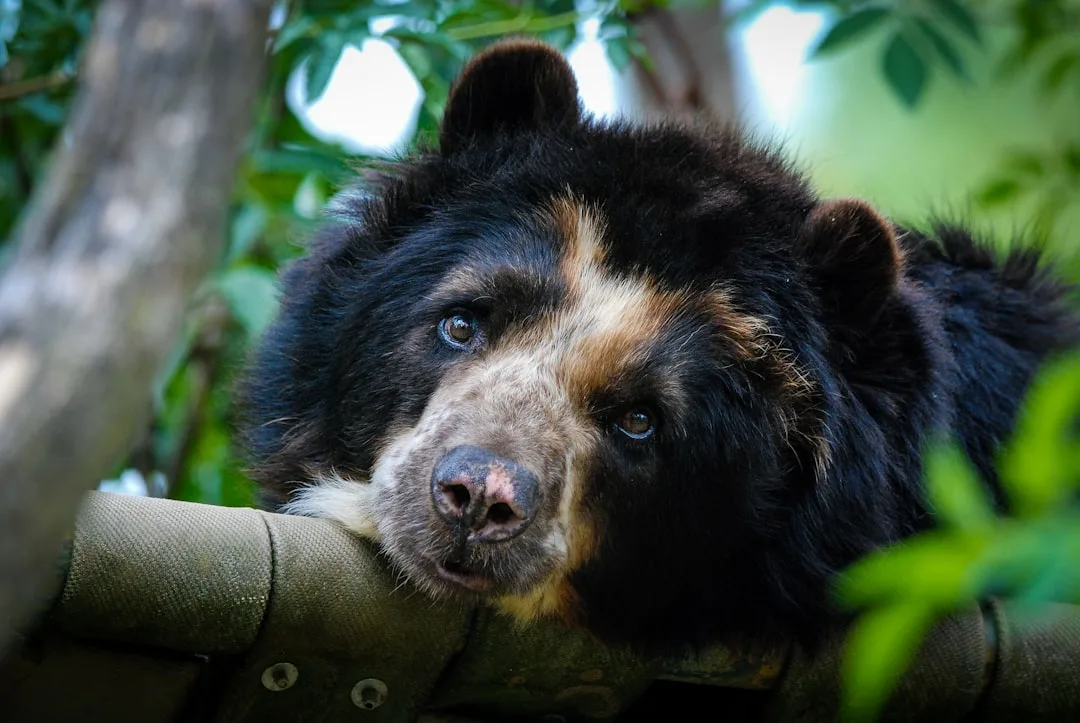
How dangerous are spectacled bears to humans?
Spectacled bears (Tremarctos ornatus) are among the least dangerous bear species in the world. Across roughly a century of records spanning the entire Andean range from Venezuela to Bolivia, fewer than five credibly documented fatal attacks on humans exist in the literature, and several of those remain disputed.
The species is shy, primarily diurnal but secretive, roughly half the body mass of a North American grizzly, and about ninety-five percent herbivorous.
The active human-bear conflict in the Andes is not danger to people but cattle predation, which a single bear can drive into the five-to-ten-head-per-year range in fragmented landscapes, triggering retaliatory shooting that constitutes the largest direct human cause of bear mortality across the range.
The Real Question Is Not "Do They Bite"
When North Americans ask whether a bear is dangerous, the implied frame is the grizzly frame. Body counts. Maulings. Trail closures. The spectacled bear sits inside a different framework, and the question that actually matters in the Andes is inverted. People are not afraid of being attacked by Tremarctos ornatus. Ranchers are afraid of losing calves to it, and the bears are dying because of that fear.
This article walks the data carefully. It compares attack rates with grizzly, polar, and American black bears, names the rare incidents that are sometimes claimed as fatal, and unpacks why the cattle file dominates everything else in spectacled bear conservation. For the natural history of the species, see our anchor profile of the spectacled bear, and for the geography that frames the conflict, where do spectacled bears live.
The Numbers: How Spectacled Bears Compare
The peer-reviewed record on spectacled bear attacks is thin because attacks are thin. Bernard Peyton's foundational ecology and conservation work in the 1980s and 1990s, Susanna Paisley's PhD field studies in Bolivia, and the long-running monitoring efforts by Spectacled Bear Conservation (SBC) Peru and the Andean Bear Conservation Alliance all converge on the same point.
Across hundreds of thousands of bear-days of human-bear coexistence in the cloud forest and paramo, the human casualty rate is essentially flat.
"In more than two decades of fieldwork with Andean bears across Peru and Ecuador, I have never recorded a single unprovoked attack on a researcher, ranger, or villager. The species is reflexively avoidant of humans. Where conflict happens, it is the bear paying the price, not the person."
- Bernard Peyton, IUCN Bear Specialist Group / Andean Bear Expert Team
Bear Attack Rates Compared
The figures below combine Herrero's North American attack databases, IUCN Bear Specialist Group regional records, and field synthesis from Peyton, Paisley, and Garcia-Rangel. They are rough order-of-magnitude estimates, not precise actuarial values, because reporting infrastructure varies enormously between Yellowstone and the eastern Andean foothills.
| Species | Estimated Population | Documented Fatal Attacks (last 100 years) | Predominant Attack Motivation |
|---|---|---|---|
| Spectacled bear (T. ornatus) | 10,000-18,000 | Fewer than 5, several disputed | Defensive (sow with cubs); no predatory record |
| American black bear (U. americanus) | ~800,000 | ~70 (1900-2009 record) | Mostly predatory in fatal cases |
| Grizzly / brown bear (U. arctos), North America | ~55,000 | ~50-60 | Defensive; minority predatory |
| Polar bear (U. maritimus) | ~26,000 | ~20-30 | Predominantly predatory |
| Asiatic black bear (U. thibetanus) | 50,000+ | Hundreds across Asian range | Defensive, very high injury rate per encounter |
Read the row carefully. The spectacled bear sits at the bottom of the global table despite occupying habitat shared with millions of rural people across six countries. A North American hiker with an irrational fear of bears would be statistically safer in the Peruvian cloud forest than in their local supermarket parking lot.
Why Spectacled Bears Are Not Dangerous
Four traits combine to produce the species' near-zero attack profile. None of them are accidental, and together they explain why a bear that lives within sight of human settlement on most of its range still does not show up in trauma ward statistics.
1. Body Size and Configuration
A male spectacled bear weighs 60 to 150 kilograms in adulthood, with most individuals clustered in the 100 to 130 kilogram range. Females run smaller, typically 35 to 80 kilograms. Compare a Yellowstone grizzly boar at 250 to 350 kilograms or a Kamchatka brown bear at 350 to 500. The spectacled bear is roughly half the mass of a grizzly and a quarter the mass of a coastal Russian or Alaskan brown bear.
Skull morphology is short and wide rather than the elongated predator-skull of a polar bear. Forelimb musculature is built for climbing and tearing bromeliads, not for delivering the swatting impact that causes most grizzly fatalities.
For a deeper look at the size question, our piece how big are spectacled bears breaks down weight-by-region, sexual dimorphism, and the implications for both ecology and conflict.
2. Diet
Tremarctos ornatus is the most herbivorous bear after the giant panda. Across the range, plant material accounts for approximately ninety-five percent of biomass consumed. Bromeliad hearts are the staple. Andean fruits, palms, cactus, sedges, and tree bark fill out the calendar. Insects, small vertebrates, and carrion appear in the diet but are minor.
Cattle predation, where it occurs, runs at one to three percent of biomass on average, which is small in dietary terms but loud in conflict terms because the bear in question may be repeatedly returning to the same herd.
Predation on humans is not part of the species' natural repertoire. There is no evolutionary scaffolding for it, no learned generation-to-generation transmission of human-as-prey behaviour, and no documented case of a wild spectacled bear stalking a person. For the full dietary breakdown, see what do spectacled bears eat.
3. Temperament
The behavioural literature uses the same words across decades and authors. Shy. Reflexively avoidant. Cryptic. Secretive. Field researchers using telemetry collars routinely report bears moving away from the researcher's approach long before visual contact. Camera-trap data from Peru and Ecuador consistently records bears reacting to human scent or sound by pausing, sniffing, and reversing direction within seconds.
The species is diurnal but functions almost like a nocturnal mammal in its avoidance behaviour around settled landscapes, shifting activity into early morning, late evening, and the deep-cloud-forest interior.
"The Andean bear is the most behaviourally cryptic of the world's eight bear species. We have collared bears living within four kilometres of villages whose presence the villagers never suspected. The species' default response to human contact is silent withdrawal, not confrontation."
- Susanna Paisley, doctoral research, Apolobamba, Bolivia
4. Habitat
Spectacled bears occupy steep, broken, vegetatively dense terrain at elevations from 250 metres to over 4,500 metres. The cloud forest is choked with bromeliads, mosses, and tangled understory. The paramo is open but rugged. In both habitats, sightlines are short, escape options for the bear are abundant, and accidental close encounters with humans are rare because humans are largely confined to a smaller subset of the elevational and topographic envelope. Habitat does much of the safety work.
For the full geographic and elevational picture, see where do spectacled bears live.
When Aggression Does Happen
Rare is not zero. The literature does record defensive aggression in specific, narrow circumstances, and any field protocol for working in spectacled bear country has to acknowledge them.
Sow With Cubs
A female with cubs of the year will defend them. Researchers have documented bluff charges, vocal threats, and short defensive contacts in encounters where a hiker or rancher walked between a sow and her cub. The pattern matches what is seen in every other bear species, scaled down to the smaller body size of the Andean species. Cubs accompany the sow for roughly two years, climbing trees rapidly when threatened.
The sow's response is brief, focused on neutralising the perceived threat, and ends as soon as the human stops moving or retreats. There is no predatory escalation in the record.
For the broader context on Andean bear reproduction, see spectacled bear cubs and family life.
Cornered or Wounded Bears
A bear injured by a snare, a poacher's bullet, or a dog pack will defend itself. Several of the most credible serious-injury incidents in the Andean record involve hunters or ranchers who closed on a wounded bear. The injury pattern in those cases is consistent with defensive contact at close range and not with predation.
Habituated or Food-Conditioned Bears
Where bears have learned to associate humans with food, the safety margin narrows. The cases on record involve agricultural plots adjacent to forest edge, garbage dumps near park boundaries, and a small number of incidents at unattended camps.
Habituation is the same risk multiplier here as in any bear context, and Spectacled Bear Conservation field manuals stress that a tame Andean bear is a dead Andean bear, both because it loses fear of humans and because it raises the probability of a retaliatory shooting.
"The most dangerous spectacled bear is the food-conditioned one. We see this in a small number of areas where ecotourism has been mismanaged, or where a single rancher has fed a bear scraps. The animal then approaches other people, the next person panics, and the bear is shot. The danger is to the bear, more often than to the person."
- Spectacled Bear Conservation (SBC) Peru, field manual
The Cattle Conflict: What Actually Drives the Fear
If physical danger to humans is not the variable, what is? Cattle.
Across the spectacled bear range, smallholder ranching extends into and onto the edges of bear habitat. Cloud forest and paramo grazing has expanded over the past half century as cattle prices have risen, pasture has crept upslope, and absentee landowners have converted increasing acreage from natural cover to grass. The result is steep terrain shared by bears and unguarded calves, with predictable consequences.
A single spectacled bear, given the opportunity, can predate five to ten head of cattle per year in a fragmented landscape. That is a small fraction of the bear's total caloric intake but an enormous fraction of a smallholder's income. A rancher running fifteen cows on the western flank of the Andes who loses three calves and a yearling has lost a quarter of his annual margin.
The bear's behaviour is rational. The rancher's response, retaliatory shooting, is also rational from inside his economic frame.
Drivers of Human-Bear Conflict in the Andes
The table below assembles the operative variables across published assessments from Peru, Ecuador, Colombia, Venezuela, and Bolivia. The relative weights vary by country, but the categories are consistent.
| Conflict Driver | Mechanism | Approximate Share of Bear Mortality |
|---|---|---|
| Cattle retaliation | Rancher shoots bear after livestock loss | Largest direct human cause; highly variable by region |
| Bushmeat and gallbladder hunting | Opportunistic kills for meat, fat, or traditional-medicine trade | Documented, smaller than retaliation |
| Crop raiding (corn, sugarcane, palms) | Farmer shoots bear feeding on subsistence crops | Significant in Ecuador and Colombian foothills |
| Habitat loss | Indirect mortality through reduced range and food | Background driver underlying all other categories |
| Road kill | Newly built Andean highways fragmenting populations | Small but rising |
| Mistaken identity | Bear shot during puma or fox-control campaigns | Rare but recurrent |
The headline finding is that direct human-attack risk does not appear in the table. It is not a relevant variable in spectacled bear management. The variables that matter are economic loss to ranchers, habitat fragmentation, and the secondary impacts of road and infrastructure development.
For the integrated conservation picture, see our companion piece spectacled bear conservation threats.
Compensation Programmes and What Works
If the cattle file drives bear mortality, the obvious lever is a programme that compensates ranchers for losses. Several have been tried.
Peru and Ecuador have run intermittent compensation schemes for two decades, administered through a mix of national protected-area authorities, NGOs, and private partnerships. Bolivia's programmes are smaller and less consistent. Colombia and Venezuela have piloted approaches with varying degrees of state and donor support. Results across the region have been mixed but real.
What works:
- Predator-proof corrals at night. A simple electric perimeter or sturdy night enclosure typically reduces depredation losses by 70 to 90 percent and is the single most effective intervention.
- Compensation tied to verification. Programmes that require a ranger or trained community member to confirm bear sign at the kill site avoid the moral hazard of paying for any livestock loss.
- Community ranger employment. Hiring local people, particularly former hunters, as bear monitors converts the economic incentive from shooting bears to protecting them.
- Combination of measures. Single-instrument programmes underperform. Layered approaches that combine compensation, corral subsidies, and ecotourism revenue are the ones that move the needle.
What does not work:
- Compensation alone, without verification or husbandry change, drifts into fraud and habituation.
- Top-down enforcement campaigns without rancher buy-in produce hidden mortality, where bears are shot and the carcass disposed of, leaving no evidence for prosecution.
- Tourism-only models that do not reach the rancher household leave the conflict driver intact.
"We have learned that you cannot solve the spectacled bear problem with a fence alone, a payment alone, or a guard alone. The only programmes that bend the mortality curve are the ones that combine all three with a long enough time horizon for ranchers to trust the system."
- Spectacled Bear Conservation, programme review
The Tourism Record
If spectacled bears were a meaningful threat to humans, tourism in the Andean cloud forest would be impossible. It is not impossible. It is thriving.
Chaparri Ecological Reserve in northern Peru, founded by the wildlife photographer Heinz Plenge and the Muchik community of Chongoyape, has hosted bear-watching tourism for over twenty years. Bears in the reserve, descended from rescued and released animals as well as wild residents, are seen at close range from observation hides on a regular basis. Across two decades of operation, the reserve has recorded zero human injuries attributable to bears.
Maquipucuna Reserve in northwestern Ecuador, in the cloud forest west of Quito, has emerged as one of the most reliable bear-watching destinations on the continent. During the seasonal Eugenia fruit ripening, bears congregate in tree canopies above the lodge, sometimes within fifteen metres of guests. The reserve has run guided bear tourism for years without a recorded injury.
"After more than fifteen years of close encounters between bears and visitors at Maquipucuna, we have not had one situation in which a bear acted aggressively toward a human. The bears tolerate respectful proximity, react to direct approach by retreating, and appear to treat tourists as background fauna once a baseline of trust is established."
- Maquipucuna Foundation, Ursus conference proceedings
For visitors, the protocol is the same as in any wildlife setting. Maintain distance, do not feed, do not approach a sow with cubs, follow guide instructions, and treat the encounter as a privilege rather than a photo opportunity to be optimised at the bear's expense.
Comparative Context: Where Spectacled Bears Sit on the Bear Risk Spectrum
The most useful frame for North American or European readers is comparison with bears they know.
| Dimension | Spectacled Bear | American Black Bear | Grizzly / Brown Bear | Polar Bear |
|---|---|---|---|---|
| Body mass (large male) | 100-150 kg | 100-300 kg | 250-500 kg | 350-700 kg |
| Diet (animal share) | ~5% | ~15% | ~30-50% | ~95% |
| Predatory attacks on humans | None recorded | Rare but documented | Rare | Predominant attack motivation |
| Defensive attacks (sow with cubs) | Occasional, low injury | Occasional | Common, severe | Less common but lethal |
| Fatal attacks per century | Fewer than 5 | ~70 | ~50-60 | ~20-30 |
| Best response to encounter | Hold ground, retreat slowly | Stand tall, fight if attacked | Defensive: play dead. Predatory: fight | Always fight, do not run |
| Tourism record | Long history, no injuries | Generally safe with food rules | High vigilance required | Armed escort required |
For the comparable analyses in our bear safety series, see are grizzly bears dangerous to humans, are black bears dangerous to humans, and are polar bears dangerous to humans.
The pattern is clear. Spectacled bear danger is closer to deer or moose risk in North America than to grizzly or polar bear risk. It is not zero, because no large mammal encounter is zero, but the practical implication is that the species belongs in the category of "treat with normal wildlife respect" rather than "carry firearms and bear spray."
What the Cases Actually Look Like
The disputed fatal incidents in the Andean literature are illustrative because of how thin the file is. Several involve carcasses found in remote terrain with bear sign at the site, where the alternative explanation, accidental fall followed by post-mortem scavenging, cannot be ruled out. Several involve hunters who pursued a wounded bear and were charged at close range.
A small number involve old, food-conditioned individuals around peri-urban edges in Ecuador and Colombia. None matches the predatory stalking pattern that defines the worst grizzly and polar bear cases.
"When we examine the disputed fatal cases attributed to Tremarctos ornatus, the consistent finding is either confirmed defensive context or insufficient forensic evidence to exclude alternative causes. The species' contribution to human mortality across its range is, in any meaningful comparison, negligible."
- IUCN Bear Specialist Group, Andean Bear Expert Team
For the broader population health picture, see again spectacled bear conservation threats, where the asymmetry between bear-on-human and human-on-bear mortality is treated quantitatively.
What to Do If You Encounter One
Most people who travel in spectacled bear range will never see a bear. Those who do should follow a simple protocol that the species' temperament makes effective.
- Stop and stand still. The bear has almost certainly seen, smelled, or heard you first. It is assessing.
- Do not run. Running can trigger a chase reflex in any large mammal even if no predatory intent exists.
- Speak in a calm, low voice so the bear identifies you as a human. Most bears retreat at this stage.
- Back away slowly along the path you came. Maintain eye contact without staring aggressively.
- If you have walked between a sow and cubs, retreat is urgent but slow. Cubs typically tree quickly. The sow's response will end when she perceives you have left her cubs' immediate envelope.
- Do not climb a tree. Andean bears are excellent climbers and the tactic is useless.
- Do not throw food. Feeding rewards habituation and shortens the bear's life.
In the extraordinarily rare event of physical contact, the response is closer to the black bear protocol than the grizzly one. Stand your ground, make yourself large, vocalise, and use any available object to deter the bear. Playing dead is not the appropriate response because predatory motivation is essentially absent and a defensive contact is brief.
Risk in Perspective
A traveller hiking the cloud forests of Peru, Ecuador, Colombia, Bolivia, or Venezuela faces a meaningful list of hazards. Altitude sickness. Slips on wet trail. Snakebite at lower elevations. Vehicle accidents on mountain roads. Waterborne illness. Spectacled bear attacks do not enter the same calculus. The species has not produced a measurable mortality signal in the region's tourism, ranching, or research populations across decades.
What spectacled bears do produce is an economic conflict with smallholder ranchers that drives retaliatory killing and constitutes the largest direct human cause of bear mortality. The conservation question is whether compensation, corral subsidies, ecotourism revenue, and community ranger employment can shift that calculus before the cumulative effect of habitat loss and persecution reduces the population below recoverable thresholds.
For the natural history that frames the conservation file, return to our anchor profile of the spectacled bear. For deeper coverage of the variables that determine the species' future, see spectacled bear conservation threats, what do spectacled bears eat, and where do spectacled bears live.
Readers preparing for biology fieldwork certifications, tropical ecology coursework, or wildlife veterinary credentials can find study material at Whats Your IQ, exam preparation resources at Pass4-Sure, and writing tools for permit applications and grant narratives at Evolang.
Frequently Asked Questions
Has a spectacled bear ever killed a human? Verified fatal attacks are extraordinarily rare across the entire Andean range. Fewer than five credibly documented cases exist in the literature over the past century, and several remain disputed because of overlap with puma predation, accidents misattributed at autopsy, and the difficulty of forensic confirmation in remote highland settings.
Bernard Peyton, Susanna Paisley, and the IUCN Bear Specialist Group have consistently characterised Tremarctos ornatus as one of the least dangerous bear species in the world.
Why do farmers in the Andes kill spectacled bears if they are not dangerous to people? Because the bears kill cattle. A single bear in fragmented cloud forest can predate five to ten head of cattle per year, which is catastrophic to a smallholder running ten or twenty animals.
Retaliatory shooting in response to livestock loss is the largest direct human cause of bear mortality across the range. Compensation programmes, predator-proof corrals, and community ranger employment have shown mixed but real effects.
Is bear spray necessary in Peru or Ecuador? For most travellers, no. The species' avoidance behaviour and rarity of aggressive encounters mean that the standard precautions used for any wildlife setting are sufficient. Hikers visiting active research sites or working in close proximity to known habituated bears may choose to carry deterrent spray, but it is not a standard tourism requirement and is not legal to import into all Andean countries.
How big is a spectacled bear compared with a grizzly? About half the mass on average. A large male spectacled bear runs 100 to 150 kilograms, compared with 250 to 500 kilograms for an adult male grizzly. The smaller body size, combined with a diet that is approximately 95 percent plant material, removes most of the physical and motivational scaffolding that produces dangerous encounters in the larger Holarctic species.
Where can I see spectacled bears safely? Chaparri Ecological Reserve in northern Peru and Maquipucuna Reserve in northwestern Ecuador are the two most established bear-watching destinations on the continent. Both have run guided tourism for two decades with frequent close encounters and no recorded human injuries. Bookings are made through the reserves directly or through specialist Andean wildlife operators.
References
- Peyton, B. (1999). Spectacled bear conservation action plan. In: Servheen, C., Herrero, S., & Peyton, B. (Eds.), Bears: Status Survey and Conservation Action Plan. IUCN/SSC Bear and Polar Bear Specialist Groups, Gland, Switzerland. https://doi.org/10.2305/IUCN.CH.1999.SSC-AP.6.en
- Garcia-Rangel, S. (2012). Andean bear Tremarctos ornatus natural history and conservation. Mammal Review, 42(2), 85-119. https://doi.org/10.1111/j.1365-2907.2011.00207.x
- Paisley, S., & Garshelis, D. L. (2006). Activity patterns and time budgets of Andean bears (Tremarctos ornatus) in the Apolobamba Range of Bolivia. Journal of Zoology, 268(1), 25-34. https://doi.org/10.1111/j.1469-7998.2005.00008.x
- Goldstein, I., Paisley, S., Wallace, R., Jorgenson, J. P., Cuesta, F., & Castellanos, A. (2006). Andean bear-livestock conflicts: a review. Ursus, 17(1), 8-15. https://doi.org/10.2192/1537-6176(2006)17[8:ABCAR]2.0.CO;2
- Velez-Liendo, X., & Garcia-Rangel, S. (2017). Tremarctos ornatus. The IUCN Red List of Threatened Species 2017: e.T22066A45034047. https://doi.org/10.2305/IUCN.UK.2017-3.RLTS.T22066A45034047.en
- Castellanos, A., Arias, L., Jackson, D., & Castellanos, R. (2011). Hematologic and serum biochemical reference values for free-ranging Andean bears in Ecuador. Journal of Wildlife Diseases, 47(4), 1003-1008. https://doi.org/10.7589/0090-3558-47.4.1003
- Peyton, B. (1980). Ecology, distribution, and food habits of spectacled bears in Peru. Journal of Mammalogy, 61(4), 639-652. https://doi.org/10.2307/1380309
- Kattan, G., Hernandez, O. L., Goldstein, I., Rojas, V., Murillo, O., Gomez, C., Restrepo, H., & Cuesta, F. (2004). Range fragmentation in the spectacled bear Tremarctos ornatus in the northern Andes. Oryx, 38(2), 155-163. https://doi.org/10.1017/S0030605304000298
Frequently Asked Questions
Has a spectacled bear ever killed a human?
Verified fatal attacks by spectacled bears on humans are extraordinarily rare.
Across roughly a century of records spanning Venezuela, Colombia, Ecuador, Peru, and Bolivia, fewer than five fatal incidents are credibly documented in the peer-reviewed and grey literature combined, and several of those remain disputed because of overlap with puma predation, accidents misattributed at autopsy, and the difficulty of forensic confirmation in remote highland communities.
The IUCN Bear Specialist Group and researchers such as Bernard Peyton and Susanna Paisley have repeatedly emphasised that Tremarctos ornatus is among the least dangerous bear species on the planet and that direct predation on humans is not part of its natural behavioural repertoire. Cattle conflict, retaliatory killing of bears by ranchers, and bushmeat hunting are the operative human-bear conflict variables, not danger to humans.
Why do farmers in the Andes kill spectacled bears if they are not dangerous to people?
Because the bears kill cattle. A spectacled bear in fragmented Andean cloud forest can predate five to ten head of cattle in a year, which is catastrophic to a smallholder running ten or twenty animals at altitude. The conflict is economic, not personal, and the ranchers who shoot bears are responding to lost calves and lost milk income rather than to physical fear of the animal.
Compensation programmes administered by Andean Bear Conservation Alliance partners, SBC Peru, and Ecuadorian protected-area authorities have shown mixed but real effects, with the best results coming from combinations of compensation, predator-proof corrals at night, and community ranger employment.
Retaliatory killing is the largest direct human cause of spectacled bear mortality across most of the range and is the conservation file that determines the species’ future, not attack risk.
Is it safe to hike or do bear-watching tourism in spectacled bear habitat?
Yes, with the standard caveats that apply to any wildlife encounter. Tourism programmes at Chaparri in northern Peru and Maquipucuna in Ecuador have run for two decades with frequent close-range bear encounters and no recorded human injuries. The bears are diurnal but secretive, generally detect humans first, and almost always retreat.
The two situations that warrant caution are surprise encounters with a sow accompanied by cubs, where defensive aggression is documented in research, and any unusual close approach by a habituated or food-conditioned bear. Hikers should make moderate noise, avoid placing themselves between a sow and her cubs, refrain from feeding bears or leaving food unsecured at lodges, and treat the encounter the way they would a black bear sighting.
The realistic risk is far below that of grizzly country and orders of magnitude below polar bear coastline.