
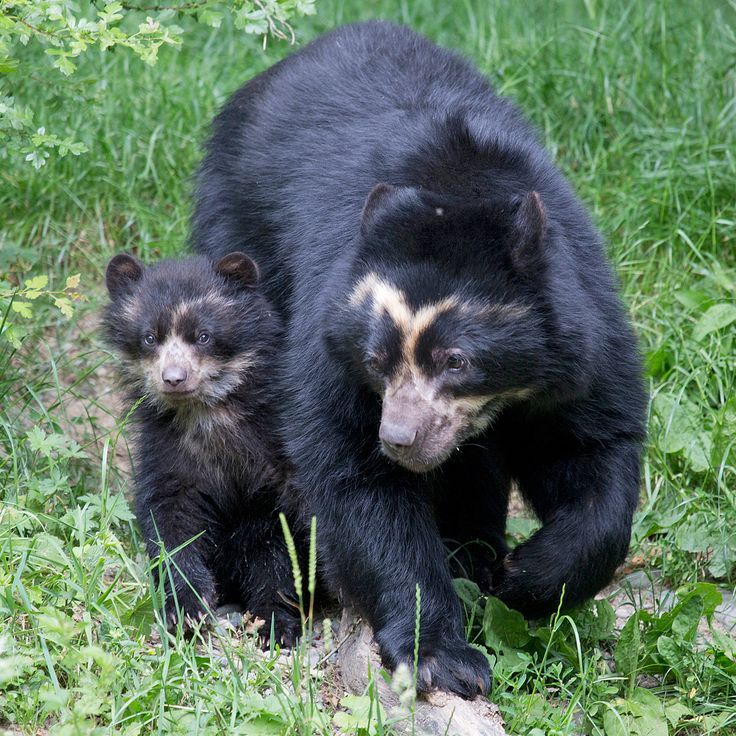
Why are Andean bears endangered?
Spectacled bear conservation starts with a hard number. The species (Tremarctos ornatus), South America's only bear, is listed by the IUCN as Vulnerable with a decreasing population trend. Roughly 13,000 to 18,000 individuals survive across six Andean countries.
The leading threats, in order of impact, are habitat loss and fragmentation (the largest by a wide margin), retaliatory killing for cattle predation, illegal hunting for gallbladder and paws destined for the traditional Chinese medicine trade, and road construction carving through previously remote Andean ridges.
Conservation depends on a network of reserves and on field organisations including the Spectacled Bear Conservation Society, San Diego Zoo Wildlife Alliance, Andean Bear Foundation, Frankfurt Zoological Society and Wildlife Conservation Society. The Paddington effect, driven by the 2014, 2017 and 2024 films, has provided a meaningful funding boost.
Why This Species Matters Beyond the Andes
The spectacled bear is not an ordinary listing on a Red List spreadsheet. It is the last surviving member of the subfamily Tremarctinae, the short-faced bears, whose extinct relatives once roamed the Americas from Alaska to Patagonia. Every other short-faced bear, including the Pleistocene giant Arctotherium, is gone. Lose Tremarctos ornatus and an entire evolutionary lineage closes.
The species also occupies a unique ecological role across the Tropical Andes: as a long-distance seed disperser through bromeliad-rich cloud forest, as a vertical migrant moving between 250 and 4,750 metres of elevation, and as a flagship for the broader fauna of the Andean biodiversity hotspot. The full biology of the species is covered at spectacled bear. This article focuses on what is killing the species and what is being done to keep it alive.
The conservation arithmetic is unforgiving. An adult female spectacled bear breeds at most once every two to four years, raises one or two cubs at a time, and may not first reproduce until age four to seven. Population recovery, even under perfect conditions, runs at less than five percent per year. Habitat loss in many districts of the Tropical Andes is currently faster than that.
IUCN Status and Population Estimates
The most recent IUCN Red List assessment classifies Tremarctos ornatus as Vulnerable (VU) under criteria A4cd, indicating an inferred population reduction of 30 to 49 percent over three generations (about 30 years), with the reduction continuing and the underlying causes not fully reversed. The trend is decreasing.
Population estimates are difficult because spectacled bears live at low density across rugged terrain that resists conventional transect sampling. Camera trap grids, scat-based DNA identification, and the unique facial spectacle patterns used as natural identifiers have improved precision, but range-wide totals remain inferred rather than directly measured.
Current estimates fall in a band of 13,000 to 18,000 wild individuals across the six range states. For comparison, the giant panda, whose recovery is documented at panda conservation success story, recovered from a low of around 1,100 in 1988 to 1,864 in 2015 with the full force of Chinese national legislation behind it.
The spectacled bear's larger but more diffuse population sits across six legal jurisdictions with very different enforcement capacities.
The detail of how those numbers are produced and where the population stands now is covered at how many spectacled bears are left. The geography of remaining habitat is at where do spectacled bears live.
"We have very few hard numbers and a lot of fragmented evidence. The honest position is that the spectacled bear is in trouble across most of its range, and that the trouble is accelerating in the parts of the Andes where roads, mines and cattle are advancing fastest. The species is not a polar bear in a clearly visible crisis. It is a forest bear in a slow, distributed crisis." Russ Van Horn, San Diego Zoo Wildlife Alliance
The First Threat: Habitat Loss and Fragmentation
Habitat loss is the dominant pressure on the species and accounts for an estimated 60 to 70 percent of total conservation risk. The Tropical Andes is a recognised global biodiversity hotspot, and it is also one of the fastest-changing landscapes in the Americas.
Cloud forest is being cleared for cattle pasture, coca cultivation, oil palm and avocado plantations, and small-holder maize and potato farming. Paramo, the high-altitude grassland that bears use as a seasonal corridor, is being burned to extend grazing.
Annual deforestation rates inside core spectacled bear range now run at 2 to 4 percent per year in the worst-affected districts of Colombia (Norte de Santander, Boyaca), Ecuador (Carchi, Pichincha, Imbabura), and Peru (Amazonas, San Martin, Cajamarca). At those rates, suitable habitat in a given district halves over 17 to 35 years.
Fragmentation matters as much as raw loss. Spectacled bears are vertical migrants. They move seasonally between elevational bands to track fruiting cycles, and a population stranded inside a single elevational belt loses access to its dry-season foods. The biology of that elevational movement is covered at what do spectacled bears eat.
When forest is replaced by pasture or plantation across an entire elevational corridor, the bears that try to cross it become exposed, slow, and easy to find. Many do not make it.
Habitat Loss and Conservation Pressure by Region
| Country and region | Estimated remaining habitat | Annual loss rate | Dominant driver | Bear status |
|---|---|---|---|---|
| Venezuela (Andes) | Severely reduced | 1 to 2% | Cattle pasture, civil unrest | Likely extirpated in many districts |
| Colombia (Cordilleras) | Fragmented | 2 to 3% | Cattle, coca, palm | Decreasing, several isolated subpopulations |
| Ecuador (Andes) | Moderate, fragmented | 2 to 4% | Pasture, mining, infrastructure | Decreasing |
| Peru (north and central) | Largest remaining | 1 to 3% | Pasture, road expansion | Decreasing but with stronghold areas |
| Bolivia (Yungas) | Moderate | 1 to 2% | Pasture, coca, road | Decreasing |
| Argentina (north-west) | Marginal | Variable | Pasture | Critically small population |
The Tropical Andes hotspot loses cloud forest faster than almost any other Neotropical ecosystem. Without corridor work, the bear's range will continue to fracture into ever smaller, ever more isolated forest islands, each of which loses its bears not in a single dramatic event but over decades of attrition.
The Second Threat: Retaliatory Killing for Cattle Predation
Spectacled bears are predominantly herbivorous. Roughly 95 percent of their diet is plant matter, as covered at what do spectacled bears eat. They are not, by any reasonable description, livestock specialists. They do, however, take cattle when opportunity arises, particularly in landscapes where forest fragmentation has put cows and bears in regular contact.
Field studies in Peru, Ecuador and Bolivia consistently report that conflict bears take an average of one to three cattle per bear per year where conflict occurs, with a long tail of higher-take individuals that account for a disproportionate share of incidents. From the bear's perspective, a calf is a slow, vulnerable, high-calorie target during dry seasons when fruit is scarce. From the smallholder's perspective, a single cow is a substantial fraction of household wealth.
Retaliation is the predictable response. In many Andean districts, killing a bear that has taken a cow is treated as legitimate self-defence by community norms, regardless of national law. Methods include shooting, snaring, and poisoned bait laid at carcass remains.
The bears that take livestock are often older males that have been displaced from prime forest by younger competitors and pushed into forest-pasture edges where the conflict happens. The research on whether spectacled bears pose a meaningful danger to humans, and how the cattle question fits into that, is at are spectacled bears dangerous.
"The cattle problem is not a bear problem. It is a forest problem. The bears that kill cows are bears that have lost the forest behind them. If we keep the forest standing, the conflict drops by an order of magnitude. If we do not, no amount of compensation will keep up with the killing." Robyn Appleton, founder, Spectacled Bear Conservation Society Peru
Mitigation work has produced clear, repeatable results. Livestock guarding through corralling cattle at night, electric fencing of high-risk paddocks, and community-based compensation schemes that pay verified losses within a defined window have all been shown to reduce retaliatory killing in pilot districts. The challenge is scale. Each pilot covers tens or hundreds of farms; the conflict zone covers tens of thousands.
The Third Threat: Gallbladder and Paw Trade
The illegal trade in bear parts is smaller in absolute volume than habitat loss but disproportionately damaging because it targets adult breeders. Gallbladders, paws, and to a lesser extent fat and claws move through traffickers from Andean villages to Pacific coast cities and out to East Asian markets, where they enter the traditional Chinese medicine supply chain.
Bear bile, used in TCM for centuries, contains ursodeoxycholic acid, which has genuine pharmacological activity but is also produced synthetically at scale and farmed from Asiatic black bears in licensed bile farms.
The continued demand for wild gallbladders is partly cultural preference for "wild" sources and partly the result of weaker regulation in Andean countries compared to the long-standing CITES enforcement on Asian bear species.
Paws are sold as luxury food items, primarily into the same markets. A single set of paws can fetch hundreds of US dollars at the trafficker level, multiples of that at retail.
The trade is hard to quantify. Customs seizures at Lima, Guayaquil and Bogota airports record tens of incidents per year, which conservation specialists treat as the visible tip of a much larger flow. Source areas align with road expansion: the bears that get killed for parts are the bears that traffickers can reach.
"We have spent two decades demonstrating that synthetic ursodeoxycholic acid is pharmacologically equivalent to wild bear bile, that the cultural preference for wild sources is the actual driver, and that the only durable solution is enforcement on the supply side combined with consumer education on the demand side. The spectacled bear is now caught in a trade that originated for Asian bears and has spread because Asian bear populations are too well protected to supply it cheaply." Bernard Peyton, IUCN Bear Specialist Group, on Andean bear bile trafficking
The Fourth Threat: Roads, Pipelines, and Linear Infrastructure
Linear infrastructure is the newest pressure. The road and pipeline networks that have advanced into the Andes since the early 2000s, often built to serve mining concessions and oil and gas projects, have done three things to spectacled bear populations.
First, direct mortality. Bears get hit by vehicles on freshly opened roads, particularly at night when they cross between forest patches.
Second, access for poachers and traffickers. A road that did not exist five years ago is a road that lets a hunter walk in with a rifle, a backpack and a return route. Most poaching pressure tracks road access with a lag of one to three years.
Third, and most consequential, fragmentation. A new road through a ridge does not need to remove a single tree to break a population in two. The road verge is open, exposed, frequented by humans, and avoided by bears. Subpopulations on either side of a road become demographically separate within a generation.
The trans-Andean road network is still expanding. The trade-off between regional development and bear conservation is real, and conservation organisations have learned that opposing roads outright is rarely effective. Mitigation work focuses on wildlife crossing structures, road-edge fencing, and landscape planning that routes new infrastructure through already-fragmented zones rather than through intact forest.
The Conservation Network
A working conservation strategy for the spectacled bear is not run by any single organisation. The species needs simultaneous action on protected areas, field research, conflict mitigation, anti-trafficking enforcement, and public funding, across six countries with different political cycles. The current network includes:
- Spectacled Bear Conservation Society Peru (SBC Peru), founded by Robyn Appleton, focuses on the dry forest population of northern Peru and runs the longest continuous field study of Tremarctos ornatus in the wild.
- San Diego Zoo Wildlife Alliance, with Russ Van Horn leading Andean bear research, supports field genetics, camera trap grids and conservation translocation work.
- Andean Bear Foundation (ABF), based in Ecuador, runs field research, community education and the public engagement work that received the largest single boost from the Paddington films.
- Frankfurt Zoological Society (FZS), working primarily in Peru and Bolivia through landscape-scale park support including Madidi.
- Wildlife Conservation Society (WCS), working across Andean countries on landscape conservation, particularly in Colombia and Bolivia.
- Local NGOs and community associations including those that manage the Chaparri community reserve in Peru.
Key Conservation Programmes and Reserves
| Programme or reserve | Country | Size and notes | Lead organisation(s) |
|---|---|---|---|
| Chaparri Reserve | Peru | 34,000 hectares, community-managed dry forest | Local communities, SBC Peru |
| Maquipucuna Reserve | Ecuador | Cloud forest, key bear-tourism site | Maquipucuna Foundation, ABF |
| Yanachaga-Chemillen National Park | Peru | 122,000 hectares, cloud forest core | SERNANP, FZS, WCS |
| Tabaconas Namballe National Sanctuary | Peru | Paramo and cloud forest, north Peru | SERNANP |
| Madidi National Park | Bolivia | Over 1.8 million hectares, biodiversity hotspot | SERNAP, WCS, FZS |
| SBC Peru field site | Peru | Long-term dry forest study | Spectacled Bear Conservation Society |
| ABF Ecuador programme | Ecuador | Cloud forest, Paddington-funded expansion | Andean Bear Foundation |
The reserves do not cover the full range, and the gaps are significant. A bear that walks out of Yanachaga-Chemillen does not walk into another protected area. The corridor work that links reserves into a functional landscape is younger than the reserves themselves and remains under-resourced relative to the scale of the threat.
Chaparri: A Community Conservation Model
Chaparri is the case study most often cited as a working model. The reserve, formally established in 2001 in northern Peru, was the first community-titled private conservation area in the country. It covers approximately 34,000 hectares of dry forest and is owned and managed by the Santa Catalina de Chongoyape farmer community. The reserve was developed in close partnership with photographer and conservationist Heinz Plenge and the Spectacled Bear Conservation Society.
What works at Chaparri is the alignment of incentives. The community owns the land, manages tourism revenue, employs rangers from its own membership, and has a direct economic stake in keeping the bears alive and visible. Bear-watching tourism, which would not exist without the bears, generates income that the community would lose if the bears were killed.
Retaliatory killing within Chaparri has dropped to functionally zero since the model stabilised, and the bears within the reserve are habituated enough to be reliably observed, which feeds back into the tourism revenue cycle.
The Chaparri model does not transplant easily. It requires legal title, community capacity, and a tourism market that not all districts can sustain. It does, however, demonstrate that the conflict between Andean farmers and spectacled bears is not biologically inevitable.
The Paddington Effect
Michael Bond's Paddington Bear, sent in the 1958 children's book A Bear Called Paddington from "deepest darkest Peru", was always anchored in the spectacled bear, the only bear species native to South America. The cultural overlap stayed mostly latent for sixty years. The 2014, 2017 and 2024 Paddington films converted it into measurable conservation funding. The relationship between the fictional Paddington and the real species is covered at spectacled bear vs Paddington: the real Andean bear.
Studio partnerships with the Andean Bear Foundation and the Spectacled Bear Conservation Society directed proceeds and publicity to in-country work. The most cited single number is from ABF's own reporting: donations rose by approximately 80 percent in the year following the 2017 release of Paddington 2. The 2024 release of Paddington in Peru, set partly in the bear's actual range, prompted renewed institutional commitments and a fresh wave of public attention.
The Paddington effect is genuine, but field biologists are careful to note its limits. A film cannot fund a corridor. It can fund the salaries that build one. A film cannot stop a bulldozer. It can fund the legal work that pushes the bulldozer's permit through a more rigorous review. The Paddington effect is a multiplier on existing capacity, not a substitute for it.
"When the second Paddington film came out, our donor pipeline shifted overnight. It did not change what we were doing. It made the things we were already doing affordable for longer. That is the honest version of the Paddington effect. It bought us time, and time is the resource conservation runs out of first." Andean Bear Foundation programme report, paraphrased from public statements
How Spectacled Bear Conservation Compares
The species sits between two more famous bear conservation stories. Polar bears, whose threats are covered at why polar bears are endangered, face a habitat collapse driven by climate change that no single national legislation can fix. Giant pandas, covered at panda conservation success story, recovered because Chinese national legislation, a 18 million hectare logging ban, and forty years of WWF partnership converged on a species concentrated in three provinces of one country.
Spectacled bears are different in a way that matters. Their habitat loss is addressable in principle (it is local land use, not global atmosphere), but their range is split across six countries with very different enforcement capacity. They have a cultural anchor (Paddington) that pandas had to invent (the WWF logo). They have a smaller, more dispersed donor base than either polar bears or pandas.
They do not yet have a single national-park-level political commitment from any range state at the scale of the Giant Panda National Park.
For broader context on threatened mammals across the site, see the endangered species overview.
What Works and What Does Not
The pattern across two decades of field experience is clear enough to summarise.
What works:
- Community-titled reserves with direct economic stake in live bears (Chaparri model)
- Compensation schemes for verified livestock losses, paired with proactive guarding
- Long-term field research that produces the data without which advocacy is unfounded
- Public engagement funded by cultural anchors (the Paddington effect, ecotourism at Maquipucuna)
- Cross-border landscape planning that treats the species as one population across six countries
- Anti-trafficking enforcement at Pacific coast export points
What does not work:
- Paper parks that exist on a map and not on the ground
- One-off compensation without verification or guarding
- Crisis-only fundraising that arrives after a population has already crashed
- Single-country plans that ignore the shared population structure across borders
- Bear-only framing that excludes the smallholder farmers who actually decide the bear's fate
"The conservation literature on Tremarctos ornatus converges on a single conclusion. The species is not lost yet, but the window is narrowing. The interventions that work are not novel and they are not technically difficult. They are continuous, well-funded, locally-led programmes operating across six national jurisdictions. The reason the species is still in trouble is that the funding and the political commitment have not yet matched the scale of the pressure." Oryx, conservation journal review
What the Next Decade Decides
The next decade will determine whether the spectacled bear stays at Vulnerable, slides to Endangered, or begins the long climb back. Three things have to go right.
Habitat protection has to outpace habitat loss. That means corridor-building between existing reserves, designation of new reserves in under-protected districts (particularly Colombia and Ecuador), and meaningful enforcement of land use rules where they already exist on paper.
Conflict mitigation has to scale. Pilot projects on livestock guarding and compensation work at the scale of hundreds of farms. The conflict zone is at the scale of tens of thousands. The gap is not a science problem. It is a funding and capacity problem.
The Paddington effect has to be turned into structural funding. Cultural moments fade. The films of 2014, 2017 and 2024 generated awareness. The next phase requires institutional commitments that survive the cultural attention cycle.
For the species itself, the underlying biology is at spectacled bear, the population numbers at how many spectacled bears are left, and the geography at where do spectacled bears live. A bear alive in 2025 is living in a habitat that is smaller, more fragmented, and more pressured than the one its parents occupied. Whether the same will be true for its cubs is the open question.
References
- Velez-Liendo, X., Garcia-Rangel, S. (2017). Tremarctos ornatus. The IUCN Red List of Threatened Species 2017: e.T22066A45034047. https://doi.org/10.2305/IUCN.UK.2017-3.RLTS.T22066A45034047.en
- Garcia-Rangel, S. (2012). Andean bear Tremarctos ornatus natural history and conservation. Mammal Review, 42(2), 85-119. https://doi.org/10.1111/j.1365-2907.2011.00207.x
- Peyton, B. (1980). Ecology, distribution, and food habits of spectacled bears, Tremarctos ornatus, in Peru. Journal of Mammalogy, 61(4), 639-652. https://doi.org/10.2307/1380309
- Kattan, G., Hernandez, O. L., Goldstein, I., Rojas, V., Murillo, O., Gomez, C., Restrepo, H., Cuesta, F. (2004). Range fragmentation in the spectacled bear Tremarctos ornatus in the northern Andes. Oryx, 38(2), 155-163. https://doi.org/10.1017/S0030605304000298
- Goldstein, I., Paisley, S., Wallace, R., Jorgenson, J. P., Cuesta, F., Castellanos, A. (2006). Andean bear-livestock conflicts: a review. Ursus, 17(1), 8-15. https://doi.org/10.2192/1537-6176(2006)17[8:ABCAR]2.0.CO;2
- Appleton, R. D., Van Horn, R. C., Noyce, K. V., Spady, T. J., Swaisgood, R. R., Arcese, P. (2018). Phenotypic plasticity in the timing of reproduction in Andean bears. Journal of Zoology, 305(2), 92-99. https://doi.org/10.1111/jzo.12541
- Velez-Liendo, X., Strubbe, D., Matthysen, E. (2013). Effects of variable selection on modelling habitat and potential distribution of the Andean bear in Bolivia. Ursus, 24(2), 127-138. https://doi.org/10.2192/URSUS-D-12-00027.1
- Castellanos, A., Altamirano, M., Tapia, G. (2005). Ecology and behaviour of reintroduced Andean bears in the Maquipucuna Biological Reserve, Ecuador. International Bear News, 14(3), 24-25. https://doi.org/10.1644/BWG-009.1
Further Reading
Expert-written coverage of the spectacled bear and bear conservation across the site:
- Spectacled bear: the species profile
- How many spectacled bears are left
- Where do spectacled bears live
- What do spectacled bears eat
- Are spectacled bears dangerous
- Spectacled bear vs Paddington: the real Andean bear
- Why polar bears are endangered
- Panda conservation success story
- Endangered species overview
External tools and resources from the publisher network:
- Evidence-based cognitive assessments at whats-your-iq.com
- Professional writing platform at evolang.info
- File conversion utilities at fileformer.com
Frequently Asked Questions
Why are Andean bears endangered?
The IUCN lists the spectacled bear (Tremarctos ornatus) as Vulnerable with a decreasing population trend, and the species is considered functionally endangered in several Andean countries. The dominant pressure is habitat loss and fragmentation across the Tropical Andes, which is removing cloud forest and paramo at roughly two to four percent per year in the worst-affected districts of Colombia, Ecuador and Peru.
The second pressure is retaliatory killing by smallholder farmers who lose cattle and maize to bears that wander out of fragmented forest, with average conflict rates of one to three cattle per problem bear per year. The third pressure is illegal hunting for gallbladders and paws, traded into traditional Chinese medicine networks via Pacific port cities. A fourth, growing pressure is road and pipeline construction through previously roadless Andean ridges.
The combined wild population is estimated at 13,000 to 18,000 individuals, fragmented across six countries, with several subpopulations already too small to be demographically viable without active corridor work.
What is being done to save the spectacled bear?
Conservation work for the spectacled bear runs along four parallel tracks. The first is protected area expansion and management: Yanachaga-Chemillen National Park (122,000 hectares, Peru), Tabaconas Namballe (Peru), Madidi (Bolivia), Maquipucuna (Ecuador) and the community-managed Chaparri Reserve (34,000 hectares, Peru) form the backbone.
The second is direct field research and population monitoring led by groups including the Spectacled Bear Conservation Society in northern Peru, the Andean Bear Foundation in Ecuador, San Diego Zoo Wildlife Alliance, the Frankfurt Zoological Society and the Wildlife Conservation Society.
The third is human-wildlife conflict mitigation, including livestock guarding programmes, electric fencing pilots, and compensation schemes that reduce retaliatory killing.
The fourth is awareness and funding, where the Paddington films have been the single largest external boost, driving an 80 percent rise in donations to the Andean Bear Foundation in the year after Paddington 2 (2017) and renewing institutional funding around the 2024 Paddington in Peru release.
How did Paddington help spectacled bears?
The Paddington Bear character, sent in Michael Bond’s 1958 story from ‘deepest darkest Peru’, is fictional but anatomically and geographically rooted in the spectacled bear, the only bear species native to South America. The 2014, 2017 and 2024 Paddington films converted that fictional anchor into a measurable conservation funding stream. Studio partnerships directed proceeds to the Spectacled Bear Conservation Society and the Andean Bear Foundation.
ABF reported donations rising by approximately 80 percent in the year following Paddington 2 (2017), and Paddington in Peru (2024) coincided with renewed long-term funding commitments and a fresh wave of public interest in Tremarctos ornatus. The Paddington effect is genuine, though field biologists are careful to point out that funding alone does not stop a bulldozer.
Money translates into conservation only when paired with effective protected area management, community engagement, and law enforcement on the ground.