
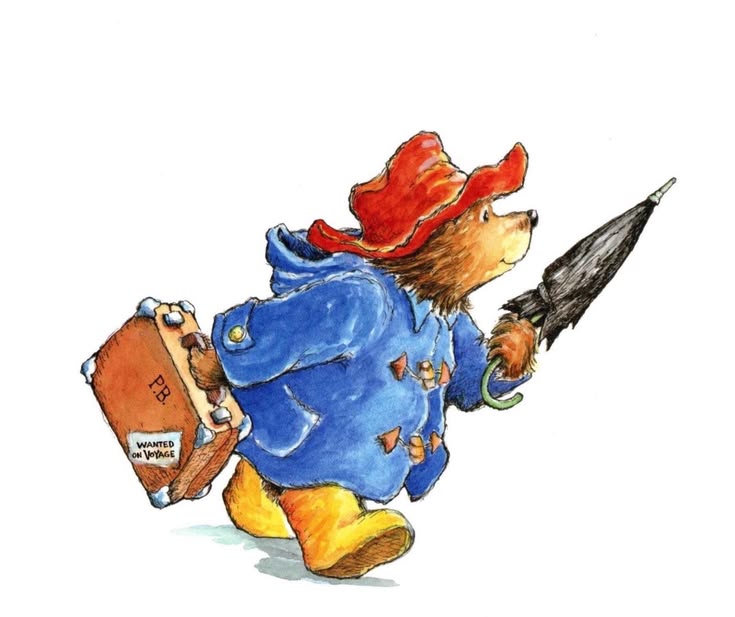
Is Paddington a real bear?
Yes. Paddington is based on a real species, the spectacled bear (Tremarctos ornatus), also known as the Andean bear. It is the only bear native to South America and the only living member of the short-faced subfamily Tremarctinae. Michael Bond's 1958 line that Paddington came from darkest Peru points to a specific, real animal that lives in the cloud forests of the Andes from Venezuela through Bolivia.
The fictional bear wears a duffle coat and eats marmalade. The real bear weighs 35 to 150 kg, eats roughly 95 percent plants, is shy, mostly solitary, and is listed as Vulnerable by the IUCN with a wild population estimated at 13,000 to 18,000 individuals.
A Children's Icon With a Real Address
Few fictional animals have a clearer biological pedigree than Paddington. The duffle coat, the marmalade sandwiches, and the labelled suitcase are inventions. The bear underneath them is not. When Michael Bond wrote A Bear Called Paddington in 1958, he placed his hero's origin in darkest Peru, and that one phrase carries genuine zoological weight.
Peru is the geographic heart of the spectacled bear, Tremarctos ornatus, the only living South American bear and the only surviving species of the Tremarctinae, the short-faced bear lineage that once produced the largest land carnivores in the Americas.
This article walks through the relationship between the fictional Paddington and the real Andean bear: where the species lives, why Bond chose it, how the 2014, 2017, and 2024 films changed conservation funding, and where the cultural success of the brand still does not match the hard reality of a declining wild population.
For the full biological profile of the species, the dedicated entry on the spectacled bear covers anatomy, reproduction, and ecology in depth. This piece is the cultural and comparative companion piece.
The Species: Tremarctos ornatus, the Only South American Bear
The spectacled bear is the eighth living bear species and one of the most distinctive. It carries pale cream or yellowish facial markings that often, though not always, ring the eyes in the shape of spectacles, hence the common name.
It is a medium-sized ursid: males reach 60 to 150 kg, females 35 to 82 kg, with body lengths of 120 to 200 cm and shoulder heights around 70 to 90 cm. Compared to a brown bear, a spectacled bear is small, short-faced, more arboreal, and far more strictly vegetarian.
It is also evolutionarily unusual. Modern phylogenies place Tremarctos ornatus as the sole living survivor of Tremarctinae, the short-faced bears, a subfamily that diverged from the ancestors of all other living bears roughly 12 to 14 million years ago.
Its closest extinct relatives include the giant short-faced bears Arctodus simus of North America and Arctotherium angustidens of Pleistocene South America, which were among the largest carnivorous land mammals that ever lived. The spectacled bear is the last twig on a once-mighty branch.
"Tremarctos ornatus is not just one bear among eight. It is the only living member of an entire subfamily, the short-faced bears, and it carries thirteen million years of evolutionary history that has no other living representative on Earth." - Bernard Peyton, Andean Bear Foundation
The animal occupies the eastern slope of the Andes from western Venezuela through Colombia, Ecuador, Peru, and Bolivia, with the largest contiguous habitat blocks lying in Peru. It uses an extraordinary altitudinal range, from lowland dry forest at around 250 metres up to paramo grassland at 4,750 metres, with the cloud forest belt between 1,800 and 3,500 metres being the core of its range. For more on the geography, see where do spectacled bears live.
Michael Bond, 1958, and Why Peru
Michael Bond bought a small toy bear from a London shop on Christmas Eve 1956 as a gift for his wife. The toy sat on the mantelpiece, and over the next two years Bond drafted stories around it. A Bear Called Paddington was published in October 1958. The opening situation, a bear at Paddington Station with a label reading Please look after this bear. Thank you, is invented. The origin clause is not arbitrary.
Bond originally considered making Paddington a bear from darkest Africa. His agent pointed out that there are no native bears in Africa. Bond then looked for a country with a real, plausible, and obscure bear. The shortlist was small: Asiatic black bears in Asia were too well known to British readers, sun bears were tied to colonial Malaya, and the giant panda was already over-exposed by the 1950s.
The spectacled bear of the Andes was the right combination: a real species, geographically remote, and largely unknown to the British public.
Darkest Peru is a Victorian rhetorical formula meaning a remote and unmapped place. It is also factually appropriate. The Peruvian cloud forest is genuinely dim under permanent canopy and near-constant cloud, and the bears are difficult to observe even where they are common. Bond chose well, and accidentally seeded a six-decade public relationship between a children's book character and a single real species.
The Real Andean Bear vs the Fictional Paddington
The fictional bear and the real one share a habitat of origin and very little else. The contrast is the article's core comparison.
Paddington vs the spectacled bear
| Trait | Paddington (fictional) | Spectacled bear (Tremarctos ornatus) |
|---|---|---|
| Origin | Darkest Peru | Andes from Venezuela to Bolivia, core in Peru |
| Adult mass | Boy-sized, anthropomorphic | 35 to 82 kg females, 60 to 150 kg males |
| Build | Bipedal, humanoid posture | Quadrupedal, semi-arboreal |
| Clothing | Blue duffle coat, red hat | None |
| Diet | Marmalade sandwiches | ~95 percent plants, ~5 percent animal matter |
| Speech | Fluent English | Snorts, grunts, soft trills, no spoken language |
| Social structure | Lives with the Brown family | Mostly solitary, mother and cubs unit |
| Lifespan | Ageless, since 1958 | 20 to 25 years wild, 30+ in captivity |
| Population | One literary character | ~13,000 to 18,000 in the wild |
| IUCN status | Not applicable | Vulnerable |
| Cultural footprint | Multi-billion pound brand | Underfunded conservation programmes |
The differences that matter biologically are diet, social structure, and behaviour. Real spectacled bears are predominantly herbivorous, focused on the hearts of bromeliads, palm shoots, fruits, cacti, and Puya plants of the high Andes, with occasional small mammals, carrion, or insects making up the remaining few percent. The detailed feeding ecology is covered at what do spectacled bears eat.
They are also genuinely shy. Direct attacks on humans are vanishingly rare, and the species avoids settlements when habitat allows.
"People come to Peru expecting Paddington and find a much smaller, much quieter animal that climbs trees, eats bromeliads, and disappears the moment it hears you. The real Andean bear is everything Paddington is not, and that is part of why it survives." - Robyn Appleton, founder, Spectacled Bear Conservation Peru
For a feel of the actual size of the animal, the entry on how big are spectacled bears lays out the dimensions next to other ursids. For the spectacle marking itself, see why spectacled bears have spectacles.
A Sister Lineage to All Other Living Bears
The spectacled bear's evolutionary position matters for understanding why conservationists treat the species as a priority. Among the eight living bears, the giant panda diverged earliest, around 19 to 22 million years ago. The next branch is the spectacled bear, splitting from the ancestors of the six Ursinae bears around 12 to 14 million years ago. Every other bear alive today, brown, polar, American black, Asiatic black, sloth, and sun, sits in that single Ursinae cluster.
Lose the spectacled bear and you lose the entire Tremarctinae subfamily. There is no surviving sister species. The closest relatives are fossil short-faced bears, and they have been extinct for at least 11,000 years. This single-lineage status is part of why agencies like the IUCN classify habitat loss in the Andes as an evolutionary distinctiveness problem, not just a population problem.
The point is rarely raised in children's books. It is, however, exactly the reason the 2014 Paddington film mattered to conservation biologists: it gave a globally recognisable face to an animal that, in scientific terms, is a once-in-an-era survivor. Compare with the case of the giant panda, the other famously charismatic single-lineage bear, and the parallel is striking.
Both species are the last representatives of ancient branches, both are folded into a global cultural brand, and both depend on that brand to keep funding flowing.
What the Real Bears Eat: The Marmalade Joke and the Bromeliad Reality
Paddington's appetite for marmalade sandwiches is one of the longest-running gags in British children's literature. The real diet of Tremarctos ornatus is less sweet but far more interesting.
Field studies across Peru, Ecuador, and Colombia consistently report the following diet composition:
- Bromeliads, particularly Puya and Tillandsia species, where the bear strips outer leaves and eats the soft, starchy hearts. Bromeliad consumption can account for 50 to 70 percent of the bulk diet in cloud-forest populations.
- Fruits, especially of Ficus (figs), Nectandra, Prunus, and various Lauraceae and Moraceae trees. Spectacled bears climb to feed and frequently build platform-like day beds in fruiting trees.
- Palm hearts and shoots, especially of Ceroxylon and Geonoma palms, taken by stripping the crown.
- Cacti, including Trichocereus species in dry forest at lower elevations.
- Insects, small vertebrates, and carrion, making up only around 5 percent of the diet by weight.
The bear is functionally a frugivore-folivore, not the omnivore most British readers picture from childhood. Its molars are flatter and broader than those of other bears, an adaptation to grinding fibrous plant matter. The skull is short and deep, with strong jaw musculature, the same general toolkit a giant panda uses on bamboo, evolved independently in two different bear lineages.
"If you want one image to replace the marmalade jar, picture a 90-kilogram bear sitting in the heart of a Puya rosette, methodically pulling off armoured leaves to eat the white, sugary base. That is what an Andean bear actually does." - Spectacled Bear Conservation Peru, field report
The 2014 Film and the Donation Surge
The first live-action Paddington film was released in November 2014. Within months, Andean bear conservation organisations reported one of the largest single cultural boosts the field had ever seen. The Andean Bear Foundation, founded by Bernard Peyton, reported an approximately 80 percent rise in donations across the 2014 to 2015 reporting period compared to the prior year.
Spectacled Bear Conservation Peru, working in the dry forests of Lambayeque, reported a parallel rise in international supporter signups and corporate sponsorship enquiries.
The mechanism is straightforward. Charismatic megafauna conservation depends heavily on public recognisability. Before 2014 the spectacled bear was poorly known outside specialist circles. After 2014 it could be named and recognised by tens of millions of new viewers. Schools, zoos, and field organisations linked educational materials directly to the film, and several British zoos with spectacled bear holdings reported attendance bumps tied to the release.
Cultural impact metrics around the Paddington films
| Year | Event | Documented effect on Andean bear awareness or funding |
|---|---|---|
| 1958 | A Bear Called Paddington novel published | Long-tail public association, low scientific impact |
| 1976-1980 | Original UK animated TV series | Reinforced brand, no measurable conservation effect |
| 2014 | Paddington live-action film | ~80 percent donation surge at Andean Bear Foundation |
| 2017 | Paddington 2 film | Sustained donation levels, new corporate partnerships |
| 2018 | UK media coverage of the species | Spectacled bear named in major outlets including BBC, Guardian |
| 2024 | Paddington in Peru film | Charity screenings tied to habitat protection, formal NGO partnerships |
| 2014-2024 | Paddington brand merchandise revenue | Estimated multi-billion GBP cumulative |
| 2014-2024 | Total spectacled bear field conservation budget | Estimated low tens of millions USD globally |
The last two rows of that table are the reason the conservation conversation has hardened around Paddington as a case study. The brand is enormous. The species is not commensurately funded. The gap between stuffed Paddington economy and real conservation budget is the structural problem the 2024 film tried to address with explicit fundraising tie-ins.
Paddington in Peru, 2024: The Conservation Tie-In
Paddington in Peru, released in November 2024 (UK) and February 2025 (US), was the first film in the franchise to be set substantially in the species' real range. The production was developed in consultation with Andean conservation organisations and tied a portion of its publicity to specific fundraising goals.
Charity screenings, partnerships with the World Land Trust, and direct cross-promotion with Peru's protected-area system gave the film an unusual profile for a family-friendly mainstream release.
It is too early to publish hard year-on-year figures for the 2024 film's conservation impact, but early reports from the Andean Bear Foundation and Spectacled Bear Conservation Peru indicate a renewed wave of supporter signups, with school engagement numbers in the UK and US reportedly up sharply on the 2017 baseline. Whether the film converts cultural attention into long-term habitat protection budgets, rather than short-term donation spikes, remains the open question.
"We do not need another Paddington toy. We need long-term funding for Andean cloud-forest corridors, ranger salaries, and conflict mitigation with cattle ranchers. The 2024 film has helped us frame that ask. It has not yet closed the gap." - Ruth Padel, poet and trustee, conservation literature
How Many Are Left, and Why It Matters
Population estimates for Tremarctos ornatus are difficult because the species is rare, cryptic, and lives in steep, forested terrain that resists camera-trap density studies. The current consensus range is 13,000 to 18,000 wild individuals, distributed unevenly across five countries. Peru holds the largest single share, possibly half the global population, with Ecuador, Bolivia, and Colombia each holding significant subpopulations and Venezuela holding a small and probably declining one.
For a fuller breakdown, see the dedicated entry on how many spectacled bears are left. The IUCN classifies the species as Vulnerable, with a population trend marked decreasing. Habitat loss to cattle ranching, illegal mining, road construction, and subsistence agriculture is the primary threat across the range.
Direct persecution by farmers in response to crop and livestock losses is a secondary, geographically uneven threat. Climate change, by shifting cloud-forest belts upslope into ever-smaller mountaintop habitat, is a longer-term but increasingly modelled risk.
The detailed threat analysis sits in spectacled bear conservation threats, which covers each driver in turn.
The Names: Ucumari, Jukumari, Andean Bear
The cultural iconography of Paddington is overwhelmingly British. The animal underneath has been known in the Andes for millennia under indigenous names that predate any European contact. In Quechua, the major language family of the central Andes, the species is ucumari. In Aymara, spoken across the Bolivian altiplano and southern Peru, it is jukumari.
Both names appear in pre-Columbian oral literature, ceremonial calendars, and folk taxonomy. The bear is woven into Andean storytelling about mountain spirits, transformation, and the relationship between humans and high country.
The modern English name Andean bear is increasingly preferred in conservation literature over spectacled bear, partly because not every individual carries clear spectacle markings, and partly because Andean anchors the species in its real geography rather than in an aesthetic accident of facial pattern. Scientific publications and the IUCN Red List use both, with Andean bear gaining ground since the early 2010s.
"The bear has been jukumari and ucumari far longer than it has been spectacled or Paddington. Conservation that fails to centre Andean communities is conservation that mistakes the brand for the animal." - IUCN, Andean Bear Conservation Action Plan
Behaviour: Why Real Bears Are Quieter Than the Story
Paddington is, in Bond's stories, sociable, chatty, and gregarious. He lives with a human family. Real spectacled bears occupy the opposite end of the bear sociality spectrum.
- They are mostly solitary. Adults associate only briefly during the breeding season, plus the long mother-cub unit during cub rearing, which lasts roughly 10 to 12 months.
- They are diurnal in low-disturbance habitat and become crepuscular or nocturnal where humans are present, an example of behavioural plasticity in response to disturbance.
- They are strong climbers. Adults regularly construct arboreal feeding platforms from bent and broken branches, used as resting and feeding stages in fruiting trees.
- Their vocal repertoire is limited compared to bears like the giant panda. Recorded sounds include a soft trill made by mothers to cubs, snorts, grunts, and occasional roars during conflict, but no extended communicative range.
- They show little territorial behaviour in the strict sense, instead maintaining overlapping home ranges of 7 to 60 km squared depending on habitat productivity.
The shy, mostly solitary, climbing-focused real bear sits awkwardly against a children's character defined by chattiness and family life. That is part of the point. The fictional Paddington is a vehicle for human values about hospitality, politeness, and migration.
The real spectacled bear is a wild animal with its own ecology, and the more the films and merchandise drift into anthropomorphism, the more important it is for conservation organisations to keep the species' actual behaviour in public view.
What the Films Got Right and What They Did Not
For a children's franchise, the Paddington films are unusually accurate in their geography. The 2024 film consulted with conservation advisers on landscape, plant cover, and bear behaviour, and the Peruvian cloud forest sequences are recognisable to anyone who has worked in the range. The choice to keep the real species named Tremarctos ornatus visible in promotional materials and tie-in publications was deliberate.
What the films do not, and arguably cannot, capture is the slowness of real conservation. A hectare of cloud forest takes a century to mature. A spectacled bear cub depends on its mother for ten to twelve months. A community-led conservation programme in Lambayeque or Loja takes years of relationship-building before it begins to deliver measurable bear-population stability. None of that fits into a feature-length narrative arc.
"Charismatic species fundraising is a 90-second pitch. Andean cloud-forest restoration is a 90-year project. Bridging the two is the actual work, and it does not look like a film." - Bernard Peyton, Andean Bear Foundation
The honest version of the cultural story is that Paddington is good for the spectacled bear in the short term, neutral in the medium term, and unknown in the long term. The films generate awareness pulses. Whether those pulses translate into durable habitat protection across five countries depends on local communities, governments, and slow-funded NGOs, not on box-office success.
Where Paddington Came From, and Where the Bears Still Live
The fictional bear came from a London shop window via a Christmas gift in 1956 and from a writer's invented Peru in 1958. The real bear has lived in the Andes for around twelve million years. The two stories intersect because Michael Bond made one good geographic decision and because three live-action films, in 2014, 2017, and 2024, took that decision seriously enough to bring real conservation organisations into their orbit.
The take-home points are simple. Paddington is a real species, not an invented one. The species is Tremarctos ornatus, the only South American bear, the only living short-faced bear, and one of the most evolutionarily distinct mammals alive. It is shy, mostly vegetarian, and Vulnerable. Its population is declining. Its real-world conservation budget is tiny next to the brand revenue of the character it inspired.
The gap between those two numbers is the gap conservation organisations are trying to close, and the films, on balance, have helped narrow it.
For readers who want to follow the species itself, the spectacled bear entry is the place to start. From there, the connected articles on where do spectacled bears live, what do spectacled bears eat, and how many spectacled bears are left cover range, diet, and population. The dedicated spectacled bear conservation threats entry covers the policy and habitat picture in detail.
Further Reading on Strange Animals
- The full species profile at spectacled bear
- Range and habitat at where do spectacled bears live
- Diet detail at what do spectacled bears eat
- Population and trend at how many spectacled bears are left
- Body size context at how big are spectacled bears
- Facial markings at why spectacled bears have spectacles
- Threats and conservation at spectacled bear conservation threats
- A parallel charismatic-bear case at giant panda
For readers interested in reasoning, language, music practice, study tools, and writing skills that transfer well beyond biology, the editors also maintain whats-your-iq.com, the music and practice site whennotesfly.com, the writing platform evolang.info, the certification prep site pass4-sure.us, and the file-conversion utility fileformer.com.
References
- Garcia-Rangel, S. (2012). Andean bear Tremarctos ornatus natural history and conservation. Mammal Review, 42(2), 85-119. https://doi.org/10.1111/j.1365-2907.2011.00207.x
- Velez-Liendo, X., & Garcia-Rangel, S. (2017). Tremarctos ornatus (errata version). The IUCN Red List of Threatened Species, e.T22066A123792952. https://doi.org/10.2305/IUCN.UK.2017-3.RLTS.T22066A45034047.en
- Peyton, B. (1980). Ecology, distribution, and food habits of spectacled bears, Tremarctos ornatus, in Peru. Journal of Mammalogy, 61(4), 639-652. https://doi.org/10.2307/1380309
- Krause, J., Unger, T., Nocon, A., Malaspinas, A. S., Kolokotronis, S. O., Stiller, M., et al. (2008). Mitochondrial genomes reveal an explosive radiation of extinct and extant bears near the Miocene-Pliocene boundary. BMC Evolutionary Biology, 8, 220. https://doi.org/10.1186/1471-2148-8-220
- Kumar, V., Lammers, F., Bidon, T., Pfenninger, M., Kolter, L., Nilsson, M. A., & Janke, A. (2017). The evolutionary history of bears is characterized by gene flow across species. Scientific Reports, 7, 46487. https://doi.org/10.1038/srep46487
- Appleton, R. D., Van Horn, R. C., Noyce, K. V., Spady, T. J., Swaisgood, R. R., & Arcese, P. (2018). Phenotypic plasticity in the timing of reproduction in Andean bears. Journal of Zoology, 305(2), 110-116. https://doi.org/10.1111/jzo.12551
- Castellanos, A., Altamirano, M., & Tapia, G. (2005). Ecology and behaviour of reintroduced Andean bears in the Maquipucuna Biological Reserve, Ecuador. Ursus, 16(2), 163-169. https://doi.org/10.2192/1537-6176(2005)016[0163:EABORA]2.0.CO;2
- Mitchell, K. J., Bray, S. C., Bover, P., Soibelzon, L., Schubert, B. W., Prevosti, F., et al. (2016). Ancient mitochondrial DNA reveals convergent evolution of giant short-faced bears (Tremarctinae) in North and South America. Biology Letters, 12(4), 20160062. https://doi.org/10.1098/rsbl.2016.0062
Frequently Asked Questions
Is Paddington a real bear species?
Yes. Paddington is canonically based on a real species, the spectacled bear (Tremarctos ornatus), also known as the Andean bear. It is the only bear native to South America and the only living member of the subfamily Tremarctinae, the short-faced bears.
Michael Bond, who created the character in 1958, set Paddington’s origin in ‘darkest Peru’ precisely because spectacled bears live in the Andean cloud forests of Peru, Ecuador, Colombia, Venezuela, and Bolivia. The fictional duffle-coat-wearing bear is anthropomorphic, but the species is not invented.
Real spectacled bears are smaller, shyer, and almost entirely vegetarian, weighing 60 to 150 kg as males and 35 to 82 kg as females, with a wild population of roughly 13,000 to 18,000 animals listed as Vulnerable on the IUCN Red List.
Why is Paddington called the bear from darkest Peru?
Michael Bond chose Peru because spectacled bears genuinely inhabit the misty, high-altitude cloud forests of the Peruvian Andes, and ‘darkest Peru’ is a Victorian-era turn of phrase meaning a remote, wild place rarely visited by outsiders. Bond was looking for an origin that felt geographically specific yet exotic to British readers in 1958, and the Andean range fit.
The cloud forest is dim under permanent canopy and cloud, the bears are elusive, and at the time western audiences had almost no familiarity with Tremarctos ornatus.
The phrase has aged into a recognisable cultural marker, and it remains accurate: the heart of the spectacled bear’s range runs through the Peruvian departments of Amazonas, San Martin, La Libertad, Ancash, Pasco, Junin, Huanuco, Cusco, and Puno, on the eastern slope of the Andes between roughly 250 and 4,750 metres elevation.
Did the Paddington films actually help spectacled bear conservation?
Yes, in measurable ways. The 2014 Paddington film and its 2017 sequel triggered documented surges in awareness, donations, and visitor interest at organisations working on Andean bear conservation. The Andean Bear Foundation reported an approximately 80 percent increase in donations in the months following the 2014 release, and Spectacled Bear Conservation Peru saw similar upticks in international support.
The 2024 film Paddington in Peru was developed in partnership with conservation advisers and explicitly tied its marketing to real-world fundraising, including charity screenings and campaigns linking ticket sales to habitat protection. The effect is real but uneven.
Cultural attention has not closed the broader gap between merchandise revenue, which runs into the billions of pounds across the Paddington brand, and on-the-ground conservation budgets, which remain comparatively modest.