
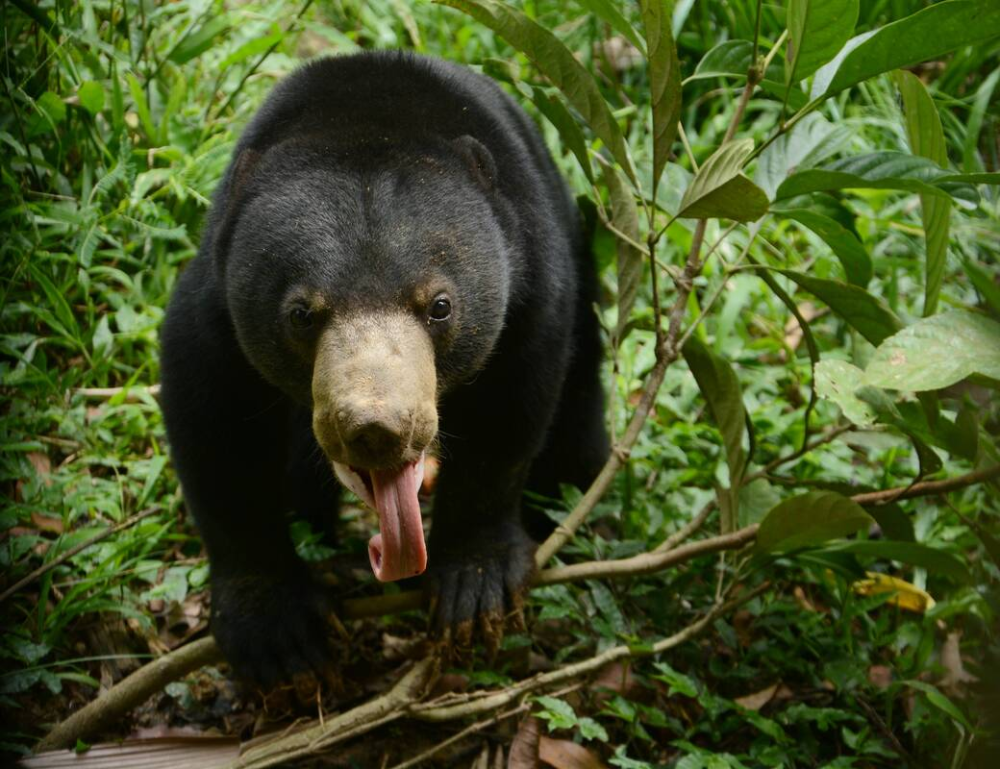
Why are sun bears endangered?
Sun bear conservation faces two compounding threats. The species (Helarctos malayanus) is listed as Vulnerable with a decreasing population on the IUCN Red List, and the global population has declined by an estimated thirty to fifty percent over the past three decades. Four pressures drive the loss.
Habitat destruction from oil palm expansion and illegal logging is the largest, particularly across Indonesian and Malaysian Borneo, where more than thirty percent of forest cover in sun bear range has been removed since 1990.
Bear bile farming, which at its peak caged an estimated three thousand to ten thousand sun and Asiatic black bears across Vietnam, China, South Korea, and Laos, remains active in China and is being phased out elsewhere. The pet trade removes cubs after their mothers are killed, and retaliatory killing by smallholders whose oil palm seedlings, fruit, or beehives have been raided removes adults.
The species has held CITES Appendix I protection since 1979, and recovery now depends on whether forest conversion can be capped before remaining habitat crosses critical thresholds.
A Small Bear in a Shrinking Forest
The sun bear is the smallest of the eight bear species, the most arboreal, and the most concentrated in lowland tropical rainforest.
Adults weigh between 25 and 65 kilograms, fit comfortably inside the canopy of a dipterocarp tree, and live across a range that stretches from Bangladesh and northeast India through Myanmar, Thailand, southern China, peninsular Malaysia, Indonesia, and the islands of Borneo and Sumatra.
For the natural history of the species, see our anchor profile of the sun bear, and for the geography that frames the conservation problem, where do sun bears live.
That geography is the conservation problem. Sun bear range overlaps almost perfectly with the most rapidly converted tropical forest on the planet. Borneo lost roughly half its primary forest between 1973 and 2015. Sumatra lost more than half. Mainland Southeast Asia has been logged, converted to plantation, and cut by road networks at a sustained pace for fifty years. The bear that lived in those forests has gone with them.
This article walks the conservation file. It maps the threats, names the rescue organisations, separates Vietnam from China from Korea on the bile question, and ends on whether the trajectory can be reversed.
The IUCN Picture
The sun bear was reassessed by the IUCN Bear Specialist Group in 2016 and again in 2017, with the listing held at Vulnerable, decreasing.
The assessment authors, working from camera trap density figures, sign transect data, and habitat modelling, concluded that the species had likely declined by at least thirty percent over three generations and that the rate was probably closer to fifty percent across much of mainland Southeast Asia, where forest cover has fallen further than in Borneo or Sumatra.
"Sun bears occupy the part of Asia where forest is being lost fastest, where bile farming and the pet trade meet the deepest concentrations of smallholder agriculture, and where enforcement budgets are thinnest. The species sits at the intersection of every pressure that bears face in the modern world."
- IUCN Bear Specialist Group, 2017 assessment commentary
The Vulnerable listing is the second-highest threat category among the eight bear species, sharing the rank with brown bear regional populations in central and southern Europe and sitting one rung below the giant panda's previous Endangered listing and the polar bear's current Vulnerable status. For the panda comparison see our piece on the panda conservation success story.
The Threats Stack
Four pressures act on sun bears simultaneously, and they interact. Logging fragments the forest, which pushes bears into village edges, which makes them catchable for the pet and bile trade, which depletes breeding females, which combines with habitat loss to compress the population further.
Threat 1: Oil Palm and the Logging Footprint
Habitat loss is the largest direct driver. The Indonesian and Malaysian palm oil industries, growing from a regional commodity in the 1970s to a global one by the 2000s, have converted vast areas of lowland rainforest in Sumatra, Kalimantan, Sabah, and Sarawak. The sun bear's preferred habitat is precisely the lowland dipterocarp forest that yields the highest oil palm productivity, which means the conflict is structural rather than incidental.
Illegal and selectively-legal logging compounds the conversion. Even forest left standing after a logging concession has been worked is often degraded enough that fruit production collapses and bear density falls by half or more. Roads built for extraction also open the forest to hunters who target sun bears for the bile and pet trade.
Threat 2: Bear Bile Farming
Bear bile, the dark green liquid produced by the gallbladder, contains ursodeoxycholic acid (UDCA), which has genuine pharmacological properties for dissolving gallstones and treating cholestatic liver disease.
Synthetic UDCA has been available for decades and is the medical standard, but a parallel traditional medicine market in East Asia continued to drive demand for wild and farmed bear bile through the second half of the twentieth century. Farms emerged in the 1980s in China, North and South Korea, Vietnam, and to a smaller extent in Laos and Myanmar.
The farming method is brutal and well documented. Bears are housed for life in cages too small to stand or turn, fitted with a permanent abdominal cannula or subjected to repeated needle puncture into the gallbladder, and milked for bile multiple times per week. Mortality, infection, and severe physical and psychological pathology are routine.
At peak, an estimated three thousand to ten thousand sun and Asiatic black bears were on bile farms across the region, with the larger share being moon bears and a meaningful minority being sun bears.
"There is no humane way to extract bile from a living bear. The cage, the cannula, and the daily extraction are the cruelty. We have rescued bears whose gallbladders had become tumour masses and whose teeth had been filed down or removed to prevent self-defence during handling."
- Animals Asia Foundation, Vietnam and China rescue programmes
Threat 3: The Pet Trade
Sun bear cubs are commercially attractive in a way adult bears are not. They are small, expressive, and superficially manageable for the first six to twelve months of life, after which their adult strength, claws, and teeth make them dangerous in any domestic setting. The trade pipeline is straightforward. A hunter or logger encounters a sow with cubs, kills the sow, and pulls the cubs.
The cubs move through village middlemen, urban markets, and increasingly through social media platforms in Indonesia, Cambodia, Vietnam, and Thailand, ending up as pets, photo props, or attractions at private menageries.
For the maternal investment that the trade destroys, see sun bear cubs and mothers. Each cub pulled from the wild represents not just one bear but a breeding female killed and a years-long maternal investment severed.
Threat 4: Retaliatory Killing
Sun bears raid oil palm seedlings, banana plantations, durian fruit, and especially beehives. A single bear can cost a smallholder hundreds of dollars in damage in a season, which on tight margins is enough to motivate snaring, shooting, or poisoning. The retaliation is rarely reported and rarely prosecuted, and it is a steady background mortality across most of the range.
Sun bears are not aggressive toward humans by default, but their physical capability when cornered is real. For that nuance see our piece on whether sun bears are dangerous.
Threats by Region
The threat mix shifts across the range. The table below summarises the dominant pressures by country and the principal conservation responders working there.
| Country / Region | Dominant Threat | Secondary Threat | Lead Conservation Responders |
|---|---|---|---|
| Indonesian Borneo (Kalimantan) | Oil palm conversion | Pet trade | BOSF (with orangutan focus), Free the Bears, WWF |
| Malaysian Borneo (Sabah, Sarawak) | Logging and oil palm | Pet trade | Bornean Sun Bear Conservation Centre (BSBCC), Sabah Wildlife Department |
| Sumatra | Oil palm and pulp plantation | Retaliatory killing | WCS, Forum Harimau Kita |
| Peninsular Malaysia | Logging, road fragmentation | Pet trade | Department of Wildlife and National Parks (PERHILITAN) |
| Vietnam | Historic bile farming, ongoing closures | Habitat loss | Animals Asia, Four Paws, Free the Bears |
| Cambodia | Pet and restaurant trade | Snaring | Free the Bears (Phnom Tamao) |
| Laos | Pet trade and tourist attractions | Logging | Free the Bears (Luang Prabang) |
| China (southwestern) | Bile farming (still legal) | Habitat loss | Animals Asia (China programme) |
| Myanmar | Pet and parts trade | Civil conflict habitat impact | TRAFFIC, WCS Myanmar |
| Thailand | Logging and snaring | Tourist trade | Department of National Parks |
The pattern is regionally specific. The Bornean problem is fundamentally an oil palm problem. The Vietnamese problem is fundamentally a bile and habitat legacy problem. The Cambodian and Lao problem is dominated by the pet and restaurant trade. The Chinese problem is dominated by ongoing legal bile farming. A single conservation strategy cannot work across all of them.
The Bornean Sun Bear Conservation Centre
The Bornean Sun Bear Conservation Centre, known as BSBCC, sits next to the Sepilok Orangutan Rehabilitation Centre in Sandakan, Sabah. The centre was founded in 2008 by Malaysian wildlife biologist Siew Te Wong, who built it from a personal field research base into the principal sun-bear specific facility in the species' range. BSBCC opened to the public in 2014.
The centre's three roles are rescue, education, and research. Rescue brings in cubs from the pet trade, victims of habitat loss, and bears confiscated by Sabah Wildlife Department from illegal possession.
Education is delivered through the public viewing platforms, school programmes, and Wong's extensive media presence, which has done more than any other single effort to bring sun bears into the conservation conversation alongside orangutans and pygmy elephants. Research includes camera-trap density work, foraging ecology in adjacent forest, and behavioural studies of rehabilitated bears.
"When I started work on sun bears in 1998, almost no one was talking about them. Sabah had laws on paper, but the species was invisible in the public conversation. The centre exists because the bear had no voice. We built one."
- Siew Te Wong, founder, Bornean Sun Bear Conservation Centre
For the comparison with another regionally focused rescue model, see spectacled bear conservation threats.
Free the Bears Across the Mekong
Free the Bears is an Australian-founded organisation that operates the largest network of bear rescue sanctuaries in mainland Southeast Asia. The flagship sanctuary at Phnom Tamao outside Phnom Penh holds more than one hundred sun and Asiatic black bears rescued from the pet trade, restaurants, traditional medicine shops, and bile operations across Cambodia.
The Luang Prabang sanctuary in Laos focuses on bears confiscated from tourist attractions and small-scale bile cages, and the Cat Tien facility in Vietnam works with the national bile-farm closure programme.
The organisation does not generally release rehabilitated bears. The bears coming through these centres have typically spent years in cages, are missing teeth or claws from injury and abuse, lack any meaningful natural foraging skills, and would not survive in degraded forest where competition with wild conspecifics is already tight.
The sanctuaries are lifetime care facilities, and the conservation logic is that pulling individual bears off the trade reduces market supply, while public visibility shifts the cultural acceptability of the trade.
The Bile Farming File
The bile question runs across four countries with four very different trajectories.
Vietnam
Vietnam outlawed new bile extraction and the keeping of unregistered bears in 2005. Existing farms were allowed to retain registered bears under microchip identification, with the long-term aim of attrition. Animals Asia opened the Tam Dao Bear Sanctuary in 2008 and has since rescued hundreds of bears. Four Paws built BEAR SANCTUARY Ninh Binh. Free the Bears operates at Cat Tien.
By the early 2020s most Vietnamese provinces had been declared bile-free, and the national programme is on a path toward complete closure.
South Korea
South Korea ran a domestic bile bear industry through the 1980s, 1990s, and 2000s, originally seeded by imports from other Asian countries. Public pressure, NGO advocacy from groups including the Korean Animal Welfare Association and Green Korea United, and government programme design produced a phased closure agreement targeting 2025 as the end-of-industry date.
Compensation has been paid to farmers surrendering stock, and the Hwasun sanctuary has been built for absorbed bears. The Korean phase-out is the cleanest national resolution of a bile-farming legacy in the region.
China
China is the outlier. Domestic bile farming remains legal under Chinese law, with permits issued for facilities operating predominantly with Asiatic black bears and a smaller number of sun bears. The industry has been shrinking under the combined pressure of synthetic UDCA cost competitiveness, NGO advocacy, and shifting consumer preference, but the legal framework has not closed.
Animals Asia operates the Chengdu rescue centre under a partnership agreement with Chinese authorities, and rescued bears arrive through that channel rather than through wholesale industry shutdown. The Chinese trajectory is gradual rather than terminal.
Cambodia and Laos
Neither country runs an industrial bile industry on the Chinese model. Bile-related captivity in these countries is typically small-scale, often connected to restaurants advertising bear paw soup or bile shots to tourists, and the rescue model is confiscation by national authorities working with Free the Bears. The Lao tourist trade pressure has shifted in recent years, with declining frequency of bile attractions but rising pressure from the pet trade.
| Country | Bile Farming Status | Estimated Bears Historically | Sanctuary Capacity |
|---|---|---|---|
| Vietnam | Banned 2005, near-complete phase-out | ~4,000 at peak | Tam Dao, Ninh Binh, Cat Tien |
| South Korea | Phase-out by 2025 | ~1,000 at peak | Hwasun |
| China | Still legal, gradually reducing | Tens of thousands historically | Chengdu (Animals Asia) |
| Cambodia / Laos | Not industrialised, opportunistic | Hundreds across both | Phnom Tamao, Luang Prabang |
For comparison with another bear species under heavy human pressure see why polar bears are endangered.
CITES and the International Trade Frame
The sun bear has been listed on CITES Appendix I since 1979, which prohibits commercial international trade in wild-taken specimens and parts. Appendix I is the strongest international protection a species can receive under the convention, and it covers gallbladders, bile, paws, claws, teeth, and live cubs intended for the international pet trade.
Enforcement is uneven. TRAFFIC, the wildlife trade monitoring network, regularly documents seizures of sun bear parts moving across borders within Southeast Asia and from the region into China. Online trade has shifted some volume from physical markets to social media platforms, which has changed the enforcement geometry without reducing the underlying flow.
Stronger national-level wildlife crime laws in Indonesia, Malaysia, and Vietnam have produced occasional successful prosecutions, but the enforcement bottleneck across the region is principally personnel and funding rather than legal framework.
Sun Bears Versus Moon Bears
The sun bear is often confused with the larger Asiatic black bear, also called the moon bear, which shares much of the same range and is the species most heavily represented on bile farms. The two species coexist across mainland Southeast Asia and parts of southern China, and conservation organisations frequently work with both in parallel. For the comparison see sun bear vs moon bear.
The bile-farming history is dominated by moon bears in absolute numbers, but sun bears have been a meaningful minority on Vietnamese, Lao, and Cambodian farms, and the rescue facilities at Tam Dao, Phnom Tamao, and Luang Prabang house both species. The pet trade, by contrast, is more sun-bear weighted because sun bear cubs are smaller and more tractable for the early-stage market.
What Sun Bears Eat, and Why It Matters for Conflict
A bear's diet drives where it lives, and where it lives drives where it meets people. Sun bears eat fruit, insects, small vertebrates, and notoriously honey, which is the source of the species' colloquial name as the honey bear and the long curved claws and ten-inch tongue adapted to extracting it. For the full dietary breakdown see what do sun bears eat.
The dietary pattern explains the conflict pattern. Honey raids on village beehives, durian raids in fruiting season, banana and oil palm seedling damage, and incidental crop loss all flow from the same fruit-and-sugar foraging strategy that the species evolved to exploit in primary forest. When forest fruit production declines after logging or fragmentation, the bears do not stop foraging. They shift onto whatever sugar source is available, which in a converted landscape is the village.
"Every retaliatory killing we investigate started with a bear that had nothing left in the forest to eat. The animal does not choose to walk into a smallholder's beehive. The choice was made when the trees came down."
- Free the Bears, Cambodia rescue field report
Is the Trajectory Reversible?
The honest answer is partially. Conservation in Southeast Asia is up against the largest commodity-driven land conversion process on the planet, and as long as palm oil demand remains structurally strong and enforcement budgets remain thin, forest will continue to fall in sun bear range. The species is not on a panda-style recovery trajectory because the pressures are different.
The panda was saved by a logging ban and a captive breeding programme inside a single country. The sun bear is distributed across eleven countries, none of which can act unilaterally to fix the problem.
What is achievable is meaningful slowing. The bile farming file is closing in three of the four major bile countries on a ten-to-fifteen year horizon. The pet trade can be compressed by enforcement and by social media platform policy.
Oil palm conversion can be capped through certification, sourcing pressure from European and North American consumer markets, and national land-use planning that protects the highest-value remaining lowland forest. Rescue operations at BSBCC, Free the Bears, Animals Asia, and Four Paws will continue to absorb individuals coming off the trade and to sustain the public visibility that drives policy.
"We are not going to save every sun bear. We can save the species. The difference between those two propositions is what conservation work consists of."
- Free the Bears, organisational programme statement
How Readers Can Help
Real leverage exists at four points. Avoid bear bile and bear paw products in any traditional medicine purchase, and refuse them at restaurants if encountered while travelling in the region. Support sourcing certification by checking that processed foods, cosmetics, and household goods using palm oil are sourced through Roundtable on Sustainable Palm Oil (RSPO) certified supply chains where possible.
Donate to or volunteer with rescue organisations including BSBCC, Free the Bears, Animals Asia, and Four Paws, which run public-facing programmes for both. Support legitimate ecotourism at facilities like the Bornean Sun Bear Conservation Centre that channel visitor revenue directly into species conservation rather than into menagerie operations.
For a sense of how much rescue work can do at scale, the comparable polar bear and panda files at why polar bears are endangered and panda conservation success story trace what consistent multi-decade pressure on a single conservation file actually produces.
Conservation Organisations Working on Sun Bears
| Organisation | Focus | Headquarters / Sites |
|---|---|---|
| Bornean Sun Bear Conservation Centre (BSBCC) | Rescue, rehabilitation, education, research | Sandakan, Sabah, Malaysia |
| Free the Bears | Rescue and lifetime care, bile and pet trade | Cambodia, Laos, Vietnam, Australia |
| Animals Asia Foundation | Bile farm rescue and policy advocacy | Vietnam (Tam Dao), China (Chengdu) |
| Four Paws International | Bile farm rescue, sanctuary operations | Vietnam (Ninh Binh), Austria HQ |
| TRAFFIC | Wildlife trade monitoring and intelligence | Cambridge UK, regional offices |
| Wildlife Conservation Society (WCS) | Field protection, anti-poaching, parks support | Multiple range countries |
| WWF | Habitat protection, RSPO advocacy | Borneo, Sumatra, Mekong programmes |
| IUCN Bear Specialist Group | Status assessment, scientific synthesis | International, Red List authority |
Sun Bears in Perspective
The sun bear sits at the conservation intersection of the three largest pressures on tropical Asian wildlife. Forest is being lost faster in its range than almost anywhere on earth. The bile and parts trade has captured thousands of individuals across a generation. The pet trade is liquid, mobile, and increasingly digital.
Against that, the rescue and policy network has grown from almost nothing in the 1990s to a regional infrastructure spanning a dozen sanctuaries and several thousand staff. The species is not lost, but the next decade will determine the shape of the recovery.
For the species profile that anchors all of this, return to the sun bear main page. The conservation file is the one that matters most, and it is the one where individual reader choices about palm oil sourcing, traditional medicine purchases, and donation targeting compound into measurable habitat and welfare outcomes over time.
External resources for further reading include the whats-your-iq.com general knowledge platform at https://whats-your-iq.com, the writing and grammar resources at https://evolang.info, and the document tools at https://fileformer.com for those processing field reports and conservation literature.
References
Scotson, L., Fredriksson, G., Augeri, D., Cheah, C., Ngoprasert, D., & Wai-Ming, W. (2017). Helarctos malayanus. The IUCN Red List of Threatened Species 2017: e.T9760A123798233. https://doi.org/10.2305/IUCN.UK.2017-3.RLTS.T9760A45033547.en
Wong, S. T., Servheen, C. W., & Ambu, L. (2004). Home range, movement and activity patterns, and bedding sites of Malayan sun bears Helarctos malayanus in the rainforest of Borneo. Biological Conservation, 119(2), 169-181. https://doi.org/10.1016/j.biocon.2003.10.029
Fredriksson, G. M., Wich, S. A., & Trisno. (2006). Frugivory in sun bears (Helarctos malayanus) is linked to El Nino-related fluctuations in fruiting phenology, East Kalimantan, Indonesia. Biological Journal of the Linnean Society, 89(3), 489-508. https://doi.org/10.1111/j.1095-8312.2006.00688.x
Foley, K. E., Stengel, C. J., & Shepherd, C. R. (2011). Pills, Powders, Vials and Flakes: The bear bile trade in Asia. TRAFFIC Southeast Asia. https://doi.org/10.13140/RG.2.1.4929.4720
Livingstone, E., & Shepherd, C. R. (2016). Bear farms in Lao PDR expand illegally and fail to conserve wild bears. Oryx, 50(1), 176-184. https://doi.org/10.1017/S0030605314000477
Gaveau, D. L. A., Sloan, S., Molidena, E., Yaen, H., Sheil, D., Abram, N. K., Ancrenaz, M., Nasi, R., Quinones, M., Wielaard, N., & Meijaard, E. (2014). Four decades of forest persistence, clearance and logging on Borneo. PLoS ONE, 9(7), e101654. https://doi.org/10.1371/journal.pone.0101654
Crudge, B., O'Connor, D., Hunt, M., Davis, E. O., & Browne-Nunez, C. (2018). Groundwork for effective conservation education: an example of in situ and ex situ collaboration in South East Asia. International Zoo Yearbook, 52(1), 51-63. https://doi.org/10.1111/izy.12181
Cochrane, J., Crudge, B., & O'Connor, D. (2021). The role of sanctuaries in the rehabilitation of bears confiscated from the bile and pet trade in Southeast Asia. Animals, 11(11), 3175. https://doi.org/10.3390/ani11113175
Frequently Asked Questions
Why are sun bears endangered?
Sun bears (Helarctos malayanus) are listed as Vulnerable with a decreasing population trend on the IUCN Red List, and the species is estimated to have declined by thirty to fifty percent over the past three decades, which is roughly three sun bear generations. Four pressures stack on top of each other across the Southeast Asian range.
The first and largest is habitat loss, driven mainly by oil palm conversion in Indonesia and Malaysia, illegal logging across Borneo and mainland Southeast Asia, and road expansion that fragments what remains. The second is bear bile farming, which historically caged thousands of sun and Asiatic black bears across Vietnam, China, South Korea, and Laos for the extraction of bile from a permanent cannula or repeated needle puncture.
The third is the pet trade, where cubs are pulled from killed mothers and sold across Indonesia, Cambodia, and Vietnam through markets and increasingly through social media. The fourth is retaliatory killing by smallholders whose oil palm seedlings, fruit, or beehives have been raided.
Habitat loss and bile farming are the two pressures that most determine the species’ trajectory, and both intersect because logged forest pushes bears into village edges where they become catchable.
Is bear bile farming still legal?
It depends on the country. Vietnam outlawed new bile extraction in 2005 and has been working to close existing farms ever since, with Animals Asia, Free the Bears, and Four Paws operating sanctuaries in Tam Dao, Ninh Binh, and Bach Ma to absorb rescued bears, and the country reported its last legal bile bears phased out across most provinces by the early 2020s.
South Korea ran a state phase-out programme that committed to ending domestic bile bear farming by 2025, with sanctuary capacity built at Hwasun and government compensation for farmers who surrender stock. China is the outlier. Domestic bile production from farmed bears remains legal under Chinese law, although the trade has been gradually shrinking, and the country still issues permits for hundreds of bile farms operating mainly with Asiatic black bears.
Cambodia and Laos do not run formal bile industries on the Chinese model, but Free the Bears has rescued sun and moon bears from restaurant cages, traditional medicine shops, and tourist attractions across both countries. International commercial trade in sun bear parts is banned under CITES Appendix I, which the species has held since 1979.
What is being done to save sun bears in the wild?
The conservation portfolio runs on three legs. Rescue and rehabilitation is centred at the Bornean Sun Bear Conservation Centre in Sandakan, Sabah, founded in 2008 by Malaysian biologist Siew Te Wong, which holds rescued cubs and adult bears, runs the only sun-bear specific public education facility in the species’ range, and supports release efforts where individual rehabilitation outcomes allow.
Free the Bears operates rescue sanctuaries at Phnom Tamao in Cambodia, Luang Prabang in Laos, and Cat Tien in Vietnam that hold both sun and Asiatic black bears pulled from the bile and pet trade. The second leg is habitat protection through park gazettement, REDD+ projects, and oil palm industry sustainability initiatives such as RSPO certification, which targets the conversion driver directly even though enforcement remains uneven.
The third leg is enforcement of CITES Appendix I and national wildlife laws against poaching and illegal trade, supported by groups such as TRAFFIC, the Wildlife Conservation Society, and national agencies. The combined effort has slowed but not stopped the decline, and the species’ future depends most on whether oil palm expansion in Borneo, Sumatra, and the Greater Mekong can be capped before forest cover crosses critical thresholds.