
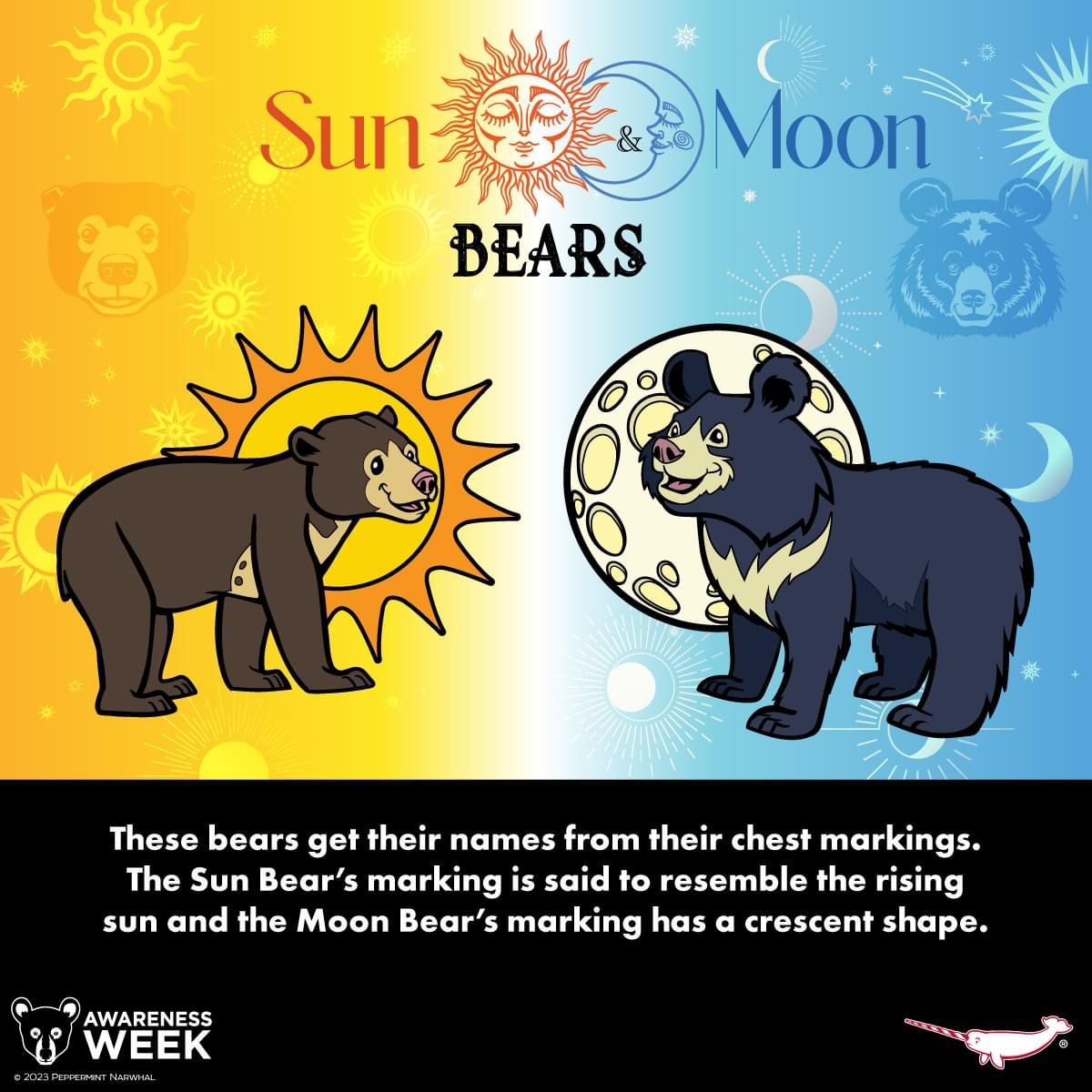
What is the difference between a sun bear and a moon bear?
Sun bears and moon bears are two different species in two different genera that happen to share Asia and happen to wear pale chest markings. The sun bear is Helarctos malayanus, the smallest bear in the world at 27 to 65 kg, with a U-shaped or horseshoe-shaped golden chest patch.
The moon bear is Ursus thibetanus, also called the Asiatic black bear, weighing 60 to 200 kg with a bold white V-shaped or crescent chest mark. Sun bears live in lowland tropical forest and specialise in honey and insects. Moon bears live in montane forest across a much wider, colder range and eat a broader omnivorous diet. Their ranges overlap in mainland Southeast Asia, where they partition habitat by altitude.
Both are listed as Vulnerable on the IUCN Red List, and both have been swept up in the bear bile farming industry that defines twenty-first century bear conservation in Asia.
Two Bears, One Continent, Two Stories
There is a particular kind of confusion that happens when an English-speaking visitor walks into a sanctuary in Vietnam or Laos and meets two bears in adjoining enclosures. One is small, sleek, and short-coated, with a bright golden U on its chest. The other is twice the size, shaggier, with a clean white V running across its breast. Both are introduced by the same word: bear. Both are described as Asian.
Both, in many cases, have come from the same bile farms, the same poacher's snare lines, the same fragmented hill forest. The bears are not the same species. They are not even the same genus. They have spent the last 5 to 6 million years on separate evolutionary tracks. But because they share a continent and a fate, their stories are usually told together.
This article disentangles the two animals: how to tell them apart in the field, where they live, what they eat, how they move through the canopy, and why the conservation movement now lumps them under the same urgent banner. For the full single-species profile of the smaller of the two, see our main page on the sun bear. For the cross-continental comparison of the larger one with its American cousin, see American black bear vs Asiatic black bear.
Side-by-Side Species Comparison
The simplest way to see the differences is in a single table. The figures below describe mature wild adults and are drawn from peer-reviewed monographs, IUCN Red List assessments, and rescue-centre body-mass records.
| Trait | Sun bear (Helarctos malayanus) | Moon bear (Ursus thibetanus) |
|---|---|---|
| Genus | Helarctos (monotypic) | Ursus |
| Adult weight | 27-65 kg | 60-200 kg |
| Body length (head and body) | 100-140 cm | 120-180 cm |
| Shoulder height | 60-75 cm | 70-100 cm |
| Coat | Short, sleek, jet black | Longer, shaggier, jet black |
| Chest mark | Gold or cream U / O / horseshoe | White V or crescent |
| Ears | Small, low, rounded | Conspicuously long, often described as Mickey Mouse ears |
| Snout | Pale grey-buff muzzle, very short | Black face with sometimes pale chin |
| Tongue | Up to 20-25 cm, longest of any bear | Standard ursine tongue |
| Front claws | Long, sickle-shaped, ivory | Long, dark, slightly less hooked |
| Habitat | Lowland tropical and dipterocarp forest | Montane and temperate forest |
| Climate | Tropical and equatorial only | Tropical to cold-temperate |
| Diet emphasis | Insects, honey, figs, soft fruit | Mast, bark, nuts, mixed plant and animal |
| Activity pattern | Largely diurnal | Largely nocturnal and crepuscular |
| Arboreality | Highly arboreal, dens in trees | Climbs well, dens in caves and trees |
| IUCN status | Vulnerable | Vulnerable |
| Population trend | Decreasing | Decreasing |
| Range | Bangladesh to Borneo and Sumatra | Iran to Japan |
The first thing the table makes obvious is size. A big moon bear can weigh four times what a small sun bear weighs. The second is climate. The sun bear is exclusively tropical. The moon bear is the only bear in the world whose range stretches from the equator to subarctic Russian Primorye. The third is coat. A sun bear's fur is so short and fine that the animal looks almost shaved next to a shaggy moon bear, an adaptation to humid lowland heat.
"The sun bear and the Asiatic black bear are sympatric across mainland Southeast Asia, but they are not ecological duplicates. Sun bears occupy lowland evergreen forest below about 1,200 metres and feed mostly on invertebrates and soft mast. Asiatic black bears use mid-elevation and montane forest above the sun bear band and shift to harder mast and bark in winter. The two species coexist by partitioning altitude and food, not by competing." - Siew Te Wong, Bornean Sun Bear Conservation Centre
The Chest Markings: Sun and Moon
Of all the field marks, the chest patch is the one a wildlife biologist checks first. Both species carry a pale marking on dark fur, but the markings differ in colour, shape, and position.
The sun
The sun bear's chest patch is golden, orange, or cream, sometimes pale yellow, occasionally almost white in older individuals. The shape is most often a U, with the open end pointing toward the throat and the two arms running down toward the shoulders. Variants include a closed O that looks like a horseshoe, a broken U with a gap in the bottom, and rare Y or splash patterns.
The mark is bright against jet-black fur, and in good light it catches the sun in a way that gives the animal its name. Read more on the developmental and signalling theories of this mark on our piece on why sun bears have chest markings.
The moon
The moon bear's chest patch is bright white or cream, almost never golden. The shape is a V or crescent, with the open end of the V pointing toward the throat and the legs of the V trailing toward the forelimbs. The mark sits higher on the chest than the sun bear's U and is usually broader.
Some bears show a thin crescent only a few centimetres tall, others wear a wide white blaze that runs from collar to belly. The geometry is what matters: a moon bear's mark is a V or crescent, never a closed horseshoe.
If you see a small black bear with a golden U on its chest, you are looking at Helarctos malayanus. If you see a larger black bear with a white V on its chest, you are looking at Ursus thibetanus. The marks resolve the question almost every time, and unlike many ursine field characters they hold up at a distance and in poor light.
Genus, Species, and the Tree of Bears
Sun bears and moon bears are not close relatives within the bear family. They sit on different branches of the ursid tree.
The sun bear is the sole living member of Helarctos, a monotypic genus that diverged from the ancestor of Ursus in the late Miocene, roughly 5 to 6 million years ago. Modern molecular phylogenies place Helarctos as a sister lineage to the sloth bear (Melursus ursinus), with both groups branching off before the radiation that produced the Ursus species we know today.
The sun bear is, in evolutionary terms, an old and isolated lineage, and that isolation shows up in its unique morphology: the shortest face, the longest tongue, the smallest body, and the proportionally largest paws of any bear.
The moon bear is one of several species in Ursus, sitting alongside the brown bear (U. arctos), the polar bear (U. maritimus), and the American black bear (U. americanus). Its closest living relative is the American black bear; the two split roughly 5 million years ago when an ancestral population was divided by the closing and opening of land bridges across what is now the Bering Strait. Its second-closest living relative within the genus is probably the brown bear.
The taxonomic punchline is that a moon bear is genetically closer to a brown bear or an American black bear than it is to a sun bear, even though sun and moon bears live next door to each other in many forests. Common ancestry in the bear family is deep, but it is not symmetrical, and "Asian bear" is a geographic label, not a clade.
"The genus Helarctos is sister to Melursus (sloth bear), and together they form a clade that diverged from Ursus in the late Miocene. The Asiatic black bear sits firmly inside Ursus, closest to the American black bear. Sun and Asiatic black bears are sympatric in much of mainland Southeast Asia, but their last common ancestor lived around 5 to 6 million years ago. They are about as related to each other as a sloth bear is to a polar bear." - IUCN/SSC Bear Specialist Group, Status Survey and Conservation Action Plan
Range: Where the Sun Sets and the Moon Rises
The geographies of the two species overlap, but the centres of gravity are very different.
Sun bear range
The sun bear is the bear of tropical Southeast Asia. It occupies lowland evergreen and dipterocarp forest from north-eastern India and southern Bangladesh, through Myanmar, Thailand, Cambodia, Laos, Vietnam, peninsular Malaysia, and into the great islands of Sumatra and Borneo. There is also a small disputed population in Yunnan, southern China.
The animal does not occur north of the tropical belt, does not climb above about 1,200 metres in most ranges, and never enters deciduous or coniferous forest. For a deeper map and an island-by-island account, see where do sun bears live.
Moon bear range
The moon bear is the most widely distributed bear in Asia. It ranges across 18 countries in a long arc from western Asia to the Pacific:
- Iran and Pakistan: small populations in the Alborz, Zagros, and northern mountains
- Afghanistan: scattered montane populations
- India: Himalayan foothills, north-eastern states, Jammu and Kashmir
- Nepal and Bhutan: middle-altitude forests
- Bangladesh: small population in Chittagong Hill Tracts
- Myanmar, Thailand, Laos, Cambodia, Vietnam: montane and mid-elevation forest
- China: still the country with the largest population, fragmented across many provinces
- Korea: a tiny remnant population in Jirisan, slowly recovering through reintroduction
- Russia: Primorsky Krai and adjacent Far East
- Mongolia: a marginal population in eastern forests
- Japan: Honshu and Shikoku, absent from Hokkaido (where brown bears live)
- Taiwan: a few hundred Formosan black bears
Where the ranges overlap
The two species are sympatric across mainland Southeast Asia and parts of north-eastern India and Bangladesh. The overlap zone, where a hiker could in theory encounter either species in the same forest, includes:
| Country | Sun bear | Moon bear | Notes |
|---|---|---|---|
| Bangladesh | Yes | Yes | Both in Chittagong Hill Tracts |
| North-east India | Yes | Yes | Sun bear at low elevation, moon bear above |
| Myanmar | Yes | Yes | Extensive overlap, partitioned by altitude |
| Thailand | Yes | Yes | Overlap in north and west |
| Laos | Yes | Yes | Both species widespread |
| Cambodia | Yes | Yes | Both in eastern forests |
| Vietnam | Yes | Yes | Overlap in central highlands and north |
| Peninsular Malaysia | Yes | No | Sun bear only |
| Sumatra and Borneo | Yes | No | Sun bear only |
| Korea, Japan, Russia | No | Yes | Moon bear only |
In the overlap countries the two species typically partition habitat by altitude. Sun bears occupy lowland evergreen forest below about 1,200 metres. Moon bears occupy mid-elevation and montane forest above that band, sometimes up to 3,000 metres in the eastern Himalayas. Where the bands meet, biologists have documented the two species using the same trail systems on different days, with sun bears more active by day and moon bears more active by night.
Diet and Foraging: Honey Specialist vs Mountain Generalist
Both species are omnivorous, but their diets are weighted very differently.
The sun bear is the most insectivorous and frugivorous of all bears. The bulk of its diet is invertebrates and soft fruit. It tears open termite mounds, rips into rotten logs for grubs, raids stingless-bee colonies for honey and brood, and climbs fig trees for masting fruit.
The animal's astonishingly long tongue (up to 20 to 25 cm) is a tool for extracting insects from deep cavities and licking honey from comb without exposing the muzzle to angry bees. Sun bears do take small vertebrates and carrion when they can, but the species is not a habitual predator.
The moon bear is more of a traditional ursine omnivore. It takes hard mast (acorns, beechnuts, walnuts), soft fruit, herbaceous plants, insects, and a meaningful amount of animal protein from carrion and small vertebrates. In some Japanese populations it strips bark from conifers in spring to feed on the cambium, an unusual behaviour that puts it in conflict with foresters.
In Russian Primorye it has been recorded scavenging tiger kills and, rarely, taking ungulates directly. The moon bear's molars are larger and flatter than the sun bear's, an adaptation to grinding hard nuts and woody plant material that the sun bear's diet does not require.
Where the two species overlap in mainland Southeast Asia, the diet partition mirrors the altitude partition. Sun bears at low elevation feed on tropical insects and figs that are unavailable in moon bear habitat. Moon bears at higher elevation feed on oaks, walnuts, and other temperate-zone mast that does not occur in the lowlands. The ecological separation is sharp enough that direct competition is rare.
"Sun bears are the most invertivorous of the bears. We have measured stingless-bee honey, termites, and beetle larvae as the dominant foods in faecal samples from Borneo. Asiatic black bears at higher elevations on the same mountains shift toward acorns and walnuts. The two animals are not eating from the same plate." - Wong, S.T., et al., Sun Bear Foraging Ecology, Bornean Sun Bear Conservation Centre
Body, Movement, and Activity
The size gap drives most of the behavioural differences.
A sun bear is small enough to feel comfortable spending most of its life off the ground. It is the most arboreal of all bears, building rough day beds in the forks of large trees, sleeping there through the heat of the day, and in some areas raising cubs in elevated dens. Its short, sickle-shaped claws and small body let it ascend smooth dipterocarp trunks 50 metres tall. It is largely diurnal, especially in undisturbed forest, although it shifts toward dawn and dusk where humans are common.
A moon bear is too heavy to live in the canopy, but it climbs well into mid-sized trees to feed on mast and to sleep. It dens more often on the ground in caves, hollow trees, and under rock overhangs. In the colder parts of its range (Korea, Russia, Japan) it hibernates for several months; in the tropical part it does not.
It is largely nocturnal and crepuscular, partly because of human pressure across most of its range. The two species can use the same forest path on the same day at different hours, and camera-trap studies in Laos and northern Thailand have documented exactly this kind of temporal partitioning.
For more on the body of the smaller species, see how small is the sun bear, the world's smallest bear. And for the question every traveller asks, see are sun bears dangerous.
The Bile Crisis: A Threat They Share
The single biggest reason these two species are usually discussed together is that they share the central conservation crisis of twenty-first century Asian bears: bear bile farming.
Bile farming is the industrial extraction of bile from the gallbladders of live captive bears, primarily Asiatic black bears but also sun bears, for use in traditional Chinese medicine. The bile contains ursodeoxycholic acid, a compound used historically to treat liver and gallbladder conditions, although safe and inexpensive synthetic versions have been available since the 1950s.
At the practice's peak in the early 2000s, roughly 10,000 bears were held in farms across China and Vietnam, often in coffin-sized cages with surgical fistulas or permanent catheters in their abdomens for daily bile drainage.
Both species end up in farms and in the gallbladder trade. Moon bears are the more common victims because they are larger, produce more bile per extraction, and are easier to catch in the temperate uplands where many traditional medicine markets are located. Sun bears are taken in smaller numbers, partly because their lower body mass produces less marketable bile, but they are also caught for the cub-pet trade and for their gallbladders sold in dried form on the black market.
Vietnam banned bile farming in 2005, although enforcement has been gradual. South Korea completed a full phase-out in 2025 with the closure of the country's last legal bile farm. China still permits regulated farming but the industry has shrunk under pressure from domestic and international NGOs.
Animals Asia, founded by Jill Robinson in 1998, has rescued more than 600 individual bears (both species) and operates sanctuaries in Chengdu, China and outside Hanoi, Vietnam. The Bornean Sun Bear Conservation Centre in Sabah, Malaysia, founded by Siew Te Wong, focuses on sun bears specifically.
"Both Asiatic black bears and sun bears are caught in the bile trade. Moon bears are the dominant victims in commercial bile farms because they are larger and produce more, but sun bears are taken in significant numbers for the gallbladder market and for the pet trade. Ending bile farming protects both species. The two crises are one crisis." - Animals Asia Foundation, End Bear Bile Farming Campaign
For a fuller account of the threats facing the smaller species, see sun bear conservation: bile farming and deforestation.
Two Other Asian Comparisons
If you have read this far, you are already most of the way to a working knowledge of Asian bears. Two related comparisons round out the picture.
The giant panda (Ailuropoda melanoleuca) is the third Asian bear of broad public familiarity, a bamboo specialist of central Chinese mountain forest. It does not overlap with sun or moon bears in diet, although it does share parts of its range with moon bears in Sichuan and Shaanxi. We compare it to its closer black-furred cousin in giant panda vs black bear.
The spectacled bear (Tremarctos ornatus) is not Asian at all; it is South America's only bear, restricted to the Andes. It shares with the sun bear a small body, an arboreal habit, and a pale facial or chest pattern, and the two species are sometimes confused in coverage of "small bears." We address those confusions head-on in spectacled bear vs other bears.
For readers comparing the American black bear to the Asiatic black bear (moon bear), our cross-continental piece black bear vs Asiatic black bear handles that pairing in detail.
A Quick Field Decision Tree
If you are looking at a black-furred Asian bear and want to know which species you are seeing, work through these checks in order:
- Size. Is the animal under 70 kg, with a short coat and a small head? Likely sun bear. Over 80 kg, shaggy, big head? Likely moon bear.
- Chest mark. Golden or cream U / horseshoe? Sun bear. Bright white V or crescent? Moon bear.
- Ears. Small, low, neat? Sun bear. Long, conspicuous, almost cartoonish? Moon bear.
- Habitat. Lowland evergreen rainforest below about 1,200 metres? Sun bear. Mid-elevation or montane forest above that band, or any forest in Korea, Japan, Russia, the Himalayas? Moon bear.
- Activity. Active by day, especially morning? Likely sun bear. Active at dusk, dawn, or night? Likely moon bear (or sun bear in disturbed habitat, so this is the weakest cue).
Most encounters will be resolved by step two. The chest mark is the single most reliable field character separating the two species, and it is visible at distances where size and ear shape are hard to judge.
Two Species, One Conservation Question
The deepest answer to "sun bear vs moon bear" is that the comparison itself is misleading if it is taken as a contest. The two animals are not competitors. They are not redundancies. They are two ancient ursine lineages, separated by 5 to 6 million years of evolution, that happen to share a continent, a forest type in their overlap zone, and a set of human pressures.
Both are losing forest. Both are caught in snares. Both end up in cages. Both are listed as Vulnerable by the IUCN, both are trending downward, and both are kept alive in part by sanctuary networks that started with one species and ended up holding the other. Saving the sun bear and saving the moon bear are not separate projects. They are one project, with two faces, two chest marks, and two scientific names.
For the single-species deep dive on the smaller of the two, return to our main page on the sun bear. For the conservation specifics including bile farming and deforestation, see sun bear conservation.
References
- Servheen, C., Herrero, S., and Peyton, B. (eds.). (1999). Bears: Status Survey and Conservation Action Plan. IUCN/SSC Bear Specialist Group. https://doi.org/10.2305/IUCN.CH.1999.SSC-AP.7.en
- Scotson, L., Fredriksson, G., Augeri, D., Cheah, C., Ngoprasert, D., and Wai-Ming, W. (2017). Helarctos malayanus. The IUCN Red List of Threatened Species 2017: e.T9760A123798233. https://doi.org/10.2305/IUCN.UK.2017-3.RLTS.T9760A45033547.en
- Garshelis, D., and Steinmetz, R. (2020). Ursus thibetanus. The IUCN Red List of Threatened Species 2020: e.T22824A166528664. https://doi.org/10.2305/IUCN.UK.2020-3.RLTS.T22824A166528664.en
- Krause, J., Unger, T., Nocon, A., Malaspinas, A.S., Kolokotronis, S.O., Stiller, M., et al. (2008). Mitochondrial genomes reveal an explosive radiation of extinct and extant bears near the Miocene-Pliocene boundary. BMC Evolutionary Biology, 8(1), 220. https://doi.org/10.1186/1471-2148-8-220
- Wong, S.T., Servheen, C.W., and Ambu, L. (2004). Home range, movement and activity patterns, and bedding sites of Malayan sun bears Helarctos malayanus in the rainforest of Borneo. Biological Conservation, 119(2), 169-181. https://doi.org/10.1016/j.biocon.2003.10.029
- Hwang, M.H., Garshelis, D.L., and Wang, Y. (2002). Diets of Asiatic black bears in Taiwan, with methodological and geographical comparisons. Ursus, 13, 111-125. https://doi.org/10.2307/3873192
- Foley, K.E., Stengel, C.J., and Shepherd, C.R. (2011). Pills, Powders, Vials and Flakes: The bear bile trade in Asia. TRAFFIC Southeast Asia. https://doi.org/10.13140/RG.2.2.10543.39844
- Livingstone, E., and Shepherd, C.R. (2016). Bear farms in Lao PDR expand illegally and fail to conserve wild bears. Oryx, 50(1), 176-184. https://doi.org/10.1017/S0030605314000477
Related reading on Strange Animals
- Sun bear
- Where do sun bears live
- Why do sun bears have chest markings
- Are sun bears dangerous
- How small is the sun bear, the world's smallest bear
- Sun bear conservation: bile farming and deforestation
- American black bear vs Asiatic black bear
- Giant panda vs black bear
- Spectacled bear vs other bears
Further reading from our network
- What's Your IQ? for cognition and animal intelligence comparisons.
- When Notes Fly for music, perception, and the natural soundscapes of forest mammals.
- Evolang for clear, expert writing on natural history and communication.
Frequently Asked Questions
What is the difference between a sun bear and a moon bear?
Sun bears and moon bears are two different species in two different genera that happen to share Asia and happen to wear pale chest markings. The sun bear is Helarctos malayanus, the only living member of its genus, weighing 27 to 65 kg with a U-shaped or O-shaped golden chest patch on a short black coat. It is the smallest bear in the world.
The moon bear, more formally the Asiatic black bear (Ursus thibetanus), weighs 60 to 200 kg and carries a bold white V-shaped or crescent chest mark on a longer black coat. Sun bears specialise in lowland tropical and dipterocarp forest from Bangladesh through mainland Southeast Asia and into Sumatra and Borneo, where they feed heavily on insects, honey, and soft fruit.
Moon bears occupy montane forest from Iran across the Himalayas to Russian Primorye, Korea, and Japan, with a much broader, colder range and a more omnivorous diet that includes bark, nuts, and small vertebrates. The two overlap in mainland Southeast Asia (Cambodia, Laos, Myanmar, Thailand, Vietnam, north-eastern India, Bangladesh) where they tend to partition habitat by altitude.
Both are listed as Vulnerable on the IUCN Red List, and both have been targeted by the bear bile farming industry.
Why are they called sun bear and moon bear?
The names come from the chest markings. The sun bear’s pale patch is golden, orange, or cream and forms a U or horseshoe shape that early naturalists compared to a rising sun on the bear’s chest. The Malay name beruang madu (honey bear) and the scientific name Helarctos (helios + arktos, sun bear) both reflect that solar imagery, although Helarctos was actually coined to mean sun bear in Greek and stuck.
The moon bear gets its name from the bold white or cream V-shaped or crescent-shaped patch that almost every Asiatic black bear carries across the upper chest. Seen straight on, the marking looks like a crescent moon lying on its side. The Mandarin name yueguang xiong (moon-light bear), the Korean bandalgaseumgom (half-moon-chest bear), and the Vietnamese gau ngua (chest-moon bear) all describe the same crescent.
The two markings are not just decorative; they are reliable field marks that let observers separate the two species at a glance even in poor light.
Can sun bears and moon bears interbreed?
No. Sun bears and moon bears are not in the same genus, let alone the same species. The sun bear is the only living species in the monotypic genus Helarctos, while the moon bear is one of several species in Ursus alongside brown bears, polar bears, and American black bears. Genetic and morphological evidence places Helarctos as an early-branching lineage in the bear family, distinct from the Ursus radiation.
The two genera diverged roughly 5 to 6 million years ago and have evolved on separate trajectories in different forest types ever since. Captive breeding studies have never produced sun bear by moon bear hybrids, and there is no documented case of hybridisation in the wild despite range overlap in mainland Southeast Asia.
The two species coexist in some forests but partition the landscape by altitude (sun bear lower, moon bear higher) and by diet (sun bear on insects, honey, and figs; moon bear on harder mast, bark, and a broader omnivorous menu). They share threats more than they share genes.