
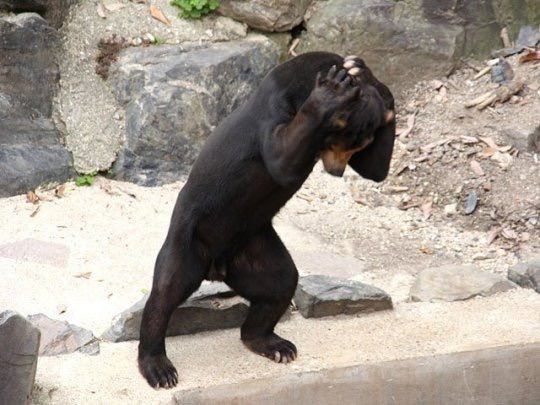
A sun bear cub is born inside a hollow tree, fifteen meters above the floor of a Bornean lowland rainforest, into a world that has no winter and no breeding season and no schedule. It weighs less than a smartphone. Its eyes are sealed, its ears are folded shut, and the thin black fuzz on its body does almost nothing against the cool damp air of the canopy.
Outside the hollow, the dipterocarp forest is at thirty-two degrees Celsius and ninety percent humidity, cicadas are screaming, and a hornbill is calling from a strangler fig two hundred meters away. The mother, a small black bear barely larger than a Labrador retriever, lies curled around the cub with her honey-pale chest crescent pressed against its head. She has been awake the whole time.
Sun bears do not hibernate, do not den seasonally, and do not give birth in coordinated winter cycles. She simply chose this hollow three weeks ago, lined it with dry leaves, and delivered her cub in the middle of an ordinary equatorial afternoon.
This is the reproductive biology of the sun bear, Helarctos malayanus, the smallest and least studied of the eight living bear species. The species ranges across the lowland and hill forests of mainland Southeast Asia and the Sunda islands, from far-eastern India and southern China through Myanmar, Thailand, Cambodia, Laos, Vietnam, peninsular Malaysia, Sumatra, and Borneo.
Wherever it lives, its life history is unlike that of any northern bear. There is no defined breeding season. There is no winter den. Cubs are not born in coordinated January litters but trickle through the year in ones and twos. And the mother, despite her tiny size, is among the fiercest defenders of her young documented in any carnivore.
Compared to its larger relatives in the temperate north, the sun bear's family life is slower, smaller, and far more vulnerable. Litters are tiny, reproductive intervals are long, sexual maturity is late, and the entire system is now under sustained pressure from a regional pet trade and bile-farming industry that targets nursing mothers specifically because their cubs sell.
The story of the sun bear cub is therefore both a story of unusual biology and a story of conservation crisis. It cannot be told without telling both.
A Bear Without a Breeding Season
Sun bear reproduction does not begin in a snowmelt mating period. It begins whenever conditions allow. The species lives across the equator in a climate that experiences essentially no thermal seasonality, with daytime highs varying by less than three degrees Celsius across the year in Bornean lowland forest. Day length varies by less than thirty minutes between solstices.
Fruiting in the dipterocarp forests is famously irregular, dominated by mast events that occur on roughly four-to-seven-year cycles rather than annual fall pulses, and termite, ant, and beetle larvae populations are continuously available rather than peaking in summer.
Under these conditions, a strict breeding season cannot evolve. Wild sun bears mate year-round, with births recorded in every calendar month at every long-term study site from Sumatra to Sabah. The Bornean Sun Bear Conservation Centre (BSBCC) in Sepilok records roughly even monthly distribution of confiscated newborns, with no evident peak.
Captive populations at zoos in Europe, North America, and Southeast Asia show the same pattern, with copulations and births spread across the calendar with only minor clustering around seasonal feeding-program changes.
What does still happen, occasionally, is delayed implantation. Some, though not all, sun bear pregnancies show the embryonic diapause that defines reproduction in northern bears, in which the fertilized blastocyst floats free in the uterus for weeks or months before implanting. This is why the published gestation range for sun bears is so wide, running from 95 days to roughly 240 days.
Pregnancies without diapause complete in just over three months. Pregnancies with diapause stretch toward eight. The biological purpose of the delay in a tropical bear is not fully understood.
The leading hypothesis is that diapause persists as an ancestral ursid trait used opportunistically when the female encounters a fruit-poor period or a stressor that argues against immediate implantation, rather than as a strict seasonal signal as in northern species.
"The sun bear is the only bear we know that can switch delayed implantation on or off depending on the individual pregnancy. Some of our captive breedings produce a cub at three and a half months. Others produce a cub at seven. The mothers do not behave differently and we do not see any obvious environmental cue. It is the most flexible reproductive system in the family Ursidae." - Dr. Siew Te Wong, Founder and CEO, Bornean Sun Bear Conservation Centre
The aseasonal pattern has direct field consequences. Surveys, censuses, and rescue logistics cannot be planned around a known birth pulse. A confiscation team in Cambodia or a forestry patrol in Sabah may receive an orphaned newborn in any month, and rescue centers must run full-capacity neonatal care year-round, unlike grizzly or polar bear research stations where cubs only emerge in spring.
Where a Sun Bear Mother Gives Birth
A sun bear sow does not dig a winter den. She has no ecological reason to. Instead, she selects a tree hollow, almost always above ground, in a large emergent tree of the lowland or hill forest. Preferred species include dipterocarps such as Shorea, Dipterocarpus, and Parashorea, along with strangler figs (Ficus), kapur (Dryobalanops), and old-growth Koompassia.
Hollow height varies from two meters above the ground to over thirty meters, with the median in BSBCC and Sumatran field studies sitting between eight and fifteen meters.
When suitable tree hollows are unavailable, sun bears use fallen log cavities and ground dens dug under buttress roots, fallen trunks, or dense thickets. Ground denning is more common in degraded or selectively logged forest where large hollow trees have been harvested out, and the shift in den-site use is one of the documented consequences of industrial timber extraction across the species range. The biogeography of the species' habitat is covered in detail in where do sun bears live.
Inside the chosen hollow, the sow lines the chamber with dry leaves, fern fronds, and shredded bark, building a soft platform that insulates the cub from the cool wood walls.
Hollow interior temperatures track ambient closely in the tropics, sitting in the 24 to 28 degree Celsius range day and night, but humidity inside the chamber rises sharply during heavy rain and the leaf lining helps wick moisture away from the cub's thin coat.
The mother rarely leaves the hollow during the first weeks after birth, and when she does, she leaves the cub buried in leaf litter and travels short distances to drink and feed before returning.
"The maternal den-site investment of a sun bear is striking once you have seen it. She will spend hours arranging leaves, tearing bark into thin strips with her front paws, and packing the bedding around the cub. We see this same nest-building behavior in our rescued mothers when they give birth in captivity. It appears to be hardwired." - Animals Asia Foundation, on bear-rescue observations across Cambodia and Vietnam
Birth: 250 to 325 Grams in a Tropical Hollow
Sun bear cubs are born at 250 to 325 grams, lighter than a can of soda, making them among the smallest neonates relative to maternal body size in any mammal. A 40-kilogram sun bear sow giving birth to a 300-gram cub produces a maternal-to-cub weight ratio of roughly 130 to 1, considerably less extreme than the 250-to-1 ratios of much larger temperate bears but still extraordinary by carnivore standards.
At birth, a sun bear cub is:
- Weight: 250 to 325 grams
- Length: 16 to 22 centimeters from nose to tail
- Eyes: sealed, opening at approximately 3 to 4 weeks
- Ears: folded closed, opening at 3 to 5 weeks
- Fur: thin black fuzz, pale chest crescent visible from birth in some individuals, fully developed by 6 to 8 weeks
- Teeth: absent at birth, deciduous teeth erupting from 6 to 10 weeks
- Movement: able to crawl toward warmth and nurse, unable to thermoregulate or stand
The pale chest crescent that defines the species is sometimes already faintly visible at birth, though in most cubs it appears as a creamy patch within the first two weeks as the surrounding fur darkens around it. No two crescents are identical, and BSBCC uses individual crescent shape as a reliable identification tool throughout each cub's life. The crescent's role in adult communication is discussed in the parent species article on the sun bear.
Newborns vocalize almost continuously, producing a high-pitched humming sound similar to that recorded in American black bear and Asian black bear cubs. The hum is interpreted as a contentment-and-nursing signal, and it switches abruptly to sharp distress cries when a cub is chilled, hungry, or separated from the mother. Caretakers at BSBCC and Free the Bears use the transition between hum and cry as the primary acoustic indicator of cub welfare in incubator-raised orphans.
Sun bear milk
Sun bear milk has been studied less extensively than the milk of temperate bears, but published analyses from captive lactating sows at zoological collections indicate fat content of approximately 20 to 28 percent during early lactation, comparable to American black bears and modestly leaner than polar bears.
Protein content is high, lactose is low, and the milk supports rapid early growth despite being produced in a tropical climate where the mother is not running on stored fat reserves but on continuous foraging.
A sun bear sow nurses on demand rather than on a schedule, with intervals between bouts ranging from one to four hours during the first weeks after birth. Bouts are short, typically two to ten minutes, and the cub remains in continuous skin contact with the mother throughout the early period.
The energetic load is heavy enough that lactating sows visibly lose body condition during the first two months even with continuous access to fruit and insect prey, and rescue-center mothers raising cubs require approximately twice the daily caloric intake of non-reproductive adults.
Cub Milestones: From Birth to Independence
The growth curve of a sun bear cub is well documented at BSBCC, Free the Bears, and several zoo populations, even though wild observations remain rare. The following table summarizes typical developmental milestones combining captive and field data.
| Age | Weight | Developmental milestone | Location |
|---|---|---|---|
| Birth | 250 - 325 g | Blind, deaf, near-hairless | Tree hollow or ground den |
| 1 - 2 weeks | 0.4 - 0.7 kg | Fur thickening, continuous humming | In den |
| 3 - 5 weeks | 0.6 - 1.2 kg | Eyes and ears opening, first soft cries | In den |
| 6 - 10 weeks | 1.2 - 2.5 kg | Deciduous teeth emerging, first attempts to stand | In den |
| 2 - 3 months | 2.5 - 4 kg | Walking, exploring den entrance | Den / immediate vicinity |
| 3 - 4 months | 3 - 6 kg | First solid food sampled, climbing competently | Den area, low branches |
| 6 months | 6 - 12 kg | Following mother on foraging trips, climbing independently | Forest |
| 12 months | 12 - 22 kg | Active foraging, still nursing, sleeping in tree nests | Forest |
| 18 months | 20 - 35 kg | Weaned, beginning independence | Forest |
| 24 - 30 months | 25 - 45 kg | Full dispersal, establishing own range | Forest |
| 3 - 5 years | 30 - 65 kg | Sexual maturity | Forest |
The sun bear cub's developmental schedule is in some respects faster than its temperate cousins. Eyes open at three to four weeks rather than the six weeks typical of black and brown bears, and ears open on a similar accelerated timeline. The faster sensory development reflects the species' tropical environment, in which there is no extended hibernation period during which cubs can remain functionally invisible.
A wild sun bear cub must become aware of its surroundings rapidly because the mother cannot afford weeks of immobility inside a sealed snow den.
"Our orphan cubs at BSBCC follow a developmental schedule that is consistent with what we infer from the few wild observations on record. They open their eyes at three to four weeks. They are climbing within three months. They are foraging on insects within four. The eighteen-month weaning is non-negotiable. We have tried earlier release programs and they have failed because the cubs are simply not ready." - Bornean Sun Bear Conservation Centre (BSBCC), on rehabilitation outcomes across more than 60 rescued cubs
The Mother: Smallest Bear, Fiercest Defender
Sun bear mothers are, ounce for ounce, the most aggressively defensive bears in the world. A 35-to-65-kilogram sun bear sow with a cub will charge predators many times her size, including reticulated pythons, clouded leopards, sun bears of the opposite sex, and on rare occasions Sumatran tigers.
She is also the dominant cause of the species' fearsome reputation among rural villagers across Southeast Asia, and the question of just how dangerous the species actually is to humans is treated in detail in are sun bears dangerous.
The defensive repertoire of a sun bear mother includes:
- Charging: explosive forward rushes from up to fifteen meters, often without prior warning
- Vocalization: deep coughing barks and growls audible at over a hundred meters
- Standing display: rising on hind legs to display the chest crescent, similar to the threat displays in adult sun bear behavior
- Biting: long curved canines used to inflict deep puncture wounds
- Climbing pursuit: chasing predators into the canopy, a capability unique among bears given the species' arboreal expertise
Sun bear sows move cubs between den sites frequently, often every few days during the first months, carrying the cub by the scruff in a posture similar to that of domestic cats. Den-site rotation is interpreted as an anti-predator strategy that limits the chance of any single predator locating a vulnerable cub during the mother's foraging absences. A wild study in Sabah documented a single cub being moved between seven different tree hollows over its first six months of life.
The mother also actively teaches her cub. Foraging skills including beehive raiding, termite-mound demolition, log breaking, and figuring out which fruits are ripe are all transmitted by direct demonstration during the eighteen-month dependency period. The full diet of the species is discussed in detail in what do sun bears eat.
Cubs without a mother, including all orphans rescued from the pet trade, must learn these skills from human caretakers using forage-puzzle enclosures and progressive forest exposure programs.
Reproductive Parameters at a Glance
The following table summarizes the species' reproductive biology in a single reference, drawing on data from BSBCC, Free the Bears, IUCN Bear Specialist Group reviews, and published zoological and field studies.
| Parameter | Value | Notes |
|---|---|---|
| Breeding season | None defined | Mating and births recorded in all months |
| Age at sexual maturity (female) | 3 - 5 years | First successful litter usually at 4 - 6 years |
| Age at sexual maturity (male) | 3 - 5 years | Behavioral maturity may lag physical |
| Estrus duration | 5 - 14 days | Variable, observed across captive breedings |
| Gestation | 95 - 240 days | Wide range due to occasional delayed implantation |
| Litter size | 1 - 2 cubs | Singletons dominant, twins approx. 10-15% |
| Birth weight | 250 - 325 g | Smallest of any bear |
| Birth location | Tree hollow, log cavity, ground den | Tree hollows preferred |
| Eyes open | 3 - 4 weeks | Faster than temperate bears |
| Weaning age | 18 months | Cubs remain with mother during this period |
| Reproductive interval | 2 - 3 years | Longer than most northern bears |
| Lifetime litters (wild) | 4 - 6 estimated | Slow life history |
| Wild lifespan | 15 - 25 years | Up to 30 in captivity |
The 2-to-3-year reproductive interval is one of the most important numbers in this table for conservation purposes. A sun bear sow cannot replace lost cubs quickly. If a mother is killed in a snare or shot for bile while raising a cub, that cub is lost from the population unless it reaches a rescue center, and the population's reproductive output for that two-to-three-year cycle is gone.
Modeling by the IUCN Bear Specialist Group consistently identifies adult female mortality as the single highest-priority demographic parameter for sun bear conservation, and the slow reproductive recovery is the reason.
"Sun bear demography is the most fragile of any bear. Late maturity, single-cub litters, and multi-year intervals between successful births combine to give this species the lowest reproductive output of any ursid. Any sustained increase in adult female mortality, whether from snaring, bile farming, or habitat loss, will translate directly into population decline within a single generation." - IUCN Bear Specialist Group, Sun Bear Expert Team
The Pet-Trade Crisis: Orphan Cubs as a Conservation Symptom
The single most visible aspect of sun bear cub conservation is not the natural den or the maternal teaching period. It is the orphan cub, alone and malnourished, arriving at a rescue center after weeks or months in the illegal pet trade. The pipeline that produces these cubs is well documented and has been operating across Southeast Asia for at least four decades.
The standard sequence works as follows. A hunter, often working from a roadside village adjacent to a logged forest concession, locates a sun bear at a feeding tree, in a hollow, or at a fruiting fig. The hunter shoots the bear, almost always an adult female chosen because she is small enough to be portable and because lactating sows are the most predictable to find at fixed locations.
If the carcass yields a gallbladder of marketable size, the bile is sold downstream into the traditional medicine market. The cub, if present, is taken alive. Cubs are valuable.
They sell as novelty pets to private buyers, to wildlife restaurants where they are kept on display before slaughter, or directly to bile farms across Vietnam, Laos, and parts of China where they will be raised to adulthood and tapped repeatedly through abdominal cannulas. The full system of bile farming and habitat-destruction pressures is covered in sun bear conservation.
Cubs entering the pet-trade pipeline are typically:
- Less than four months old, far below natural weaning
- Severely dehydrated from inadequate fluid intake
- Malnourished, fed cow milk or rice gruel that lack the fat content required for ursid neonates
- Parasitized with intestinal worms and ectoparasites
- Behaviorally damaged, showing stereotypical pacing, self-mutilation, and abnormal vocalization
Confiscation by national wildlife authorities or partner NGOs typically occurs only after the cub has spent weeks to months in these conditions, and a substantial fraction of confiscated cubs die during the first weeks of rehabilitation despite intensive veterinary care. Survivors face a long road.
A cub orphaned at three months has missed approximately fifteen months of maternal teaching that cannot be fully reconstructed, and the rehabilitation process at BSBCC and Free the Bears is built around staged exposure to forest enclosures, group integration, and forage-puzzle skill building over two to seven years before any release attempt.
"Every orphan cub we receive represents a dead mother. That is the part of this story we never want anyone to forget. The cute photographs are real but they are also a record of a wild population being killed one female at a time." - Free the Bears, on rescue operations across Cambodia, Laos, and Vietnam
Rescue Centers: BSBCC and Free the Bears
The two anchor institutions in sun bear cub rescue both began as small-scale rehabilitation efforts and grew into permanent sanctuaries with associated research, education, and policy work.
The Bornean Sun Bear Conservation Centre (BSBCC) is located in Sepilok, Sabah, Malaysian Borneo, adjacent to the older Sepilok Orangutan Rehabilitation Centre. BSBCC was founded in 2008 by Dr. Siew Te Wong, the world's leading sun bear biologist and the author of the species' chapter in the IUCN Bears: Status Survey and Conservation Action Plan.
The center operates large forest enclosures totaling approximately two and a half hectares of regenerating dipterocarp forest, integrated rehabilitation programs for confiscated cubs and adults, an active visitor education facility, and a research program covering arboreal nest building, foraging ecology, and individual chest-crescent cataloging. As of recent reports BSBCC has rescued, rehabilitated, and where possible released over 60 sun bears.
Free the Bears is an Australian-founded NGO that operates sanctuaries in Cambodia (Phnom Tamao), Laos (Tat Kuang Si and Luang Prabang), and Vietnam (Ninh Binh and Cat Tien).
Its sanctuaries house several hundred bears combined including sun bears and the larger Asian black bear (Ursus thibetanus), and the organization runs forest patrols, snare-removal programs, customs training, and policy advocacy alongside cub rescue.
Free the Bears operates the largest sun bear sanctuary network in mainland Southeast Asia and has rescued cubs from contexts ranging from single private pet ownership to industrial-scale bile farms holding dozens of bears in extraction cages.
Both organizations function as the de facto wild-population insurance policy for the species across their respective regions, and both rely on continuous donor support combined with national-government cooperation. They are regularly cited in IUCN documents as essential to any conservation strategy for Helarctos malayanus.
The species' anatomical and ecological context, including its status as the world's smallest bear, is part of the reason rescue is even practically possible at the scale these organizations achieve. Larger species would simply require facilities and budgets beyond what NGO-scale operations can sustain.
Comparison with Other Bear Cubs
Sun bear cub biology sits at one end of a spectrum of ursid reproductive strategies, with polar bears and grizzlies at the other end. The contrasts are illuminating.
| Species | Litter size | Birth weight | Den type | Weaning | Sexual maturity |
|---|---|---|---|---|---|
| Sun bear | 1 - 2 (typically 1) | 250 - 325 g | Tree hollow / ground | 18 months | 3 - 5 yr |
| Spectacled bear | 1 - 3 (typically 2) | 300 - 360 g | Cave / ground | 12 - 18 months | 4 - 7 yr |
| American black bear | 1 - 6 (typically 2 - 3) | 200 - 450 g | Winter den | 16 - 18 months | 3 - 5 yr |
| Brown bear / grizzly | 1 - 4 (typically 2 - 3) | 350 - 500 g | Excavated winter den | 2.5 - 3.5 yr | 4 - 7 yr |
| Polar bear | 1 - 3 (typically 2) | 600 g | Snow den | 2 - 2.5 yr | 4 - 6 yr |
For deeper comparisons across the family see the companion articles on spectacled bear cubs, grizzly bear cubs, and black bear cubs. The sun bear stands out for the smallest typical litter, the only routinely arboreal birth den, the absence of any defined breeding season, and the longest reproductive interval relative to body size.
"When we compare ursid cub biology, the sun bear is the consistent outlier. Singleton litters dominate. Births happen in any month of the year. The den is in a tree, not in the ground or in snow. And the maternal investment per cub, measured as months of dependency divided by litter size, is the highest in the family. The species has effectively all of its eggs in a very small number of baskets." - Zoo Biology, in published reviews of comparative ursid reproduction
What the Future Holds for Sun Bear Cubs
The arithmetic of sun bear conservation is not encouraging. A species with a single cub per litter, a two-to-three-year reproductive interval, and a sexual maturity age of four to six years cannot withstand sustained adult female mortality.
The IUCN Red List currently categorizes sun bears as Vulnerable, with population estimates ranging from a few tens of thousands range-wide and a continuing decline of approximately 30 percent over the past three generations. Nearly every parameter that drives that decline traces back through the cub.
The protective levers that exist are the ones rescue centers, government enforcement bodies, and concession-level certification systems are pushing on. Snare removal in protected areas reduces accidental catch of females. Bile-farm phaseout programs in Vietnam and Cambodia close the demand-side market for adult bears.
Chain-of-custody monitoring in palm oil and timber concessions keeps cleared land from cutting into intact forest where mothers nest. Rescue-center release programs return rehabilitated cubs to safe forest blocks where snare and hunting pressure has been controlled. None of these are individually sufficient. All of them together may stabilize the species long enough for the slow reproductive cycle to recover.
The single newborn cub in the canopy hollow, weighing less than a smartphone, is the central image of the species' fragility. So is the orphan cub at BSBCC, drinking formula from a bottle held by a human caretaker, who will spend the next five to seven years of its life learning the forest skills its mother would have taught it in eighteen months. The sun bear cub is a small animal carrying very large numbers behind it.
References
- Wong, S. T., Servheen, C., & Ambu, L. (2004). Home range, movement and activity patterns, and bedding sites of Malayan sun bears in the Rainforest of Borneo. Biological Conservation, 119(2), 169-181. https://doi.org/10.1016/j.biocon.2003.10.029
- Steinmetz, R., Garshelis, D. L., Chutipong, W., & Seuaturien, N. (2013). Foraging ecology and coexistence of Asiatic black bears and sun bears in a seasonal tropical forest in Southeast Asia. Journal of Mammalogy, 94(1), 1-18. https://doi.org/10.1644/11-MAMM-A-351.1
- Hwang, M. H., & Garshelis, D. L. (2007). Activity patterns of Asiatic black bears (Ursus thibetanus) in the Central Mountains of Taiwan. Journal of Zoology, 271(2), 203-209. https://doi.org/10.1111/j.1469-7998.2006.00203.x
- Frederick, C., Hunt, K. E., Kyes, R., Collins, D., & Wasser, S. K. (2012). Reproductive timing and aseasonality in the sun bear (Helarctos malayanus). Journal of Mammalogy, 93(2), 522-531. https://doi.org/10.1644/11-MAMM-A-225.1
- Cheah, C. (2013). The status and conservation of sun bears in Malaysia. International Bear News, 22(2), 17-19. https://doi.org/10.5167/uzh-77324
- Schwarzenberger, F., Frederick, C., Reid, K., et al. (2004). Faecal progestagen metabolite analysis for non-invasive monitoring of reproductive function in the sun bear (Helarctos malayanus). Animal Reproduction Science, 80(1-2), 137-150. https://doi.org/10.1016/S0378-4320(03)00130-2
- Servheen, C., Herrero, S., & Peyton, B. (1999). Bears: Status Survey and Conservation Action Plan. IUCN/SSC Bear Specialist Group. https://doi.org/10.2305/IUCN.CH.1999.SSC-AP.2.en
- Crudge, B., O'Connor, D., Hunt, M., Davis, E. O., & Browne-Nunez, C. (2018). Groundwork for effective conservation education: An example of in situ and ex situ collaboration in South East Asia. International Zoo Yearbook, 52(1), 109-122. https://doi.org/10.1111/izy.12181
Related Reading
If you found this article useful, you may also enjoy our companion pieces on the sun bear species overview, the deep dive on sun bear conservation, bile farming, and deforestation, the geographic survey of where sun bears live, and the diet article on what sun bears eat. For broader context on bear-human interactions read are sun bears dangerous and the comparative size piece on how small the sun bear is.
Cross-species cub comparisons are available in spectacled bear cubs and family life, grizzly bear cubs and family life, and black bear cubs and mothers.
For readers interested in puzzles, language, and other curiosity-driven content from across our partner network, you can explore What's Your IQ, When Notes Fly, and the writing platform Evolang.
Frequently Asked Questions
How many cubs do sun bears have at one time?
A sun bear (Helarctos malayanus) mother typically produces a single cub, with twins documented in roughly 10 to 15 percent of recorded births and triplets effectively absent from the wild record. This is the smallest litter size of any bear species and one of the smallest among large carnivores worldwide.
Singletons dominate because the sun bear’s tropical equatorial environment offers no seasonal pulse of fat-rich food comparable to the salmon runs, oak mast, or bamboo bloom that allow other bears to support multiple cubs. A mother cannot store the deep autumn fat reserves of a brown or black bear, since there is no autumn, and her milk supply is therefore tightly capped.
Captive litters at zoos and rescue centers including the Bornean Sun Bear Conservation Centre (BSBCC) in Sabah and Free the Bears in Cambodia confirm that twin pregnancies do occur but second-cub mortality is high in the first weeks of life.
The reproductive interval between successful litters is two to three years, longer than the one to two years documented in temperate bears, and the lifetime reproductive output of a wild sun bear sow is consequently very low. This slow life history is one of the central reasons the species is listed as Vulnerable on the IUCN Red List.
How long does a sun bear cub stay with its mother?
Sun bear cubs remain with their mother for approximately 18 months in the wild, a dependency comparable to American black bears and shorter than the 2.5 to 3.5 years documented in grizzly and brown bears. Cubs are weaned around 18 months, at which point they begin foraging independently while still ranging within the maternal home range for several additional months. Full dispersal typically occurs between 18 and 30 months.
During the dependency period, the sun bear sow is among the most protective mothers in the entire bear family. She moves cubs frequently between tree hollow dens, log cavities, and ground nests of leaves, and she will charge any perceived threat including humans, clouded leopards, reticulated pythons, and tigers. Mortality from the mother’s defensive behavior is the single largest source of human injury attributed to sun bears in Borneo and Sumatra.
Sexual maturity in females is reached between three and five years, and most wild sows produce their first surviving cub at four to six years old. The combination of late maturity, single-cub litters, and multi-year reproductive intervals means a wild sun bear that survives to natural old age may produce only four to six cubs across her entire life.
Why are so many sun bear cubs orphaned by the pet trade?
Sun bear cubs are among the most heavily trafficked bear cubs on Earth because the species combines high commercial value, small adult size, and a nursing mother who can be killed relatively easily by a hunter targeting bile or meat.
The standard pattern documented across Indonesia, Malaysia, Cambodia, Laos, Vietnam, and Myanmar is that a hunter kills the mother in a tree hollow or at a feeding tree, the cub is taken alive, and the cub is then sold either to a private buyer who wants a novelty pet, to a wildlife restaurant chain, or directly to a bile farm where it will be raised to adulthood for gallbladder extraction.
Cubs in this pipeline are typically less than four months old, far below the 18-month wild weaning age, and they arrive at rescue centers severely malnourished, dehydrated, infected with parasites, and showing the stereotypical pacing and self-mutilation of early maternal deprivation. The two largest dedicated rescue networks are the Bornean Sun Bear Conservation Centre (BSBCC) in Sepilok, Sabah, founded by Dr.
Siew Te Wong in 2008, and Free the Bears, which operates sanctuaries in Cambodia, Laos, and Vietnam. Both centers report a steady inflow of confiscated cubs that has not declined despite stronger national legislation, because enforcement on the ground remains weak across most of the species range.