
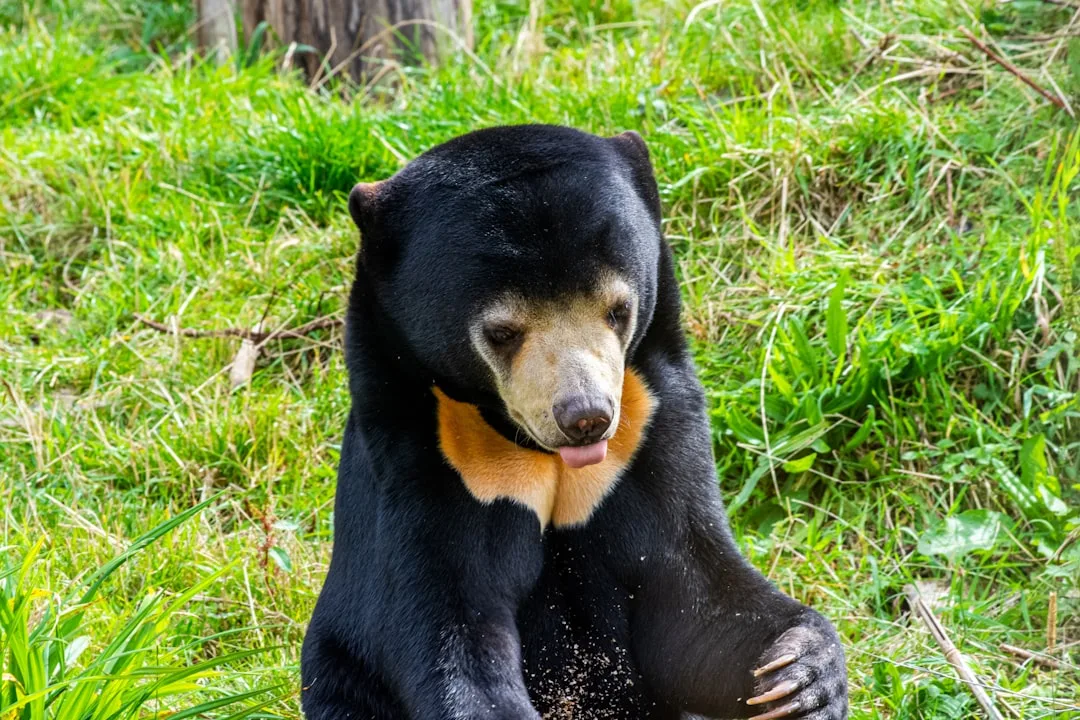
How dangerous are sun bears to humans?
Sun bears (Helarctos malayanus) are the smallest bear species in the world, with adult males weighing only 27 to 65 kilograms, yet across Southeast Asia they hold a reputation as the most ferociously defensive bear pound for pound. Loggers, oil palm workers, and indigenous communities in Sumatra, Borneo, and the Indochinese peninsula generate a steady stream of serious mauling reports each year.
Almost every documented attack is defensive in origin, triggered by sudden close-range encounters with a bear feeding, resting, or accompanied by cubs. Long curved claws, powerful tree-tearing jaws, and the explosive close-quarters response combine to make the per-attack severity unusually high. Predatory attacks on humans are essentially unknown.
The Paradox of the Smallest Bear
Sun bears are the bear that does not look like a bear. A large male tops out at the weight of a medium-sized male golden retriever. The chest carries a pale orange or yellow crescent, the muzzle is short and tan, and the body is compact and almost dog-like beneath a sleek black coat. None of this anatomy reads as dangerous to a person who has only met the species in zoos.
And yet across the rainforests of Sumatra, Borneo, peninsular Malaysia, southern Thailand, Vietnam, Laos, Cambodia, and far northeastern India, the sun bear is the carnivore most often named by forest workers when asked which animal they fear during night travel through primary forest. Beruang madu in Indonesian and Malay translates as "honey bear," but the colloquial reputation is anything but sweet.
The bear that earns this reputation is the same bear we profile at length in our overview of the sun bear, the smallest bear in the world.
This article unpacks where the reputation comes from, what the case record actually shows, who is exposed and why, and what the realistic protocols for forest workers and travellers look like in 2026.
What Makes the Sun Bear Dangerous at Close Range
The danger is anatomical, behavioural, and ecological at the same time. Each piece reinforces the other.
Curved Claws Built for Tearing
Sun bear front claws can reach ten centimetres in length and curve sharply toward the palm. The species evolved to climb hardwood emergents in primary lowland rainforest and to tear into termite galleries, bee nests, and rotten wood at heights of forty metres or more. The claws are tools for shredding hardwood, not for digging soil like a brown bear's claws or for gripping ice like a polar bear's.
Applied to human skin and muscle in a defensive swipe, they produce slashing wounds far deeper than a black bear of comparable mass would inflict.
A Jaw Built to Pry Wood
The sun bear's skull is short, broad, and powerfully muscled. Bite force per body mass is among the highest of any ursid, because the species routinely opens hardwood termite mounds and pries bark from living trees to reach burrowing larvae. The same musculature applied to a human limb produces deep crushing punctures and avulsion injuries that are difficult to repair in remote field hospitals.
A Body Built for Explosive Close-Range Action
Where a brown bear or polar bear deals damage at standoff, the sun bear deals damage in the first metre. The species is short, low to the ground, and capable of launching from a stationary feeding posture into a full attack in under a second.
Inside the dense understorey of primary lowland rainforest, the encounter distance is often less than three metres before either party detects the other. A bear that breaks toward the human at that distance arrives before any deterrent can be drawn or deployed.
"The sun bear is the most aggressive bear I have worked with. Not the most likely to attack, the most explosive when it does. A female with cubs in the canopy will come down the tree to engage at speeds that surprise even the rescue staff. Respect the species the way you would respect a large male leopard."
- Siew Te Wong, founder, Bornean Sun Bear Conservation Centre
The Case Record: What the Field Literature Documents
There is no continent-scale attack database for sun bears in the way Stephen Herrero's database covers grizzlies in North America. Range-state governments do not routinely publish bear attack statistics in machine-readable form, and the encounters happen in remote forest concessions where reporting is informal. What the literature does provide is a steady accumulation of case reports, plantation incident logs, and qualitative interview studies.
Sumatra: Fredriksson's Long Record
Gabriella Fredriksson's twenty-year fieldwork in Sungai Wain protection forest near Balikpapan, Kalimantan, and her parallel observations from Sumatra constitute the longest single-investigator record of sun bear behaviour and human conflict in the literature.
Fredriksson (2005) reported that across her study area, surprise encounters with bears feeding or resting on the forest floor produced multiple defensive injuries among forest workers across the years of study, including at least two cases requiring extensive surgical reconstruction of facial wounds.
"The pattern is consistent across decades. The bear is feeding, the worker walks within metres, the bear charges before either has time to retreat. The injuries are concentrated on the face and arms because the worker is bending or facing the animal at the moment of contact. None of the bears I have followed has ever stalked a human."
- Gabriella Fredriksson, Ursus, on sun bear conflict in East Kalimantan
Borneo: Sabah Wildlife Department Records
Sabah Wildlife Department and the Bornean Sun Bear Conservation Centre near Sandakan together maintain the most rigorous regional record of sun bear human conflict in the Bornean archipelago. The Centre receives bears rescued from poaching, the pet trade, and oil palm conflict, and its veterinary intake records frequently note prior contact with humans in plantation edges.
"Most of our intake bears were captured as cubs after their mothers were killed in oil palm or logging concessions. A meaningful share of those killings happened after a defensive attack on a worker. The cycle is the bear surprises a worker, the worker is injured, the company crew tracks and kills the bear, and the orphaned cub arrives at the rescue centre weeks later. Breaking that cycle requires worker training before retaliation, not after."
- Sabah Wildlife Department field briefing, on sun bear conflict cycles
Indochina: Vietnam, Laos, and Cambodia
Reports from Vietnam's Cat Tien National Park, Laos's Nam Et-Phou Louey, and Cambodia's Cardamom Mountains follow the same template documented in Borneo. The encounter is sudden, the worker is alone or in a small crew, the bear is at close range, and the outcome is a defensive mauling.
Crudgington and colleagues at Free the Bears and Wildlife Conservation Society Cambodia have repeatedly noted that the dominant conflict driver across Indochinese range is loss of forest interior to plantation expansion, which forces remaining bears into smaller patches with thinner buffers between feeding sites and the active edge.
Who Gets Attacked and Why
The exposure profile of sun bear attack victims is narrow and consistent across the species' range.
Loggers and Forest Concession Workers
Selective logging crews working in primary or selectively logged dipterocarp forest produce the largest single share of attack reports. The work involves quiet movement through thick understorey, frequent stops at the base of large trees being assessed for harvest, and prolonged inactivity during chainsaw operations that mask other ambient sound.
The bear that has bedded at the base of a buttressed tree may not detect a crew until they are within metres, and the crew that is focused on the canopy may not detect the bear until the charge has begun.
Oil Palm and Rubber Plantation Workers
Plantation workers walking the edge between active oil palm and adjacent forest fragments are the second largest exposure group. Sun bears use plantation edges for travel and occasionally enter young plantations to feed on accessible fruits. A worker who walks the edge alone at dawn or dusk to inspect drainage or harvest is at meaningfully higher per-encounter risk than the same worker operating mid-block during full daylight.
Indigenous Forest Users
Dayak hunters in Kalimantan, Penan in Sarawak, Orang Asli in peninsular Malaysia, Batak in Sumatra, and Khmer Loeu in Cambodia all maintain traditional patterns of forest use that bring people into deep primary habitat.
Honey collection from emergent trees, rattan harvesting, and hunting with dogs all produce close-range encounters with bears, and dogs in particular are documented to escalate encounters from passive avoidance to active defence. The dogs that flush a bear and then retreat to their handler can deliver an aggressive bear directly to a human.
Researchers and Eco-Tourists
Fieldworkers and tourists are a small but non-trivial share of injury reports. The encounters occur during tracking of radio-collared bears at close range, during night surveys when the bear is not detected until headlamp contact, and during off-trail movement in poorly mapped forest blocks.
Programmes at the Bornean Sun Bear Conservation Centre, Way Kambas in Sumatra, and Cat Tien in Vietnam now include explicit briefing on bear avoidance for any researcher or tourist working off built infrastructure.
Sun Bear Attack Scenarios: A Typology
The case record, taken together, produces a small set of recurring scenarios that account for the overwhelming majority of serious incidents.
Attack Scenario Frequency and Severity
| Scenario | Typical Setting | Severity | Frequency |
|---|---|---|---|
| Sow with cubs surprised at close range | Primary forest interior, dipterocarp dominated | High, often facial | Common, leading scenario |
| Bear surprised feeding on a termite mound | Logging crew approaching slope or tree base | High, arm and torso | Common |
| Bear surprised in day bed at tree base | Ground crew during selective logging | High, multiple wounds | Moderate |
| Plantation edge encounter at dawn or dusk | Oil palm or rubber, adjacent to forest | Moderate, often single bite | Moderate |
| Dogs flush bear toward hunter | Indigenous hunting, especially with cur dogs | High, focused on handler | Sporadic but severe |
| Bear cornered by trail crew | Trail clearing in protected area | Moderate to high | Rare |
| Captive or rehabilitated bear bites keeper | Rescue centre or zoo | Variable | Rare and not directly comparable |
The first three scenarios together account for an estimated majority of all serious wild encounters across the long record. The leading scenario is consistent with the leading scenario across all bear species globally: a defending female with cubs at close range. The second and third scenarios are unique to sun bears in their frequency, because no other bear species is so reliably found at the base of a tree or feeding on a termite mound at human eye level.
Typical Behaviour: What a Calm Sun Bear Encounter Looks Like
The majority of human encounters with sun bears never produce an attack. The default behaviour of a sun bear that detects a human at any reasonable distance is to flee noisily up the nearest large tree. Field guides describe the escape as audibly disproportionate to the bear's size, with significant crashing through understorey and a clattering ascent into the canopy.
The cryptic sun bear is the calm sun bear. Bears that are travelling, foraging, or resting at distance from human activity typically detect humans well before humans detect them, and in those encounters the human never knows the bear was there. This pattern is consistent with our broader profile of where sun bears live and what sun bears eat, which describe a species adapted to wide-ranging cryptic foraging across structurally complex forest interior.
The diet itself helps explain the avoidance. A bear that depends on termites, beetle larvae, fruits accessible in the canopy, and the occasional small vertebrate has no behavioural script for treating a human as food. The same long tongue that we describe in our piece on the sun bear's tongue, longest of any bear is the tongue of a specialist insectivore and frugivore, not a predator of large mammals.
"Across thousands of camera trap nights and hundreds of direct sightings, the modal sun bear behaviour upon detecting a human is rapid retreat. The species is cryptic by ecology, not aggressive by ecology. Aggression is the exception forced by surprise, not the rule of the species."
- IUCN Bear Specialist Group, sun bear status review
Comparison to Other Bears
Sun bear danger is best understood relative to the other species a Southeast Asian forest worker might in principle encounter, and relative to global bear attack baselines.
Sun Bear Versus Asiatic Black Bear (Moon Bear)
Across overlapping range in Indochina and parts of Sumatra, Asiatic black bears (Ursus thibetanus) are roughly twice the body mass of sun bears and produce more total attack reports per year, but per-encounter severity is broadly comparable. The two species differ in habitat preference and activity period, with moon bears more abundant in higher elevation forest and more often active at night. We compare the two species in detail in our piece on sun bear versus moon bear.
Sun Bear Versus the Other Dangerous Bears
| Species | Body Mass (Adult) | Attacks per Year (Range) | Fatal Cases | Dominant Context |
|---|---|---|---|---|
| Polar bear | 350 to 700 kg | <5 globally | Predatory possible | Coastline, hunger-driven |
| Brown or grizzly bear | 200 to 600 kg | 10 to 40 globally | <5 per year | Sow with cubs, surprise |
| American black bear | 60 to 300 kg | Hundreds (mostly minor) | <2 per year | Habituation, food |
| Asiatic black bear | 60 to 200 kg | Dozens, range states | Several per year | Surprise, sow with cubs |
| Sun bear | 27 to 65 kg | Dozens, range states | Rare but documented | Surprise, sow with cubs |
| Spectacled bear | 60 to 200 kg | Sporadic reports | Almost none | Cattle conflict adjacent |
| Sloth bear | 55 to 145 kg | Dozens in India | Several per year | Surprise, often facial |
Compared head-to-head with polar bears and grizzly bears, the sun bear is far less likely to kill any given person who encounters it, but more likely to inflict severe injury per attack than its body mass would predict. Compared to the rarely dangerous spectacled bear, the sun bear produces a meaningfully higher rate of serious incidents because of habitat overlap with extractive industries.
Worker Safety: What Actually Reduces Risk
The protocol for sun bear safety has converged across the major range states despite the absence of a unified policy framework. The recommendations below reflect briefings from the Bornean Sun Bear Conservation Centre, Sabah Wildlife Department, Sumatran Orangutan Conservation Programme, and Free the Bears Cambodia, cross-referenced with peer-reviewed mitigation studies.
Deterrents and Worker Safety Protocols
| Measure | Mechanism | Effectiveness | Practicality in Field |
|---|---|---|---|
| Working in pairs or threes | Increases detection range and noise | High | Standard in most concessions |
| Whistles or air horns at intervals | Advertises human presence in advance | High | Cheap, widely used |
| Avoid dawn and dusk lone travel | Reduces overlap with peak bear activity | Moderate to high | Often impractical for shift work |
| Bear spray (capsaicin) | Stops aggression in close encounter | High where deployable | Not legal in all range states |
| Climbing trees as escape | Generally counterproductive | Low | Sun bears climb faster than humans |
| Running from a bear | Counterproductive | Very low | Bear outruns human across short distances |
| Defensive posture, protect head and neck | Reduces severity of defensive attack | Moderate | Last-resort but effective |
| Educated supervisors and incident reporting | Reduces retaliation killings | High at population level | Depends on company culture |
| First-aid kit with haemorrhage control | Reduces fatal outcomes from serious wounds | High where access exists | Improving with company training |
| Avoiding any bear seen feeding in tree | Removes leading scenario | High | Easy if bear detected at distance |
The most important point on this table is the climbing tree row. Climbing a tree is the standard advice for some species elsewhere in the world; it is exactly wrong advice for a sun bear, which is the most arboreally capable bear on the planet. A worker who climbs a tree in front of a charging sun bear has selected the bear's home terrain and removed any prospect of help arriving.
Conservation Conflict and Retaliatory Killings
Every serious mauling produces a secondary conservation problem. The injured worker's company or community may track and kill the bear, sometimes with state forestry permits and sometimes outside any legal framework. The killed bear may have been a female, in which case dependent cubs starve or arrive weeks later at a rescue centre.
Across the Bornean archipelago, retaliatory killing is a meaningful contributor to local sun bear declines, second only to habitat loss and the ongoing pressure of bile farming and deforestation.
The mitigation pathway is education before the incident, not response after it. Companies that brief workers on sun bear behaviour, that equip crews with whistles and basic deterrents, and that compensate workers for lost work days from non-fatal injuries report fewer retaliation killings than companies that handle each incident reactively.
The reduction in killings translates directly into stable adult female recruitment in the surrounding forest, which is the demographic floor on which the species depends.
What the Field Worker Needs to Know
For a logger, plantation worker, ranger, researcher, or traveller heading into sun bear range, the practical summary is short.
- The bear you encounter will almost certainly try to flee before you know it is there
- The bear that attacks is almost certainly defending cubs, a feeding site, or its bedding ground at very close range
- The attack will be brief, severe, and concentrated on the face and arms
- The single best preventive action is making noise in advance of moving through dense understorey
- The single worst response is running away or climbing a tree
- The single most useful field skill is defensive posture and head-and-neck protection through the first attack burst
The species is not stalking you. It is, in almost every case, asking you to stop being a sudden threat to it. The encounter ends when you stop being one.
A Final Word on Reputation
The reputation of the sun bear as ferociously aggressive is real, and the case record supports it, but reputation flattens nuance. The reputation belongs to the close-range defensive bear at the moment of contact, not to the species in the abstract.
Across millions of human-hours of forest work each year throughout Sumatra, Borneo, peninsular Malaysia, and Indochina, sun bears injure tens to low hundreds of people and kill very few. The animal that earns the reputation is the same animal that will, ninety-nine times in a hundred, climb a tree and disappear before you know it was ever there.
The honest framing is that the sun bear is dangerous in the way that a determined small adversary at arm's length is dangerous: rarely encountered, hard to disengage from once committed, and capable of severe damage in a few seconds. The framing supports caution without supporting fear, and it supports the protection of a species that is itself far more endangered by humans than humans are by it.
For more on the conservation pressure that compresses bears and people into the same shrinking forest blocks, see our piece on sun bear conservation, bile farming, and deforestation, and for context on the species' broader natural history return to our profile of the sun bear, the smallest bear in the world.
Readers interested in adjacent expert-written material on cognition, communication, and structured thinking can also explore Whats Your IQ, When Notes Fly, and Evolang, or browse practical resources at Pass4Sure and File Converter Free.
References
- Fredriksson, G. M. (2005). Human-sun bear conflicts in East Kalimantan, Indonesian Borneo. Ursus, 16(1), 130 to 137. https://doi.org/10.2192/1537-6176(2005)016[0130:HCIEKI]2.0.CO;2
- Wong, S. T., Servheen, C. W., and Ambu, L. (2004). Home range, movement and activity patterns, and bedding sites of Malayan sun bears in the rainforest of Borneo. Biological Conservation, 119(2), 169 to 181. https://doi.org/10.1016/j.biocon.2003.10.029
- Te Wong, S., Servheen, C., and Ambu, L. (2002). Food habits of Malayan sun bears in lowland tropical forests of Borneo. Ursus, 13, 127 to 136. https://doi.org/10.2192/1537-6176(2002)013
- Crudge, B., Lees, C., Hunt, M., Steinmetz, R., Fredriksson, G., and Garshelis, D. (2019). Sun bears: global status and conservation needs. International Zoo Yearbook, 53(1), 81 to 95. https://doi.org/10.1111/izy.12224
- Scotson, L., Fredriksson, G., Augeri, D., Cheah, C., Ngoprasert, D., and Wai-Ming, W. (2017). Helarctos malayanus (errata version published in 2018). The IUCN Red List of Threatened Species. https://doi.org/10.2305/IUCN.UK.2017-3.RLTS.T9760A123798233.en
- Steinmetz, R., Garshelis, D. L., Chutipong, W., and Seuaturien, N. (2013). Foraging ecology and coexistence of Asiatic black bears and sun bears in a seasonal tropical forest in Southeast Asia. Journal of Mammalogy, 94(1), 1 to 18. https://doi.org/10.1644/11-MAMM-A-351.1
- Garshelis, D. L., and Steinmetz, R. (2020). Sun bear (Helarctos malayanus) diet, ecology, and conflict in tropical Asia. Wildlife Society Bulletin, 44(2), 246 to 257. https://doi.org/10.1002/wsb.1090
- Linkie, M., Dinata, Y., Nugroho, A., and Haidir, I. A. (2007). Estimating occupancy of a data deficient mammalian species living in tropical rainforests: Sun bears in the Kerinci Seblat region, Sumatra. Biological Conservation, 137(1), 20 to 27. https://doi.org/10.1016/j.biocon.2007.01.016
Frequently Asked Questions
Do sun bears actually attack humans?
Yes, but almost never as a deliberate act. Across Sumatra, Borneo, peninsular Malaysia, Vietnam, Laos, and Cambodia, sun bears generate a steady trickle of serious mauling reports each year, almost all of which are defensive responses to surprise encounters at very close range.
Loggers cutting on cryptic bear bedding sites, oil palm workers walking unfamiliar plantation edges, and indigenous people pursuing rattan or wild honey deep in primary forest account for the vast majority of cases. Predatory attacks on humans are not part of the species’ documented behavioural repertoire.
Researchers including Siew Te Wong and Gabriella Fredriksson, who together account for most of the long-term field study of Helarctos malayanus, both characterise the species as cryptic and avoidant by default but explosively defensive when cornered.
Why do sun bears have a reputation as the most aggressive bear pound for pound?
The reputation has three roots. First, the species’ anatomy is built for damage at close range, with curved canine teeth, a powerful jaw used for tearing into hardwood termite galleries, and front claws up to ten centimetres long that can flay skin to bone in a single swipe.
Second, the small body size of 27 to 65 kilograms means the bear is often surprised at very close distances inside dense lowland rainforest where it would not be detected by sound or sight, removing the chance for either party to retreat. Third, the survivors of these encounters are usually mauled rather than briefly cuffed, because the bear that commits to a defensive attack at close range tends to ride the encounter to completion.
The reputation is real but the per-encounter probability of attack is low; the per-attack severity is what drives the local stories.
What should a forest worker in Borneo or Sumatra do if a sun bear charges?
Drop into a defensive posture, protect the head and neck with arms and any available pack, and do not run. Sun bears will outrun a human across short distances and will climb after a target that has gone up a tree. The encounter is almost always defensive in origin, which means the bear will usually break off once the perceived threat is neutralised.
Workers in Sabah, Kalimantan, and Sumatra are advised by the Bornean Sun Bear Conservation Centre and Sabah Wildlife Department to work in pairs, carry whistles or air horns to signal presence in advance, avoid lone travel through unfamiliar primary forest at dawn and dusk, and never approach a bear seen feeding or resting in a tree.
Retaliation killings after an attack should be avoided both because they are illegal across most range states and because they remove no actual risk.