
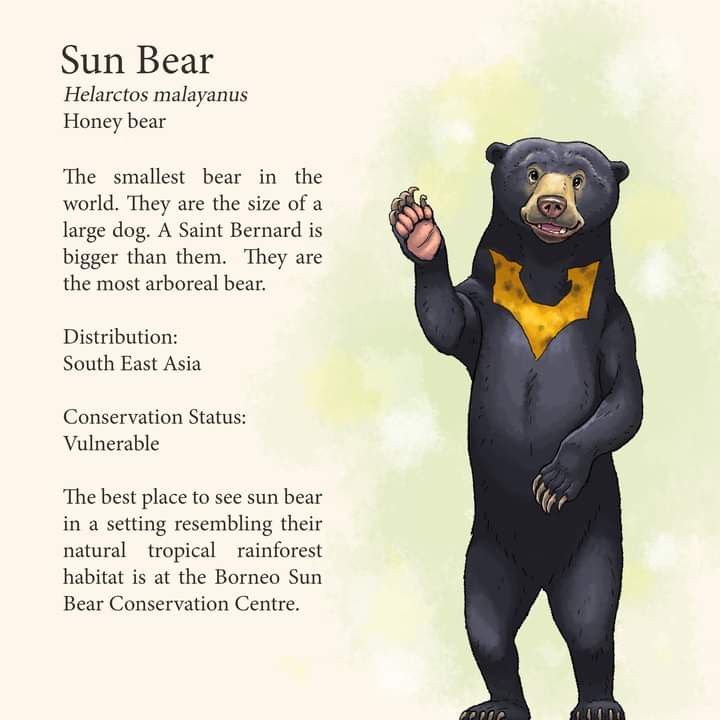
The sun bear is the smallest bear species on Earth and the only one that lives its entire life in the tropics. Unlike polar bears or grizzlies, Helarctos malayanus never hibernates, climbs almost constantly, and wears a blaze of yellow or orange fur across its chest that gives the species both its common name and its ancient folkloric identity. It is the only bear placed in its own genus, and the only one that combines strict tropical ecology with a fully arboreal lifestyle.
This guide covers every major aspect of sun bear biology and ecology: body plan, climbing adaptations, tongue specialisation, diet, social behaviour, reproduction, subspecies, conservation status, and the relationship between sun bears and the people who share Southeast Asian rainforests. It is a reference entry, not a summary - so expect specifics: centimetres, kilograms, years, range countries, and verified records.
Etymology and Classification
The scientific name Helarctos malayanus was erected by the Danish zoologist Peter Wilhelm Lund in the nineteenth century. The genus name combines the Greek roots helios ("sun") and arktos ("bear"), a direct reference to the golden chest patch. The species epithet malayanus reflects the original type locality in the Malay Peninsula.
In Bahasa Malaysia and Indonesian the sun bear is called beruang madu, literally "honey bear", after its most famous feeding habit. In Thai it is mii kwai or "water buffalo bear", a reference to its disproportionately powerful forequarters. In Vietnamese it is gau cho, in Burmese wet-wun.
Sun bears are the only members of the genus Helarctos. Molecular evidence places them on an early-branching lineage within the family Ursidae, distinct from the closely related Ursus clade that contains brown, polar, and black bears. Current genetic work suggests the sun bear line split from the common bear ancestor roughly five to seven million years ago.
That deep divergence is visible in their skull shape, tongue anatomy, and hand structure - sun bears are not simply smaller versions of other bears, they are differently built animals.
Two subspecies are currently recognised. H. m. malayanus occupies the Asian mainland and Sumatra. H. m. euryspilus is the Bornean sun bear, restricted to the island of Borneo and measurably smaller, with a distinctive chest patch shape. Some authors consider the two so distinct that the Bornean form could eventually warrant full species status, though this remains unresolved.
Size and Physical Description
Sun bears are the smallest bears alive today. The size gap between them and the next-smallest species (the Andean bear) is modest, but the gap between sun bears and the largest bears - polar and Kodiak - is enormous.
Adults:
- Head-body length: 100-140 cm
- Shoulder height: 60-72 cm on all fours
- Tail: 3-7 cm (very short)
- Weight (males): 27-80 kg, typically 40-60 kg
- Weight (females): 27-50 kg, typically 30-45 kg
Cubs at birth:
- Length: roughly 20 cm
- Weight: 300-325 grams - about the size of a large apple
Sun bears are compact, stocky, and powerful for their size. They have exceptionally short fur for a bear - a dense black coat only a few centimetres long - which reflects their hot, humid habitat where a thick pelt would be a serious liability. The muzzle is light greyish or tan, the chest patch is yellow, orange, or cream, and the pattern of that patch is unique to each individual. Researchers use photographs of the chest blaze to track known bears in the wild without capture or tagging.
The head is broad and short-jawed. The bite force is remarkable for an animal this size - sun bears routinely crack open hardwood logs to reach beetle larvae. Their forepaws are large and inward-turning, with hairless soles for grip and claws reaching 10 cm in length. The hind feet are plantigrade, like all bears, but flexible enough for sure-footed tree climbing.
The skin, particularly around the neck and shoulders, is unusually loose. This is not an accident of anatomy. A sun bear seized from behind by a tiger or clouded leopard can twist its body inside its own skin, rotate its head back, and bite the attacker's face. Few large carnivores share this capacity.
Built for the Canopy
Sun bears are the most arboreal of the eight living bear species. They do not merely climb occasionally - they live in the trees. Adults feed, sleep, raise cubs, and escape threats in the canopy, descending to the forest floor primarily to travel between fruiting trees or to dig into termite mounds.
Climbing adaptations:
- Long, curved, un-retractable claws - up to 10 cm
- Hairless paw pads for traction on wet bark
- Powerful forelimbs disproportionate to body size
- Inward-rotated forefeet that hook around trunks
- Loose skin around the neck for rapid body rotation
- Relatively small body mass that supports arboreal locomotion
- Short fur that does not snag on branches
Sun bears build sleeping platforms - loose arrangements of bent branches similar in form to orangutan nests - high in the canopy, often at fifteen metres or more. They use the same or similar nests repeatedly, though the platforms collapse within weeks and must be rebuilt.
Cubs are carried into trees by their mothers very early in life and spend most of infancy several metres off the ground, a protective strategy that removes them from the reach of tigers, leopards, wild dogs, and adult male sun bears - all of which are known to kill cubs when the opportunity arises.
Unlike hibernating bears, sun bears never enter prolonged dormancy. Food is available year-round in their tropical habitat, so the metabolic shutdown of winter sleep would be pointless. They maintain a consistent activity budget throughout the year, adjusting only for local fruiting cycles and weather.
The Tongue
Among the sun bear's most distinctive features is its tongue. At 20-25 centimetres when fully extended, it is the longest tongue in the bear family and one of the longest relative to body size in any carnivore.
The tongue is narrow, muscular, and tapered. Its length evolved for a specific set of feeding tasks:
- Probing the inner chambers of bee and wasp nests
- Extracting honey from hollow branches and rock crevices
- Cleaning out termite galleries after the bear breaks open the mound
- Harvesting ants and ant brood from tree trunks
- Reaching beetle larvae through narrow cracks in hardwood
The tongue's reach, combined with the bear's strong claws and powerful bite, allows sun bears to exploit food sources that other mammals cannot reach. This is a key reason they can coexist across parts of their range with clouded leopards, tigers, and Asiatic black bears - they are not competing for the same prey.
The common name "honey bear" refers directly to this equipment. A sun bear will climb a tree, tear open a wild bee colony with its claws, and endure hundreds of stings to scoop out comb and larvae with its tongue. Short fur, thick skin, and a high tolerance for pain make this possible.
Diet and Foraging
Sun bears are opportunistic omnivores with a strong bias toward soft, high-energy foods. Their diet is one of the most varied of any bear species, but several items dominate.
Primary foods:
- Termites (including entire mounds broken open with forelimbs)
- Ants and ant brood
- Beetle larvae extracted from dead wood
- Bees, wasps, and honey
- Wild figs (Ficus spp.) - a keystone food in many ranges
- Durian, rambutan, and dozens of other tropical fruits
Secondary foods:
- Small mammals and lizards
- Bird eggs and nestlings
- Carrion (when encountered)
- Palm hearts and tender shoots
- Crops (especially bananas, corn, coconuts, palm fruit)
Sun bears are important ecological actors. By consuming fruit across wide areas and defecating seeds far from parent trees, they contribute significantly to tropical seed dispersal. By breaking open hardwood logs to reach grubs, they accelerate the decomposition of fallen timber and redistribute nutrients to the soil. By digging into termite mounds, they expose soil and control insect populations.
Researchers describe the sun bear as an "ecosystem engineer" in several published studies - a role that would be hard for other forest animals to replace.
A sun bear's daily foraging range is small compared to temperate bears - typically a few square kilometres - but the bear may visit dozens of specific fruiting trees, known nest sites, and remembered termite mounds within that zone.
Life Cycle and Reproduction
Sun bear reproduction is less rigidly seasonal than in temperate species. Mating can occur in any month, though some populations show loose peaks tied to regional fruiting cycles. Pairs engage in extended courtship involving wrestling, mock fighting, and vocal exchanges that can continue for several days.
Unlike most bears, sun bears sometimes form stable, long-term pair bonds. Wild observations document mated pairs travelling together, feeding side by side, and in some cases cooperating in the rearing of cubs. This is unusual in the family Ursidae, where adult males are generally absent from family life and can be dangerous to cubs.
Females use a form of delayed implantation similar to other bears, though the biology is poorly understood in the wild. Total gestation - including the delay - can last from 95 to 240 days. True embryonic development takes only the last 95 days or so. The reproductive pause allows females to time cub birth to periods of fruit abundance.
Typical reproductive cycle:
- Mating: any month, occasionally prolonged
- Gestation: 95-240 days (implantation delayed until conditions favourable)
- Litter size: 1-2 cubs, usually just 1
- Birth weight: 300-325 grams
- Eye opening: roughly 25 days
- First solid food: 2-3 months
- Weaning: 18-24 months
- Independence: 2-3 years
- Sexual maturity: 3-4 years
Cubs are born in a ground den - usually a hollow log or dense thicket on the forest floor - and are tiny, blind, and nearly furless. The mother nurses them with milk that is roughly 20% fat, less rich than polar bear milk but more than adequate for the tropical environment. Cubs climb early and accompany their mothers through the canopy well before weaning.
A female typically produces her next litter only after the previous cub is fully independent, giving sun bears a slow reproductive rate that complicates population recovery.
Social Behaviour and Communication
Sun bears were historically described as solitary, and adults do generally live alone across the majority of their range. However, captive studies and field observations since roughly 2000 have painted a more complex picture. Sun bears are highly social when circumstances permit, and their communication is unusually rich for a solitary carnivore.
Documented social phenomena:
- Long-term mated pairs, occasionally seen feeding together in the wild
- Facial mimicry during play and solicitation (confirmed 2019)
- Complex vocal repertoire - grunts, huffs, moans, and high-pitched chirps
- Scent-marking of trees with both claw scrapes and urine
- Tolerant feeding aggregations at rich fruiting trees
- Mothers and semi-independent cubs sharing ranges for extended periods
The 2019 Scientific Reports study on facial mimicry, led by researchers working at the Bornean Sun Bear Conservation Centre in Sabah, documented sun bears exchanging precise facial expressions with one another - including specific combinations of exposed teeth and open mouths - within fractions of a second.
This made the sun bear the first non-primate, non-domesticated species scientifically confirmed to demonstrate this level of facial communication. The finding implies a degree of social cognition that challenges the old view of sun bears as purely solitary.
Range, Population, and Subspecies
Sun bears inhabit the tropical and subtropical forests of Southeast Asia, one of the most biodiverse and also most deforested regions on Earth.
Range by country:
| Country | Status |
|---|---|
| Indonesia | Widespread on Borneo and Sumatra; major stronghold |
| Malaysia | Both peninsular and East Malaysian populations |
| Thailand | Declining; most remaining in large protected areas |
| Myanmar | Present but poorly surveyed |
| Laos | Fragmented; heavy poaching pressure |
| Cambodia | Small, declining populations |
| Vietnam | Very scarce; locally extinct in many former areas |
| China | Only southern Yunnan; critically small population |
| India | Northeastern states; status uncertain |
| Bangladesh | Possibly extinct or near-extinct |
No reliable global population estimate exists. Density estimates from camera trap surveys range from less than one bear per 100 square kilometres in degraded forest to several bears per 100 square kilometres in intact primary rainforest. The two subspecies differ noticeably.
Subspecies comparison:
| Feature | H. m. malayanus (mainland/Sumatra) | H. m. euryspilus (Borneo) |
|---|---|---|
| Adult body mass | Larger, up to 80 kg | Smaller, rarely over 50 kg |
| Chest patch | Variable, often U-shaped | Often smaller, rounder |
| Skull shape | Longer-muzzled | Shorter, more compact |
| Coat | Slightly longer | Very short |
| Habitat | Lowland to hill forest | Lowland rainforest |
Bornean sun bears (H. m. euryspilus) may eventually be reclassified as a full species, though this remains unresolved.
Conservation Status and Threats
The IUCN Red List classifies sun bears as Vulnerable with a decreasing population trend. The species is listed on CITES Appendix I, which prohibits international commercial trade, and is protected under national law in every range state. Enforcement varies widely.
Primary threats:
- Habitat loss. Oil palm, rubber, pulp plantations, logging, and road construction have fragmented most of the sun bear's range. Borneo and Sumatra have lost more than 40% of their primary forest since the 1970s.
- Poaching for bile and gall bladders. Sun bear bile is used in traditional medicine in parts of Southeast Asia and East Asia. Gall bladders are sold whole. Adult bears are killed; cubs are sometimes taken for the pet trade.
- Bile farming. In several range states, captive sun bears have been kept in small cages with surgically implanted catheters draining bile. Despite bans in many countries, illegal operations persist. The welfare consequences are severe.
- Pet trade. Cubs are captured when mothers are killed. Orphaned cubs end up in homes, roadside attractions, or private collections - almost none survive to adulthood in these settings.
- Human-bear conflict. Sun bears that raid crops or honey hives are often killed by farmers. Plantation expansion into former forest increases the frequency of encounters.
- Road mortality. New forest roads fragment habitat and kill bears directly.
Conservation efforts include protected area management across the range, anti-poaching patrols, community education programmes, and rescue and rehabilitation at centres such as the Bornean Sun Bear Conservation Centre in Sabah and Free the Bears operations in Laos and Cambodia. The long-term outlook for the species depends on the fate of Southeast Asia's remaining primary forest.
Sun Bears and Humans
Sun bears occupy a particular place in the folklore of Southeast Asia. In parts of Borneo, Indigenous Dayak communities have traditionally regarded the sun bear with respect bordering on fear, associating it with the forest itself. In Malay culture the name beruang madu is entirely descriptive, focused on the bear's honey-raiding habit rather than on any supernatural attribute.
Modern relationships are more difficult. Sun bears are hunted illegally across much of their range for meat, bile, gall bladders, claws, and teeth. Cubs continue to be taken for the pet trade despite national laws. In agricultural areas, bears are killed when they damage crops. Conservation organisations work to reduce these pressures through enforcement, education, and - where appropriate - financial compensation to affected farmers.
Ecotourism remains small but growing in parts of Borneo and peninsular Malaysia, where rehabilitated bears in forest enclosures allow visitors to observe the species without impact on wild populations. Done well, this tourism supports conservation and livelihoods. Done badly, it risks habituating rescued bears to human presence in ways that preclude eventual release.
Related Reading
- Polar Bear: The Arctic's Apex Predator in a Warming World
- How Bears Hibernate
- Bears of the World: Power, Intelligence, and Survival
- Grizzly Bear: North American Predator
References
Relevant peer-reviewed and governmental sources consulted for this entry include IUCN/SSC Bear Specialist Group assessments (most recent sun bear assessment, 2016 and subsequent updates), the CITES Appendix I listing for Helarctos malayanus, and published research in Scientific Reports (facial mimicry study, 2019), Journal of Zoology, Biological Conservation, and Ursus.
Range and subspecies information reflects consolidated findings from the TRAFFIC sun bear trade reports and the Bornean Sun Bear Conservation Centre's published field data.
Frequently Asked Questions
How big are sun bears?
Sun bears (Helarctos malayanus) are the smallest bears alive today. Adults measure 100-140 cm from nose to tail and stand only about 70 cm at the shoulder. Males typically weigh 27-80 kg, with most wild males falling in the 40-60 kg range. Females are slightly smaller at 27-50 kg. For comparison, a large sun bear weighs less than half of a small female polar bear.
Cubs are tiny at birth - around 300 grams - and remain dependent on their mothers for up to two years. The Bornean subspecies (H. m. euryspilus) is measurably smaller than the mainland Malayan form (H. m. malayanus).
What do sun bears eat?
Sun bears are opportunistic omnivores with a strong preference for insects and fruit. Their core diet includes termites, ants, beetle larvae, bees, honey, wild figs, durian, and other tropical fruits. They will also take small vertebrates, birds’ eggs, and carrion when available. Their enormous 20-25 cm tongue is adapted for probing honey combs and insect galleries inside trees.
Sun bears play a significant ecological role as seed dispersers for rainforest fruit trees and as structural modifiers of dead wood - by tearing open logs to reach grubs they accelerate nutrient cycling across the forest floor.
Where do sun bears live?
Sun bears inhabit the tropical and subtropical forests of Southeast Asia. Their range spans Borneo, Sumatra, the Malay Peninsula, Myanmar, Thailand, Laos, Cambodia, Vietnam, southern Yunnan in China, and small pockets of northeastern India and Bangladesh. They prefer undisturbed lowland rainforest but also persist in hill forest, peat swamp forest, and even heavily logged areas when sufficient fruiting trees remain.
They are almost entirely absent from plantations, farmland, and urban areas. Of the historical range, habitat fragmentation has reduced continuous populations to scattered strongholds, mostly inside protected parks and reserves.
Are sun bears endangered?
The IUCN lists sun bears as Vulnerable with a decreasing population trend. No reliable global population estimate exists, but researchers suggest the species has declined by more than 30% over the past three generations (roughly 30 years). Habitat loss from logging, oil palm expansion, and road construction is the single largest threat.
Secondary threats include poaching for traditional medicine (especially bile and gall bladders), the live pet trade in cubs, and conflict with farmers protecting crops. The bile-farming industry - where captive sun bears are kept in small cages and tapped for bile sold as medicine - remains a major welfare and conservation issue despite being illegal in most range states.
Do sun bears hibernate?
No. Sun bears are the only bear species that lives exclusively in the tropics, and food - fruit, insects, and honey - is available to them throughout the year. There is no seasonal shortage severe enough to force the metabolic shutdown seen in brown bears or black bears during winter.
Females do, however, use a form of delayed implantation that allows them to time cub birth to periods of fruit abundance, which is a subtle cousin of the reproductive pause seen in temperate bears. Because they never enter true hibernation, sun bears remain active year-round and raise cubs on a flexible schedule.
Why do sun bears climb so much?
Sun bears are the most arboreal members of the bear family. Adults climb every day to feed on fruit, raid bee nests, escape predators, and sleep. Their anatomy is built for climbing: exceptionally long claws (up to 10 cm), powerful forelimbs, loose skin that allows rapid body rotation in tight spaces, and inward-turning forefeet that hook onto bark. They build rough sleeping platforms of bent branches in the canopy, similar to the nests made by orangutans.
Cubs learn to climb very early - often before they are weaned - and spend most of their infancy several metres off the ground, which helps protect them from tigers, clouded leopards, and adult male sun bears.
Can sun bears mimic facial expressions?
Yes. In a 2019 study published in Scientific Reports, researchers working with rescued sun bears at the Bornean Sun Bear Conservation Centre documented precise facial mimicry during play and solicitation. Two bears would exchange nearly identical expressions - including specific combinations of exposed upper incisors and open-mouth displays - within fractions of a second.
This made the sun bear the first non-primate species (and only the second non-domesticated mammal after some canids) scientifically confirmed to show this level of facial communication. The finding suggests sophisticated social cognition despite the species’ largely solitary adult lifestyle.
Are sun bears dangerous to humans?
Sun bears are among the least dangerous bears relative to their strength - they generally avoid people - but they are far from harmless. When cornered, surprised with cubs, or defending a carcass or bee nest, a sun bear can inflict severe injuries with its long claws and powerful bite. Loose neck skin lets a restrained bear swing around and bite almost any attacker from behind, a defensive feature unusual among carnivores.
Most attacks in Indonesia, Malaysia, and Myanmar occur when humans walk into close range accidentally in dense rainforest, or when farmers try to drive bears out of crops. Fatal attacks are extremely rare.