
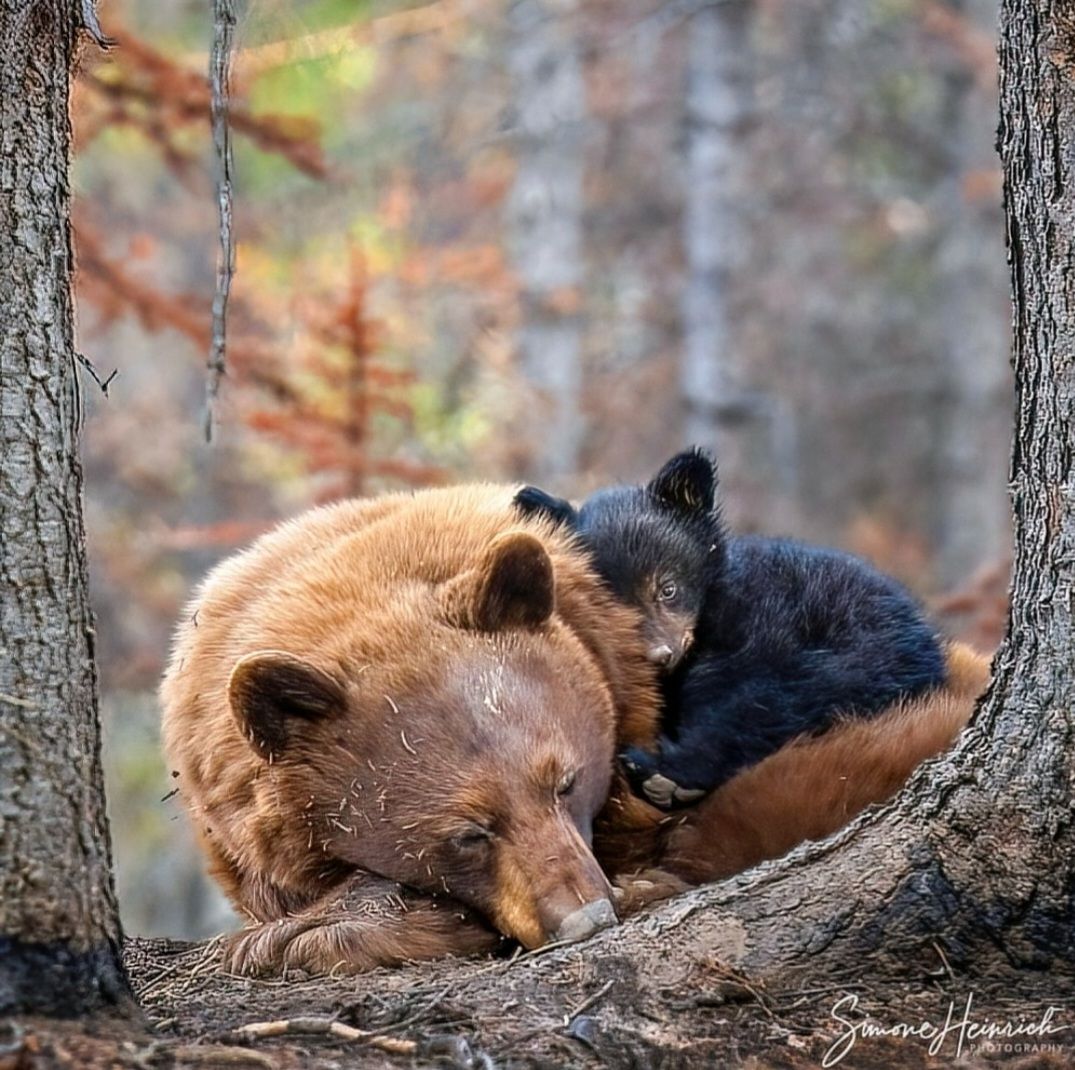
A black bear cub is born underground in the dead heart of winter, to a mother who has been asleep for two months and will not eat or drink for three more. It weighs less than a pint of milk. Its eyes are sealed shut, its ears do not yet function, and the fine fuzz on its body is so thin that pink skin shows through it.
Outside the den, the eastern hardwood forest sits under hard frost, the Appalachian ridges are buried in February snow, and across the Rocky Mountain west the temperature at three in the morning drops well below zero. Inside the den chamber, wedged into the deep fur of the mother's belly in a space barely larger than a kitchen drawer, the cub is already gaining weight on milk as rich as cream.
This is the reproductive strategy of the American black bear, the most numerous and most widely distributed bear in the world. The species ranges from the spruce forests of central Alaska, across boreal Canada, down through the Appalachians to northern Florida, into the Sierra Madre of Mexico, and through the entire western mountain spine from the Yukon to Arizona.
Wherever it lives, its family cycle follows the same strict rhythm: a short summer of mating, a hidden autumn of embryonic suspension, a January or February birth inside a silent den, a two- to three-month invisible infancy, and a dependency of roughly 18 months in which the mother teaches her cubs almost everything they will need to know to survive in the forest.
Compared to its larger cousins, the black bear's family life is faster, more flexible, and more productive. Litters are bigger, cubs grow up sooner, and dispersal happens earlier. But the underlying biology is the same evolutionary puzzle that fascinates everyone who studies ursid reproduction: an animal that produces newborns the size of a chipmunk and grows them, on stored fat alone, into thirty-pound bears in less time than a human pregnancy lasts.
From Mating to Implantation: The Hidden Five Months
Black bear reproduction does not begin in the den. It begins in early summer, roughly seven to eight months before birth, on forest edges, beech ridges, and remote logging roads where solitary adults briefly tolerate each other for the purpose of mating. Mating season runs May through July, peaking in June across most populations and slightly later in the southern Appalachians and the southwestern desert mountains.
A receptive female is courted and bred by more than one male during her estrus, which lasts up to three weeks, and multiple paternity within a single litter has been genetically confirmed in Minnesota, Pennsylvania, North Carolina, and across western populations.
What follows is not what a casual observer would predict. The fertilized egg develops to the blastocyst stage, a small unattached ball of cells, and then stops. It floats free in the uterus, neither implanting nor degrading, for four to five months. This is delayed implantation, also known as embryonic diapause, and it is the pivot on which the entire black bear reproductive cycle turns.
Implantation occurs in October or November, triggered by declining day length, falling progesterone, and above all by maternal fat reserves. A female who failed to reach adequate body condition during late-summer hyperphagia will reabsorb the blastocyst entirely. There is no implantation, no cubs, and no catastrophic fast-through-lactation that would otherwise kill her. The full feeding biology behind this autumnal decision is covered in the companion article on what do black bears eat.
"Delayed implantation makes the black bear pregnancy a conditional event rather than a committed one. The body decides in October whether to proceed, and the decision is made by fat.
In years when oak mast fails across our Minnesota study area, we see reabsorption rates climb steeply, and those females den without giving birth, recover condition over the winter, and rebreed the following cycle as if nothing happened." - Lynn Rogers, founder of the North American Bear Center and Wildlife Research Institute, on four decades of black bear cub-rearing observation
Once implantation occurs, effective gestation is short, about 60 to 70 days of active fetal development. Total elapsed time from spring mating to mid-winter birth spans roughly 220 days nominal, with a wide tolerance because the diapause buffer absorbs variation in mating date. This elasticity allows birth to land consistently in the coldest, most protected part of the denning season regardless of whether the sow was bred in mid-May or late July.
The Winter Den as a Nursery
A black bear den is not a hibernation bunker. It is a nursery. Pregnant sows typically enter their dens earlier than any other age or sex class, often in late October or early November, weeks before serious snow and weeks before adult males den. In southern populations such as the Appalachians and the Ozarks, sows often choose hollow standing trees, large brush piles, and root cavities.
In the Rocky Mountain west and across boreal Canada, dens are excavated into hillsides, dug under fallen trees, or located in natural rock cavities. In Pennsylvania, more than half of recorded black bear dens are little more than a flattened bed of leaves under a windfall, with the sow's back open to the weather. The full physiology of denning is covered in detail in black bear hibernation and denning.
Inside the den, the sow's heart rate drops from roughly 40 to 50 beats per minute to 8 to 19, and her core body temperature falls only about 4 to 6 degrees Celsius from normal. She does not eat, drink, urinate, or defecate for the entire denning period, typically four to six months in northern populations and three to four in southern ones. Her body recycles urea into protein, reabsorbs water from her own breath, and catabolizes fat at a precisely regulated rate.
Cubs are born into the middle of this state, into the quietest room in the North American forest.
Birth itself takes place while the sow is in deep torpor, and observations from den-cam projects in Minnesota and Pennsylvania show that she remains semi-conscious throughout, rousing just enough to lick the cubs clean, reposition them along her belly, and consume the placenta and any soiled bedding.
There is no recorded case in any black bear study of a sow leaving the den before her cubs are mobile enough to follow.
Birth: 300 Grams in the Dark
Cubs are born in January or February, with the peak in late January across most populations and slightly earlier in the deep South. Birth is brief and nearly silent. Cubs emerge one at a time, usually within a few hours of each other, and crawl immediately toward warmth along the belly using a strong rooting reflex.
At birth, a black bear cub is:
- Weight: 200 to 450 grams, roughly the size of a chipmunk or a stick of butter
- Length: 17 to 23 centimeters from nose to tail
- Eyes: sealed, opening at approximately 6 weeks of age
- Ears: closed, opening at 3 to 5 weeks
- Fur: extremely thin gray fuzz, skin visible through it
- Teeth: absent, erupting from 6 to 9 weeks
- Movement: able to crawl toward heat and nurse, unable to thermoregulate or stand
The sow gathers the cubs against her belly, in the deepest part of her fur where temperature is highest. For the first several weeks, the cubs do almost nothing except nurse and sleep. Newborn black bears vocalize almost continuously, producing a low humming sound that biologists working den-cam projects have compared to a distant motor or purring cat.
The sound is generated without effort and is thought to signal contentment, warmth, and active milk letdown; hungry or chilled cubs switch to sharp distress cries that trigger maternal repositioning within seconds.
What makes black bear milk extraordinary
Black bear milk averages 22 to 33 percent fat during early lactation, modestly leaner than brown bear or polar bear milk but still more than six times richer than cow milk. The fat content is the reproductive strategy. It must simultaneously:
- Keep cubs warm in a den chamber that hovers near or just above freezing.
- Fuel explosive growth from 300 grams at birth to 2 to 5 kilograms at den emergence, an order-of-magnitude gain in roughly 90 to 100 days.
- Be produced entirely from the sow's own fat reserves, since she is not eating, drinking, or hunting.
A sow produces somewhere between 0.5 and 1.0 liters of milk per day inside the den, scaled to litter size. Drawing that much energy from stored fat is what drives her catastrophic weight loss. A female entering the den at 110 kilograms in a mast-rich Pennsylvania year typically emerges in the 75 to 85 kilogram range, a loss approaching 25 to 30 percent of body mass.
With a litter of four cubs, the deficit climbs higher. Few placental mammals can survive that kind of catabolic load, and almost none can do it while gestating, giving birth, and nursing simultaneously.
Growth Inside the Den: Cub Milestones Month by Month
For roughly 90 to 100 days after birth, the family is functionally invisible to field researchers. No biologist has ever directly observed a wild black bear birth. Almost everything known about early cub development comes from captive births at facilities like the North American Bear Center, acoustic and infrared monitoring of wild dens by Lynn Rogers and his colleagues in Minnesota, and decades of post-emergence weighing of marked cubs across the species range.
The growth curve inside the den is rapid and remarkably consistent across subspecies and latitudes.
| Age | Weight | Developmental milestone | Location |
|---|---|---|---|
| Birth (Jan-Feb) | 200 - 450 g | Blind, deaf, near-hairless | Inside den |
| 2 weeks | 0.4 - 0.7 kg | Fur thickening, continuous humming | Inside den |
| 3 - 5 weeks | 0.6 - 1.2 kg | Ears opening, first soft cries | Inside den |
| 6 weeks | 1.0 - 1.6 kg | Eyes open | Inside den |
| 6 - 9 weeks | 1.2 - 2.0 kg | Teeth emerging, first attempts to stand | Inside den |
| 10 - 12 weeks | 2.0 - 3.5 kg | Walking, exploring chamber | Inside den |
| 3 months | 2.5 - 4 kg | First solid food tasted (regurgitated by sow or sampled at den mouth) | Late den / emergence |
| 12 - 16 weeks | 2 - 5 kg | Den emergence (April-May) | Exiting den |
| 6 months | 10 - 18 kg | Following mother, foraging actively, still nursing | Outside |
| 8 months | 15 - 25 kg | Weaned in most populations | Outside |
| 1 year | 20 - 40 kg | Wintering with mother in shared den | Outside, denning again |
| 17 - 18 months | 30 - 60 kg | Family separation (males disperse, females may stay near natal range) | Outside |
| 2 years | 40 - 75 kg | Independent, sub-adult phase | Outside |
Two facts from that table deserve emphasis. First, the weight gain from 300 grams to 4 kilograms over roughly 100 days represents a multiplier above 12x, achieved entirely on milk produced from catabolized maternal fat. Second, the eye-open milestone at six weeks is unusually late among placental carnivores; for comparison, domestic puppies open their eyes at 10 to 14 days. The black bear schedule reflects the safety of the den: there is nothing to look at and no advantage to opening early.
Den Emergence and the First Outside World
Families emerge from the den in April or early May, with timing varying by latitude, elevation, and that year's snowpack. In the southern Appalachians, emergence often occurs in mid-March; in the southern Yukon and interior Alaska it can run into late May. Emergence is cautious and slow.
The sow typically exits first, sometimes several days before her cubs, and lingers near the entrance assessing scent, wind, and any signs of predator activity. If anything worries her, she retreats back inside for hours or days. Cubs follow on her schedule, nursing still, exploring tentatively, and learning to walk on packed snow and then on soft thawing earth.
The first four to six weeks outside the den are a continuation of denning in miniature. The family stays close to the den, rarely moving more than one or two kilometers, and returns to the chamber, hollow trees, brush piles, or root wads during cold nights and rain. Milk remains the primary food.
The sow begins grazing on early green vegetation, last-year's berries uncovered by snowmelt, ant colonies under loose bark, and winter-killed deer carcasses if she can find them, but cubs sample rather than feed.
"Post-emergence is the most fragile window in a sow's year. Her fat reserves are nearly gone, three or four cubs are committed to lactation, and the forest has not yet produced much to eat. A late spring, a deep persistent snowpack, or a bad mast year the previous fall can push entire cohorts into mortality within weeks of leaving the den.
We typically see cub mortality of 30 to 40 percent in the first year, and most of those losses concentrate in the first 90 days outside the den." - Sterling Miller, Alaska Department of Fish and Game and the National Wildlife Federation, on long-term mark-recapture data from black bear populations
By June, across most of the range, the family is fully mobile, the cubs are eating solid food in volume, and the sow has begun rebuilding body condition. The cubs continue nursing opportunistically into autumn, but the transition to omnivory is rapid once it starts. For the adult diet that the cubs are learning to replicate, see what do black bears eat.
Regional Variation: Reproduction by Population
Black bear reproductive biology is strikingly conserved in its core mechanics, but litter size, timing, and reproductive interval vary substantially across the species' enormous range. Food quality, female body size, and population density all play roles.
| Region / population | Mean litter | Mean age at first reproduction | Reproductive interval | Notes |
|---|---|---|---|---|
| Pennsylvania / mid-Atlantic | 2.8 - 3.0 | 3 - 4 years | 2 years | Oak mast, agricultural edge, exceptional growth |
| Northern Minnesota | 2.4 - 2.8 | 4 - 6 years | 2 years | Lynn Rogers / NABC long-term study |
| Great Smoky Mountains | 2.5 - 2.7 | 4 - 5 years | 2 years | Acorn-driven cycles, occasional 3-year intervals after mast failures |
| Adirondacks / New England | 2.4 - 2.6 | 4 - 5 years | 2 years | Beechnut and acorn forests |
| Florida (subtropical) | 2.0 - 2.4 | 4 - 5 years | 2 years | Year-round forage, shorter dens |
| Rocky Mountain interior (CO, ID, MT) | 1.8 - 2.3 | 5 - 7 years | 2 - 3 years | Variable mast, drought sensitive |
| Cascades / Pacific Northwest | 2.0 - 2.4 | 5 - 6 years | 2 years | Salmonberry, devil's club, salmon access in some watersheds |
| Southern Yukon / interior Alaska | 1.6 - 2.0 | 6 - 8 years | 3 years | Cold, short summers, smaller body size |
| New Mexico / Arizona | 1.7 - 2.1 | 5 - 7 years | 2 - 3 years | Drought-driven variability |
Females in the food-rich eastern hardwood forests reproduce earlier, more often, and with larger litters than females in cold or arid western populations. A Pennsylvania sow may produce her first litter at three years old and twelve litters across her life; an interior Alaska sow may not produce her first cubs until eight and lose half of them in poor years.
Across the species, the typical reproductive interval is two years, but stretches to three when a sow keeps yearlings through a second winter, and stretches further when mast failures suppress implantation.
For the broader habitat context behind these regional differences, see where do black bears live.
The Genetics of Color: Black, Cinnamon, Blond, and Kermode in the Same Litter
One of the most distinctive features of black bear cub biology is that color is not heritable in the simple way most people assume. A jet-black sow can produce a cinnamon cub, a blond cub, and a black cub in the same litter, all biologically full siblings. The pattern is most visible in western populations where multiple color phases coexist, but it has been documented in long-term Minnesota and Wisconsin study populations as well.
The genetics involve at least three loci, with the dominant black allele at the TYRP1 gene (tyrosinase-related protein 1) showing incomplete penetrance. A heterozygous black sow paired with a heterozygous brown sire produces offspring expressing any of the standard color phases, and segregation often shows directly within a single litter.
The Kermode (creamy white) phase of British Columbia's central coast is governed by a separate recessive allele at the MC1R gene, which is why two black-coated parents who both carry the recessive can produce a white spirit bear cub.
"We have one female who has produced four litters in fourteen years of monitoring. Two of those litters contained both black and cinnamon cubs, and one contained black, cinnamon, and blond cubs in the same family. The mother is solid black, but her contribution to color is recessive, and the variance shows up immediately when we follow her through the year.
Color phase in this species is not what most people imagine." - Ursus, summary of long-term cub-color records from western North American black bear study populations
The full color story, including the Kermode and glacier phases and the ecology behind cinnamon dominance in the southwest, is covered in the dedicated article on black bear color phases: cinnamon, blond, and Kermode.
The Mother as Defender
Black bear sows are famously, and dangerously, defensive of cubs.
The species is far more reclusive than the grizzly, and the great majority of black bear encounters with humans end without incident, but the situations in which black bears do attack people are dominated by two scenarios: predatory encounters by hungry sub-adult males in the boreal interior, and defensive responses by sows with cubs when surprised at close range.
The general human-conflict picture is treated in are black bears dangerous to humans, but the specific maternal pattern matters here.
A black bear mother typically defends her cubs through a graded sequence:
- Treeing the cubs: a cough, a huff, or a jaw pop signals the cubs to climb the nearest tree. Most sows then position themselves at the base, between threat and tree.
- Bluff charges: explosive forward rushes that stop short, often with snorting, slapping the ground, and chuffing. Most encounters resolve at this stage.
- Direct contact: rare but serious, usually after sustained provocation or in surprise encounters at very close range, often involving dogs.
The treeing strategy is unique to the species among North American bears. Grizzly cubs do not climb reliably and grizzly mothers therefore defend on the ground; black bear cubs climb at eight weeks old and the sow's tactical landscape is built around vertical escape. This is one reason black bear families thrive in dense forest and grizzlies do not.
"The black bear mother's response is shaped by the tree. She moves cubs up, watches, and only escalates if treeing fails or cubs are threatened in the tree. We have had habituated females allow us within a few meters with newborn cubs nearby, then turn aggressive when a strange dog or a strange person triggered the cubs' alarm.
The defense is contextual and graded, not blind aggression." - Journal of Mammalogy, summary of habituation-based observations of cub defense behavior at the Wildlife Research Institute, Minnesota
The North American Bear Center and What Long-Term Habituation Revealed
Almost everything described above benefits from one of the longest and most controversial wildlife studies in North America: the work of Lynn Rogers and the North American Bear Center in Ely, Minnesota.
Beginning in the late 1960s and accelerating through the 1990s, Rogers used habituation rather than darting and collaring as his primary research method, allowing him to walk with wild black bears, observe denning sows, attend births by infrared den-cam, and document mother-cub interactions at a level of detail no telemetry-based study has matched.
The decades of habituation work produced several findings that reshaped the field:
- Cubs vocalize continuously during nursing, and the humming sound was misinterpreted by earlier researchers as labored breathing.
- Mothers will accept and nurse orphaned cubs in some circumstances, contradicting the older assumption of strict maternal exclusivity.
- Sows with cubs do not follow infanticidal-avoidance patterns to the same degree as brown bears, in part because adult male black bears are less likely to commit infanticide than adult male brown bears, although it does occur.
- Cub mortality is dominated by predation (other black bears, occasional bobcats, coyotes, and golden eagles in open habitats) and by accidents (falls from trees, drowning, vehicle strikes near cabin areas).
- The mother-cub bond does not weaken slowly. It ends abruptly during the second June after birth, often within a single day, when the sow's pheromones shift and she actively drives the cubs away to clear her own approach to estrus.
The research has been criticized over methodology, and some specific claims remain contested, but the den observations and cub developmental data from this body of work form the modern baseline for everything we understand about wild black bear cub-rearing.
For comparison with the grizzly system, see grizzly bear cubs and family life and the more extreme polar adaptation in polar bear cubs, denning, and survival. The closest evolutionary parallel within Ursus is covered in brown bear cubs and mothers.
Mortality, Dispersal, and the End of the Bond
First-year cub mortality across most black bear populations runs 30 to 40 percent, with the bulk of deaths concentrated in the first 90 days outside the den. Causes break down approximately as follows in long-term study populations:
- Starvation and maternal abandonment: roughly 30 to 40 percent of recorded cub mortality, peaking in poor mast years and in late springs.
- Predation: 25 to 35 percent, including adult male black bears (the largest single predator), bobcats, coyotes, and in some western systems wolves and mountain lions.
- Accidents: 10 to 20 percent, including falls from trees, drowning, and (in semi-developed landscapes) vehicle strikes.
- Disease and parasites: 5 to 15 percent, including parvovirus-related conditions and severe parasite loads in undernourished cubs.
Cubs that survive the first year reach a far better safety threshold. Yearling mortality drops to roughly 10 to 20 percent in most populations, and by the second year the survival rate approaches adult levels.
Family separation typically occurs at 17 to 18 months of age, in the early summer (May or June) following the cub's first full winter spent denning with the mother. Separation is abrupt. The sow's return to estrus, signaled by pheromones, drives a behavioral break that often happens within a single 24-hour window. Cubs that have been inseparable from her for nearly two years are suddenly tolerated less, then chased, then ignored.
After separation, sons disperse aggressively. Documented dispersal distances run from 20 to over 200 kilometers, with extreme records above 300 in fragmented eastern landscapes. The behavior is universal in adult-male black bears and serves both inbreeding avoidance and competition release. Daughters disperse much shorter distances.
In dense food-rich populations, a daughter may settle in a portion of her mother's home range and produce her first litter within sight of the den where she was born. This female philopatry produces matrilineal cluster patterns that remain visible across generations in long-term study areas.
For the broader population context behind these dispersal patterns, see where do black bears live.
Why the Black Bear Family System Works
The black bear reproductive cycle is one of the most successful mammalian strategies in temperate North America.
The species has more individuals across more habitat than all other North American bears combined, and the reasons trace directly to the family system covered in this article: large litters, fast cub growth, early independence at 18 months, female philopatry, two-year reproductive cycles, and an emergency-stop mechanism in delayed implantation that prevents catastrophic reproductive losses in bad food years.
Compared with the brown bear's three-year families and the polar bear's two-year arctic gauntlet, the black bear is the productivity champion of Ursus. A single Pennsylvania sow producing twelve litters of three cubs over a twenty-year reproductive lifespan can in principle leave 36 offspring, of which perhaps 18 to 22 survive to dispersal.
That throughput, combined with the species' dietary flexibility and its tolerance for human-modified landscapes, explains why black bears have expanded into former range across the eastern United States over the past forty years even as larger ursids have retreated.
For more on the deep evolutionary background of cognition and strategy across the genus, the broader treatment in our article series at What's Your IQ explores how mammalian intelligence and learning capacity scale with parental investment, while the long-term writing project at Evolang covers communication and signaling, including the highly graded vocal repertoire of bear families.
The companion piece bears of the world: power, intelligence, and survival places the black bear's family system into full ursid context.
What Stays Constant Across the Cubs
A black bear cub is one of the most disproportionate newborns in the mammalian world. It enters the world at less than one five-hundredth of its mother's weight, in a den buried under January snow, to a parent who is technically asleep. Four months later, it walks out into the spring forest. Eighteen months later, it walks away from her for good.
Across that span the mother rebuilds her body twice, defends her cubs through bluff charges and treeing, runs the entire enterprise on stored fat for the first hundred days, and produces a litter of two or three or four every two years for as long as the food holds out.
Everything about the system is shaped by the den, by delayed implantation, and by the milk that bridges them. The decades of habituation-based observation by Lynn Rogers and the North American Bear Center, combined with mark-recapture studies across the eastern hardwoods, the Rocky Mountain west, and the boreal interior, have produced one of the best-documented mammalian reproductive cycles in North America.
The cubs of color, the eighteen-month bond, the abrupt summer separation, and the female philopatry that builds matrilineal clusters across generations are all consequences of the same evolutionary logic: invest small at birth, grow fast in the safety of the forest, and reproduce on a tight two-year clock.
For other articles in this series, see black bear hibernation and denning, black bear color phases: cinnamon, blond, and Kermode, and the parent species page on the American black bear. For broader bear reading we maintain at sister sites, see the writing reference resources at Evolang and the deep dives at When Notes Fly, and for content tools that support our editing process, see File Converter Free.
References
- Rogers, L. L. (1987). Effects of food supply and kinship on social behavior, movements, and population growth of black bears in northeastern Minnesota. Wildlife Monographs, 97, 1-72. https://doi.org/10.2307/3830545
- Garshelis, D. L., & Hellgren, E. C. (1994). Variation in reproductive biology of American black bears. Journal of Mammalogy, 75(1), 175-188. https://doi.org/10.2307/1382250
- Bridges, A. S., Vaughan, M. R., & Klenzendorf, S. (2004). Seasonal variation in American black bear (Ursus americanus) activity patterns: quantification via remote photography. Wildlife Biology, 10(4), 277-284. https://doi.org/10.2981/wlb.2004.033
- Czetwertynski, S. M., Boyce, M. S., & Schmiegelow, F. K. A. (2007). Effects of hunting on demographic parameters of American black bears. Ursus, 18(1), 1-18. https://doi.org/10.2192/1537-6176(2007)18[1:EOHODP]2.0.CO;2
- Ritland, K., Newton, C., & Marshall, H. D. (2001). Inheritance and population structure of the white-phased Kermode black bear. Current Biology, 11(18), 1468-1472. https://doi.org/10.1016/S0960-9822(01)00448-1
- Belant, J. L., Kielland, K., Follmann, E. H., & Adams, L. G. (2006). Interspecific resource partitioning in sympatric ursids. Ecological Applications, 16(6), 2333-2343. https://doi.org/10.1890/1051-0761(2006)016[2333:IRPISU]2.0.CO;2
- Oli, M. K., Jacobson, H. A., & Leopold, B. D. (1997). Pattern of space use by female black bears in the White River National Wildlife Refuge, Arkansas, USA. Journal of Environmental Management, 49(4), 427-435. https://doi.org/10.1006/jema.1996.0140
- Obbard, M. E., Coady, M. B., Pond, B. A., Schaefer, J. A., & Burrows, F. G. (2010). A distance-based analysis of habitat selection by American black bears (Ursus americanus) on the Bruce Peninsula, Ontario, Canada. Canadian Journal of Zoology, 88(11), 1063-1076. https://doi.org/10.1139/Z10-072
Frequently Asked Questions
How many cubs do black bears have at one time?
An American black bear (Ursus americanus) mother typically produces a litter of two or three cubs, with the documented range running from a single cub to six. Black bears produce the largest litters of any bear species. Twins are the most common outcome at roughly 50 to 60 percent of recorded litters across most populations, followed by triplets at 20 to 30 percent, singletons at 10 to 15 percent, and quadruplets at 3 to 8 percent.
Five-cub and six-cub litters are rare but verified, particularly in food-rich populations of the eastern United States and the Great Lakes region. Litter size is tightly correlated with maternal body condition entering the den.
A sow who reached a pre-denning weight above about 80 kilograms in interior populations, or above 110 kilograms in oak-mast-rich populations, produces larger litters consistently, while an underweight sow usually produces a singleton or reabsorbs the pregnancy during delayed implantation. Newborns are tiny at 200 to 450 grams, blind, deaf, and nearly hairless, representing a mother-to-cub weight ratio above 250 to 1 in most cases.
This extreme disproportion is the direct consequence of the species’ winter-fast reproductive strategy, in which the mother cannot afford to carry large fetuses through hibernation and instead grows her cubs explosively on milk that runs 22 to 33 percent fat.
How long do black bear cubs stay with their mother?
Most black bear cubs remain with their mother for between 16 and 18 months, a substantially shorter dependency than the 2.5 to 3.5 years documented in grizzly and brown bears. The shortening reflects two factors: black bears reproduce on a faster schedule, with sows often returning to estrus on a strict two-year cycle, and the species’ smaller body size and forest cover make early independence more survivable than it is for an open-country grizzly cub.
Cubs den with their mother for one full winter after birth, emerge with her the following spring at approximately 15 to 18 months old, then separate during the early-summer mating season as the sow’s pheromones shift and she actively pushes the family group apart. During those 18 months the cubs learn the seasonal calendar of fruits, nuts, ants, larvae, and carrion that defines the species’ diet.
Sons typically disperse 20 to 200 kilometers from their natal range during their second or third summer, while daughters frequently inherit a portion of their mother’s home range, settling adjacent to her and producing their own first litter at four to seven years old.
Can black bear cubs in the same litter be different colors?
Yes, and it is one of the most striking features of black bear reproductive genetics. A single black bear sow can produce a litter that contains a jet-black cub, a cinnamon-brown cub, and a blond cub at the same time, all biologically full siblings.
Color phase in Ursus americanus is controlled primarily by variation at the TYRP1 gene, which codes for a tyrosinase-related protein involved in melanin synthesis, and the dominant black allele is incompletely penetrant in many western populations. A heterozygous black sow paired with a heterozygous brown sire can produce offspring expressing any of the standard color phases, and the segregation often shows directly within a single litter.
Lynn Rogers and the North American Bear Center have documented mixed-color litters repeatedly in their long-term Minnesota study population, and the same pattern is well established in the Rocky Mountain, Cascades, and southwestern populations where cinnamon and blond morphs are common. The Kermode (white) and glacier (blue-gray) phases involve separate alleles and are rarer geographically, but the same principle of within-litter color variation applies.