
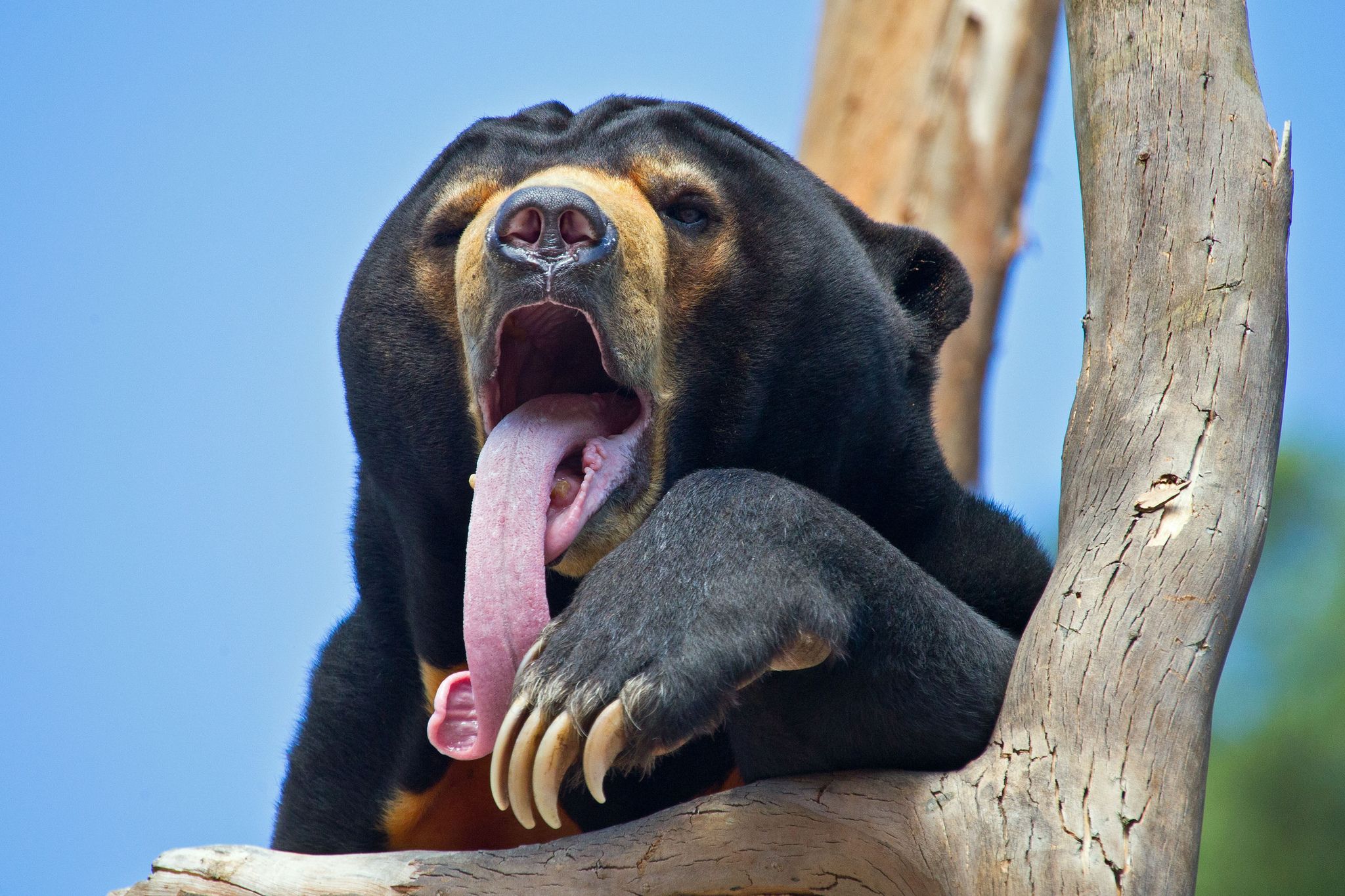
Pull up almost any viral wildlife clip from the past five years and there is a fair chance you have already seen a sun bear tongue at full extension. A small, glossy black bear with a creamy chest blaze sits in the fork of a tropical hardwood, dips its head into a hollow, and extends what looks impossibly like a thin pink ribbon out of its face.
The ribbon stretches and stretches, easily as long as the bear's own forearm, then retracts in a flicker. The first time most people watch the footage, they assume it is a digital edit or a snake hiding in the tree. It is neither. It is the tongue of a sun bear (Helarctos malayanus), the longest tongue of any bear on Earth, and the most heavily specialised feeding tool in the entire ursid family.
This is a closer look at that tongue: the measurements, the mechanics, the prey it pulls out of holes, the comparative anatomy that places it inside a wider story of insect-eating mammals, and the conservation reasons it matters. The sun bear is already the most physically distinctive member of the bear family, and the tongue is the single feature that makes that distinction visible from a metre away.
The Headline Numbers
Before the biology, the figures most readers came here to find.
| Trait | Sun bear value | Notes |
|---|---|---|
| Tongue length (protruded) | 20-25 cm | Longest of any bear species |
| Tongue length to body length | Roughly 1:5 to 1:6 | Highest ratio in Ursidae |
| Body length (head to rump) | 100-140 cm | Smallest bear species |
| Adult mass | 27-80 kg | About one tenth of a polar bear |
| Claw length (forepaw) | Up to 10 cm | Curved, used to open cavities |
| Termite consumption | Up to 1 kg per day | Field estimates from Bornean populations |
| Stingless bee specialty | Trigona species | Honey, brood, and wax targeted |
A sun bear weighs less than a German shepherd in many cases, yet projects a tongue longer than most domestic cats are tall. That mismatch is not accidental. Every centimetre of that tongue is the product of a feeding niche that no other bear in Asia exploits at anything like the same intensity.
"The tongue of Helarctos malayanus is, in functional terms, the most derived feeding apparatus in the bear family. It is the single trait that defines the species in cross-section just as clearly as the chest patch defines it from the front."
- Siew Te Wong, founder of the Bornean Sun Bear Conservation Centre, in conversation with field volunteers at the Sepilok facility, Sabah
The remarkable thing is not just that this tongue exists, but that it exists in a small, lightly built animal that nobody outside Southeast Asia had really studied until the 1990s. The sun bear was the last of the eight living bear species to receive sustained scientific attention, and the tongue is one of the reasons researchers had to throw out almost everything they had been told to expect of "small tropical bears".
What the Tongue Actually Looks Like
In a relaxed, closed mouth, the sun bear tongue is unremarkable. It folds inside the oral cavity in a manner similar to a domestic dog's tongue, occupying roughly the same volume relative to skull size. The species' tongue surface is darker than that of most temperate bears, with a charcoal pigmentation toward the base that fades to a pale pink toward the tip.
The drama begins when the bear extrudes the tongue. It is not a tongue that simply unrolls. It elongates, narrowing into a flexible probe that the bear can curl, hook, and rotate inside cavities far smaller than its own jaw. Several features distinguish it from the tongues of related species:
- Extreme length and elasticity. A protrusion of 20-25 cm from an animal whose closed muzzle measures only 12-14 cm.
- Tapering tip. Narrower at the working end, allowing access through holes too small for the snout.
- High musculature. The genioglossus and hyoglossus muscles are unusually well developed for an ursid, supporting fine motor control during extraction.
- Pigmented surface. Dense filiform papillae help retain insects, larvae, and viscous honey.
- Saliva chemistry. Field observations suggest abundant viscous saliva that traps prey items, comparable in function to the glue-like saliva of pangolins and anteaters.
To watch a sun bear feed at the Bornean Sun Bear Conservation Centre is to watch a precision instrument at work. The bear rips open a log with its forepaws, sniffs the cavity, then projects the tongue into the opening. The whole movement looks closer to that of an aardvark or a giant anteater than to any other bear.
"In our care facility we routinely watch sun bears clear an entire colony of stingless Trigona bees out of a hollow bamboo section in under two minutes. They use the tongue almost like a pipette. The honey, the brood, the wax fragments: everything goes the same way, and the bear barely moves its head."
- Bornean Sun Bear Conservation Centre, public interpretation panel, Sepilok, Sabah
How the Tongue Works in the Wild
The sun bear is sometimes described as an "anteater bear", and the description is not unfair, but it understates the breadth of the species' diet. The tongue is built for insect and honey extraction, but the same tongue handles soft tropical fruit, crushed beetle larvae, and even small vertebrate carcasses. What unites these foods is geometry: they are usually hidden inside something that needs opening, and the opening is usually too narrow for a bear-sized jaw.
The hunting sequence in the rainforest goes like this:
- Detect. The bear locates a target colony or fruit cache, almost always by smell. Sun bears have an exceptional olfactory sense, comparable to that of brown bears.
- Open. The forepaws, armed with curved claws up to 10 centimetres long, rip into the bark, mound, or wood.
- Extract. The tongue does the rest, working through the cavity faster than a bear can re-enlarge the opening with its claws.
- Persist. The bear remains at a single rich site for an hour or more, repeating the cycle until the colony is exhausted.
The tongue and the claws are paired tools that evolved together. A long tongue without strong opening claws would be useless, and powerful claws without a long tongue would lead to enormous wasted excavation. The pairing is the reason sun bears can profit from feeding niches that other Asian bears cannot.
"The functional unit is not the tongue alone but the tongue, the claws, and the bite. Take any one element away and the system fails. This is one of the reasons we treat dental and limb injuries in our rescued sun bears with such caution. A bear that loses claw function or jaw strength becomes effectively unable to feed naturally, regardless of tongue condition."
- Gabriella Fredriksson, Indonesian-Dutch sun bear ecologist, in Mammalian Biology 73 (2008): 28-35
The diurnal pattern matters here too. Where other Asian bears tend to feed at night to avoid people, sun bears in undisturbed forest are largely diurnal, partly because their primary prey colonies are most active during daylight. In human-disturbed areas, the species shifts to nocturnal foraging, but the tongue does the same job in the dark. It is a tool that does not depend on vision.
A Specialist's Menu: What the Tongue Pulls Out
The sun bear's diet is broader than the term "honey bear" suggests, but the long tongue is most clearly an adaptation to the high-calorie, low-volume insect resources that fill tropical forests year-round. Field studies from Borneo, Sumatra, and the Malay Peninsula list a remarkably consistent core menu.
Major insect and invertebrate prey
| Prey type | Typical genus or family | Where the tongue is used |
|---|---|---|
| Stingless bees | Trigona spp. | Honey, brood, wax extracted from hollow trees |
| Honey bees | Apis dorsata, Apis cerana | Honey raids on exposed combs |
| Subterranean termites | Macrotermes, Coptotermes, Microcerotermes | Mound interiors after claw breach |
| Wood-nesting termites | Nasutitermes spp. | Galleries inside fallen logs |
| Carpenter ants | Camponotus spp. | Tunnels inside standing dead trees |
| Weaver ants | Oecophylla smaragdina | Leaf nests, eggs and larvae |
| Beetle larvae | Cerambycidae, Scarabaeidae | Inside cracked hardwood |
| Earthworms | Several Asian taxa | Soft soil after rainfall |
Most field accounts list termites and stingless bees as the two single most important food categories by frequency of feeding sign, with hard mast fruits taking over during peak fruiting seasons such as durian and fig fruiting.
The sun bear is therefore not a strict insectivore in the way the giant anteater is, but it relies on a tongue with insectivore-grade specialisation across a substantial fraction of its annual diet. For more on the broader feeding ecology of the species, see the companion article on what sun bears eat.
A useful figure from Bornean studies: an adult sun bear can consume up to 1 kilogram of termites in a single day when a major mound is broken open during termite swarming events. That is several hundred thousand individual insects, and it would be physiologically impossible without a tongue that can pick them up faster than the bear has to chew them.
Why "Honey Bear"?
The English nickname for the sun bear is "honey bear", and the Malay equivalent, beruang madu, means the same thing. The name predates any scientific understanding of tongue length and reflects what villagers across Southeast Asia had observed for centuries: a small, black, claw-armed bear that smelled of beeswax, frequently appeared near hollow trees, and routinely raided beekeepers' wild log hives.
The species' relationship with honey is genuine and intense. Sun bears are willing to take hundreds of stings in a single session at a wild bee nest, and the loose neck skin that gives them rotational defence against predators also lets them shrug off bee attacks at the body. Wild Apis dorsata combs, which can hang from cliff faces and tall emergent trees, are accessed by sun bears that climb directly to the comb, hold on with their forepaws, and tongue out the honey while suspended.
That image, a small bear hanging from one paw and probing a comb with a 25-centimetre tongue, is exactly the one that has gone viral online over the past few years. It is also the image that has caused the most public confusion. Reposts on social platforms have variously claimed the footage shows a "fake bear", a "person in a bear suit", or a "rare anteater".
The viral confusion that swept the internet around 2017, when crowds at Hangzhou Zoo accused staff of dressing a person in a bear costume, deepened that misreading; readers can find the full story in our piece on how small the sun bear really is.
The bear itself is real. So is the tongue.
Comparative Tongue Anatomy: Where the Sun Bear Sits
To appreciate just how unusual the sun bear's tongue is, it helps to compare it to the tongues of other bears and of unrelated insectivorous mammals. The picture that emerges is of a single species solving a tropical-forest extraction problem with anatomy that no other bear has bothered to evolve.
Tongue length comparison across selected mammals
| Species | Approximate tongue length | Body length | Feeding niche |
|---|---|---|---|
| Sun bear (Helarctos malayanus) | 20-25 cm | 100-140 cm | Insects, honey, fruit (specialist) |
| Sloth bear (Melursus ursinus) | 10-15 cm | 140-190 cm | Termites and ants (suction-based) |
| Asiatic black bear (Ursus thibetanus) | 9-11 cm | 120-190 cm | Generalist omnivore |
| Brown bear (Ursus arctos) | 10-12 cm | 170-280 cm | Generalist omnivore |
| American black bear (Ursus americanus) | 9-12 cm | 120-200 cm | Generalist omnivore |
| Polar bear (Ursus maritimus) | 10-13 cm | 200-300 cm | Marine carnivore |
| Giant panda (Ailuropoda melanoleuca) | 10-12 cm | 120-190 cm | Bamboo |
| Spectacled bear (Tremarctos ornatus) | 8-10 cm | 130-200 cm | Vegetation, fruit |
| Giant anteater (Myrmecophaga tridactyla) | 50-60 cm | 180-220 cm | Ants and termites (specialist) |
| Ground pangolin (Smutsia temminckii) | 25-40 cm | 60-80 cm | Ants and termites (specialist) |
Two patterns jump out. First, every bear except the sun bear sits in a narrow band of 8-15 cm tongue length, regardless of body size. The sun bear breaks that pattern decisively. Second, the only mammals that do break the pattern in the same direction, the anteaters and pangolins, are full insectivore specialists with much more extreme anatomy. The sun bear sits, evolutionarily speaking, on the early shoulder of an insectivore curve that other lineages have followed all the way.
Among the bear family, the closest functional comparison is the sloth bear of India, Sri Lanka, and Nepal. The sloth bear has converged on the same problem, vacuuming termites and ants out of mounds, but with very different anatomy. Its solution is a missing pair of upper incisors, a long mobile snout, and pursed lips, all driving a powerful suction system that can pull termites in and out at audible distance.
The sun bear, in contrast, evolved a longer, more dexterous tongue and kept its dentition intact. The sloth bear vacuums; the sun bear probes. Two specialist Asian bears, two different paths to the same calorie source.
For a side-by-side look at the sun bear and another commonly confused Asian bear, the species pair is covered in sun bear vs moon bear.
"What you see in the sun bear and the sloth bear is one of the cleanest cases of independent evolution toward the same dietary niche inside a single mammal family. They are not sister species, they are not geographically overlapping in any meaningful way, and yet they ended up sharing a feeding strategy. Convergent evolution in the bear family is rarer than people think, and this is the textbook example."
- IUCN Bear Specialist Group, Bears: Status Survey and Conservation Action Plan, 1999 update
How the Tongue Develops
Sun bear cubs are born small, blind, and almost hairless, in a den at the base of a hollow tree or in a thicket. The mother carries, suckles, and grooms a single cub (rarely two) for the first months. Tongue elongation in the cub appears early.
Hand-reared cubs at the Bornean Sun Bear Conservation Centre extend tongues already disproportionate to their bodies by their fourth or fifth month, and by the time they are weaned at twelve to eighteen months they are using the tongue in adult fashion to probe enrichment puzzles.
This early development matters because sun bear mothers spend an unusually long time with their cubs, often two years or more, and a substantial portion of that time is spent teaching foraging. A juvenile sun bear watches its mother open a termite mound, then reproduces the sequence on the next mound. The tongue's reach is innate; the foraging behaviour around it is learned.
This is one of the reasons captive-raised orphans cannot be released directly into the wild. They have the equipment but not the curriculum. Rehabilitation programs in Sabah and Sumatra spend years teaching former pet-trade orphans how to actually use the tongue in a forest setting. Without this slow, hands-off retraining the bears starve, regardless of the tools they were born with.
For broader context on sun bear behaviour and ecology, see the main sun bear species profile, the article on where sun bears live, and the related piece on how fast sun bears can climb trees.
Why the Tongue Matters for Conservation
It is tempting to treat tongue length as a piece of trivia, the kind of fact that goes well in a quiz card. In practice, the sun bear's tongue has several direct conservation implications.
First, the tongue is part of the species' niche signature. Sun bears do something in tropical forests that no other bear does. They redistribute insect biomass, open up hardwood logs that then become microhabitats for hundreds of smaller species, and disperse fruit seeds across enormous home ranges. The tongue is a non-substitutable part of that ecological role. If sun bears disappear, no other Asian mammal steps into the niche.
Second, the tongue is fragile. Captive bears with poor diets, missing teeth, or chronic infection lose tongue function early, and rehabilitation programs have learned to monitor it as a leading welfare indicator. Bears rescued from bile farms, where iron cages and monotonous food regimes are the rule, often present with reduced tongue length and reduced muscular control even after their bodies recover.
Third, the tongue's specialisation makes the species especially vulnerable to habitat change. Sun bears can survive in selectively logged forest as long as termite mounds, hollow trees, and stingless bee colonies remain. They cannot survive in oil palm monocultures. Industrial agriculture removes the very microhabitats that the long tongue evolved to exploit. The tongue is, in a sense, both the species' greatest competitive advantage and the trait that pins it to a vanishing forest type.
The IUCN Red List currently classifies Helarctos malayanus as Vulnerable with a decreasing population trend. Habitat loss, the pet trade in cubs, and the persistent illegal trade in sun bear gall bladders for traditional medicine are the three principal threats. None of these will be solved by knowing the tongue length, but understanding why the species is so deeply tied to intact forest does help build the public case for protecting that forest in the first place.
For curious readers who want to understand the visual identification of the species, the chest patch story is covered in why sun bears have chest markings.
How Viral Photos Confused the Public
In recent years the most widespread images of the sun bear have arrived not through nature documentaries but through social media. A still photograph of a sun bear standing on its hind legs at Hangzhou Zoo, with the tongue partly extended, prompted online accusations that staff had dressed a person in a costume. Subsequent video clips of feeding bears at rescue centres, with the tongue at full extension into a hollow, attracted similar suspicion.
There are several reasons the species reads as "uncanny" in casual photography. The smallest size in the bear family, combined with the smooth black coat, the cream chest blaze, and the extreme tongue, simply does not match the brain's stored template for "bear". Sun bears also rear up frequently, often holding the upright posture for long stretches while sniffing the air, which heightens the resemblance to a bipedal animal in a costume.
The viral confusion has been good and bad for the species. On one hand, it has generated more global awareness of Helarctos malayanus than any other event in the species' modern history; rescue centres and conservation NGOs have used the moment well. On the other, it has reinforced the idea that the sun bear is a curiosity rather than a serious conservation priority. A bear that looks like a costume can be hard to argue for in a budget meeting.
Educators, zookeepers, and researchers have responded by foregrounding the tongue as a teaching feature. Once visitors understand what the tongue is for, they tend to treat the rest of the animal as the genuine, evolutionarily distinct species it is.
Other Species Worth Comparing
The sun bear's tongue makes most sense in a comparative frame. Several other bears are worth a look in this context. The closest tropical-bear analogues are the sloth bear, mentioned above, and to a much lesser extent the spectacled bear of the Andes, which is largely vegetarian but shares the small-bear, tropical-environment profile.
The giant panda sits at the opposite end of the dietary spectrum: a bamboo specialist whose tongue and oral anatomy have moved in a completely different direction, away from extraction and toward grinding.
Outside the bear family, the long-tongue feeding niche has been radiated repeatedly. Anteaters, pangolins, aardvarks, numbats, and even some small primates have evolved similar solutions to the same problem. None are close relatives. The convergence simply tells us that, in habitats where social insects represent a stable, high-calorie food source, evolution finds long tongues again and again.
For readers interested in the cognitive and behavioural sophistication that often accompanies these specialised feeding niches, our partner sites publish related material: the cognitive research site whats-your-iq.com is a good starting point for the question of how foraging specialisation shapes brain evolution, and the music-cognition platform whennotesfly.com covers the equivalent topic of acoustic learning in non-human animals.
Readers who like long-form science writing in adjacent fields may also enjoy the language and writing platform at evolang.info.
Studying the Tongue Yourself
For the rare reader who wants to study the sun bear tongue more directly, a few practical notes.
- Field observation is hard. Sun bears are reclusive in undisturbed forest and rarely allow approach close enough to see the tongue clearly. The best chance is fixed-camera footage, particularly at fruiting trees and known termite hotspots.
- Captive observation is easier. Rescue centres in Sabah and Sumatra offer regular public viewing, and most run feeding enrichment sessions designed to bring the tongue out into clear view.
- Skull and dental specimens are widely available in mammalogy collections, including in major European, North American, and Asian natural history museums.
- Published material is now substantial. The 2008 Mammalian Biology paper by Fredriksson and colleagues on Bornean sun bear ecology remains a standard reference, and more recent work from the Sabah-based teams has filled in fine-grained behavioural detail.
If you are looking to build careers around wildlife biology, related skill-building sites include the certification preparation platform pass4-sure.us and the document conversion utility fileformer.com, both of which are useful tools for students preparing applications and submission materials.
Closing the Loop
The sun bear is the smallest, the strangest, and arguably the most misunderstood member of the bear family. Its tongue, at 20 to 25 centimetres, is the single most diagnostic feature of the species, and the one that most clearly explains the rest of its biology.
The same tongue that makes the sun bear look surreal in viral footage is the reason the species can survive on stingless bees and termite swarms in forests where the other Asian bears would lose to the larger generalists. It is the reason villagers across Southeast Asia have called this bear beruang madu for centuries before any biologist measured a single specimen.
For the broader story of the species, return to the main sun bear profile. For its diet, see what do sun bears eat. For its small size, see how small the sun bear really is. The tongue is only the most visible part of a species that, the more closely you look, becomes only stranger and more compelling.
References
- Fredriksson, G., Wich, S. A., and Trisno (2006). Frugivory in sun bears (Helarctos malayanus) is linked to El Nino-related fluctuations in fruiting phenology, East Kalimantan, Indonesia. Biological Journal of the Linnean Society 89: 489-508. https://doi.org/10.1111/j.1095-8312.2006.00688.x
- Wong, S. T., Servheen, C., and Ambu, L. (2002). Food habits of Malayan sun bears in lowland tropical forests of Borneo. Ursus 13: 127-136. https://doi.org/10.2192/1537-6176(2002)013[0127:FHOMSB]2.0.CO;2
- Te Wong, S., Servheen, C., and Ambu, L. (2004). Home range, movement and activity patterns, and bedding sites of Malayan sun bears in the rainforest of Borneo. Biological Conservation 119: 169-181. https://doi.org/10.1016/j.biocon.2003.10.029
- Steyaert, S. M. J. G., et al. (2012). The mating system of the brown bear Ursus arctos: review and new insights from a Southern European population. Mammal Review 42: 12-34. https://doi.org/10.1111/j.1365-2907.2011.00184.x
- Garshelis, D. L. and Steinmetz, R. (2020). Helarctos malayanus. The IUCN Red List of Threatened Species 2020: e.T9760A123798233. https://doi.org/10.2305/IUCN.UK.2020-1.RLTS.T9760A123798233.en
- Joshi, A. R., Garshelis, D. L., and Smith, J. L. D. (1997). Seasonal and habitat-related diets of sloth bears in Nepal. Journal of Mammalogy 78: 584-597. https://doi.org/10.2307/1382910
- Taylor, M. F. J., Read, J. L., et al. (2009). Convergent evolution of insectivory in mammalian carnivores. Mammalian Biology 74: 425-440. https://doi.org/10.1016/j.mambio.2009.05.003
- Taylor, A. B., et al. (2018). Comparative anatomy of the tongue in Carnivora. Journal of Anatomy 233: 251-272. https://doi.org/10.1111/joa.12831
Frequently Asked Questions
How long is a sun bear tongue?
Adult sun bears (Helarctos malayanus) extrude a tongue that measures 20 to 25 centimetres, the longest of any bear species relative to body size and the longest in absolute terms among the eight living ursids. That is roughly the length of a pencil or a standard kitchen knife, projected from the mouth of an animal that itself rarely exceeds 70 centimetres at the shoulder.
The tongue is muscular, narrow, slightly tapered toward the tip, and capable of curling into and out of small openings. Researchers at the Bornean Sun Bear Conservation Centre in Sabah have recorded captive bears reaching deep into hollow logs and bamboo internodes that no other carnivore in the region could exploit.
The functional reach matters more than the bare measurement: the tongue acts in concert with the bear’s long, curved claws, which open the cavity, and a flexible jaw that lets the head twist sideways into narrow holes. Together this produces an extraction tool unique among bears.
Why is the sun bear tongue so long?
The sun bear evolved its long tongue as an adaptation to a diet built around social insects and stingless bee honey in tropical Southeast Asian rainforests. Termite mounds, ant colonies inside hollow trees, and Trigona bee nests deep in tree cavities all hide concentrated, high-calorie food behind narrow openings.
A bear with normal tongue length and bear-sized claws can rip the structure open but cannot reach the prey inside without further damaging the wood. A long protrusible tongue solves that problem. It also reduces the time the bear spends with its head pressed against an angry colony, which lowers exposure to stings and bites. Comparative anatomy supports this interpretation.
The other heavily insectivorous bear, the sloth bear (Melursus ursinus) of South Asia, evolved a different solution to the same problem: shorter tongue, but pursed lips and a missing pair of upper incisors that let it suction termites in and out at high speed. Two bears, two tongue strategies, one feeding niche.
Does any other bear have a tongue this long?
No. The sun bear is the only bear species whose tongue regularly exceeds 20 centimetres in protruded length, and the only Asian bear with this trait. Sloth bears come closest in functional terms, with tongues around 10 to 15 centimetres combined with their suction-feeding apparatus, but their absolute length is shorter.
Brown bears, polar bears, American black bears, Asiatic black bears, spectacled bears, and giant pandas all have proportionally short, wide tongues suited to general omnivory rather than insect extraction.
The closest mammalian parallel to the sun bear in tongue specialisation is not another bear at all but the giant anteater (Myrmecophaga tridactyla), whose tongue reaches 60 centimetres and shares the same insect-extraction logic, despite the two species being separated by tens of millions of years of evolution.
The sun bear represents what convergent evolution looks like inside the bear family: a single species, on a single feeding strategy, with anatomy radically different from its close relatives.