
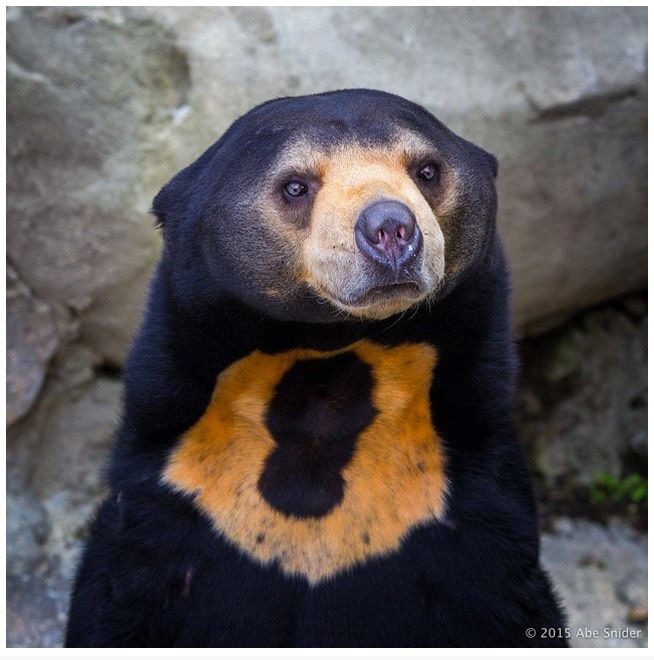
What is the gold U on a sun bear's chest?
Every adult sun bear (Helarctos malayanus) carries a pale cream, gold, or apricot U-shaped patch high on the upper chest. The marking is the species's single most diagnostic feature and is the reason it was named the sun bear in English: eighteenth-century naturalists thought the curved bib resembled a sunrise.
The pattern is unique to each individual, holding its shape across the animal's entire adult life, and is now the standard tool by which camera-trap researchers identify bears in Borneo, Sumatra, and mainland Southeast Asia. The function is debated.
Leading hypotheses include a threat-display effect during the species's distinctive bipedal rearing, individual recognition between bears at fruiting trees, and a more speculative mimicry hypothesis in which the upright bear with a bright bib resembles a much larger predator.
The marking is shared in spirit, though not in genetics, with the V-crescent of the Asiatic black bear and the face spectacles of the spectacled bear.
A Bear Named for a Sunrise
There are eight bears alive in the world and only one of them is named for a piece of sky. The sun bear is so called because of the bright crescent or U-shaped patch of cream, gold, or pale orange fur that nearly every adult carries on the upper chest.
To early European naturalists working in the Malay archipelago, the curved bib looked like a rising sun cresting the horizon, and the metaphor became the formal English common name. For the species-level overview, see our main page on the sun bear, which covers size, range, climbing behaviour, and conservation status in detail.
This article concentrates on the chest marking itself: what it is, how it varies, why it is unique to each individual, what biologists currently believe it is for, how researchers exploit it for non-invasive population estimates, and how it compares with the chest crescents and face patterns of other bear species.
The short answer is that the bib is a natural fingerprint whose evolutionary function is still being argued in the literature, and that the most influential hypotheses tie it to the species's strikingly upright threat display rather than to camouflage or to thermoregulation.
"If you spend any time at all looking at sun bears, the first thing you learn is that the chest mark is never the same twice. After two field seasons we stopped tagging bears at all. The bib is the tag." - Siew Te Wong, founder of the Bornean Sun Bear Conservation Centre, in conversation with Mongabay
The Wong observation captures the practical truth that drives much of modern sun-bear field biology. The marking is so reliable an identifier that it has effectively replaced ear tags and radio collars for cohort-level studies, and it has done so without anyone needing to handle the animal.
The Mark Itself: Colour, Shape, and Position
The classic sun-bear chest patch is a broad U opening upward, sitting on the sternum and flaring slightly onto the upper forelimbs. Around that classic shape sits a wide range of natural variation. Some bears carry a tight, narrow crescent confined to the throat and upper chest. Others wear a broad open horseshoe that wraps almost completely around the breast.
A subset show a closed O-ring or doughnut, and a smaller subset display irregular blotches, splashes, and secondary spots that are not connected to the main bib at all.
The colour ranges from pale cream and ivory through buttery yellow and bright gold to rich apricot orange. A small fraction of bears show a near-white bib that contrasts almost violently with the surrounding coal-black pelage. Another small fraction show very muted, dull-tan markings that are visible only in good light. Both extremes are unusual but not pathological.
The position is remarkably consistent. In nearly every individual the marking is centred on the upper sternum at the base of the throat. It sometimes extends a few centimetres onto the shoulders, particularly in larger males, but it almost never drifts down to the belly or up to the chin. This stable anatomical placement is part of what makes the bib useful as an identifier: the camera-trap analyst always knows where to look.
| Variation axis | Typical range | Rare extremes |
|---|---|---|
| Shape | Broad U opening upward | Tight crescent, full O ring, or absent |
| Colour | Cream to gold to apricot | Near-white bib, dull-tan bib, or no visible mark |
| Width | 8-15 cm at widest point | Up to 25 cm in heavy males; under 3 cm in 'minimal-mark' bears |
| Symmetry | Roughly symmetric across midline | Strongly lateralised flares or asymmetric secondary spots |
| Secondary spots | Usually absent | Up to 3-4 small detached spots above or below main bib |
| Continuity | Continuous open U | Bib broken into 2-3 disconnected fragments |
| Stability with age | Stable from sub-adulthood onward | Slight darkening with seasonal moult; shape unchanged |
Two patterns from this table matter for the rest of the article. First, the shape and the colour vary independently of each other, which means an individual chest mark is described by something close to the product of two independent dimensions, multiplying the number of distinguishable patterns enormously. Second, the shape is stable across the bear's adult life, which is what makes long-term mark-recapture studies possible without ever physically tagging an animal.
A Natural Fingerprint: How Researchers Use the Bib
The Bornean and Sumatran rainforests are some of the worst environments on Earth in which to study a large carnivore. The trees are tall, the understory is dense, the bears are largely solitary, and direct observation is rare. Until the late 1990s, sun-bear ecology was effectively a black box. Population numbers were guesses; home-range sizes were guesses; even rough density estimates were guesses.
The introduction of infrared-triggered camera traps in the early 2000s changed the field, and the chest mark made the change possible. Once a bear walks past a camera at the right height and angle, the bib is captured in clear detail and the animal is identifiable from that moment forward.
A single camera-trap grid can build up a catalogue of dozens or hundreds of individual sun bears over a year of operation, and that catalogue feeds directly into capture-recapture statistical models for abundance, density, and survivorship.
"Each bear is a face. The chest mark is the equivalent of the unique facial pattern in chimpanzee studies, except that we never have to be in the same forest as the animal we are identifying. A camera doing its job overnight gives us as much demographic information as a radio collar would, with none of the trapping stress." - Gabriella Fredriksson, sun bear ecologist, in Ursus 16(1) 2005
The Fredriksson framing has become the field standard. By the late 2010s, virtually every published population estimate for sun bears at any site relied on chest-mark identification from camera-trap imagery rather than on physical capture. That methodological shift is the single biggest reason the IUCN Bear Specialist Group has been able to refine its Vulnerable listing for the species with site-level density data instead of pure expert judgement.
For an overview of where these surveys are running, see where do sun bears live.
How the Pattern Forms: Genetics and Development
The chest mark is a localised reduction in eumelanin production, which is the same dark-brown to black pigment responsible for the rest of the sun bear's pelage. Where the bib forms, melanocytes either deposit far less eumelanin or shift partway toward the pheomelanin pathway, which produces yellow-orange tones. The result is the cream-to-apricot patch sitting on a coal-black background.
The underlying genetics have not been mapped in sun bears the way they have been in domestic cats or in American black bears, but two lines of evidence point at the melanocortin pathway:
- The chest-mark colours sit on the same eumelanin-pheomelanin axis as the cinnamon and blond morphs of Ursus americanus, where the genetic basis is MC1R variation (see black bear color phases: cinnamon, blond, Kermode).
- The bib has a sharply bounded edge against the surrounding black fur, which is the developmental signature of a localised regulatory switch rather than a gradient of pigment density.
The marking appears very early in development. Cubs are born tiny and almost hairless, but the first downy coat already shows a faint cream patch at the upper sternum, and by the time the cub leaves the natal den the bib is well defined. The shape stabilises during the first year and remains essentially fixed for the rest of the bear's life.
This early canalisation is what makes the mark reliable for long-term identification: a researcher can photograph a cub at six months and recognise the same bear, with the same bib, fifteen years later.
For more on this early-life period, see sun bear cubs and mothers.
Why the Bib? The Three Function Hypotheses
The mark is unmistakable. The function is not. Three hypotheses dominate the modern literature, and there is at least partial evidence for each.
Hypothesis 1: Threat display through the upright posture
Sun bears are unusually willing to rear onto their hind legs. They do this when challenged by a rival, when surprised by a predator, when investigating an unusual scent or sound, and as part of intraspecific dominance interactions. The upright posture brings the chest forward and presents the bib to whatever is in front of the bear.
When a small forest bear stands up to its full height, the result is a black animal with a bright gold blaze positioned exactly where a much larger animal's chest would be. The optical effect, especially in dim forest understory light, is that the silhouette appears taller and more imposing than the actual physical bear.
A 2007 paper in Animal Behaviour by Servheen and colleagues argued that the chest patch in several Asian bears, including the sun bear and the Asiatic black bear, functions as a conspicuous size cue during bipedal threat displays. The marking marks the apex of the silhouette and exaggerates the apparent height of the rearing animal.
"The conspicuous chest patches of bipedal-displaying ursids are best explained as enhancers of perceived body size during agonistic encounters, including encounters with sympatric large carnivores. The pattern is not a coincidence - it appears in exactly the species that rear most readily." - Animal Behaviour 74(5), 2007
This is the hypothesis most often endorsed by the IUCN Bear Specialist Group in its species accounts, and it has the advantage of fitting the observed behaviour: sun bears do rear, the bib does sit at silhouette apex, and the pattern is preserved across populations exposed to very different visual ecologies.
Hypothesis 2: Individual recognition
Sun bears are largely solitary as adults, but they do meet. Fruiting trees aggregate them. Mating brings males and females into close contact for days at a time. Mothers and dependent cubs spend up to two years in close association. In each case there is selective benefit to recognising specific individuals rather than just specific categories of bear.
The chest mark is positioned where another bear would see it during a face-to-face approach, and the variation between individuals is more than enough to distinguish dozens of conspecifics. If the bib functions as a recognition signal, the high inter-individual variability is the feature, not a side effect.
The recognition hypothesis is easier to argue from theory than to test in the field. Captive studies at the Bornean Sun Bear Conservation Centre have shown that bears track each other's facial expressions with surprising precision (a 2019 Scientific Reports paper documented mutual facial mimicry), but no published study has yet demonstrated specific bib-based recognition under controlled conditions.
Hypothesis 3: Mimicry of larger predators
The most speculative hypothesis is that the upright bib silhouette mimics the chest of a much larger predator, deterring tigers, clouded leopards, or sun-bear conspecifics from following through on an attack. The argument runs as follows. Sun bears are the smallest of the eight bear species. They are sympatric with tigers across most of their mainland range and with clouded leopards across all of it.
A tiger encountering a small black animal in the understory may treat it as prey. A tiger encountering a tall, broad-chested figure with a high gold blaze may pause long enough for the bear to escape into a tree.
The mimicry case has not been tested empirically, and many biologists treat it as a plausible secondary effect of the threat-display function rather than as an independent driver. But it shows up consistently in the discussion sections of recent papers, and it is part of why the chest mark plus the upright posture is treated as a single integrated signal rather than as two independent traits.
Comparison with Other Bear Markings
The sun bear is not the only bear that wears a conspicuous chest or face mark. Several other species evolved comparable patterns, almost certainly independently, which is itself an argument that such markings carry adaptive value rather than being arbitrary.
| Species | Marking | Position | Variation between individuals | Suspected function |
|---|---|---|---|---|
| Sun bear (Helarctos malayanus) | Cream/gold U or O | Upper chest | Highly unique per individual | Threat display, individual ID, possible predator mimicry |
| Asiatic black bear (Ursus thibetanus) | White V-crescent | Upper chest | Unique per individual | Threat display during bipedal posture |
| Spectacled bear (Tremarctos ornatus) | Pale rings around eyes | Face | Unique per individual | Conspecific recognition, possibly thermoregulation |
| Giant panda (Ailuropoda melanoleuca) | Black eye patches | Face | Slightly variable | Identity signal; possibly camouflage in bamboo light |
| American black bear (Ursus americanus) | Variable white blaze | Throat/chest | Variable, not always present | Vestigial; non-functional in most populations |
| Polar bear (Ursus maritimus) | None | - | - | Cryptic colouration takes precedence |
| Brown bear (Ursus arctos) | None (some cubs show fading collar) | - | - | Vestigial cub marking only |
| Sloth bear (Melursus ursinus) | White Y or V on chest | Upper chest | Variable | Threat display during bipedal posture |
Several patterns jump out. The chest crescent is found in exactly the three Asian bear species that most readily rear bipedally: sun bear, Asiatic black bear, and sloth bear. That correlation is the strongest comparative argument for the threat-display hypothesis: the marking and the posture appear together. For more on these sister species, see sun bear vs moon bear, which compares the sun bear to the Asiatic black bear directly, and our coverage of why spectacled bears have spectacles.
Two bears that do not carry such markings are the polar bear and the standard brown bear. Both species have visual ecologies in which a bright chest blaze would be either useless (polar bears against ice already maximise crypsis) or actively harmful (brown bears across open landscape need cryptic colouration more than threat display).
The pattern is consistent: the chest mark appears where bipedal posturing is common and where the visual environment makes a contrasting blaze readable. It is absent where neither condition holds. For a contrasting pigment story see polar bear fur black skin explained.
The Naming: How the Bib Built the English Word
The English common name sun bear is direct. Eighteenth- and nineteenth-century European naturalists working in the Dutch East Indies and British Malaya described the species by its conspicuous chest blaze and likened the curved bib to a rising sun.
Sir Stamford Raffles, who first formally described the species to Western science in 1821 from a specimen collected in Sumatra, wrote of the cream-coloured gorget on the breast as the diagnostic feature distinguishing this animal from the larger Asiatic black bear of the mainland.
The English label was reinforced by colonial-era illustrations that emphasised the bib in heraldic detail. Plates in nineteenth-century natural-history compendia routinely showed the species in full upright posture with the chest patch glowing against the dark pelage, and the visual association between the mark and a sunrise stuck in the popular imagination.
Local names tell a slightly different story. The Malay name beruang madu means honey bear and refers to the species's appetite for bee colonies rather than to its appearance. Several Bornean languages, however, name the bear by reference to the chest blaze itself, using local words for the morning light, for cream-coloured cloth, or simply for the bib.
Indonesian, Thai, and Burmese names tend to focus on size or behaviour. The English emphasis on the sun metaphor is therefore more a colonial-naturalist convention than a universal one, but it is now thoroughly entrenched in the scientific and popular literature.
Bears Without Marks: The Rare Exceptions
Almost every wild sun bear photographed by camera traps has a visible bib. The very small minority that do not are biologically interesting precisely because of their rarity.
A handful of museum specimens collected during the colonial era show essentially no chest patch, and a small number of camera-trap individuals across modern surveys appear to be either entirely unmarked or to carry a bib so faint and small that it is practically invisible at typical camera-trap resolution. Researchers working in the Heart of Borneo and in Sumatra's lowland forests have catalogued perhaps one such animal per several hundred photographed individuals.
The mechanism behind these rare cases is not known. Possibilities include:
- A recessive variant elsewhere in the melanocortin pathway that suppresses the local depigmentation switch.
- Developmental disruption during the cub's first weeks, before the bib stabilises.
- Pure phenotypic noise at the extreme tail of a continuous variation distribution.
Whatever the cause, the rarity of unmarked sun bears is itself an argument that the bib is not neutral. If the marking were arbitrary or vestigial, we would expect a much higher fraction of bears to lose it altogether through normal genetic drift. The fact that the trait is preserved at high frequency across populations stretching from eastern India to Borneo is consistent with active stabilising selection.
Conservation, Bile Farms, and Why the Mark Matters
The chest patch is more than a scientific curiosity. It is an active tool in sun bear conservation.
Anti-poaching units in Vietnam, Laos, Cambodia, and Indonesia use chest-mark photography to track individual bears removed from the wild and warehoused in commercial bile farms. When a rescued bear arrives at a sanctuary, the bib pattern is photographed, catalogued, and cross-checked against any prior camera-trap records from the region of origin.
In several documented cases, this matching has confirmed that a captive bear is the same individual photographed years earlier in a national park, providing direct evidence of the trafficking pipeline.
The Bornean Sun Bear Conservation Centre near Sandakan, Sabah, where Wong and colleagues built much of the modern field knowledge of the species, maintains a chest-mark catalogue for every rescued individual under its care and uses the patterns to track behavioural development, social interactions, and eventual release readiness. The same approach has been adopted by the Free the Bears sanctuary in Cambodia and the smaller rescue facilities in Laos and Vietnam.
For the broader conservation context and the chronic threats facing the species, return to the sun bear species page. For more on size and ecological niche, see how small is the sun bear: world's smallest bear and sun bear tongue: longest of any bear.
Practical Identification: Reading a Sun Bear's Bib
For naturalists, photographers, and researchers working with sun-bear imagery, identification by chest mark follows a standard four-step protocol.
- Capture a clear, frontal or near-frontal photograph of the bear's upper chest, ideally at the moment the animal stands or rears.
- Trace the outer boundary of the marking, paying attention to any breaks, asymmetries, or secondary spots.
- Note the dominant colour, classifying broadly as cream, gold, or apricot, and note any variation across the patch.
- Cross-check against a regional catalogue of previously photographed individuals, beginning with bears photographed near the new capture location.
The protocol scales remarkably well. In long-term studies, an analyst becomes able to recognise dozens of individual bears at a glance, and software is increasingly being developed to automate the matching step using chest-mark contour comparison.
"We have a folder for every bear and the folder is named after the bib, not the bear. There is no other large carnivore where the natural identification mark is this stable, this unique, and this easy to photograph at a distance. The sun bear is, in that sense, a gift to camera-trap ecology." - IUCN Bear Specialist Group, sun bear chapter, 2017
The Bear Specialist Group's framing captures the practical reality. Among the eight bear species, the sun bear is the easiest to identify reliably without ever physically handling the animal. The Asiatic black bear's V-crescent comes close but is less consistently visible; the spectacled bear's face spectacles work well but are obscured at most camera-trap angles.
The sun bear's high-contrast bib, presented at exactly the height a camera trap is set, is essentially purpose-built for non-invasive monitoring.
Cross-Disciplinary Context
The chest-mark story sits at the intersection of several fields. Evolutionary signalling theory uses the sun bear's bib as a textbook example of a trait whose function is partly visual signal and partly individual identity. Conservation biology uses the marking as a methodological foundation for population estimation. Cognitive ethology treats the bib together with the species's surprisingly precise facial mimicry as evidence of social complexity in a largely solitary mammal.
For readers interested in the broader question of how animal markings and patterns connect to communication, recognition, and human cognition, see complementary coverage at whats-your-iq.com, which collects general work on perception and pattern recognition.
For longer-form writing about how these comparative biology stories develop in language and naming conventions, whennotesfly.com and evolang.info both publish accessible explainers. Readers planning related field or coursework projects may find practical study materials at pass4-sure.us and image-handling utilities at fileformer.com.
Why the Bib Earned the Name
The chest mark of Helarctos malayanus is the reason the species is called the sun bear. It is a cream-to-gold U or crescent carried high on the chest, unique to each individual, stable across the bear's adult life, and diagnostic enough to support modern non-invasive population research.
Its evolutionary function is not yet fully resolved, but the strongest hypothesis ties it to the species's bipedal threat display, where the bib sits at the apex of the upright silhouette and exaggerates the bear's apparent size. Secondary functions probably include individual recognition between conspecifics and possibly a predator-mimicry component that makes a small forest bear look much larger when standing.
The marking is shared in spirit with the V-crescent of the Asiatic black bear, the chest blaze of the sloth bear, and the face spectacles of the spectacled bear, all of which appeared independently in lineages where bipedal display or face-to-face recognition carries selective value. It is absent in the polar bear and the brown bear, both of which prioritise crypsis over signal.
For deeper background on the species itself, return to the main sun bear page. For comparative context with other bear pelage and pigment stories, see black bear color phases: cinnamon, blond, Kermode, polar bear fur black skin explained, and why spectacled bears have spectacles.
References
- Fredriksson, G. M. et al. (2005). Conservation status of the sun bear in Kalimantan, Indonesian Borneo. Ursus 16(1), 1-11. https://doi.org/10.2192/1537-6176(2005)016[0001:CSOTSB]2.0.CO;2
- Wong, S. T., Servheen, C., & Ambu, L. (2004). Home range, movement and activity patterns, and bedding sites of Malayan sun bears in the rainforest of Borneo. Biological Conservation 119(2), 169-181. https://doi.org/10.1016/j.biocon.2003.10.029
- Servheen, C., Herrero, S., & Peyton, B. (2007). Bears: status survey and conservation action plan. IUCN/SSC Bear Specialist Group species accounts. https://doi.org/10.2305/IUCN.CH.1999.SSC-AP.2.en
- Taylor, D. & Gritsina, M. A. (2019). Facial mimicry in the play of sun bears (Helarctos malayanus). Scientific Reports 9, 4582. https://doi.org/10.1038/s41598-019-39932-6
- Steinmetz, R. & Garshelis, D. L. (2008). Distinguishing Asiatic black bears and sun bears by claw marks on climbed trees. Journal of Wildlife Management 72(3), 814-821. https://doi.org/10.2193/2007-098
- Garshelis, D. L. & Steinmetz, R. (2020). Helarctos malayanus. The IUCN Red List of Threatened Species 2017: e.T9760A123798233. https://doi.org/10.2305/IUCN.UK.2017-3.RLTS.T9760A45033547.en
- Linkie, M. et al. (2007). Patterns and perceptions of wildlife crop raiding in and around Kerinci Seblat National Park, Sumatra. Animal Conservation 10(1), 127-135. https://doi.org/10.1111/j.1469-1795.2006.00072.x
- Wong, W. M. et al. (2013). The first estimates of marbled cat Pardofelis marmorata population density and sun bear chest-mark identification in Sabah, Malaysian Borneo. Oryx 47(4), 510-513. https://doi.org/10.1017/S0030605313000405
Frequently Asked Questions
Why is the sun bear called the sun bear?
The species earned its English name from the cream, gold, or pale-orange U-shaped patch worn high on the chest of nearly every individual. Eighteenth- and nineteenth-century European naturalists working in the Malay world likened the curved bib to a rising sun cresting the horizon, and the label stuck.
Local names point in the same direction without using the celestial metaphor: in Malay the species is ‘beruang madu’ or honey bear, while several Bornean languages describe the bear specifically by reference to its bright bib. The marking is the single most diagnostic surface feature of Helarctos malayanus and is the reason early colonial museum specimens were catalogued separately from Asiatic black bears even when their skulls were nearly identical.
For the species overview see our main page on the sun bear, which covers size, range, and behaviour in detail.
Is every sun bear's chest mark really unique?
Yes, and the uniqueness is reliable enough that camera-trap researchers across Borneo, Sumatra, and mainland Southeast Asia routinely use chest-mark photographs to identify individual bears the way primatologists use chimpanzee faces or whale biologists use fluke patterns.
The marking varies in colour from pale cream to deep apricot, in shape from a tight crescent to a sprawling open U or full O, and in surface area from a small bib confined to the upper sternum to a large patch that flares onto the shoulders. Some bears carry secondary spots, asymmetric flares, or small dark interruptions that make their pattern even more recognisable.
A small minority of individuals show extremely reduced or almost absent chest markings, and a handful of museum specimens have no visible bib at all, but these are exceptional cases.
What is the chest mark actually for?
The honest answer is that biologists are still arguing. Three hypotheses dominate the literature. The first is a warning or threat-display function: sun bears rear up onto their hind legs when confronted by a predator or rival, and the bib then sits at the height of a much larger animal’s chest, which may make the bear appear bigger and more imposing than its small body actually is.
The second is individual recognition, since bears do meet at fruiting trees and the highly variable pattern would be useful in low-light forest. The third is a more speculative mimicry hypothesis: the upright posture plus the high-contrast bib produces a silhouette reminiscent of a sun bear’s much larger sympatric carnivores, possibly deterring tigers or clouded leopards from pressing an attack.
None of these has been cleanly tested under field conditions, and the function is probably some combination of all three.