
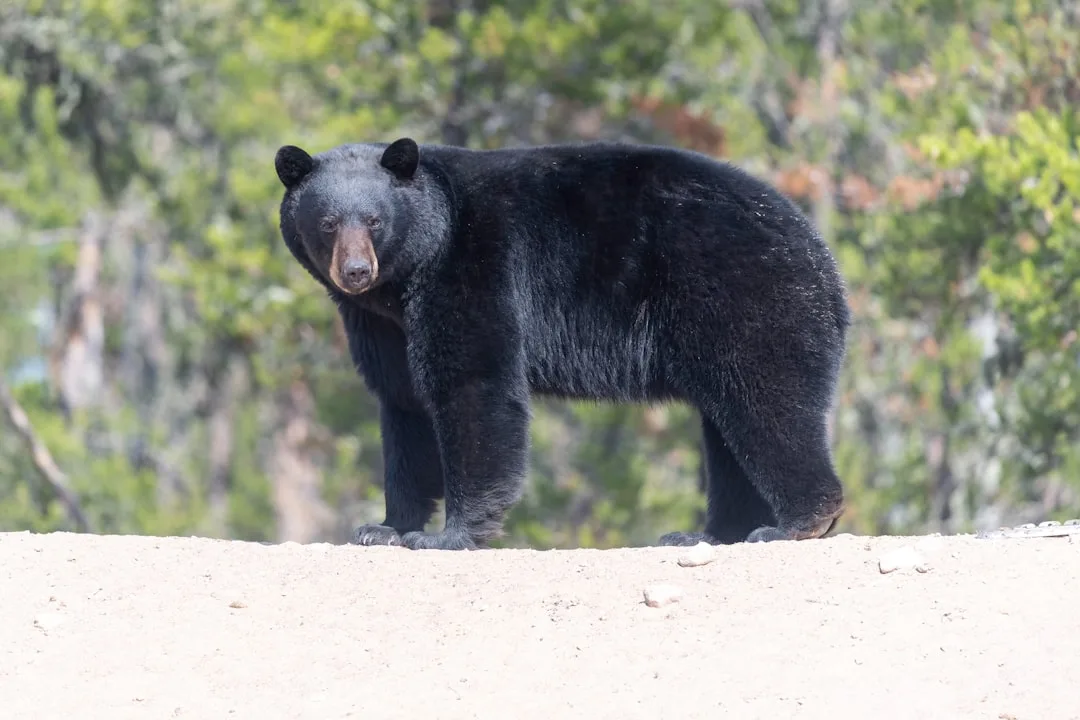
Where do black bears live and how many are there?
Black bear habitat spans 41 of the 50 United States, 11 of Canada's 13 provinces and territories, and a small but persistent fragment of northern Mexico extending through Sonora, Chihuahua, Coahuila, and Nuevo Leon. The continental population is 600,000 to 800,000 individuals, the largest bear population on Earth and by a wide margin the most abundant bear species in North America.
The densest concentrations sit in Alaska, British Columbia, Ontario, North Carolina, Tennessee, and Pennsylvania. Sixteen subspecies are currently recognised, including the white Kermode or spirit bear of coastal British Columbia and the slate-blue glacier bear of southeastern Alaska.
The species is expanding its range, returning to states it had not occupied in living memory, including New Jersey, Ohio, Missouri, and Kentucky.
A Continental Animal
The American black bear is the only bear species endemic to North America, and it has the geographic footprint to prove it. Where the brown bear is now confined to the West and the polar bear to the Arctic, the black bear holds forest, swamp, and mountain habitat from the Yukon delta to the cypress sloughs of the Florida panhandle, and from the redwood coast of California to the white pine ridges of Cape Breton Island.
The animal does not occupy this range uniformly. It clusters in the contiguous boreal and temperate forest belts that survived European clearance, the rugged terrain that resisted timber and agricultural conversion, and the protected lands assembled across the twentieth century. But the species absolutely refuses to be a relict.
The same animal that fishes salmon out of an Anan Creek tributary in Tongass National Forest hunts blueberries on a New Jersey suburb's edge in August, and both populations are increasing.
For the species profile that anchors this range and population work, see our full overview of the American black bear, which covers physiology, behaviour, and ecological role across the continent.
How Many Black Bears Are There?
The figure quoted across modern wildlife agency literature, IUCN Red List entries, and peer-reviewed continental syntheses is 600,000 to 800,000 individuals across the species range, with the upper edge of that band reflecting unsurveyed boreal forest in northern Quebec, Labrador, and the Northwest Territories where the bear certainly exists but cannot be counted with the methods applied to managed populations further south.
Garshelis, Scheick, Doan-Crider, Beecham, and Obbard (2016), the authors of the most recent IUCN Red List assessment for Ursus americanus, compiled jurisdiction-by-jurisdiction figures and arrived at a working continental estimate of roughly 850,000 when Mexican populations were folded in.
Subsequent revisions to state and provincial estimates, particularly downward adjustments in California and Pennsylvania based on improved mark-recapture work, have brought the consensus working figure to the 600,000 to 800,000 band that the species recovery community now cites.
The breakdown by country is approximately:
- United States: 339,000 to 465,000 individuals
- Canada: 380,000 to 450,000 individuals
- Mexico: roughly 3,000 individuals across all four range states combined
The continental population exceeds the combined population of every other bear species worldwide. Brown bears across Eurasia and North America total roughly 200,000. Polar bears total approximately 26,000. Asiatic black bears total perhaps 50,000. Sun bears, sloth bears, spectacled bears, and giant pandas together do not reach 50,000. The black bear is, in absolute and relative terms, the bear that won.
"Black bears are the most abundant ursid on Earth, occupying a vast and diverse range that includes nearly all of forested North America. Continental population estimates consistently place the species above 600,000 individuals, with strong recovery trends across most of the eastern United States."
- Garshelis, Scheick, Doan-Crider, Beecham, and Obbard, IUCN Red List Assessment of Ursus americanus, 2016
The 41 US States
Forty-one of the fifty United States hold established breeding populations of black bears as of the most recent state agency assessments.
The nine states without resident populations are typically Hawaii, plus Great Plains and Corn Belt states that lost their bears during nineteenth-century settlement and have never recovered them: Iowa, Nebraska, Kansas, North Dakota, South Dakota, Illinois, Indiana, and Delaware sit in or near that group, with peripheral wandering bears occasionally documented in the agriculturally dominated states of the central tier.
State-by-State Black Bear Population Estimates
The table below compiles state agency working estimates as of recent management plans, with population figures rounded to reflect the precision typically reported. Estimates derive from mark-recapture studies, hunter harvest models, hair-snare DNA work, and tetracycline biomarker studies depending on the jurisdiction.
| State | Population Estimate | Trend | Notes |
|---|---|---|---|
| Alaska | 100,000-200,000 | Stable | Largest state population by far |
| California | 30,000-40,000 | Stable | Sierra Nevada and coastal mountains |
| Maine | 35,000-40,000 | Stable | Largest population east of Mississippi |
| Pennsylvania | 18,000-20,000 | Stable | Dense Appalachian core |
| North Carolina | ~20,000 | Increasing | Highest coastal density on the continent |
| Idaho | 20,000-30,000 | Stable | Mountain core population |
| Wisconsin | ~24,000 | Increasing | Northern forest belt |
| Michigan | ~12,000 | Stable | Upper Peninsula stronghold |
| Minnesota | ~15,000 | Stable | Northern boreal interface |
| Oregon | 25,000-35,000 | Stable | Cascades and Coast Range |
| Washington | 25,000-30,000 | Stable | Olympic and Cascade core |
| New York | 6,000-8,000 | Increasing | Adirondacks, Catskills, Allegheny |
| Virginia | 17,000-19,000 | Increasing | Blue Ridge and coastal plain |
| West Virginia | 12,000-14,000 | Stable | Allegheny core |
| Tennessee | ~7,000 | Increasing | Smokies and Cumberland Plateau |
| New Hampshire | 5,000-6,000 | Stable | White Mountains and beyond |
| Vermont | ~5,500 | Stable | Green Mountains and lowlands |
| Massachusetts | 4,500-5,000 | Increasing | Western and central counties |
| New Mexico | 5,000-7,000 | Stable | Sky islands and Sangre de Cristo |
| Arizona | 2,000-3,000 | Stable | Mogollon Rim, sky islands |
| Colorado | 17,000-20,000 | Stable | Recent revised upward estimates |
| Utah | ~4,000 | Stable | Uinta and central plateaus |
| Wyoming | ~5,000 | Stable | Outside grizzly core |
| Montana | ~13,000 | Stable | Statewide mosaic |
| Florida | ~4,050 | Increasing | Isolated subspecies (U.a. floridanus) |
| Georgia | ~5,100 | Stable | Three core populations |
| Alabama | 200-400 | Increasing | Mobile and northeast Alabama |
| Mississippi | 150-200 | Increasing | Recent recolonisation |
| Louisiana | ~700 | Increasing | Louisiana black bear delisted 2016 |
| Arkansas | ~5,000 | Stable | Recovery anchor for Midwest |
| Missouri | ~800 | Increasing | Recolonising from Arkansas |
| Kentucky | ~700 | Increasing | Eastern coalfield recovery |
| Ohio | 50-100 | Increasing | Recolonising from Pennsylvania |
| New Jersey | 3,000-4,000 | Stable | Densest population per square mile in US |
| Connecticut | 1,000-1,200 | Increasing | Northwest hills core |
| Maryland | 2,000-2,500 | Increasing | Western counties |
| Rhode Island | 10-30 | Increasing | Wandering bears established |
| South Carolina | ~1,000 | Stable | Mountains and coastal |
| Texas | <100 | Increasing | Big Bend and Trans-Pecos |
| Oklahoma | ~3,000 | Increasing | Ouachita and Ozark recovery |
| Nevada | ~700 | Increasing | Sierra Nevada and Carson Range |
The figures sum to a US working total of approximately 400,000, in line with the 339,000 to 465,000 range cited in continental syntheses. Variance within that band is mostly a matter of how Alaska is counted, since the state's vast roadless interior makes precise estimation impossible and the state agency cites a range rather than a point figure.
The 11 Canadian Provinces and Territories
Canada holds roughly 380,000 to 450,000 black bears across 11 of its 13 provinces and territories. The two without established populations are Prince Edward Island, where the species was extirpated in the nineteenth century and the small island geography prevents natural recolonisation, and Nunavut, where the high Arctic tundra simply does not provide the forest cover and food supply the species requires.
Wandering individuals occasionally turn up in southern Nunavut around the tree line, and the territory is included in some range maps for that reason, but no breeding population persists.
Canadian Black Bear Population Estimates
| Province or Territory | Population Estimate | Notes |
|---|---|---|
| British Columbia | 120,000-160,000 | Largest provincial population; Kermode bear in central coast |
| Ontario | 85,000-105,000 | Vast boreal core |
| Quebec | 70,000-85,000 | Boreal and mixed forest |
| Alberta | 35,000-40,000 | Foothills and boreal |
| Manitoba | 25,000-35,000 | Boreal core |
| Saskatchewan | 24,000-28,000 | Northern forest belt |
| Yukon | ~10,000 | Boreal valleys |
| Northwest Territories | 5,000-7,000 | Southern boreal |
| Newfoundland | 6,000-10,000 | Island subspecies (U.a. hamiltoni) |
| New Brunswick | ~17,000 | Acadian forest |
| Nova Scotia | ~10,000 | Mainland and Cape Breton |
British Columbia's roughly 120,000 to 160,000 black bears include the central coast population from which the Kermode or spirit bear (Ursus americanus kermodei) emerges, with approximately 400 white-coated individuals alongside roughly 6,000 dark-coated bears that carry the recessive allele responsible for the white morph.
Ontario's boreal interior holds the largest single contiguous population in eastern Canada, while Quebec's combined boreal and mixed-forest populations rank among the most productive bear habitats on the continent.
"British Columbia supports one of the largest black bear populations in North America, estimated at 120,000 to 160,000 animals across diverse forest habitats from the boreal interior to coastal temperate rainforest. The province is a stronghold for both the species and several distinctive coastal subspecies, including the Kermode bear of the central and north coast islands."
- British Columbia Ministry of Environment, Black Bear Management Plan
Mexico: The Southern Edge
The southern fringe of black bear range extends into the Sierra Madre Occidental and the Sierra Madre Oriental of northern Mexico, with established but small populations in Sonora, Chihuahua, Coahuila, and Nuevo Leon. Total Mexican population is estimated at approximately 3,000 individuals, distributed in fragmented mountain populations separated by lower-elevation desert and grassland that the species does not cross readily.
The Mexican black bear (Ursus americanus eremicus) is listed as endangered under Mexican federal law (NOM-059-SEMARNAT) and protected from hunting throughout its national range.
Cross-border movement between southern Arizona, southern New Mexico, southwestern Texas, and adjacent Mexican states has been documented through camera-trap and DNA work, and the persistence of the Mexican populations is in part a function of recolonisation pressure from healthier US sky-island populations to the north.
The Mexican bears tend to be:
- Smaller on average than northern conspecifics, with adult males rarely exceeding 250 pounds
- More cinnamon and brown in colour phase, with black-coated individuals a minority
- More omnivorous and seasonally mobile, tracking acorn, manzanita, and prickly pear crops up and down elevation gradients
- More sensitive to drought, which has stressed populations during the recent multidecadal Southwest drought
For comparison with the southernmost brown bear range, see our piece on where do grizzly bears live, which covers a species whose Mexican populations went extinct in the 1960s.
The 16 Subspecies
Sixteen subspecies of Ursus americanus are currently recognised in the standard taxonomy, distinguished by geography, coat colour, body size, and skull morphology. Genetic work has questioned the validity of some of the older subspecies designations, but the Florida bear, the Kermode bear, the glacier bear, the Newfoundland bear, and the Louisiana bear all retain strong support as distinct lineages.
Black Bear Subspecies and Their Ranges
| Subspecies | Common Name | Range | Distinctive Features |
|---|---|---|---|
| U.a. americanus | Eastern black bear | Eastern US and Canada | Nominate form, broad distribution |
| U.a. altifrontalis | Olympic black bear | Pacific Northwest coast | Heavy coat, dark phase |
| U.a. amblyceps | New Mexico black bear | Southern Rockies, Southwest | Cinnamon morph common |
| U.a. californiensis | California black bear | California, southern Oregon | Often brown phase |
| U.a. carlottae | Haida Gwaii black bear | Haida Gwaii (Queen Charlotte Is.) | Largest skull, island endemic |
| U.a. cinnamomum | Cinnamon bear | Northern Rockies | Cinnamon and blond phases |
| U.a. emmonsii | Glacier bear | Southeast Alaska | Blue/silver-tipped fur |
| U.a. eremicus | Mexican black bear | Sonora, Chihuahua, Coahuila, NL | Endangered, smaller body |
| U.a. floridanus | Florida black bear | Florida and southern Georgia | Isolated, highly arched skull |
| U.a. hamiltoni | Newfoundland black bear | Newfoundland island | Largest body, isolated lineage |
| U.a. kermodei | Kermode/spirit bear | Central BC coast | White morph (~400) and dark |
| U.a. luteolus | Louisiana black bear | Louisiana, east Texas, west MS | Recently delisted (2016) |
| U.a. machetes | West Mexican black bear | Sierra Madre Occidental | Smaller, isolated |
| U.a. perniger | Kenai black bear | Kenai Peninsula, Alaska | Coastal salmon-feeding population |
| U.a. pugnax | Dall black bear | SE Alaska coastal islands | Heavy coat, salmon-feeder |
| U.a. vancouveri | Vancouver Island black bear | Vancouver Island | Larger body, island endemic |
The Florida black bear (U.a. floridanus) is geographically and genetically isolated from the rest of the species range, separated by the agricultural and urban matrix of the Deep South. The 2023 Florida Fish and Wildlife Conservation Commission population estimate places the subspecies at roughly 4,050 individuals across seven recognised subpopulations, up from a low of perhaps 300 in the 1970s.
The animal is no longer state-listed but remains a conservation priority because of its isolation and limited gene flow.
The Kermode or spirit bear (U.a. kermodei) of the Great Bear Rainforest carries a recessive allele at the MC1R gene that produces a cream to white coat in homozygous individuals. Roughly 400 white-coated bears live alongside approximately 6,000 dark-coated conspecifics across the central British Columbia coast, with the highest white-morph frequency on Princess Royal and Gribbell islands.
For more on the genetics and other unusual coat phases, see our piece on black bear color phases including cinnamon, blond, and Kermode.
The glacier bear (U.a. emmonsii) of southeast Alaska, with its slate-blue, silver-tipped pelage, is the rarest colour morph in the species and concentrates around Yakutat Bay and the Saint Elias Range.
"Subspecies designations in Ursus americanus reflect a mixture of geographic isolation, genetic differentiation, and morphological distinctiveness. Several lineages, particularly the Florida, Newfoundland, Kermode, and Louisiana populations, are robustly supported by genetic and morphological evidence and represent priority units for conservation management."
- Wildlife Society Bulletin, on subspecies management of North American bears
Where the Bears Are Densest
Population totals tell only part of the story. Density, measured in bears per 100 square kilometres, identifies the habitats that produce the highest carrying capacity and the highest probability of human-bear interaction.
The densest documented black bear populations on the continent share three features:
- Productive forest with reliable mast crops (oak, beech, hickory, maple)
- Permanent water in the form of rivers, swamps, or coastal estuaries
- Limited grizzly competition, since brown bears suppress black bear density wherever ranges overlap
The leading dense-population zones include:
- Southeast Alaska coastal islands: 100+ bears per 100 km² on salmon-bearing islands
- Central and northern coast British Columbia: 80-120 per 100 km² in salmon-producing watersheds
- Northern California to southern Oregon redwood and mixed conifer: 50-100 per 100 km²
- Great Smoky Mountains National Park: roughly 150 bears per 100 km² in the densest core
- Pisgah and Nantahala National Forests, North Carolina: 80-150 per 100 km² in mast-rich oak habitat
- Coastal North Carolina (Albemarle-Pamlico peninsula): among the highest densities on the continent, with bears averaging 250-300+ pounds, the largest body sizes recorded for the species
- Allegheny National Forest, Pennsylvania: 50-80 per 100 km² in mature mixed-deciduous habitat
- Adirondacks, New York: 30-60 per 100 km² across protected forest
The coastal North Carolina peninsula population is famous for producing the largest black bears ever recorded, including documented individuals over 800 pounds. The combination of agricultural waste corn, soybean fields, dense pocosin and gum-cypress habitat, and a near-total absence of competition has produced what wildlife biologists call a "bear factory."
Habitat Preferences: Why the Bear Wins
The black bear is one of the most habitat-flexible large mammals on the continent. Where the polar bear depends on sea ice and the brown bear specialises in open valleys with riparian production, the black bear is a forest generalist that thrives anywhere with cover, mast, and water.
Preferred Habitat Components
Black bears prefer landscapes that provide:
- Mature forest cover for thermal regulation, denning, and predator avoidance
- Mast-producing hardwoods, especially oak (acorns), beech, hickory, and chestnut where it persists
- Soft mast diversity: blueberry, blackberry, huckleberry, manzanita, serviceberry
- Riparian corridors for travel, water, and seasonal food production
- Rugged terrain that limits human access and provides denning options
- Mosaic structure combining mature forest with shrub edges and disturbed openings
Habitat Adaptability
What truly sets the species apart is its tolerance for landscapes a brown bear would not consider. Black bears thrive in:
- Boreal coniferous forest of Alaska, Yukon, and the eastern shield
- Cypress and gum swamps of the southeastern coastal plain
- Sky-island sub-alpine forest in Arizona, New Mexico, and northern Mexico
- Temperate rainforest of the Pacific Northwest and southeast Alaska
- Mixed deciduous forest of the Appalachians and Ozarks
- Suburban edge habitat in New Jersey, Pennsylvania, North Carolina, and Florida
- Cypress-tupelo wetland of Louisiana, Arkansas, and Mississippi
The urban-fringe black bear is now a documented ecological category. New Jersey's roughly 3,000-4,000 bears live in the most densely human-populated state in the union, and the population continues to grow despite intensive hazing, hunting, and management. Florida's bears walk through Orlando exurbs. North Carolina's bears bed in soybean fields. The species has demonstrated, repeatedly, that it can occupy almost any landscape that is not actively farmed or paved.
For deeper context on diet and how black bears extract calories from such varied landscapes, see what do black bears eat. For a related question many people ask after hearing about urban-fringe populations, see are black bears dangerous to humans.
Range Expansion: The Story of the Last 30 Years
One of the most dramatic stories in twentieth-century North American wildlife management is the recovery of the black bear in the eastern United States. The species was nearly extirpated from the agricultural Midwest and parts of the South by 1900 through a combination of habitat clearance, unregulated hunting, and persecution as livestock predators.
By 1950, breeding populations persisted only in Appalachia, the Adirondacks, the northern Great Lakes, parts of New England, the southern Atlantic coastal plain, and the Ozark-Ouachita system.
The recovery since then has been continuous and accelerating.
Documented Recolonisation Events
- New Jersey: A small remnant in the northwestern hills expanded statewide beginning in the 1980s. The state went from roughly 100 bears in 1970 to 3,000 to 4,000 today.
- Ohio: Recolonised from a Pennsylvania source population beginning in the late 1990s. Now established in the southern and eastern counties, with breeding documented in over a dozen.
- Missouri: Bears reintroduced into Arkansas in the 1960s expanded north into the Missouri Ozarks beginning in the 1990s. Current population approximately 800.
- Kentucky: Once nearly extirpated, eastern Kentucky now supports approximately 700 bears across the central Appalachian coalfield.
- Indiana, Illinois, and Iowa: Wandering bears regularly documented; no established breeding populations as of the most recent assessments, but the trajectory points toward eventual recolonisation.
- Connecticut, Massachusetts, and Rhode Island: Recovery from near-extirpation continues, with each state now supporting growing populations.
The mechanism of expansion is straightforward. Forest cover in the eastern United States has roughly doubled since 1900 as marginal farmland has been abandoned and replanted. Hunting regulations, beginning in the early twentieth century and tightening through mid-century, ended the unregulated harvest that had driven the species toward local extinction. The bears themselves did the rest, dispersing along forested corridors and occupying habitat that had been waiting for them for a century.
"Black bear range expansion in the eastern United States represents one of the most successful recoveries of any large carnivore in modern conservation. Documented recolonisation across New Jersey, Ohio, Missouri, and Kentucky reflects forest regrowth, hunting regulation, and the species' inherent ecological flexibility. The trend is expected to continue as additional dispersal corridors mature."
- Tabitha Graves, US Geological Survey, on black bear recovery
In western North America, range expansion is more about infill within historical range than about new geographic recolonisation. California, Oregon, Washington, and Idaho populations are thought to be at or near carrying capacity in their core habitats, with continued growth occurring at the urban-wildland interface.
Range Contractions: Where the Bear Has Lost Ground
While the eastern recovery dominates the narrative, the species has lost ground in some western and southwestern landscapes:
- Mexican Sierra Madre populations are reduced from historical levels and remain endangered, though stable to slightly increasing in protected zones
- Southern Texas and the lower Rio Grande Valley lost their bears entirely in the early twentieth century and have not recovered
- The Great Plains never had dense bear populations, but riparian and breaks-country populations along the Missouri and Yellowstone river systems were extirpated and have not returned
- Sonoran Desert lowland populations are gone, with bears now confined to sky-island ranges
The contemporary range map shows a species consolidated in mountain, forest, and swamp habitats with extensive recolonisation of the East and stable maintenance of western core populations. The continental net is positive, but not uniformly so.
Comparison with Other Bear Species
The black bear's continental footprint becomes clearer when set against the other North American and Holarctic bears.
Range and Population Comparison
| Species | Range Area | Total Population | Densest Region |
|---|---|---|---|
| American black bear | 41 US states, 11 CA prov./terr., 4 MX states | 600,000-800,000 | Coastal NC, BC central coast, SE Alaska |
| Brown/grizzly bear | Western NA, Eurasia | ~200,000 worldwide | Kamchatka, Alaska, Romania |
| Polar bear | Circumpolar Arctic | ~26,000 | Hudson Bay, Beaufort Sea |
| Asiatic black bear | South and East Asia | ~50,000 | Russian Far East, Japan |
The species occupies more North American territory than the grizzly and polar bear combined and at three times the population density. For European context, see our profile on the European brown bear and where they live, and for the Arctic comparison, see polar bear populations and where they live.
What Determines the Carrying Capacity
The carrying capacity of any given landscape for black bears is determined by:
- Mast production: Acorn, beech, hickory, and pine nut production in autumn drives the fat reserves bears need to survive winter and reproduce successfully
- Soft mast diversity: Berries, drupes, and other summer fruits set the spring through summer condition trajectory
- Protein supplementation: Salmon runs, ungulate carrion, and ant colonies augment plant-based diets in productive habitats
- Cover and security: Bears require thermal cover, escape cover, and denning habitat
- Mortality regime: Hunting harvest, vehicle collisions, and depredation removals collectively set the demographic ceiling
- Disease and parasitism: Trichinellosis, ascarids, and roundworm parasites reduce vigour but rarely cause population-level effects
In the highest-density landscapes, all five environmental factors converge. The Albemarle-Pamlico peninsula of North Carolina combines waste agricultural grain, dense escape cover, mild winters, low predation pressure, and limited hunting in some refuges, producing the body sizes and densities for which the region is famous.
Behaviour Drives Range: Cubs, Hibernation, and Dispersal
The bear's reproductive biology, denning ecology, and dispersal behaviour collectively shape its range. Understanding these processes makes the maps make sense.
Cubs are born in midwinter dens to mothers who are themselves hibernating. The relationship that follows shapes the next generation's dispersal patterns and determines how rapidly populations can colonise new habitat. For the full picture, see black bear cubs and mothers.
Denning ecology imposes a hard constraint on northern range. A bear that cannot find a secure den site cannot survive a Yukon or Quebec winter. The species adapts with tree dens, ground excavations, rock outcrops, brush piles, and even agricultural ditches, but the requirement is non-negotiable. For more on denning behaviour and how it varies by latitude, see black bear hibernation and denning.
Subadult dispersal is the engine of range expansion. Young males in particular move 50 to 200 kilometres from their natal range, and these dispersing males are the bears that establish new populations or augment small ones. The recolonisation of Ohio, Missouri, and the New England states all rest on this single demographic process.
Reading the Range Map
A well-drawn black bear range map for North America shows:
- Continuous range across most of Canada north of agricultural areas, with gaps for the high Arctic, the central prairies, and PEI
- Continuous range in the northern New England states, the Adirondacks-Catskills, the southern Appalachians, and the central Atlantic coast
- Continuous range in the boreal-Pacific belt from the Yukon through coastal Alaska, BC, Washington, Oregon, and northern California
- Continuous range in the Sierra Nevada, the Cascades, and the northern and central Rockies
- Fragmented range in the southern Rockies, the Mogollon Rim, and the sky islands of Arizona, New Mexico, and northern Mexico
- Isolated populations in Florida, Louisiana, eastern Texas, the Ozarks, parts of the lower Midwest, and central British Columbia islands
- Expanding edges into New Jersey, Maryland, Connecticut, Massachusetts, Rhode Island, southern Ohio, eastern Kentucky, the Missouri Ozarks, and Mississippi
The map is less continuous than it appears at first glance, and the gaps are as ecologically meaningful as the filled zones. Black bears do not cross extensive open agricultural landscapes readily, and the mosaic of recovery and absence in the central US reflects exactly that constraint.
Population Trends Going Forward
The continental black bear population is stable to increasing across the great majority of its range. State and provincial agency assessments project:
- Continued eastern expansion as forest regrowth and hunting regulation continue to support recovery
- Stable western core populations with increasing human-bear conflict at the urban-wildland interface
- Continued growth in coastal North Carolina, Florida, and Louisiana subspecies and populations
- Stable to slightly improving Mexican populations under endangered-species protection
- Pressure on subspecies and isolates from climate-driven mast failures and habitat fragmentation
The dominant management challenge is no longer recovery but coexistence. As bear populations expand into landscapes that have not held bears for a century or more, agencies face the practical work of garbage management, education, depredation response, and the politics of hunting allocation in a public that has not had to think about bears for several generations.
"The trajectory of Ursus americanus across most of its North American range is one of demographic stability or growth. Long-term monitoring of harvest data, mark-recapture estimates, and human-bear conflict reports indicates that the species has successfully reoccupied much of its historical range and is poised to continue expanding into landscapes from which it was extirpated during the nineteenth and early twentieth centuries."
- Journal of Wildlife Management, on long-term black bear population trends
Putting the Range and Population in Context
For an animal that was once dismissed as a forest relict and a pest, the American black bear has produced one of the most quietly successful conservation stories on the continent.
Forty-one states, eleven Canadian provinces and territories, four Mexican states, 600,000 to 800,000 individuals, sixteen subspecies, and a documented recovery trajectory across an entire half of the continent add up to a species that does not need rescue. It needs management, education, and the cultural patience of communities relearning how to live next door to a large omnivore.
For the species profile that anchors all of this, see again our overview of the American black bear. For comparative context with the other large-bodied bear of the continent, our piece on where do grizzly bears live covers a parallel but smaller-scale recovery. And for the questions readers ask after they finish the range map, see are black bears dangerous to humans, what do black bears eat, and black bear hibernation and denning.
Readers preparing for wildlife biology coursework, certification exams, or general cognitive practice can find aptitude resources at Whats Your IQ, professional certification preparation at Pass4-Sure, and writing tools for grant applications and field reports at Evolang. For lighter reading away from bear country, When Notes Fly covers music and culture, and File Converter Free handles the document work that comes with public-lands permits.
Frequently Asked Questions
How many black bears are there in North America? Current peer-reviewed and agency estimates place the continental population between 600,000 and 800,000 individuals, with the United States holding approximately 339,000 to 465,000, Canada 380,000 to 450,000, and Mexico roughly 3,000. The species is the most numerous bear on Earth and by a wide margin the largest bear population in North America.
Which US states have the most black bears? Alaska holds the largest single-state population at 100,000 to 200,000, followed by Maine at 35,000 to 40,000, California at 30,000 to 40,000, Idaho at 20,000 to 30,000, Wisconsin at roughly 24,000, and Pennsylvania at 18,000 to 20,000. North Carolina has the densest coastal population on the continent, with bears averaging the largest body sizes recorded for the species.
Are black bears expanding their range? Yes. Black bears have re-established breeding populations in New Jersey since the 1980s, recolonised southern Ohio from a Pennsylvania source beginning in the late 1990s, recovered eastern Kentucky after near-extirpation in the twentieth century, and pushed back into Missouri from an Arkansas reintroduction stronghold. Forest regrowth on abandoned farmland and modern hunting regulation have driven the recovery.
What is the rarest black bear subspecies? The Mexican black bear (Ursus americanus eremicus) and the Florida black bear (U.a. floridanus) are the most geographically restricted and conservation-priority subspecies, with roughly 3,000 and 4,050 individuals respectively. The white-coated Kermode or spirit bear of central British Columbia, while not a separate subspecies, is rarer still as a colour morph, with only about 400 white-coated individuals worldwide.
Where do black bears live in Canada? Black bears live in 11 of Canada's 13 provinces and territories, with the only exclusions being Prince Edward Island and Nunavut. British Columbia holds the largest provincial population at 120,000 to 160,000, followed by Ontario at 85,000 to 105,000 and Quebec at 70,000 to 85,000. Newfoundland holds an island-endemic subspecies (U.a. hamiltoni) of roughly 6,000 to 10,000 individuals.
References
- Garshelis, D. L., Scheick, B. K., Doan-Crider, D. L., Beecham, J. J., & Obbard, M. E. (2016). Ursus americanus. The IUCN Red List of Threatened Species 2016. https://doi.org/10.2305/IUCN.UK.2016-3.RLTS.T41687A114251609.en
- Pelton, M. R. (2003). Black bear (Ursus americanus). In G. A. Feldhamer, B. C. Thompson, & J. A. Chapman (Eds.), Wild Mammals of North America: Biology, Management, and Conservation (2nd ed., pp. 547-555). Johns Hopkins University Press. https://doi.org/10.56021/9780801874161
- Hristienko, H., & McDonald, J. E. (2007). Going into the 21st century: a perspective on trends and controversies in the management of the American black bear. Ursus, 18(1), 72-88. https://doi.org/10.2192/1537-6176(2007)18[72:GITSCA]2.0.CO;2
- Williamson, D. F. (2002). In the Black: Status, Management, and Trade of the American Black Bear (Ursus americanus) in North America. TRAFFIC North America, World Wildlife Fund. https://doi.org/10.13140/RG.2.2.27293.62240
- Onorato, D. P., Hellgren, E. C., Van Den Bussche, R. A., & Doan-Crider, D. L. (2004). Phylogeographic patterns within a metapopulation of black bears (Ursus americanus) in the American Southwest. Journal of Mammalogy, 85(1), 140-147. https://doi.org/10.1644/1545-1542(2004)085<0140:PPWAMO>2.0.CO;2
- Puckett, E. E., Etter, P. D., Johnson, E. A., & Eggert, L. S. (2015). Phylogeographic analyses of American black bears (Ursus americanus) suggest four glacial refugia and complex patterns of postglacial admixture. Molecular Biology and Evolution, 32(9), 2338-2350. https://doi.org/10.1093/molbev/msv114
- Scheick, B. K., & McCown, W. (2014). Geographic distribution of American black bears in North America. Ursus, 25(1), 24-33. https://doi.org/10.2192/URSUS-D-12-00020.1
- Marshall, H. D., & Ritland, K. (2002). Genetic diversity and differentiation of Kermode bear populations. Molecular Ecology, 11(4), 685-697. https://doi.org/10.1046/j.1365-294X.2002.01479.x
Frequently Asked Questions
How many black bears are there in North America?
Current peer-reviewed and agency estimates place the continental population of American black bears between 600,000 and 800,000 individuals, making the species the most numerous bear on Earth and by a wide margin the largest bear population in North America.
Garshelis, Scheick, Doan-Crider, Beecham, and Obbard (2016) compiled jurisdiction-by-jurisdiction estimates for the IUCN Red List assessment and arrived at roughly 850,000 across the species range when Mexican populations were included, with subsequent state and provincial revisions trimming the working figure to the 600,000 to 800,000 band most agencies use today.
The United States holds approximately 339,000 to 465,000, Canada holds roughly 380,000 to 450,000, and Mexico contributes a small but ecologically important fraction in the Sierra Madre Occidental and Oriental.
Which US states have the most black bears?
Alaska holds the largest single-state black bear population at roughly 100,000 to 200,000 animals, followed by California at approximately 30,000 to 40,000, Pennsylvania at roughly 20,000, North Carolina at 20,000 with the densest coastal population on the continent, and Maine at 35,000 to 40,000 with the largest population in the eastern United States.
Tennessee, Virginia, Wisconsin, Michigan, Minnesota, New York, New Hampshire, Vermont, Washington, Oregon, and Idaho each support populations in the four to fifteen thousand range, and the species occupies all forty-one states with established breeding populations either continuously or in expanding fragments returning to historic range.
Are black bears expanding their range?
Yes, and the trend is one of the clearest large-mammal recoveries in North American conservation history. Black bears have re-established breeding populations in New Jersey since the 1980s, recolonised southern Ohio from a Pennsylvania source population beginning in the late 1990s, recovered eastern and central Kentucky after near-extirpation in the twentieth century, and pushed back into Missouri from an Arkansas reintroduction stronghold.
Range expansion is documented in agency reports from the New Jersey Division of Fish and Wildlife, Ohio Division of Wildlife, Kentucky Department of Fish and Wildlife Resources, and Missouri Department of Conservation. The pattern is forest regrowth on abandoned farmland combined with hunting regulation, the same recipe that returned wild turkey, beaver, and white-tailed deer to most of their historical eastern range.