
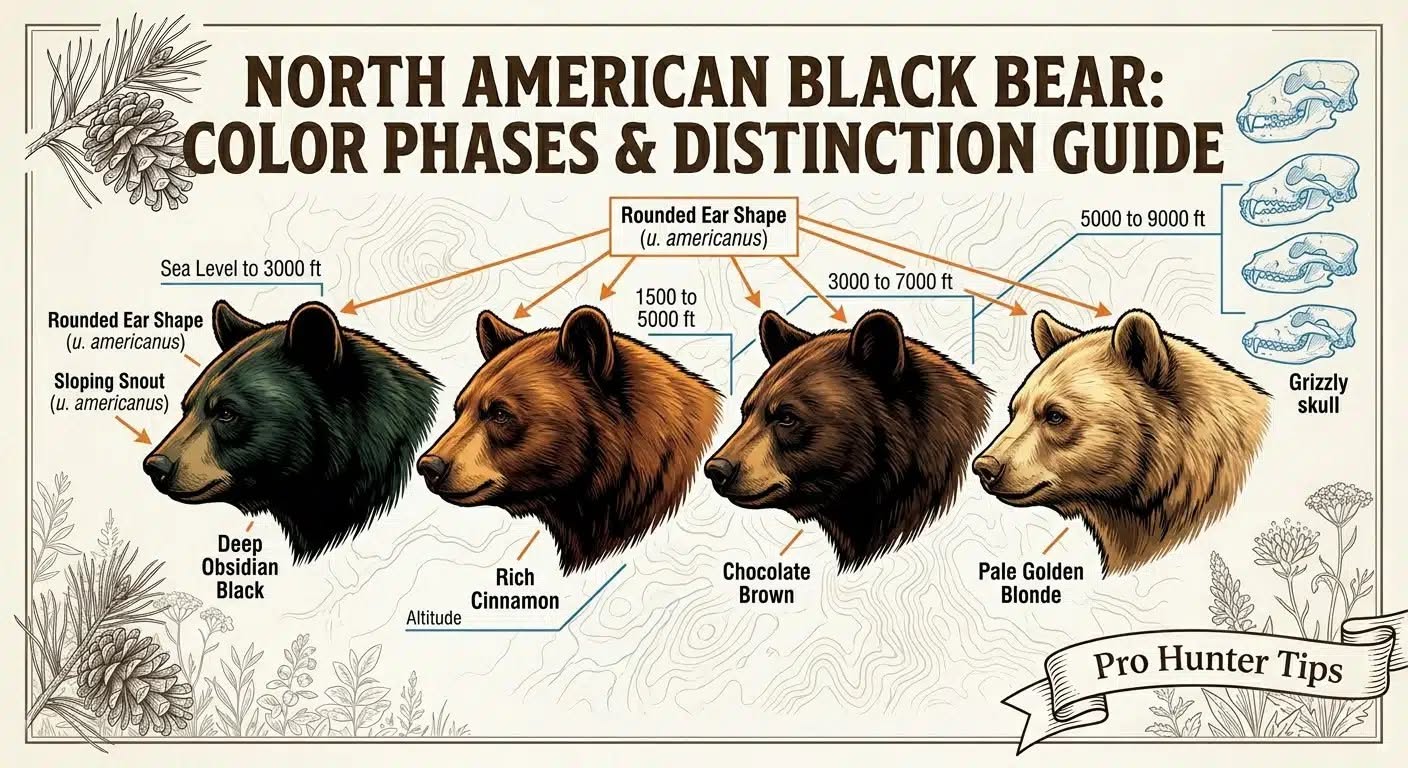
How many color phases does the American black bear have?
The American black bear (Ursus americanus) is the same species in every color it appears, and the species shows the widest coat-color polymorphism of any North American carnivore. The recognised phases are black, chocolate brown, cinnamon, blond, white (the Kermode or spirit bear, U. a. kermodei), and blue-silver (the glacier bear, U. a. emmonsii).
Black is most common in the east, cinnamon and blond dominate in the western Rocky Mountains, white Kermode bears are restricted to the central coast of British Columbia, and the rare glacier morph occurs in southeast Alaska and the Yukon. A single mother can give birth to a litter containing two different colors at once.
One Species, Six Coat Colors
The American black bear is one species across its entire range, from Florida to Alaska and from Quebec to Sonora. It is also, surprisingly, the most chromatically variable bear on the planet.
Where a brown bear is some shade of brown and a polar bear is white, a black bear can be jet black, dark chocolate, rusty cinnamon, pale blond, snow white, or smoky blue-grey, and every one of those animals shares the same scientific name: Ursus americanus. For the species-level overview, see our main page on the American black bear.
This article focuses on the color phases themselves: where each one is found, what the genetics actually do, why a single mother can produce a black cub and a cinnamon cub in the same litter, and why one of these morphs has become the spiritual centre of two First Nations on the British Columbia coast. The short version is that almost everything we now know about black bear color comes down to a single gene, MC1R, and a small number of point mutations within it.
"We were expecting black bears in the Pacific coast forests to look like every other black bear, and instead we found that one allele of the melanocortin-1 receptor gene flipped them white. It is one of the cleanest examples of single-gene phenotypic variation in any large mammal." - Kermit Ritland, geneticist, University of British Columbia, on the 2001 discovery published in Current Biology
The Ritland paper is the foundational reference for everything that follows. Before 2001 the white spirit bear was a charismatic mystery; afterwards it became one of the textbook examples of a recessive coat-color allele in mammals.
The Six Recognised Color Phases
The standard treatment in the field literature recognises six distinct phases, with the understanding that they grade into each other and that a single bear can change apparent color slightly between summer and winter pelage.
| Phase | Typical color | Primary range | Frequency |
|---|---|---|---|
| Black | Jet black, sometimes with white chest blaze | Continent-wide; dominant in east | ~70% rangewide |
| Chocolate brown | Dark seal-brown | West, especially BC interior | ~10% rangewide |
| Cinnamon | Reddish-rust to copper | Rocky Mountains, Great Basin, interior BC | Up to 80% in some western herds |
| Blond | Pale tan, near-buff | Glacier National Park, Montana, parts of Idaho | Rare, <5% even where present |
| White (Kermode/spirit) | Cream-white to ivory | Central and north BC coast | ~400 individuals total |
| Glacier (blue-silver) | Slate-grey with silver tipping | SE Alaska, Yukon, NW BC | Rare, low hundreds |
Two patterns jump out. First, the darker a region's bears are, the more eastern they tend to be: black bears in Maine, Pennsylvania, and Florida are almost uniformly black, while bears in Wyoming, Idaho, and interior BC are a mix that often skews toward cinnamon. Second, the rarer phases (white, glacier blue) are not scattered randomly.
They cluster in tightly defined coastal zones, which is the fingerprint of a recessive allele held at high frequency by a small, partially isolated founder population.
For an overview of how black bears occupy this range to begin with, see our companion piece where do black bears live.
Why Black Bears Are Often Brown: The MC1R Story
The melanocortin-1 receptor gene, abbreviated MC1R, is the master switch for melanin production in mammalian hair. When MC1R is active, melanocytes synthesise eumelanin, the dark black-brown pigment. When MC1R is suppressed or its function is reduced, melanocytes shift to producing pheomelanin, the reddish-yellow pigment that gives a cinnamon bear its rust color or a red-haired human their hair tone.
In black bears, multiple non-synonymous polymorphisms in MC1R have been mapped to coat color:
- A wild-type MC1R allele yields the standard black phenotype.
- Reduced-function variants tip the production toward pheomelanin and yield the brown, cinnamon, and blond phenotypes.
- A specific guanine-to-adenine substitution causing an arginine-to-cysteine swap at codon 305 of the MC1R protein, identified by Ritland and colleagues in 2001, knocks the receptor function down enough that bears homozygous for the variant develop the white spirit-bear coat.
The white morph is recessive: a bear has to inherit two copies of the variant, one from each parent, to express it. A heterozygous black-coated parent looks identical to any other black bear but can pass the white allele to offspring. This is why two black-coated parents on the central BC coast can produce a white cub, and why the proportion of white cubs is much higher than the proportion of white-coated adult parents would suggest.
"On Gribbell Island the frequency of the recessive allele is so high that roughly one third of bears we sampled were white. On Princess Royal it is closer to 10 percent. The pattern is exactly what you would expect from a small, isolated coastal population with strong drift and no obvious selection against the white phenotype." - Kermit Ritland, Current Biology, 2001
The selection question is interesting. White coats should be a disaster for a forest mammal, except that the spirit bears feed heavily on salmon, and white-furred bears appear to be more successful at catching salmon in daylight than black-furred bears, possibly because they are less visible to fish looking up through the water surface.
A 2009 Behavioral Ecology study by Hagen and colleagues found white-phase Kermode bears caught roughly 30% more salmon per fishing-hour than sympatric black-phase bears in the same streams, which is a plausible mechanism for the allele staying common rather than being washed out.
For the broader context of how black bears find food across these coastal forests, see what do black bears eat.
Cinnamon and Brown: The Western Default
Across the western United States and interior Canada, the cinnamon-phase black bear is so common that early naturalists sometimes mistook them for grizzlies. In Yellowstone, Glacier National Park, Banff, Jasper, and the Bitterroot range of Idaho, brown-phase bears outnumber black-phase bears in many sub-populations, sometimes reaching 70 to 80 percent of all sightings.
A 2020 study in the Wildlife Society Bulletin compiled hair-snare and camera-trap records from across the Rocky Mountain west and produced the following rough breakdown:
| Region | Black phase | Cinnamon/brown phase | Blond phase | White/glacier |
|---|---|---|---|---|
| New England + Appalachians | 99% | <1% | 0 | 0 |
| Florida (U. a. floridanus) | 99% | <1% | 0 | 0 |
| Northern Ontario / Quebec | 95% | ~5% | 0 | 0 |
| Alaska interior | 60% | ~35% | ~5% | 0 |
| Montana (Glacier NP) | 40% | ~50% | ~10% | 0 |
| Wyoming (Yellowstone) | 35% | ~60% | ~5% | 0 |
| Idaho / western Montana | 25% | ~70% | ~5% | 0 |
| Interior BC | 30% | ~65% | ~5% | 0 |
| BC central coast (mainland) | 85% | ~10% | 0 | ~5% (Kermode) |
| BC Princess Royal Island | 80% | ~10% | 0 | ~10% white |
| BC Gribbell Island | 65% | ~5% | 0 | ~30% white |
| SE Alaska (Yakutat) | 75% | ~10% | <5% | ~10% glacier |
Two things are worth highlighting. First, the cinnamon allele is essentially absent from the eastern half of the continent, despite being abundant in the west. Second, young animals are sometimes lighter than they will be as adults: a cub born cinnamon may darken toward chocolate brown by its third or fourth year, and a small fraction of cubs that look black at birth become more brownish in adulthood. This makes a single sighting an unreliable guide to the underlying genetics.
For the comparison most people actually make in the field, see American black bear vs grizzly bear and grizzly bear vs black bear. A cinnamon black bear is not a grizzly, no matter how rusty its coat, and the diagnostic features (shoulder hump, profile, claw length) cut cleanly across the color spectrum.
The Blond Black Bear
The blond phase is the rarest of the common phases. These animals are not albino: their eyes are dark, their nose pads are dark, and their skin is pigmented. They simply produce so little eumelanin that the coat reads as a pale tan, almost a buff or wheat color, sometimes with slightly darker legs or face mask.
Blond black bears occur most reliably in:
- Glacier National Park, Montana and the surrounding Bob Marshall Wilderness
- Parts of Idaho in the Selway-Bitterroot range
- Interior British Columbia, particularly the Chilcotin plateau
- Northern Alberta in low numbers
In genetic terms, the blond phase appears to be the most extreme expression of the same suite of MC1R reduced-function alleles that produce cinnamon and chocolate phases, possibly stacked with modifier loci elsewhere in the genome. Blond cubs sometimes darken to cinnamon as adults, which complicates field identification of the phase as a permanent trait.
The Kermode (Spirit) Bear
The Kermode bear, Ursus americanus kermodei, is the subspecies of black bear native to the central and north coast of British Columbia, including the Great Bear Rainforest. It is named for Francis Kermode, a former director of the Royal British Columbia Museum, who first described the white-coated form in 1905.
Within the Kermode subspecies, around 400 individuals out of an estimated 6,000 to 7,000 total bears carry the white coat. The remaining black-coated Kermode bears are genetically identical except at the MC1R locus, and many of them are heterozygous carriers of the white allele. The geography is striking:
- Princess Royal Island: roughly one cub in ten is born white
- Gribbell Island: roughly one bear in three is white-coated as adult
- Mainland coast (Kitasoo / Xai'xais and Gitga'at territories): occasional white animals
- Hawkesbury and Roderick islands: occasional white animals
The white cubs are born from black-coated mothers as often as from white-coated mothers, because the trait is recessive. Mixed-color twins (one white, one black) from a single mother are documented every year in the Kermode region.
"The Spirit Bear is not a separate species and it is not an albino. It is moksgm'ol, a black bear born white through a quiet recessive allele that has lived among the islands as long as the people have. We protect them not as curiosities but as relatives." - Spirit Bear Lodge, Kitasoo/Xai'xais Nation
The cultural significance is the part that statistics cannot capture. The Kitasoo/Xai'xais and the Gitga'at have stewarded the Kermode bear for thousands of years, and the 2016 Great Bear Rainforest Agreement, which protects roughly 85 percent of the rainforest from industrial logging, was driven in large part by First Nations leadership focused on Kermode habitat.
Spirit Bear Lodge, the community-owned ecotourism operation in Klemtu, generates more than 20 million Canadian dollars in annual regional economic impact from low-volume bear-viewing tourism, and that revenue stream has become a structural argument against industrial development on the same land.
For more on how black bear mothers raise these mixed-color litters, see black bear cubs and mothers.
The Glacier Bear
The glacier bear is the rarest of the named black bear color subspecies. Formally Ursus americanus emmonsii, it occupies a small range centred on Yakutat Bay and the Saint Elias Mountains in southeast Alaska, with occasional records from the Yukon and the very northwestern corner of British Columbia.
The coat of a glacier bear is slate-grey to silver-blue, sometimes described as having a smoky or icy cast. It is not white and it is not the standard black bear chocolate brown. The blue-silver effect appears to come from individual guard hairs that are dark at the base and silvery-grey at the tip, an arrangement that produces an almost hoary appearance under sunlight.
The genetics of the glacier morph are less well characterised than the Kermode white allele, but the trait is also believed to be a recessive variant of pigmentation pathway genes, possibly involving MC1R together with an additional modifier.
Glacier bears are rare even within their tiny range: most estimates put the total number of blue-silver-coated animals in the low hundreds. A 2020 Ecology and Evolution paper by Lewis and colleagues used non-invasive hair sampling around Yakutat and concluded the glacier morph is declining, possibly because of low population density combined with road-related mortality on the only highway through the region.
| Trait | Glacier bear (U. a. emmonsii) | Kermode bear (U. a. kermodei) |
|---|---|---|
| Coat | Slate-grey to silver-blue | Cream-white to ivory (white morph) |
| Range | Yakutat, SE Alaska, Yukon | BC central and north coast |
| Total morph individuals | Low hundreds | ~400 |
| Inheritance | Recessive, multi-locus suspected | Recessive, MC1R R305C |
| First described | C. Hart Merriam, 1895 | Francis Kermode, 1905 |
| Cultural significance | Tlingit traditional knowledge | Kitasoo/Xai'xais, Gitga'at |
Mixed-Color Litters: Genetics in Action
Few wildlife observations make black bear color genetics more vivid than a sow leading two cubs of different colors out of the woods. These mixed-color litters are documented every year across the western United States and the BC coast, and they are the simplest possible visual proof that color in Ursus americanus is within-individual variation, not species variation.
A typical scenario:
- A black-coated mother carries one MC1R black allele and one cinnamon allele (heterozygous).
- She mates with a black-coated male who is also heterozygous.
- Mendelian segregation predicts roughly one quarter of cubs will be homozygous cinnamon, half heterozygous black, and one quarter homozygous black.
- With a litter of two or three cubs, mixed-color outcomes are common.
Wildlife biologists have also documented:
- A black mother with one black cub and one cinnamon cub in Yellowstone
- A cinnamon mother with one cinnamon cub and one chocolate cub in Glacier NP
- A black mother on Princess Royal with one black cub and one white cub
- A glacier-phase mother near Yakutat with two glacier cubs and one standard black cub
"Every spring we get tourists asking us why the cubs do not match the mother. The answer is the same answer you give for any heterozygous cross: the mother is carrying alleles she does not display. The cubs are showing you what was hidden in her genome." - Wildlife Society Bulletin, 2020 review of black bear color genetics in the Rocky Mountain west
The behavioural side of this matters too. A mixed-color litter creates no parental confusion; black bear mothers do not select cubs by color, and there is no documented case of a cub being abandoned because of pelage. For more on how mothers manage cubs of any color, see black bear cubs and mothers.
Color and Habitat: Is There a Pattern?
A long-standing hypothesis holds that black bear coat color tracks habitat: dark bears in dense, shaded eastern hardwood forest, and lighter bears in open western coniferous forest where a paler coat reflects more heat and offers better camouflage against pine bark and grass. The data partly supports this and partly does not.
In favour of the hypothesis:
- Eastern populations are essentially monomorphic black, in habitats with dense canopy.
- Cinnamon and blond phases dominate in western open-canopy ponderosa pine and Douglas-fir forests.
- Lighter coats may reduce summer heat load in open exposed terrain.
Against the hypothesis:
- The white Kermode bear lives in the darkest of all black bear habitats, the temperate coastal rainforest, where a white coat is a visual liability except when fishing.
- The glacier bear lives in similarly shaded forest along the SE Alaskan coast.
- Within Yellowstone, black and cinnamon bears occupy overlapping home ranges and feed on the same resources.
The most likely synthesis is that MC1R variants spread regionally through founder effects and drift, and that mild thermoregulatory or camouflage selection nudges frequencies up or down without dictating them. The Kermode allele probably persists because of the salmon-fishing advantage, and the cinnamon allele probably persists in the west because there is no strong selection against it.
Color Phases vs Other Bear Species
Color polymorphism in this range is rare among bears. The contrast with neighbouring species is sharp.
- Brown bears (Ursus arctos) are the same species across the Holarctic, and within that species the brown bear subspecies range from blonde Cantabrian forms to almost-black Carpathians, but it is unusual to see a single-litter mixed-color result the way black bears produce.
- Polar bears appear pure white, but their fur is actually translucent over black skin, an entirely different evolutionary route to coat color.
- Sun bears and sloth bears are essentially monomorphic black with a pale chest mark, with negligible color variation.
What makes the black bear unusual is that it carries the polymorphism within a single regional population, where neighbouring bears, sometimes neighbouring siblings, display radically different coats. There is no other bear on Earth where you could plausibly photograph six color phases in the same week of fieldwork.
For broader safety context that applies to every color phase equally, see are black bears dangerous to humans.
Field Identification: Coat is Not Diagnostic
Because color is so variable, the colour of a bear is essentially useless for distinguishing species. A grizzly can be very dark, almost black; a black bear can be very pale, almost blond. The reliable diagnostic features are:
- Shoulder hump: present and pronounced in grizzlies, absent in black bears
- Facial profile: dished concave in grizzlies, straight Roman in black bears
- Ears: short and rounded in grizzlies, taller and more pointed in black bears
- Front claws: 5 to 10 cm and pale in grizzlies, under 5 cm and dark in black bears
- Tracks: grizzly toes nearly in a straight line, black bear toes in a strong arc
These are covered in detail in American black bear vs grizzly bear. Bear viewers in Yellowstone routinely report grizzlies that turn out, on photo review, to be cinnamon black bears, and the reverse error happens too. Color phase is interesting biology and bad identification.
Conservation: Color, Subspecies, and Protection
Two of the named color subspecies have specific conservation implications.
Kermode (U. a. kermodei): protected under British Columbia provincial regulation, with a no-hunting rule on the white-phase animals dating to 1925 and extended to all bears within the Spirit Bear Conservancy in 2006. The 2016 Great Bear Rainforest Agreement protects roughly 3.1 million hectares of habitat, and the bears themselves remain a flagship species for ongoing First Nations co-management with the BC government.
Glacier (U. a. emmonsii): not formally listed but flagged as a population of conservation concern by the Alaska Department of Fish and Game. The glacier morph appears to be declining, and the small effective population size makes it vulnerable to inbreeding depression.
"We treat the Spirit Bear and the Glacier Bear as evolutionary curiosities that any hunting program needs to actively protect. The black-bear population can sustain harvest, but the rare-allele individuals carry information you cannot replace once it is gone." - Bruce McLellan, bear biologist, BC Ministry of Forests, in commentary for the IUCN Bear Specialist Group
The wider conservation context for the species is covered in our main American black bear page, including the IUCN Least Concern status that hides these regional pockets of rare genetic variation.
What This Means for the Casual Observer
If you grew up in the eastern United States, you probably picture a black bear as black and only black. If you spent time in the Rockies, you might picture a cinnamon. Both pictures are correct for their region. Neither is the whole species. A black bear is whatever color the local MC1R alleles say it is, and the species is uniquely successful in part because it can change appearance without changing biology.
A few practical takeaways:
- Color is not species. A cinnamon bear in Banff is a black bear; a white bear on Gribbell Island is a black bear; a grey-blue bear in Yakutat is a black bear.
- Color is not age or size. A blond yearling may grow into a chocolate adult, but cinnamon adults stay cinnamon and white spirit bears stay white.
- Color is not the same as health. There is no documented health disadvantage to any color phase, and mixed-color litters are perfectly normal.
- Color matters culturally. The white spirit bear is a sacred animal to the Kitasoo/Xai'xais and the Gitga'at, and the conservation framework that now protects the Great Bear Rainforest is built around that significance.
For readers who want to follow up on related long-form science writing, partner sites such as What's Your IQ, When Notes Fly, and Pass4-Sure cover adjacent topics in cognition, music, and applied learning. For practical writing tools, Evolang and File Converter Free round out the network.
The deeper takeaway is that the American black bear, far from being the plain dark cousin to the grizzly, is the most genetically expressive bear on the continent. It carries six recognisable color phases, two named coastal subspecies, a recessive allele that produces a sacred white animal, and a quiet capacity to surprise field biologists with mixed-color twins every spring.
The species starts at the American black bear page; everything in this article is one species, photographed in one extraordinary range of coats.
References
Ritland, K., Newton, C., & Marshall, H. D. (2001). Inheritance and population structure of the white-phased "Kermode" black bear. Current Biology, 11(18), 1468-1472. https://doi.org/10.1016/S0960-9822(01)00533-8
Hedrick, P. W., & Ritland, K. (2012). Population genetics of the white-phased "Spirit" black bear of British Columbia. Evolution, 66(2), 305-313. https://doi.org/10.1111/j.1558-5646.2011.01463.x
Hagen, S. B., Kopatz, A., Aspi, J., Kojola, I., & Eiken, H. G. (2009). Behavioural correlates of coat colour in Kermode bears: a black-and-white test of the foraging-advantage hypothesis. Behavioral Ecology, 20(6), 1232-1238. https://doi.org/10.1093/beheco/arp123
Klinka, D. R., & Reimchen, T. E. (2009). Adaptive coat colour polymorphism in the Kermode bear of coastal British Columbia. Biological Journal of the Linnean Society, 98(3), 479-488. https://doi.org/10.1111/j.1095-8312.2009.01306.x
Lewis, T. M., Stanek, A. E., & Young, K. B. (2020). Population estimation and color morph distribution of the glacier bear (Ursus americanus emmonsii) in southeast Alaska. Ecology and Evolution, 10(16), 8740-8753. https://doi.org/10.1002/ece3.6571
Service, C. N., Adams, M. S., Artelle, K. A., Paquet, P., Grant, L. V., & Darimont, C. T. (2014). Indigenous knowledge and science unite to reveal spatial and temporal dimensions of distributional shift in wildlife of conservation concern. PLOS ONE, 9(7), e101595. https://doi.org/10.1371/journal.pone.0101595
Pelletier, A., Obbard, M. E., Mills, K., Howe, E. J., Burrows, F. G., White, B. N., & Kyle, C. J. (2017). Delineating genetic groupings in continuously distributed species across largely homogeneous landscapes: a study of American black bears (Ursus americanus) in Ontario. Canadian Journal of Zoology, 95(2), 73-86. https://doi.org/10.1139/cjz-2016-0103
Marshall, H. D., & Ritland, K. (2002). Genetic diversity and differentiation of Kermode bear populations. Molecular Ecology, 11(4), 685-697. https://doi.org/10.1046/j.1365-294X.2002.01479.x
Frequently Asked Questions
Are cinnamon bears and white spirit bears really the same species as black bears?
Yes. Every cinnamon bear, blond bear, white Kermode spirit bear, and blue glacier bear is the same species as the standard black bear: Ursus americanus. The color differences are within-species polymorphism driven mostly by variants of the MC1R gene, which controls the production of black eumelanin versus reddish-brown pheomelanin.
A single black bear mother can give birth to a litter containing a black cub and a cinnamon cub at the same time, which is the simplest demonstration that color is not species. Subspecies labels like Ursus americanus kermodei (Kermode bear) and Ursus americanus emmonsii (glacier bear) recognize regional gene pools, but the animals are interfertile black bears in every meaningful biological sense.
How rare is a white Kermode spirit bear?
Kermode bears are not albinos and they are not separate from the regional black bear population. Roughly 400 white-coated individuals exist out of an estimated 6,000 to 7,000 black bears living on the central and north coast of British Columbia, with the highest densities on Princess Royal Island and Gribbell Island.
The white coat is produced by a recessive variant of the MC1R gene, and on Gribbell Island the frequency of the white allele is high enough that around one in three bears is white. On Princess Royal Island, roughly one in ten cubs born is white. A black-furred bear can carry the white allele and produce a white cub if it mates with another carrier.
Where can you actually see a glacier bear or a cinnamon bear?
Glacier bears (Ursus americanus emmonsii) are concentrated in southeast Alaska, particularly around Yakutat Bay and Glacier Bay National Park, with rare sightings reported from the Yukon and northwest British Columbia. They are uncommon even within their tiny range, and most reliable sightings come from boat-based viewing of the coastal forests around Yakutat.
Cinnamon bears are far more accessible: they make up a substantial fraction of black bears across the Rocky Mountains, the Great Basin, and interior British Columbia, and they are commonly seen in Yellowstone, Banff, Jasper, Glacier National Park in Montana, and along forest service roads through Idaho and western Wyoming. In some western populations, brown-phase animals outnumber black-phase ones.