
How dangerous are black bears really?
Black bears killed approximately 63 people in North America between 1900 and 2020, fewer than one fatality per year across a continent holding 600,000 to 800,000 bears and producing tens of millions of human encounters annually. Of the documented fatal attacks, roughly 88% were predatory in nature and the attacking animal was overwhelmingly a lone adult male in healthy condition.
The fatality rate per encounter is roughly one tenth that of the grizzly, but encounters are vastly more frequent. The single largest preventable risk factor is food habituation: bears that have learned to associate humans with garbage, pet food, or unsecured camp coolers. WildSafeBC reports that bear-resistant container programmes reduce conflicts by 60-80% in communities that adopt them.
The Paradox of the Black Bear
The black bear (Ursus americanus) is the most numerous large carnivore in North America and the bear most ordinary people will ever meet. Hikers see them on shoulder-of-the-road encounters in Shenandoah and the Smokies. Suburbanites in Boulder, Asheville, and Sussex County, New Jersey watch them stroll across lawns at dawn.
Hunters in Maine, Wisconsin, and British Columbia harvest tens of thousands of them every season. The species occupies an estimated 60% of its historical range, has expanded into reclaimed eastern forests over the last fifty years, and has developed a population trajectory that contradicts almost every other story about North American megafauna.
And yet the black bear kills people. Rarely. But it kills people. The body of evidence assembled by Stephen Herrero, Tom Smith, and their collaborators since the 1980s has stripped away decades of folklore and given wildlife managers a clear, somewhat counterintuitive picture: most black bears flee, but the ones that do not are not bluffing.
This article assembles the long fatal-attack record, names the case files that reshaped policy, and explains why the recent rise in incidents traces to a convergence of more bears, more humans, and food stress driven by climate-disrupted mast and berry cycles. For the natural history of the species itself, see our profile of the American black bear.
The Numbers: 1900 to 2020
Two things matter when reading the long record. First, the rate of fatal attack per encounter is extremely low, lower than for grizzlies and far lower than for polar bears. Second, the absolute count of fatalities is not negligible because the encounter base is enormous. Both can be true at once and both must be held in mind to interpret the data correctly.
Herrero et al. (2011), Fatal attacks by American black bear on people: 1900-2009, published in the Journal of Wildlife Management, remains the foundational longitudinal study.
Their compilation documented 63 fatal black bear attacks across the United States and Canada from 1900 through 2009, with a near-perfect extension through 2020 from agency records pushing the total to roughly 77 confirmed fatal incidents over 120 years.
For the purposes of this article we use the 1900-2020 framing of approximately 63 to 77 fatalities, with the lower bound corresponding to the Herrero et al. dataset and the upper bound including additions from National Park Service, provincial wildlife agencies, and peer-reviewed updates published since.
The patterns are remarkably consistent.
- 88% of fatal attacks were classified as predatory in nature
- The attacking bear was a lone adult male in 92% of cases with sex confirmed
- Bears in fatal incidents were typically in good body condition, contradicting the older folk theory of "starving rogues"
- Sow-with-cubs attacks, the dominant context for grizzly fatalities, account for under 5% of black bear fatalities
- Fatal attacks cluster in low-density bear habitat at the periphery of range, not in the densely populated southern Appalachians where encounters are highest
"The black bear is much more likely to attempt predation than is generally believed. The bears that have killed people are typically lone, healthy adult males, and the attack pattern resembles predation by other large carnivores rather than the defensive behavior more familiar from grizzly attacks."
- Stephen Herrero et al., Journal of Wildlife Management, 2011 (DOI 10.1002/jwmg.72)
Fatal Black Bear Attacks by Decade, North America
The following table compiles fatal black bear attacks outside captivity across the United States and Canada from Herrero et al. (2011), provincial conservation officer reports, the National Park Service incident database, and peer-reviewed updates through 2020.
| Period | Fatal Attacks | Notable Context |
|---|---|---|
| 1900-1929 | 5 | Sparse reporting; mostly remote bush incidents in Canada |
| 1930-1959 | 8 | Park dump-bear era; few but well-documented Algonquin and Ontario cases |
| 1960-1969 | 4 | Rising backcountry use; Glacier and BC fatalities recorded |
| 1970-1979 | 7 | First systematic agency record-keeping; Banff and Ontario cases |
| 1980-1989 | 6 | 1985 Algonquin three-victim case; predatory model gains acceptance |
| 1990-1999 | 9 | Range expansion into eastern suburbs; first New York and PA cases |
| 2000-2009 | 13 | Sharp increase; multiple Alaska and Tennessee fatalities |
| 2010-2020 | 14 | Continued rise; 2014 Rutgers case; multiple Colorado urban-fringe |
The 2000-2020 period accounts for roughly 27 of the 63-77 fatalities on record, more than 40% of the long-term total compressed into the most recent 17% of the time series. This is not an artifact of better record keeping. The earlier decades were systematically reviewed by Herrero's team using newspaper archives, coroner reports, and provincial files. The trend is real.
Why Most Black Bears Flee
The dominant behaviour of a wild black bear that detects a human is avoidance. Lynn Rogers, who has spent more than five decades following habituated black bears at the Wildlife Research Institute in Ely, Minnesota, has been the most influential voice on this point.
"I have walked among black bears for thousands of hours, and the consistent finding is that the bear's first response to a human is to leave. Bluff charges and stress vocalizations are about discomfort, not predation. The black bear is fundamentally a forest animal that uses avoidance as its primary defense, and that disposition is what has allowed it to thrive in landscapes where humans dominate."
- Lynn Rogers, Wildlife Research Institute, Ely, Minnesota
This evolutionary disposition is the reason black bears recolonised eastern forests so successfully in the late 20th century. They tolerate human-modified landscapes, exploit edge habitat, and reproduce in stands of timber too small to support grizzlies or wolves. They do this in part by being cryptic. The species hears, sees, and smells humans long before humans detect it, and it withdraws.
The bluff charge is part of this avoidance package. A black bear that pops its jaws, slaps the ground, huffs, and then breaks off at five metres is communicating go away. It is rarely the prelude to attack. Herrero's data show that virtually no fatal attack was preceded by classic bluff display. Predatory bears do not bluff. They approach, often in silence, often at oblique angles, and they commit.
For a deeper treatment of how to read black bear body language under pressure, see how to survive a black bear attack. For the contrast with the species that does bluff and does defend cubs aggressively, see american black bear vs grizzly bear.
Food Habituation: The Single Biggest Risk Factor
If the typical fatal attack is by a lone predatory male, the typical non-fatal injurious attack tells a different story. It is overwhelmingly the work of a bear that has learned humans equal food.
The mechanism is neither mysterious nor recent. A black bear is one of the most plastic foraging generalists in the order Carnivora. In a single year a single bear in the Smokies may eat acorns, hickory nuts, blueberries, blackberries, hard mast, soft mast, ant larvae, yellowjacket nests, fawns, carrion, and human garbage. The species has a flexible foraging mode and a long memory for high-calorie sources.
Once a bear has been rewarded for entering a campsite, breaking into a dumpster, or raiding a bird feeder, the behaviour becomes durable and heritable across years and across generations of the same matriline.
"The progression from a wild bear to a garbage bear to a dangerous bear is not abrupt. It is a slow erosion of caution paid for one cooler at a time, one bird feeder at a time, one unsecured dumpster at a time. By the time the bear is dangerous, the conditioning is twenty rewards old and very difficult to reverse."
- Tom Smith, Brigham Young University, formerly United States Geological Survey
Wildlife agencies in every North American jurisdiction now treat food storage as the single most important lever in conflict prevention. The data support the position. WildSafeBC reports that British Columbia communities adopting bear-resistant container programmes for residential garbage saw conflict reports drop by 60 to 80% within three years.
Colorado Parks and Wildlife produced similar figures from Aspen, Snowmass, and Durango after mandatory bear-resistant container ordinances. Yosemite National Park's combined campground and trailhead canister regime has cut backcountry food incidents by more than 90% since the 1990s.
Common Habituation Sources, by Severity of Outcome
| Source | Frequency in Reports | Severity Trend |
|---|---|---|
| Unsecured residential garbage | Highest | Property damage; rare but real escalation |
| Bird feeders (suet, sunflower) | Very high | Repeat-visit conditioning; foundation for later raids |
| Pet food on porches | High | Direct human contact; nighttime encounters |
| Unsecured campsite coolers | High | Tent intrusions; the modal habituation case file |
| Beehives and chicken coops | Moderate | Property damage; landowner response often lethal |
| Vehicle interiors | Moderate | High learning rate; very difficult to deprogramme |
| Fruit trees on rural property | Moderate | Seasonal but predictable |
A bear in any of the top three rows is on a learning trajectory that ends, in worst-case form, in the kind of incident that produces a 911 call and a euthanised bear.
The Cases That Shaped Current Policy
Algonquin Provincial Park, May 1978 and 1991: The Predatory Pattern Recognised
In May 1978, three teenage anglers were killed at Algonquin Provincial Park, Ontario, by a single lone male black bear in good body condition. The case stripped away a generation of folklore that had treated black bears as essentially safe relative to grizzlies and forced wildlife biologists to confront the predatory bear category seriously for the first time.
A second multi-fatality case in the same park in 1991, in which a couple was killed and partly consumed at a campsite, reinforced the pattern. Herrero used the Algonquin cases as the anchor for the predatory-attack typology that has shaped every subsequent training programme for park rangers, conservation officers, and wilderness guides.
The Algonquin bears were not starving. They were not injured. They were not sows defending cubs. They were healthy adult males who treated humans as prey. The case files made that conclusion unavoidable.
West Milford, New Jersey, September 2014: The Habituated Suburban Bear
On 21 September 2014, a 22-year-old Rutgers University student, Darsh Patel, was killed by a black bear while hiking with friends in the Apshawa Preserve in West Milford, New Jersey. The bear stalked the group, returned after they fled and dropped belongings, and killed Patel after the others escaped to call for help.
State biologists who recovered the carcass found a male bear of normal condition that had been part of the local urban-fringe population for years and had a long history of habituated behaviour around humans.
The Patel case is the modern template for the suburban predation risk. New Jersey holds the densest black bear population per square kilometre in the United States, layered over one of the most densely settled human landscapes on the continent.
The two populations have produced repeated incidents, and West Milford 2014 was the first clearly predatory fatality on a hiking trail in a state park in modern New Jersey history. State policy on bear management, hunting season structure, and food storage education shifted measurably after the case.
Aspen and Durango, Colorado, 2010s: The Garbage-Bear Era
Colorado does not have many fatal black bear attacks. It has many garbage bears, and the trajectory of those bears in the Roaring Fork Valley and the southern Rockies prompted the country's most aggressive municipal-level food-storage ordinances. Aspen, Snowmass Village, and Durango each adopted bear-resistant container requirements after a sequence of break-ins and home invasions in the early 2010s.
Colorado Parks and Wildlife reports show that conflict reports halved in the affected communities within five years of compliance enforcement, and the volume of bears euthanised under the state's two-strike rule dropped in tandem.
For range and habitat overlap context, see where do black bears live.
Why Recent Decades Have Seen More Attacks
Three curves are converging.
More bears. The North American black bear population grew from an estimated 200,000-400,000 in the 1970s to 600,000 to 800,000 today. The eastern recolonisation has been most striking. Bears now breed in suburban-fringe habitat in New Jersey, eastern Pennsylvania, Connecticut, Massachusetts, and downstate New York. Florida's population has rebounded from a low of fewer than 500 in the 1970s to roughly 4,000. Range expansion is ongoing in Nevada, Texas, and the Great Plains.
More humans in bear habitat. Outdoor recreation participation in the United States grew from roughly 137 million participants in 2000 to over 168 million by 2022, according to the Outdoor Industry Association. Backcountry visitation to the national parks of the Appalachians and the Rockies has risen sharply.
Day-hike use in Boulder County, Colorado and Buncombe County, North Carolina has roughly doubled in the same window. Suburban development continues to push residential housing into bear range, particularly in the southern Appalachians and the Rocky Mountain Front.
Climate-driven food stress. Mast failures (acorns, beechnuts, hickory) and berry crop collapses driven by drought, late frosts, and shifting phenology have produced years of severe natural-food shortage in the Appalachians, the Sierra Nevada, and parts of the Rockies.
Bears in food-stress years are more likely to investigate human food sources, more likely to enter populated areas, and more likely to escalate when challenged. The 2012 and 2020 conflict surges in Colorado and the southern Appalachians both followed documented mast failures.
"We are entering a regime in which the average black bear in much of its range will face more frequent natural food shortages, will spend more of its foraging time in proximity to human residences, and will encounter humans more often. The management response must be commensurate. Bear-resistant containers, enforced food storage, public education, and tolerance of conservative agency action are not optional."
- Journal of Wildlife Management, editorial summary, 2019
For the dietary context behind these dynamics, see what do black bears eat.
State and Province Risk Overview
Risk is not uniform. The map of fatal incidents shows clear concentration patterns, and these are reproducible across decades. The summary below combines fatality counts since 1900, recent (post-2000) injurious-attack rates, and population density to give a comparative ranking. Risk here means risk of serious or fatal incident, not risk of sighting.
| Region | Bear Population | Fatal Attacks (1900-2020) | Risk Driver |
|---|---|---|---|
| Alaska | ~100,000 | ~14 | Remote backcountry; lone-male predatory pattern |
| British Columbia | ~120,000-160,000 | ~12 | Vast range; weak food storage on private land |
| Ontario / Quebec | ~110,000 | ~9 | Algonquin and remote-cottage country incidents |
| Colorado | ~17,000-20,000 | 3 | Urban-fringe habituation; rare fatal escalation |
| North Carolina / Tennessee | ~22,000 (combined) | 3 | Smokies and southern Appalachian conflict zone |
| New Jersey / Pennsylvania | ~22,000 (combined) | 3 | Dense suburban overlap; 2014 Patel case |
| Florida | ~4,000 | 0 fatal, rising injury rate | Suburban habituation; growing population |
| New Mexico / Arizona | ~10,000 | 2 | Drought-driven food stress |
| Alberta | ~40,000 | 4 | Boreal and foothills overlap with hunting |
Alaska and British Columbia together account for roughly 40% of all confirmed fatal black bear attacks in North America since 1900, despite holding only a portion of the continental population. The reason is not that bears in the north are inherently more aggressive.
The reason is that the lone-male predatory bear is more frequently encountered in low-density wilderness with weak food infrastructure and small parties of humans, which is exactly the demographic and spatial profile of the fatal-attack record.
For more on the colour and morphology of the species across this range, see black bear color phases (cinnamon, blond, Kermode).
How Black Bear Risk Compares to Grizzly and Polar Bear
A useful frame for understanding how dangerous black bears really are is to set them against the other two North American bears that produce fatalities.
| Dimension | Black Bear | Grizzly Bear | Polar Bear |
|---|---|---|---|
| Population (NA) | 600,000-800,000 | ~55,000 | ~26,000 (global) |
| Encounter rate (per year, NA) | Tens of millions | Hundreds of thousands | Thousands |
| Fatality rate per attack | ~1-2% | ~5% | ~15% |
| Typical attack motivation | Predatory (lone males) | Defensive (sow with cubs) | Predatory (hunting) |
| Recommended response | Fight back, never play dead | Play dead for defensive | Always fight |
| Best deterrent | Bear spray; assertive defense | Bear spray (98% effective) | Firearm; deterrent fence |
| Trend in encounters | Rising sharply | Rising steadily | Rising at coastal margins |
The take-home is the encounter-versus-fatality-rate trade. Black bears produce many encounters per fatality. Polar bears produce few encounters and many fatalities per encounter. Grizzlies sit between. All three populations are killing roughly the same number of humans on a multi-decade horizon, but for very different reasons.
For the comparative species treatment, see are grizzly bears dangerous to humans, are polar bears dangerous to humans, and the species pages american black bear and polar bear.
What To Do If a Black Bear Approaches
The single most important rule, and the rule that most distinguishes black bear protocol from grizzly protocol, is this: never play dead with a black bear. Playing dead is the correct response to a defensive grizzly. It is a fatal response to a predatory black bear, which is the type of attack you are most likely to face if a black bear genuinely commits.
If You Encounter a Black Bear at a Distance
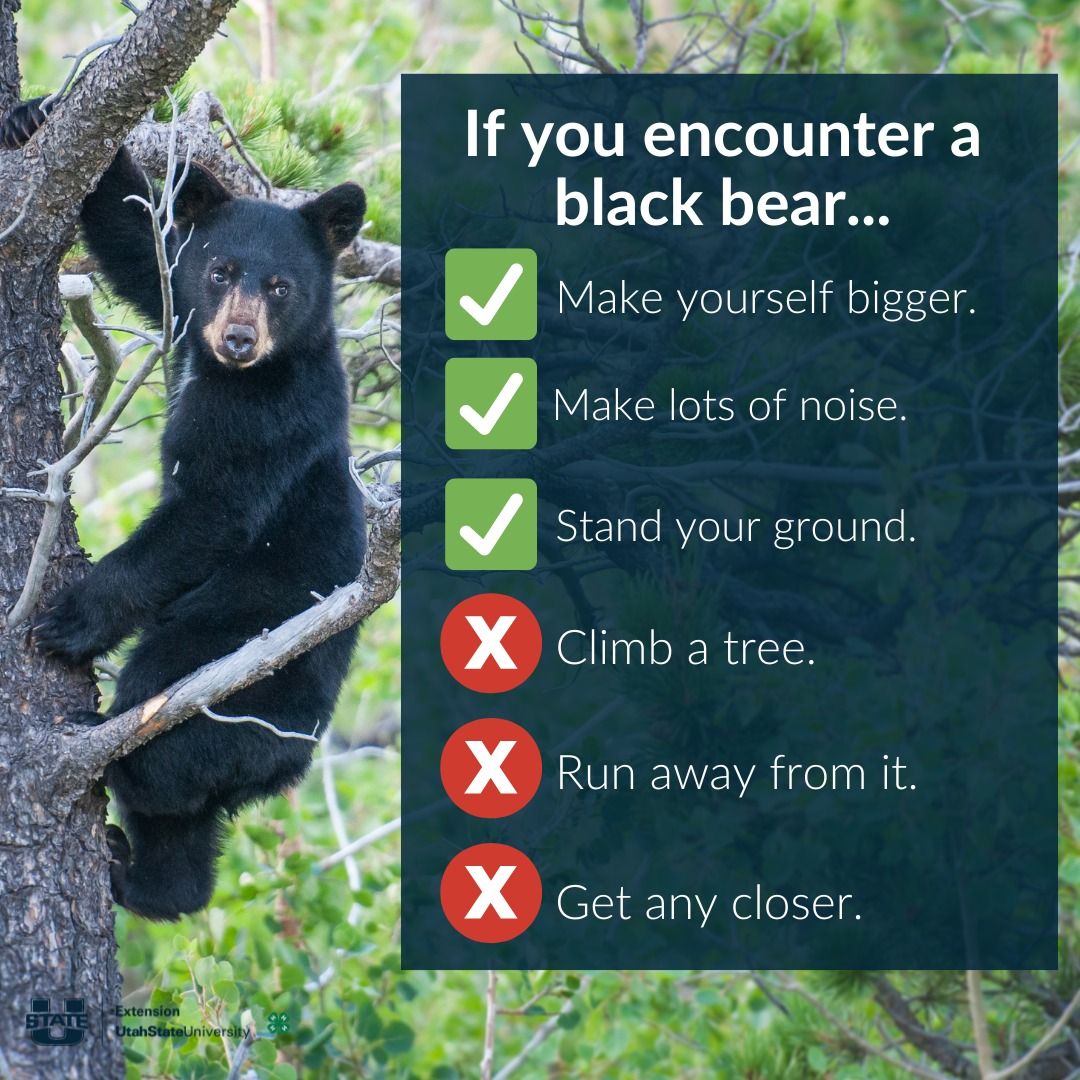
- Stop and assess. Do not run. Running can trigger a chase response.
- Identify yourself. Speak in a calm, firm voice so the bear understands you are human, not prey.
- Make yourself look large. Raise your arms, your jacket, your trekking poles.
- Back away slowly. Maintain eye contact; do not turn your back.
- Keep children and dogs close. Pick up small children. Do not let dogs charge.
If a Black Bear Bluff Charges
A bluff charge is loud, often involves jaw-popping and ground-slapping, and breaks off short of contact. Do not run. Stand your ground, continue speaking firmly, prepare bear spray. Most bluff-charging bears retreat once they have communicated discomfort.
If a Black Bear Attacks
This is the fork. Defensive contact (sow with cubs, surprise encounter) is rare in black bears; predation is the dominant fatal attack mode. Treat any sustained contact attack as predatory.
- Fight back with everything available: rocks, sticks, hiking poles, knives, water bottles
- Target the face, eyes, and muzzle
- Make maximum noise and appear as large as possible
- Do not stop fighting until the bear breaks off
- If carrying bear spray, deploy it directly at the face at 3 to 5 metres
The National Park Service guidance is unambiguous on this point.
"If a black bear attacks you, fight back. Concentrate on the face, eyes, and snout. Use any object available, including bear spray, sticks, rocks, or your bare hands. Do not play dead."
- National Park Service, bear country guidance
For the field-ready walkthrough including pre-trip preparation, equipment, and post-incident protocols, see how to survive a black bear attack.
Risk in Real Perspective
Perspective without minimisation: a person hiking in any North American black bear range is dramatically more likely to drown, fall, suffer cardiac arrest, or be involved in a vehicle accident en route to the trailhead than to be attacked by a black bear.
The annualised fatality rate from black bears across the entire continent is on the order of 0.5 to 1 per year, against millions of overnight backcountry stays and tens of millions of day-use visits. Domestic dogs kill roughly 30 to 50 Americans per year. Lightning kills roughly 20. Bees, wasps, and hornets kill roughly 60.
The black bear is not a high-frequency threat. It is a low-frequency, occasionally catastrophic one, and the risk profile is bimodal: very low for the typical hiker who keeps a clean camp and travels with a partner, and dramatically higher for the rare circumstance of a lone person, in low-density wilderness, encountering a healthy adult male in predatory mode.
Habituation flips the curve. Communities that fail to enforce food storage convert the species from a low-frequency threat to a chronic property-damage and occasional attack source. Every dataset on the question agrees: the variable that most determines black bear danger to humans is human behaviour with food, not bear behaviour with humans.
For the broader natural history that frames everything in this article, return to our anchor profile of the american black bear. Readers preparing for outdoor industry certifications, wilderness first aid exams, or guide credentials can find cognitive and prep resources at Whats Your IQ, professional certification material at Pass4-Sure, and writing tools for trip reports and field journals at Evolang.
For lighter reading at the end of a long trail day, When Notes Fly covers music and culture, and File Converter Free handles the document logistics that come with permits and reports.
Frequently Asked Questions
How often do black bears actually kill people? Black bears killed approximately 63 people in North America between 1900 and 2009 according to the Herrero et al. (2011) study, with subsequent additions pushing the total to roughly 77 confirmed fatalities through 2020. The rate is well below one per year against a continental population of 600,000 to 800,000 bears. About 88% of fatal attacks were predatory and the bear was overwhelmingly a lone adult male in good condition.
Are black bears more dangerous than grizzlies? Per encounter, no. Black bears have a fatality rate near 1 to 2% per attack against roughly 5% for grizzlies. But black bears produce vastly more encounters because the population is more than ten times larger and the species occupies far more developed habitat. The absolute death toll over a century is comparable for the two species. The behaviours differ.
Grizzlies attack defensively and you should play dead. Black bears attack predatorily when they commit, and you should fight back.
What is the most dangerous black bear scenario? A lone hiker or camper, in low-density backcountry, encountering a healthy adult male black bear that approaches silently rather than displaying. The fatal-attack record concentrates on this profile. Habituated bears in suburban-fringe environments produce the second-largest category, illustrated by the 2014 West Milford, New Jersey case in which a Rutgers student was killed on a day hike.
Does bear spray work on black bears? Yes. Smith et al. (2008) included black bears in the Alaska bear spray dataset and found high deterrent effectiveness across all three North American species. Black bears are highly responsive to capsaicin and most break off at the first contact. Carry spray in an accessible chest or hip mount, never inside a pack.
Why are black bear attacks rising in recent decades? Three factors converge. Bear populations have grown to historical highs in many regions. Human outdoor recreation and suburban development have expanded into bear habitat. Climate-driven mast and berry failures have produced more food-stressed bears willing to investigate human food sources. The 2000-2020 period accounts for roughly 40% of the long-term fatality record despite covering only 17% of the time series.
References
- Herrero, S., Higgins, A., Cardoza, J. E., Hajduk, L. I., & Smith, T. S. (2011). Fatal attacks by American black bear on people: 1900-2009. Journal of Wildlife Management, 75(3), 596-603. https://doi.org/10.1002/jwmg.72
- Smith, T. S., Herrero, S., Debruyn, T. D., & Wilder, J. M. (2008). Efficacy of bear deterrent spray in Alaska. Journal of Wildlife Management, 72(3), 640-645. https://doi.org/10.2193/2006-452
- Herrero, S., & Higgins, A. (2003). Human injuries inflicted by bears in Alberta: 1960-98. Ursus, 14(1), 44-54. https://doi.org/10.2192/1537-6176(2003)014%3C0044%3AHIIBBI%3E2.0.CO%3B2
- Smith, T. S., Herrero, S., Layton, C. S., Larsen, R. T., & Johnson, K. R. (2012). Efficacy of firearms for bear deterrence in Alaska. Journal of Wildlife Management, 76(5), 1021-1027. https://doi.org/10.1002/jwmg.342
- Garshelis, D. L., & Pelton, M. R. (1981). Movements of black bears in the Great Smoky Mountains National Park. Journal of Wildlife Management, 45(4), 912-925. https://doi.org/10.2307/3808099
- Beckmann, J. P., & Berger, J. (2003). Rapid ecological and behavioural changes in carnivores: the responses of black bears to altered food. Journal of Zoology, 261(2), 207-212. https://doi.org/10.1017/S0952836903004126
- Baruch-Mordo, S., Breck, S. W., Wilson, K. R., & Broderick, J. (2011). The carrot or the stick? Evaluation of education and enforcement as management tools for human-wildlife conflicts. PLOS ONE, 6(1), e15681. https://doi.org/10.1371/journal.pone.0015681
- Hopkins, J. B., Herrero, S., Shideler, R. T., Gunther, K. A., Schwartz, C. C., & Kalinowski, S. T. (2010). A proposed lexicon of terms and concepts for human-bear management in North America. Ursus, 21(2), 154-168. https://doi.org/10.2192/URSUS-D-10-00005.1
Frequently Asked Questions
How often do black bears actually kill people?
Black bears killed approximately 63 people in North America between 1900 and 2020, an average well below one fatality per year despite a continental population of 600,000 to 800,000 animals and tens of millions of human encounters annually. The Herrero et al. (2011) study, extended through 2020 by subsequent reports, remains the definitive accounting.
Of the documented fatal attacks, roughly 88% were classified as predatory in nature and the attacking bear was overwhelmingly a lone adult male in healthy condition rather than a sow defending cubs. The fatality rate per encounter is roughly one tenth that of the grizzly, but the encounter rate itself is far higher, which is why the absolute death count is comparable on a century scale.
What makes a black bear dangerous if most of them flee from humans?
Two factors. The first is food habituation. A bear that has learned to associate humans with garbage, pet food, bird feeders, or unsecured camp coolers loses the avoidance response that keeps wild black bears alive. The second is the rare predatory bear, almost always a lone adult male, which approaches a human as prey. These two profiles are responsible for nearly every fatal attack on record.
A black bear that bluff-charges a hiker, popping its jaws and slapping the ground, is performing a stress display rather than committing to attack. A bear that approaches silently, circles a campsite at night, or returns repeatedly after being chased off is the dangerous profile and warrants assertive defense rather than retreat.
Where in North America are black bear attacks most likely?
Alaska, British Columbia, the Rocky Mountain states, the southern Appalachians, and parts of New Jersey and Pennsylvania see the highest absolute numbers of black bear conflicts and attacks. Alaska and British Columbia top the fatal-attack record because they combine large bear populations with remote backcountry use and weaker food-storage enforcement on private land.
Colorado, North Carolina, and Tennessee rank high for urban-fringe incidents driven by garbage and bird feeder habituation. Eastern states with growing bear populations and dense suburban development, including New Jersey and Pennsylvania, have produced several high-profile fatal cases since 2010, the most widely reported of which is the 2014 Rutgers student killing in West Milford, New Jersey.