
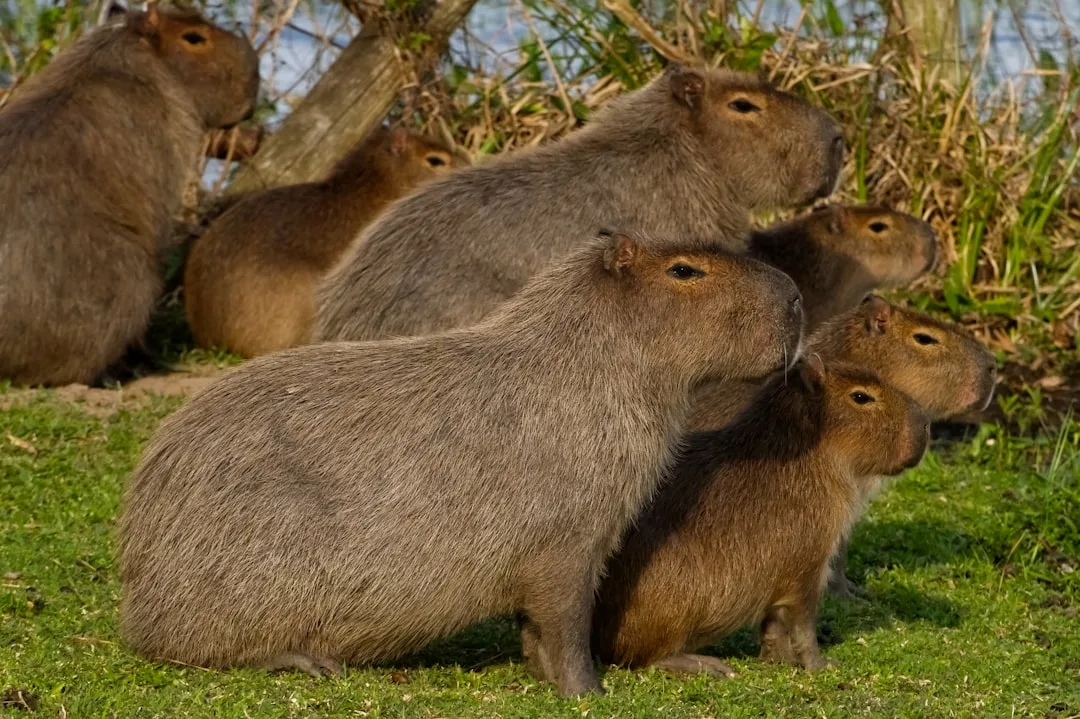
How big do capybaras get?
Adult capybaras (Hydrochoerus hydrochaeris) weigh 35-79 kg (77-174 pounds) and reach 106-134 cm (42-53 inches) in length, making them the largest rodents on Earth. The largest verified wild capybara weighed 91 kg. They stand about 50-62 cm (20-24 inches) tall at the shoulder. Females are slightly larger than males - unusual among mammals but consistent with other rodent species.
The Internet's Favorite Animal
A capybara sits in a pond with a turtle on its back. Nearby, ducks swim around it. A small monkey approaches and climbs onto the capybara's head. The capybara does not react. It continues sitting in the pond, looking calmly ahead, completely unbothered.
This is a normal day for a capybara. Across South America, capybaras have been photographed peacefully coexisting with virtually every animal they encounter, monkeys, birds, turtles, crocodiles, tigers, ducks, cats, dogs. The internet has dubbed them "nature's friend" and made them one of the most popular animals in global social media.
They are also the largest rodents on Earth, relatives of guinea pigs that grew to dog size.
The Size
Capybaras are significantly larger than other rodents.
Statistics:
- Weight: 35-79 kg (77-174 pounds)
- Length: 106-134 cm (42-53 inches)
- Shoulder height: 50-62 cm (20-24 inches)
- Record weight: 91 kg (wild specimen)
Compared to other rodents:
- Beaver: up to 30 kg (half the size)
- Porcupine: up to 16 kg
- Groundhog: up to 6 kg
- Average rat: 0.3 kg
- Guinea pig (closest relative): 1 kg
Body shape:
- Barrel-shaped body
- Short legs
- Partially webbed feet (for swimming)
- No tail
- Coarse brown fur
- Large blocky head with small ears
The Universal Friend Phenomenon
Capybaras have earned internet fame for their unusual social behavior.
Documented interactions:
Capybaras have been photographed or filmed calmly coexisting with:
- Monkeys (climbing on them, grooming them)
- Birds (perching on their backs, eating insects from their fur)
- Turtles (riding on their backs while swimming)
- Cats (both wild and domestic)
- Dogs
- Crocodiles and caimans (in the same water without conflict)
- Tigers (in zoo settings)
- Ducks (floating with them)
- Deer
Why so chill:
Several factors contribute to capybara universal friendliness:
Size. They are too large for most small predators to challenge, so they don't need defensive behaviors against smaller animals.
Herbivory. They eat only plants, so they pose no predatory threat to anything else.
Group living. Their social structure (herds of 10-40) makes them accustomed to tolerating other individuals sharing space.
Calm temperament. Their baseline physiology is relaxed, low aggression, minimal territorial behavior, slow reflexes.
Scent signals. Specialized scent glands produce signals that may communicate social acceptance to nearby animals.
Water as defense. Predators often avoid capybaras in water (their preferred habitat), so they don't need to be defensive in much of their environment.
Ignoring strategy. When other animals approach, capybaras often simply ignore them rather than react.
The exceptions:
Capybaras do have predators, jaguars, pumas, anacondas, and caimans can kill them. In response to these specific threats, capybaras flee into water and alert the herd. But they don't generalize predator responses to other species that merely share their space.
Where They Live
Capybaras inhabit tropical and subtropical South America.
Native range:
- Panama (southernmost)
- Venezuela
- Colombia
- Ecuador (east of Andes)
- Peru (Amazon region)
- Brazil
- Bolivia
- Paraguay
- Argentina (northern)
- Uruguay
Habitat requirements:
- Water: essential; they cannot survive far from it
- Grasslands: for grazing
- Wetlands: ideal habitat
- River edges: common gathering places
- Tropical climate: warmth needed
Elevation range: mostly lowland, below 1,500 meters.
Introduced populations:
- Florida, USA: escaped pet capybaras have established breeding populations estimated at several thousand individuals
- Various localized populations from pet escapes in Europe and Asia (typically limited by cold winters)
Diet
Capybaras are strict herbivores.
Primary foods:
- Grasses (60-70% of diet in most seasons)
- Aquatic plants (important during dry season)
- Fruits (seasonal)
- Tree bark (limited)
- Sedges and reeds
Daily consumption:
Adults eat 3-4 kg of vegetation daily. They spend significant time grazing, typically at dawn and dusk in areas with human hunting pressure, or throughout the day in safer environments.
Coprophagy:
Capybaras re-ingest their own feces (coprophagy). This is normal and essential for their digestion:
- Extracts additional nutrition from tough plant material
- Similar to rabbits and guinea pigs
- Allows survival on low-quality forage
- Part of their digestive ecology, not a behavioral quirk
Digestive system:
Their four-chambered stomach works similarly to a cow's, using microbial fermentation to break down cellulose. Combined with coprophagy, this allows them to extract maximum nutrition from plant material.
Social Structure
Capybaras live in family groups called herds.
Herd composition:
- Dominant male
- Multiple females
- Their offspring
- Sometimes subordinate males
Herd size:
- Typical: 10-20 individuals
- Large herds: 30-40
- Dry season concentrations: up to 100+ temporarily
Communication:
Capybaras communicate through:
- Vocalizations: purring, barking, whistling, clicking
- Scent marking: from nasal and anal glands
- Body posture: aggressive and submissive signals
- Tooth chattering: warning signal
Grooming:
Herd members groom each other, reinforcing bonds and removing parasites. This grooming sometimes extends to non-capybara species that join the group.
Swimming and Water
Capybaras are semi-aquatic.
Adaptations:
- Webbed feet: help propel them through water
- High-set eyes, ears, nostrils: allow breathing while mostly submerged
- Dense fur: provides some buoyancy
- Strong swimmers: can cover several hundred meters
Time in water:
- Dry season: much of the day (cooling)
- Wet season: less time, mostly for drinking and escape
- Hot daytime: often submerged with only eyes and nose showing
Underwater capabilities:
Capybaras can hold their breath for up to 5 minutes. They sometimes sleep in water with only their noses exposed, reducing predator visibility.
Swimming uses:
- Escape from predators
- Access to aquatic food
- Thermoregulation (cooling)
- Transportation between feeding areas
- Hiding
Reproduction
Capybara reproduction is relatively straightforward.
Basics:
- Gestation: 5 months
- Litter size: 2-8 pups (average 4)
- Birth weight: 1-1.5 kg
- Sexual maturity: 12-18 months
Birth:
Females give birth on land, usually in concealed locations. Multiple females in a herd often give birth around the same time, creating synchronized nurseries.
Communal care:
After birth, multiple mothers may nurse each other's pups, similar to some other social rodents. Pups mingle freely within the herd.
Development:
Pups are precocial, born with fur and open eyes, able to walk within hours. They begin grazing within the first week and are weaned by about 16 weeks.
Lifespan:
- Wild: 8-10 years
- Captive: up to 12 years
Predators
Capybaras face multiple predators.
Main predators:
- Jaguars: primary large predator, can kill adult capybaras
- Pumas: hunt capybaras where their ranges overlap
- Anacondas: large snakes that take capybaras from water
- Caimans: attack swimming capybaras
- Ocelots: target young capybaras
- Large eagles: take pups
Human predation:
Indigenous peoples have hunted capybaras for thousands of years. Modern hunting continues in some regions for meat and leather. Capybara meat is legal and consumed in several South American countries.
Why they still thrive:
Despite predation, capybaras remain abundant because:
- High reproductive rate (2-8 pups per year per female)
- Effective group defense
- Rapid flight into water
- Size (only large predators can kill adults)
- Geographic range (widespread across continent)
Human Relationships
Capybaras have complex relationships with humans.
As food:
Capybara meat is legal and eaten in Venezuela, Colombia, and parts of Brazil. During Lent, the Catholic Church historically classified capybaras as fish (because they live in water), allowing them to be eaten on fast days. This classification persists in some regions.
Commercial capybara farms exist in Venezuela, producing meat for the local market.
As pets:
- Japan: legal and popular
- United States: legal in some states (Texas, Pennsylvania), illegal in others
- UK/Europe: legal in some countries with licenses
- South America: legal in most countries
Capybaras make surprisingly good pets when raised from young age with adequate space and water. They bond with humans similarly to dogs. Cost and space requirements limit their popularity.
Cultural significance:
Capybaras appear in:
- Indigenous mythology across South America
- Regional folklore
- Modern internet memes and social media
- Video games and cartoons
- Japanese "capybara-themed" merchandise industry
Internet fame:
Since around 2010, capybaras have become increasingly popular on social media. Videos of capybaras with other animals regularly go viral. Japanese zoos featuring capybara hot tub baths have attracted millions of views.
Conservation
Capybara populations are stable overall.
Status:
- IUCN: Least Concern
- Global population: likely millions
- Trend: stable or slightly increasing in protected areas
Regional concerns:
- Some populations declining from habitat loss
- Agricultural expansion reduces wetland habitat
- Road collisions kill many capybaras near human-developed areas
- Pet trade pressure on young capybaras
Protection:
Capybaras benefit from protection in multiple South American national parks and reserves. Their ability to thrive in human-modified landscapes (pastures, rice paddies, reservoirs) helps maintain populations even outside protected areas.
Agricultural value:
In some regions, farmers consider capybaras beneficial; they graze grass without damaging crops and their droppings fertilize pastures. In other regions, they compete with livestock and are considered pests.
The Cultural Phenomenon
The capybara has achieved something unusual, genuine mass popularity.
Few animals have become internet sensations like capybaras. Their image (placid, round, unbothered) has become shorthand for chill, calm, stress-free existence. "Be like a capybara" is a common social media catchphrase.
This popularity is based on real traits:
- They are genuinely calm most of the time
- They genuinely tolerate other species
- They genuinely appear to enjoy soaking in water
- Their facial structure gives a naturally serene expression
But popularity has also generated myths:
- Capybaras are not always friendly; they can be aggressive if provoked
- They are not pets for most situations (large size, water requirements)
- They do bite and can cause serious injury
- They are not as rare as popularity suggests (they are abundant)
- Wild capybaras are appropriately cautious, not universally trusting
What the capybara represents culturally, an animal that seems to have figured out how to coexist peacefully with everything, is not quite accurate. But it's close enough to reality that the image holds.
Capybaras are herd-dwelling herbivores who have evolved to be large, calm, and social. Their tolerance of other species reflects ecological circumstances (abundant resources, few conflicts, water as common protection). But the internet has read into this a philosophical message about acceptance and coexistence.
Whether or not capybaras actually embody that message in a human sense, they embody it biologically, through their evolution into an animal whose default response to anything unexpected is to ignore it and continue existing peacefully.
How Capybaras Compare to Other Giant Rodents
Our research team has compiled a comparison of the largest living and extinct rodents. The capybara's current title as the largest rodent is unambiguous, but the fossil record shows that far larger rodents once existed in South America.
Largest Rodents Past and Present
| Species | Period | Approximate body mass | Status |
|---|---|---|---|
| Josephoartigasia monesi | Pliocene (~3 Mya) | 400-1,500 kg | Extinct |
| Phoberomys pattersoni | Miocene (~8 Mya) | 500-700 kg | Extinct |
| Castoroides (giant beaver) | Pleistocene | 60-100 kg | Extinct |
| Capybara (Hydrochoerus hydrochaeris) | Present | 35-79 kg | Least Concern |
| Lesser capybara (H. isthmius) | Present | 27-34 kg | Least Concern |
| North American beaver | Present | 15-35 kg | Least Concern |
| Eurasian beaver | Present | 11-30 kg | Least Concern |
| Crested porcupine | Present | 13-27 kg | Least Concern |
| Patagonian mara | Present | 8-16 kg | Near Threatened |
Josephoartigasia monesi, nicknamed the "giant guinea pig," is the largest rodent ever documented. A well-preserved skull found in Uruguay in 2007 suggests a body length of approximately 3 meters and an estimated weight approaching 1,500 kg - heavier than a bison. Its bite force, calculated from skull biomechanics, was estimated at approximately 1,400 N, suggesting it used its incisors as defensive weapons rather than for feeding.
"The South American rodent radiation is one of the most spectacular experiments in mammalian evolution. Capybaras are the last surviving representatives of a lineage that once produced rodents the size of small cars. The fossil record tells us there is nothing intrinsic to the rodent body plan that limits them to small size. They simply face competition from ungulates where large size becomes advantageous." - Dr. Andres Rinderknecht, Museo Nacional de Historia Natural, Montevideo [1]
The Sociality of Capybaras
Capybara social organization has been studied extensively since Emilio Herrera's work at the Universidad Simon Bolivar in Venezuela in the 1980s. Herrera and Macdonald documented that capybara herds are structured around a dominant male who fathers most (but not all) of the group's offspring, multiple related females, and subordinate males with restricted reproductive opportunities [2].
What Herrera found particularly striking was how fluid this structure could be. During the dry season, when water and forage became concentrated, multiple herds temporarily fused into aggregations of up to 100 capybaras. These mega-herds maintained peaceful relations despite not being genetically related - an unusual pattern for territorial mammals.
"Capybaras invert our expectations of mammalian territoriality. They defend resources when scarce and cooperate when abundant, rather than the other way around. This social flexibility is a major part of why they are so successful across such varied habitats." - Professor Emilio Herrera, Universidad Simon Bolivar [2]
Capybara Herd Dynamics
| Context | Typical size | Cohesion | Aggression |
|---|---|---|---|
| Wet season (resources abundant) | 10-20 | Loose | Minimal |
| Dry season (concentrated at water) | 30-100 | Dense aggregations | Low between herds |
| Mating period | 10-30 | Tight | Male-male competition |
| With newborn pups | 10-20 | Very tight | Defensive against predators |
| Farm pastures | 5-100+ | Adapted to human presence | Variable |
Notable Research Findings
- Capybaras have a special throat pouch for producing vocalizations. A 2021 acoustic study identified at least 10 distinct call types used in different social contexts, including a specific infant distress call that produces group mobilization.
- Capybaras are a significant reservoir for Rickettsia rickettsii, the bacterium that causes Brazilian spotted fever. Their abundance in peri-urban Brazil has been linked to rising cases of the disease. Public health authorities in Sao Paulo state have monitored capybara populations as part of zoonotic surveillance since 2012.
- Capybaras can hold their breath for up to 5 minutes and frequently sleep in water with only nostrils exposed. Their dense fur traps air, providing thermal insulation even in cool water.
- Capybara teeth, like all rodents, are continuously growing and self-sharpening. Adults chew an estimated 3 to 5 kg of vegetation daily, keeping their incisors properly worn.
- Our research team notes that the Venezuelan Catholic Church's historical classification of capybaras as "fish" for Lenten purposes persists informally in some rural communities. The origin is a 16th-century Papal ruling based on the animal's semi-aquatic lifestyle, and it remains a point of quirky cultural interest in South American food traditions.
References
[1] Rinderknecht, A., & Blanco, R. E. (2008). The largest fossil rodent. Proceedings of the Royal Society B, 275(1637), 923-928. DOI: 10.1098/rspb.2007.1645
[2] Herrera, E. A., & Macdonald, D. W. (1989). Resource utilization and territoriality in group-living capybaras (Hydrochoerus hydrochaeris). Journal of Animal Ecology, 58(2), 667-679.
[3] Moreira, J. R., Ferraz, K. M. P. M. B., Herrera, E. A., & Macdonald, D. W. (Eds.). (2013). Capybara: Biology, Use and Conservation of an Exceptional Neotropical Species. Springer.
[4] Labruna, M. B. (2009). Ecology of Rickettsia in South America. Annals of the New York Academy of Sciences, 1166, 156-166.
[5] Quintana, R. D. (2007). Conservation status of the capybara (Hydrochoerus hydrochaeris) in the Lower Delta of the Parana River. Acta Zoologica Mexicana, 23(2), 123-144.
[6] IUCN Red List. (2016). Hydrochoerus hydrochaeris assessment. International Union for Conservation of Nature.
Related Articles
- Naked Mole Rats: The Immortal Mammal
- Beavers: The Ecosystem Engineers That Shape Landscapes
- Rodents: The Most Successful Mammals on Earth
Frequently Asked Questions
How big do capybaras get?
Adult capybaras (Hydrochoerus hydrochaeris) weigh 35-79 kg (77-174 pounds) and reach 106-134 cm (42-53 inches) in length, making them the largest rodents on Earth. The largest verified wild capybara weighed 91 kg. They stand about 50-62 cm (20-24 inches) tall at the shoulder. Females are slightly larger than males - unusual among mammals but consistent with other rodent species.
They have barrel-shaped bodies, short legs, partially webbed feet (for swimming), and no tails. Their coarse brown fur helps protect them from sun and insects. Capybara skulls are substantial - approximately 25 cm long. They have specialized ever-growing incisor teeth like all rodents, but capybara teeth are particularly large, allowing them to eat tough aquatic plants and grasses.
Despite their large size, they remain unmistakably rodents, sharing ancestry with mice and rats through guinea pigs (their closest relatives).
Why do capybaras get along with every animal?
Capybaras have earned social media fame for photos and videos showing them coexisting peacefully with nearly every animal species they encounter - monkeys, birds, turtles, crocodiles, tigers, and even predators. Scientists believe this unusual friendliness results from several factors. First, capybaras are naturally calm and non-aggressive herbivores that lack fear responses most prey species have.
Second, they are social animals living in groups of 10-40, so they accept other animals as potential group members easily. Third, they produce a specific scent from their noses that may signal social acceptance to other animals. Fourth, their substantial size (they can weigh as much as a large dog) discourages small predators from attacking, so capybaras don’t need to be defensive.
Even their largest predators (jaguars, anacondas, pumas) rarely manage successful hunts against healthy adult capybaras. The combination of size, calmness, lack of defensive behavior, and their tendency to simply ignore other species has made them the internet’s favorite ‘universal friend’ animal.
What do capybaras eat?
Capybaras are strict herbivores that primarily eat grasses and aquatic plants. An adult capybara consumes 3-4 kg of vegetation daily. In the wet season, they eat mostly grass. In the dry season, they rely more on aquatic plants accessible through swimming. They have four-chambered stomachs similar to cows and re-ingest their own feces (called coprophagy) to extract maximum nutrition from tough plant material.
This is normal for capybaras and essential for their digestion - rather than disgusting, it’s an adaptation that helps them thrive on low-nutrient food. They also eat fruits when available, particularly during the rainy season when trees fruit heavily. They require lots of water both for drinking and as habitat - they are semi-aquatic, spending significant time in rivers, ponds, and wetlands where they can swim and escape predators.
Capybaras can consume up to 4 kg of fresh grass daily, making them significant grazers in South American ecosystems.
Where do capybaras live?
Capybaras live in tropical and subtropical South America, from Panama through most of South America excluding the west coast of Chile. They inhabit tropical rainforests, savannas, and wetlands across Venezuela, Colombia, Brazil, Argentina, Uruguay, Paraguay, Ecuador, Peru, and Bolivia. Their habitat requirement is simple: access to water. They live near rivers, ponds, swamps, lakes, and streams.
They cannot survive far from water and will relocate if water dries up. They are active from dusk to dawn in areas where humans hunt them; in less disturbed regions they remain active throughout the day. They gather in herds of 10-40 individuals.
Capybaras have been introduced to some areas outside their native range, including parts of Florida in the United States (where invasive populations now number several thousand), and they have been kept as pets in many countries (legal in some, banned in others). They thrive in captivity when given sufficient water and space.
Are capybaras dangerous?
No, capybaras are not dangerous to humans and rarely attack anything. They are primarily prey animals, not predators, and their defensive response to threats is to flee into water. Capybaras do have teeth capable of causing serious injury if they bite (their incisors are 6-8 cm long), but they essentially never bite humans except in rare cases of captive animals under extreme stress.
Several documented cases exist of capybaras biting zookeepers or owners after prolonged provocation. Wild capybara attacks on humans are extraordinarily rare. The main risk from capybaras is indirect: they can carry ticks that transmit diseases to humans (similar to deer in North America), and rabies outbreaks occasionally affect South American capybara populations.
In natural encounters, a capybara’s worst response is usually to panic and stampede away - which could injure bystanders if they block the escape route. Capybaras raised as pets from young age bond with humans similarly to dogs and show minimal aggression even in adulthood.