
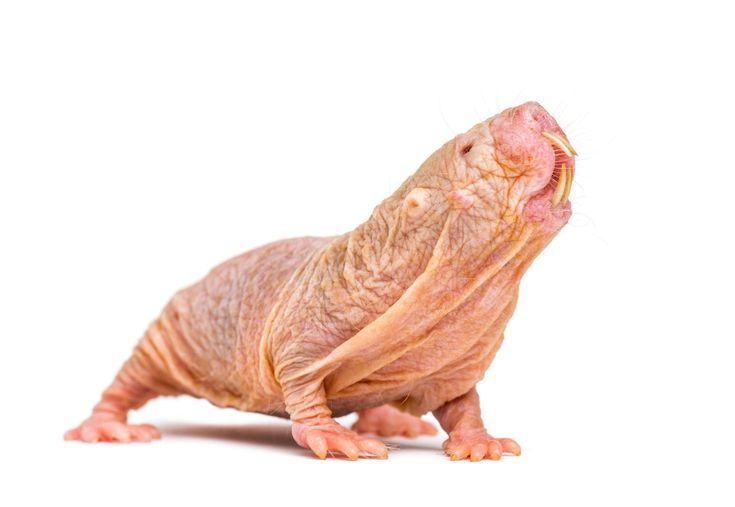
The naked mole-rat is the strangest mammal on Earth.
It is a rodent that lives 30 years in a 30-gram body, a mammal that does not maintain its own body temperature, a vertebrate that survives 18 minutes without oxygen by switching to plant-style metabolism, a near-immortal animal that shows no detectable ageing, a creature essentially immune to cancer, and one of only two mammal species that live in eusocial colonies like bees and ants.
Every one of those claims is a discrete biological oddity, and every one of them is true at once in the same small pink animal.
This guide covers the full biology and ecology of Heterocephalus glaber: its underground range in the Horn of Africa, colony organisation, queen-worker-soldier caste system, extreme longevity, cancer resistance, oxygen-deprivation biology, near-blindness, pain insensitivity, vocal dialects, and conservation status. It is a reference entry, not a summary - so expect specifics: grams, minutes, metres, temperatures, and the precise mechanisms biologists have identified.
Etymology and Classification
The scientific name Heterocephalus glaber comes from the Greek heteros (different) and kephale (head), together with Latin glaber (smooth, hairless). The literal meaning - "different-headed smooth one" - captures the two features that most struck 19th-century anatomists: the asymmetric, chisel-like teeth that break away from the typical rodent bauplan, and the nearly bald, wrinkled pink skin.
For decades the species was classified in the family Bathyergidae alongside other African mole-rats. Molecular evidence published in 2015 showed that Heterocephalus diverged from the rest of the mole-rat lineage roughly 31 million years ago - deep enough in evolutionary time to warrant its own family. Taxonomists accordingly moved the species into Heterocephalidae, of which it is the sole living member.
The naked mole-rat is therefore not a close relative of true moles (which are not rodents at all) and only distantly related to the Damaraland mole-rat and other African burrowers it superficially resembles.
That long evolutionary isolation matters. Almost every weird trait of the naked mole-rat - the eusocial colony, the 30-year lifespan, the cold-blooded metabolism, the fructose-switching biochemistry, the cancer resistance - appears to have evolved down a single lineage over tens of millions of years of subterranean life, independently of any other mammal on Earth.
Size and Physical Description
Naked mole-rats are small, even for rodents. Adult workers weigh 30-35 g, measure 8-10 cm in body length plus a 3-4 cm tail, and stand only a few centimetres high at the shoulder. The queen is the largest animal in the colony, reaching 50-80 g by the middle of her reign, with a longer body and more pronounced belly.
Workers:
- Body length: 8-10 cm
- Tail: 3-4 cm
- Weight: 30-35 g
- Diet: tubers, shared communal food
Soldiers:
- Body length: up to 11 cm
- Weight: 40-50 g
- Diet: same as workers, but larger body mass for defence
Queen:
- Body length: up to 12 cm, with elongated lumbar vertebrae
- Weight: 50-80 g
- Physically transforms from a normal female after assuming the role
Pups at birth:
- Length: around 3 cm
- Weight: 1.5-2 g - lighter than a raisin
The most obvious feature of the species is the near-absence of fur. Only a scatter of fine sensory whiskers remain on the body, concentrated on the snout and above the eyes; the rest is bare, wrinkly, translucent pink skin through which blood vessels and muscle fibres are sometimes visible. A few dozen long vibrissae run along the flanks and serve as a tactile map of the tunnel walls.
The skin is remarkably loose, which lets a mole-rat squeeze past obstacles in narrow tunnels and run backwards nearly as fast as forwards.
The head is dominated by two pairs of large, forward-facing incisors that protrude outside the lips. The naked mole-rat can close its mouth behind these teeth, which means it can dig without swallowing dirt. Each pair of teeth moves independently - the upper and lower incisors can operate like a pair of chopsticks. Roughly 25% of the naked mole-rat's voluntary musculature is dedicated to controlling its jaws and teeth, an astonishing proportion for any mammal.
The eyes are small and nearly useless. Naked mole-rats can detect light and some shadowed movement but cannot resolve shapes in the way a surface-dwelling rodent does. In place of vision they rely on a sophisticated tactile sense distributed across whiskers, skin, and the teeth themselves.
A Cold-Blooded Mammal
Naked mole-rats are functionally poikilothermic. Their body temperature matches the temperature of the burrow, which is typically 28-32 degrees Celsius with very little daily or seasonal variation. Unlike almost every other mammal, they make no serious attempt to hold a stable core temperature. Place a naked mole-rat in a cold chamber and its body simply cools; place it in a warm one and it warms.
This is unprecedented across mammals and has forced biologists to soften what was once considered a defining feature of the class.
Their solution to cold is behavioural rather than metabolic. When the tunnel is too cool, mole-rats pile into sleeping chambers in stacks five or six animals deep, sharing warmth. When it is too warm they spread out. They lack the insulating fur, brown fat, and shivering reflex typical of other small mammals because, deep in the Horn of Africa, their burrow almost never swings outside the narrow temperature band they tolerate.
This strategy has enormous metabolic benefits. By not spending energy on internal heating, naked mole-rats need only a fraction of the food a similar-sized mouse or vole would. Their basal metabolic rate is among the lowest of any mammal, which in turn is one of several factors implicated in their extreme longevity.
The Colony and Eusociality
The naked mole-rat is one of only two confirmed eusocial mammal species on Earth. The other is the Damaraland mole-rat (Fukomys damarensis) of southern Africa. Every other mammal species lives in family groups or looser aggregations; only these two show the full eusocial pattern of reproductive division of labour seen in bees, ants, termites, and some wasps.
The caste structure:
- Queen. A single dominant breeding female mates exclusively with one to three consorts. She suppresses reproduction in every other female in the colony.
- Consorts. The two or three breeding males. They live longer than average workers and stay close to the queen.
- Workers. The majority of the colony. Smaller, younger, or less dominant animals handle tunnel maintenance, food transport, pup care, and general labour.
- Soldiers. Larger non-breeders - the biggest non-queen animals in the colony. They defend against snakes, predatory mole-rats, and rival colonies.
Colony sizes range from about 20 up to 300 individuals, with an average of around 75-80. The colony is effectively a single extended family, with the queen's pups filling every role.
How the queen keeps control:
The queen suppresses reproduction in other females through a combination of pheromones, physical shoving, and a general atmosphere of social dominance. Worker females have functional ovaries but do not ovulate as long as they are around the queen. Remove the queen from the colony and within days several females enter oestrus; within weeks, a violent struggle ensues and one emerges as the new queen.
That new queen then undergoes a dramatic physical transformation. Her lumbar vertebrae elongate, her hips widen, her muscles reorganise, and her body mass roughly doubles over the course of months. No other mammal is known to show this kind of post-maturity skeletal restructuring. Her ovaries and uterus enlarge in parallel, and within weeks to months she starts producing litters.
Mating and reproduction:
- Gestation: 70 days
- Litter size: 11-28 pups, with a verified record of 33
- Litters per year: up to 4-5
- Weaning: roughly one month, then transition to shared faecal pellets rich in gut bacteria
Pups are born hairless, pink, and blind. Workers across the colony help care for them, feeding them their own faecal pellets to seed the pups' intestinal bacteria. Multiple adults will pile on top of the pups to keep them warm in the nest chamber.
A single queen can produce more than 900 pups during her lifetime. The captive queen Martha, maintained at a U.S. research facility, produced over 900 pups in 25 years with no detectable decline in reproductive output until shortly before her death.
Extreme Longevity
Naked mole-rats live 20-30 years in captivity, with queens often passing 30 and some individuals approaching 37 years. Mice of similar body size live 2-3 years. Other rodents top out at 10-15 years. Nothing this small lives this long.
More remarkably, naked mole-rats appear not to age in any ordinary sense. In most mammals, the probability of dying in any given year rises exponentially with age - a pattern called Gompertzian mortality. Naked mole-rat mortality stays roughly flat. A 25-year-old mole-rat is approximately as likely to die in the next year as a 2-year-old.
This pattern, called negligible senescence, has been documented only in a handful of species across the animal kingdom, and among mammals it is essentially unique to Heterocephalus glaber.
Measurable biological markers of ageing do not change in expected ways:
- DNA damage accumulates more slowly than in other rodents
- Telomeres remain stable across decades
- Protein quality control remains strong into old age
- Cardiovascular function, bone density, and fertility persist for 20+ years
Queens reproduce into their third decade. Workers continue tunnelling and foraging without obvious deterioration. Old individuals sometimes die from infection, injury, or failure of a single system, but they rarely show the cascading multi-organ decline that typifies mammalian ageing.
Cancer Resistance
Cancer is effectively absent in naked mole-rats. Large pathology surveys, including studies led by Jens Munster at the University of Haifa and Vera Gorbunova's team at the University of Rochester, have autopsied thousands of individuals and found only a handful of confirmed tumours - fewer than a dozen documented cases across the entire scientific literature.
Mechanisms identified so far:
- High-molecular-weight hyaluronic acid. Naked mole-rat cells produce a form of hyaluronic acid roughly five times larger than the human or mouse version. It fills the extracellular matrix and prevents cells from packing densely enough to form tumours.
- Early contact inhibition. Their cells stop dividing as soon as they touch their neighbours, far earlier than mouse or human cells. This removes the opportunity for uncontrolled proliferation.
- Tumour suppressor activation. Both the p53 and retinoblastoma pathways are more readily triggered than in other mammals, pushing suspicious cells into senescence or death.
- Robust DNA repair. Their error correction machinery is unusually accurate, reducing the mutation rate that fuels cancer in the first place.
- Exceptionally clean proteostasis. Their ribosomes translate proteins with very few errors, limiting the burden of misfolded protein junk that accumulates in ageing tissue.
The combined effect is an animal that effectively refuses to develop the cellular conditions cancer requires. The mechanisms are now a central topic in translational biomedical research, and several human therapies under investigation draw directly on mole-rat biology.
Hypoxia and Oxygen Deprivation
Naked mole-rats tolerate low-oxygen atmospheres that would kill nearly any other mammal. Deep burrows in the Horn of Africa routinely drop to 7-9% oxygen with 5-10% carbon dioxide, conditions lethal to surface mammals within minutes. Naked mole-rats treat this as a normal day at the office.
Pushed further, they survive in atmospheres with as little as 5% oxygen for hours on end, and survive up to 18 minutes with no oxygen at all, recovering fully once normal air returns.
The fructose switch:
A 2017 paper in Science demonstrated that under zero-oxygen stress, naked mole-rat tissues release fructose into the bloodstream and begin metabolising it anaerobically. Fructose metabolism bypasses the oxygen-dependent step that normally shuts down during hypoxia in other mammals. The pathway is the one plants use to store energy in tubers. Its activation in a mammal is unique.
During anoxia, the animal's heart rate and metabolism slow dramatically, brain activity persists, and tissues show no visible injury afterwards. Human cells placed in identical conditions experience massive energy failure, lactic acid build-up, and cell death within minutes.
The evolutionary driver is clear. In a sealed burrow crowded with dozens of bodies, oxygen is a resource like food, and the colony that can keep functioning when oxygen drops has a significant survival advantage.
Pain Insensitivity
Naked mole-rats do not feel pain from acids or capsaicin - the active chemical in chilli peppers. Acid that would burn a mouse's skin or a human's eyes produces no visible response in naked mole-rats. Capsaicin injected into the paw, which causes minutes of vocal distress in nearly every other mammal, elicits nothing.
The mechanism involves modifications to specific sodium channels and nerve growth factor signalling in their peripheral nervous system. In ordinary mammals, these pathways translate tissue damage or acidic conditions into pain signals. In naked mole-rats the pathway is truncated or silent for those specific stimuli.
Importantly, they do feel other kinds of pain - mechanical damage, extreme heat, and certain inflammatory triggers still elicit withdrawal responses. The insensitivity is targeted, not generalised. The leading adaptive explanation is that their burrows naturally accumulate high carbon dioxide, which lowers tissue pH. A mammal that treated ambient acidosis as painful would live in constant agony. Evolution solved the problem by deleting the response.
Diet and Foraging
Naked mole-rats are specialist herbivores that feed on large underground storage organs - tubers, bulbs, and fleshy roots - belonging to plants like Pyrenacantha malvifolia. A single tuber can weigh 20 kg, roughly 1,000 times the mass of a worker mole-rat, and the colony exploits it gradually.
The sustainable-farming habit:
Workers chew into a tuber through a small access hole, excavate the inside, and carry fragments back along the tunnel to communal feeding galleries. Crucially, they leave the outer skin and vascular core intact, so the tuber regenerates over months or years. A single well-managed tuber can feed a colony repeatedly. Biologists call this "geophagy plus stewardship" and it is rare among mammalian herbivores.
Because tubers are scarce in arid habitat, tunnel systems must cover enormous ground. A typical colony maintains 3-5 km of total tunnel length, with foraging tunnels pushing outward in search of new tubers and chambers storing discovered food for later.
Communication and Vocal Dialects
Naked mole-rats produce at least 17 distinct vocalisations, identified by researchers through acoustic analysis. Chirps, squeaks, grunts, trills, and sneeze-like coughs carry specific meanings ranging from "food here" to "intruder in tunnel" to "come warm me up."
A 2021 study in Science showed that each colony has its own dialect. Chirps from one colony differ statistically from chirps of another, and naked mole-rats respond more strongly to their own dialect than to a neighbouring colony's. When a pup is fostered into a foreign colony, it adopts the new dialect within weeks. Vocal learning of this kind is rare among mammals - previously documented mainly in cetaceans, bats, and some primates.
The dialect appears to reinforce colony identity and aggression toward strangers, who are reliably killed if they stray into another colony's tunnels.
Tunnel Architecture
A naked mole-rat colony maintains a sprawling underground city.
| Feature | Typical value |
|---|---|
| Total tunnel length | 3-5 km per colony |
| Tunnel depth | 10-50 cm |
| Tunnel diameter | 3-5 cm |
| Nest chamber | 20-40 cm across, central, well-insulated |
| Toilet chambers | Multiple, sealed off and periodically reused |
| Food storage | Distributed throughout foraging sections |
| Soil moved annually | Up to 5,000 kg per colony |
Tunnels are kept scrupulously clean. The colony designates specific chambers as toilets, uses them for weeks at a time, then seals them off and digs replacements. The central nest chamber is maintained at close to optimum temperature and humidity, insulated by its depth and by the bodies of sleeping colony members.
Range, Habitat, and Conservation
Naked mole-rats occur only in the Horn of Africa: Ethiopia, Kenya, and Somalia. They inhabit arid to semi-arid savanna and scrubland at low to moderate elevations, wherever soils are dry enough to hold stable tunnels and soft enough to dig. They avoid genuine sand and avoid heavy clay that seals shut; their preferred substrate is a compact, crumbly earth that supports tunnels with minimal collapse risk.
The IUCN lists the species as Least Concern with a stable population trend. Their subterranean lifestyle insulates them from many threats that affect surface mammals: drought, wildfires, most predators, and routine agricultural disturbance. They are not harvested for meat or trade, and the small amounts of habitat fragmentation caused by local land use have not produced measurable population decline.
Research demand has built up substantial captive colonies in laboratories across North America, Europe, and Asia. These populations are self-sustaining and do not depend on wild imports. If anything, captive colonies are now more intensively studied than wild ones, given how difficult it is to excavate and monitor subterranean colonies non-destructively.
Naked Mole-Rats in Biomedical Research
Few animals occupy as much space in modern biology research as the naked mole-rat. Laboratories study the species as a model for:
- Cancer prevention and tumour suppression
- Mechanisms of extreme longevity
- Hypoxia and stroke tolerance
- Pain signalling and chronic pain therapies
- Vocal learning in mammals
- Reproductive suppression and pheromonal communication
- Senescence and negligible ageing
Captive colonies at the University of Rochester, the Max Planck Institute, the University of Haifa, the University of Illinois at Chicago, and the Calico longevity research institute collectively house thousands of animals. Some of the most widely cited longevity research of the past decade - including work on hyaluronic acid, ribosome fidelity, and proteostasis - originated in mole-rat tissue samples.
Related Reading
- Capybara: World's Largest Rodent
- Beavers: Nature's Ecosystem Engineers
- Rodents: The Most Successful Mammals on Earth
References
Relevant peer-reviewed and institutional sources consulted for this entry include the IUCN Red List assessment for Heterocephalus glaber, the Buffenstein research group publications on mole-rat longevity in The Journals of Gerontology and Aging Cell, Gorbunova and Seluanov's cancer-resistance work in Nature and Nature Communications, Park et al. 2017 in Science on fructose-based anaerobic metabolism, Barker et al. 2021 in Science on colony dialects, and Jens Munster's comparative pathology surveys at the University of Haifa.
Specific figures on lifespan, colony size, and litter records reflect the most recent consolidated data from captive research colonies.
Frequently Asked Questions
How big are naked mole-rats?
Adult naked mole-rats (Heterocephalus glaber) measure 8-10 cm from nose to rump with an additional 3-4 cm tail, and weigh 30-35 g as workers - roughly the mass of a AA battery. The breeding queen is noticeably larger at 50-80 g because her lumbar vertebrae elongate after she assumes the role, widening her body to accommodate the enormous litters she will produce.
Soldiers and larger workers can approach queen size but never trigger the skeletal change unless they become reproductive. Newborn pups weigh 1.5-2 g at birth, smaller than a raisin, and emerge hairless, blind, and entirely dependent on the colony.
What do naked mole-rats eat?
Naked mole-rats are strict herbivores that feed almost entirely on large underground storage organs - tubers, bulbs, and fleshy roots belonging to plants like Pyrenacantha malvifolia. A single tuber can weigh 1,000 times more than the mole-rat eating it, and the colony harvests it slowly from the inside, leaving the outer skin and core intact so the plant regrows. This sustainable farming behaviour means one tuber can feed a colony for months or years.
Workers transport food fragments back to central chambers using their forward-facing incisors. Because tubers are scarce in the arid Horn of Africa, tunnel systems can stretch 3-5 km in total length as the colony prospects for new food sources.
Where do naked mole-rats live?
Naked mole-rats live exclusively underground in the arid savannas and scrublands of the Horn of Africa - Ethiopia, Kenya, and Somalia. They occupy sealed tunnel systems dug into hard, dry soil at depths of 10-50 cm, where surface temperatures swing wildly but subterranean conditions stay remarkably stable at 28-32 degrees Celsius with high humidity.
Each colony maintains several kilometres of tunnels connecting feeding galleries, nest chambers, toilet rooms, and food storage areas. The tunnels are rarely opened to the surface, and when they are, soldiers guard the entrance aggressively. Air in the deeper chambers is naturally low in oxygen and high in carbon dioxide - conditions that would poison most mammals but suit naked mole-rats perfectly.
Are naked mole-rats endangered?
The IUCN lists naked mole-rats as Least Concern. They are locally abundant across their range in the Horn of Africa and tolerate a variety of arid habitats. Their underground lifestyle protects them from most surface threats, including drought, predators, and agricultural disturbance. The species faces no significant poaching or trade pressure.
Localised habitat loss from expanding human land use affects some populations, and ongoing political instability in parts of Somalia complicates long-term monitoring, but there is no evidence of widespread decline. Their unusual biology has also driven demand for captive research colonies in laboratories studying ageing and cancer, but these colonies are self-sustaining and do not rely on wild capture.
How long do naked mole-rats live?
Naked mole-rats routinely live 20-30 years in captivity, with the reigning queen often passing 30 and some individuals approaching 37. For a rodent this small the lifespan is extraordinary - mice of similar size live 2-3 years. More unusual still, naked mole-rats appear not to age in any measurable sense.
Mortality rates stay roughly flat across their adult life instead of rising exponentially with age, and they show no decline in fertility, activity, or DNA damage repair until very close to death. Researchers call this negligible senescence. Queens continue producing large litters into their third decade, and workers continue tunnelling and foraging without visible deterioration.
Why don't naked mole-rats get cancer?
Cancer is extraordinarily rare in naked mole-rats. Detailed pathology surveys, including work led by Jens Munster and teams at the University of Rochester and University of Haifa, have examined thousands of individuals and found only a handful of confirmed tumours across decades of study. Several mechanisms appear to contribute.
Their cells produce an unusually heavy form of hyaluronic acid that fills the extracellular space and prevents cells from crowding into tumours. Their cells also exhibit early contact inhibition, stopping division as soon as they touch neighbours, far sooner than human or mouse cells would. Additional protection may come from exceptionally accurate DNA repair, stable telomeres, and an unusually vigilant immune system.
These combined defences make them a leading model organism for human cancer research.
Are naked mole-rats really eusocial like bees?
Yes - naked mole-rats meet the technical definition of eusociality that was originally coined for insects. A single reproductive queen monopolises breeding within a colony of 20-300 individuals. She mates with one to three selected males, known as consorts, and all other animals in the colony are non-reproductive.
The non-breeders divide into overlapping worker and soldier castes, with smaller individuals handling tunnel maintenance and food transport while larger ones defend against snakes and rival colonies. Workers raise the queen’s pups cooperatively, eat the same communal food, and share body heat by piling into sleeping chambers.
The Damaraland mole-rat (Fukomys damarensis) shows the same pattern, making these two species the only genuinely eusocial mammals on Earth.
Can naked mole-rats really survive without oxygen?
They come closer than any other mammal. In a 2017 study published in Science, researchers placed naked mole-rats in a zero-oxygen chamber and found that they survived up to 18 minutes with no permanent damage, recovering fully once oxygen returned. The mechanism is remarkable - their cells switch from glucose-based metabolism to fructose-based metabolism, a biochemical pathway normally seen only in plants.
Fructose does not require oxygen to yield ATP at the stage that matters most, so the animal can keep its heart and brain running even in a sealed, stale burrow. They can also survive hours in atmospheres with just 5% oxygen, conditions that would kill a human in minutes. This tolerance evolved because deep mole-rat tunnels often accumulate dangerously low-oxygen, high-CO2 air.