
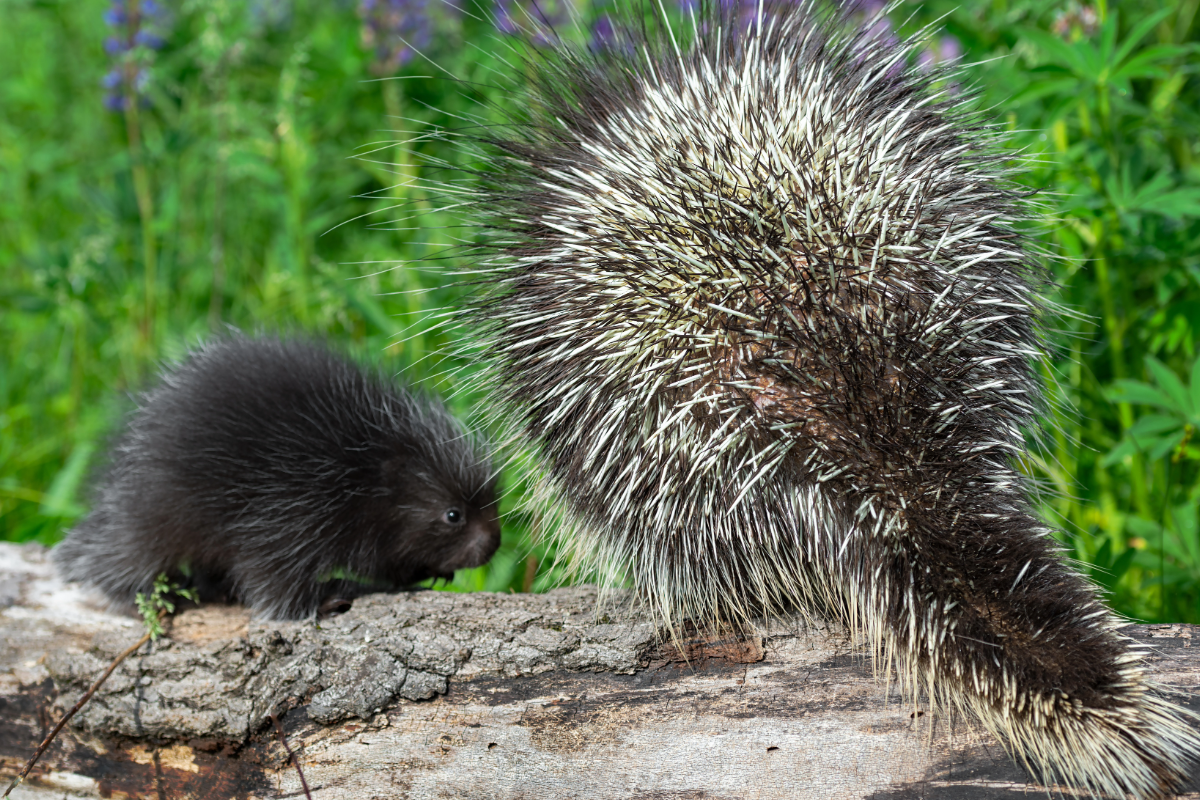
The North American porcupine is the continent's second-largest rodent, a slow-moving tree climber famous for the roughly thirty thousand barbed quills it carries across its back, sides, and tail. Unlike most rodents, which depend on flight or burrows to escape predators, Erethizon dorsatum has evolved a static defence so effective that nearly every large carnivore in its range has learned to leave it alone.
This guide covers porcupine biology in detail: size, quill anatomy, diet, tree climbing, reproduction, the specialist predators that still manage to kill porcupines, the animal's startling hunger for salt, and its conservation status.
This is a reference entry, not a summary - so expect specifics: grams, centimetres, quill counts, gestation weeks, and verified behavioural records. Where the common culture gets the porcupine wrong - and it very often does - this guide states the correction plainly.
Etymology and Classification
The genus name Erethizon comes from the Greek word meaning "to irritate" or "to provoke", a reference both to the animal's quills and its grumbling, chattering vocal repertoire. The species epithet dorsatum simply means "of the back", pointing to the quill-covered back that is the animal's most obvious feature.
The common English word porcupine traces through Middle French porc-espin (spiny pig) from the Latin porcus (pig) and spina (thorn), even though porcupines are rodents rather than pigs.
In many Algonquian and Iroquoian languages the porcupine has its own distinct root name, unconnected to any pig-word, reflecting its long cultural importance to Indigenous peoples across North America who used quills for decorative embroidery long before European contact.
Porcupines belong to the order Rodentia, but they sit in an evolutionary branch of their own. The world's porcupines divide into two separate families that evolved quills independently:
- Erethizontidae - the New World porcupines, including the North American porcupine, the prehensile-tailed porcupines of Central and South America, and several tropical relatives. Most New World species are tree specialists.
- Hystricidae - the Old World porcupines of Africa, southern Europe, and Asia. These are mostly terrestrial, larger on average, and only distantly related to the New World lineage.
The two families last shared a common ancestor more than thirty million years ago and developed their quills in parallel. This makes porcupine quills one of the more striking examples of convergent evolution in mammals: two separate lineages, on separate continents, arrived at the same defensive strategy at different times.
The North American porcupine is the only erethizontid that has expanded northward out of the tropics, and it is one of the very few rodents that thrives at the northern tree line.
Size and Physical Description
North American porcupines are heavy-bodied, short-legged, and built for slow climbing and sitting rather than speed or agility.
Adults:
- Body length: 60-90 cm from nose to rump
- Tail length: 15-30 cm
- Shoulder height: 20-30 cm
- Weight: 5-13 kg, occasionally up to 18 kg in exceptional males
- Males are modestly larger than females
Newborn porcupettes:
- Body length: ~25 cm
- Weight: 340-640 grams
- Fully furred, eyes open, teeth erupted, quills present within hours
The porcupine's body plan is unmistakable. A rounded, arched back gives way to a thick, muscular tail. The face is blunt, with small dark eyes, small rounded ears partly hidden in fur, and a broad nose pad. The legs are short and stout, tipped with curved claws that give the animal a strong grip on bark but limit its speed to a clumsy shuffle on flat ground - a healthy adult rarely exceeds 3-4 km/h. This slowness is not a weakness: when a porcupine cannot outrun a threat, it does not need to.
Beneath the quill coat the porcupine carries two further hair layers. Long woolly underfur traps warm air against the skin and provides most of the insulation. Longer guard hairs - darker, coarser - lie over the underfur between the quills. The face, belly, inner thighs, and underside of the tail are quill-free, covered only by ordinary fur.
Those unquilled zones are the animal's single structural weakness, and the predators that kill porcupines successfully are the ones that have learned to reach them.
Quill Anatomy and How Quills Work
A quill is a modified hair. Structurally it is a hollow keratin tube, 2-8 centimetres long, pigmented in alternating bands of yellow, black, or brown. Each quill is anchored in the skin by a standard hair follicle and arrector pili muscle, which lets the porcupine raise the quills into full defensive posture in about a second when alarmed.
Key features of a porcupine quill:
- Hollow shaft - lightweight, increases buoyancy, stores air
- Microscopic backward-facing barbs concentrated near the tip
- Loose attachment in the skin - detaches with light contact
- Antibiotic fatty-acid coating on the outer surface
- Replaced continuously through normal moult and regrowth
The barbs are the crucial feature. Under a scanning electron microscope each quill tip shows hundreds of tiny overlapping scales that point backward along the shaft. When a quill enters flesh, body heat and the mechanical action of surrounding muscle cause the barbs to swell and flare, locking the quill in place. Removing the quill backward is extremely difficult because the barbs drag outward.
If left in, the quill continues to migrate inward through tissue at roughly a millimetre an hour, driven by ordinary muscle movement. Human or veterinary removal requires pliers and often sedation. Cutting the quill before extraction does not release pressure and may cause the shaft to snap off beneath the skin.
Quill counts vary with the individual, but the commonly cited figure is around 30,000 quills per adult. A porcupine does not lose all of them in a single encounter: even a major tail strike on a large attacker typically leaves dozens, not thousands, of quills embedded. The porcupine regrows lost quills within a few weeks through the same follicles that produced them originally.
Why porcupines cannot shoot quills
The idea that porcupines launch quills at attackers is perhaps the most persistent myth in North American natural history. It is wrong. Quills are embedded in skin and can only be transferred by physical contact. What fuels the myth is a combination of real behaviours:
- Loose attachment. A minor bump can dislodge quills. A full-speed charge by a curious dog throws loose quills for a short distance.
- Tail lashing. A threatened porcupine lashes its tail sideways with surprising speed, so fast that the human eye cannot track individual movements. Quills released during the lash appear to fly through the air.
- Body shaking. Agitated porcupines vigorously shake their coat, and any already-loose quills are thrown clear.
Biologists have filmed hundreds of defensive encounters. In none of them does a quill leave the skin without contact. An attacker always has to touch the porcupine to be quilled - which, given the number of quills on offer, is more than sufficient.
Self-antibiotic quills
Porcupines routinely fall out of trees. Skeletal surveys of wild adults find that a significant minority carry healed rib, limb, and pelvic fractures consistent with repeated falls. A falling porcupine very often quills itself on impact. Under ordinary mammal biology that kind of deep self-puncture by its own bacteria-laden hair would be a recipe for chronic abscess and sepsis. Porcupines survive these falls routinely.
The explanation is that quills are naturally coated with a thin film of free fatty acids that show broad antibacterial activity against the skin bacteria most likely to cause wound infection. Chemical analysis of quill coatings has identified palmitoleic, linoleic, and oleic acids among the active compounds.
The working hypothesis among biologists is that the antibiotic coating evolved precisely because porcupines quill themselves so often. Self-inflicted injury was a greater selection pressure than predator injury, and the coating reduced the cost of an otherwise dangerous defence.
Either way, a quill that punctures its own owner is far less likely to cause a serious infection than an ordinary hair-borne injury would be.
Habitat and Range
The North American porcupine has the broadest range of any porcupine species in the world. Its continental distribution runs from the northern tree line across boreal Canada and Alaska, down through New England and the Great Lakes, along the Rockies and Sierra Nevada, and into the arid southwestern United States and parts of northern Mexico. Within that range porcupines occupy strikingly different habitats:
| Region | Typical habitat | Dominant trees exploited |
|---|---|---|
| Boreal Canada and Alaska | Mixed conifer and hardwood forest | Spruce, balsam fir, aspen, birch |
| New England and Great Lakes | Northern hardwood and hemlock stands | Hemlock, sugar maple, beech, basswood |
| Rocky Mountains and Sierra | Montane conifer forest | Ponderosa pine, Douglas fir, aspen |
| Southwestern US and N. Mexico | Pinyon-juniper, riparian cottonwood, desert | Juniper, pinyon pine, mesquite, cottonwood |
Desert porcupines have fewer trees to climb and den more often in rock crevices and abandoned burrows. Boreal porcupines rely on dense conifer canopy for daytime roosts. Across the full range the porcupine's baseline needs are the same: mature woody vegetation for food, protected cavities or rock shelters for daytime rest, and freedom from heavy human disturbance.
Unlike many forest mammals, porcupines do tolerate roadsides and small human settlements - a tolerance that ultimately kills many of them via vehicle strikes and conflict with dogs.
Porcupines are solitary for most of the year. Home ranges overlap heavily, especially in prime forest, but interactions between adults are generally brief and either indifferent or avoidance-based. The exception is autumn, when males travel longer distances in search of receptive females.
Diet and Seasonal Feeding
Porcupines are strict herbivores, but their diet shifts so dramatically between seasons that a summer porcupine and a winter porcupine can look almost like different animals nutritionally.
Summer diet (May-September):
- Fresh leaves and buds from deciduous trees
- Forbs, grasses, and sedges
- Acorns, beech nuts, and other mast
- Apples, berries, and soft fruits
- Aquatic plants, including water lily roots
- Flowers of clover, goldenrod, and lupine
Winter diet (November-April):
- Inner bark (phloem and cambium) of trees
- Evergreen needles, especially of hemlock and fir
- Occasional persistent mast under snow
- Mistletoe in the southwestern range
The winter bark diet is the porcupine's most distinctive feeding strategy. After the first hard freeze, porcupines climb into a chosen feeding tree and strip the outer bark from patches of trunk and branches to expose the living cambium layer beneath. They gnaw this cambium for calories and sugars.
A single porcupine may use only a handful of trees in a winter and revisit the same ones for weeks, leaving a characteristic bright-wooded scar visible high on the trunk. Extensive bark removal sometimes girdles and kills the tree, which is why porcupines were historically treated as pests in commercial timber stands.
Bark is nutritionally poor. Porcupines lose measurable body mass every winter and enter spring hungry but surprisingly resilient, with specialised gut microbes that ferment cellulose and a lowered metabolic rate that conserves energy through cold weeks.
The salt craving
Porcupines have one of the most pronounced sodium cravings known in mammals. Their plant-heavy diet is extremely low in sodium, and the summer aquatic plant feeding they prefer in many ranges is partly a salt-seeking behaviour. In human landscapes the salt drive becomes a problem. Porcupines chew:
- Axe handles, paddles, and tool grips that absorb human sweat
- Leather bridles, saddles, and boot straps
- Plywood and pine panelling in cabins and outhouses
- Road signs, utility poles, and wooden culverts treated with salt or exposed to road brine
- Tent ropes, sleeping pads, and boat seats at remote campsites
Trail-side porcupines can destroy entire sections of boardwalk, backcountry signage, or cabin flooring in a single season. Management in North American national parks often includes metal cladding on the lower metre of wooden structures in porcupine country for exactly this reason. The animal's memory for salt sources is long: a cabin that produced a chewed paddle for one porcupine in the 1990s may still be visited by its descendants a generation later.
Climbing, Locomotion, and Daily Routine
A porcupine is slow, heavy, and flat-footed on the ground but a competent climber. Its claws are long, curved, and strong, and the pads of its feet carry a pebbled, non-slip surface that grips bark well. In climbing mode the porcupine uses all four feet plus its muscular tail, which is pressed against the trunk as a fifth contact point. The spines on the underside of the tail act as brakes against the bark during descent.
Porcupines are crepuscular and nocturnal. A typical day runs as follows:
- Dawn - the porcupine climbs into a chosen daytime tree or retreats to a rock den or hollow log.
- Day - long rest periods, often high in the canopy, with occasional slow feeding bouts.
- Dusk - descent, drink, begin main feeding period.
- Night - active feeding, travel between food trees, occasional salt visits.
- Pre-dawn - return to shelter.
Falls are a routine part of porcupine life, not an anomaly. Bark breaks. Branches bend. Heavy feeding positions shift the animal's centre of gravity. Skeletal studies show that a significant fraction of wild adults carry healed fractures, and the antibiotic quill coating discussed earlier is one of the main reasons those falls remain survivable.
The porcupine's first reaction to losing grip is to tuck its head and try to land quill-coated back first, which often leaves quills in its own body but protects the soft belly on impact.
Reproduction and Porcupettes
Porcupine reproduction is remarkably slow for a rodent. Where most rodents produce large litters after short gestations, the North American porcupine produces a single precocial offspring after a gestation of about 210 days - roughly seven months.
Reproductive calendar:
- October-November: mating season; males travel and vocalise
- Gestation: ~7 months
- May-June: single porcupette born (occasionally twins)
- Summer: nursing and slow accompaniment of mother
- Autumn: weaning at 4-5 months, juvenile independence
- 18-24 months: sexual maturity reached
Courtship is famously elaborate. Males compete by vocalising, urine-marking, and occasionally fighting, and the winning male approaches the female with a drawn-out courtship that includes showering her with urine as a chemical signal - a behaviour confirmed by direct observation and video in both wild and captive settings.
The female's cooperation is required, and she flattens her quills only when she has chosen her mate. Contrary to a joke that has followed porcupines for a hundred years, mating is not a dangerous exercise for either animal: the male approaches the female from behind while she raises her tail over her back, exposing the unquilled underside.
Porcupettes are precocial, meaning they are born well-developed and mobile. At birth they already have:
- Open eyes
- Erupted teeth
- A full coat of fur
- Functional but soft quills
The quills harden within a few hours of birth as the keratin dries in air. Within a day or two the porcupette can lift its tail, raise its coat, and produce a recognisable defensive posture. It begins to climb within a week and follows the mother on short feeding trips from about two weeks of age. Weaning is gradual and largely complete by four to five months, though the porcupette may remain loosely associated with the mother into the following winter.
Predators and Defence
Adult North American porcupines are on the short list of native mammals that most predators decline to attack. Wolves, coyotes, bobcats, lynx, cougars, black bears, and golden eagles will all occasionally kill a porcupine, but most individual predators learn after a single quilling to leave porcupines alone. The porcupine's defensive sequence is highly stereotyped:
- Freeze. A detected porcupine often attempts concealment first.
- Warn. If the threat persists, the porcupine chatters its teeth loudly and releases a strong musky odour from a gland at the base of the tail. The odour is a honest signal of what is coming next.
- Turn. The porcupine rotates its back toward the attacker and tucks its head down, protecting the vulnerable face.
- Raise. Quills go vertical, maximising the defensive surface.
- Lash. If contact comes, the tail whips sideways with enough force to drive quills deep into the attacker's muzzle, paws, or chest.
The fisher
The one North American predator that hunts porcupines as a regular prey item is the fisher (Pekania pennanti), a large weasel-family mustelid of northern forests. Fishers are fast, agile, and willing to attack the porcupine's head directly. A typical fisher attack consists of repeated strikes at the face, forcing the porcupine to turn and re-turn until it can no longer protect its head.
Once the face is compromised the fisher flips the porcupine onto its back and kills through the unquilled belly. Fisher reintroduction programmes in New England and the upper Midwest were partly motivated by porcupine damage to commercial timber, and populations of both species now rise and fall in a loose predator-prey cycle across recovered fisher ranges.
Other significant mortality factors for adult porcupines include vehicle strikes, winter starvation in bad bark years, and - especially for juveniles - displacement and exposure after separation from the mother.
Conservation Status
The IUCN Red List classifies Erethizon dorsatum as Least Concern. The species is widespread across North America, tolerates a range of climates from boreal to desert, and occupies both primary forest and heavily modified human landscapes. No continental-scale threat has been identified.
Regional pictures are less uniform. During the twentieth century porcupines were heavily controlled in parts of New England, the northern Midwest, and the Pacific Northwest because of damage to commercial timber and fruit orchards. Bounty programmes, poisoning, and shooting reduced numbers significantly in some states.
Those programmes have largely ended, but fisher reintroductions and ongoing vehicle mortality have kept local densities low in several areas where porcupines were historically common. Elsewhere the species appears stable or recovering.
The main contemporary pressures on porcupines are:
- Road mortality, especially where forest highways cut through winter feeding ranges
- Dog predation near rural and exurban homes
- Local timber-industry control in commercial plantations
- Sodium-poisoning from road brine in a small subset of roadside animals
- Habitat loss in the southwestern range as riparian cottonwood stands decline
None of these currently rises to a species-level threat, but together they produce patchy, sometimes counterintuitive distributions. A visitor to the boreal forest is likely to encounter porcupines within days of paying attention. A visitor to parts of New England may drive for a week without seeing one.
Porcupines and Humans
Porcupine quills have been used for decorative embroidery across North America for thousands of years. Indigenous artisans - especially in the Great Lakes, northeastern woodlands, and plains cultures - flattened, dyed, and stitched quills into birch bark boxes, moccasins, pipe stems, and ceremonial clothing long before European contact. Quillwork predates and in many regions inspired beadwork.
The practice survives today as a specialised traditional art, with master practitioners in several First Nations and Native American communities.
For rural North Americans the porcupine is usually a small but memorable problem. Dogs get quilled; paddles get chewed; cabins get invaded. Veterinary clinics in porcupine country report a seasonal rhythm of quilling cases through spring and autumn. The standard advice is consistent: do not try to pull quills from a dog at home.
Embedded quills migrate, sometimes into joints or organs, and a home removal that leaves fragments behind can cause serious later problems. Sedation and professional removal is both safer and ultimately cheaper.
For humans, a rare accidental quilling is most often caused by stepping or sitting on a discarded quill, and simple pliers-based removal is generally sufficient because a single quill rarely migrates as dangerously as a heavy dog-dose can.
In scientific terms the porcupine is an increasingly interesting species. The barbed geometry of its quills has been studied as a model for low-force, high-retention medical staples and surgical adhesion devices. The antibiotic coating on quills is under continuing chemical study as a potential source of novel antimicrobials. And the porcupine's slow, precocial reproductive strategy is cited in comparative mammalogy as a useful counterpoint to the fast-and-many model of most rodents.
Related Reading
- Beavers: Nature's Ecosystem Engineers
- Capybara: The World's Largest Rodent
- Rodents: The Most Successful Mammals on Earth
- Naked Mole-Rat: The Almost-Immortal Mammal
References
Relevant peer-reviewed and governmental sources consulted for this entry include the IUCN Red List assessment for Erethizon dorsatum, U.S.
Forest Service bulletins on porcupine feeding damage, Canadian Wildlife Service range maps, and published work in the Journal of Mammalogy, Canadian Journal of Zoology, and Integrative and Comparative Biology covering quill mechanics, fatty-acid coatings, fisher predation, and reproductive ecology.
Size, quill, and life-history figures reflect the consolidated values used in the current edition of Mammals of North America and the American Society of Mammalogists species account.
Frequently Asked Questions
How big are North American porcupines?
Adult Erethizon dorsatum weigh between 5 and 13 kilograms, with body lengths of 60-90 centimetres plus a 15-30 centimetre tail. Males are slightly larger than females but the dimorphism is modest compared with many rodents. That makes the North American porcupine the second-largest rodent on the continent after the beaver.
Weight fluctuates heavily across the year - bears of the rodent world, porcupines lose roughly 17 per cent of their body mass in late winter after months of living on bark and regain it through summer feeding.
Do porcupines really shoot their quills?
No. The image of porcupines launching quills like arrows is folklore, not biology. Quills are modified hairs embedded in the skin and can only be released by physical contact. What fools observers is how lightly they detach: a glancing strike from the tail, or even vigorous body shaking, is enough to throw loose quills a short distance. Combined with the porcupine’s fast sideways tail lash, this creates the convincing illusion that quills are being fired.
In reality an attacker must touch the porcupine to be quilled.
How many quills does a porcupine have and how do they work?
A typical adult carries about 30,000 quills covering the back, sides, and tail. Each quill is a hollow keratin hair 2-8 centimetres long tipped with hundreds of microscopic barbs arranged like fish hooks. When a quill enters flesh, muscle contractions and body heat cause the barbs to flare outward, making the quill almost impossible to withdraw cleanly and allowing it to migrate deeper into tissue.
The face and belly are unquilled - which is why the fisher, the porcupine’s specialist predator, attacks the head and flips the prey to reach the soft underside.
Where do porcupines live?
North American porcupines occupy the widest range of any porcupine species. The core range covers the forested belt of Canada, Alaska, New England, the Great Lakes states, the Rocky Mountains, and the Pacific Northwest. Additional populations extend south into the arid southwestern United States and northern Mexico, where porcupines adapt to pinyon-juniper, desert scrub, and riparian cottonwood habitats.
They prefer areas with mature trees for feeding and rock piles, hollow logs, or abandoned burrows for daytime shelter. Unlike most rodents, porcupines are solitary for most of the year and maintain overlapping home ranges rather than defended territories.
What do porcupines eat?
Porcupines are strict herbivores with a strongly seasonal diet. In summer they feed on leaves, buds, flowers, fruits, nuts, acorns, aquatic plants, and green grasses. In winter, when soft vegetation disappears under snow, they switch almost entirely to the inner bark (phloem and cambium) of trees. Hemlock, sugar maple, beech, basswood, willow, and white pine are common winter foods.
This bark-heavy diet is nutritionally poor, which is why porcupines lose significant body mass each winter. They also crave sodium intensely and will travel several kilometres to chew wooden objects contaminated with human sweat, road salt, antifreeze, or animal urine.
How long do porcupines live?
Wild North American porcupines can live up to 18 years, though most die before reaching 10 due to predation, vehicle strikes, and winter starvation. Captive porcupines have exceeded 20 years thanks to consistent food and veterinary care. Females reach sexual maturity at about 18 months; males at roughly 2 years.
A female typically produces a single porcupette per year after a remarkably long gestation of about seven months - extreme for a rodent of this size. The long gestation produces an exceptionally well-developed baby: eyes open, teeth erupted, quills present, and able to climb within days.
Are porcupines endangered?
The IUCN Red List classifies Erethizon dorsatum as Least Concern. The species is widespread, adaptable, and tolerates a range of habitats from boreal forest to desert. Local populations fluctuate - in parts of New England and the upper Midwest porcupines were heavily culled during the twentieth century because of damage to timber and orchards, and fisher reintroductions lowered numbers further in some regions.
Elsewhere road mortality is the leading cause of death. Overall the continental population is considered stable and the porcupine faces no continental-scale threat, but it is absent from some areas where historical persecution and fisher recovery together suppress numbers.
Are porcupines dangerous to humans and pets?
Porcupines are not aggressive toward humans and will attempt to climb or shuffle away before fighting. They pose no significant danger to an alert adult. Dogs are another matter - curious dogs are the single biggest source of quill injuries seen by North American veterinarians. A quilled dog needs prompt veterinary removal under sedation because embedded quills migrate through tissue and can reach vital organs.
Cutting the quills before removal does not help and may snap them off. The safest household rule in porcupine country is to keep dogs leashed around dusk and dawn, when porcupines are most active.