
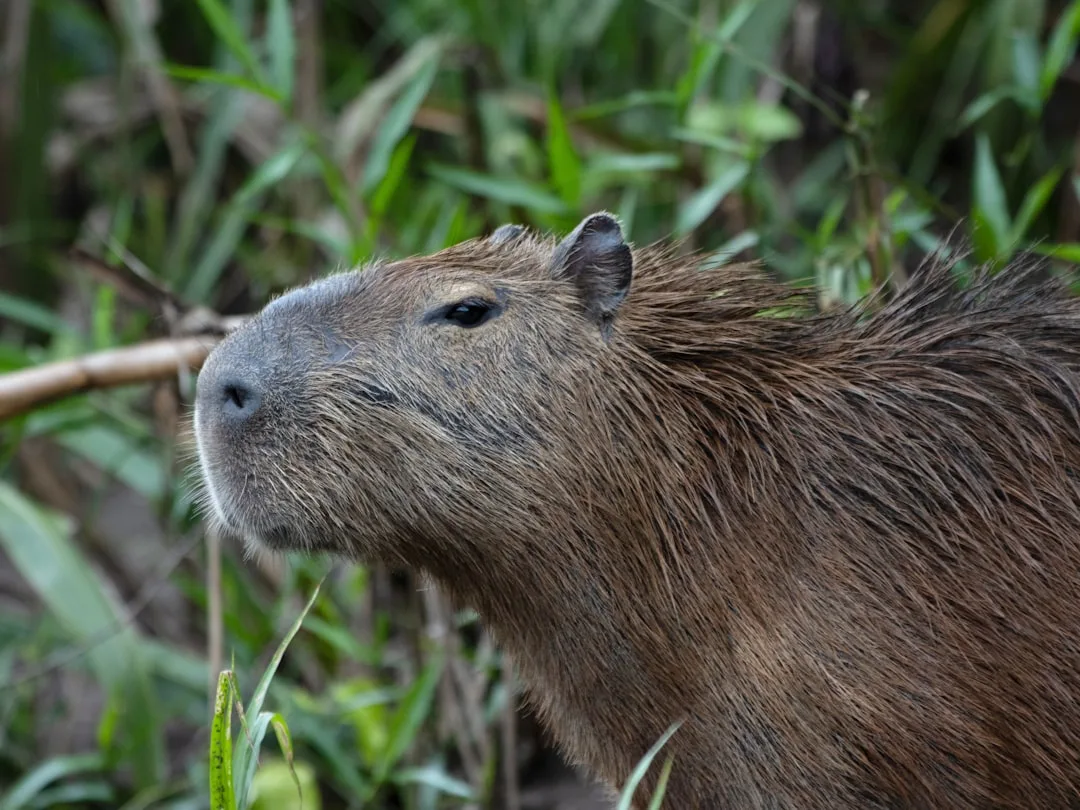
The capybara is the largest living rodent on Earth. An adult stands roughly the same height as a Labrador, weighs as much as a grown man, and spends most of its life either grazing beside a river or half-submerged in it. Hydrochoerus hydrochaeris is native to South America east of the Andes, where it occupies nearly every wetland, riverbank, and flooded grassland from Panama to northern Argentina.
It is one of the few large mammals that is genuinely common across its entire range, and one of the only large South American herbivores that shows no sign of population decline.
Over the past decade the capybara has also become the internet's favourite animal. Videos of capybaras sharing hot springs with monkeys, allowing birds to perch on their heads, and tolerating house cats kneading their flanks have built the reputation of an animal that 'gets along with everyone'. The reality behind that meme is a mix of biology, habitat, and temperament - and it is genuinely interesting.
This guide covers every aspect of capybara biology and ecology: size, anatomy, habitat, semi-aquatic adaptations, social organisation, diet, reproduction, communication, conservation status, and the species' long and strange relationship with humans. It is a reference entry, not a summary, so expect specifics: kilograms, minutes, square kilometres, and verified records.
Etymology and Classification
The name 'capybara' comes from the Tupi language of Brazil, where ka'apiûara means something like 'grass-eater' or 'one who eats thin leaves'. Early Portuguese colonists adopted the word, and every Western language name for the species descends from that same root. The genus name Hydrochoerus, coined by the German zoologist Peter Simon Pallas in 1766, is built from Greek roots meaning 'water hog'.
The specific name hydrochaeris repeats the same idea. Early European naturalists could not decide whether the animal was a giant rat, a small pig, or something else entirely, and the naming history reflects that confusion.
Taxonomically the capybara is a rodent in the family Caviidae, the same family that contains guinea pigs, maras, and rock cavies. Within Caviidae it sits in the subfamily Hydrochoerinae alongside one other living species, the lesser capybara (Hydrochoerus isthmius), which is found only in Panama and the extreme northwest of Colombia. The two species look similar but the lesser capybara is about two-thirds the size and has different chromosome counts.
Capybaras belong to a larger group of South American rodents called Caviomorpha. These animals share a common ancestor that likely arrived in South America from Africa roughly 40 million years ago, probably on floating vegetation rafts.
While South America remained an isolated continent for most of the Cenozoic, caviomorphs diversified into dozens of species ranging from mouse-sized spiny rats to the extinct Josephoartigasia monesi, a capybara-like rodent that weighed more than a tonne. The modern capybara is by far the largest surviving member of this lineage.
Size and Physical Description
Capybaras are unmistakable: a barrel-shaped body, short legs, a blunt head with a broad muzzle, small round ears, and no visible tail. The overall impression is something halfway between a giant guinea pig and a small pony.
Adults:
- Body length: 1.0-1.3 metres from nose to rump
- Shoulder height: 50-62 centimetres
- Weight: 35-66 kg typical, up to 91 kg in exceptional wild individuals
Newborn pups:
- Length: roughly 25 centimetres
- Weight: 1.1-1.5 kg
- Fully furred, mobile, and able to follow the herd within hours
Unusually among large mammals, female capybaras are typically slightly heavier than males of the same age. The difference is small - a few kilograms - but it runs the opposite way of almost every other ungulate-style grazer.
The body is covered in coarse reddish-brown fur that ranges from almost yellow in dry-country individuals to dark chocolate in forest populations. The coat is sparse - an adaptation for a semi-aquatic lifestyle - and the skin beneath is surprisingly pale and thin, which makes capybaras prone to sunburn and is one reason they spend so much time in water or shade during the middle of the day.
The head is one of the most specialised parts of the capybara body. The eyes, ears, and nostrils are all positioned near the top of the skull in a near-straight line, allowing the animal to breathe, see, and hear with only the top few centimetres of its head above the surface. The muzzle is broad and blunt, hiding a pair of enormous orange-tinted incisors that never stop growing.
Males carry a distinctive raised scent gland on the top of the nose called a morrillo, which they use to mark territory by rubbing it on vegetation.
Capybaras have four toes on each front foot and three toes on each back foot, all tipped with short blunt claws and connected by partial webbing. The webbing gives them the swimming ability of a waterbird on a mammal body.
Built for a Semi-Aquatic Life
Capybaras are the most thoroughly aquatic rodents of their size. Every major feature of their biology is tuned for a life spent switching between grazing on land and resting, sleeping, mating, and escaping predators in fresh water.
Aquatic adaptations:
- Eyes, ears, and nostrils set on top of the skull so the body can stay submerged while the head scans the surroundings
- Partially webbed toes for propulsion
- Dense bone structure that helps the animal stay neutrally buoyant
- Fur that dries quickly and sheds water
- Ability to hold the breath for up to five minutes
- Capacity to sleep in water with just the nose above the surface
When threatened, a capybara's first response is almost always to run to water. In the Pantanal and Venezuelan Llanos, the difference between a hungry jaguar and a safe afternoon can be measured in the three seconds it takes the herd to scatter into a lagoon. Once submerged, capybaras can swim powerfully for hundreds of metres, walk along the bottom of a shallow river, or simply hide in reeds with only their nostrils showing.
Water also solves the capybara's thermoregulation problem. The species evolved in tropical wetlands where afternoon temperatures routinely exceed 35 degrees Celsius. Their sparse fur and thin, pale skin shed heat well but provide almost no insulation. Capybaras can overheat within minutes under direct midday sun, which is why they seek shade and wallows, bathe frequently, and do most of their grazing at dawn, dusk, and through the night.
They have no meaningful cold tolerance. In the southern edge of their range, in northern Argentina and Uruguay, occasional winter cold snaps kill capybaras outright. This is the main reason the species is absent from cooler regions further south.
Diet and Feeding Behaviour
Capybaras are strict herbivores. Their diet is dominated by grasses and aquatic plants, varied with reeds, sedges, fallen fruit, and bark during dry periods. An adult eats 3-4 kg of vegetation per day, which is roughly 5-8 per cent of body mass.
Primary foods:
- True grasses (Poaceae) - dominant in wet season
- Aquatic plants such as water hyacinth and water lettuce
- Sedges and reeds
- Tree bark and fallen fruit - important in dry season
- Agricultural crops, especially sugar cane, rice, and melons, where ranches border wetlands
Capybaras chew using a sideways grinding motion, not the up-down motion of most mammals. The cheek teeth are flat and heavily ridged for pulverising fibrous plant material. The incisors are chisel-shaped, orange-fronted with hard enamel and softer dentine behind, which wears at different rates and keeps the front edge sharp. These front teeth grow continuously - more than a centimetre per month - and would spiral out of the mouth if the animal stopped grazing.
The capybara gut is built like a giant fermentation vat. A long caecum hosts bacteria that break down cellulose and produce short-chain fatty acids the animal can absorb. This process is slow and inefficient on the first pass, so capybaras practise coprophagy: every morning they eat a special type of soft faecal pellet, sending semi-digested plant matter and microbial protein back through the digestive tract.
The second pass extracts B vitamins and additional energy that would otherwise be lost. Rabbits and guinea pigs do the same thing for the same reason.
Social Life and Herd Structure
Capybaras are intensely social. A typical herd contains 10-20 animals centred on a dominant male, several adult females with their young, and a number of subordinate males. In the dry season, when wetlands shrink and animals concentrate around the remaining water, herds merge temporarily into aggregations of up to 100 individuals, which then split back into smaller groups once the rains return.
Within a herd:
- The dominant male defends the group's territory and controls access to females
- Adult females share pup-rearing, and young capybaras will nurse from any lactating female in the group
- Subordinate males are tolerated but regularly displaced from the centre of the herd
- Solitary males, usually older individuals pushed out of breeding groups, occupy territorial margins
Territory sizes range from a few hectares in dense wetland to several square kilometres in drier savannah. Both sexes scent-mark, but dominant males do most of it using the morrillo gland on the nose, anal glands, and urine. Fights between males involve lunges with the incisors and can leave permanent scars. Fatal fights are rare but documented.
Capybara social structure looks less like a deer herd and more like a small primate troop. Females groom each other, pups play together for hours, and the whole herd moves, rests, and flees as a unit. This level of coordination is one of the reasons the species has been such a successful filmmaker's subject - a capybara herd is almost always doing something photogenic.
Communication
Capybaras communicate through at least ten distinct vocalisations, plus scent and body language. Their vocabulary includes:
- Purr - contact call between mothers and pups
- Bark - sharp alarm call that triggers the herd to flee into water
- Whistle - contact call between separated adults
- Click - low-intensity signal used during grooming and resting
- Squeal - high-pitched distress call from pups
- Grunt - general contact between adults
- Teeth chatter - threat display between males
- Huff - mild irritation or warning
- Cough - territorial announcement by dominant males
- Cry - a repetitive whining used by lost pups
Scent communication layers on top of vocalisations. Males anoint vegetation with secretions from the morrillo and anal glands. Females in oestrus scent-mark more intensively than usual, advertising readiness to mate. All adults rub their flanks on trees and posts to deposit skin oils and cut hair.
Reproduction and Life Cycle
Capybaras reproduce year-round in the tropical core of their range and seasonally at the cooler edges. Most mating activity coincides with the onset of the rainy season, when food abundance peaks. Mating takes place in water: the female backs toward a male, who grips her shoulders with his forelegs. The whole act lasts only a few minutes and may be repeated dozens of times during oestrus.
Reproductive timeline:
- Gestation: 130-150 days
- Litter size: 1-8 pups, typically 4
- Birth location: in dense vegetation on land (not in water)
- Weaning age: approximately 16 weeks
- Sexual maturity: 18 months for females, 22 months for males
- Inter-litter interval: 6-12 months
Pups are born precocial - fully furred, eyes open, mobile, and capable of grazing within hours. Within a day they follow the herd into water and swim competently. Communal nursing means any lactating female in the group may nurse any pup; genetic studies show that most females nurse their own offspring preferentially but accept others routinely.
Pup mortality is high. Predation by caimans, anacondas, jaguars, pumas, ocelots, foxes, feral dogs, and large raptors accounts for roughly half of all pup deaths in the first year. Flooding, disease, and occasional infanticide by dominant males round out the causes. Adults are eaten most often by jaguars, pumas, anacondas, and large caimans. Human hunters take a significant number in certain regions.
In the wild, capybaras rarely live beyond ten years. In captivity, with protection and veterinary care, they reach twelve or thirteen, occasionally fifteen.
Range and Habitat
| Country | Habitat notes |
|---|---|
| Brazil | Pantanal, Amazon basin, coastal wetlands - largest populations |
| Venezuela | Llanos - ranched and hunted at commercial scale |
| Colombia | Orinoco and Amazon watersheds |
| Argentina | Northeastern provinces, invasive in Buenos Aires suburbs |
| Uruguay | Rio de la Plata wetlands |
| Paraguay | Chaco and Paraguay River |
| Bolivia | Amazon and Paraguay watersheds |
| Guianas | Coastal wetlands and savannahs |
| Panama | Range overlaps with lesser capybara |
Typical capybara density in good habitat runs between 2 and 6 animals per hectare. In the Venezuelan Llanos during the late dry season, concentrations of 100-300 capybaras around a single water hole are routine. Feral populations of escaped pets have established in Florida.
In the suburbs of Buenos Aires, a rapidly growing capybara population has colonised gated residential neighbourhoods built on former wetlands, triggering ongoing debate about how to manage a large native rodent in a human city.
Conservation Status
The IUCN Red List classifies capybaras as Least Concern with a stable global population. The species is not listed under CITES. Capybaras tolerate hunting, farming, and habitat modification remarkably well thanks to their high reproductive rate, broad diet, and flexibility in habitat choice.
Threats at the local scale:
- Habitat loss. Drainage of wetlands for agriculture, especially soy and cattle, eliminates core capybara habitat.
- Pollution. Pesticide runoff and mercury from mining accumulate in capybara tissues via the plants they eat.
- Road mortality. Capybaras killed by vehicles are a growing problem near expanding cities.
- Hunting. Illegal hunting pressure remains high in parts of Colombia, Brazil, and Peru. Legal hunting in Venezuela is regulated but historically heavily abused.
- Disease. Capybaras host the ticks that transmit Brazilian spotted fever to humans, and control programmes sometimes reduce local populations.
Use by humans:
Capybaras are farmed commercially in Venezuela and parts of Colombia for meat and leather. The meat is dense, lean, and tastes somewhere between pork and rabbit. Capybara leather is valued for soft gloves and specialist garments. In parts of Venezuela capybara meat is a traditional Lenten food, the legacy of a 16th-century ecclesiastical classification of the animal as a 'fish' for religious purposes because it lived in water - a designation that has never been formally retracted.
Capybaras and Humans
Indigenous peoples across South America have hunted, eaten, and lived alongside capybaras for thousands of years. Pre-Columbian archaeology shows capybara bones at sites from the Orinoco delta to northern Argentina. Several Amazonian groups consider the capybara a food animal of last resort, eating it only when larger game is unavailable, while others treat it as a dietary staple.
In the Venezuelan Llanos, cattle ranches and capybara herds share the same grasslands, and ranchers generally tolerate the rodent as long as it stays out of crops.
In the 21st century, capybaras have become something new: a globally famous internet animal. Japanese zoos were the first to popularise capybara hot spring bathing, a practice that combined the species' natural love of warm water with visitor-friendly cuteness. Social media then took over.
Videos, photographs, and memes have turned the capybara into a kind of cultural shorthand for calm, tolerance, and effortless social harmony. The meme captures something real - capybaras really are unusually placid around other species - but the reasons are ecological rather than spiritual.
This fame has had consequences for the species. Exotic pet demand has risen sharply in the United States, Japan, parts of Europe, and the Gulf. Capybaras make poor pets: they require constant water access, need same-species companions, and can destroy a house with their continuously growing incisors. Several jurisdictions have banned private ownership in response to welfare problems.
Responsible organisations discourage capybara pet-keeping and advocate viewing the species in the wild or in accredited zoos.
Related Reading
- Rodents of the World: The Most Successful Mammal Order
- Guinea Pigs: Domestic Cousins of the Capybara
- Inside the Pantanal: South America's Greatest Wetland
- Semi-Aquatic Mammals: Life Between Land and Water
References
Relevant peer-reviewed and governmental sources consulted for this entry include the IUCN Red List assessment of Hydrochoerus hydrochaeris (most recent revision), long-term field studies of capybara ecology in the Venezuelan Llanos published in the Journal of Mammalogy and Biotropica, commercial wildlife management literature from Venezuela's Ministerio del Ambiente, behavioural studies of capybara social structure and communication in Animal Behaviour, and taxonomic revisions of the family Caviidae in Molecular Phylogenetics and Evolution.
Population estimates and hunting figures reflect the most recent consolidated reports available at the time of writing.
Frequently Asked Questions
How big are capybaras?
Adult capybaras (Hydrochoerus hydrochaeris) measure 1.1-1.3 metres from nose to rump, stand 50-62 cm tall at the shoulder, and weigh between 35 and 66 kg. Unusually for large mammals, females are typically slightly larger than males, especially when pregnant. The heaviest wild capybara on record weighed 91 kg, and the heaviest captive individual topped 100 kg.
Newborn pups emerge fully furred and mobile, weighing 1.1-1.5 kg - small enough to fit in both hands but already equipped with working incisors. The species easily exceeds every other living rodent in mass: the next-largest rodent, the beaver, is half the size.
What do capybaras eat?
Capybaras are strict herbivores specialised for grazing. Grasses and aquatic plants make up around 70-90% of their diet, supplemented by reeds, sedges, tree bark, fallen fruit, and cultivated crops where ranches border wetlands. An adult eats 3-4 kg of vegetation per day.
Because their large hindgut ferments tough cellulose slowly, capybaras also practise coprophagy - they eat a special type of soft faecal pellet each morning to recover B vitamins and microbial protein produced overnight. This second pass through the gut dramatically improves nutrient absorption from low-quality plant material.
They chew in a sideways motion and rarely stop grazing for long, which keeps their perpetually growing incisors worn to a functional length.
Where do capybaras live?
Capybaras inhabit every South American country east of the Andes except Chile. Their range stretches from eastern Panama and Colombia through Venezuela, the Guianas, Brazil, Bolivia, Paraguay, Uruguay, and northeastern Argentina. Populations concentrate in wetlands such as the Venezuelan Llanos, the Brazilian Pantanal, the Amazon and Orinoco river systems, and the marshes of the Rio de la Plata basin.
Capybaras require three things from their habitat: standing fresh water for thermoregulation, predator escape, and drinking; dense herbaceous vegetation for grazing; and cover for daytime resting. They adapt easily to ranch dams, rice paddies, golf courses, and the edges of growing cities. Feral populations exist in Florida and an invasive population has established itself in the suburbs of Buenos Aires.
Are capybaras endangered?
The IUCN lists capybaras as Least Concern with a stable global population. They are abundant across most of their range and in places achieve densities that land managers treat as overpopulation. Capybaras are farmed and legally hunted for meat and leather in Venezuela, Colombia, and parts of Brazil, and the species tolerates this pressure because it reproduces quickly - females can produce a litter of up to eight pups every year.
That said, local populations face real threats: habitat loss from agriculture, pollution of wetlands, road mortality near expanding cities, and illegal hunting in some areas. Capybaras are a keystone prey species for jaguars, pumas, anacondas, and caimans, so declines ripple through tropical ecosystems.
How long do capybaras live?
Wild capybaras typically live 8-10 years, with most deaths caused by predation rather than old age. In captivity, with protection from jaguars and anacondas and access to veterinary care, capybaras regularly live 12 years and occasionally reach 15. Pup mortality in the wild is high - studies in the Venezuelan Llanos estimate 50% of pups die in the first year due to predation by caimans, jaguars, foxes, and large raptors.
Females reach sexual maturity at around 18 months and may produce one to two litters per year until they die. Males that survive predation frequently die in fights over dominance within their herds.
Why do capybaras get along with other animals?
Capybaras have become internet-famous for tolerating other species climbing on them, grooming them, or sharing their space. The biology behind the meme is practical rather than mystical. Capybaras are large, placid herbivores with no natural need to defend food against most other animals. They live in open wetland habitats where alarm from any species - birds, monkeys, other mammals - signals nearby predators, so tolerating company is adaptive.
Their calm disposition also comes from living in stable herds of 10-20 individuals, which selects for low aggression within the group. Small birds pick parasites off their fur, capybaras get free grooming, and the relationship looks like friendship but is closer to an unspoken trade deal.
Can capybaras be kept as pets?
In some countries capybaras are kept as exotic pets, but for most people the answer is a firm no. Capybaras are highly social and suffer severe psychological distress without companions of their own species - responsible keepers maintain at least two, preferably a small herd. They require constant access to a swimming pool large enough to fully submerge in, a grass-heavy outdoor paddock, and a secure fence taller than most garden walls.
Adults are 50 kg of muscle with continuously growing front teeth capable of damaging furniture, plumbing, and human limbs. Veterinary care for capybaras is specialised and expensive. Laws vary widely by country, state, and city - capybaras are legal pets in parts of Texas but banned in California, legal in Japan but restricted across much of Europe.
How are capybaras related to guinea pigs?
Capybaras and guinea pigs sit in the same family, Caviidae, and share a common ancestor that lived in South America roughly 20 million years ago. Both belong to a rodent group called Caviomorpha, which radiated across the continent while it was an isolated island. The capybara is classified in the subfamily Hydrochoerinae along with the little-known lesser capybara (Hydrochoerus isthmius) and the rock cavies of Brazil.
Anatomically the connection is obvious once you look past the size difference: capybaras have the same blocky head, constantly chewing jaw movement, absence of a visible tail, and short stubby legs seen in their smaller relatives. Behaviour lines up too - both form stable mixed-sex herds, vocalise constantly, and practise coprophagy.