
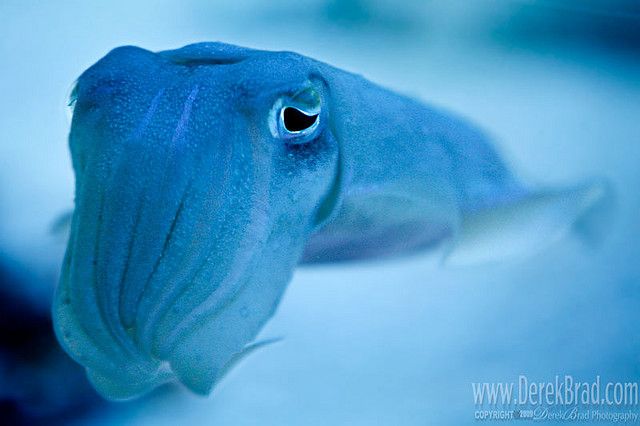
How do cuttlefish change color?
Cuttlefish change color using millions of specialized skin cells called chromatophores, each containing pigment sacs that can expand or contract within milliseconds. When a muscle pulls the sac open, the color becomes visible; when released, the sac closes and the color disappears. Cuttlefish skin has up to 200 chromatophores per square millimeter, allowing dense and rapid color pattern changes.
Dancing Skin on a Colorblind Body
A cuttlefish hovers above a coral reef. In under a second, patterns ripple across its skin, brown blotches, then sandy yellow, then black-and-white stripes, then perfect invisibility against the reef. A curious diver watches the display. The cuttlefish watches back with large W-shaped pupils.
It can't actually see the colors on its own body.
Cuttlefish are colorblind. They have one type of photoreceptor, seeing only brightness, not color. Yet they produce the most sophisticated color displays in the animal kingdom. Nobody fully understands how they do it, and the answer may involve their skin literally seeing colors their eyes cannot.
The Animal
Cuttlefish are cephalopod mollusks, relatives of octopuses, squid, and nautiluses. They are not fish despite the name.
Physical features:
- Length: 5-50 cm depending on species
- Body: flat, broad, oval
- Arms: 8 short arms
- Tentacles: 2 long feeding tentacles (retractable)
- Eyes: large with distinctive W-shaped pupils
- Internal shell: cuttlebone (calcified structure)
The cuttlebone:
Cuttlefish have an internal shell called a cuttlebone. It's a gas-filled chamber that:
- Provides buoyancy control
- Maintains body shape
- Helps them hover at specific depths
- Is made of calcium carbonate
The cuttlebone is the white, oval-shaped object often sold as a calcium supplement for pet birds. It's the remains of dead cuttlefish washed ashore.
Color-Changing Machinery
Cuttlefish skin is extraordinarily complex.
Three cell layers:
Chromatophores (top layer):
- Pigment-filled sacs
- Expand and contract via muscles
- Cuttlefish have up to 200 per square millimeter
- Different chromatophores contain different colors (red, yellow, brown, black)
Iridophores (middle layer):
- Structural color cells
- Reflect specific wavelengths
- Create blues and greens
- Work like interference patterns on butterfly wings
Leucophores (bottom layer):
- White reflector cells
- Diffuse light backward through other layers
- Amplify colors from chromatophores above
Neural control:
Each chromatophore connects directly to nerves. A cuttlefish brain can control millions of individual chromatophores precisely and in coordination. Changes happen in milliseconds.
Speed:
Complete body color changes in under a second. Wave patterns can flow across the skin faster than video playback. No other animal approaches this speed.
The Colorblind Paradox
Cuttlefish eyes have one type of photoreceptor.
What this means:
One photoreceptor type = brightness only, no color. In camera terms, cuttlefish see in "monochrome" or grayscale.
Humans vs cuttlefish:
- Humans: 3 cone types (red, green, blue), plus rods for low-light
- Cuttlefish: 1 photoreceptor type
- Humans see color
- Cuttlefish cannot distinguish red from blue (same brightness)
The paradox:
How do cuttlefish match their background's colors so perfectly when they can't see color?
Research theories:
Skin color detection: Cuttlefish skin contains opsin proteins (normally eye-specific). These may detect light wavelengths directly through the skin.
Pupil wavelength analysis: The W-shaped pupil may refract light in ways that encode color information as spatial patterns that a monochrome system can detect.
Polarization detection: Cuttlefish can see polarized light, which may provide color-like information.
Combined systems: Multiple mechanisms may work together.
Research is ongoing. Whatever the mechanism, cuttlefish match backgrounds so precisely that some camouflage behaviors are currently unexplained by known biology.
Hunting
Cuttlefish are active predators with specialized strategies.
Prey:
- Fish (various species)
- Crabs and shrimp
- Other crustaceans
- Small cephalopods (including own species sometimes)
- Worms
The attack:
Two long feeding tentacles normally hide inside the body. When prey is in range (about 20 cm), the tentacles shoot out in 20-40 milliseconds at impressive speed. Suction cups with barbs grip the prey.
The prey is pulled back to eight short arms and then to a sharp parrot-like beak that bites it apart.
Hypnotic displays:
Before attacking, cuttlefish sometimes produce "passing-cloud" displays where waves of color flow across their skin. This may hypnotize or disorient prey, making them easier to catch.
Learning:
Cuttlefish learn which prey types and capture techniques work best. They modify their hunting based on experience. Individuals develop preferences and techniques through learning, not just instinct.
Intelligence
Cuttlefish demonstrate remarkable cognitive abilities.
Marshmallow test:
The classic human delay-of-gratification test was adapted for cuttlefish. Given:
- Immediate lower-quality food
- Delayed higher-quality food
Cuttlefish consistently wait up to 2 minutes for better food.
This demonstrates:
- Impulse control
- Future planning
- Understanding of delayed rewards
- Cognitive flexibility
Memory:
Cuttlefish remember:
- Solutions to problems for weeks
- Specific locations of food sources
- Individual humans who've handled them
- Past experiences affecting future choices
Problem-solving:
Laboratory studies have documented cuttlefish:
- Opening jars to access food
- Learning maze solutions
- Adapting hunting techniques to new prey types
- Overcoming obstacles through trial and error
Social recognition:
Cuttlefish recognize individual conspecifics and can identify humans who handle them frequently.
Brain structure:
- Approximately 500 million neurons
- Complex folding patterns
- Large relative to body size
- High processing efficiency
Reproduction
Cuttlefish reproduction is elaborate and deadly.
Mating season:
Most species breed in spring/summer. Large aggregations gather at shallow breeding sites.
Displays:
Males produce elaborate color displays to attract females and intimidate rivals. A single male may show different displays to female and rival male simultaneously (different colors on each side of the body).
Sexual competition:
Large males have multiple strategies:
- Direct competition through displays
- Sneaky mating by small "cross-dressing" males that display female colors to avoid rival male aggression
Mating:
Male transfers sperm to female via a specialized arm (hectocotylus). Sperm is stored in a special pouch until egg-laying.
Egg-laying:
Females lay grape-like clusters of eggs on hard substrates. Some species lay hundreds of eggs per clutch.
Death after reproduction:
Like most cephalopods, cuttlefish are semelparous; they reproduce once and die. Females guard eggs without feeding until death. Males die shortly after mating.
Species Diversity
Over 120 cuttlefish species exist worldwide.
Notable species:
Common cuttlefish (Sepia officinalis):
- Mediterranean and eastern Atlantic
- Up to 50 cm long
- Commercially important for food
- Well-studied scientifically
Giant cuttlefish (Sepia apama):
- Australian waters
- Up to 1 meter long
- Famous for mass mating aggregations
- Largest cuttlefish species
Broadclub cuttlefish (Sepia latimanus):
- Indo-Pacific reefs
- Known for dramatic color displays
- Popular with underwater photographers
Flamboyant cuttlefish (Metasepia pfefferi):
- Small Indo-Pacific species
- Bright colors and unique walking locomotion
- Toxic (only toxic cuttlefish species)
Where They Live
Cuttlefish inhabit coastal waters worldwide.
Distribution:
- Mediterranean Sea
- Atlantic Ocean (eastern and western coasts)
- Indian Ocean
- Pacific Ocean (west and east)
- Notable absence: no native cuttlefish in the Americas' west coast
Depth range:
- Most species: 0-100 meters
- Some species: up to 600 meters
- Coastal preference
Habitats:
- Coral reefs
- Seagrass beds
- Sandy bottoms
- Rocky shores
- Kelp forests (some species)
Human Uses
Cuttlefish have multiple uses in human culture.
Food:
Cuttlefish are important food in many coastal cultures:
- Mediterranean cuisine (paella, calamari-style preparations)
- Japanese cuisine (sushi, sashimi)
- Chinese and Korean dishes
- Italian seafood traditions
Their flesh is tender and mild-flavored.
Ink:
Cuttlefish ink (sepia) was historically a primary artist's pigment. Renaissance artists used sepia ink extensively. The name "sepia" comes directly from the cuttlefish genus Sepia.
Modern culinary use: squid ink pasta and rice dishes often use cuttlefish ink.
Cuttlebone:
The internal shell (cuttlebone) is sold as:
- Pet bird calcium supplement
- Tool for metal casting (jewelry making)
- Polishing material
- Dental supply material
Scientific Importance
Cuttlefish are major research subjects.
Neuroscience:
Their large neurons and color-change abilities make them ideal for studying:
- Neural control of complex behavior
- How nervous systems integrate sensory information
- Visual processing
- Color perception mechanisms
Vision research:
The colorblind color-change paradox has inspired research into:
- Distributed sensing (color detection without eyes)
- Polarization vision
- Alternative visual processing systems
Biomaterials:
Cuttlefish skin has inspired:
- Adaptive camouflage technology
- Color-changing materials
- Display technologies
Intelligence research:
As intelligent invertebrates, cuttlefish help research:
- Evolution of cognition
- Minimum neural requirements for intelligence
- Alternative forms of intelligence to vertebrate brains
The Ancient Lineage
Cuttlefish have existed for roughly 65 million years.
Cephalopods generally are much older, nautiloids appeared 500+ million years ago, with the group diversifying through deep time. Cuttlefish specifically appeared in the Cretaceous period and survived the dinosaur extinction.
Throughout this history, cuttlefish have refined their color-change system to its current extreme sophistication. The combination of:
- Millions of individual chromatophores
- Neural control enabling millisecond precision
- Pattern generation producing complex displays
- Possible skin-based color detection
Represents tens of millions of years of evolutionary optimization.
What they are currently doing in the ocean, hunting, communicating, camouflaging, reproducing, they've been doing for longer than mammals have been the dominant land animals.
Each cuttlefish in the ocean today is a living example of one of evolution's most successful experiments in distributed visual processing. They see without seeing colors. They display without being aware of their own display. They remember, plan, choose, and communicate, all while being fundamentally alien to vertebrate perspectives on what intelligence and vision should look like.
If humans ever encounter alien intelligence, it may resemble cuttlefish more than us.
Chromatophore Architecture in Detail
Our research team has tracked research on the cephalopod chromatophore system for years because it represents the most sophisticated color-control hardware in the animal kingdom. Each cuttlefish contains between 1 and 4 million chromatophores, each of which is an individual pigment cell surrounded by 15 to 25 radial muscles under direct neural control. Expanding the muscles stretches the pigment sac into a disk up to 500 times its contracted area, making the pigment visible.
"The cuttlefish chromatophore system is the most remarkable piece of evolutionary hardware I have ever studied. Each of more than a million cells is under direct neural control, and the animal can update the entire pattern in under 200 milliseconds. Nothing else in the biological world approaches this level of distributed real-time display." - Professor Roger Hanlon, Marine Biological Laboratory, Woods Hole [1]
Beneath the chromatophores are two additional color-producing layers: iridophores that create structural blue, green, and silver reflections, and leucophores that produce white scattering. Together, these three layers allow cuttlefish to produce nearly any color and brightness visible to most predators.
Cuttlefish Color System Layers
| Layer | Cell type | Color produced | Speed of change |
|---|---|---|---|
| Outer | Chromatophores | Yellow, orange, red, brown, black | Milliseconds |
| Middle | Iridophores | Blue, green, silver (structural) | Seconds to minutes |
| Deep | Leucophores | White, broadband scattering | Passive |
Cognitive Achievements in Cuttlefish
A 2021 study by Alexandra Schnell and colleagues at the University of Cambridge placed cuttlefish in the cognitive spotlight by demonstrating that they can delay gratification for up to 130 seconds to receive a preferred food item [2]. Prior to this study, delayed gratification at this level had been demonstrated in a handful of species - primates, corvids, some parrots, and dogs. It had not been shown in any invertebrate.
"The cuttlefish result surprised us. We were not expecting 130 seconds of self-control from an invertebrate. The implication is that the cognitive substrate for complex decision-making is much more widespread in the animal kingdom than we had assumed, and that very different neural architectures can produce equivalent behavioral outcomes." - Dr. Alexandra Schnell, University of Cambridge [2]
Cuttlefish also show context-specific memory, episodic-like recall (remembering what happened where and when), and individual personality differences. A 2017 study confirmed that cuttlefish remembered the specific temporal patterns of past prey availability and adjusted foraging behavior accordingly.
Cognitive Demonstrations in Cuttlefish
| Ability | Observation | Reference |
|---|---|---|
| Delay of gratification | 130+ seconds for preferred prey | Schnell et al., 2021 |
| Episodic-like memory | Recall of what/where/when events | Jozet-Alves et al., 2013 |
| Problem solving | Opening complex puzzle boxes | Schnell et al., 2019 |
| Numerical discrimination | Choosing larger quantities up to 5 | Yang & Chiao, 2016 |
| Personality differences | Consistent bold/shy phenotypes across contexts | Staudinger et al., 2013 |
| Countershading | Matching complex 3D surfaces | Barbosa et al., 2008 |
Notable Research Findings
- Cuttlefish are colorblind at the level of retinal photoreceptors, having only one visual pigment. Research suggests they may detect color through a different mechanism involving chromatic aberration and pupil shape, though this hypothesis remains debated.
- The distinctive W-shaped pupil of cuttlefish allows them to control the amount of light entering each portion of the visual field independently, likely compensating for the single-pigment colorblindness problem.
- Cuttlefish cuttlebone (the internal hard structure) contains gas-filled chambers that provide precise buoyancy control. The cuttlebone can be refilled or drained at depths up to 600 meters, making cuttlefish one of few animals with active buoyancy control down to those depths.
- Cuttlefish are classified as sentient under UK animal welfare law since 2022. This designation, based on extensive behavioral and cognitive research, affects how they can be used in research and aquaculture.
- Our research team notes that while cuttlefish life spans are short - typically 1 to 2 years - their entire lifestyle is compressed into that window. They hatch with mature color-change capabilities, learn rapidly, mate, lay eggs, and die. Most of their sophisticated cognitive abilities develop within the first few months of life.
- The Giant Australian cuttlefish (Sepia apama) is the largest cuttlefish species, with specimens reaching 50 cm mantle length and over 10 kg. Each winter, they gather by the thousands off South Australia's Spencer Gulf to mate in one of the most spectacular marine aggregations in the Southern Hemisphere.
- Some cuttlefish use gender mimicry during mating displays. Male cuttlefish have been observed displaying female-like coloration patterns on one side of their body while showing male coloration on the other, allowing them to approach guarded females undetected by the guard male. This is one of the most sophisticated cases of deceptive signaling documented in any invertebrate.
References
[1] Hanlon, R. T., & Messenger, J. B. (2018). Cephalopod Behaviour (2nd ed.). Cambridge University Press.
[2] Schnell, A. K., Boeckle, M., Rivera, M., Clayton, N. S., & Hanlon, R. T. (2021). Cuttlefish exert self-control in a delay of gratification task. Proceedings of the Royal Society B, 288(1946), 20203161. DOI: 10.1098/rspb.2020.3161
[3] Jozet-Alves, C., Bertin, M., & Clayton, N. S. (2013). Evidence of episodic-like memory in cuttlefish. Current Biology, 23(23), R1033-R1035. DOI: 10.1016/j.cub.2013.10.021
[4] Stubbs, A. L., & Stubbs, C. W. (2016). Spectral discrimination in color blind animals via chromatic aberration and pupil shape. Proceedings of the National Academy of Sciences, 113(29), 8206-8211.
[5] Mather, J. A. (2008). Cephalopod consciousness: Behavioural evidence. Consciousness and Cognition, 17(1), 37-48.
[6] Deravi, L. F., Magyar, A. P., Sheehy, S. P., et al. (2014). The structure-function relationships of a natural nanoscale photonic device in cuttlefish chromatophores. Journal of the Royal Society Interface, 11(93), 20130942.
Related Articles
- Octopus Intelligence: The Smartest Invertebrates
- Mimic Octopus: The Master of Disguise
- Giant Squid: The Real Kraken
Frequently Asked Questions
How do cuttlefish change color?
Cuttlefish change color using millions of specialized skin cells called chromatophores, each containing pigment sacs that can expand or contract within milliseconds. When a muscle pulls the sac open, the color becomes visible; when released, the sac closes and the color disappears. Cuttlefish skin has up to 200 chromatophores per square millimeter, allowing dense and rapid color pattern changes.
Beneath the chromatophores lie iridophores (structural color cells) and leucophores (white reflectors) that add additional layers of color manipulation. A cuttlefish can completely transform its appearance in under a second, producing dynamic patterns that move across its skin like flowing video. No other animal changes color this quickly or precisely.
The cells are controlled directly by neurons, giving cuttlefish the fastest-responding color change system in the animal kingdom.
Are cuttlefish really colorblind?
Yes, cuttlefish are colorblind despite their incredible color-changing abilities - one of biology’s strangest paradoxes. They have only one type of photoreceptor, meaning they see the world in shades of brightness only, not color. How they match their environment’s colors so perfectly while being unable to perceive color is still being researched.
One theory suggests they detect colors through their skin - cuttlefish skin contains opsin proteins (normally found in eyes) that may sense light wavelengths. Another theory proposes they use their W-shaped pupil to analyze light wavelengths like a prism. Their skin may essentially ‘see’ colors that their eyes cannot, allowing color-matching camouflage without conscious color perception.
This discovery has fundamentally changed understanding of animal vision - showing that sensory systems can distribute across body tissues rather than concentrating in eyes. Research continues on how cuttlefish integrate non-eye color detection with their color-change behaviors.
How smart are cuttlefish?
Cuttlefish are among the most intelligent invertebrates, with cognitive abilities rivaling those of some birds and small mammals. They pass the marshmallow test - a delay-of-gratification experiment originally designed for human children. When offered an immediate low-quality food versus waiting for a preferred food, cuttlefish consistently wait up to 2 minutes for the better option. This demonstrates impulse control and future planning.
They solve mazes, remember solutions for weeks, recognize individual humans, and show personality differences between individuals. Their learning extends to complex tasks like opening jars or navigating through obstacles. Their brain-to-body ratio is among the highest of any invertebrate. They have approximately 500 million neurons (more than most mammals smaller than themselves).
Research suggests cuttlefish experience distinct emotional states including stress, curiosity, and what may be playfulness. Some scientists argue cuttlefish intelligence may include rudimentary awareness, though this remains debated in the field.
What do cuttlefish eat?
Cuttlefish are active predators that eat fish, crabs, shrimp, and other small marine animals. They hunt by stalking prey with color-matching camouflage, then striking rapidly with two specialized feeding tentacles. These tentacles are normally hidden inside their body but shoot out in 20-40 milliseconds to grab prey. The tentacles have suction cups with barbs for secure grasping. Once caught, prey is pulled to a sharp beak that bites it apart.
Cuttlefish eat their own body weight in prey every 3-5 days. Before attacking, they often display mesmerizing color patterns that may hypnotize or disorient prey - a behavior called ‘passing-cloud display’ where waves of colors move across their skin. Some species specialize on crustaceans, using their hard beaks to crack shells. Others focus on fish, using speed and camouflage ambush.
Their hunting intelligence is sophisticated - they learn specific prey-capture techniques for different species and adjust strategy based on previous success.
How long do cuttlefish live?
Cuttlefish lifespan is surprisingly short given their intelligence - typically just 1-2 years in the wild for most species. Some larger species may reach 3-5 years, but most cuttlefish die shortly after reproducing. Like other cephalopods, they experience ‘semelparity’ - they reproduce once at the end of their lives and then die. After mating, females lay eggs and then die while guarding them (they don’t eat during egg-guarding).
Males typically die shortly after mating. This short lifespan is biologically puzzling for such intelligent animals, since most intelligent species live longer to benefit from accumulated knowledge. Researchers have proposed that cuttlefish evolution favored rapid maturation and reproduction over longevity because high predation pressures made long-term survival unlikely anyway.
Aquarium-kept cuttlefish often live slightly longer than wild individuals but still have short lifespans compared to fish of similar size. Their intelligence must develop rapidly - cuttlefish become effective hunters and complex behaviors within months of hatching.