
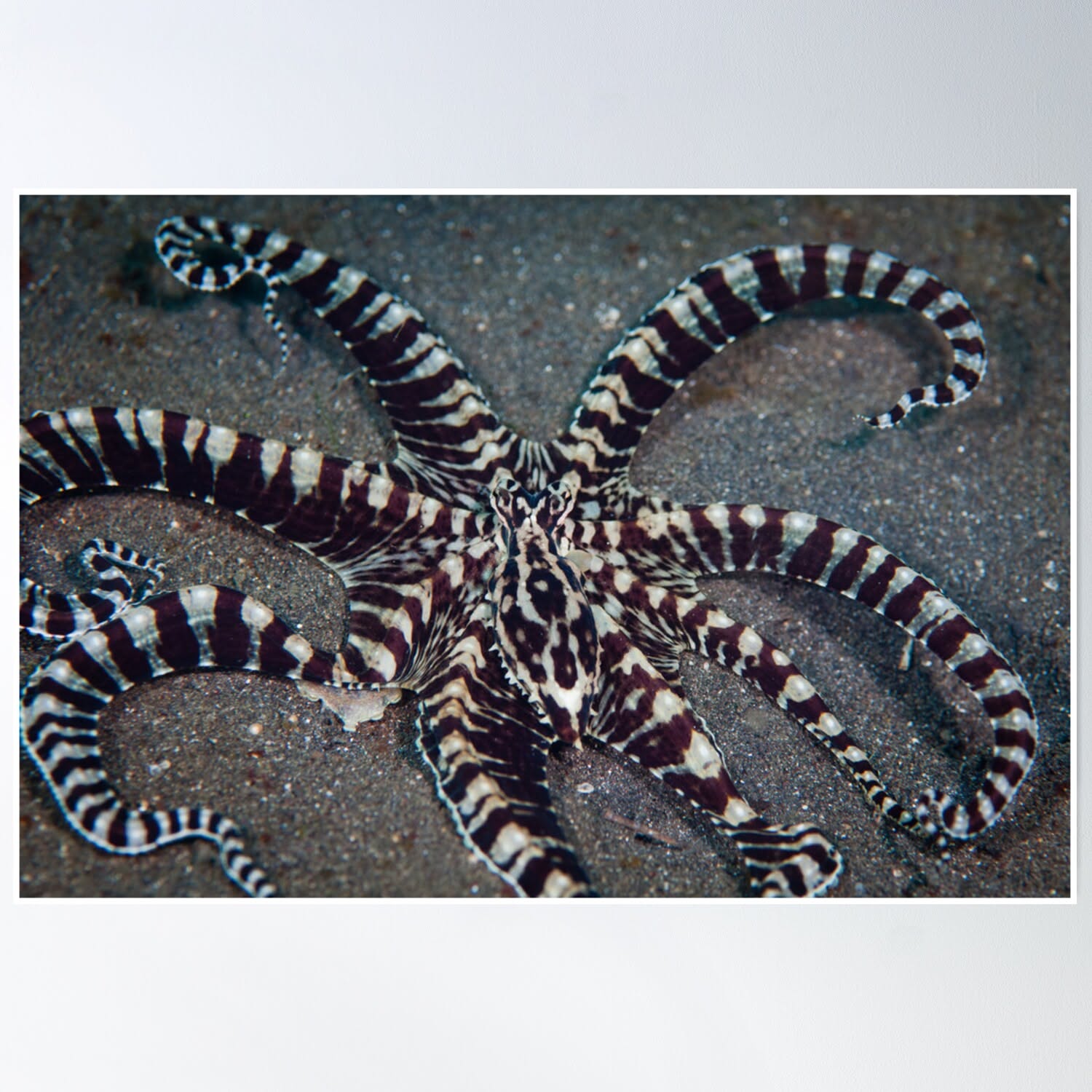
What is a mimic octopus?
The mimic octopus (Thaumoctopus mimicus) is a small octopus species discovered in 1998 off the coast of Indonesia that can impersonate at least 15 different marine species - including venomous lionfish, banded sea snakes, flounders, jellyfish, and mantis shrimp. It is the only known animal that can consciously choose which species to mimic based on which threat it encounters.
Not Hiding, Impersonating
Most animals that evade predators hide. They camouflage against backgrounds, retreat into crevices, or stay still. The mimic octopus does something fundamentally different. When threatened, it doesn't hide; it transforms into a different species entirely.
A damselfish attacks it? It becomes a banded sea snake, because banded sea snakes eat damselfish. A larger predator approaches? It flattens into a flounder. Another octopus challenges it for territory? It spreads its tentacles like a venomous lionfish. The mimic octopus carries in its body the acted-out shapes of at least 15 different marine species, switching between them based on what threat it encounters.
Discovered only in 1998, the mimic octopus is one of the most sophisticated examples of adaptive deception in any animal on Earth.
The Discovery
The mimic octopus (Thaumoctopus mimicus) was first filmed in 1998 by divers off the coast of Sulawesi, Indonesia. Footage showed a small octopus flatten itself into a flounder, then moments later transform into what appeared to be a banded sea snake.
Researchers initially doubted the footage. Octopuses were known for color-changing camouflage, but no species had been documented doing active behavioral mimicry of other animals. Follow-up expeditions confirmed the behavior and formally described the species in 2005.
Basic statistics:
- Length: up to 60 cm including tentacles
- Weight: 200-500 grams
- Range: Indonesia, Philippines, Malaysia, Thailand, Vietnam, northern Australia
- Habitat: shallow estuaries and sand flats, 2-40 m depth
- Lifespan: approximately 9 months (typical for small octopus species)
The Impersonations
Researchers have documented the mimic octopus impersonating at least 15 different marine species.
Confirmed impersonations:
Flounder (flatfish). The octopus flattens itself against the seafloor and swims with a rippling motion identical to flatfish. Its normal tentacle shape disappears entirely.
Banded sea snake. Six tentacles hide in a burrow; two are extended and striped black and white, waving in the water like a sea snake's head. This mimicry works because the mimic octopus can control its chromatophores to produce the distinctive banded pattern.
Lionfish. Tentacles spread out like the venomous spines of a lionfish. Color changes to match the reddish-brown and white lionfish pattern. Predators that recognize lionfish venomous spines avoid the mimic.
Jellyfish. The octopus drifts upward in the water column with tentacles held above the body, impersonating the movement of a drifting jellyfish.
Mantis shrimp. Body shape and movement pattern mimic the distinctive appearance of a mantis shrimp. Given that mantis shrimp can deliver devastating strikes, predators avoid them.
Other documented impersonations:
- Sand anemones
- Stingrays
- Gobies
- Brittle stars
- Giant crabs
- Seahorses
- Jawfish
- Small schooling fish
Researchers believe more impersonations exist. Field observations regularly document new ones, and the species may be capable of more transformations than have been catalogued.
Context-Specific Mimicry
What makes the mimic octopus unique is not just that it mimics; it is that it chooses impersonations based on context.
Observed pattern:
- Damselfish attacks → mimic octopus becomes a banded sea snake (damselfish predator)
- Aggressive octopus approach → mimic octopus becomes a lionfish (venomous deterrent)
- Open foraging → flatfish mimicry (low-profile movement on seabed)
- Swimming between burrows → sea snake or jellyfish mimicry
This selective mimicry suggests cognitive sophistication. The octopus is not running through a fixed routine; it is assessing threats and choosing appropriate responses.
Experimental evidence:
In controlled observations, individual mimic octopuses have switched between 4-5 different impersonations within a 30-minute period, each triggered by specific environmental stimuli.
Young mimic octopuses appear to learn their repertoire by watching adult octopuses or by observing the species they will later imitate. Without this learning period, their impersonations are cruder and less effective.
The Shape-Changing Machinery
The mimic octopus uses several biological systems to accomplish its transformations.
Chromatophores:
Like all octopuses, mimic octopuses have three types of skin cells:
- Chromatophores: pigment cells that stretch or contract to reveal or hide color
- Iridophores: structural-color cells that reflect specific wavelengths
- Leucophores: white reflector cells that diffuse light
These cells are controlled by nerves, allowing color changes within milliseconds. The octopus can match multiple colors in specific patterns simultaneously.
Papillae:
Skin projections called papillae can change texture between smooth and rough, allowing mimicry of different surface qualities. Scales, spikes, smoothness, all achievable through papillae control.
Muscular deformation:
The mimic octopus has no hard skeleton. Its entire body can stretch, compress, and reshape through muscle action. This allows:
- Flattening to paper-thin for flatfish mimicry
- Elongating into snake-like shapes
- Bunching into crab-like postures
- Spreading into jellyfish-like shapes
Neural control:
Octopuses have decentralized nervous systems, each arm has its own neural cluster. The mimic octopus uses this architecture to control complex shape-changing behaviors that involve different body parts doing different things simultaneously.
Why Such Extreme Adaptations?
Understanding the mimic octopus requires understanding its habitat.
The environment:
Indonesian and Indo-Pacific estuaries are among the most predator-dense shallow-water environments on Earth:
- Many small and medium-sized predatory fish
- Aggressive reef fish extending into the sand flats
- Larger octopuses that cannibalize smaller ones
- Hunting seabirds
- Larger fish that venture from coral reefs
The problem:
Sand flats offer no hiding places. Unlike reef-dwelling octopuses that can retreat into crevices, mimic octopuses are exposed in open terrain.
Standard octopus defenses (inadequate here):
- Color camouflage works against similarly-colored sand, but sand-colored octopuses are still octopus-shaped and detectable by shape-detecting predators
- Ink clouds work but require the octopus to escape while predator is distracted
- Retreat to burrow works for some attacks but not against burrowing predators
The mimic solution:
Active mimicry provides defense without requiring escape or hiding. The octopus stays in place but transforms into something predators don't want to attack.
The combination of the hostile environment, octopus cognitive capabilities, and decentralized nervous system likely produced the mimic octopus's exceptional abilities.
Hunting Behavior
Mimic octopuses are also predators.
Prey:
- Small fish
- Crabs and crustaceans
- Mollusks
- Worms
Hunting technique:
The octopus uses its tentacles to grab prey. Given its small size, it targets animals it can overpower. Like other octopuses, it injects paralytic saliva through its beak to subdue prey.
Mimicry for hunting:
Researchers believe mimic octopuses also use impersonation offensively:
- Mimicking harmless species to approach prey
- Appearing as a flatfish to ambush passing prey
- Lying in open sand while appearing as sediment
Reproduction
Mimic octopus reproduction follows typical octopus patterns.
Mating:
Males transfer sperm to females using a specialized arm (hectocotylus). Mating is brief and often involves elaborate posture displays.
Eggs:
Females lay 20,000-100,000 eggs in protected burrows. They guard the eggs until hatching, not eating during this period.
Death after reproduction:
Like most octopus species, females die after their eggs hatch. The physiological toll of prolonged egg-guarding without feeding results in death. Males also typically die shortly after mating.
Lifespan:
Approximately 9 months total. Given this short lifespan, the mimic octopus must develop its full repertoire of impersonations rapidly.
Conservation Status
Mimic octopuses face growing threats.
Current assessment:
The IUCN has not yet formally assessed Thaumoctopus mimicus. They are not currently listed as threatened.
Threats:
- Aquarium trade: live mimic octopuses are collected for tropical aquariums
- Habitat loss: coastal development destroys estuary habitat
- Climate change: warming ocean temperatures affect Indo-Pacific ecosystems
- Pollution: coastal runoff degrades shallow water habitats
- Scientific collection: research collecting impacts localized populations
Aquarium trade problem:
Mimic octopuses survive poorly in captivity. Most die within weeks of capture due to stress, inadequate diet, and specific environmental requirements. This makes the aquarium trade particularly damaging, each captured specimen represents a likely death.
Research access:
Most study of mimic octopuses happens through field observation rather than capture. Divers photograph and film wild individuals without disturbing them. This approach has yielded more useful data than captive studies.
Cultural Impact
The mimic octopus has become a viral favorite since its discovery.
Viral videos:
Nature documentary footage of mimic octopus transformations has been viewed hundreds of millions of times across platforms. The species' dramatic shape-shifting makes it exceptionally photogenic.
Educational presence:
Mimic octopuses feature in:
- Elementary and middle school biology curricula
- University zoology courses
- BBC, National Geographic, and other nature documentaries
- Marine biology popular science books
- Museum displays (via models and video, since they don't survive captivity)
Cultural symbol:
The mimic octopus has become a cultural symbol of adaptability and creative defense. Its approach, becoming something else rather than hiding, resonates with human concepts of resilience and transformation.
What Makes It Special
Several cephalopod species can mimic their surroundings. A few can change shape dramatically. But the mimic octopus combines capabilities in ways no other animal has matched:
Multiple species mimicry. Most mimics impersonate one model species. The mimic octopus impersonates at least 15.
Context-specific selection. It chooses which impersonation based on current threat, not just running a random program.
Behavioral mimicry. It doesn't just change color or shape; it moves like the species it impersonates. A flounder mimic swims like a flounder, not like an octopus pretending to be a flounder.
Learned repertoire. Young mimic octopuses learn their impersonations rather than having them all genetically pre-programmed. This suggests cognitive flexibility.
Evolution meeting cognition. The species represents a convergence of anatomical possibility (soft body, chromatophores, decentralized nervous system) and cognitive capability (learning, threat assessment, decision-making) producing an outcome no other animal achieves.
Some researchers argue that the mimic octopus challenges assumptions about invertebrate intelligence. A creature smaller than a human hand is performing behaviors that seem to require understanding of other species, context evaluation, and strategic decision-making.
What else the mimic octopus can do remains open. Each new expedition to Indonesian waters documents new behaviors. The species was invisible to science until 1998 - what other marine animals with similar capabilities might still be undiscovered in the world's under-studied tropical estuaries?
Mimicry Categorized
Biologists distinguish several types of mimicry, and the mimic octopus (Thaumoctopus mimicus) is capable of a particularly rare form: behavioral Batesian mimicry across multiple model species. Our research team finds this notable because it is perhaps the most sophisticated case of single-animal multi-model mimicry documented.
"What sets the mimic octopus apart is not just that it mimics multiple species, but that it appears to select which species to mimic based on the specific threat present. This is Batesian mimicry with cognitive decision-making layered on top - an unusual combination." - Dr. Mark Norman, Museum Victoria, who first described the species [1]
Types of Mimicry in Nature
| Type | Description | Example |
|---|---|---|
| Batesian | Harmless species resembles harmful | Viceroy butterfly mimics monarch |
| Mullerian | Two harmful species share warning signals | Monarch and viceroy (revised view) |
| Aggressive | Predator mimics harmless to approach prey | Anglerfish lure |
| Behavioral | Movement/posture mimicry rather than morphology | Stick insects |
| Multi-model | Single species imitating multiple models | Mimic octopus, some butterflies |
Documented Mimic Octopus Impressions
The mimic octopus has been filmed imitating at least 15 different species, though only a few imitations are well-documented and context-appropriate. The most reliably observed impressions are:
- Flatfish (sole): arms trailing behind, body flattened, gliding along the bottom. Used when crossing open areas with little cover.
- Lionfish: arms spread wide resembling venomous spines, hovering in the water column. Used against larger mid-water predators.
- Banded sea snake: six arms hidden, two arms extended with banded coloration. Used when threatened by damselfish, which sea snakes prey on.
- Mantis shrimp: short, hunched posture with striking-like motion. Used when hunting small fish that avoid mantis shrimp.
- Jellyfish: floating with arms hanging in a bell shape. Used in mid-water.
- Brittle star: body pressed to substrate, arms radiating outward. Used on rocky bottom.
"The mimic octopus is a reminder that we have a limited imagination about what invertebrates can do. Before 1998, no one believed such flexible, context-dependent multi-model mimicry existed in a mollusc. We now have to assume that other species with similar cognitive capabilities exist but have not been described." - Dr. Roger Hanlon, Marine Biological Laboratory [2]
Notable Research Findings
- The mimic octopus was formally described in 2005 in a paper by Mark Norman, Julian Finn, and Tom Tregenza, seven years after the first observation. Its complete taxonomic status took years to establish because of its extreme morphological variability.
- Mimic octopuses live in shallow, silty estuaries of Indonesia and Malaysia - habitats generally avoided by other octopus species because of the lack of hiding places. The mimic octopus appears to have colonized this niche specifically by using behavioral mimicry as a substitute for camouflage.
- A single mimic octopus was filmed switching between four different species impressions in under 30 minutes during field observation, suggesting rapid assessment and response to changing threats.
- Our research team notes that the mimic octopus's coloration - brown and white bands - is a component of several of its impressions, particularly the sea snake and the lionfish. This "base coloration" has been selected to match the warning signals of multiple venomous species rather than any single model.
- Juvenile mimic octopuses demonstrate impressions before they would ever have encountered a functional teacher, suggesting the mimicry repertoire is at least partly innate. However, refinement and context-selection seem to improve with experience.
- The mimic octopus is currently not classified by the IUCN, reflecting the fact that we still know relatively little about population sizes and trends. It is widely thought to have limited range and specific habitat requirements, making it potentially vulnerable to coastal development in Southeast Asia.
- Wunderpus photogenicus, a closely related species also found in Indo-Pacific waters, displays similar but less elaborate mimicry. The existence of two mimicry-capable species in overlapping ranges suggests that the behavior evolved in a common ancestor.
- The Indonesian fishing ports where mimic octopuses were first documented, including Lembeh Strait and Bali's north coast, have become key diving destinations for underwater photographers specifically seeking mimic octopus encounters. Economic pressure from this diving industry has generally aligned with conservation interest.
What Animals Camouflage the Best?
Cephalopods lead all animals in dynamic camouflage, and the mimic octopus (Thaumoctopus mimicus) takes camouflage into an entirely different category - active behavioral mimicry of at least 15 distinct marine species including flounders, banded sea snakes, lionfish, jellyfish, and mantis shrimp.
Discovered in 1998 off Sulawesi and formally described in 2005, this 60 cm octopus reshapes its 200-500 gram body based on which predator approaches. Other camouflage masters include the common cuttlefish (Sepia officinalis), which shifts color and texture in under a second, and the closely related Wunderpus photogenicus.
Static camouflage experts include leaf-tailed geckos, stick insects, ghost pipefish, and Arctic foxes. But no other known animal consciously selects which species to impersonate based on specific threat identification.
References
[1] Norman, M. D., Finn, J., & Tregenza, T. (2001). Dynamic mimicry in an Indo-Malayan octopus. Proceedings of the Royal Society B, 268(1478), 1755-1758. DOI: 10.1098/rspb.2001.1708
[2] Hanlon, R. T., Watson, A. C., & Barbosa, A. (2010). A "mimic octopus" in the Atlantic: Flatfish mimicry and camouflage by Macrotritopus defilippi. Biological Bulletin, 218(1), 15-24.
[3] Huffard, C. L., Saarman, N., Hamilton, H., & Simison, W. B. (2010). The evolution of conspicuous facultative mimicry in octopuses: An example of secondary adaptation? Biological Journal of the Linnean Society, 101(1), 68-77.
[4] Wickler, W. (1968). Mimicry in Plants and Animals. McGraw-Hill.
[5] Hanlon, R. T., & Messenger, J. B. (2018). Cephalopod Behaviour (2nd ed.). Cambridge University Press.
Related Articles
- Octopus Intelligence: The Smartest Invertebrates
- Giant Squid: The Real Kraken
- Cuttlefish: The Color-Changing Masters
Frequently Asked Questions
What is a mimic octopus?
The mimic octopus (Thaumoctopus mimicus) is a small octopus species discovered in 1998 off the coast of Indonesia that can impersonate at least 15 different marine species - including venomous lionfish, banded sea snakes, flounders, jellyfish, and mantis shrimp. It is the only known animal that can consciously choose which species to mimic based on which threat it encounters.
It lives in shallow estuaries and sand flats at depths of 2-40 meters in the Indo-Pacific region. Unlike most octopuses that use camouflage to blend in, the mimic octopus actively takes on the shape, color, and movement patterns of other specific species. It reaches only 60 cm in length including tentacles but can change its appearance within seconds.
The species was unknown to science until divers filmed it in Sulawesi in 1998, making it one of the most remarkable recent animal discoveries.
What species can the mimic octopus impersonate?
The mimic octopus has been documented impersonating at least 15 different marine species, with researchers believing it can probably impersonate more.
Confirmed impersonations include: flatfish (flounders - swimming flattened along the seafloor), banded sea snakes (hiding 6 tentacles and extending 2 striped ones), lionfish (spreading tentacles to mimic venomous spines), jellyfish (drifting with tentacles held upward), mantis shrimp, sand anemones, stingrays, gobies, brittle stars, giant crabs, seahorses, jawfish, and various small fish.
It chooses impersonations based on context - when threatened by damselfish (which are aggressive to territory invaders), it mimics a banded sea snake (a damselfish predator). When attacked by other octopuses, it mimics a lionfish. This context-specific mimicry suggests cognitive sophistication beyond simple trained responses. Scientists have filmed individual mimic octopuses switching between 4-5 different impersonations within a single 30-minute period.
How does the mimic octopus change its appearance?
The mimic octopus uses the combined capabilities common to octopuses plus additional behavioral sophistication. Like all octopuses, its skin contains chromatophores (pigment cells), iridophores (structural color cells), and leucophores (white reflector cells) that change color within milliseconds through muscular contraction. It has papillae - skin projections that can change its texture between smooth and rough.
What makes the mimic octopus unique is its ability to rapidly change its body posture and movement pattern to match other species. It can flatten to look like a flounder, fold its body to look like a sea snake, or stretch vertically to look like a jellyfish. Each impersonation requires specific neural patterns learned through experience. Young mimic octopuses must learn their impersonations by watching model species.
Without this learning, they cannot convincingly mimic other animals. The species demonstrates both evolutionary adaptation and individual cognitive learning working together.
Why does the mimic octopus need to impersonate?
The mimic octopus lives in open sand flats with few hiding places, making it extremely vulnerable to predators. Unlike reef-dwelling octopuses that can hide in crevices, mimic octopuses must protect themselves through active deception. By impersonating venomous or dangerous species (lionfish, sea snakes, jellyfish), it makes itself appear too dangerous to attack. By mimicking flatfish, it uses the same camouflage benefit as the model species.
Its eight tentacles allow it to take poses impossible for most predators to replicate, making its impersonations remarkably convincing. The mimic octopus is also a predator itself - it hunts small fish, crabs, and mollusks by grabbing them with its tentacles. Its impersonation abilities may also help it get close to prey.
Some researchers believe mimic octopuses evolved in response to the high-predator environment of Indonesian sand flats, where static camouflage alone was insufficient for survival.
Where do mimic octopuses live?
Mimic octopuses live only in the Indo-Pacific region, specifically in shallow sandy and muddy estuaries at depths of 2-40 meters. Their habitat includes Indonesia (especially Sulawesi), Papua New Guinea, Philippines, Malaysia, Thailand, Vietnam, and parts of northern Australia. They are most commonly observed in river mouths and estuaries where freshwater meets saltwater. Sandy bottoms provide burrows for them to retreat into during inactive periods.
They are typically solitary except during mating. Unlike many octopus species that hide in crevices or shells, mimic octopuses prefer open areas where they can see approaching predators and respond with appropriate mimicry. The species was only discovered in 1998 because divers don’t commonly explore the muddy river mouths where they live - most diving tourism focuses on coral reefs.
Research expeditions to their habitats continue to document new mimicry examples and behaviors that expand our understanding of this remarkable animal.