
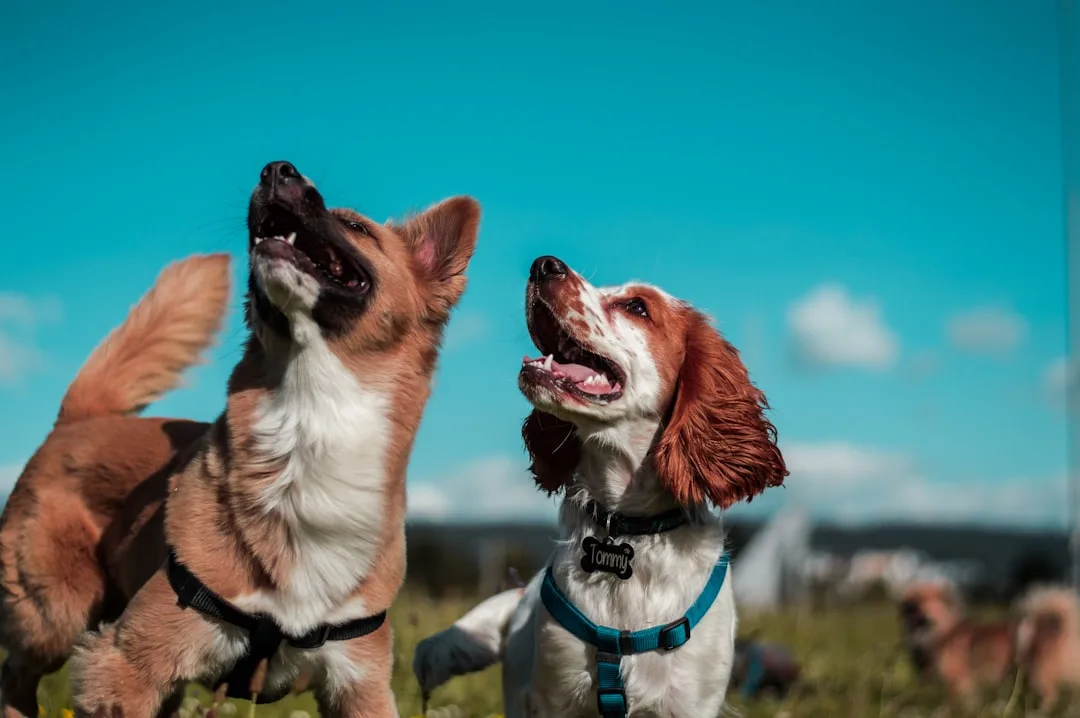
Dogs communicate through three primary channels: vocalizations (barking, growling, whining, howling), body language (posture, tail position, ear orientation, facial expression), and scent marking (urine, anal gland secretions, pheromones). While human communication is predominantly verbal, dogs rely more heavily on body language and scent, channels that humans often miss entirely. Understanding all three systems is essential for accurately interpreting what a dog is expressing.
The Three Communication Systems in Dogs
Each of the three communication channels serves different purposes in dog social life and operates over different distances.
Vocalizations are immediate, context-specific, and carry emotional intensity information. A bark encodes information about arousal level, urgency, and approximate size of the barking dog (pitch correlates inversely with body size). Growls communicate threat, play, and warning depending on context. Whines and whimpers signal appeasement, distress, or solicitation. Howls function as long-distance location broadcasts.
Body language is the dog's primary real-time social communication medium and is continuous, a dog is always communicating something through its posture, even in stillness. The entire body participates: tail height and movement pattern, ear orientation, weight distribution (forward versus back), eye softness or hardness, facial muscle tension, piloerection (hackle raising), and lip position all contribute simultaneously to a complete communicative signal.
Scent communication operates at a different timescale entirely. Scent marks persist in the environment after the marking dog has left, creating a chemical bulletin board for subsequent dogs. Urine marks encode identity, sex, reproductive status, and health. Anal gland secretions are individual chemical signatures. Pheromones, particularly in intact females, broadcast reproductive state over significant distances.
"The most common error humans make in interpreting dog communication is treating it as analogous to human verbal language. Dogs' primary channel is body language, and they are extraordinarily sophisticated communicators within that channel. The problem is not that dogs communicate poorly; it is that humans are unskilled readers of canine body language." Dr. Patricia McConnell, certified applied animal behaviorist
Understanding Dog Vocalizations
Bark pitch, rhythm, and context all encode meaning. Dogs vary their barks significantly depending on what they are communicating:
Alert barking: Rapid, repetitive barks at moderate pitch. Signals detection of something novel or potentially threatening. Common at the door or window.
Playful barking: Higher-pitched, often with a rising inflection. Accompanied by play bow or bouncy movements. Invites interaction.
Demand barking: Single or repetitive barks directed at a specific person or object. Often used to solicit food, attention, or access.
Alarm/distress barking: Continuous, urgent, often louder than alert barking. Signals high arousal or genuine fear response.
Territorial barking: Deep, sustained barking at the boundary of perceived territory. Can escalate to aggression if the perceived threat advances.
Growling is one of the most misunderstood vocalizations. Many owners discourage growling, which is a significant error: growling is a critical warning signal in the dog's communication repertoire. A dog that has been punished for growling may learn to suppress the warning and bite without it, removing a communication step that is valuable for human safety.
Play growls are common and normal: they are typically higher-pitched, accompanied by relaxed body language and play signals, and differ distinctly from threat growls.
Body Language: Reading the Whole Dog
Accurate reading of dog body language requires assessing the entire dog simultaneously rather than isolating individual signals.
Tail position and movement: A tail held high and moving rapidly in short arcs signals high excitement or potential arousal/arousal. A tail at medium height with loose, wide wags signals relaxed friendliness. A tail at half-mast held loosely signals relaxation or uncertainty. A tail tucked between the legs signals fear or submission. Importantly, tail wagging does not universally mean friendliness, high-held, rapid wags in a stiff-bodied dog can precede aggression.
Ear orientation: Forward-pointing ears signal attention and interest. Ears relaxed to the sides signal calm. Ears pinned flat against the head signal fear, appeasement, or submission.
Eye expression: Soft, squinty eyes signal relaxation and trust. Wide, hard eyes with visible whites ("whale eye") signal stress or threat. A sustained hard stare is a threat signal.
Body weight distribution: Weight shifted forward, onto the toes, signals alertness, potential challenge, or predatory attention. Weight shifted backward signals uncertainty, fear, or appeasement.
| Body Signal | Relaxed/Friendly | Alert/Aroused | Fearful/Submissive | Aggressive/Threatening |
|---|---|---|---|---|
| Tail position | Medium height, loose wag | High, rapid wag | Tucked | High, stiff, flagging |
| Ears | Relaxed, soft | Forward, upright | Pinned flat | Rigid forward |
| Eyes | Soft, squinty | Wide, hard | Averted, whale eye | Hard stare, forward |
| Body posture | Weight neutral | Forward shift | Lowered, crouching | Rigid, forward |
| Mouth | Slightly open, relaxed | Closed or open | Closed, lip licking | Lip curl, snarl |
| Hackles | Flat | May raise | Flat | Raised |
Calming Signals: Appeasement Communication
Norwegian dog trainer Turid Rugaas identified a set of behaviors she termed "calming signals" specific, culturally cross-understood dog communication displays used to reduce tension, signal non-threat, and appease other dogs or humans. These include:
- Yawning: Frequently used in mildly stressful situations; signals discomfort without escalation
- Lip licking: Quick tongue-flick over the nose; indicates anxiety or appeasement
- Turning the head away or turning the body sideways: Reduces threat to another dog
- Sniffing the ground: Displacement behavior signaling desire to avoid confrontation
- Slow blinking: Signals non-threat in human-dog interaction contexts
- Sitting or lying down: Strong appeasement display
Recognition of calming signals allows owners and handlers to interpret a dog's stress level accurately in real time and adjust the situation accordingly. A dog displaying multiple calming signals during training is communicating that it is feeling overwhelmed.
How Dogs Communicate with Humans Specifically
Dogs have developed specific adaptations for communicating with humans that do not exist in other canids, including wolves raised in identical environments. Domestic dogs:
- Follow human pointing gestures to locate hidden food, an ability wolves lack even when raised by humans
- Use referential gaze to direct human attention toward desired items
- Monitor human eye gaze to determine if a human is watching them
- Read human facial expressions for emotional cues
- Modulate their behavior based on a human's attentional state
"Dogs' ability to use human communicative gestures surpasses that of chimpanzees and wolves. This is not simply a product of training, young puppies with minimal human contact already outperform adult chimpanzees on social cue tasks. Domestication has fundamentally rewired the dog's social cognition toward humans." Hare, B. & Tomasello, M. (2005), Science
These adaptations make dogs uniquely effective partners in human-directed communication. Dogs read our faces, follow our attention, and adjust their own communicative behavior based on whether they perceive us as attending to them, capabilities that appear to have been shaped directly by thousands of years of living alongside humans.
Scent Communication: The Invisible Language
Scent communication is the channel least accessible to human perception but arguably most important in dog-to-dog interaction. Dogs have approximately 300 million olfactory receptors compared to approximately 6 million in humans. Their olfactory processing capacity is proportionally massive.
Urine marking encodes: individual identity (dogs identify specific individuals by urine scent), sex, reproductive status, age, and health information including stress hormones. Male dogs mark more frequently than females and over-mark sites previously marked by other dogs, a behavior that is not merely territorial but also communicative (responding to the previous message with one's own).
The anal glands, two small sacs flanking the rectum, produce highly individual secretions released during defecation and in social encounters. These secretions are unique chemical signatures, the reason dogs sniff each other's hindquarters upon meeting is to exchange this identity and status information rapidly.
| Scent Source | Information Encoded | Range and Duration |
|---|---|---|
| Urine | Identity, sex, reproductive status, health | Meters; hours to days depending on substrate |
| Anal glands | Individual identity, health state | Close range; direct contact or defecation site |
| Paw glands (interdigital) | Identity, territory | Deposited during scratching after elimination |
| Sebaceous skin glands | Individual identity, health | Close range; direct body contact |
| Pheromones (females) | Reproductive state (estrus) | Detectable over significant distances for intact males |
Communication Breakdowns: Why Misreading Happens
Most dog bites occur not because dogs give no warning but because the warning signals were not read by the humans present. Studies of dog bite incidents consistently find that in the majority of cases involving children, the bite was preceded by communicative signals that were either not recognized or ignored.
Children are particularly at risk because they make behaviors that dogs read as threatening: direct approach, sustained eye contact, leaning over the dog, reaching over the top of the head, grabbing, behaviors adults also engage in but that dogs consistently find uncomfortable when performed by strangers or in high-arousal contexts.
Education in canine body language is the most effective bite prevention tool available. Research by the Blue Cross (UK) found that teaching children to recognize dog stress signals reduced bite incidents significantly in school programs.
For more on dog behavior and communication, see Why Do Dogs Howl?, Why Do Dogs Tilt Their Heads?, Why Do Dogs Lick People?, How Smart Are Dogs?, and Do Dogs Understand Human Emotions?.
References
Rugaas, T. (2006). On Talking Terms with Dogs: Calming Signals (2nd ed.). Dogwise Publishing.
Hare, B., & Tomasello, M. (2005). Human-like social skills in dogs? Trends in Cognitive Sciences, 9(9), 439-444. https://doi.org/10.1016/j.tics.2005.07.003
Miklosi, A. (2007). Dog: Behaviour, Evolution, and Cognition. Oxford University Press.
Yin, S. (2009). Low Stress Handling, Restraint and Behavior Modification of Dogs and Cats. CattleDog Publishing.
Albuquerque, N., Guo, K., Wilkinson, A., Savalli, C., Otta, E., & Mills, D. (2016). Dogs recognize dog and human emotions. Biology Letters, 12(1), 20150883. https://doi.org/10.1098/rsbl.2015.0883
McConnell, P. B. (2002). The Other End of the Leash: Why We Do What We Do Around Dogs. Ballantine Books.
Frequently Asked Questions
How do dogs communicate?
Dogs communicate through vocalizations (barking, growling, whining, howling), body language (posture, tail position, ear orientation, facial expression), and scent (urine marking, anal gland secretions, pheromones). Body language is their primary channel.
What does dog body language tell you?
Dog body language communicates emotional state across a spectrum from relaxed to fearful to aggressive. Tail height, ear position, eye softness, weight distribution, and muscle tension all contribute simultaneously. Accurate reading requires assessing the whole dog, not isolated signals.
What are calming signals in dogs?
Calming signals are appeasement behaviors dogs use to reduce tension: yawning, lip-licking, turning the head away, sniffing the ground, and lying down. They indicate stress or discomfort and are widely understood across dogs regardless of breed.
Why can dogs follow pointing gestures but wolves cannot?
Domestic dogs have evolved specific adaptations for reading human communicative gestures through thousands of years of living with people. Young puppies with minimal human contact already outperform adult chimpanzees on human social cue tasks. This is a domestication-specific adaptation.
What does a dog's bark mean?
Bark characteristics encode meaning. Alert barks are rapid and repetitive. Playful barks are higher-pitched with bouncy body language. Demand barks are directed and persistent. Alarm barks are louder and continuous. Territorial barks are deep and sustained.
Is it bad if a dog growls?
No, growling is an important warning signal. Punishing growling teaches dogs to suppress the warning and bite without it. The cause of the growl should be addressed, not the growl itself. Play growls (higher-pitched, with relaxed body language) are normal and harmless.