
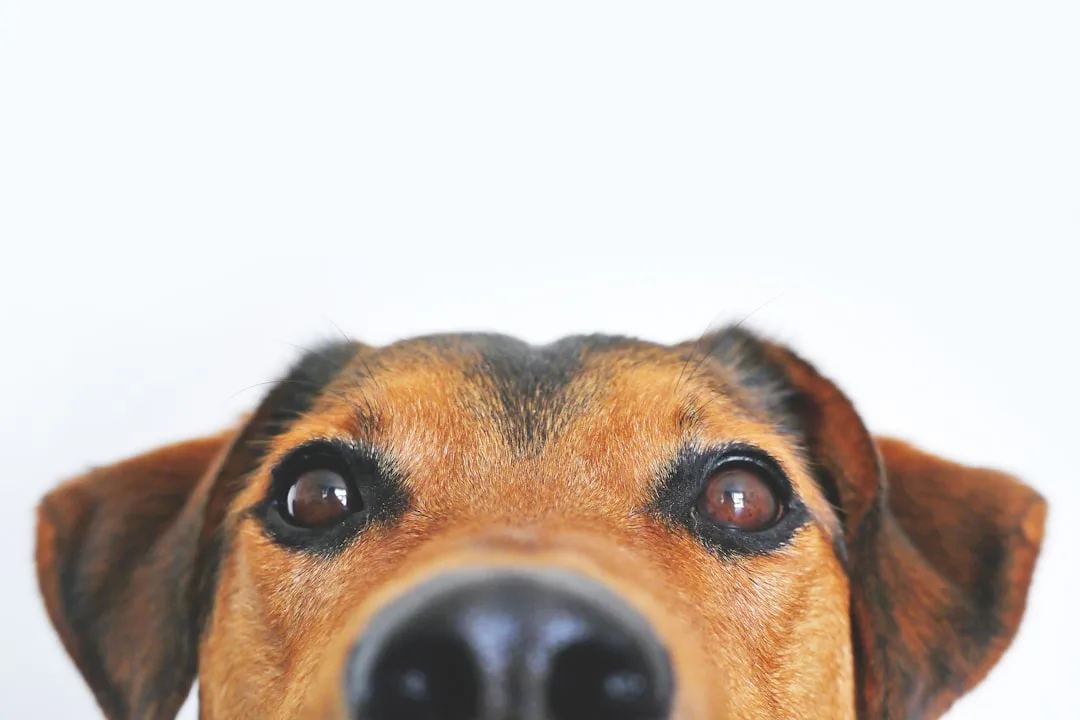
Dogs see the world with dichromatic vision; they perceive two primary color ranges (blue and yellow) rather than the three color ranges (blue, green, red) that humans use. Their visual acuity is approximately 20/75, meaning what a human can read at 75 feet, a dog must be 20 feet away to resolve clearly.
Yet in several critical respects, particularly low-light sensitivity and motion detection, dog vision surpasses human capability significantly. Understanding how dogs actually see helps owners communicate with them more effectively and explains many behaviors that puzzle owners.
Can Dogs See Color?
Dogs can see color, but their color range is narrower than human color perception. Humans have three types of cone photoreceptor cells (trichromatic vision) sensitive to long wavelengths (red), medium wavelengths (green), and short wavelengths (blue). Dogs have only two types of cone cells (dichromatic vision), sensitive to medium-short wavelengths (blue-violet) and long-medium wavelengths (yellow-green).
The practical effect is that dogs cannot distinguish red from green, both colors appear as a similar shade of yellow-brown or grey. Blue and yellow remain clearly distinct for dogs. This is functionally similar to the most common form of human red-green color blindness (deuteranopia or protanopia).
A 2013 study by Neitz, Geist, and Jacobs confirmed that dogs use color information for object recognition and that they specifically rely on blue-yellow discrimination to differentiate objects when color is the only available cue. Dogs trained to respond to a yellow object could readily distinguish it from blue and grey objects, confirming functional color vision within their spectral range.
"Dogs do use color, but their palette is different from ours. Understanding this helps explain why your dog may not be interested in a red toy on green grass; it probably looks nearly invisible to them. A blue or yellow toy on green grass stands out clearly." Jay Neitz, Ph.D., vision scientist, Medical College of Wisconsin
What Colors Can Dogs See Best?
Based on the documented dichromatic cone system, dogs see blue most vividly. Yellow is also clearly perceived. Colors in the green-to-red range appear desaturated and less distinct, often appearing as shades of yellow, grey, or brown.
This has practical implications for dog toys and training equipment. A red ball on green grass, a combination chosen intuitively by many owners because it looks bright and obvious to a human eye, may appear as a pale object on a pale background from the dog's perspective. A blue or yellow ball on green grass presents far better contrast.
Agility and flyball equipment is increasingly being manufactured in blue or yellow for this reason.
Visual Acuity: How Sharp Is a Dog's Vision?
Dogs have an estimated visual acuity of approximately 20/75. This means a dog must be 20 feet away to perceive the same detail a person with normal 20/20 vision can resolve at 75 feet. By the criteria used for human vision classification, this would qualify as significant visual impairment.
The anatomical basis for this lower acuity is the ratio of rod to cone cells in the retina. Cones, which provide fine detail discrimination, are fewer in number and less densely packed in the dog retina than in the human retina. Dogs have a visual streak, a horizontal band of higher cone density, rather than the small, highly concentrated fovea centralis that gives primates their sharp central focus.
Despite lower acuity, dogs are excellent at identifying and tracking moving objects. Their motion detection capabilities significantly exceed human performance, which is directly relevant to their ancestral role as pursuit predators.
Dog Vision vs. Human Vision: A Comparison
| Visual Characteristic | Dogs | Humans | Advantage |
|---|---|---|---|
| Color range | Dichromatic (blue + yellow) | Trichromatic (blue, green, red) | Humans |
| Visual acuity | ~20/75 | 20/20 (average) | Humans |
| Field of view | ~250 degrees | ~180 degrees | Dogs |
| Binocular overlap | ~75-100 degrees (breed variable) | ~120 degrees | Humans (depth perception) |
| Low-light sensitivity | High (more rods, tapetum lucidum) | Moderate | Dogs |
| Motion detection | Superior | Standard | Dogs |
| Flicker fusion rate | ~70-80 Hz | ~60 Hz | Dogs (see more frames) |
| Ultraviolet detection | Some evidence of UV sensitivity | None | Dogs (tentative) |
How Well Do Dogs See in the Dark?
Dogs are significantly better than humans at seeing in low-light conditions. This advantage comes from three anatomical features working together.
Rod photoreceptors. Rods detect light and dark without providing color information, and dogs have a much higher ratio of rods to cones than humans do. This means their retinas are more sensitive to low levels of light.
Tapetum lucidum. Dogs (and most non-primate mammals) have a reflective layer behind the retina called the tapetum lucidum. When light enters the eye, passes through the retina without being absorbed by a photoreceptor, and would otherwise be lost, the tapetum reflects it back through the retina for a second chance to trigger a photoreceptor.
This effectively doubles the photon-capture efficiency of the retina in low light. The tapetum is what causes dogs' eyes to glow green or yellow in photographs taken with flash; it is reflecting the flash back at the camera.
Larger pupils. Dogs' pupils can dilate to a larger absolute diameter than human pupils, allowing more total light into the eye in dim conditions.
Together, these features give dogs roughly five times better low-light vision than humans. This is why dogs navigate confidently in conditions that humans find nearly dark.
Field of View and Depth Perception
Dogs have a wider total field of view than humans, approximately 250 degrees compared to the human 180 degrees. This wide view is provided by the lateral placement of the eyes on the skull, which is an ancestral prey-detection adaptation. However, wider total field of view comes at a cost: the binocular overlap (the zone where both eyes can see the same point simultaneously, providing stereoscopic depth perception) is narrower in dogs than in humans.
This binocular overlap varies substantially across breeds depending on skull shape. Breeds with widely spaced lateral eyes (Greyhound, Saluki, Whippet) have a very wide total field of view but relatively narrow binocular zone, giving them excellent peripheral awareness but less precise depth discrimination. Breeds with more forward-facing eyes (Boston Terrier, Pug, some retrievers) sacrifice total field of view for greater binocular overlap.
Depth perception matters most for catching moving objects and jumping. Dogs are typically adequate at these tasks, but they rely more heavily on motion parallax (the way nearby objects appear to move faster against the background when the observer moves) than on pure stereopsis for distance judgment.
How Dogs' Flicker Fusion Rate Affects Their Perception
Flicker fusion rate is the frequency at which a rapidly flickering light appears as steady to the viewer. Humans have a flicker fusion rate of approximately 55 to 65 Hz, which is why cinema at 24 frames per second appears as smooth motion. Dogs have an estimated flicker fusion rate of 70 to 80 Hz.
This means dogs perceive more frames per second as distinct images than humans do. A practical implication: older fluorescent lights operating at 50 Hz may appear as a strobing or flickering light source to dogs, essentially a disco light from the dog's perspective, even though humans perceive them as steady. Dogs may be distressed by or behaviorally reactive to fluorescent lighting that appears perfectly normal to their owners.
Modern LED lighting, which operates at much higher frequencies or is DC-powered, does not have this problem.
Do Dogs See Ultraviolet Light?
A 2014 study by Grigg, Gonzalez-Bhakti, and Douglas published in Proceedings of the Royal Society B found that the corneas, lenses, and vitreous fluid of domestic dogs allow ultraviolet wavelengths (approximately 375 nm) to reach the retina, unlike human eyes which filter UV at the lens. Whether the dog retina has photoreceptors tuned to UV is not established with certainty, but the optical system does not prevent UV from reaching the retina.
If dogs can detect UV, they may perceive patterns on flowers, fur markings, and urine trails (which fluoresce under UV) that are completely invisible to humans. This remains an active area of research rather than a confirmed capability, but it adds an additional dimension to how dogs' sensory world may differ from ours.
How Dog Vision Affects Behavior
Understanding the visual capabilities of dogs helps explain many behaviors. Dogs that ignore or seem confused by red toys may simply not be able to distinguish them from backgrounds. Dogs that respond energetically to fast movements but ignore slow movements are responding to their superior motion detection system. Dogs that hesitate on stairs in low light may have visual conditions that impair even their enhanced low-light vision.
Dogs also rely heavily on smell and hearing as primary senses, with vision third in their sensory hierarchy. This means a dog presented with conflicting visual and olfactory information will typically trust its nose over its eyes.
For related reading, see How Far Can Dogs Smell?, Why Do Dogs Tilt Their Heads?, How Smart Are Dogs?, Why Do Dogs Howl?, and Signs of a Healthy Dog.
References
Neitz, J., Geist, T., & Jacobs, G. H. (1989). Color vision in the dog. Visual Neuroscience, 3(2), 119-125. https://doi.org/10.1017/S0952523800004430
Grigg, N. P., Gonzalez-Bhakti, M., & Douglas, R. H. (2014). Extreme long wavelength sensitivity in the eye of the domestic dog. Proceedings of the Royal Society B: Biological Sciences, 281(1788), 20140493. https://doi.org/10.1098/rspb.2014.0493
Miller, P. E., & Murphy, C. J. (1995). Vision in dogs. Journal of the American Veterinary Medical Association, 207(12), 1623-1634.
Tansley, K. (1965). Vision in Vertebrates. Chapman and Hall.
Pretterer, G., Bubna-Littitz, H., Windischbauer, G., Gabler, C., & Griebel, U. (2004). Brightness discrimination in the dog. Journal of Vision, 4(3), 241-249. https://doi.org/10.1167/4.3.6
Frequently Asked Questions
What colors can dogs see?
Dogs can see blue and yellow clearly. They cannot distinguish red from green, which appear as similar shades of yellow-brown or grey. Their color perception is similar to red-green color blindness in humans.
How good is a dog's eyesight?
Dogs have an estimated visual acuity of 20⁄75, meaning they need to be 20 feet away to see what a person with normal vision sees at 75 feet. However, they have superior low-light vision and motion detection compared to humans.
Can dogs see in the dark?
Dogs have significantly better low-light vision than humans due to more rod photoreceptors, a reflective tapetum lucidum layer behind the retina, and larger pupils. They can see approximately five times better than humans in dim conditions.
What colors should I buy for dog toys?
Blue and yellow toys provide the best contrast for dogs and are most visible against common backgrounds. Red toys on green grass are very difficult for dogs to see due to their inability to distinguish those color ranges.
Do dogs have good peripheral vision?
Yes. Dogs have a total field of view of approximately 250 degrees compared to humans’ 180 degrees, giving them excellent peripheral awareness. However, their binocular overlap (for depth perception) is narrower than humans’.
Why do dogs' eyes glow in photos?
Dogs’ eyes glow in flash photographs because of the tapetum lucidum, a reflective layer behind the retina that bounces light back through the retina to improve low-light vision. The flash reflects off this layer back toward the camera.