
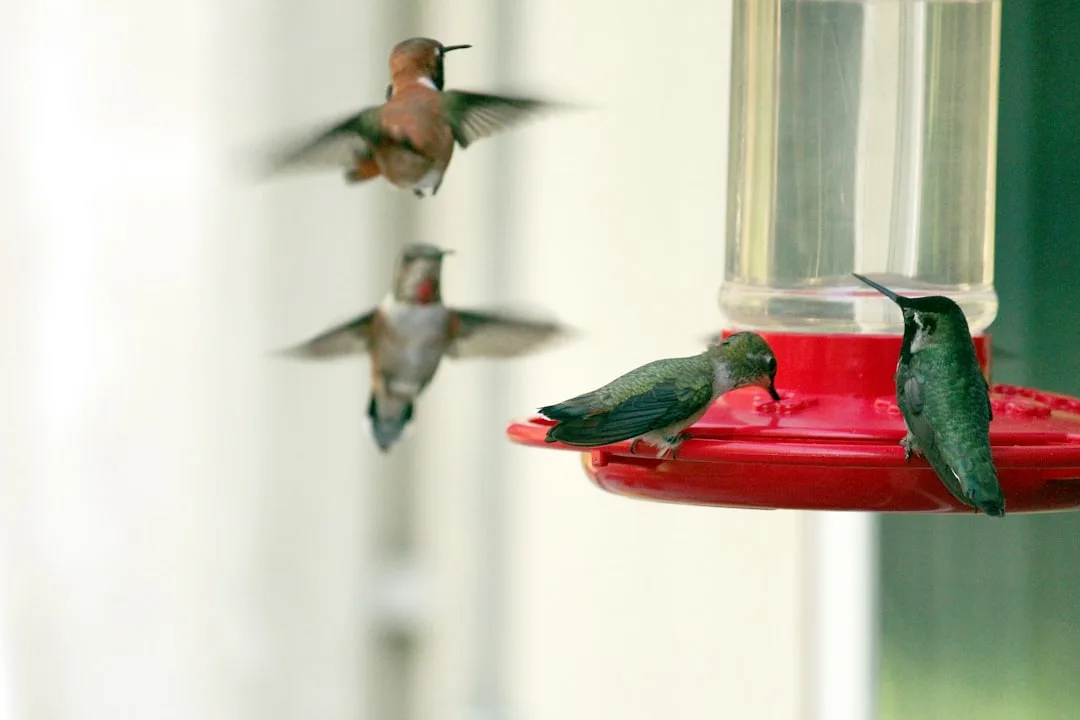
Anna's hummingbird is one of the most conspicuous and best-studied hummingbirds in North America.
A resident of the Pacific Coast from Baja California to southern Alaska, Calypte anna combines a medium-sized hummingbird body plan with a suite of extraordinary behaviours: a 40-metre vertical courtship dive that reaches roughly 27 metres per second, a mechanical squeak produced by vibrating tail feathers at the bottom of that dive, a structural pink-to-magenta gorget and crown unique among North American hummingbirds, winter torpor deep enough to survive snowstorms, and a range that has expanded hundreds of kilometres northward in less than a century.
Unlike most temperate hummingbirds it does not migrate, and unlike most tropical ones it regularly faces freezing nights.
This guide covers every major aspect of Anna's hummingbird biology and ecology: size and structure, the dive display and its tail-feather acoustics, structural colour, diet, torpor, nesting, range expansion, conservation, and the tight link between this species and the gardens and cities of the Pacific Coast. It is a reference entry, not a summary - so expect specifics: grams, metres per second, body-lengths, g-forces, and verified records.
Etymology and Classification
The scientific name Calypte anna honours two people. The genus Calypte was erected in 1856 by John Gould for a small group of hummingbirds with distinctively iridescent crowns; the name derives from Greek kalupto, meaning 'to cover' or 'to hide', probably referring to the way the iridescent feathers of the crown and gorget appear and disappear depending on viewing angle.
The species epithet anna commemorates Anna Debelle Massena, Duchess of Rivoli, a nineteenth-century Italian aristocrat whose husband Francois Victor Massena was an amateur ornithologist and whose collection of North American hummingbird specimens included the type of this species, described by Rene Primevere Lesson in 1829.
Anna's hummingbird belongs to the order Apodiformes, a group whose Latin name means 'without feet' and whose members share the trait of tiny, weak, near-vestigial legs. Inside Apodiformes the family Trochilidae contains about 360 described hummingbird species, all native to the Americas.
The genus Calypte contains two species: Anna's hummingbird and Costa's hummingbird (Calypte costae) of the American Southwest and Baja California deserts. The two are close relatives and show similar gorget structure but differ in range, habitat, and display behaviour.
Molecular phylogenies place Calypte within the so-called 'bee hummingbird' clade, a North American radiation that also includes the calliope, rufous, and Allen's hummingbirds. Despite this grouping, Anna's hummingbird is not closely related to the Cuban bee hummingbird, which is in a different genus on a separate branch of the family tree.
Size and Physical Description
Anna's hummingbird is medium-sized by hummingbird standards - noticeably larger than the calliope or ruby-throated, much larger than the Cuban bee hummingbird, and roughly equal in mass to the rufous hummingbird. The body plan is compact and slightly chunky compared to the streamlined profile of migratory species, which is consistent with a bird that does not need to cover continent-spanning distances each year.
Body dimensions:
- Total length: 9-10 cm from bill tip to tail
- Wingspan: 12-14 cm
- Bill length: 1.5-2 cm, straight, slender, black
- Weight: 3.5-4.5 g in males, 3.5-5.0 g in females
Sex differences:
- Males: iridescent pink-to-magenta crown and throat gorget that extends laterally as pointed plumes, green upperparts, pale grey underparts
- Females: green upperparts, pale grey underparts, white-tipped outer tail feathers, usually a small central throat patch of red or pink feathers
- Juveniles: resemble females with a slightly streakier throat; first-year males begin developing gorget feathers late in their first year
Unlike some hummingbirds, sex differences in overall size are minimal. What sets the male apart visually is the gorget and crown, which can appear blazing rose-pink at certain angles and flat black at most others. The bill is straight rather than curved, well-suited to the tubular flowers typical of Pacific Coast chaparral and to ornamental garden plants.
The feet are almost vestigial, as they are across Apodiformes. The legs are too short and weak for walking or hopping. An Anna's hummingbird can grip a twig tightly and shuffle sideways for a few centimetres, but on a flat surface it is essentially helpless. Flight handles nearly all activities: feeding, courtship, territorial defence, even bathing through flight spray and rain.
The wing is built like a miniature rigid propeller. The shoulder joint rotates nearly 180 degrees, letting the wing invert between strokes so that lift is generated on both halves of each beat. Wing beat frequency in Anna's hummingbird averages about 40-50 hertz in level flight - slower than a bee hummingbird but still far faster than any non-hummingbird in the region.
The Dive Display
The single most famous behaviour of Anna's hummingbird is the male courtship dive. It is the aerial display that made the species central to modern research on biomechanics and acoustics, and it remains one of the highest-performance flight manoeuvres known in any bird.
Structure of the display:
- The male climbs nearly vertically to roughly 30-40 metres above a perched female
- He pauses briefly at the top
- He dives head-first in a nearly vertical line toward her
- At the bottom of the dive he pulls up sharply, passing within centimetres of the female
- He produces a sharp chirp or 'squeak' at the pullout
- He climbs again and repeats the dive, typically 3-8 times in a bout
- Between dives he may hover a few centimetres in front of the female and produce a scratchy buzzing song
Performance benchmarks:
| Metric | Value |
|---|---|
| Typical dive start height | 30-40 m above female |
| Peak dive speed | ~27 m/s (~97 km/h) |
| Mass-specific speed | ~385 body lengths per second |
| Wing posture at peak | Folded, held close to the body |
| G-force at pullout | ~9-10 g |
| Duration of audible squeak | ~60 ms |
The 385-body-lengths-per-second figure was published by Christopher Clark in 2009 in the journal Proceedings of the Royal Society B. In relative terms it is faster than a peregrine falcon in a stoop, faster than a fighter jet at full throttle, and faster than the space shuttle during atmospheric re-entry when each is measured in its own body lengths per second.
The absolute speed is modest - a sprinting cheetah is slightly faster than a diving Anna's - but scaled to body size the manoeuvre is extreme.
At the pullout, the 9-10 g load is sustained by the tiny body with no apparent ill effects. For comparison, human fighter pilots typically lose consciousness at 8-10 g without a pressure suit. The bird's short neck, compact mass distribution, and low total mass protect it from the blood-pooling problems that affect human pilots under similar loads.
The Tail-Feather Squeak
For decades observers assumed the sharp note at the bottom of the dive was a vocalisation - essentially a yell. Work by Christopher Clark beginning in his doctoral research at UC Berkeley and continuing at UCLA showed that the sound is mechanical, not vocal, and comes from the male's tail.
Evidence that the sound is non-vocal:
- Birds with specific tail feathers experimentally trimmed produced dives without the squeak while retaining all normal vocal calls
- Isolated tail feathers placed in a wind tunnel at realistic dive airspeeds reproduced the natural sound
- The frequency of the sound matches predictions from the physical dimensions of the vibrating feather
- The sound only occurs at the pullout, when the tail is briefly spread wide in the airstream
The sound is produced by a single pair of outer tail feathers - the rectrices - whose narrow inner vanes flutter in the high-speed airstream when the male spreads his tail for a fraction of a second at peak dive velocity. The flutter vibrates at around 4 kilohertz, in the range audible to most humans and clearly perceptible to the female. The entire sound lasts roughly 60 milliseconds.
Related species in the same genus and in sister groups produce their own distinct dive sounds with different tail-feather geometries. Costa's hummingbird produces a higher, thinner whistle. The broad-tailed hummingbird generates a constant wing whine rather than a pulse. Each pattern appears to encode species identity.
Structural Colour: Pink Without Pigment
The male's crown and throat gorget glow rose-pink to magenta in direct sunlight and appear dull black or grey from other angles. This colour is not produced by pigment. It is generated structurally, by the precise geometry of stacked melanin platelets and air spaces inside each feather barbule.
Structural mechanism:
- Gorget feather barbules contain stacks of thin melanin-filled platelets
- Platelets are separated by microscopic air-filled gaps of specific thickness
- Incoming light interferes constructively at certain wavelengths and angles
- At the correct viewing geometry, red-pink wavelengths dominate
- At other angles, no colour reinforcement occurs and the feather appears dark
This is the same thin-film interference physics that produces the colour of peacock feathers, morpho butterflies, and soap bubbles. Unlike pigment-based colour, structural colour depends entirely on viewing angle. A male Anna's hummingbird is nondescript from most directions and blinding from one specific angle.
During courtship the male positions himself so that the female sees the gorget and crown at peak reflection, and during the dive the orientation of his head at the pullout again places the full colour directly in her line of sight.
The visible hue in Anna's hummingbird - a deep rose-pink that shifts toward magenta and crimson - is produced by platelet geometry specific to this species. Close relatives have similar platelets tuned to different wavelengths: Costa's hummingbird produces a violet-purple gorget, Allen's and rufous hummingbirds produce orange-copper, and the calliope hummingbird produces streaked magenta rays on a white field.
Females and juveniles lack the full gorget. Many adult females carry a small central patch of a few iridescent feathers on the throat, enough to hint at the structural machinery without the full display. First-year males develop gorget feathers gradually through the first full moult.
Range and Range Expansion
Historically Anna's hummingbird was restricted to coastal California, northern Baja California, and nearby islands. Since the 1930s the species has expanded its breeding range dramatically, now occupying the entire Pacific Coast from Baja north through coastal British Columbia and into parts of southern Alaska, and inland through parts of Arizona, Nevada, and Oregon.
Drivers of the range expansion:
- Eucalyptus plantings. Widespread planting of blue gum and other eucalyptus species in California and the Pacific Northwest created dense, long-blooming nectar sources that flower from winter through spring - exactly when native flowers are scarce.
- Tree tobacco and ornamental shrubs. Nicotiana glauca, Grevillea, Leucospermum, and a range of garden ornamentals from Australia and South America all provide nectar through otherwise lean months.
- Sugar-water feeders. Residential feeders maintained through winter have converted formerly marginal habitat into reliable year-round territory.
- Mild winters. Pacific Coast maritime climate is mild enough that torpor-capable hummingbirds can survive most winters even at northern latitudes.
- Urban heat islands. Cities stay warmer in winter than surrounding countryside, reducing the energetic cost of surviving cold nights.
The northward expansion continues. Regular breeding is now documented in the Sitka area of southeast Alaska, where a century ago no hummingbird was present. Individual birds are occasionally recorded even further north, though these sightings are not yet consistent breeding records.
Diet and Feeding
Anna's hummingbirds are nectarivores that depend on flowers, supplemented by small insects and spiders, tree sap from sapsucker wells, and occasional fruit juice. The bird visits hundreds of flowers per day and takes in roughly its own body weight or more in nectar daily.
Preferred nectar sources:
- Manzanita (Arctostaphylos)
- Currants and gooseberries (Ribes)
- Monkeyflower (Mimulus)
- California fuchsia (Epilobium canum)
- Salvia and penstemon species
- Eucalyptus blossoms
- Tree tobacco (Nicotiana glauca)
- Agave in desert margins
- Garden ornamentals: fuchsia, bottlebrush, abutilon, grevillea
The tongue is a precision feeding structure shared across hummingbirds. It is forked at the tip, with the outer edges curling inward to form two parallel grooves lined with hair-like lamellae. High-speed video shows that the tongue does not simply suck nectar.
As it is extruded the tongue compresses and flattens; when the tip touches nectar, it snaps open and the lamellae unfurl, trapping liquid between them; the nectar is drawn back into the bill as the tongue retracts. The cycle repeats 15-20 times per second.
Non-nectar food sources:
- Small flies, gnats, midges, and aphids captured on the wing or gleaned from foliage
- Small spiders taken from webs
- Tree sap drunk from shallow wells drilled by red-breasted sapsuckers
- Fruit juice from damaged or overripe fruit
- Sugar-water from backyard feeders (ideal 4:1 water to white sugar, never honey or red dye)
Sapsucker wells are a particularly interesting winter food source. Red-breasted sapsuckers drill horizontal rows of shallow holes in the bark of willows, alders, maples, and other trees. The holes fill with dilute sugary sap, and they also trap small insects.
Anna's hummingbirds follow sapsucker activity closely and visit the wells on a regular circuit, especially during cold weeks when few flowers are blooming. Maple sap has been documented as a particularly important mid-winter food for northern populations.
Anna's hummingbirds also drink directly from lawn sprinklers, garden hoses, drip irrigation, and fountain spray. They often fly in tight zigzag patterns through the spray, combining drinking, bathing, and evaporative cooling in a single behaviour.
Nightly and Winter Torpor
Anna's hummingbirds survive cold nights and winter weather by entering torpor, a form of regulated hypothermia that cuts metabolism by up to 95 per cent. This is the only reason a three- to five-gram warm-blooded animal can survive freezing winter nights in Oregon, Washington, or southern Alaska.
Torpor physiology:
- Heart rate: drops from hundreds of bpm to as low as 50 bpm
- Breathing: from high resting rate to near-undetectable
- Body temperature: falls from ~40 C to as low as 3-9 C in extreme cold
- Metabolic rate: reduced by approximately 90-95 per cent
- Posture: feathers fluffed, bill often angled upward, feet gripping tightly
Torpor is not sleep. It is a regulated state in which the hypothalamus sets a much lower temperature target. A bird in torpor appears dead to a human observer - eyes closed, respiration invisible, body cool. It ignores light touches and can be handled carefully.
Arousal is deliberate and expensive: the bird shivers its flight muscles to generate heat and rewarm the core, a process that takes 20-60 minutes depending on starting temperature and can use an appreciable share of the bird's overnight fat reserves.
Anna's hummingbirds have been documented in torpor while snow accumulates on and around them. Photographs and video from western Washington and coastal British Columbia show individuals motionless on twigs with snowflakes settling on their backs. After the storm passes they rouse, feed at whatever flowers or feeders remain functional, and resume normal activity.
Winter torpor is different in degree rather than kind from ordinary overnight torpor. Birds simply drop deeper and stay cooler longer when outside temperatures fall further. The physiological ceiling of this ability appears to lie somewhere below freezing, which places a soft northern limit on where the species can reliably winter even with feeders.
Nesting and Reproduction
Anna's hummingbirds breed earlier in the year than almost any other North American bird. Courtship begins in late autumn in the southernmost populations, nests are under construction by December in coastal California, and eggs are often laid in January and February - while much of North America is still in deep winter. This early schedule matches the peak flowering of manzanita and eucalyptus.
Nest construction:
- Location: forked twig 1-10 m above ground, often in a small tree or shrub
- Materials: plant down, spider silk, cobweb, lichen flakes, bark fragments
- Size: ~4 cm across and 2-3 cm deep
- Camouflage: lichen chips stuck to the outside blend the nest into the branch
Spider silk is the structural secret. It binds the soft plant fibres, anchors the nest to the branch, and allows the walls to stretch elastically as the chicks grow. The nest begins at egg-laying time roughly the size of a walnut half and expands over the three to four weeks of chick rearing to hold two near-adult-sized young.
Breeding timeline:
- Clutch size: 2 white eggs (rarely 1 or 3)
- Incubation: 14-19 days, female only
- Nestling period: 18-23 days
- Fledgling dependence: 7-14 days after first flight
- Broods per season: often 2, occasionally 3 in warm areas
The female handles all nesting duties. Males defend territories around reliable nectar sources but play no role in incubation or chick rearing. Females return to the nest every 10-15 minutes during daylight to regurgitate a mix of nectar and arthropod prey to the nestlings. Chick growth is explosive: fledglings leave the nest at near-adult body mass.
Conservation Status and Relationship With Humans
The IUCN Red List classifies Anna's hummingbird as Least Concern with an increasing population trend. The species is one of the clearest conservation winners among North American hummingbirds. Its range has expanded dramatically in less than a century, population densities in coastal cities are often higher than in wildland habitat, and the species now breeds in regions where no hummingbird was historically present.
Main localised threats:
- Window collisions during dives and territorial flights near glass
- Predation by outdoor domestic cats, especially at feeders and low nests
- Pesticide use that reduces insect prey and contaminates nectar
- Extreme cold snaps at the northern edge of range, particularly when feeders freeze
- Habitat loss in specific regions, though offset by garden habitat elsewhere
None of these threats currently endangers the global population, which is estimated in the high single digits of millions of mature individuals. The species has become the most familiar backyard hummingbird of the Pacific Coast. Its willingness to nest near houses, its year-round residency, its dramatic dive displays, and its fearless approach to sprinklers and feeders all make it central to the daily experience of hummingbird-aware residents from San Diego to Sitka.
The cultural relationship is largely positive. Anna's hummingbird appears on stamps, gardening guides, and birding logos. Sugar-water feeders are a near-universal fixture in Pacific Coast yards, and recommendations for feeder maintenance (4:1 ratio, no honey, no red dye, frequent cleaning, winter heating where possible) are widely disseminated. The species also benefits from native-plant gardening movements that promote manzanita, currant, salvia, and monkeyflower in residential landscapes.
Modern ornithology continues to find new details in Anna's hummingbird biology.
Research published over the last two decades has clarified the biomechanics of the dive, the acoustics of the tail-feather squeak, the microstructure of the gorget, the depth and regulation of torpor, the cognitive map that lets the bird remember hundreds of flower locations, and the fine details of the range expansion.
The species remains a frontier subject for biomechanics, sensory ecology, and urban evolution research.
Related Reading
- Bee Hummingbird
- Ruby-throated Hummingbird
- Hummingbird: Fastest Wings in the Animal Kingdom
- Hummingbird Hover Flight Physics
- Hummingbirds: Nature's Tiny Flying Machines
References
Relevant peer-reviewed and governmental sources consulted for this entry include the Cornell Lab of Ornithology's Birds of the World account for Calypte anna, BirdLife International species factsheets, IUCN Red List assessments (2023 and 2024), Christopher J.
Clark's research on hummingbird dive acoustics published in Proceedings of the Royal Society B (2008) and Proceedings of the National Academy of Sciences (2009), and studies on hummingbird torpor, feeding mechanics, and structural colour published in Journal of Experimental Biology, Nature, Current Biology, and The Auk. Range expansion data reflect consolidated Breeding Bird Survey and eBird records through 2024.
Frequently Asked Questions
How big is an Anna's hummingbird?
Anna’s hummingbirds (Calypte anna) measure 9-10 cm from bill tip to tail and weigh 3-6 grams, with most adults in the 3.5-4.5 gram range. Wingspan is 12-14 cm. They are medium-sized by hummingbird standards - noticeably larger and stockier than the ruby-throated or calliope hummingbird, and much larger than the Cuban bee hummingbird, which weighs under two grams. Males and females are similar in size, though females are often slightly heavier.
The bill is straight, black, and roughly 1.5-2 cm long, matched to the tubular red and pink flowers of the Pacific Coast.
Where do Anna's hummingbirds live?
Anna’s hummingbirds are Pacific Coast residents of North America, breeding from Baja California in Mexico north through California, Oregon, Washington, British Columbia, and into coastal southern Alaska. They occupy coastal sage scrub, chaparral, oak woodland, riparian corridors, gardens, parks, and suburban yards.
The species is strongly tied to year-round flower availability, which is why urban and suburban areas with ornamental plantings and sugar-water feeders now support exceptionally high densities. Historically the species was largely restricted to coastal California and northern Baja, but its range has expanded dramatically since the 1930s.
Why don't Anna's hummingbirds migrate?
Anna’s hummingbirds are unusual among hummingbirds because they do not undertake long seasonal migrations. Most hummingbird species in temperate North America, including the rufous and ruby-throated, travel thousands of kilometres between winter and summer ranges.
Anna’s hummingbirds stay in their breeding range year-round thanks to three factors: mild Pacific Coast winters, an expanded calendar of flower availability created by planted ornamentals like eucalyptus and tree tobacco, and ubiquitous backyard sugar-water feeders. Winter nights are survived by entering torpor. Some individuals make short altitudinal or latitudinal movements, but there is no organised migration in the traditional sense.
How fast is an Anna's hummingbird dive?
Male Anna’s hummingbirds dive from up to 40 metres above a perched female and accelerate to a peak speed of roughly 27 metres per second - about 97 kilometres per hour. In absolute terms that is slower than a peregrine falcon, but in body-lengths-per-second the dive reaches about 385 body lengths per second.
That mass-specific speed is faster than the relative velocity of a peregrine in a stoop, a fighter jet at full afterburner, and even the space shuttle during atmospheric re-entry. At the bottom of the dive the bird pulls up at forces of roughly 9-10 g, which would cause greyout or blackout in a human pilot.
What makes the squeak sound at the end of the dive?
The sharp chirp or squeak heard at the bottom of an Anna’s hummingbird dive is not vocal. Christopher Clark, then at the University of California, Berkeley, showed in a 2008 Proceedings of the Royal Society B paper and a 2009 follow-up in PNAS that the sound is produced by air rushing past a single pair of modified outer tail feathers that vibrate at high frequency as the male spreads his tail at peak dive speed.
Clark demonstrated this by trimming specific tail feathers on captured males and observing the change in the sound, then by placing feathers in a wind tunnel and reproducing the note. Each sub-species and several related hummingbirds produce distinct sounds using the same mechanism.
What do Anna's hummingbirds eat?
Anna’s hummingbirds feed mainly on flower nectar, supplemented by small insects, spiders, tree sap, and occasional fruit juice. They visit hundreds of flowers a day, favouring tubular red, pink, and orange blooms such as manzanita, gooseberry, currant, monkeyflower, eucalyptus, tree tobacco, fuchsia, and salvia.
Insects supply the protein and amino acids that nectar lacks, and adults hawk small flies and midges on the wing and glean aphids and spiders from foliage. In winter, when flowers are scarce, Anna’s hummingbirds drink from sap wells drilled by red-breasted sapsuckers, picking up both dilute sugar solution and the small insects trapped in the sap.
Backyard sugar-water feeders at a 4:1 water to white sugar ratio are widely used and have significantly influenced the species’ range expansion.
How do Anna's hummingbirds survive cold weather?
Anna’s hummingbirds survive freezing nights and snowstorms by entering torpor, a regulated state of hypothermia. After the last feeding of the day, the bird perches in a sheltered spot, fluffs its feathers, and lowers its body temperature from the normal avian 40 C to as little as 3-9 C in extreme cold.
Heart rate drops from hundreds of beats per minute to as low as 50 bpm, breathing slows to near-undetectable levels, and metabolism falls by up to 95 per cent. In this state a bird can be handled gently without waking. At dawn the bird shivers its flight muscles to rewarm its core over 20-60 minutes.
This is why Anna’s hummingbirds can be photographed sitting in falling snow in Washington, British Columbia, and southern Alaska, despite weighing less than a US nickel.
Are Anna's hummingbirds endangered?
The IUCN Red List classifies Anna’s hummingbird as Least Concern with an increasing population trend. This is one of the clearest conservation success stories among North American hummingbirds. The species has expanded its breeding range hundreds of kilometres northward since the 1930s, driven by ornamental plantings, mild Pacific winters, and backyard feeders. Modern breeding populations now exist where the species was entirely absent a century ago.
Main threats are localised rather than global: window collisions, outdoor domestic cats, pesticide use, extreme cold snaps at the northern edge of range, and habitat loss in specific regions. None currently threatens the global population, which is estimated in the high single digits of millions of mature individuals.