
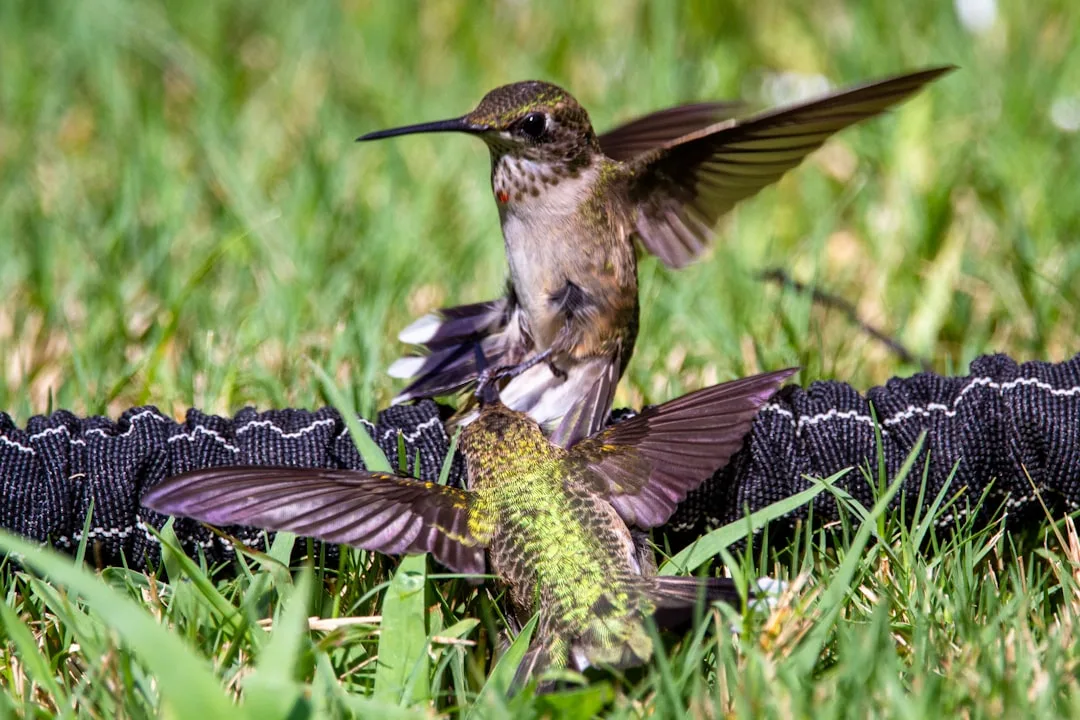
The ruby-throated hummingbird is the most common and widespread hummingbird in eastern North America and the only breeding hummingbird across most of its vast range. Weighing less than a US nickel, beating its wings roughly fifty-three times a second, and capable of crossing the Gulf of Mexico in a single eighteen to twenty-two hour non-stop flight, Archilochus colubris compresses more physiological extremity into three grams of bird than almost any other vertebrate on Earth.
This guide covers every major aspect of ruby-throated hummingbird biology: size and structure, the mechanics of hovering flight, diet and flower co-evolution, the nightly torpor that keeps them alive, the migration that defines their year, courtship and nesting, the iridescent gorget, conservation status, and the relationship between hummingbirds and the human gardens that increasingly support them.
It is a reference entry, not a summary - so expect specifics: grams, hertz, kilometres, beats per minute, and verified records.
Etymology and Classification
The scientific name Archilochus colubris combines Greek and Latin roots. Archilochus translates roughly to 'first-ranked' or 'chief', likely a reference to the genus's position as a type group for North American hummingbirds. The species epithet colubris is a Latinised form of a Caribbean indigenous word for hummingbird, recorded by early European naturalists in the seventeenth century. Linnaeus formally described the species in 1758.
The ruby-throated hummingbird belongs to the order Apodiformes - 'without feet' - a group that also contains the swifts. The name reflects the order's characteristic short, weak legs and tiny feet. Within Apodiformes, the family Trochilidae contains roughly 360 described hummingbird species, all endemic to the Americas.
The genus Archilochus contains just two species: the ruby-throated and the closely related black-chinned hummingbird (Archilochus alexandri) of western North America. The two hybridise occasionally where their ranges meet along the Great Plains.
Genetic evidence places hummingbirds as relatively recent products of explosive radiation. Molecular dating suggests Trochilidae diversified from a single ancestor around 22 million years ago, with ongoing speciation continuing into the present. The ruby-throated lineage itself likely diverged from the black-chinned ancestor within the last few million years, coinciding with climatic separation of eastern and western North American woodlands.
Size and Physical Description
Ruby-throated hummingbirds are small even by hummingbird standards, though they are larger than the world's smallest bird, Cuba's bee hummingbird. Their body plan is exquisitely tuned for sustained hovering and precise aerial manoeuvring.
Body dimensions:
- Total length: 7-9 cm from bill tip to tail
- Wingspan: 8-11 cm
- Bill length: 1.5-2 cm, straight, slender, black
- Weight: 2-6 g depending on sex, season, and fat load
Sex differences:
- Males: 2.5-3.5 g average, iridescent ruby-red gorget, forked black tail, emerald-green upperparts
- Females: 3-4 g average, plain white throat, rounded tail tipped with white, duller green above
- Juveniles: resemble females; young males begin developing gorget feathers in late summer
The feet, consistent with Apodiformes anatomy, are almost vestigial. The legs are too short and weak for walking or even hopping. A ruby-throated hummingbird can grip a perch tightly and shuffle sideways, but on flat ground it is essentially helpless. Flight does all the work that legs would in most birds: take-off, landing, travel, feeding, even bathing in the spray of waterfalls or sprinklers.
The wing is structurally unusual. Unlike typical bird wings, which flex at the wrist and elbow, a hummingbird wing pivots almost entirely at the shoulder. This rigid-wing, mobile-shoulder design lets the bird rotate the entire airfoil through a figure-eight pattern roughly fifty to eighty times per second, generating lift on both the forward and backward strokes.
Slow-motion photography shows wing tips tracing a flattened horizontal figure eight in hovering flight and a more circular path in forward flight.
Built for Extreme Metabolism
Ruby-throated hummingbirds push vertebrate physiology to its limits. Every anatomical feature exists to support, or to survive, a metabolism running at the upper edge of what warm-blooded biology can sustain.
Metabolic benchmarks:
- Heart rate at rest: 250-500 bpm
- Heart rate in active flight: up to 1,260 bpm
- Heart rate in nightly torpor: as low as 50 bpm
- Breathing rate at rest: ~250 breaths per minute
- Body temperature active: ~40 C
- Body temperature in torpor: as low as 18 C
The heart itself occupies a disproportionate share of body volume - roughly 2.5 per cent of total mass, compared with 0.5-1 per cent in most birds. Flight muscles are equally hypertrophied: the paired pectoralis and supracoracoideus together make up around 25-30 per cent of body mass, giving the bird enough power to accelerate vertically from a dead hover and to hold a stationary position in a moderate breeze.
Oxygen supply to these muscles is extraordinary. Mitochondrial density in hummingbird flight muscle is among the highest recorded in any vertebrate. Capillaries run so densely through the tissue that nearly every muscle fibre touches a blood vessel directly. This is necessary because hovering consumes oxygen at a rate that would be unsustainable over minutes in most vertebrates - yet ruby-throated hummingbirds hover for hours each day during foraging.
Fuel is the other half of the equation. A ruby-throated hummingbird must consume roughly half its body mass in sugar every day just to avoid starvation. During migration preparation that rises to full body mass in daily intake. The liver and pectoral muscles switch between burning sugars during active feeding and burning fats during flight and migration, with some of the highest fat-oxidation rates ever measured in a land vertebrate.
Hovering, Backward Flight, and Aerial Control
The ruby-throated hummingbird is the only North American bird that can hover in true stationary flight and fly backward under full control. This is not a trick of perspective - the wings generate lift on both the forward and reverse half of each stroke, and the bird can hold position against a breeze, reverse out of a flower, pivot on its axis, and fly upside down briefly during display dives.
Aerodynamic features that enable this:
- Shoulder joint rotates nearly 180 degrees, allowing the wing to invert
- Rigid wing acts as a propeller more than a traditional flapping aerofoil
- Symmetrical lift generation on up- and downstrokes (vs. ~75/25 in typical birds)
- Wing beat frequency tunable between roughly 40 and 200 Hz depending on task
Typical flight speeds:
| Flight mode | Speed |
|---|---|
| Hovering | 0 km/h |
| Forward cruise | 40-50 km/h |
| Courtship dive | up to 95 km/h |
| Backward flight | ~2 m/s |
| Sustained migration pace | ~40 km/h |
During courtship dives, male ruby-throated hummingbirds climb 10-15 metres above a female, then plunge down in a steep U-shape that generates a loud chirp from tail feathers vibrating in the airstream. The G-forces involved are substantial for such a small animal - estimated at around 9 G at the bottom of the dive, a load that would incapacitate a trained fighter pilot without a pressure suit.
Diet and Flower Co-evolution
Ruby-throated hummingbirds are nectarivores in daily practice and facultative insectivores out of necessity. Sugar powers flight; insects and spiders supply the protein, fat, minerals, and vitamins that nectar lacks.
Preferred nectar sources:
- Trumpet creeper (Campsis radicans)
- Cardinal flower (Lobelia cardinalis)
- Bee balm (Monarda didyma)
- Jewelweed (Impatiens capensis)
- Trumpet honeysuckle (Lonicera sempervirens)
- Red columbine (Aquilegia canadensis)
Many of these flowers have co-evolved with ruby-throated hummingbirds and related species. They share features that are diagnostic for hummingbird pollination syndrome - ornithophily - including tubular shape, red or orange colouration, daytime opening, copious dilute nectar, and a lack of scent (birds have limited olfaction compared with insects). Flower tubes match the length of hummingbird bills; nectar concentrations match hummingbird digestive preferences, generally 20-25 per cent sucrose.
The tongue is one of the most remarkable feeding structures in vertebrates. It is forked at the tip, with the outer edges curling inward to form two parallel grooves lined with hair-like lamellae. For decades it was assumed the tongue sucked nectar by capillary action.
High-speed video published in the 2010s showed that the reality is more dynamic: as the tongue is extruded it compresses and flattens; when the tip touches nectar, the tongue snaps open and the lamellae unfurl, trapping liquid between them; the nectar is pulled back into the bill when the tongue retracts. The cycle repeats about 15-20 times per second.
Insect prey:
- Aphids
- Gnats and midges
- Fruit flies
- Mosquitoes
- Small spiders captured from webs or leaves
- Leafhoppers
Adult hummingbirds hawk flying insects on the wing and glean stationary prey from bark and foliage. Nestlings eat almost nothing but insects and spiders for their first days of life; the female arrives at the nest roughly every 20 minutes during daylight to regurgitate a meal of partly digested arthropods.
A ruby-throated hummingbird visits more than 1,000 individual flowers in a typical day. Each visit lasts only a second or two. The aggregate flower count for a single bird over one summer exceeds 100,000 blooms, which places the species among the most efficient pollinators in its range.
Life Cycle and Reproduction
Ruby-throated hummingbird breeding is brief, intense, and strictly seasonal. Males return north from Central America ahead of females in spring, establish territories centred on rich nectar sources, and display aggressively to any hummingbird that enters. Courtship is conducted entirely in the air. The male performs his diving U-shape display and a side-to-side pendulum flight in front of a perched female. If she accepts, copulation is brief.
Males play no role after mating. Females build, incubate, and rear alone.
Nest construction:
- Location: outer branch of a deciduous tree, 3-15 m above ground
- Material: plant down, bud scales, lichens, spider silk
- Size: about 4 cm diameter, 4 cm deep - roughly the size of a thimble
- Camouflage: lichens on the outside make the nest resemble a lumpy knot
Spider silk is the structural secret. It binds the nest material, anchors it to the branch, and allows the walls to stretch as the nestlings grow. A newly built nest fits two pea-sized white eggs snugly; two weeks later it has expanded to accommodate two chicks many times heavier.
Breeding timeline:
- Clutch size: 2 eggs (occasionally 1 or 3)
- Incubation: 12-14 days
- Nestling period: 18-22 days
- Fledgling dependence: 7-10 days after first flight
- Broods per season: typically 1-2, occasionally 3 in the south
Females frequently begin a second nest while still feeding the first brood, laying new eggs within days of the first chicks fledging. This compresses an enormous amount of reproductive investment into a breeding window of just three to four months. By the time fall migration begins, adult females are often heavily worn and have lost body condition that they will need to rebuild quickly before the Gulf crossing.
Migration and the Gulf of Mexico Crossing
Migration defines the ruby-throated hummingbird's year. Breeding occupies the bird for roughly four months. Migration and wintering together consume the other eight.
Autumn migration timeline:
- Late July to August: adult males depart first, moving south in stages
- August to September: adult females follow, often with fattened juveniles
- September to October: juveniles undertake their first migration alone, with no parental guidance
- October to November: last stragglers cross into Mexico and Central America
The Gulf of Mexico crossing is the best-known feat. Many birds follow the coastline through Texas and overland into Mexico - a longer but safer route. A large proportion, however, launch from the northern Gulf coast of Louisiana, Mississippi, Alabama, or Florida and fly directly across roughly 800 km of open water. The flight takes 18 to 22 hours depending on wind, with no opportunity to feed, drink, or rest.
Fuel mathematics of the crossing:
| Metric | Value |
|---|---|
| Typical lean body weight | 3 g |
| Fattened pre-crossing weight | 5-6 g |
| Fat percentage at departure | ~40 per cent of total mass |
| Fat burn rate in flight | ~0.15 g per hour |
| Total fat burned in crossing | ~2.5-3 g |
| Arrival weight | close to lean starting mass |
Hummingbirds prepare by hyperphagia - feeding at roughly five to ten times normal rates for two to three weeks before departure. They become noticeably plump; the breast becomes soft and rounded as subcutaneous fat accumulates. The bird takes off with a fuel ratio that no commercial airliner matches: roughly 40 per cent of total mass is pure combustible fat.
Not every bird makes it. Storms, unexpected headwinds, or late-season departures can mean death at sea. The population absorbs these losses, year after year, and has done so since the species evolved.
Spring migration reverses the process. Birds cross back over the Gulf in March and April, usually taking advantage of tailwinds from Caribbean high-pressure systems. Arrival in the southern United States often coincides precisely with the first blooming of red buckeye and coral honeysuckle.
Nightly Torpor
Ruby-throated hummingbirds solve the night-time energy problem with controlled hypothermia. Each evening, after the last feeding session, a bird retreats to a sheltered twig, grips tightly, turns its bill up at an angle, fluffs its feathers, and closes its eyes. Over the next half hour, the body systematically shuts down.
Physiological changes during torpor:
- Heart rate: from 250-500 bpm at rest to about 50 bpm
- Breathing: from ~250 per minute to near undetectable
- Body temperature: from ~40 C to as low as 18 C
- Metabolism: reduced by up to 95 per cent
Torpor is not sleep. It is a true regulated hypothermia, with the hypothalamus setting a much lower temperature target. A hummingbird in torpor can appear dead to a human observer. The bird will ignore light touches and can be handled carefully without waking. Arousal is deliberate and expensive: at dawn, the bird trembles as muscle contractions generate heat and rewarm the core. Full alertness is usually reached within 20 minutes of first movement.
Without torpor a three-gram bird with a resting metabolism of a few hundred heartbeats per minute simply could not store enough fuel to survive a cool night. The mechanism becomes even more critical during migration stopovers, when a bird may arrive at a new site with almost no reserves and must survive until it can refuel.
The Gorget: Structural Colour
The adult male ruby-throated hummingbird's defining feature is the iridescent ruby-red throat patch, or gorget. The colour is not produced by pigment. It is produced by the physical structure of the feathers themselves.
Structural mechanism:
- Gorget feather barbules contain stacks of melanin-filled platelets
- Platelets are separated by microscopic air-filled spacers
- Light hits the stack at varying angles
- Wavelengths reinforce or cancel based on geometry
- At the correct angle, red wavelengths dominate
- At other angles, the feather appears dull black or grey
This is the same physical principle that gives peacock feathers and soap bubbles their colour. Unlike pigment, structural colour is viewing-angle dependent. A male ruby-throated hummingbird looks nondescript from most angles and blinding from one specific direction. During courtship, the male positions himself so the female sees the gorget at peak reflection; against a brightly lit background, a rival male or territorial intruder receives the full flash as a warning.
Females and juveniles lack the gorget entirely, showing a plain white throat sometimes marked with fine grey streaks. First-year males begin to develop scattered red gorget feathers in late summer and complete the adult plumage over their first full moult.
Conservation Status and Threats
The IUCN Red List classifies the ruby-throated hummingbird as Least Concern with a stable or slightly increasing population trend. The global population is estimated at 34-36 million individuals. Breeding Bird Survey data in North America show no significant long-term decline; if anything, the species has expanded range and density in parts of the upper Midwest and southeastern Canada over recent decades.
Several factors contribute to this relative success:
- Wide breeding range across eastern North America
- Tolerance of suburban and agricultural landscapes
- Popularity of hummingbird feeders in private gardens
- Abundance of nectar-producing ornamental plants
Threats exist nonetheless. Habitat loss on Central American wintering grounds is the largest concern, particularly fragmentation of tropical forest and conversion of shade coffee plantations - which support high hummingbird densities - to sun coffee or other intensive agriculture. Pesticide use that reduces insect prey can also depress nesting success, because chicks depend on arthropods rather than nectar.
Window strikes are a significant cause of mortality in suburban areas. Climate-driven shifts in flower phenology threaten to decouple migration timing from peak nectar availability, particularly at range edges. Severe weather during Gulf crossings - more variable as tropical systems shift - increases migration-season losses.
Responsible feeder practices support local populations: a plain 1:4 ratio of white table sugar to water, no red dye, thorough cleaning every few days, and refilling more often in hot weather. Native flowering plants are more valuable than feeders over the long term because they also support the insects the birds need.
Hummingbirds and Humans
Hummingbirds are among the most observed and celebrated wild birds in North America. Ruby-throated hummingbirds in particular benefit from cultural momentum - gardens planted specifically for them, feeders hung on millions of porches, spring arrival dates tracked by citizen science projects like Journey North. This attention translates into tangible habitat gains in suburban environments that would otherwise be hostile to insect-dependent birds.
Indigenous peoples across the Americas have long recognised hummingbirds as significant. Stories among Cherokee, Hopi, and Taino peoples cast the hummingbird variously as messenger, healer, and symbol of endurance. European arrivals in the sixteenth and seventeenth centuries recorded astonishment at birds so small and fast that they initially mistook them for large insects.
Modern ornithology keeps finding surprises in the ruby-throated hummingbird. Research published since 2010 has clarified tongue mechanics, migration energetics, torpor regulation, and structural colour physics. The bird remains a frontier subject for physiologists studying the upper limits of vertebrate performance.
Related Reading
- Hummingbird Migration: How Tiny Birds Cross Continents
- Hummingbirds of North America: Species Guide
- How Birds Fly: The Biomechanics of Flight
- Pollinators of the Americas: Bees, Birds, and Bats
References
Relevant peer-reviewed and governmental sources consulted for this entry include the Cornell Lab of Ornithology's Birds of the World account for Archilochus colubris, the North American Breeding Bird Survey, IUCN Red List assessments (2023 and 2024), and published research in Journal of Experimental Biology, Proceedings of the Royal Society B, The Auk, and Nature. Specific physiological values reflect consolidated figures from hummingbird energetics research published between 2000 and 2024.
Frequently Asked Questions
How small are ruby-throated hummingbirds?
Ruby-throated hummingbirds (Archilochus colubris) measure just 7 to 9 cm from bill tip to tail and weigh between 2 and 6 grams depending on season and fat reserves. A typical non-migrating adult weighs about 3 grams, lighter than a US nickel. Wingspan is roughly 8 to 11 cm. Females are slightly larger and heavier than males, which is unusual among birds but common in hummingbirds.
Newly fledged chicks weigh under a gram at hatching and grow in a cup nest the size of a thimble. The bird’s apparent size in flight is exaggerated by its blur of wingbeats.
What do ruby-throated hummingbirds eat?
Ruby-throated hummingbirds are primarily nectarivores but depend on insects and spiders for protein, fat, and minerals. A single bird may visit more than a thousand flowers a day, favouring tubular red or orange blooms such as trumpet creeper, cardinal flower, bee balm, and jewelweed. Flowers and hummingbird tongues have co-evolved: the forked, fringed tongue unrolls into nectar and traps droplets by capillary action as it retracts.
To balance the sugar-only diet, adults snatch gnats, fruit flies, aphids, mosquitoes, and small spiders from the air or glean them from leaves. Nestlings eat almost nothing but insects for their first days.
Where do ruby-throated hummingbirds live?
Ruby-throated hummingbirds breed across most of eastern North America from the Gulf Coast up into southern Canada and west to the Great Plains. They prefer deciduous and mixed woodland edges, suburban gardens, old fields, and riparian corridors with plenty of flowering plants. In winter almost the entire population migrates to Mexico, Belize, Guatemala, Honduras, and Costa Rica, occupying tropical dry forest, shade coffee plantations, and scrub.
A small number overwinter along the US Gulf Coast. The species is absent from western North America, where it is replaced by rufous, Anna’s, black-chinned, and other hummingbirds in the same family.
How do ruby-throated hummingbirds migrate across the Gulf of Mexico?
Most ruby-throated hummingbirds cross the Gulf of Mexico in a single non-stop flight of roughly 800 km, taking 18 to 22 hours over open water. To prepare, they hyperphagically feed for weeks and nearly double their body mass with pure fat - a bird that weighs 3 grams in summer may leave shore weighing 6 grams. During the crossing they burn through that fat at roughly 0.15 grams per hour, arriving nearly back at lean weight.
Headwinds or storms can be fatal. Not every bird takes the open water route; some follow the Gulf coast through Texas, a longer but lower-risk overland path.
Why do hummingbirds enter torpor at night?
Ruby-throated hummingbirds have the highest mass-specific metabolic rates of any warm-blooded vertebrate. Their resting heart rate alone hits several hundred beats per minute and can reach 1,260 bpm during activity. Maintaining normal body temperature through a cool night would burn more fuel than a bird this small can store.
Torpor solves this: heart rate drops to around 50 bpm, breathing slows dramatically, and body temperature falls from roughly 40 C to as low as 18 C. This cuts energy use by up to 95 per cent. A bird in torpor looks dead - bill pointed up, eyes closed - but warms back up within 20 minutes at dawn and resumes feeding.
Why is the male's throat patch so red?
The red gorget is a structural colour, not a pigment. Each gorget feather carries microscopic stacks of melanin-filled platelets separated by thin air layers. When light hits the stack, waves bounce off each layer and interfere with each other. At the correct viewing angle, red wavelengths reinforce and dominate, producing the blazing metallic ruby flash. At other angles the same feather appears dull black.
This is why a displaying male can switch between invisible and blinding in a fraction of a second simply by turning his head. Females and juveniles lack the gorget, carrying a plain white throat instead. The flash is used in courtship dives and territorial disputes.
How long do ruby-throated hummingbirds live?
Most ruby-throated hummingbirds live 3 to 5 years in the wild once they survive their first migration. The oldest confirmed individual, tracked through bird banding, reached just over 9 years of age. Mortality is high in the first year: fledglings must learn to feed, survive summer weather, fatten for migration, and complete the Gulf crossing, all within a few months of hatching.
Estimates suggest that fewer than half of hatched chicks survive to see a second breeding season. Once a bird has completed one full migration cycle, annual survival improves markedly, though predation by hawks, roadrunners, praying mantises, and even large spiders still takes a toll.
Are ruby-throated hummingbirds endangered?
The IUCN Red List classifies the ruby-throated hummingbird as Least Concern. The global population is estimated at 34 to 36 million birds and has been roughly stable or slightly increasing over recent decades, partly thanks to the popularity of backyard feeders and nectar-rich garden plants across the eastern United States and Canada.
Threats do exist: habitat loss on wintering grounds in Central America, pesticide use that reduces insect prey, window strikes in suburban and urban areas, and climate-driven mismatches between flower bloom timing and migration. Responsible feeder practices - plain 1:4 sugar to water, no dye, regular cleaning - support local populations without causing harm.