
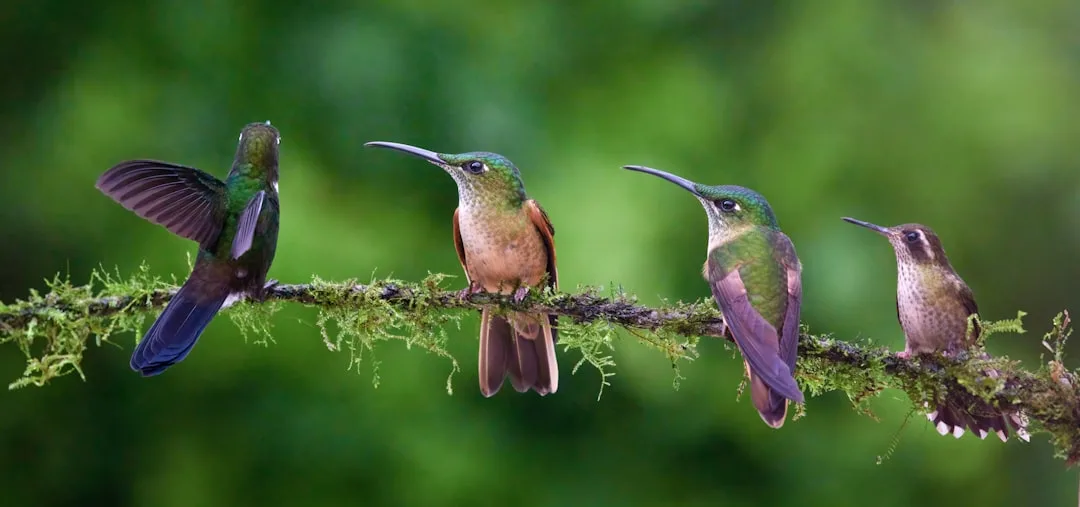
The sword-billed hummingbird is the only bird on Earth whose bill is longer than the rest of its body. A living paradox of proportions, Ensifera ensifera looks less like a functional animal and more like a rapier someone has strapped to a small green bird.
The bill measures 10-11 centimetres from base to tip, the body measures roughly 14 centimetres from shoulder to vent, and once you discount the tail, the tool is longer than the craftsman.
No other bird species comes close to this ratio, and the adaptations that surround it - mobile neck, upward-angled perch, foot-based scratching, specialised flight muscles - form one of the most coherent packages of evolutionary strangeness in the bird world.
This guide covers every aspect of sword-billed hummingbird biology and ecology: size and proportions, Andean habitat, co-evolution with Passiflora mixta, hovering flight mechanics, the unusual preening and perching behaviours forced on it by its anatomy, nesting and life cycle, and conservation. It is a reference entry, not a summary, so expect specifics: centimetres, grams, elevations, and the chain of causes and consequences that made this bird what it is.
Etymology and Classification
The scientific name Ensifera ensifera comes from the Latin ensis, meaning sword, and ferre, meaning to bear - the sword-bearing sword-bearer. The tautonymous construction is a traditional signal in zoology that the species is the type and often the only member of its genus. Ensifera is exactly that: a monotypic genus containing this one species, first described scientifically by the French naturalist Jules Bourcier in 1839.
The sword-billed hummingbird sits inside the hummingbird family Trochilidae, order Apodiformes, class Aves. Trochilidae is one of the largest bird families on Earth with more than 360 species, almost all restricted to the Americas. Within the family the sword-bill belongs to the coquettes and brilliants clade, a group of mostly montane hummingbirds concentrated in the Andean cordillera.
Molecular phylogenies place Ensifera as an isolated branch with no close surviving sisters, consistent with its highly specialised ecology.
Common names in Spanish include colibri pico espada and picaflor espada, both translating directly as sword-beak hummingbird. In indigenous Quechua traditions the bird is often associated with the deep-tubed passionfruit vines whose fruits and flowers humans also use.
Size and Physical Description
The sword-billed hummingbird is a mid-sized hummingbird whose proportions are dominated by a single structure. Measurements vary slightly across the Andean range but the key values are remarkably consistent.
Adult measurements:
- Body length (shoulder to vent, bill and tail excluded): ~14 cm
- Bill length: 10-11 cm
- Tongue length: ~14 cm, extending beyond the bill tip
- Total length (bill tip to tail tip): 20-25 cm
- Weight: 10-12 g
- Wingspan: ~14-16 cm
Proportion metrics:
- Bill-to-body ratio: ~1.5 (bill is 150 per cent of body length)
- Bill as a percentage of total length: ~45 per cent
- Bill weight: ~1 g, roughly 8-10 per cent of total body mass
Plumage is relatively subdued for a hummingbird. Males show bronze-green upperparts with a slightly darker crown and throat, greyish underparts with a hint of green iridescence in good light, and a faintly forked dark tail. Females are similar but with more white or buff speckling on the underparts and a shorter, rounder tail. Juveniles resemble females but with paler fringes on body feathers.
The bill itself is black, long, slightly decurved at the tip, and tipped with a tiny hooked extension in some individuals.
The sword-bill's body plan has been quietly restructured to support the bill. The neck vertebrae are slightly more numerous and more mobile than in similar-sized hummingbirds, allowing the bird to pivot the head through a wider arc without twisting the torso. The pectoral muscles, which power the wings, are disproportionately large.
Even the feet, though vestigial for walking as in all hummingbirds, show slightly longer toes than is typical, which turns out to be useful because the bird uses them for grooming.
The Bill - a Closer Look
A 10-11 centimetre bill on a 14 centimetre bird is a structural challenge as much as an evolutionary one. Several design features make it work.
The bill is extremely light. Despite its length it weighs only about a gram, built from a thin keratin sheath over a hollow, strut-filled bone core. The internal architecture resembles the spongy trabecular pattern seen in flight-adapted bones generally, which keeps bending stiffness high while cutting mass. Without this lightweight engineering the bird would simply topple forward in flight.
The bill is slightly decurved and almost perfectly matched to the curvature of its target flowers. Passionflower vines drop their blossoms downward on long stems, and the corolla tubes hang with a gentle outward bend. A sword-bill hovering below such a flower can slide its bill straight into the tube without any head-craning.
Inside the bill runs an extraordinarily long tongue. The tongue extends about 14 centimetres when fully deployed, which means it protrudes beyond the tip of the already extreme bill. Like other hummingbirds, the sword-bill's tongue is forked and lined with fringed lamellae that unfurl on contact with nectar and snap shut as the tongue is retracted, loading a liquid column into the throat with every pump. The tongue is flicked in and out roughly 10-15 times per second during active feeding.
Andean Habitat and Range
Sword-billed hummingbirds are restricted to the Andes mountains and are essentially absent from any other biome. Their distribution runs from western Venezuela and the Colombian Andes in the north, south through Ecuador and Peru, to central Bolivia - a belt of humid montane forest roughly 4,500 km long but rarely more than a few tens of kilometres wide at any latitude.
Preferred habitat:
- Humid montane cloud forest
- Elfin forest at treeline
- Edges of paramo grassland
- Mountain gardens at appropriate elevation
- Forest gaps with abundant long-tubed flowering vines
Elevation band:
- Lower limit: ~1,700 m
- Core range: 2,200-3,200 m
- Upper limit: ~3,500 m
Within this band the bird favours areas with persistent mist, dense epiphyte cover, and scattered flowering vines - particularly Passiflora mixta, Passiflora cumbalensis, and related species that hang their long-tubed blooms in clearings and along forest edges.
The range is structurally linear, which means local populations are strung out along the Andean spine and depend on corridors of connected forest at the right altitude. Where mountain roads and pasture have broken these corridors, sword-bills become scarce or vanish from intervening gaps.
The cloud forest itself is one of the wettest biomes on Earth, with constant mist, rainfall frequently exceeding 2,000 mm per year, and daytime temperatures that rarely swing beyond 10-20 degrees Celsius. These steady conditions suit a small warm-blooded animal that would struggle to regulate its body temperature under larger extremes.
Co-evolution with Passiflora mixta
No account of the sword-billed hummingbird makes sense without the banana passionfruit, Passiflora mixta, and no textbook discussion of plant-pollinator co-evolution leaves out the sword-bill.
Passiflora mixta is a climbing vine of the Andean cloud forest that produces large pink flowers with a corolla tube roughly 12 centimetres long. The nectar sits at the bottom of that tube. For essentially every other nectar-feeding bird in the region the tube is unreachable; even long-billed hummingbirds like violet-tailed sylphs or thornbills cannot insert their bills to the base. The sword-billed hummingbird, with its 10-11 cm bill and 14 cm tongue, can.
Because the sword-bill is the only bird that can drink from the flower, it is also the only bird that regularly carries its pollen. Each time the bird hovers below the flower and slides its bill in, the front of its forehead and crown touch the flower's sexual structures, picking up pollen on the feathers and depositing pollen from previously visited flowers on the stigma. The plant's reproduction depends almost entirely on this single species of pollinator.
From the plant's perspective, investing in a long corolla is expensive but filters out visitors that would steal nectar without transferring pollen. From the bird's perspective, investing in a long bill is expensive but opens a nectar source with almost no competition. Over thousands of generations each has pushed the other further in the same direction, a feedback loop known as reciprocal co-evolution.
The sword-bill and the banana passionfruit are the most frequently cited vertebrate-plant example of this process in the scientific literature.
Other long-tubed Andean flowers also receive regular visits from sword-bills, including species of Brugmansia, Fuchsia, Datura, and various bromeliads. In most of those cases the bird is one of several possible pollinators rather than the exclusive one, but its reach into long corollas makes it disproportionately important for deep-tube specialists.
Hovering Flight with a Handicap
Every hummingbird is an aerodynamic marvel, but the sword-bill has to be that marvel while carrying what is effectively a skewer longer than itself. The centre of gravity is pushed sharply forward, rotational inertia increases along the bill axis, and the normal head-down posture used by many hummingbirds to feed from above becomes impossible.
Compensating features:
- Enlarged pectoral muscles for extra wing power
- Proportionally larger wings than expected for body mass
- Slightly lower wingbeat frequency (40-60 beats per second) offset by higher lift per stroke
- Body tilted upward during hover to keep the bill horizontal or slightly downward
- Approach to flowers usually from below or beside, not above
The wingbeat pattern is the standard hummingbird figure-of-eight in which both the downstroke and the upstroke generate lift. The sword-bill cannot switch to wing flapping that relies mostly on the downstroke because stability during hover depends on symmetric lift. The wings pivot almost entirely at the shoulder; the primaries rotate through a large angle to reverse the leading edge on each half-cycle.
Even with the extra muscle, hovering is energetically expensive, and the bird has to visit many flowers per day to break even.
At flight speeds of a few metres per second the sword-bill cruises with a gently undulating path typical of hummingbirds, using short bouts of powered flight punctuated by glides. Take-offs are slower than in smaller hummingbirds; the bird cannot simply spring off a perch without first levering its bill upward to clear the perch surface.
Perching, Preening, and Grooming
The sword-bill's most famous oddity besides the bill itself is how it handles gravity when not flying. At rest it perches with the bill angled almost straight up, sometimes fully vertical, rather than held level like most birds. Biomechanical studies suggest this posture transfers the load of the bill from the jaw and neck muscles to the cervical vertebrae and ligaments, which can support static weight more cheaply.
A bird that had to hold a horizontal 10 cm bill all night would burn calories it cannot spare; one that can prop the bill skyward essentially converts muscle effort into passive skeletal support.
Feather maintenance is a second consequence of the extreme bill. Most birds preen by running the bill through feathers to align barbs, redistribute oils, and remove parasites. The sword-bill's bill cannot reach most of its body surface: the tip is too far from the torso for effective grooming, and the base is too thick to fit between feathers. The solution is foot-based scratching.
The sword-bill uses its feet to rake its head, neck, and back in postures that look awkward for a hummingbird, whose legs are otherwise nearly vestigial. Preening of the wings and belly still involves the bill to the extent possible, but the overall grooming routine is visibly different from that of other hummingbirds.
Drinking from dew, rain, or water features happens at steep angles so that liquid runs down the bill into the mouth rather than dripping off the end. Even yawning and calling motions are subtly altered by the mechanical implications of bill length.
Life Cycle and Reproduction
Sword-billed hummingbirds do not form pairs. Males hold loose territories built around patches of long-tubed flowers and defend them against rivals with aerial chases and short buzzing display flights. When a female visits to feed, mating may occur without the formation of any lasting bond. The male plays no role after copulation.
Nesting is entirely the female's work. She builds a small cup nest about 4-5 cm across, larger than a bee hummingbird nest but still tiny by bird standards, woven from moss, lichen, plant down, and spider silk. The nest is typically attached to a horizontal branch or a fork 3-10 metres above ground in cloud forest understory. Spider silk gives the cup elasticity, which matters because the nest walls must stretch around rapidly growing chicks.
Nesting summary:
- Clutch size: 2 white eggs
- Egg size: about 1.5 cm long
- Incubation: 16-19 days
- Nestling period: approximately 22-26 days before fledging
- Broods per year: 1-2, depending on local flower availability
Females must incubate while still maintaining their own demanding metabolism, which forces them to leave the nest frequently for short feeding trips. Chicks hatch naked and blind. They are fed a diet richer in arthropods than the adult diet, because nestlings need protein, amino acids, and minerals more than pure sugar to build feathers, bones, and muscle.
As they grow the proportion of regurgitated nectar increases. Fledglings stay dependent on the mother for a short period after leaving the nest, then disperse.
Lifespan, Predation, and Mortality
Wild sword-billed hummingbirds typically live about 5 years, with banded individuals occasionally documented at 7-8 years. First-year mortality is significant and shaped by several factors.
Main mortality sources:
- Nest predation by small mammals, snakes, and jays
- Starvation during gaps in flower bloom cycles
- Weather events: cold snaps, heavy rain, landslides
- Collisions with windows and wires near human settlements
- Small raptors such as forest falcons and accipiters
Once a bird has cleared its first year, annual adult survival is good for a hummingbird. The species' specialised niche means fewer competitors at its food source, and its cloud forest habitat hosts comparatively few large predators compared with lower elevations.
Conservation Status and Threats
The IUCN Red List currently classifies the sword-billed hummingbird as Least Concern, reflecting its wide latitudinal range along the Andes and its ability to visit gardens as well as native forest. The assessment notes, however, that the population trend is decreasing, and national conservation assessments in several Andean countries list the bird at higher concern in specific regions.
Primary threats:
- Cloud forest loss. Andean cloud forests are being cleared for pasture, small farms, coffee plantations, and infrastructure. Fragmentation is particularly damaging because the range is already linear.
- Disruption of Passiflora populations. Where passionfruit vines are cleared or heavily grazed, the bird loses its core nectar source. Cultivated Passiflora tripartita (a close relative, also known as banana passionfruit in commerce) is grown as a crop but often in monoculture with limited habitat value.
- Climate shift. Cloud forest depends on a stable elevation band where warm moist air meets cooler mountain slopes. As temperatures rise, the cloud band shifts upward, and above a certain elevation there is no more mountain. This compresses habitat from both sides.
- Hybridisation and invasive plants. Introduced flowering plants in gardens compete with native nectar sources and can alter community pollination dynamics.
- Direct disturbance. Roads, powerlines, and tall fencing in mountain passes increase collision risk. Tourism where poorly managed can alter feeding patterns around popular lodges and reserves.
Conservation measures include protected areas across all five range countries, cloud forest restoration programs in Colombia and Ecuador, and pollinator-focused research that uses sword-bills as an indicator species for the health of long-tubed flower guilds. The species benefits indirectly from any policy that preserves Andean cloud forest generally.
Sword-billed Hummingbirds and Humans
Andean rural residents are generally familiar with sword-bills, particularly in regions where gardens and small orchards include long-tubed ornamentals. The bird's improbable silhouette is a minor local icon; it appears on stamps, ecotourism logos, and conservation posters across several countries.
Ecotourism has become one of the most useful tools for sword-bill conservation. Lodges in the Ecuadorian and Colombian cloud forest attract visitors specifically for views of the species, often using feeders planted with dense arrays of long-tubed flowers or dripping sugar feeders fitted with extended tubes to accommodate the bill. Well-run operations channel revenue into forest protection.
Poorly run ones habituate birds to feeders, displace natural foraging, and can reduce the reproductive success of local populations.
In agriculture the sword-bill has niche economic relevance as the de facto pollinator of wild and semi-cultivated banana passionfruit. Where commercial Passiflora plantations depend on long-tubed varieties, sword-bill populations contribute directly to fruit set. Where short-tubed hybrids have replaced long-tubed stock, the bird's ecological service is lost, with knock-on consequences for the rest of the co-evolved flower community.
Related Reading
- Bee Hummingbird: Smallest Bird in the World
- Anna's Hummingbird: Pacific Coast Jewel
- Ruby-throated Hummingbird: Eastern North America's Tiny Traveller
- Hummingbirds: Nature's Tiny Flying Machines
- Hummingbird Hover Flight Physics
- Hummingbird Fastest Wings
References
Relevant peer-reviewed and governmental sources consulted for this entry include the IUCN Red List assessment for Ensifera ensifera, published research on Andean plant-pollinator co-evolution in Ecology, American Naturalist, and Biotropica, and morphological studies of trochilid bills and tongues in Journal of Avian Biology and The Auk.
Distribution and elevation data follow BirdLife International range maps and national avifauna references for Colombia, Ecuador, Peru, and Bolivia. Specific measurements of Passiflora mixta corolla length and pollination exclusivity reflect consolidated findings from Andean pollination ecology studies over the last three decades.
Frequently Asked Questions
Why is the sword-billed hummingbird's bill so long?
The sword-billed hummingbird (Ensifera ensifera) evolved its 10-11 cm bill to reach nectar at the bottom of extremely deep tubular flowers that no other hummingbird can access. Its primary nectar source, the banana passionfruit Passiflora mixta, has a corolla tube around 12 cm long - unreachable for any hummingbird with a conventional bill.
By specialising in this flower and a handful of similarly long-tubed Andean species, the sword-bill has claimed a nectar niche with almost no competition. The arrangement is the classic example of reciprocal co-evolution, where plant and pollinator have lengthened each other’s key traits over millions of years.
How long is the sword-billed hummingbird's bill compared to its body?
The bill measures 10-11 cm, while the body from shoulder to vent is only about 14 cm long. This makes the sword-bill the only bird in the world whose bill is longer than its body when the tail is excluded. The bill-to-body ratio reaches roughly 1.5, the most extreme recorded in any bird species. For comparison, most long-billed hummingbirds have bills representing 20-40 per cent of body length.
The sword-bill sits at more than 150 per cent and has done so consistently enough that the trait has driven a cascade of unusual anatomical and behavioural adaptations.
Where does the sword-billed hummingbird live?
Sword-bills inhabit the Andes mountains from western Venezuela and Colombia through Ecuador and Peru to central Bolivia, a range of roughly 4,500 km of mountain chain. They are specialists of humid montane cloud forest, elfin forest near the treeline, and the edges of paramo grassland, occurring between 1,700 and 3,500 metres above sea level. They favour areas with dense epiphyte cover, scattered flowering vines, and persistent mist.
Because their preferred habitat is linear and fragmented along the Andean spine, populations are spread out and dependent on connected forest corridors. Individual birds readily visit rural gardens with long-tubed ornamentals at appropriate elevations.
What does the sword-billed hummingbird eat?
The sword-billed hummingbird feeds primarily on nectar from long-tubed Andean flowers, above all Passiflora mixta, the banana passionfruit, which it is essentially the only effective pollinator of. Other regular nectar sources include long-tubed species of Brugmansia, Fuchsia, Datura, and various bromeliads.
A sword-bill visits hundreds of flowers per day, hovering at each for a second or two while its 14 cm tongue flicks in and out at roughly 15 times per second to collect nectar. Like all hummingbirds it also hawks small insects and spiders in flight for protein, amino acids, and minerals. Nestlings are fed a high proportion of arthropods during the first days of life.
How does the sword-billed hummingbird preen and scratch?
Because the bill is so long it physically cannot be used to preen feathers across most of the body, the sword-billed hummingbird has developed an unusual grooming routine. It uses its feet rather than its bill to scratch its head, neck, and back, contorting in ways that look awkward compared with other birds. When resting, it typically perches with the bill angled upward at a steep angle, sometimes nearly vertical.
This posture shifts the weight of the bill onto the neck and spinal column rather than the jaw muscles, reducing the energetic cost of simply holding the head up. Drinking from dew or rain also tends to happen at steep angles so the water can be tipped into the throat.
Is the sword-billed hummingbird endangered?
The IUCN Red List currently classifies the sword-billed hummingbird as Least Concern, thanks to its wide latitudinal range across the Andes and its tolerance for gardens and forest edges at appropriate elevations. However, the population trend is considered decreasing and local conservation assessments in individual countries list it at higher concern in some regions.
Primary threats include cloud forest clearance for agriculture and pasture, disruption of Passiflora mixta populations, climate-driven shifts in the elevation band of cloud forests, and fragmentation that isolates local populations along the Andean chain. Because its ecology is tightly linked to a handful of co-evolved flower species, loss of those plants would remove its entire nectar niche.
How does the sword-billed hummingbird fly with such a long bill?
Carrying a 10-11 cm bill attached to a 14 cm body shifts the centre of gravity strongly forward, which ought to make controlled hovering difficult. The sword-bill compensates with enlarged flight muscles, a mobile neck, and a flight style that keeps the body tilted slightly upward during hover.
Wingbeat frequency is moderate for a hummingbird at roughly 40-60 beats per second, lower than in smaller species, because the wings themselves are proportionally larger and generate more lift per stroke. The bird prefers to approach long flowers from directly below or beside, rather than from above, so the bill can slide straight into the corolla without the head having to be cranked down.
How long do sword-billed hummingbirds live?
Sword-billed hummingbirds live about 5 years on average in the wild, with occasional banded individuals documented at 7-8 years. Annual survival is good for an adult that has cleared its first year, because the bird’s specialised bill has few competitors and it lives at elevations with fewer large raptors than lowland species face.
First-year mortality is significant, driven by predation on nests, starvation during flower scarcity between bloom peaks, and weather events in the cloud forest. Females nest once or twice per year, laying two white eggs in a cup nest attached to a small branch, and raise the chicks alone without male involvement after mating.