
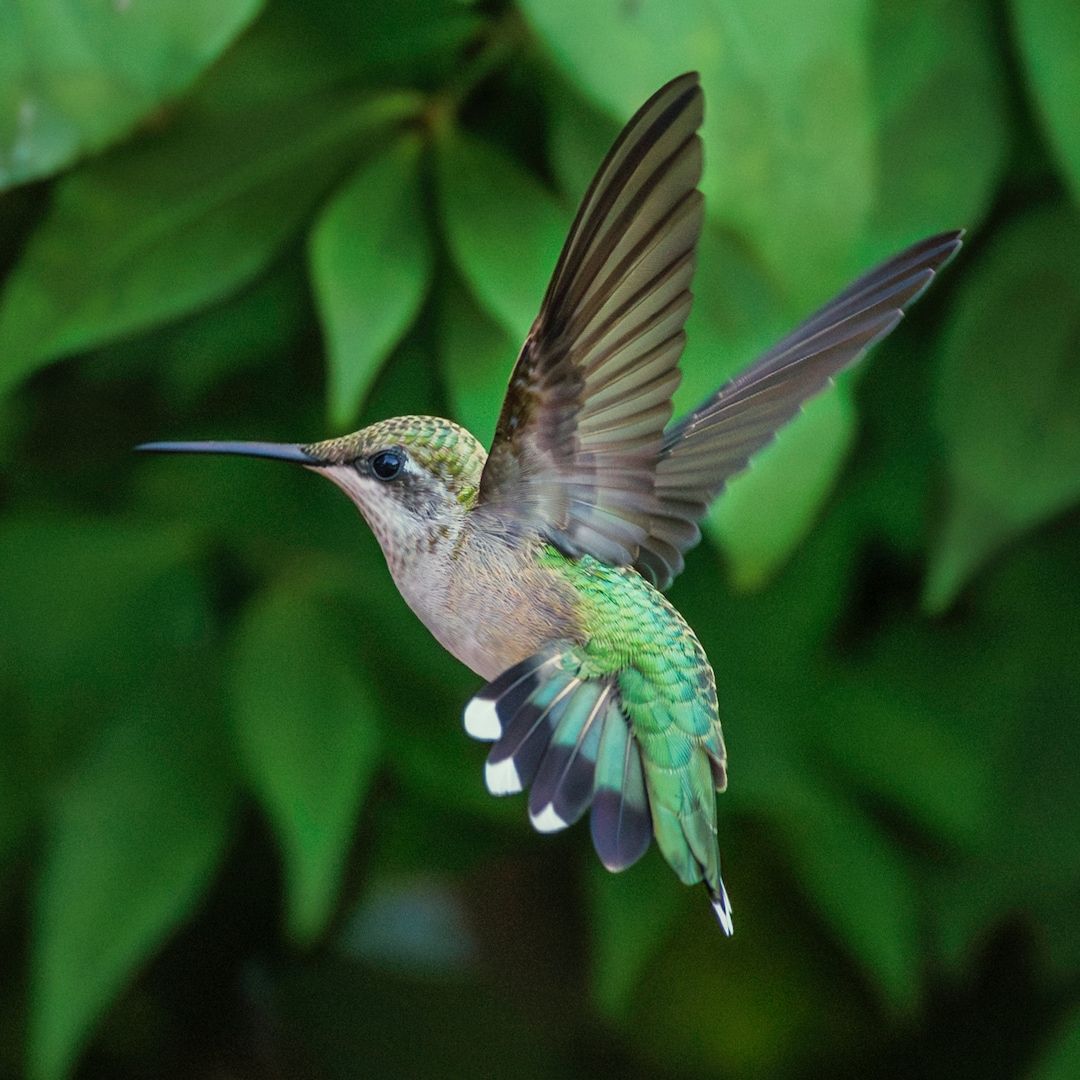
How fast do hummingbird wings beat?
Hummingbird wings beat 50-80 times per second during normal hovering, with some species reaching 200 beats per second during courtship displays. The ruby-throated hummingbird averages 53 beats per second during hover. The smaller bee hummingbird (the smallest bird in the world) beats its wings up to 80 times per second.
The Smallest Birds, the Fastest Wings
A ruby-throated hummingbird weighs 3 grams - about the weight of a paperclip. It beats its wings 53 times per second. Its heart rate during flight reaches 1,260 beats per minute. It burns through calories at a rate that, scaled up to human proportions, would require eating 35 kilograms of sugar per day.
And every fall, this 3-gram bird flies non-stop across the Gulf of Mexico, a 20-hour journey over 800 kilometers of open ocean where it cannot stop, cannot rest, and cannot eat. Then it does it again in spring, flying the other direction.
Hummingbirds are biological impossibilities that nonetheless exist. They are the only birds on Earth capable of true hovering flight, and the extreme physiology that makes this possible pushes against the absolute limits of vertebrate biology.
The Figure-Eight Wing
Most birds fly by flapping their wings up and down. The downstroke generates lift. The upstroke is essentially a recovery motion - the bird draws its wing back without producing lift. This works for forward flight because air flow over the wings during forward movement provides lift continuously.
For hovering, this system fails. A bird trying to hover would rise on each downstroke and fall on each upstroke, unable to maintain altitude.
Hummingbirds solved this through a unique shoulder joint that allows their wings to rotate almost 180 degrees between strokes.
The figure-eight pattern:
- Downstroke. Wing sweeps downward and slightly forward, generating lift and forward motion.
- Rotation. Wing rotates at the shoulder joint, flipping to the opposite orientation.
- Upstroke. The rotated wing now acts like a downstroke in reverse, generating lift as it moves upward.
- Rotation again. Wing rotates back to original orientation.
- Repeat.
During normal hovering, the wingtip traces a figure-eight pattern in the air, producing lift on both the forward and backward portions of the pattern. This continuous lift generation allows stable hovering.
Unique shoulder joint:
The hummingbird shoulder has much greater rotational freedom than any other bird's shoulder. Other birds have shoulder joints built for power, with muscles and ligaments that constrain rotation to prevent injury during forceful flapping. Hummingbirds traded some of this structural integrity for rotational freedom.
Only insects achieve similar continuous lift generation. Hummingbird flight is sometimes described as more insect-like than bird-like, despite hummingbirds being true vertebrates with all the standard avian features.
"During hovering, the hummingbird wing generates approximately 75 percent of the lift on the downstroke and 25 percent on the upstroke. This balance is not found in any other vertebrate and it is the key to sustained stationary flight." - Douglas Warrick, Oregon State University, Nature, 2005 [1]
| Lift Profile Across the Wingbeat | Hummingbird | Typical Songbird | Insect (bee) |
|---|---|---|---|
| Lift on downstroke | ~75% | ~100% | ~60% |
| Lift on upstroke | ~25% | near 0% | ~40% |
| Wing rotation between strokes | ~180 degrees | 20-30 degrees | ~140 degrees |
| Stroke plane (hovering) | Horizontal | Tilted | Horizontal |
| True hovering capability | Yes | No | Yes |
The Wing Beat Speed
Hummingbird wings beat at speeds far beyond what human vision can resolve.
Typical rates:
- Ruby-throated hummingbird (hovering): 53 beats per second
- Ruby-throated (courtship display): 200 beats per second briefly
- Bee hummingbird (smallest species): up to 80 beats per second
- Giant hummingbird (largest species): 10-15 beats per second
The smaller the hummingbird, the faster the wings beat. This is because smaller wings must move faster to generate equivalent lift. Bee hummingbirds, which weigh only 2 grams, beat their wings fastest because their wings are so small.
Why we hear humming:
Human hearing detects sound waves in the range of 20 Hz to 20,000 Hz. Hummingbird wings beating 50-200 times per second produce sound in the 50-200 Hz range - well within human hearing. The "hum" is the actual sound of the wings moving through the air, not a vocalization.
Different species produce slightly different humming sounds based on wing beat frequency and wing shape. Experienced birders can identify hummingbird species by the pitch and character of the humming.
The Extreme Metabolism
Hovering requires enormous energy. Hummingbirds have evolved the most intense metabolism of any bird and among the most intense of any vertebrate.
Typical metabolic rates:
- Heart rate (hovering): 1,200-1,260 beats per minute
- Heart rate (resting): 250 beats per minute
- Body temperature: 40-42°C (slightly hotter than humans)
- Breaths per minute (hovering): 250
- Oxygen consumption: approximately 10 times greater than humans per gram of body weight
For comparison, a human heart rate during moderate exercise is 120-150 beats per minute. A hummingbird's heart beats 8-10 times faster. Their circulatory system is essentially operating at the red-line of what mammalian-style cardiovascular biology can achieve.
Food intake:
A hummingbird consumes approximately half its body weight in nectar daily. This is approximately 1-2 grams of sugar for a 3-gram bird.
Scaled to human proportions:
- A 70 kg person would need to eat 35 kg of sugar per day
- This is approximately 650 cans of regular Coca-Cola
- Or approximately 8,000 sugar cubes
Hummingbirds cannot store this amount of energy - they need continuous intake. A hummingbird without nectar access for 3-4 hours will starve to death. They visit 1,000-2,000 flowers daily and supplement nectar with insects captured from spider webs or mid-air.
The Insect Problem
Sugar alone cannot sustain hummingbird biology. They need protein, vitamins, and minerals that nectar lacks.
Insect consumption:
Hummingbirds eat small insects regularly - gnats, midges, small spiders, fruit flies, and mosquitoes. A typical hummingbird catches several hundred insects per day alongside its nectar consumption.
Methods:
- Hover and snatch. The hummingbird hovers near flowers or spider webs where insects congregate and picks them off individually.
- Aerial pursuit. Hummingbirds can chase and catch insects in flight, using their maneuverability to outfly most prey.
- Spider web stealing. Hummingbirds often visit spider webs to take stuck insects, sometimes provoking attacks from the spider.
Protein intake is essential, particularly for females producing eggs and young birds growing rapidly. Baby hummingbirds require protein-rich food to develop flight muscles capable of supporting the species' extreme metabolism.
Torpor: The Sleep That Saves Them
A hummingbird's extreme metabolism creates a life-threatening problem. Without food, they burn through energy reserves in hours. A normal sleep schedule of 6-8 hours without eating would kill them.
Evolution's solution: torpor.
What torpor is:
Torpor is a state of drastically reduced metabolism - similar to hibernation but shorter and triggered daily. During torpor:
- Heart rate drops from 1,200+ to as low as 50 beats per minute
- Body temperature falls from 40°C to as low as 18°C
- Breathing slows dramatically
- Muscle activity stops almost completely
- Metabolic rate falls to approximately 5 percent of normal
A torpid hummingbird looks dead. It hangs motionless, often upside-down, and does not respond to gentle handling. Yet it is alive and conserving enough energy to survive the night.
Triggering torpor:
Hummingbirds enter torpor based on:
- Decreasing light at dusk
- Falling temperature
- Low food reserves
The state can last 12+ hours on cold nights. At sunrise, the hummingbird emerges from torpor by shivering its flight muscles, gradually warming the body back to operating temperature. The warming process takes approximately 20 minutes.
Without torpor, hummingbirds would starve to death during every night of their lives. Torpor is not optional or occasional - it is a biological necessity that the species cannot survive without.
The Gulf of Mexico Crossing
Every autumn, ruby-throated hummingbirds that breed in eastern North America migrate to Central America. The journey includes a non-stop crossing of the Gulf of Mexico - approximately 800 km of open ocean with no landing options.
Pre-migration preparation:
In the weeks before migration, hummingbirds enter a period of intensive eating called hyperphagia. They consume nectar at rates beyond their normal maximum, building fat reserves to fuel the upcoming journey.
By the time migration begins, a hummingbird's body weight has approximately doubled - from 3 grams to 6+ grams. Approximately 40 percent of their body mass is stored fat. A migrating hummingbird is essentially a flying fat reserve with wings.
The crossing:
The non-stop flight takes approximately 20 hours. During this time, the hummingbird must:
- Maintain continuous flight (no options to stop)
- Navigate using the position of the sun and stars
- Handle weather changes at altitude
- Avoid predators (larger migrating birds of prey, occasional storms)
- Arrive before exhausting fat reserves
Energy calculations:
A 6-gram hummingbird at the start of migration has approximately 2.4 grams of fat. This fat provides approximately 24 kcal of energy. Twenty hours of continuous flight consumes approximately 1-1.2 kcal per hour in a hummingbird. The journey requires 20-24 kcal - exactly the available energy.
This is almost exactly at the limit of what the bird can do. A hummingbird that starts the crossing underweight or encounters adverse weather can die mid-ocean, and some do. The species' ability to make this crossing is a matter of meteorology and metabolism working out, year after year.
The return journey:
Spring migration reverses the route, timed to arrive in North America as flowers begin blooming. Birds that fail to arrive on schedule may starve before food is available.
The Rufous Hummingbird
While the ruby-throated hummingbird's migration is impressive, the rufous hummingbird's is extreme.
The route:
Rufous hummingbirds breed in Alaska and the Pacific Northwest, then migrate to Mexico each winter. The round trip is approximately 6,500 km (4,000 miles).
Why this is remarkable:
Rufous hummingbirds weigh only 3-4 grams. The 6,500 km migration is the longest migration of any bird species relative to body size. In terms of body-lengths traveled, this is equivalent to a human walking around the Earth multiple times.
Juvenile solo migration:
First-year rufous hummingbirds migrate alone, without adult guidance. Adults leave breeding grounds first, usually by early August. Juvenile birds hatched that summer follow weeks later with no experienced companions.
How do juveniles find Mexico? Through genetic programming. The specific migratory route is encoded in their DNA. Young hummingbirds emerge from eggs knowing approximately where to go and how to find it.
Navigation mechanisms:
Research suggests rufous hummingbirds use:
- Sun position (primary)
- Star patterns (at night if flying then)
- Earth's magnetic field (possibly)
- Landmark memory (for subsequent migrations after the first)
Most hummingbirds live 3-5 years and make 6-10 migratory trips in their lifetime. Each trip reinforces route knowledge, but the first trip - made by naive young birds - must work without any learned information.
Species Diversity
Approximately 360 hummingbird species exist, all concentrated in the Americas. Hummingbirds do not naturally live anywhere else - they are exclusively a New World group.
Geographic distribution:
- South America: highest diversity, approximately 300 species
- Central America: 70+ species
- Caribbean: 20+ species
- North America: 16 species
- Mexico: serves as crossroads for North/Central American species
The Andes mountains are the center of hummingbird diversification, with many species specialized for specific elevations. The sword-billed hummingbird of Ecuador has a bill longer than its body, adapted to specific long-tubed flowers available at its altitude.
Size range:
The largest species is the giant hummingbird (Patagona gigas) at 24 cm long and 20 grams. The smallest is the bee hummingbird (Mellisuga helenae) of Cuba at 6 cm long and 2 grams - the smallest bird in the world.
Some species are restricted to tiny ranges. The Juan Fernández firecrown (Sephanoides fernandensis) exists only on Robinson Crusoe Island off Chile, with fewer than 1,500 individuals remaining. Other species have huge ranges spanning thousands of kilometers.
The Pollination Partnership
Hummingbirds are important pollinators for thousands of plant species. This relationship evolved over tens of millions of years and has produced extraordinary specializations.
What hummingbirds pollinate:
- Most red tubular flowers
- Specific orchid species
- Many tropical American fruit trees
- Numerous vines and climbers
- Some species of cactus
Plants pollinated by hummingbirds typically have:
- Long tubular shapes matching hummingbird bills
- Red coloration (attractive to hummingbirds, less visible to bees)
- Specific nectar chemistry
- Flowering schedules matching hummingbird activity
Without hummingbirds:
If hummingbirds disappeared, thousands of plant species would lose their primary pollinators. Some would survive through alternative pollinators (bees, moths), but many hummingbird-specialized plants would decline or extinct entirely.
This ecological dependency flows both ways. Hummingbirds need the flowers; the flowers need the hummingbirds. The relationship is mutualistic and has driven coevolution in both directions.
Why Hummingbirds Matter
Hummingbirds represent one of the most extreme examples of evolutionary specialization in vertebrate biology.
Every aspect of their biology has been optimized for a single approach to life - hovering near flowers, drinking nectar, rapidly moving between widely spaced food sources. This specialization has produced:
- The only true hovering capability in birds
- The highest metabolic rates in vertebrate biology
- One of the most extreme cardiovascular systems
- Unique wing and shoulder anatomy
- Behavioral adaptations (torpor, hyperphagia) found in no other birds
The costs of this specialization are real. Hummingbirds cannot walk - their feet are too small and weak to support their weight. They cannot survive more than a few hours without food. They are vulnerable to any disruption of nectar sources. Climate change affects them more severely than most bird groups because their margins for error are so thin.
But the rewards, in evolutionary terms, are also real. Hummingbirds exploit an ecological niche available to no other vertebrate. Their flexibility to visit widely spaced flowers continuously, their ability to hover in place while feeding, and their efficient high-speed travel allow them to thrive in environments where no larger pollinator could survive.
When you watch a hummingbird hover at a flower, you are watching biology at its upper limits - heart racing at 1,200 beats per minute, wings beating 53 times per second, metabolism running so hot the bird would die without immediate continuous nutrition. All in a body smaller than most human thumbs, capable of crossing the Gulf of Mexico non-stop twice a year, and simultaneously elegant and impossible.
They are some of the most remarkable animals on Earth, and they live in gardens where people rarely pause long enough to appreciate what is happening in front of them.
Wind Tunnel Studies and Aerodynamic Findings
Much of what we know about hummingbird flight comes from wind tunnel experiments at the University of California, Berkeley, and Stanford University. Researchers train captive hummingbirds to hover at fixed feeding stations inside wind tunnels while high-speed cameras record the wings at up to 10,000 frames per second. Particle image velocimetry tracks the air currents the wings generate.
These studies have revealed that a hovering hummingbird creates two counter-rotating vortex rings per wingbeat - one on the downstroke and one on the upstroke - each carrying the bird's full body weight in downward momentum. This is unique among vertebrates; even other hovering animals like bats generate only a single effective vortex per beat.
"The discovery of the dual vortex wake in hovering hummingbirds solved a long-standing mystery. These birds were generating far more lift than single-stroke models predicted. The upstroke turns out to be nearly as aerodynamically productive as the downstroke, which is why hummingbirds alone can hold station in still air." - Bret Tobalske, University of Montana Flight Lab [2]
Wind tunnel research has also shown that hummingbirds are remarkably stable against perturbation. When a sudden gust hits a hovering bird, it re-establishes position within about 200 milliseconds - faster than a human pilot can react to an autopilot disengagement. The visual system, flight muscles, and wing mechanics form a tight control loop that corrects for turbulence before the eye can register it.
Thermoregulation at the Extreme
Running a heart at 1,200 beats per minute and a flight muscle at 10 times human oxygen consumption generates enormous heat. Hummingbirds solve this problem with three anatomical radiators: the bare skin patches around the eyes, the legs and feet, and the underside of the wings. Thermal imaging by a team at George Fox University has shown that more than half the metabolic heat a hovering hummingbird produces exits through the eye patches alone.
At high altitude - some Andean species hover above 4,500 meters, where oxygen is thin and air is cold - this radiator system must operate in reverse. High-altitude hummingbirds show higher hemoglobin oxygen affinity, larger heart muscle, and reduced heat dissipation areas. The same family contains species adapted to Amazonian lowlands where heat dumping is the problem and species adapted to Andean paramo where heat retention is the problem.
Conservation Pressures and Urban Adaptation
Despite their specialization, hummingbirds have adapted remarkably well to human landscapes. Anna's hummingbirds have expanded their range northward from southern California to British Columbia over the last 70 years, taking advantage of ornamental garden plants and sugar feeders that provide year-round nectar. Ruby-throated hummingbirds now overwinter in the southeastern United States in small but growing numbers, where they once migrated entirely to Central America.
| Species | IUCN Status | Estimated Population | Primary Threat |
|---|---|---|---|
| Ruby-throated hummingbird | Least Concern | 36 million | Habitat loss, climate mismatch |
| Rufous hummingbird | Near Threatened | 6.5 million (declining) | Cold snaps, habitat loss |
| Anna's hummingbird | Least Concern | 8 million (increasing) | Window strikes |
| Juan Fernandez firecrown | Critically Endangered | ~1,500 | Habitat degradation, invasives |
| Mangrove hummingbird | Endangered | ~2,500 | Mangrove deforestation |
| Black-breasted puffleg | Critically Endangered | <250 | Cloud forest loss |
The Kalenux Team has reviewed banding records from the Hummingbird Monitoring Network and found that the median lifespan of a banded wild hummingbird is just under four years, with a documented maximum of nine years for a female broad-tailed hummingbird recaught at the same Colorado meadow where she was banded as an adult. For an animal with a heart that beats twice a second and a metabolism that would kill any larger creature, four years is an extraordinary run.
What Are Some of the Fastest Animals on Earth?
Hummingbirds reach surprising speeds for their size - male Anna's hummingbirds dive at 385 body-lengths per second during courtship, a proportional speed faster than a fighter jet or any other vertebrate. In absolute speed, the peregrine falcon leads all animals at 389 km/h in its stoop, followed by the golden eagle at 322 km/h. The white-throated needletail, another bird, clocks 169 km/h in level flight.
On land, the cheetah sprints at 113 km/h and the pronghorn antelope sustains 90 km/h. In water, the sailfish reaches 109 km/h. Hummingbird wings beat 50-80 times per second during hovering and up to 200 times during courtship, with ruby-throated hummingbirds averaging 53 beats per second while the 3-gram bee hummingbird hits 80. Their heart rates can exceed 1,260 beats per minute.
References
- Warrick, D. R., Tobalske, B. W., and Powers, D. R. (2005). "Aerodynamics of the hovering hummingbird." Nature, 435(7045), 1094-1097.
- Tobalske, B. W., Warrick, D. R., Clark, C. J., Powers, D. R., Hedrick, T. L., Hyder, G. A., and Biewener, A. A. (2007). "Three-dimensional kinematics of hummingbird flight." Journal of Experimental Biology, 210(13), 2368-2382.
- Suarez, R. K. (1992). "Hummingbird flight: sustaining the highest mass-specific metabolic rates among vertebrates." Experientia, 48(6), 565-570.
- Clark, C. J. (2009). "Courtship dives of Anna's hummingbird offer insights into flight performance limits." Proceedings of the Royal Society B, 276(1670), 3047-3052.
- Healy, S. D., and Calder, W. A. (2006). "Rufous hummingbird." Birds of North America Online, Cornell Lab of Ornithology.
Related Articles
- Hummingbirds: Nature's Tiny Flying Machines
- Bird Migration: The Longest Journeys in the Animal Kingdom
- How Fast Can a Peregrine Falcon Dive?
Frequently Asked Questions
How fast do hummingbird wings beat?
Hummingbird wings beat 50-80 times per second during normal hovering, with some species reaching 200 beats per second during courtship displays. The ruby-throated hummingbird averages 53 beats per second during hover. The smaller bee hummingbird (the smallest bird in the world) beats its wings up to 80 times per second. During territorial aerial displays, some species reach 200 beats per second briefly - the fastest wing movement of any vertebrate.
Human hearing perceives these wing beats as the distinctive humming sound that gives hummingbirds their name. At 80 beats per second, individual wingbeats are imperceptible to the human eye - we see only a blur. High-speed cameras revealed the detailed mechanics of hummingbird wing motion only in the 1940s.
Why can hummingbirds hover but other birds cannot?
Hummingbirds have unique wing anatomy that allows them to generate lift during both the downstroke AND upstroke of their wings. Most birds generate lift only during the downstroke, so sustained hovering is impossible - the bird would crash during every upstroke. Hummingbird wings can rotate nearly 180 degrees at the shoulder joint, flipping upside-down between strokes.
This allows them to trace a figure-eight pattern through the air, generating lift continuously. The shoulder joint architecture is unique - it has much greater rotational freedom than any other bird’s shoulder. Only insects achieve similar continuous lift generation, which is why hummingbirds can hover, fly backward, and maneuver in ways that superficially resemble insect flight despite being vertebrates.
How much do hummingbirds eat?
Hummingbirds eat roughly half their body weight in nectar every day - approximately 8 times their body weight in total food intake including protein from insects. A typical ruby-throated hummingbird weighs 3 grams and consumes 1.5 grams of sugar daily. Scaled to human proportions, this would be equivalent to a 70 kg person eating 35 kg of sugar per day. Hummingbirds must feed every 10-15 minutes during daylight hours, or they will starve.
Without regular nectar access, a hummingbird dies within a few hours. They visit 1,000-2,000 flowers per day and consume proteins from small insects to meet nutritional needs beyond pure sugar. Their extreme metabolism (heart rate up to 1,260 beats per minute, body temperature around 40°C) requires continuous high-calorie intake.
How do hummingbirds sleep without dying of starvation?
Hummingbirds enter a state called torpor every night, where their metabolism drops to approximately 5 percent of normal. Their heart rate falls from 1,260 beats per minute to as low as 50-180 beats per minute. Body temperature drops from 40°C to as low as 18°C - a change that would kill most mammals but does not harm hummingbirds.
This torpor is essential for survival; without it, the bird would burn through its fat reserves in a few hours and starve during sleep. Torpor is triggered by decreasing daylight, falling temperature, or low food reserves. Emerging from torpor takes approximately 20 minutes of shivering to re-warm the body.
Some hummingbird species also use torpor during unseasonably cold days or food shortages, essentially entering mini-hibernation states to survive difficult conditions.
How do hummingbirds migrate such long distances?
Ruby-throated hummingbirds migrate from North America to Central America each year - a 3,000+ mile round trip. The most remarkable leg is their non-stop crossing of the Gulf of Mexico, approximately 800 km (500 miles) of open water. Before migration, they double their body weight by feeding intensively, building fat reserves up to 40 percent of body mass. The Gulf crossing takes approximately 20 hours of continuous flight.
They cannot stop or rest - no resting options exist over open ocean. They complete this crossing using the stored fat, arriving in Mexico significantly lighter but alive. Rufous hummingbirds perform even more extreme migrations, flying 6,500 km from Alaska to Mexico - the longest migration of any bird relative to body size. Juvenile rufous hummingbirds make this migration alone, finding the route through genetic programming rather than learned guidance.